
UK Virtual Cards Market Size and Share
Market Overview
| Study Period | 2020 - 2031 |
|---|---|
| Forecast Data Period | 2026 - 2031 |
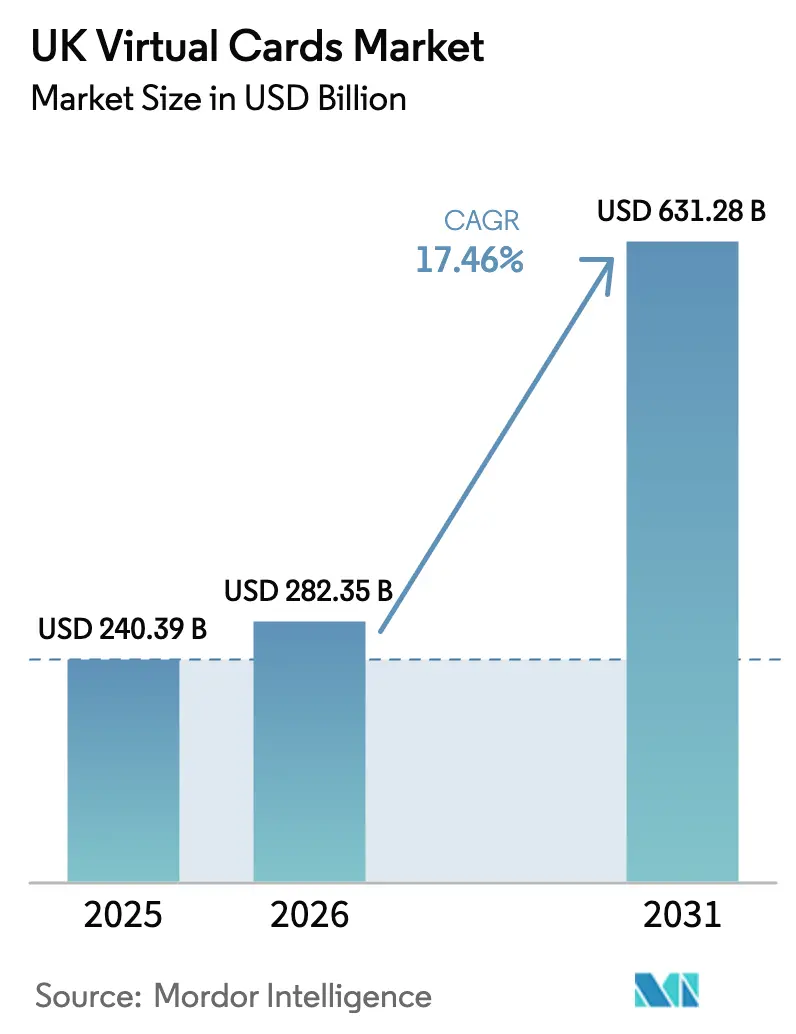
| Base Year Market Size (2025) | USD 240.39 Billion |
| Market Size (2026) | USD 282.35 Billion |
| Market Size (2031) | USD 631.28 Billion |
| Growth Rate (2026 - 2031) | 17.46 % |
| Market Concentration | Medium |
Major Players *Disclaimer: Major Players sorted in no particular order Image © Mordor Intelligence. Reuse requires attribution under CC BY 4.0. | |
UK Virtual Cards Market Analysis by Mordor Intelligence
The UK virtual cards market size is expected to grow from USD 240.39 billion in 2025 to USD 282.35 billion in 2026 and is forecast to reach USD 631.28 billion by 2031 at 17.46% CAGR over 2026-2031. Growth is anchored in mandatory digital-tax reporting under HMRC’s Making Tax Digital (MTD) rules, ISO 20022 messaging upgrades that enrich reconciliation data, and rapid open-banking API uptake that slashes onboarding times for new issuers. Business users gravitate to single-use virtual cards for fraud mitigation, while SMEs embrace prepaid versions to impose strict budget ceilings. Tokenization programs now embedded at tier-1 banks further sharpen security and drive mainstream acceptance, and remote-payment functionality—useful for cross-border trade after Brexit—cements virtual cards as a strategic spend-control tool across corporate finance departments.
Key Report Takeaways
- By use, single-use cards captured 58.92% of the UK virtual cards market share in 2025 and are forecasted to expand at a 18.98% CAGR through 2031.
- By payment type, remote payments held 70.56% of the UK virtual cards market size in 2025 and are expected to advance at an 18.54% CAGR to 2031.
- By end user, the business segment commanded 56.68% of the UK virtual cards market share in 2025, with a projected 19.62% CAGR to 2031.
- By card type, virtual prepaid cards are set to post the fastest growth at an 18.24% CAGR, even though virtual credit cards retained a 47.35% share of the UK virtual cards market size in 2025.
Note: Market size and forecast figures in this report are generated using Mordor Intelligence’s proprietary estimation framework, updated with the latest available data and insights as of 2026.
UK Virtual Cards Market Trends and Insights
Drivers Impact Analysis*
| Driver | (~) % Impact on CAGR Forecast | Geographic Relevance | Impact Timeline |
|---|---|---|---|
| Rising SME demand for flexible B2B spend controls | +3.2% | UK-wide, strongest in London and Manchester | Medium term (2-4 years) |
| Mainstream push by tier-1 UK banks for tokenized issuance | +2.8% | National, led by London financial centers | Short term (≤ 2 years) |
| Open-banking APIs enabling instant KYC/BIN sponsorship | +2.1% | UK-wide, concentrated in fintech hubs | Short term (≤ 2 years) |
| Mandatory HMRC Making-Tax-Digital rules | +1.9% | National compliance requirement | Medium term (2-4 years) |
| ISO 20022 migration enriching data fields | +1.4% | Financial institutions and corporates | Long term (≥ 4 years) |
| Employee SaaS subscriptions needing single-use cards | +1.8% | Business centers, remote work settings | Short term (≤ 2 years) |
| Source: Mordor Intelligence | |||
Rising SME demand for flexible B2B spend controls
Small and mid-sized enterprises are prioritising granular spend limits, merchant-category blocking, and time-bound authorisations to keep tighter reins on cash flow as economic conditions remain volatile. The Crown Commercial Service confirmed GBP 3.52 billion in direct SME public-sector spend during 2024, underscoring the scale of transactions now moving to highly configurable payment rails[1]. Finance teams also favour instant issuance because many employees work remotely and need digital-first tools to settle ad-hoc supplier invoices without waiting for plastic cards. Single-use virtual tokens are attractive because they lapse automatically, preventing forgotten subscriptions from draining budgets. Together, these control features position virtual cards as essential working-capital instruments for the UK’s 5.5 million SMEs.
Mainstream push by tier-1 UK banks for tokenized issuance
Lloyds Banking Group’s decision to migrate 10 million cards onto Visa’s token platform by 2026 signalled a systemic shift away from static PANs. Tokenisation reduces fraud exposure by replacing each card number with dynamic credentials that lose value immediately after use, a security upgrade now marketed aggressively to large corporate clients. Mastercard’s pledge to remove manual card entry from online checkouts by 2030 further accelerates issuer adoption, because banks need to meet merchant expectations for effortless payments. Early adopters benefit from easier ERP integration, allowing automated limit resets and richer data capture. As more banks deploy token frameworks, resistance among late movers is likely to erode quickly.
Open-banking APIs enabling instant KYC/BIN sponsorship
UK Finance recorded 8 million active open-banking users in 2024, with payment volumes growing 78.5% year on year, providing a ready infrastructure for real-time issuer connectivity[2]. Open APIs let fintechs perform identity checks and funding-source verifications in minutes, slashing onboarding time from the weeks previously required for manual processes. Because issuers can now plug directly into sponsor banks for BIN ranges, even small providers can launch virtual cards without a full banking license. Instant provisioning helps corporates spin up project-based cards as soon as a budget is approved. The streamlined model intensifies competition and broadens market access for niche virtual-card products.
Mandatory HMRC Making-Tax-Digital rules are increasing real-time receipt capture
Businesses over the GBP 85,000 VAT threshold must keep digital records and submit returns via MTD-compatible software, creating urgency for payments that automatically tag tax data at the point of sale. Virtual cards embed transaction metadata directly into accounting platforms, eliminating manual receipt uploads and reducing audit risk. From April 2024, the mandate will be extended to all VAT-registered firms, forcing more than 1 million companies to upgrade payment workflows. Integration with expense-management tools shields finance teams from penalties linked to late or inaccurate filings. As HMRC plans to bring Income Tax Self Assessment into MTD, demand for compliant virtual-card rails is set to deepen.
Restraints Impact Analysis*
| Restraint | (~) % Impact on CAGR Forecast | Geographic Relevance | Impact Timeline |
|---|---|---|---|
| Interchange-fee caps compressing issuer economics | -2.4% | UK-wide | Medium term (2-4 years) |
| Merchant mistrust around “card-not-present” fraud liability | -1.8% | Traditional retail sectors | Long term (≥ 4 years) |
| Patchy acceptance at legacy government suppliers | -1.1% | Procurement channels | Short term (≤ 2 years) |
| Consumer privacy pushback on token-level data sharing | -0.9% | Consumer-facing markets | Medium term (2-4 years) |
| Source: Mordor Intelligence | |||
Interchange-fee caps compressing issuer economics
The Payment Systems Regulator estimates UK merchants pay more than GBP 250 million annually in unexplained card-scheme fee increases, signalling likely caps that will erode issuer margins[3]. Mastercard has already raised cross-border acquiring fees, amplifying the concern that revenue per transaction will fall further. Smaller virtual-card providers, lacking volume discounts, may need to pivot towards subscription pricing or premium analytics to stay profitable. Investor appetite could wane if margin pressure intensifies, spurring consolidation among sub-scale issuers. Conversely, large banks see an opportunity to leverage economies of scale and absorb volume from struggling fintechs.
Persistent merchant mistrust around card-not-present fraud liability
Remote-purchase fraud climbed 22% in 2024, feeding scepticism among bricks-and-mortar retailers asked to accept virtual cards for distance sales. Even with Strong Customer Authentication in place, merchants fear costly chargebacks and delayed settlements. Some suppliers, therefore, mandate bank transfers, undermining the universality of virtual-card programmes. Issuers are countering with fraud-scoring APIs and insurance products, but uptake remains slow outside digitally savvy sectors. Until education narrows this trust gap, acceptance constraints will cap growth potential.
*Our forecasts treat driver/restraint impacts as directional, not additive. The impact forecasts reflect baseline growth, mix effects, and variable interactions.
Segment Analysis
By Use: Single-use cards drive security-first adoption
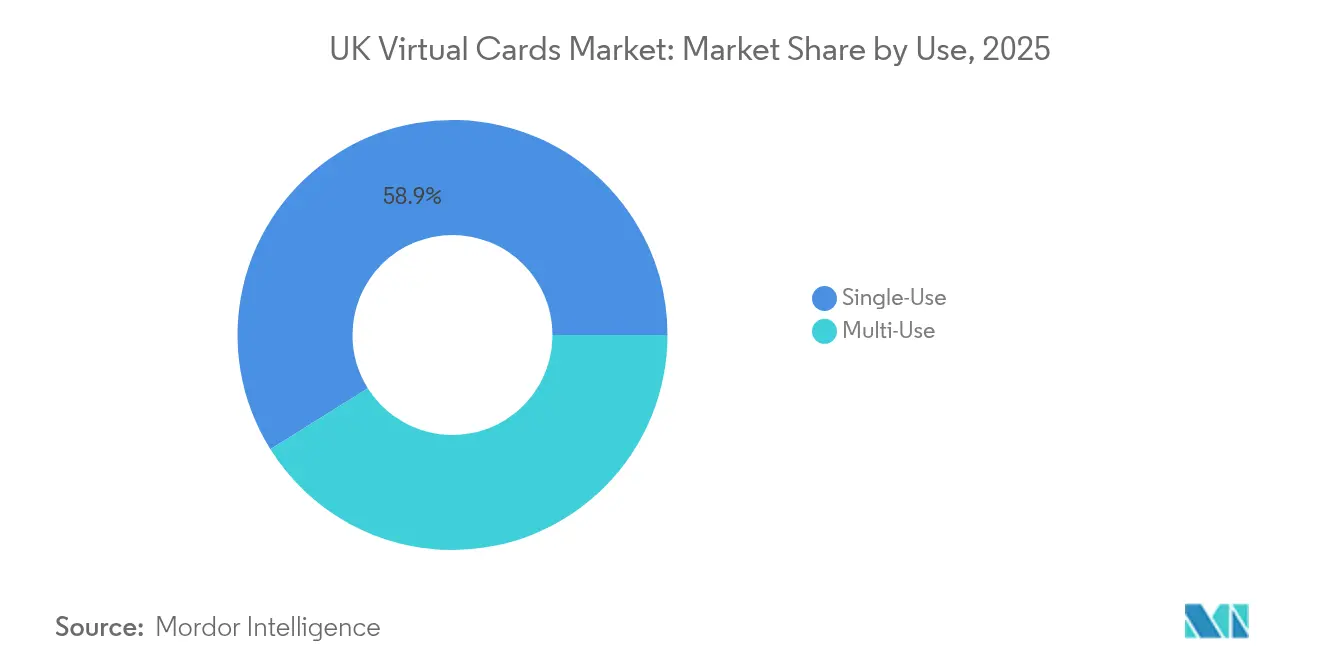
Single-use virtual cards captured 58.92% of the UK virtual cards market share in 2025, expanding at a projected 18.98% CAGR to 2031 as finance teams prioritize one-time credentials that shut after settlement, eliminating the risk of stored-card compromise. Subscription SaaS growth amplifies this need because single-use tokens expire before unauthorized rebills can occur.
Multi-use tokens remain relevant for trusted suppliers on recurring contracts, yet adoption lags as companies weigh higher fraud exposure. Mastercard’s April 2024 wallet integration that pairs biometric authentication with real-time limit updates further propels single-use popularity. Across travel and ad-hoc spend, employees welcome the convenience of instant numbers delivered to mobile wallets, reinforcing robust demand in the UK virtual cards market.

By Payment Type: Remote dominance reflects a digital-first economy
Remote payments held 70.56% of the UK virtual cards market size in 2025 and will grow at an 18.54% CAGR to 2031, illustrating the preference for online procurement and cross-border supplier settlement after Brexit-driven fee complexities. The Office for National Statistics logged a rebound in foreign card spend during peak travel months, proving that businesses remain comfortable executing remote transactions that virtual cards facilitate.
Physical point-of-sale (POS) utilization lingers behind because many small merchants operate terminals lacking token acceptance. Revolut’s 2024 iPad POS application begins to close this gap, yet corporate buyers still lean on contact-free channels where virtual-card rails thrive. For importers paying EU vendors, remote virtual card numbers bypass bank-transfer delays, solidifying remote supremacy in the UK virtual cards market.
By End User: Business segment leads through compliance automation
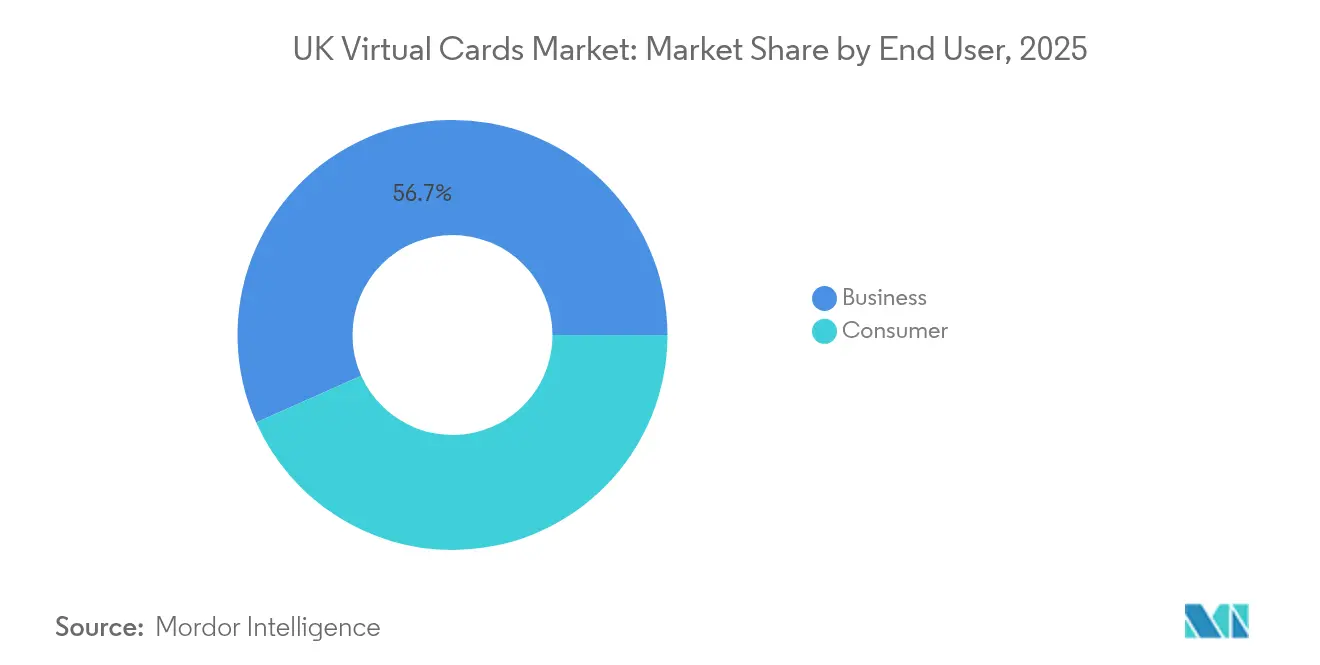
Business users controlled 56.68% of the UK virtual cards market share in 2025 and are forecasted to grow 19.62% annually to 2031, energized by MTD’s compulsory digital record-keeping. Automated VAT coding embedded in transaction strings makes virtual cards attractive to finance teams seeking audit-ready data. Consumers adopt at a slower clip, deterred by established wallet preferences and limited education on virtual-card benefits.
Enterprise platforms now deliver approval workflows, budget dashboards, and ERP integrations unseen in consumer products, locking in corporate loyalty. Recent venture funding into CleverCards underscores investor belief in the enterprise-expense niche, sustaining momentum in this key slice of the UK virtual cards industry.
By Card Type: Credit cards lead while prepaid gains momentum
Virtual credit cards held a 47.35% stake in the UK virtual cards market in 2025, thanks to existing corporate credit lines and familiar underwriting, yet virtual prepaid instruments will outpace all others with an 18.24% CAGR to 2031. Tightening risk policies prompt finance leaders to ring-fence spend in prepaid wallets, trading float benefits for certainty and limiting exposure as missed credit-card payments rise, per FICO analytics.
Debit-based virtual cards fill niche scenarios where instant clearing is paramount, but market preference tilts towards prepaid for discretionary team budgets and towards credit for larger, strategically timed outlays. Government cancellation of traditional procurement cards is expected to nudge departments toward prepaid virtual variants offering granular privilege controls.
Geography Analysis
London anchors the largest share of the UK virtual cards market activity, supported by the city’s dense banking ecosystem and regulatory sandboxes nurturing payments innovation. Manchester’s fintech corridor follows, buoyed by open-banking pioneers that embed instant KYC and same-day issuing. Edinburgh’s historical banking base supplies tech talent and compliance expertise, rounding out the urban triad where adoption sits highest. Rural regions lag in merchant readiness and digital-transformation pace, yet government broadband upgrades promise to narrow this divide over the forecast horizon.
Northern Ireland shows early-stage virtual-card deployment among export-oriented SMEs seeking sterling-euro spend flexibility amid post-Brexit currency considerations. Scotland’s devolved public-sector digitization initiatives further open procurement channels as agencies pivot from physical cards to tokenized counterparts offering audit trails aligned with MTD. Wales, leveraging support programs for start-ups, records rising issuance from challenger banks operating branch-light models. Cross-border trade friction since Brexit sustains elevated demand for card-based settlement because SEPA-linked transfers incur new fees. Virtual cards streamline tax reclaim workflows and supply line-item clarity that simplifies customs declarations. The Bank of England’s exploration of a digital pound could later dovetail with token frameworks, giving regional issuers a head start in integrating central-bank digital currency rails. Overall, geographic adoption patterns underscore that digital infrastructure maturity and proximity to fintech hubs dictate penetration speed within the UK virtual cards market.
Regulatory Landscape
Virtual card programs in the United Kingdom sit primarily within the Payment Services Regulations 2017 and the Electronic Money Regulations 2011, with authorization, conduct, and safeguarding expectations overseen by the Financial Conduct Authority (FCA). FCA guidance on payment services and e-money was updated in November 2024, reinforcing how firms structure issuance, customer protections, and operational controls for digital payment instruments that underpin virtual card credentials.
Policy action around fraud controls and fee transparency also affects issuer economics and acceptance. The Payment Services (Amendment) Regulations 2024 introduced scope for payment service providers to delay outbound payment execution when fraud or dishonesty is suspected, influencing how providers manage risk for remote and tokenized payments. Separately, the Payment Systems Regulator (PSR) advanced remedies on card scheme and processing fees in a December 2025 decision, increasing scrutiny of Mastercard and Visa fee structures and pushing clearer disclosures to acquirers, which can flow through to virtual card pricing and program design as the government progresses its payment-services modernization agenda (highlighted at Mansion House 2025).
Value Chain Analysis
The UK virtual cards value chain starts with card networks (Visa and Mastercard) providing rails and tokenization capabilities, then moves to issuing institutions (including high-street banks such as Lloyds Banking Group, NatWest, HSBC UK, and Barclays) that originate virtual credentials, extend credit where relevant, and provide BIN sponsorship and risk controls. Processing, authorization, and fraud tooling are delivered through the acquirer and processor ecosystems, while secure provisioning into wallets and enterprise systems depends on token service providers and issuer platform capabilities that support single-use and multi-use credentials.
Distribution and monetization increasingly run through fintech enablers and software platforms embedding virtual cards into procure-to-pay, ERP, and expense workflows to automate reconciliation and policy controls. Integration layers include Taulia embedding Visa-enabled virtual cards with Lloyds into SAP Business Suite environments, and procurement platforms working with network partners (for instance, GEP with Mastercard) to make virtual card payments a native option inside purchasing and accounts payable processes. Value capture shifts toward data-rich services such as expense policy, approvals, audit trails, and analytics, while key bottlenecks remain scheme fee pressure, merchant acceptance for certain POS scenarios, and implementation effort across legacy supplier and public-sector procurement systems.
Competitive Landscape
The UK virtual cards market remains moderately fragmented. High-street banks—Lloyds, NatWest, HSBC, Barclays—wield established corporate relationships and balance-sheet scale to bundle virtual cards with cash-management suites. Challenger banks such as Revolut, Monzo, and Starling differentiate through instant onboarding, fee transparency, and user-experience design that resonates with digital-native SMEs. Payment-network partners Visa and Mastercard catalyze convergence through tokenization mandates, forcing both incumbents and newcomers onto convergent security architectures.
Strategic themes concentrate on open-banking data leverage, with providers layering spend analytics atop transaction streams to create value-added dashboards. Partnerships proliferate: Worldpay and Mastercard rolled out a travel-sector virtual-card program in November 2024, tackling multi-currency settlement pain points for agencies. Fintechs target public-sector renewal opportunities after the Cabinet Office curtailed physical procurement-card issuance, pitching virtual solutions that promise spend ceilings and auto-reconciliation.
Patent-filing trends reveal intensifying R&D on digital identity proofing and blockchain-anchored credential storage from companies including Microsoft and Bank of America. Consolidation pressure may rise as interchange-fee scrutiny renders sub-scale issuers less profitable. Yet open-API access keeps market-entry barriers low, ensuring a dynamic mix of providers contends for share inside the UK virtual cards market through 2030.
UK Virtual Cards Industry Leaders
-
Revolut
-
Monzo
-
Starling Bank
-
Barclaycard Payments
-
HSBC UK
- *Disclaimer: Major Players sorted in no particular order

Market Opportunities and Future Outlook
A near-term opportunity is aligning virtual card programs to the UKs payments-modernization and data-rich compliance environment, where corporate finance teams prioritize reconciliation and auditability. HM Treasury published the Payments Forward Plan in February 2026, setting a sequenced roadmap for regulatory and infrastructure initiatives, and this creates whitespace for issuers and platforms to package virtual cards with stronger controls, reporting, and fraud tooling in ways that map to evolving payment-service rules and buyer expectations.
Another opportunity is deeper embedding of virtual cards into programmable and tokenized payment infrastructure initiatives alongside account-to-account rails, to deliver tighter spend controls and automation for businesses. In June 2026, the Retail Payments Infrastructure Board (RPIB) issued a formal consultation tied to the National Payments Vision on next-generation retail payments infrastructure design, with focus areas that include clearing and messaging capable of supporting programmable payments. Providers that connect virtual card issuance and token lifecycle management into ERP, expense, and procurement platforms can use this direction of travel to differentiate on workflow automation (approvals, line-level data capture, and controls) rather than relying primarily on interchange economics under heightened scheme-fee scrutiny.
Recent Industry Developments
- June 2026: Revolut announced plans to launch five new credit card products in the UK, signaling a broader push into credit alongside its existing digital payments and card stack. For virtual card programs, deeper credit product breadth can expand business spend use cases and drive tighter integration of issuance, controls, and repayment features within a single app-led ecosystem.
- February 2026: HM Treasury published the Payments Forward Plan, setting a sequenced roadmap for regulatory and infrastructure initiatives. This creates whitespace for issuers and platforms that can package virtual cards with stronger controls, reporting, and fraud tooling in ways that map cleanly to evolving payment-service rules and buyer expectations.
- November 2024: NatWest and Mastercard launched the Approval2Buy mobile virtual card solution for UK companies and employees using the Mastercard mobile virtual card app for digital wallet corporate payments. This broadened wallet-based corporate issuance and reinforced the shift toward instant, controlled virtual credentials for employee spend at scale.
Research Methodology Framework and Report Scope
Market Definition and Coverage
For this report, we define the UK virtual cards market as the value of payments made using virtual card credentials (single use or multi use) that are issued for debit, credit, and prepaid use, and then used for online, in-app, or B2B spend inside the United Kingdom.
Scope exclusions: Crypto-linked payment tokens, BNPL vouchers, gift e-vouchers, and closed-loop store charge cards are excluded.
Segmentation Overview
- By Use
- Single-Use
- Multi-Use
- By Payment Type
- Remote Payments
- POS Payments
- By End User
- Consumer
- Business
- By Card Type
- Virtual Debit Card
- Virtual Credit Card
- Virtual Prepaid Card
Data Sources, Market Sizing, and Validation
Desk Research
Desk research helped us frame the demand pool and set realistic guardrails for payment values and adoption. We relied on public payments and financial-system references such as the Bank of England, UK Finance, the Office for National Statistics (ONS), and the Financial Conduct Authority (FCA), which were useful for market context and observed consumer and business payment behavior. We also reviewed standards and scheme-level documentation (such as EMVCo and ISO materials) to keep the wording consistent around tokenization and virtual credentials.
To connect the market to issuer and merchant activity in the UK, we used annual reports, investor presentations, and audited filings from banks, card issuers, and payment enablers that disclose cards and payments performance. News and financials databases were used to track product launches, partnerships, and major program changes, and we checked an import-export shipment-level database selectively for signals around cross-border e-commerce flows that can affect remote card usage. The desk sources listed here are illustrative only, and many other public sources were referred to for data collection, validation, and clarification.
Primary Interviews and Surveys
Primary interviews and surveys were used to confirm how virtual cards are actually issued and used in the UK, and to tighten assumptions that are not visible in public datasets. We spoke with a mix of issuers, processors, fintech program teams, expense and travel managers, and merchants to validate adoption timing, typical use cases, and the split between consumer remote commerce and corporate spend across the UK.
Distribution of primary research fieldwork respondents
| Company type | Respondent position |
|---|---|
| Top tier: 28% | CXOs: 13% |
| Mid tier: 57% | Functional/Unit leaders: 42% |
| Smaller Players: 15% | Managers: 45% |
Market-Sizing & Forecasting
Sizing starts from a top-down reconstruction of UK card-enabled payment value, which is then filtered using virtual card penetration by use case and channel. After the model is anchored, we run selective bottom-up checks, such as sampled issuer program volumes, observed corporate card rollouts, and fee proxies where disclosures exist, and then we adjust totals only when the evidence is consistent.
Key inputs that shaped the model included: growth in UK e-commerce and in-app spend, the share of B2B payments moving onto virtual credentials (procurement, travel, and expense use), tokenization and wallet provisioning momentum, single-use versus multi-use issuance patterns, and the pace of issuer and enterprise onboarding. For forecasting, scenario analysis was used so that macro changes (rates and consumer demand), regulation and fraud controls, and enterprise digitization speed could be expressed as practical high, base, and low cases. Where bottom-up signals were missing for smaller issuer programs, we used peer-based adoption bands and then re-checked the implied payment value against the total cards market and the interview insights.
Data Validation & Update Cycle
Outputs are checked against independent indicators, including card transaction value trends, e-commerce growth signals, and the pace of wallet and tokenized credential usage, so that the final number does not drift away from observable activity. Large variances trigger a second pass on assumptions, followed by internal peer review where inputs, math, and labeling are rechecked before sign-off.
The report is refreshed once a year, and we also run interim updates when there is a material event, such as a major regulatory change, a large issuer program shift, or a step-change in enterprise adoption. Before delivery, we review the latest public updates again so clients receive a current view rather than an older snapshot.
Mordor Intelligence's UK Virtual Cards Market Sizing Compared With Other Published Estimates
Published numbers for UK virtual cards do not always line up because the market can be measured in different ways, such as payment value versus service revenue, and because some studies mix card types or use different base years. Differences also show up when authors apply broad global ratios to the UK without cross-checking issuer behavior and corporate spend patterns.
Gift e-vouchers and closed-loop store charge cards sit outside Mordor Intelligence's scope, and that alone can move totals when other sources treat them as virtual card substitutes in remote commerce. Another common gap comes from what is counted as the market unit, since some publishers report issuer or platform revenue, while our model sizes the underlying payment value and then tests it against UK card-usage signals and interview feedback.
Benchmark comparison
| Source | Market Size | Gaps in Research Methodology |
|---|---|---|
| Mordor Intelligence | USD 282.35 B (2026) | |
| Trade Publisher A | USD 0.29 B (2025) | Represents virtual-card service revenue sizing rather than total payment value, which naturally produces a much smaller figure and is not directly comparable to payment-volume based sizing. |
| Payments Brief B | USD 0.36 B (2025) | Uses a revenue-based definition with limited UK-specific validation and may apply global allocation logic, which can understate UK program rollouts and corporate spend moving to virtual credentials. |
Taken together, the spread mainly reflects different measurement units and scope adjacency items that get blended in by some publishers. With a payment-value model tied back to UK cards and e-commerce signals, and then pressure-tested through interviews, the market size stays traceable to clear inputs and repeatable steps.
Key Questions Answered in the Report
What is driving the rapid growth of the UK virtual cards market?
Regulatory digitization under HMRC’s Making Tax Digital rules, widespread tokenization by major banks, and strong SME demand for tight spend controls collectively push the market toward a 17.46% CAGR over the forecast period.
Which virtual-card segment is expanding the fastest?
Single-use tokens lead with a 18.98% CAGR because they eliminate stored-card fraud risk and curb unauthorized SaaS renewals.
How large is the remote-payment opportunity?
Remote payments already account for 70.56% of the UK virtual cards market size and will grow nearly 18.54% annually through 2031 as online procurement and cross-border trade accelerate.
Why are prepaid virtual cards gaining momentum with businesses?
Prepaid instruments cap potential losses, support budget certainty, and sidestep rising credit-risk concerns, fueling an 18.24% CAGR in the prepaid segment.
What regulatory changes could affect issuer profitability?
The Payment Systems Regulator’s review of scheme and interchange fees may cap revenue per transaction, urging issuers to develop subscription models or analytics upsells.
How fragmented is the competitive field?
High-street banks and challenger fintechs share the stage, signifying moderate concentration that still leaves room for niche specialists.