
UK Residential Vacuum Cleaner Market Size and Share
Market Overview
| Study Period | 2020 - 2031 |
|---|---|
| Forecast Data Period | 2026 - 2031 |
| Base Year Market Size (2025) | USD 310 Million |
| Market Size (2026) | USD 324.7 Million |
| Market Size (2031) | USD 409.28 Million |
| Growth Rate (2026 - 2031) | 4.74 % |
| Market Concentration | Medium |
Major Players *Disclaimer: Major Players sorted in no particular order Image © Mordor Intelligence. Reuse requires attribution under CC BY 4.0. | |
UK Residential Vacuum Cleaner Market Analysis by Mordor Intelligence
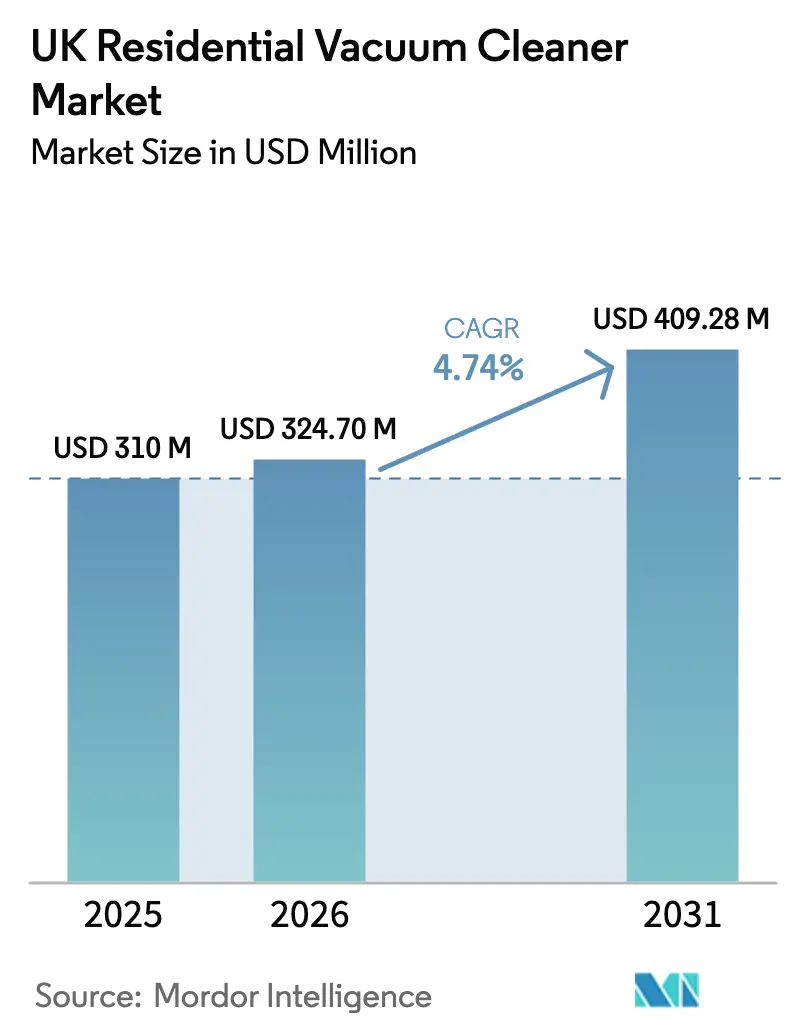
The UK residential vacuum cleaners market size is expected to grow from USD 310 million in 2025 to USD 324.7 million in 2026 and is forecast to reach USD 409.28 million by 2031 at 4.74% CAGR over 2026-2031. Demand continues to pivot toward cordless stick and robotic units as urban households prioritize convenience, run-time, and smart-home integration. Energy-efficiency labelling, rising electricity costs, and sustained post-pandemic hygiene concerns reinforce replacement cycles, while regulatory clarity on CE-mark recognition reduces time-to-market for new launches.[1]Department for Business and Trade, “UK Government Extends CE Marking Recognition,” gov.uk Established players such as Dyson and SharkNinja lead a rapid innovation race, yet both contend with component cost inflation and Brexit-linked supply-chain friction. Online retail is scaling fastest, reshaping shopper journeys and giving brands direct data feedback loops, although multi-brand stores still dominate high-involvement purchases. Competitive intensity is therefore high, but incremental value growth flows from premium features, retailer-exclusive editions, and eco-design credentials.
Key Report Takeaways
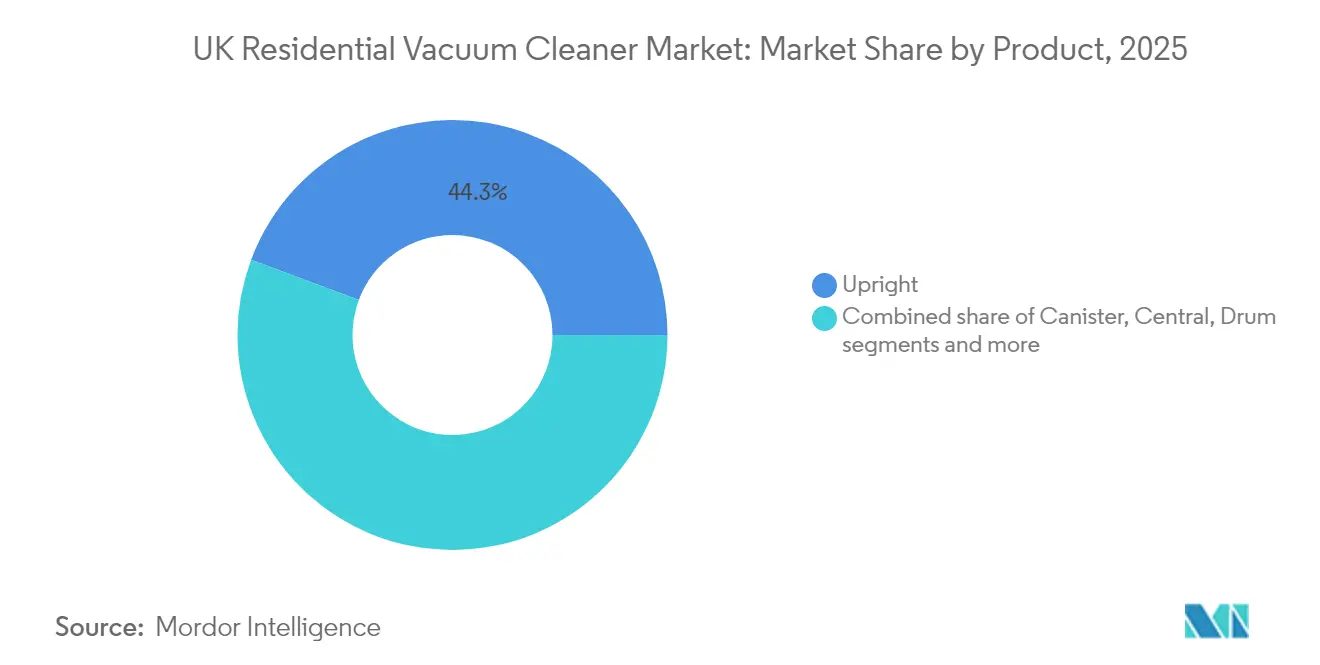
- By product type, upright models led with 44.30% of the UK residential vacuum cleaners market share in 2025, while robotic units are projected to grow at a 6.12% CAGR through 2031.
- By cord type, corded vacuums accounted for 57.30% share of the UK residential vacuum cleaners market size in 2025; the cordless segment is expanding at 5.55% CAGR between 2026-2031.
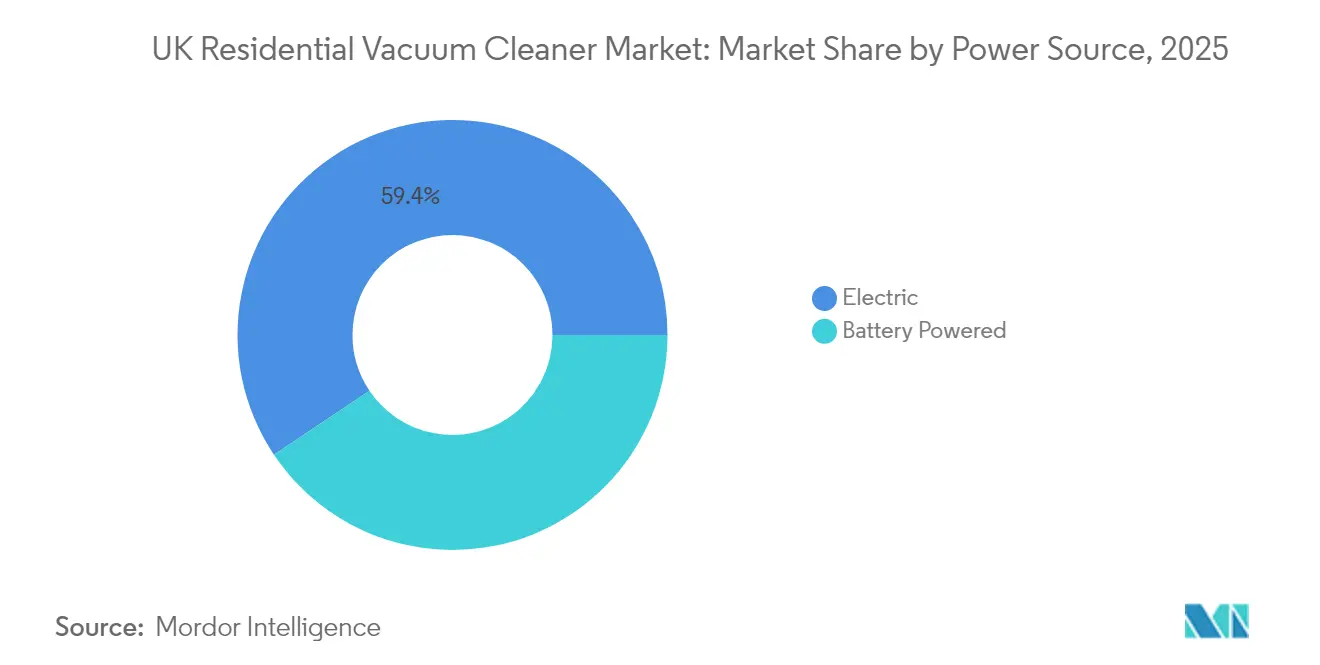
- By power source, electric-powered units held 59.40% share of the UK residential vacuum cleaners market size in 2025; battery-powered models are set to grow at 5.38% CAGR to 2031.
- By distribution, multi-brand stores controlled 39.40% revenue share in 2025, while online channels recorded the highest forecast CAGR at 5.82% through 2031.
- By geography, England commanded 79.60% of the UK residential vacuum cleaners market size in 2025; Northern Ireland is the fastest-growing region at 5.04% CAGR to 2031.
Note: Market size and forecast figures in this report are generated using Mordor Intelligence’s proprietary estimation framework, updated with the latest available data and insights as of 2026.
UK Residential Vacuum Cleaner Market Trends and Insights
Drivers Impact Analysis*
| Driver | (~) % Impact on CAGR Forecast | Geographic Relevance | Impact Timeline |
|---|---|---|---|
| Rapid adoption of cordless vacuums | +2.4% | Urban centers across England | Medium term (2–4 years) |
| Energy-efficiency labelling | +1.9% | UK-wide | Short term (≤2 years) |
| Heightened hygiene focus post-COVID | +1.4% | Densely populated cities | Short term (≤2 years) |
| Smart-home penetration | +1.8% | London and other tech hubs | Medium term (2–4 years) |
| Retailer-exclusive premium launches | +0.9% | High-income areas | Short term (≤2 years) |
| Source: Mordor Intelligence | |||
Rapid Adoption of Cordless Stick & Upright Vacuums across UK Households
Cord-free technology is reshaping household cleaning, evidenced by a 5.8% CAGR projection for cordless units through 2030. Longer runtimes, lighter chassis, and one-click emptying have unlocked genuine room-to-room mobility, pushing premium price points higher and supporting margin growth. SharkNinja’s PowerDetect line exemplifies the appeal, offering up to 70 minutes of operation and self-empty docks that satisfy larger homes without mid-session charging. Brands are therefore monetizing convenience even as real wages face pressure, signalling consumers’ readiness to pay for tangible daily time savings and ergonomic gains.
Energy-Efficiency Labelling (Ecodesign) Fueling Replacement Demand
Energy-efficiency rules have accelerated the UK vacuum cleaner replacement cycle, sustaining sales momentum even after Brexit. EU Ecodesign standards lifted average vacuum performance while cutting wattage, and their legacy continues to shape buyer expectations despite the country’s regulatory independence.[2]European Union, “Ecodesign Directive: Energy Labeling for Vacuum Cleaners,” europa.eu Shoppers now scan energy labels as closely as price tags, a habit reinforced by steep electricity bills. Manufacturers are responding with adaptive-suction models that trim power draw without sacrificing pickup. Electrolux’s 800 Series illustrates the shift: its smart modes cut consumption by up to 52% on corded units and 47% on cordless versions, showing how efficiency can coexist with premium features.[3]Electrolux Group, “Electrolux Launches 800 Series with Recycled Plastics,” electroluxgroup.com Rising utility costs mean operating expense has become a headline spec, making high-rated models more compelling than ever for UK households.
Heightened Hygiene Focus Post-COVID Lifting Multi-Surface Sales
British households now equate vacuuming with health protection. HEPA-sealed systems capable of trapping allergens and viruses have become a baseline expectation, elevating formerly niche filtration upgrades into mainstream SKUs. Multi-surface heads that transition between carpet and hard flooring without manual swapping satisfy varied post-renovation floor plans. Brands that quantify particle removal efficacy and partner with allergy foundations achieve persuasive differentiation.
Smart-Home Penetration Accelerating App-Connected Robots
Smart-phone scheduling, room mapping, and voice-assistant links are redefining robotic vacuums, giving the segment an industry-leading 6.3% CAGR outlook. Consumers pay a clear premium because hands-free upkeep delivers measurable lifestyle convenience. Wi-Fi diagnostics also allow brands to push firmware updates and subscription consumables, tilting revenue toward recurring streams.
Retailer-Exclusive Premium Launches Boosting Value Growth
Co-developed colourways, accessory bundles, and limited editions create scarcity and discourage direct price comparison, keeping promotional discounting in check. Retailers gain margin-accretive traffic drivers, while manufacturers secure controlled merchandising and rapid sell-through data. These tactical collaborations, therefore, anchor premium ASPs even in a price-sensitive retail climate.
Restraints Impact Analysis*
| Restraint | (~) % Impact on CAGR Forecast | Geographic Relevance | Impact Timeline |
|---|---|---|---|
| Price sensitivity amid cost-of-living squeeze | -2.4% | Low-income regions nationwide | Medium term (2–4 years) |
| Brexit-linked component duties | -1.9% | Manufacturers sourcing from the EU | Short term (≤2 years) |
| Substitution by steam-mops & hard-floor appliances | -1.4% | Urban areas with hard flooring | Medium term (2–4 years) |
| Source: Mordor Intelligence | |||
Price Sensitivity Amid Cost-of-Living Squeeze Dampening Premium Uptake
Household budgets are under strain, prompting value-driven shoppers to delay purchases above GBP 300 (USD 377) or trade down to mid-tier lines. Brands respond with “good-better-best” ladders that re-package core innovations—digital motors or self-clean brushes—at reduced specifications to defend volume. Budget SKUs from private labels further intensify price comparisons, testing the resilience of established premium segments.
Brexit-Linked Component Duties Disrupting Inventory Flow
Divergent customs checks and rules-of-origin paperwork have raised inbound costs for motors, plastics, and PCB assemblies. Some producers have shifted partial assembly to the UK to avoid repeated border crossings, yet short-term stock buffering ties up working capital and compresses margins. While the government’s indefinite CE-mark recognition simplifies regulatory filings, logistics friction persists until supply chains fully reroute.
*Our forecasts treat driver/restraint impacts as directional, not additive. The impact forecasts reflect baseline growth, mix effects, and variable interactions.
Segment Analysis
By Product: Uprights Hold Leadership as Robots Surge
Upright units captured 44.30% UK residential vacuum cleaners market share in 2025, aided by strong brand recognition and perceived deep-cleaning power. Their dominance is slowly eroding, however, as robots blitz marketing channels with 6.12% CAGR momentum and demonstrably hands-free operation. The UK residential vacuum cleaners market for robotic models is buoyed by dual vacuum-mop hybrids and self-empty bases that extend user disengagement intervals. Canister designs retain a loyal niche among multi-surface households seeking maneuverability under furniture, while wet-and-dry machines cater to garage and renovation clean-ups, underscoring the breadth of cleaning scenarios manufacturers must address.
Sustained R&D around LiDAR mapping, AI obstacle avoidance, and edge-to-edge suction widens functional gaps between robotic generations. Premium robots now promise dirt storage for up to 60 days, positioning themselves as semi-autonomous home maintenance appliances rather than traditional vacuums. Meanwhile, uprights evolve through ergonomic articulating joints and allergen-sealed dust bins to preserve their relevance, often bundling extra stair tools and anti-hair-wrap rollers for pet owners.


By Cord Type: Cordless Freedom Commands Premium
Corded models retained 57.30% of UK residential vacuum cleaners market share in 2025 because they cost less up front and run continuously without battery worries. Yet the cordless segment is racing ahead at a 5.55% CAGR through 2031, signaling a broad consumer shift toward grab-and-go cleaning. The pattern is strongest in urban flats and among younger buyers, who favor lighter bodies and instant start-up over peak motor wattage. Premium cordless units now post run-times near 70 minutes and feature self-empty bases, as seen in SharkNinja’s PowerDetect line. Even so, average cordless prices still sit two to three times higher than equivalent corded SKUs, underlining the value growth they deliver to brands.
This premium gap, while lucrative, also heightens exposure to inflation-linked belt-tightening as shoppers evaluate convenience versus cost. Manufacturers respond by offering modular battery packs, quick-charge cradles, and tiered feature sets that let price-sensitive households step into cordless ownership. Marketing messages now emphasize “total clean time per charge” and “auto power optimization” rather than raw wattage, aligning with evolving purchase criteria. As a result, the UK residential vacuum cleaners market size for cordless models is on track to capture a larger slice of future revenues, even if corded units keep a foothold among budget-driven families seeking uninterrupted runtime.
By Power Source: Battery Innovation Redefines Performance Metrics
Electric mains units dominate in sheer unit volume, yet battery-powered designs rewrite performance perceptions through high-torque digital motors synchronized with smart load-sensing algorithms. The UK residential vacuum cleaners market size for battery-powered formats is on track to expand at 5.38% CAGR, capturing incremental share as run-times climb and watt-hour price declines accelerate. Research teams allocate substantial resources to thermal management, cell chemistry, and rapid-charge circuitry, knowing that runtime ratings headline marketing copy and heavily influence conversion.
Environmental regulations that promote energy conservation compound pressure on corded watts, nudging consumers toward variable-speed, energy-aware battery models that self-throttle suction when debris sensors read low dust levels. This shift creates a virtuous cycle: greater demand for funds further battery R&D, which in turn unlocks lighter designs and longer autonomy.
By Distribution Channel: Online Acceleration Reshaping Retail Landscape
Multi-brand chains still shepherd 39.40% of 2025 sales, providing hands-on demonstrations, impulse accessory bundling, and immediate take-home gratification. Nevertheless, pure-play e-commerce and direct-to-consumer storefronts grow at 5.82% CAGR, fostering price transparency and doorstep return policies that de-risk high-ticket online purchasing. The pandemic-driven boom in click-and-collect entrenched omnichannel buyer journeys, where shoppers research rankings and unboxing videos online before validating suction feel in store.
Premium brands leverage flagship concept stores to deliver theatrical product demos and explain subscription filter programs, but scale distribution nationwide via marketplace storefronts. Online share, therefore, expands fastest in rural Scotland, Wales, and parts of Northern Ireland, where physical range is sparse, underscoring the importance of last-mile logistics partnerships and responsive chat support.
Geography Analysis
England underpins 79.60% of the UK residential vacuum cleaners market, reflecting both population weight and higher disposable incomes. London and the broader Southeast set style cues: early adoption of robotic and app-linked units cascades outward through social media and retailer adjacency. Retail clusters in Manchester, Birmingham, and Leeds also function as showcase hubs, giving manufacturers critical floor space to demonstrate filtration performance and self-cleaning docks.
Northern Ireland represents the highest growth trajectory at a 5.04% CAGR through 2031. Robust housing completions, cross-border value shopping, and a younger demographic amplify demand for mid-priced cordless sticks that double as car vacuums. Compact geography enhances last-mile delivery economics, allowing online pure-plays to offer next-day service even in semi-rural postcodes.
Scotland’s market leans toward models with hospital-grade HEPA filtration, a response to long indoor winters and associated air-quality awareness. Central Belt cities such as Glasgow embrace cordless convenience, whereas Highlands consumers favor durability and large debris paths suited to mixed flooring in detached homes. Wales shows a tilt toward robust wet-and-dry and all-surface machines that contend with mud tracked in from outdoor lifestyles. Both territories increasingly rely on e-commerce to overcome limited store density, prodding brands to refine region-specific search advertising and flexible delivery slots.
Value Chain Analysis
The UK residential vacuum cleaner value chain begins with upstream components such as electric motors, batteries and battery-management systems, plastics, PCBs, sensors for robotic systems (including LiDAR and cameras), filtration media (including HEPA), and key accessories (brush rolls, floor heads, hoses, chargers, and docks). The chain is heavily import-led, with more than 85-90% of unit volume sourced from overseas manufacturing hubs, led by China, plus supply from European and Southeast Asian locations. UK-based value add is concentrated in product design, R&D, and software and firmware development, alongside brand-building, with Dyson’s UK engineering footprint as an example. Compliance work, including energy-related product requirements and product safety, sits alongside design and sourcing as a gate before market entry.
On the downstream side, finished goods typically move through ocean and road logistics into UK distribution centres, with hub activity clustered around the Midlands and the Southeast to support national reach and proximity to major population centers and ports. Channel execution spans multi-brand retailers, exclusive brand outlets, and fast-growing online and D2C fulfillment, supported by third-party last-mile carriers and reverse logistics for returns. After-sales service, warranty handling, and consumables (filters, bags, brush heads, and in some cases subscription replenishment programs) complete the loop, while product safety surveillance and corrective actions can feed back into supplier selection, component specifications, and retailer requirements.
Competitive Landscape
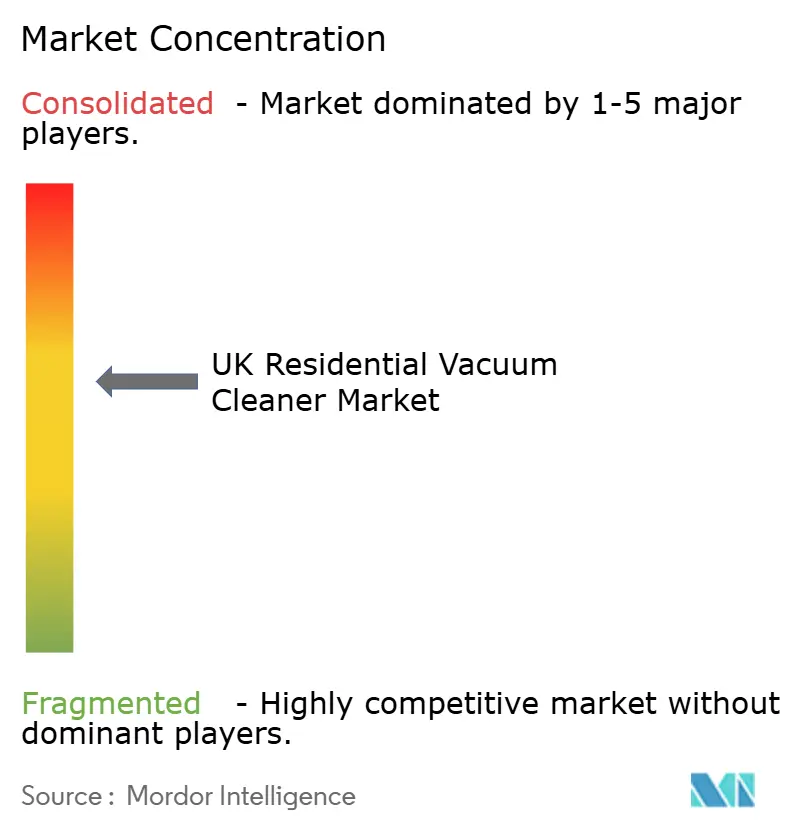
The UK residential vacuum cleaners market sits at a moderate concentration point where two leaders—Dyson and SharkNinja—absorb significant mindshare yet leave room for challengers. Dyson’s direct-sales strategy spotlights aerodynamic engineering and digital motor IP, sustaining premium status and high brand loyalty. SharkNinja counters with rapid SKU refreshes, aggressive media spend, and wide multi-channel availability, achieving double-digit volume gains over the last two fiscal years.
Legacy players Hoover Candy and Vax leverage heritage cues and value-for-money positioning, while Miele capitalizes on German engineering credibility and extended product lifespans. Component inflation and Brexit-induced customs complexity spur near-shoring evaluations; Gtech has already repatriated selected assembly lines to the West Midlands to shorten lead times and safeguard quality.
Strategic plays span cross-category expansions into air purifiers and floor-care consumables, bundling HEPA filters and scent pods into subscription replenishment models that smooth revenue. Co-marketing with smart-home platforms enables vacuum brands to ride broader home-automation adoption waves. The competitive picture remains fluid, yet players that balance product novelty with price segmentation and sustainable material commitments are best placed to secure share.
UK Residential Vacuum Cleaner Industry Leaders
Dyson Ltd.
SharkNinja
Operating LLC Vax Ltd. (Techtronic Industries)
Hoover Candy Group S.r.l.
Miele & Cie. KG
- *Disclaimer: Major Players sorted in no particular order

Market Opportunities and Future Outlook
A near-term opportunity is supply-chain diversification and resilience in a market that is highly import-dependent. Manufacturers and sourcing teams are expanding beyond China into alternative manufacturing bases where available, including Vietnam and the Philippines cited in recent import mix shifts. This opening supports dual-source qualification for components such as motors, batteries, and electronics, and helps stabilize lead times for UK retailers that run on tight promotional calendars. With warehousing concentrated across the Midlands and the Southeast, brands that improve inbound-to-DC planning and integrate reverse logistics for online returns can reduce execution friction in the fastest-scaling channel.
Product opportunities focus on high-utility cordless stick models and smart robotic systems. In practice, consumers reward convenience features such as longer runtime, self-empty docks, app-based diagnostics, and more advanced mapping. Recent launches from leading brands point to active innovation in auto-empty and convertible form factors, which supports premiumization while also feeding into tiered portfolios for cost-of-living constrained shoppers. Sustainability-led redesign is another monetizable track, with industry moves toward recycled plastics and efficiency-oriented operating modes. Electrolux’s 800 series, for example, is positioned around recycled content and energy-saving smart modes, giving brands space to differentiate on materials, energy use, and lifecycle support through consumables and service.
Recent Industry Developments
- June 2026: SharkNinja Operating LLC launched the Shark PowerDetect Transformer, a system converting between upright, stick, and handheld configurations. The launch expands cross-form-factor portfolio and strengthens a multi-form-factor approach to accelerate replacement cycles and increase shelf presence in the UK market.
- May 2026: Dyson Ltd. announced the Dyson V10 Konical cordless vacuum featuring an auto-empty dock. The expansion in the premium cordless segment supports Dyson’s focus on ease-of-use, with implications for ASPs and customer loyalty in the UK.
- February 2026: Dyson Ltd. unveiled the Dyson PencilWash wet and dry cleaner in the UK market. The addition diversifies Dyson’s UK portfolio and reinforces its hygiene-focused positioning for multi-surface cleaning.


Research Methodology Framework and Report Scope
Market Definition and Coverage
This market covers the value of vacuum cleaners purchased for household use in the United Kingdom, counted in revenue terms across major retail and direct sales routes, and tracked in USD for consistency across years.
Scope exclusions: It excludes vacuum cleaners primarily bought for commercial or industrial cleaning use cases and related after-sales services.
Segmentation Overview
- By Product
- Upright
- Canister
- Central
- Drum
- Wet and Dry
- Robotic
- By Cord Type
- Corded
- Cordless
- By Power Source
- Battery Powered
- Electric
- By Distribution Channel
- Multi-brand Stores
- Exclusive Brand Outlets
- Online
- Other Distribution Channels
- By Geography
- England
- Scotland
- Wales
- Northern Ireland
Data Sources, Market Sizing, and Validation
Desk Research
Desk work starts by mapping the demand pool for home floorcare in the UK, then grounding it in public data series that hold up across years. We refer to sources such as the UK Office for National Statistics for household counts and income trends, HM Revenue and Customs trade statistics for appliance import flows, and UK Government updates on product safety and environmental compliance that can influence replacement cycles.
To keep assumptions grounded, we also review manufacturer annual reports and investor presentations, major retailer category commentary, and credible trade publications. Where needed, paid subscriptions are used for company financials and news screening, patent databases for feature direction (battery and filtration), and shipment-level import data to sanity-check units and declared values. The sources listed here are illustrative, and we also used other public and paid references to collect, validate, and clarify inputs.
Primary Interviews and Surveys
Primary work is used to confirm what the desk inputs miss, especially around pricing ladders, channel mix, and how quickly cordless and robotic models are displacing older formats. We speak with a mix of brand-side managers, channel stakeholders, and industry specialists across the UK, so assumptions can be checked against what is actually selling and what is being promoted.
The same input is used to pressure-test replacement timing, the role of promotions in average selling price movement, and how returns and warranty behavior affect net revenue recognition in certain channels.
Distribution of primary research fieldwork respondents
| Company type | Respondent position |
|---|---|
| Top tier: 30% | CXOs: 22% |
| Mid tier: 48% | Functional/Unit leaders: 36% |
| Smaller Players: 22% | Managers: 42% |
Market-Sizing & Forecasting
Sizing begins with a top-down build where household counts and appliance replacement behavior are used to reconstruct the demand pool, which is then translated into value using price bands observed across the main retail channels. To keep the totals from drifting, we also run selective bottom-up checks using sampled brand revenues, channel checks on unit movement, and ASP times volume calculations for key product groups.
Inputs that matter in this market include the split between corded and cordless units, the share of robotic models in household purchases, promotion intensity in online and multi-brand stores, battery-related price premiums, and the typical replacement cycle driven by wear and filtration performance. When public indicators are incomplete, gaps are filled using interview-led ranges and then normalized back to observable signals such as import unit trends and category pricing.
Forecasts are built using scenario analysis supported by trend lines in household formation, real income expectations, and the pace of product mix shift toward cordless and robotic models. Assumptions are kept traceable, and we revisit the ones that move results the most, such as mix-driven ASP progression and channel share changes.
Data Validation & Update Cycle
Checks are run at multiple points so results remain consistent with independent signals and do not rely on a single data stream. We compare outputs with trade flows, company commentary on category demand, and channel-level pricing patterns, and then investigate large jumps that do not match what respondents describe.
Before sign-off, the model is reviewed in steps, and outliers trigger a re-check of the underlying input series, followed by selective re-contact with sources when needed. Reports are refreshed annually, and interim updates are made when material events occur, after which a final pre-delivery pass is completed so the view reflects the latest available information.
Mordor Intelligence's UK Residential Vacuum Cleaner Market Size Compared Against Other Published Estimates
Published market values can differ because analysts do not always count the same end users, channels, or product set, and they may also use different pricing points when converting units into revenue. We also see gaps when one estimate is kept at factory-gate value while another is closer to retail value, which changes the final number materially.
Commercial floorcare equipment often gets mixed into household vacuum totals, and that item sits outside Mordor Intelligence's scope for this UK residential study, which keeps the demand pool tied to home purchases only. Other differences typically come from how robotic units are classified, whether online-only promotions are reflected in ASPs, and how frequently the model is refreshed when inflation and discounting move quickly.
Benchmark comparison
| Source | Market Size | Gaps in Research Methodology |
|---|---|---|
| Mordor Intelligence | USD 310 M (2025) | |
| Regional Consultancy A | USD 1003 M (2024) | Uses a broader floorcare scope that appears to include non-residential demand, and it relies on factory-gate pricing assumptions that do not align with consumer channel price points. |
| Trade Journal B | USD 862 M (2024) | Leans heavily on customs values as the main sizing anchor, which can miss domestically distributed stock and does not consistently reflect retail margins and promotion-driven ASP swings. |
The spread is driven mainly by scope discipline and pricing level, followed by how product types like robotic models are treated in the counted basket. By keeping inputs tied to household purchase signals and then cross-checking with trade and channel indicators, we can present a market value that is easier to trace and repeat over time.


Key Questions Answered in the Report
What is the current size of the UK residential vacuum cleaners market?
The market is valued at USD 324.7 million in 2026 and is projected to reach USD 409.28 million by 2031.
Which product segment is growing fastest?
Robotic vacuum cleaners are expanding at a 6.12% CAGR through 2031, outpacing all other product formats.
How important is the cordless segment?
Cordless models are forecast to grow at 5.55% CAGR, steadily eroding corded share as battery technology improves.
Which region in the UK is seeing the quickest market growth?
Northern Ireland leads with a projected 5.04% CAGR between 2026 and 2031.
How are rising living costs affecting vacuum cleaner sales?
Budget pressures are driving some consumers to trade down, but premium brands are countering through tiered product lines and exclusive retailer collaborations.
What role do energy-efficiency labels play in purchase decisions?
High visibility of A-class labels continues to spur replacement demand as households seek to lower electricity bills, supporting a positive sales cycle.
Page last updated on:


 Your data is secure and never sold or shared.


