
United Kingdom Hedge Funds Market Size and Share
Market Overview
| Study Period | 2020 - 2031 |
|---|---|
| Forecast Data Period | 2026 - 2031 |
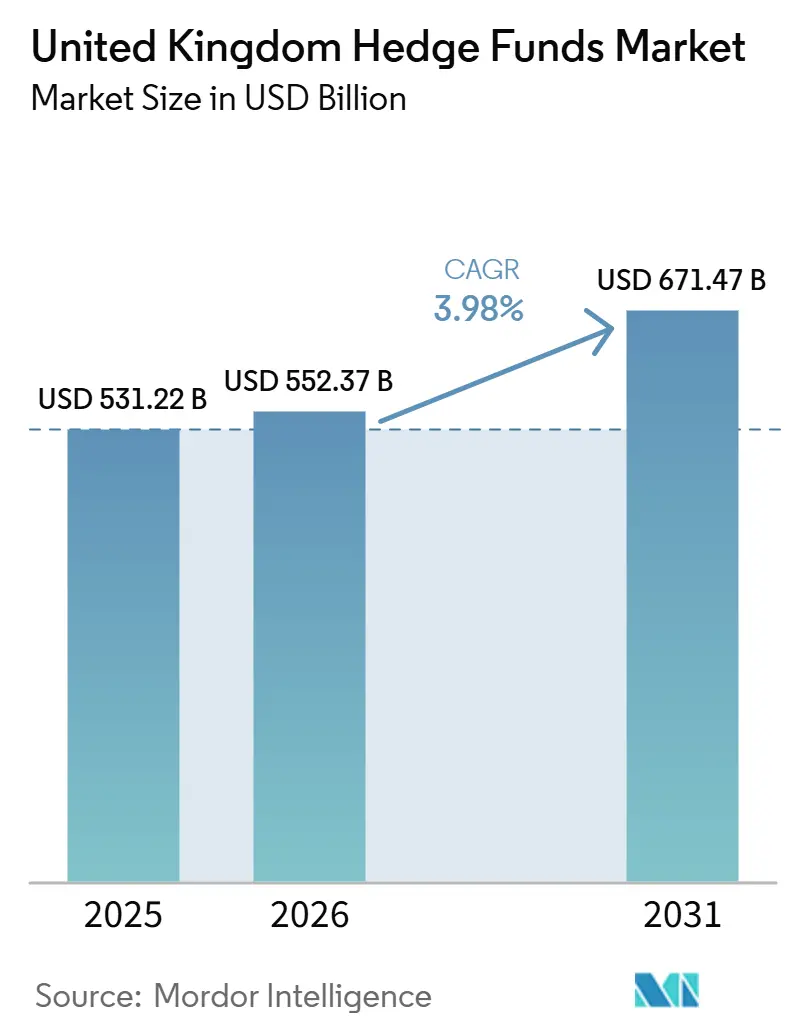
| Base Year Market Size (2025) | USD 531.22 Billion |
| Market Size (2026) | USD 552.37 Billion |
| Market Size (2031) | USD 671.47 Billion |
| Growth Rate (2026 - 2031) | 3.98 % |
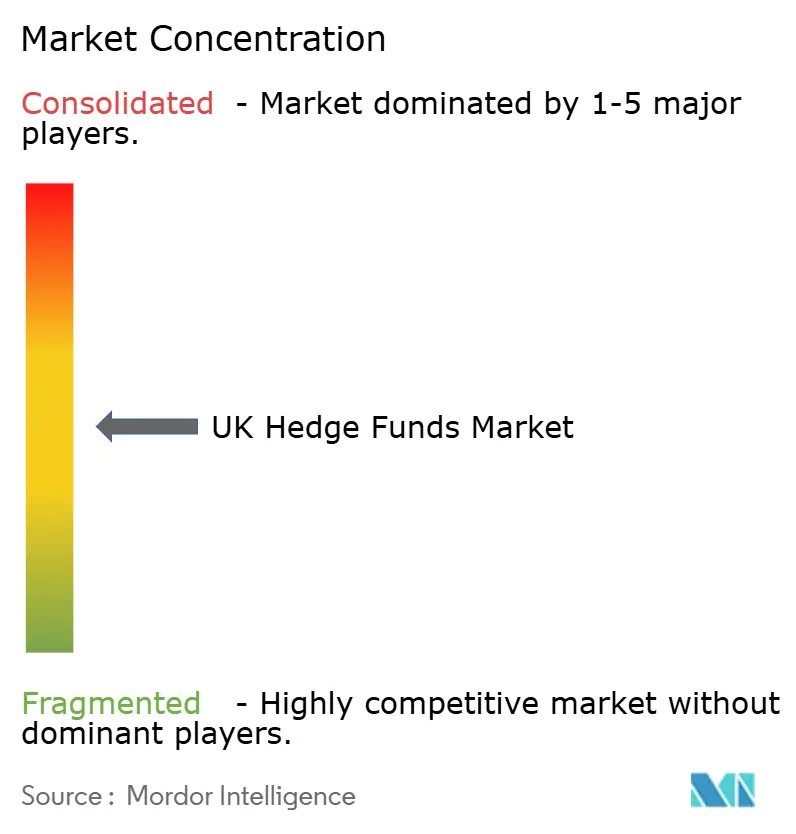
| Market Concentration | Medium |
Major Players *Disclaimer: Major Players sorted in no particular order Image © Mordor Intelligence. Reuse requires attribution under CC BY 4.0. | |
United Kingdom Hedge Funds Market Analysis by Mordor Intelligence
The United Kingdom Hedge Funds Market size was valued at USD 531.22 billion in 2025 and is estimated to grow from USD 552.37 billion in 2026 to reach USD 671.47 billion by 2031, at a CAGR of 3.98% during the forecast period (2026-2031).
London’s post-Brexit resilience, a decisive regulatory push toward cross-border harmonization, and the continued reallocation of pension assets away from leveraged LDI mandates are the prime engines of this expansion. Institutions are directing fresh capital toward systematic and ESG-labelled strategies while daily-dealing UCITS vehicles broaden the regional investor base and lower perceived liquidity risk. Technology spending on alternative data, cloud-native execution, and low-latency connectivity is redefining competitive advantage, allowing managers to harvest alpha from volatile macro conditions. However, higher compliance costs, talent drift to US funds, and lingering uncertainty over EU passporting remain headwinds; a pro-growth stance from HM Treasury and the FCA keeps the United Kingdom hedge fund market on a firm upward trajectory.
Key Report Takeaways
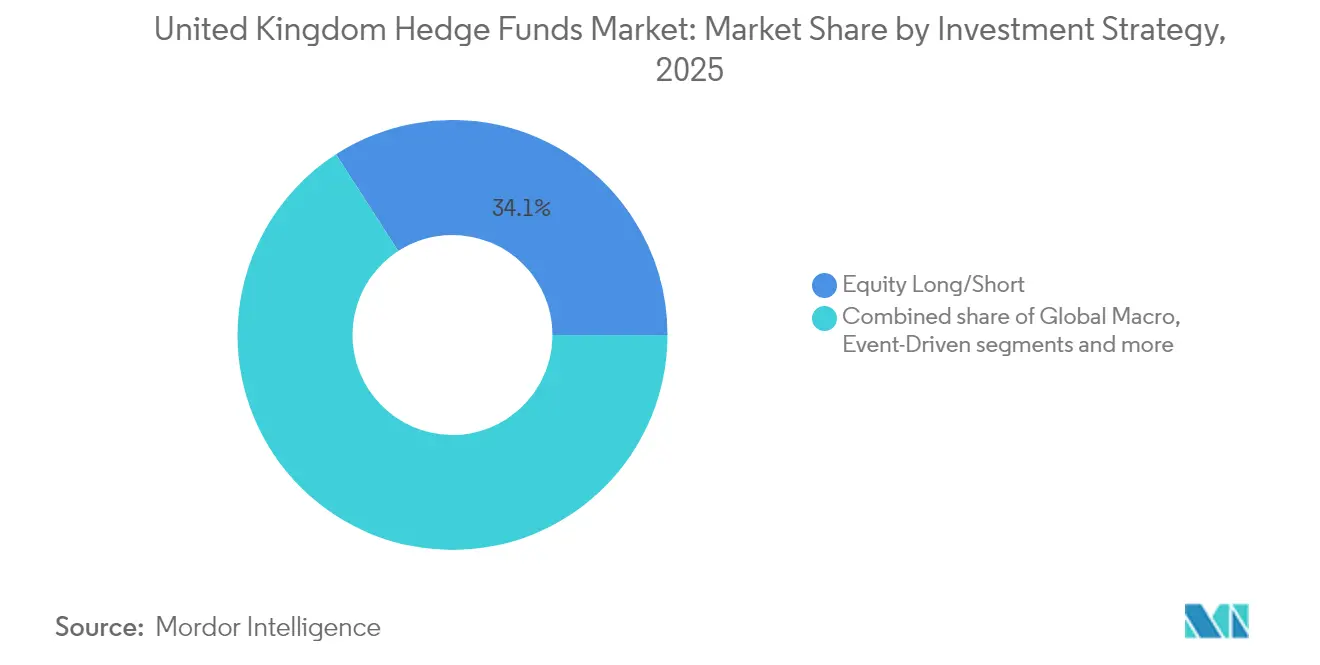
- By investment strategy, equity long/short led with 34.12% of the United Kingdom hedge fund market share in 2025, while the global macro is projected to post the fastest 6.22% CAGR through 2031.
- By investor type, pension funds held 56.25% of the United Kingdom hedge fund market share in 2025; family offices are expected to advance at a 6.78% CAGR to 2031.
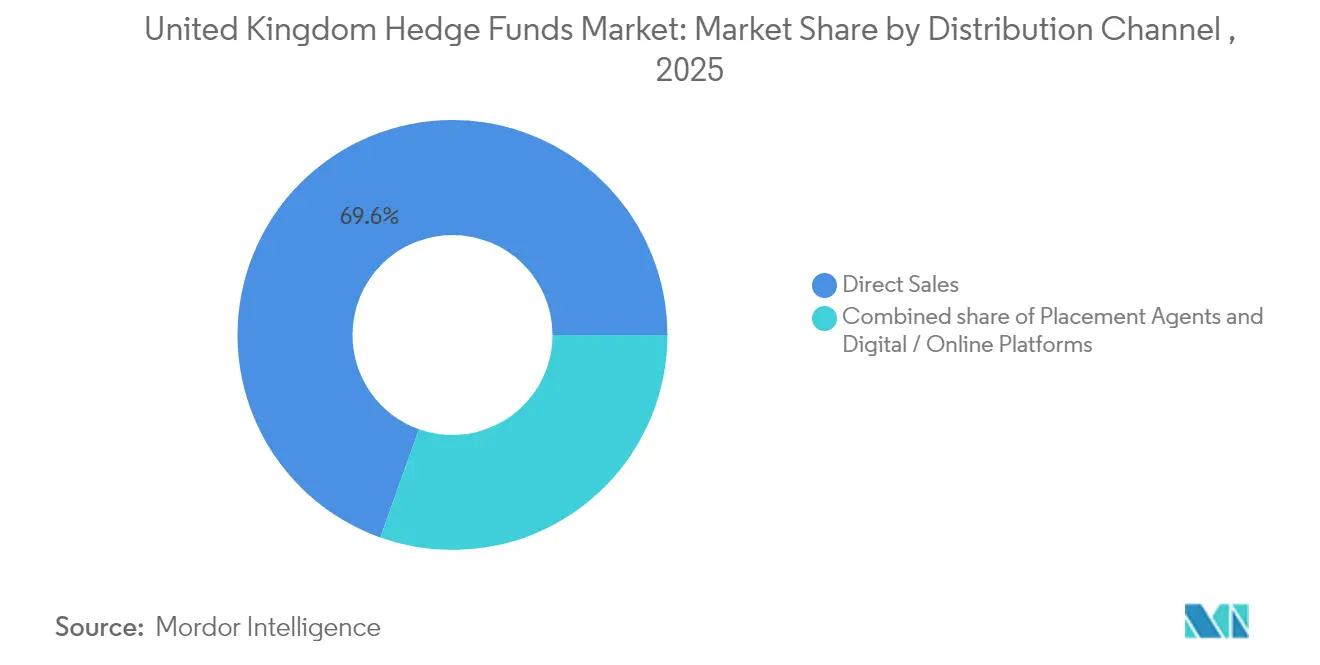
- By distribution channel, direct sales commanded 69.55% of the United Kingdom hedge fund market size in 2025, whereas digital/online platforms are set to grow at a 5.15% CAGR.
- By fund domicile & structure, UK-onshore funds accounted for a 45.32% share of the United Kingdom hedge fund market size in 2025, and UCITS-compliant hedge funds are forecast to expand at a 4.55% CAGR.
- By investment location, London captured a 83.21% share of the United Kingdom hedge fund market in 2025 and is also the fastest-growing center at 5.12% CAGR to 2031.
Note: Market size and forecast figures in this report are generated using Mordor Intelligence’s proprietary estimation framework, updated with the latest available data and insights as of 2026.
United Kingdom Hedge Funds Market Trends and Insights
Drivers Impact Analysis*
| Driver | ( ~ ) % Impact on CAGR Forecast | Geographic Relevance | Impact Timeline |
|---|---|---|---|
| UK pension schemes’ post-LDI shift to alternatives | +1.2% | UK, Channel Islands | Medium term (2-4 years) |
| Rise of UCITS/AIFMD-compliant hedge-fund structures | +0.8% | UK and EU | Long term (≥ 4 years) |
| ESG-driven capital inflows into sustainable strategies | +0.6% | Global, London-centric | Medium term (2-4 years) |
| Volatility-rich macro environment unlocking alpha | +0.7% | Global | Short term (≤ 2 years) |
| London’s quant-talent magnetism | +0.4% | London | Long term (≥ 4 years) |
| Adoption of alternative-data & cloud-native execution tech | +0.5% | UK-wide, London-focused | Medium term (2-4 years) |
| Source: Mordor Intelligence | |||
UK Pension Schemes’ post-LDI Shift to Alternatives
The gilt-market shock of 2022 exposed leverage vulnerabilities in LDI portfolios, triggering a structural rethink among trustees. Defined-benefit schemes have raised alternative allocations from 14% to 39% of risky assets, and hedge-fund exposure now stands near 6% of total scheme assets, up from zero at the start of the millennium[1]. An estimated USD 254 billion in redeployed assets is expected to filter into hedge funds before 2030. Added oversight from the pensions regulator and stricter leverage caps on LDI mandates create durable tailwinds for uncorrelated strategies. Managers able to package downside-risk mitigation and liquidity management are best placed to win these mandates.
Rise of UCITS/AIFMD-compliant hedge-fund structures
Since the Overseas Funds Regime launched in September 2024, 47 new UCITS hedge funds have debuted, marking a 34% increase from 2023, and have drawn in USD 19.05 billion from European investors[2]. This growth highlights the increasing appeal of UCITS wrappers as the primary passport for European distribution. Insurers and wealth managers eager for hedge-fund-style returns within a retail framework are drawn to UCITS wrappers. These wrappers provide liquidity and daily NAV reporting and enforce strict risk-diversification rules, making them a preferred choice for institutional and retail investors alike. While the AIFMD delegation rules pose challenges, UCITS vehicles present a scalable solution, allowing London-based portfolio management to align with EU marketing regulations. This adaptability ensures that UCITS funds remain a competitive and compliant option for cross-border distribution in Europe.
ESG-driven capital inflows into sustainable strategies
Starting in July 2024, the FCA's Sustainability Disclosure Requirements rolled out four distinct labels alongside a stringent anti-greenwashing clause. These measures aim to enhance transparency and accountability in sustainable investments. With clearer compliance guidelines, sustainable hedge-fund assets surged 23% year-over-year, reaching USD 113.03 billion[3]. This growth reflects increased investor confidence and reduced hesitation in adopting sustainable strategies. Family offices led the charge, with 43% increasing their allocations in 2024, showcasing their proactive approach to sustainability. Managers funneled USD 2.92 billion into climate-data feeds, transition-risk models, and stewardship resources, significantly raising the stakes for new entrants by creating higher entry barriers. Systematic platforms that can adeptly harness detailed ESG datasets are reaping the benefits of their early-mover status, positioning themselves as leaders in the evolving sustainable investment landscape.
Volatility-rich macro environment unlocking alpha.
Cross-asset volatility hit post-2008 highs in 2024, fuelled by rate-path bifurcation, commodity supply shocks, and geopolitical cross-currents. UK-based macro funds returned 18.7% on average, outpacing the broader hedge-fund composite by nearly 1,000 basis points. Discretionary specialists exploited interest-rate convexity in Gilts and short-duration EU sovereigns, while systematic trend followers captured extended currency and commodity moves. London’s time zone straddles between US and Asian sessions, combined with dense liquidity and multi-dealer connectivity, enables rapid risk deployment.
Restraints Impact Analysis*
| Restraint | ( ~ ) % Impact on CAGR Forecast | Geographic Relevance | Impact Timeline |
|---|---|---|---|
| Regulatory uncertainty on EU passporting post-Brexit | −0.9% | UK-EU | Long term (≥ 4 years) |
| HMRC tightening on performance-fee & carried-interest tax | −0.6% | UK | Medium term (2-4 years) |
| Compensation-led talent migration to US funds | −0.4% | London-centric | Short term (≤ 2 years) |
| Rising ODD & cyber-security compliance costs | −0.3% | UK-wide | Medium term (2-4 years) |
| Source: Mordor Intelligence | |||
Regulatory uncertainty on EU passporting post-Brexit
Due to the lack of comprehensive equivalence, the EU investor base has contracted by roughly 35%. It has compelled managers to navigate private placement filings across all 27 member states, significantly increasing the complexity of compliance processes. Stricter reporting and delegation clauses under AIFMD II, set to take effect in April 2024, have led to a surge in legal fees and operational costs, rising by as much as 60%. These changes have placed additional pressure on mid-tier firms, many of which lack the scale to absorb such costs. As a result, several firms have shifted their trading and compliance functions to Dublin or Luxembourg, undermining London’s traditional clustering advantage and reducing its role as a central hub. Furthermore, as clarity on these regulations remains elusive, the incentive for new fund launches to establish themselves within the EU bloc continues to grow, driven by the need to ensure smoother access to the European investor market.
HMRC tightening on performance fee and carried-interest tax
In 2024, close to 10,000 high-net-worth individuals exited the United Kingdom, driven by retrospective investigations into disguised remuneration schemes and the Labour Party's indications of tightening non-dom exemptions. These measures have created significant uncertainty for wealthy individuals and professionals in the financial sector. The HMRC has issued retrospective tax bills to over 200 hedge-fund professionals, depleting partnership capital through substantial back payments and penalties. Additionally, proposals to treat carried interest as ordinary income could raise the effective tax rate to 45%, prompting some portfolio managers to explore relocation options in Switzerland and Singapore, which offer more favorable tax regimes. The rising costs of advisory services, particularly for compliance and tax planning, are placing a disproportionate burden on emerging managers. This financial strain is accelerating consolidation within the industry as smaller players struggle to compete with larger, more established firms.
*Our forecasts treat driver/restraint impacts as directional, not additive. The impact forecasts reflect baseline growth, mix effects, and variable interactions.
Segment Analysis
By Investment Strategy: Systematic approaches drive the alpha generation
Equity long-short strategies captured 34.12% of the United Kingdom hedge fund market in 2025, driven by improved factor-decomposition tools and real-time risk dashboards that refine gross and net exposure limits. Managers exploit single-stock dispersion, which widened as retail flows and thematic rotations heightened idiosyncratic volatility. Global Macro, though smaller today, is projected to expand at a 6.22% CAGR, buoyed by central-bank divergence that creates persistent currency and rates trades. Event-driven books revived alongside a 38% pick-up in United Kingdom-listed M&A announcements, while Relative-Value desks profit from widening credit-curve kinks as quantitative tightening drains primary-dealer balance sheets.
Multi-strategy giants such as Citadel and Millennium allocate incremental capital dynamically across these sleeves, using risk-budgeting engines that optimize marginal Sharpe contribution. The United Kingdom hedge fund market size tied to quantitative signals keeps rising as systematic funds represent 60% of recent launches, integrating alternative datasets on supply chains, satellite imagery, and consumer web traffic. Managers spent USD 1.50 billion in 2024 on data curation, feature engineering, and GPU clusters. London’s deep pool of PhDs fuels machine-learning adoption, and Man Group’s rebuilt Condor platform showcases the direction of travel with real-time data ingestion and reinforced model governance.

By Investor Type: Family offices accelerate alternative allocations
Pension funds controlled 56.25% of the United Kingdom hedge fund market in 2025 as stricter funding ratio targets compelled trustees to diversify beyond traditional 60/40 mixes. The shift away from leveraged LDI structures following gilt turmoil anchors stable long-term capital for hedge-fund managers. Family offices, though smaller in absolute terms, are growing at 6.78% CAGR as multi-generational wealth transfer aligns with direct relationships and bespoke mandates. Insurers remain steady allocators, targeting capital-efficient strategies compatible with Solvency II.
Sovereign wealth funds have opened London offices to secure deal flow and co-investment rights, enhancing the prestige of the United Kingdom hedge fund market. Digital onboarding portals reduce operational friction, letting smaller institutions and charities allocate with lower minimums. Funds-of-funds face fee compression as allocators opt for direct exposure and co-investment, forcing them to pivot toward operational due diligence services. Family offices’ appetite for ESG-aligned systematic products boosts seeding opportunities for niche managers, fostering a vibrant start-up pipeline.
By Distribution Channel: Digital transformation reshapes access
In 2025, direct sales commanded a dominant 69.55% share of the United Kingdom's hedge fund market, highlighting the deep-rooted ties in institutional capital-raising. Chief Investment Officers (CIOs) and trustees continue to value in-person meetings and tailored reporting when bestowing multi-million-pound mandates. These face-to-face interactions and customized solutions remain critical in building trust and ensuring alignment with institutional objectives. However, digital platforms are on the rise, boasting a 5.15% CAGR due to streamlined KYC modules that have slashed onboarding durations from weeks to mere days. This shift reflects the growing demand for efficiency and technological integration in the capital-raising process.
Placement agents are evolving, focusing on ESG verification, cybersecurity diligence, and navigating regulatory nuances for cross-border marketing. These agents are increasingly seen as vital intermediaries, helping funds meet stringent compliance requirements while addressing investor concerns about sustainability and security. Leveraging AI, matching engines analyze style-factor exposures and volatility profiles, ensuring investor preferences align seamlessly with fund offerings, thus enhancing visibility for smaller managers. This technology-driven approach improves fund discovery and levels the playing field for emerging managers seeking to attract institutional capital. The shift to virtual operational due diligence, a trend solidified by the pandemic, has diminished geographic barriers. This normalization of virtual processes has enabled allocators to evaluate funds more efficiently, regardless of location. As a result, the United Kingdom hedge fund market is reaping the benefits of a wider allocator base, all while keeping travel expenses in check and fostering a more inclusive investment landscape.
By Fund Domicile & Structure: Regulatory arbitrage drives optimization
In 2025, UK-onshore funds secured a 45.32% market share, as domestic pension trustees leaned towards familiar oversight and sterling share classes. This preference stems from the perceived stability and regulatory familiarity offered by onshore funds, which align with the operational and compliance needs of pension trustees. The FCA, with its tailored AIFMD adjustments, lightened Annex IV reporting and introduced risk-based supervisory tiers. These moves aim to reduce cost burdens, making onshore options more appealing compared to their offshore counterparts. Offshore vehicles, such as those in the Channel Islands and Cayman Islands, continue to cater to end investors seeking tax neutrality. However, these vehicles face challenges from increased operational overheads driven by heightened transparency mandates, which add complexity to their management.
Since Brexit, assets totaling USD 56.54 billion have shifted to Ireland and Luxembourg, ensuring continued EU marketing flexibility. UCITS-compliant funds, growing at a brisk 4.55% CAGR, provide daily liquidity within a risk-diversified framework, making them a favorite for wealth-management platforms. 2024 saw the introduction of Long-Term Asset Funds (LTAFs), designed for illiquid strategies like private credit, tapping into new inflows from defined-contribution pensions. This structural diversity empowers the United Kingdom hedge fund market to navigate varied liquidity horizons and regulatory landscapes, all while retaining portfolio management in London.
Geography Analysis
London remains the undisputed nucleus of the United Kingdom hedge fund market, boasting a 83.21% share in 2025 and a projected 5.12% CAGR. The abolition of bonus caps in 2024, paired with a spike in foreign direct investment, solidified its edge over New York and Hong Kong for cross-asset liquidity and human capital. Large banks escalated compensation bands for quants and execution traders, reinforcing the city’s talent gravity. Cloud-native execution, co-located data centers, and low-latency fiber routes to US and EU markets keep trading costs competitive. The FCA’s early adoption of sustainability disclosure rules further differentiates London from ESG-committed allocators.
South-East England operates as a strategic extension, absorbing cost-sensitive functions while maintaining proximity to counterparties. The corridor from Reading to Brighton hosts cybersecurity operations, fund-administration hubs, and data-archiving centers. Improved rail and fiber connectivity means portfolio managers can run real-time risk oversight from satellite offices without compromising execution quality. The region’s business-park ecosystems also appeal to start-ups rolling out AI-driven analytics and liquidity-sourcing tools for the broader United Kingdom hedge fund market.
Scotland and North-West England contribute niche specializations that diversify the geographic footprint. Edinburgh’s fintech sandbox accelerates regulatory-technology pilots, while Glasgow’s university partnerships funnel data science graduates into systematic trading teams. Manchester focuses on trade reconciliation and compliance analytics, leveraging lower operating costs and solid STEM talent. Although investment decision-making gravitates to London, regional hubs mitigate operational risk concentration and cultivate local expertise, reinforcing the resilience of the United Kingdom hedge fund industry.
Regulatory Landscape
The United Kingdom hedge fund market operates under a Financial Conduct Authority (FCA) framework that has been moving toward proportional supervision and simplified reporting for asset managers, while staying aligned with international expectations on governance, risk management, and investor protection. In July 2024, the FCA rolled out Sustainability Disclosure Requirements (SDR) labels alongside an anti-greenwashing rule, which has put product labeling, disclosures, and ESG data governance at the center of hedge fund product design and distribution.
A regulatory reset is underway for alternative managers. On 14 July 2026, HM Treasury and the FCA opened consultations to overhaul the UK AIFM regime (including FCA CP26/28) and published draft legislation to replace the onshored EU-derived approach with a three-tier structure based on NAV (Large above GBP 5 billion, Medium GBP 750 million to GBP 5 billion, Small below GBP 750 million). At the same time, the FCA launched the Fund Reporting for Asset Management Entities (FRAME) framework (CP26/26) to standardize and simplify fund reporting, with consultations closing on 14 October 2026 and implementation scheduled for 2028. Together, these steps are already shaping compliance budgets, fund structuring choices, and how firms compare UK versus EU-onshore operating models.
Value Chain Analysis
The United Kingdom hedge fund value chain begins with capital formation from domestic and international allocators, led by pension funds, insurers, family offices, and high-net-worth channels, and then routes into managers based in London and other UK hubs. Fund structures span UK-onshore AIFs and offshore vehicles used for tax neutrality, as well as UCITS wrappers for broader distribution. FCA and HM Treasury reforms increasingly push governance and oversight toward proportionality by size and risk profile.
Execution and operations rely on prime brokers and trading venues, supported by a specialist services layer that includes fund administrators, depositaries/custodians, auditors, legal counsel, and compliance and cyber-security providers. Technology and data have become core inputs, ranging from alternative data sourcing and cloud infrastructure to model governance and low-latency connectivity for systematic strategies. Industry bodies such as AIMA also play an active role in advocacy and coordination with regulators, influencing how reporting frameworks and the proposed UK AIFM tiers translate into operating models for both large multi-strategy platforms and smaller emerging managers.
Competitive Landscape
In the United Kingdom hedge fund market, the top 20 managers control nearly half of the assets under management (AUM), indicating moderate market concentration. These multi-strategy behemoths leverage platform economics, centralized risk management, a shared research infrastructure, and scale-driven fee reductions to draw in trading pods. Their ability to operate at scale allows them to negotiate favorable terms and maintain a competitive edge. With their substantial financial resources, they gain priority access to premium data feeds and cutting-edge execution venues, which are critical for maintaining operational efficiency. This competitive advantage forces mid-sized peers to focus on high-conviction, specialized niches to differentiate themselves in the market.
Technology defines the competitive frontier. Man Group invested USD 125.6 million in upgrading its Condor platform to integrate machine-learning libraries, real-time order-book analytics, and automated model-governance checks. US titans Citadel, Millennium, and Point72 ramped London headcount, inflating pay packets to record levels and triggering a compensation spiral that squeezes smaller boutiques. ESG-compliant systematic strategies represent lucrative white space, but the data and governance spend required to win the FCA’s sustainability label limits entrant numbers.
Distribution is also in flux. Fintech marketplaces match allocators to managers by factor footprint and liquidity tolerance, shaving intermediary fees. Placement agents shift toward advisory on cyber-resilience and operational due diligence to sustain relevance. Heightened FCA oversight on valuation, conflicts of interest, and side-pocket governance adds compliance layers that favor well-capitalized houses. Consequently, emerging managers pursue seeding deals with family offices to attain critical mass, ensuring the United Kingdom hedge fund market sustains entrepreneurial churn despite scale pressures.
United Kingdom Hedge Funds Industry Leaders
-
Man Group plc
-
Marshall Wace LLP
-
Citadel Europe LLP
-
Millennium Capital Partners LLP
-
Brevan Howard Asset Management LLP
- *Disclaimer: Major Players sorted in no particular order
Market Opportunities and Future Outlook
The more immediate opportunities sit in strategies and wrappers that fit allocator priorities around diversification, uncorrelated returns, and downside protection, themes that align with allocator behavior into H2 2026. As allocators tighten selection, manager differentiation is increasingly tied to repeatable risk management, transparency, and the ability to deliver institutional-grade reporting and controls, especially for systematic and macro-oriented approaches that depend on data and execution depth.
Regulatory modernization also creates room for compliance-led product engineering and distribution. The FCA and HM Treasury consultations launched on 14 July 2026 to redesign the UK AIFM regime into NAV-based tiers, alongside the FCA FRAME reporting initiative, support demand for standardized reporting pipelines, outsourced compliance tooling, and operational setups that can serve both UK-onshore and UCITS distribution. Separately, with private credit holding high institutional attention and the UK introducing Long-Term Asset Funds (LTAFs) for less liquid exposures, platforms and managers with strong governance, valuation controls, and liquidity management have clearer pathways to expand product shelves while meeting higher oversight expectations.
Recent Industry Developments
- June 2026: Citadel Europe LLP disclosed a public short position of 0.56 percent in the Swedish housing platform Hemnet. The disclosure points to continued regional engagement and ongoing regulatory reporting across exchanges.
- May 2026: Man Group plc initiated a $50 million share buyback programme. This action supports market sentiment and provides a basis for potential EPS uplift via the buyback.
- April 2026: Man Group plc trading statement for quarter ended 31 March 2026, AUM of $228.7 billion. The update indicates continued asset growth and ongoing positioning within the UK hedge fund landscape.
Research Methodology Framework and Report Scope
Market Definition and Coverage
For this report, the UK hedge funds market is measured as the total assets under management (AUM) run by hedge fund managers operating in the United Kingdom, stated in USD and tracked across the study period.
Scope exclusions: We exclude private equity, real estate funds, and traditional long-only mutual funds, even when they sit under the same asset manager brand.
Segmentation Overview
- By Investment Strategy
- Equity Long/Short
- Global Macro
- Event-Driven
- Relative Value / Arbitrage
- Quantitative / Systematic
- Multi-Strategy
- Credit / Fixed-Income
- By Investor Type
- Pension Funds
- Insurance Companies
- Sovereign Wealth Funds
- Family Offices
- High-Net-Worth Individuals
- Funds of Funds
- By Distribution Channel
- Direct Sales
- Placement Agents / Intermediaries
- Digital / Online Platforms
- By Fund Domicile & Structure
- UK-Onshore (Ltd / LLP / AIF)
- Offshore (Channel Islands, Cayman)
- EU Onshore (Ireland, Luxembourg)
- UCITS-Compliant Hedge Funds
- By Region
- London
- South East England
- Scotland
- North West England
Data Sources, Market Sizing, and Validation
Desk Research
Desk research was used to set the market frame and to build clean starting points for UK-managed hedge fund AUM, flows, and structural trends. Public and official sources were used for this, such as The Investment Association statistical releases, TheCityUK asset management landscape publications, FCA publications and register information, and Bank of England financial stability outputs, which support how assets and risks are discussed in the UK market.
To keep figures comparable, AUM series from these sources were aligned to consistent timing and currency handling, and then checked against manager disclosures in annual reports, investor presentations, and fund documents. We also referenced reputable academic and peer-reviewed finance research where it helps interpret broad hedge fund return drivers and leverage discussions, and we used paid subscriptions focused on company financials and intelligence, news and financials, and patent databases to speed up fact checks when public disclosure was thin. The desk sources listed here are illustrative, and we also used other public documents and datasets for data collection, validation, and clarification.
Primary Interviews and Surveys
Primary work was used to pressure-test what "UK-managed" means in practice, especially when funds are domiciled offshore but managed from London, and when UK-regulated wrappers sit alongside offshore structures. Interviews covered hedge fund managers, service providers, allocators, and compliance specialists to validate AUM splits by strategy, typical redemption terms, and how fee pressure and performance cycles affect asset retention.
Because the report is UK-focused, we concentrated on local decision makers and market practitioners, then triangulated against cross-border allocator behavior where it affects UK inflows.
Distribution of primary research fieldwork respondents
| Company type | Respondent position |
|---|---|
| Top tier: 28% | CXOs: 17% |
| Mid tier: 55% | Functional/Unit leaders: 23% |
| Smaller Players: 17% | Managers: 60% |
Market-Sizing & Forecasting
Sizing starts with a top-down rebuild of the UK hedge fund AUM pool using reported UK-managed assets, then it is reconciled against the UK share of global hedge fund assets and the local mix of strategy styles. After shaping that demand pool, we used selective bottom-up approximations to sanity-check totals, including rolling up sampled manager AUM disclosed in filings and public statements, then scaling using manager counts and known concentration patterns.
Inputs that matter in this market were kept practical and observable, including (i) UK-managed hedge fund AUM levels and net flow direction, (ii) performance cycle effects on assets, (iii) investor mix shifts across institutions and private capital sources, (iv) liquidity terms and gating prevalence, which influence how "sticky" AUM is, and (v) the balance between offshore funds and UK-regulated wrappers that broaden distribution. When gaps showed up in strategy splits or domicile shares, we used interview-led ranges first and then constrained them to published totals so the model stayed internally consistent.
For forecasting, scenario analysis was used because hedge fund AUM in the UK is sensitive to macro conditions and allocator risk appetite that can change quickly. Base, conservative, and upside paths were built around expected return environments, likely net inflow ranges, and FX translation effects, and then aligned to what practitioners indicated as reasonable over the forecast window.
Data Validation & Update Cycle
Results were checked in multiple steps so the final number is not driven by one dataset or one assumption. Our team compared model outputs against independent signals like UK asset management growth rates, global hedge fund AUM direction, and visible shifts in allocator behavior, and then we reviewed any large year-on-year jumps before sign-off.
When an outlier was found, the related driver was traced back to its input series, and follow-up questions were raised with interviewees if the change could not be explained by performance, flows, or FX timing. Reports are refreshed annually, and interim updates are made when material events occur, such as major regulatory changes or sudden market dislocations. Before delivery, the model is rerun with the latest available inputs so clients receive an up-to-date view.
Mordor Intelligence's UK Hedge Funds Market Sizing Compared With Other Published Estimates
Published market sizes for UK hedge funds often do not line up because the underlying yardstick is not always the same, and the boundary between UK-managed assets and UK-domiciled funds is treated differently across publications. Differences also show up when one estimate is AUM-based and another is closer to management fee pools, which can make the market look smaller even if assets are large.
The main gap comes from whether offshore-domiciled funds run by UK teams are included, and Mordor Intelligence counts them when the investment management activity is based in the United Kingdom and the assets are managed from there, rather than filtering only by fund domicile. Other gaps come from FX timing (spot versus annual average), older base years that miss later performance and flows, and assumptions on how allocator demand changes after volatility spikes.
Benchmark comparison
| Source | Market Size | Gaps in Research Methodology |
|---|---|---|
| Mordor Intelligence | USD 531.22 B (2025) | |
| Industry Association A | USD 460.00 B (2023) | Uses a UK hedge fund AUM snapshot tied to a single year and commonly reports in GBP, with limited normalization for cross-border mandates and subsequent flow effects. |
| Policy Paper B | USD 335.00 B (2023) | Uses a conservative industry AUM figure and may omit some managed-account and multi-manager structures, and the number is not refreshed with an annual market-model cadence. |
The spread across figures is largely explained by what gets counted as part of UK-managed hedge fund assets, plus the timing of FX conversion and the year the snapshot was taken. By tying the value to observable AUM signals and then checking it against disclosures and allocator feedback, we keep the result traceable to inputs that can be reviewed and repeated.
Key Questions Answered in the Report
What CAGR is the United Kingdom hedge fund market expected to post through 2031?
The market is projected to register a 3.98% CAGR, rising from USD 531.22 billion in 2025 to USD 671.47 billion by 2031.
Which investor group currently allocates the largest share to hedge funds in the United Kingdom?
Pension funds hold 56.25% of assets, reflecting post-LDI diversification toward alternatives.
Why are UCITS structures important for United Kingdom hedge-fund managers after Brexit?
UCITS wrappers provide a recognized EU passport, enabling United Kingdom managers to distribute daily liquidity hedge-fund strategies across Europe despite the loss of full passporting rights.
How is ESG regulation shaping product development?
The FCA’s Sustainability Disclosure Requirements prompted a 23% jump in sustainable hedge-fund assets and forced managers to invest heavily in ESG data and verification frameworks.
What technological investments differentiate leading United Kingdom hedge-fund firms?
Spending on alternative data, GPU-accelerated machine-learning platforms, and cloud-native execution systems underpin alpha generation and operational scalability for top managers.
Has Brexit led to a mass relocation of hedge-fund activity out of London?
While some mid-tier firms opened EU subsidiaries, London still commands 83.21% domestic share and continues to attract foreign direct investment, anchored by talent depth and market access.