
Market Overview
| Study Period | 2020 - 2031 |
|---|---|
| Forecast Data Period | 2026 - 2031 |
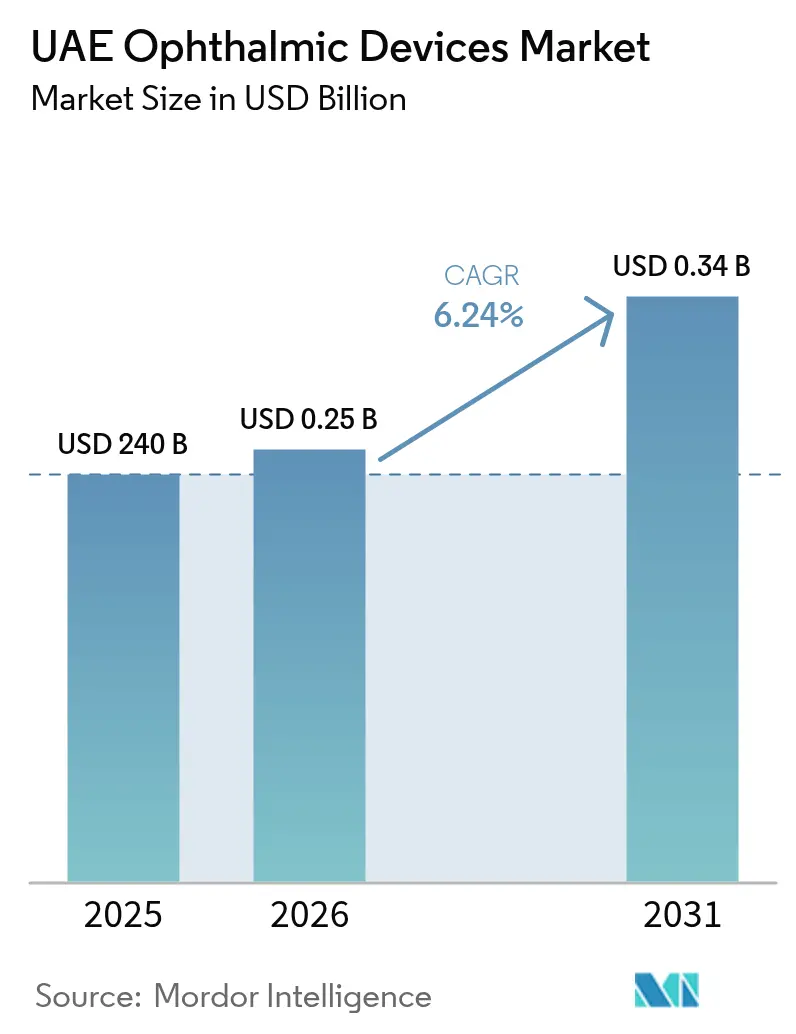
| Base Year Market Size (2025) | USD 240 Billion |
| Market Size (2026) | USD 0.25 Billion |
| Market Size (2031) | USD 0.34 Billion |
| Growth Rate (2026 - 2031) | 6.24 % |
| Market Concentration | Medium |
Major Players *Disclaimer: Major Players sorted in no particular order Image © Mordor Intelligence. Reuse requires attribution under CC BY 4.0. | |
UAE Ophthalmic Devices Market Analysis by Mordor Intelligence
UAE ophthalmic devices market size in 2026 is estimated at USD 254.98 million, growing from 2025 value of USD 240 million with 2031 projections showing USD 344.9 million, growing at 6.24% CAGR over 2026-2031. Sustained demand arises from the country’s high diabetes prevalence, mandatory vision-screening regulations, and the government’s commitment to AI-enabled eye-care programs. Vision-care products—spectacles, contact lenses, and related accessories—retain the largest revenue pool, while diagnostic systems such as fundus cameras and OCT scanners post the fastest unit growth. Hospitals continue to underwrite capital-intensive purchases, but ambulatory surgery centers (ASCs) are attracting fresh device installations as cataract and refractive procedures shift to day-care settings. International manufacturers deepen their regional presence through partnerships with Emirati hospital groups, using Dubai and Abu Dhabi as launchpads for premium innovations.
Key Report Takeaways
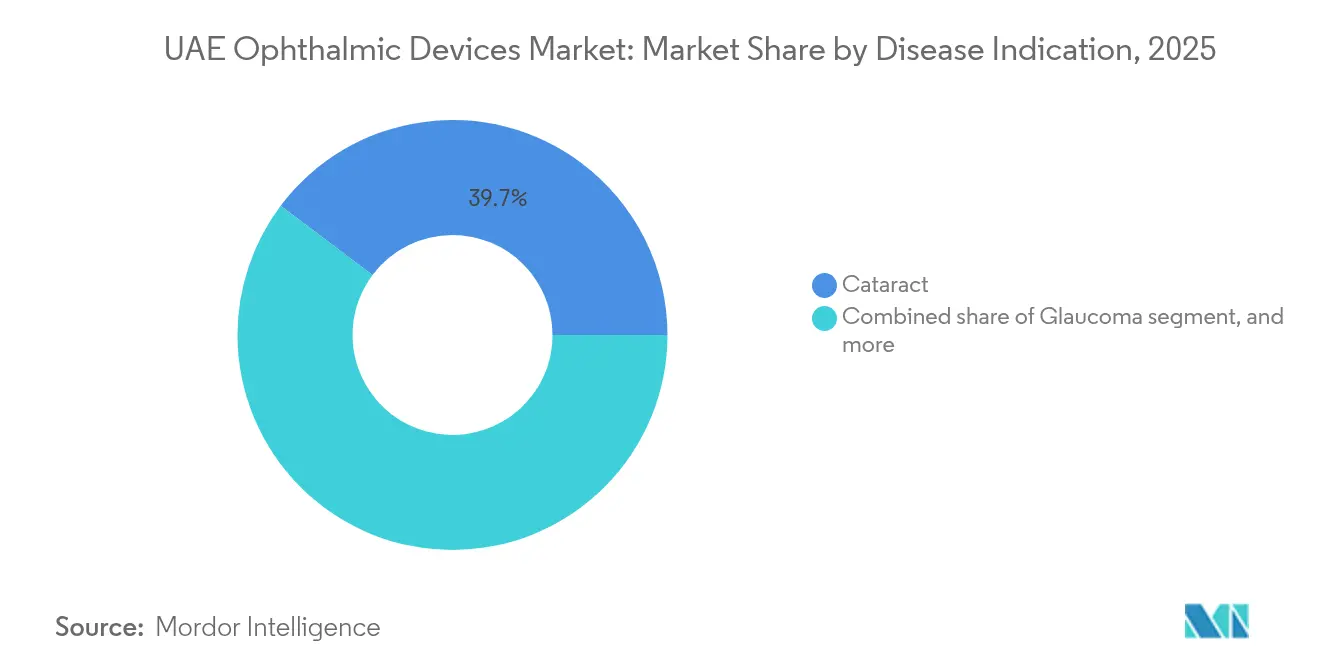
- By device type, vision-care products held 63.58% of the UAE ophthalmic devices market share in 2025; diagnostic and monitoring systems are expanding at an 8.42% CAGR to 2031.
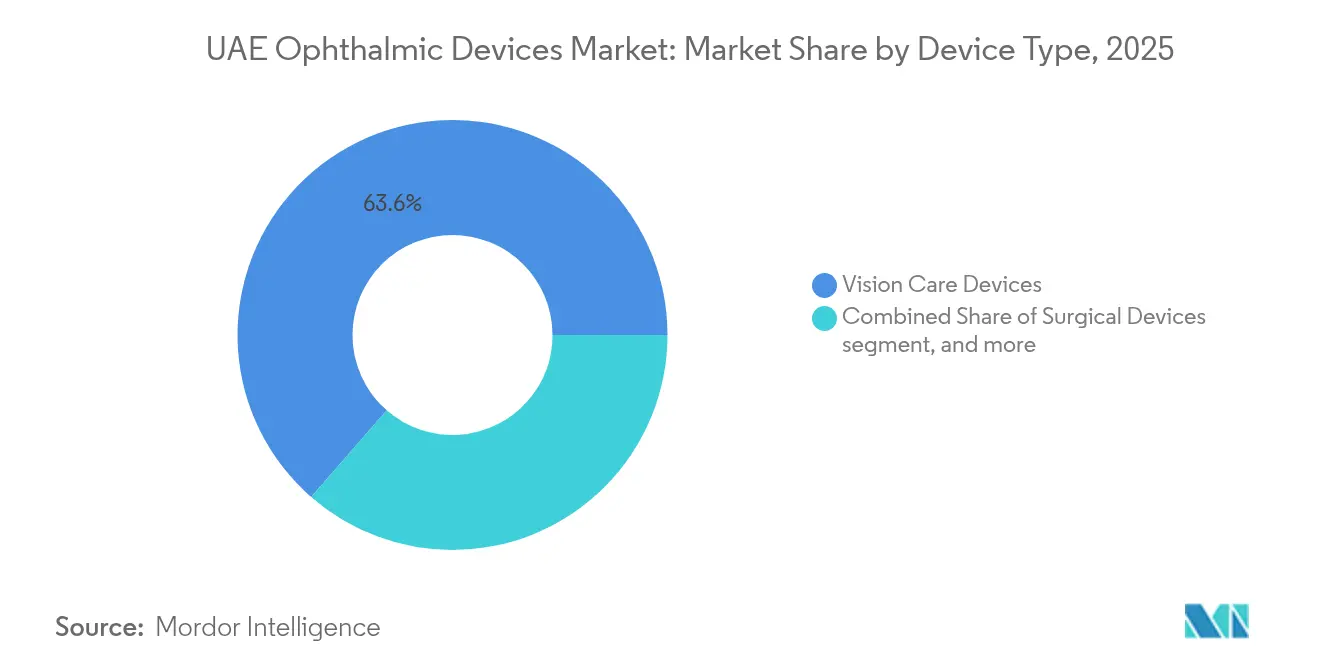
- By disease indication, cataract accounted for a 39.74% slice of the UAE ophthalmic devices market size in 2025, whereas diabetic retinopathy cases are climbing at a 7.63% CAGR through 2031.
- By end-user, hospitals dominated with 41.86% revenue in 2025, while ASCs represent the fastest-growing setting at a 7.45% CAGR to 2031.
Note: Market size and forecast figures in this report are generated using Mordor Intelligence’s proprietary estimation framework, updated with the latest available data and insights as of 2026.
UAE Ophthalmic Devices Market Trends and Insights
Drivers Impact Analysis*
| Driver | % Impact on CAGR Forecast | Geographic Relevance | Impact Timeline |
|---|---|---|---|
| Rising prevalence of diabetes-linked retinopathy in Emirati population | +1.5% | Abu Dhabi & Dubai concentration | Long term (≥ 4 years) |
| Mandatory periodic vision screening for driving-license renewals | +1.2% | Nationwide | Medium term (2-4 years) |
| Medical-tourism initiatives boosting premium eye-care demand | +0.9% | Dubai & Abu Dhabi | Medium term (2-4 years) |
| Surge in femto-laser cataract procedures at day-surgery centers | +0.7% | Urban hubs (Dubai & Abu Dhabi) | Short term (≤ 2 years) |
| Government-funded AI & tele-ophthalmology pilots | +0.6% | Pilots in Abu Dhabi; national rollout | Medium term (2-4 years) |
| Expansion of vision insurance (Thiqa, Dubai mandatory plans) | +0.5% | Nationwide, stronger in Dubai | Medium term (2-4 years) |
| Source: Mordor Intelligence | |||
Rising Prevalence of Diabetes-Linked Retinopathy in Emirati Population
A 19% diabetes rate among UAE adults pushes demand for early retinal screening as payers and providers race to curb vision loss[1]. National AI screening programs accelerate fundus analysis from half an hour to three minutes, spurring orders for OCT and ultra-wide field cameras that integrate seamlessly with cloud-based algorithms.
Mandatory Periodic Vision Screening for Driving License Renewals
All emirates require eyesight checks at each license renewal, creating a continuous flow of patients to optical centers. Dubai Health Authority’s 2025 standards specify autorefractors, keratometers, and slit-lamp biomicroscopes as mandatory equipment, reinforcing baseline demand for entry-level diagnostics[2].
Medical-Tourism Initiatives Boosting Premium Eye-Care Demand
Dubai registered double-digit growth in inbound patients for refractive and cataract surgery in 2024, with Cleveland Clinic Abu Dhabi noting a 35% jump in international volumes[3]. Hospitals are lining up femtosecond lasers and trifocal IOLs to meet expectations of overseas clientele seeking same-day discharge.
Surge in Femto-Laser Cataract Procedures at Day-Surgery Centers
Outpatient cataract programs reduce phaco energy by 35% and incision variability by 28%, allowing ASCs to cut chair time and improve throughput. Device makers highlight smaller footprints and faster setup to suit multi-theatre ambulatory hubs.
Restraints Impact Analysis*
| Restraints Impact Analysis | (~) % Impact on CAGR Forecast | Geographic Relevance | Impact Timeline |
|---|---|---|---|
| High capital cost of advanced OCT & femto lasers | –0.8% | Strongest in smaller emirates | Short term (≤ 2 years) |
| Shortage of fellowship-trained ophthalmic surgeons outside tier-1 cities | –0.6% | Northern emirates | Medium term (2-4 years) |
| Import tariff & registration delays for new devices | –0.4% | Nationwide | Short term (≤ 2 years) |
| Safety concerns over low-cost IOL failures | –0.3% | Nationwide, higher in price-sensitive clinics | Short term (≤ 2 years) |
| Source: Mordor Intelligence | |||
High Capital Cost of Advanced OCT & Femto Lasers
Initial price tags ranging from USD 300,000 to USD 500,000 strain clinic budgets, especially outside Dubai and Abu Dhabi where average surgical volumes are lower. Financing programs from manufacturers soften cash-flow pressures but do not erase maintenance overheads that remain close to 10% of equipment value annually.
Shortage of Fellowship-Trained Ophthalmic Surgeons Outside Tier-1 Cities
Cataract and retinal devices often sit idle in northern emirates because only a handful of subspecialists reside there. Local universities run accelerated residency tracks, yet the pipeline will take several years to close existing gaps.
*Our forecasts treat driver/restraint impacts as directional, not additive. The impact forecasts reflect baseline growth, mix effects, and variable interactions.
Segment Analysis
By Device Type: Vision Care Holds Leadership While Diagnostics Accelerate
Vision care products retained 63.58% of the UAE ophthalmic devices market in 2025 on the back of mandatory insurance cover and a consumer preference for high-fashion frames. Optical retail majors leverage robust footfall from license-renewal examinations to cross-sell premium lenses. Diagnostic platforms, registering an 8.42% CAGR to 2031, scale rapidly as AI algorithms demand high-resolution imaging inputs. Vendor roadmaps focus on portable OCT units operable in primary-care settings, enlarging reach beyond tertiary hospitals.
Momentum for surgical systems centers on femtosecond laser consoles and micro-invasive glaucoma shunts. Hospital groups trial disposable phaco tips to shorten re-processing cycles, enhancing ASC economics. These upgrades maintain revenue diversity and cushion suppliers against cyclical swings in vision-care accessories.

By Disease Indication: Cataract Remains Dominant as Diabetic Retinopathy Surges
Cataract captured a 39.74% UAE ophthalmic devices market share in 2025, propelled by sunlight exposure and a greying expatriate workforce. Clinics differentiate through premium trifocal lenses that extend clear focus across all distances, lifting procedure revenue per case. Diabetic retinopathy, growing at 7.63% CAGR, overtakes glaucoma as the second-largest value pool by 2031. Laser photocoagulation devices equipped with pattern-scan modules secure higher adoption as payers authorise early-intervention protocols to limit downstream costs.
Marker-based AMD monitoring and micro-shunt implants for glaucoma round out the therapeutic mix. Suppliers integrate voice-activated microscopes to streamline theatre workflow, an appealing feature given the surgeon shortfall in peripheral emirates.
By End-User: Hospitals Retain Scale Advantage as ASCs Gain Momentum
Hospitals supplied 41.86% of total device revenue in 2025, reflecting their capacity to absorb USD 1 million+ multi-room surgical build-outs. Integrated ophthalmology departments within quaternary centres handle complex cases such as combined corneal-retinal repairs that command higher average selling prices. ASCs, registering a 7.45% CAGR, benefit from insurance reimbursement parity for same-day cataract surgery, steering a volume shift away from inpatient settings. Purpose-built day-surgery facilities now feature three-room layouts that accommodate parallel surgery lists, further boosting equipment utilisation.
Specialty eye clinics thrive in preventive care and chronic disease follow-ups, particularly in diabetic retinopathy management where monthly OCT scans are routine. Their procurement skew favours compact imaging units that fit within 1,000 sq ft footprints typical of retail-adjacent premises.
Geography Analysis
Dubai anchors the UAE ophthalmic devices market thanks to a concentration of private hospitals, a vibrant optical retail scene, and the emirate’s branding as a medical-tourism hub. The Dubai Health Authority’s investment promotion programme offers streamlined licensing and 100% foreign ownership, enticing multinational manufacturers to situate regional headquarters in Dubai Healthcare City. Continuous inflows of affluent visitors seeking Lasik and lens-replacement procedures underpin premium-device turnover.
Abu Dhabi positions itself as an innovation centre, leveraging public-private partnerships through its Department of Health. Cleveland Clinic Abu Dhabi’s adoption of the PreserFlo MicroShunt for glaucoma management signals first-mover status in high-value subsegments. The Thiqa insurance scheme’s broad coverage of ophthalmic interventions supports steady patient flows. Government AI pilots run out of Abu Dhabi’s tech parks bolster demand for interoperable imaging modalities.
Northern emirates—Sharjah, Ajman, Ras Al Khaimah, Fujairah, and Umm Al Quwain—present underpenetrated retail and surgical opportunities. MAGRABi Retail Group’s takeover of Kefan Optics injects modern dispensing formats into these catchments. Public hospitals procure autorefractors and slit lamps in bulk as part of primary-care upgrades, yet adoption of femtosecond lasers lags due to limited surgeon availability. Tele-consult platforms that connect metropolitan specialists to peripheral clinics aim to bridge this gap, subtly stimulating demand for high-definition fundus cameras compatible with cloud networks.
Regulatory Landscape
Ophthalmic devices in the United Arab Emirates are regulated under a federal framework anchored by Federal Decree-Law No. (38) of 2024 on medical products, which formalized the Emirates Drug Establishment (EDE) as a central authority for medical product oversight. Medical equipment is classified by risk (Class I to Class IV), and pre-market registration is required before importing, marketing, or trading. Applications are typically supported by recognized quality conformity evidence (for example, CE marking or US FDA clearances), manufacturing documentation, and certified origin paperwork.
Alongside federal product authorization, emirate-level facility rules shape what compliant equipment is needed in practice. Dubai Health Authority (DHA) issued Standards for Optical Center and Optometry Services (January 2025), defining mandatory equipment and operational requirements for optical centers and reinforcing that devices used in licensed settings must meet applicable federal registration requirements. The ongoing transition of selected regulatory services from MOHAP to the EDE (active through late 2025) adds a procedural checkpoint for manufacturers and local agents, especially for registration steps, compliance certificates, and keeping documentation aligned between federal authorization and local facility licensing.
Competitive Landscape
Global suppliers—Alcon, Johnson & Johnson Vision, Carl Zeiss Meditec, and Bausch + Lomb—anchor the UAE ophthalmic devices market through direct offices and preferred-supplier contracts with flagship hospitals. Johnson & Johnson’s rollout of its TECNIS Odyssey IOL range targets cataract cases seeking spectacle independence. Alcon drives adoption of its image-guided femtosecond system that calibrates capsulotomy diameter in real time.
Regional consolidation intensifies in vision care. MAGRABi Retail Group’s acquisition of Kefan Optics adds more than 100 outlets, creating a pan-Gulf dispensing network that guarantees volume commitments to lens manufacturers. EssilorLuxottica’s majority stake in Ghanada Optical Co. secures an Abu Dhabi prescription laboratory, tightening control over edging and surfacing, and enabling two-day delivery to coastal emirates.
Technology partnerships, increasingly featuring AI layers, distinguish premium suppliers. Heidelberg Engineering teams with RetinSight to embed deep-learning algorithms into OCT workstations, elevating clinicians’ capacity to assess geographic atrophy progression. Bayer’s RAFEK initiative with the Emirates Society of Ophthalmology illustrates cross-sector collaboration where pharmaceutical know-how dovetails with device-based disease monitoring.
UAE Ophthalmic Devices Industry Leaders
-
Alcon Inc.
-
Carl Zeiss Meditec AG
-
EssilorLuxottica SA
-
Johnson & Johnson Vision Care
-
Bausch + Lomb Corporation
- *Disclaimer: Major Players sorted in no particular order

Market Opportunities and Future Outlook
There is room to scale retinal screening infrastructure beyond tertiary hospitals into optical centers, primary care, and peripheral emirates. In the UAE, consistent eyesight checks for driving license renewals keep patient flow steady and support recurring demand for baseline diagnostics, including autorefractors, keratometers, and slit-lamp biomicroscopes, as well as higher-end imaging aligned with diabetic retinopathy pathways. The in-market diabetes context, cited at 19% among adults, supports adoption of imaging systems that can fit into AI-enabled screening workflows, pulling demand toward interoperable fundus cameras and OCT platforms that can be deployed outside hospitals and connected to specialist networks in Dubai and Abu Dhabi.
Abu Dhabi's capability buildout creates additional demand pockets for specialized diagnostics, surgical platforms, and related infrastructure. The Department of Health Abu Dhabi has been advancing regulatory and clinical pathways for advanced ophthalmic therapies, including the UAE's first gene therapy clinical trial for MerTK-linked retinitis pigmentosa, which increases the need for precise retinal imaging, disease monitoring, and data-grade diagnostics in specialist programs. In July 2026, the Abu Dhabi Biobank and Bascom Palmer Eye Institute announced plans to establish the Middle East's first Eye Bank in Abu Dhabi, reinforcing a practical expansion track for corneal transplantation ecosystems and associated device needs, from corneal assessment and imaging through surgical instrumentation, alongside established cataract and glaucoma procedure volumes in day-surgery settings.
Recent Industry Developments
- June 2026: New Al Shefa Clinic in Dubai announced the launch of the Alcon Voyager Direct Selective Laser Trabeculoplasty (DSLT) system as part of its advanced eye-care service offering. Adding an automated, non-contact laser option expands the procedural toolkit for glaucoma and ocular hypertension management and supports demand for modern laser systems in outpatient clinic settings.
- May 2026: The Emirates Drug Establishment (EDE) approved Bausch + Lomb's MIEBO for dry eye disease, with Gulf News noting the UAE was the third country globally to authorize the treatment. The decision highlights the UAE's role as a fast-moving regional access market for ophthalmology innovations and can accelerate formulary adoption and clinic-level dry eye service expansion.
- January 2026: Alcon introduced its Unity VCS combined cataract and vitreoretinal surgical platform to the Middle East market, with Dubai serving as a regional launch venue. A unified platform approach supports operating room efficiency for providers handling both cataract and retina cases and strengthens competitive pressure for integrated surgical ecosystems across hospital and ambulatory surgery center procurement.
Research Methodology Framework and Report Scope
Market Definition and Coverage
For this study, the UAE ophthalmic devices market is defined as the value of devices used to diagnose, monitor, treat, or correct eye conditions that are sold into the UAE through clinical and vision-care channels.
Scope exclusions: We exclude ophthalmic drugs and general hospital consumables that are not specific to eye care device use.
Segmentation Overview
- By Device Type
- Diagnostic & Monitoring Devices
- OCT Scanners
- Fundus & Retinal Cameras
- Autorefractors & Keratometers
- Corneal Topography Systems
- Ultrasound Imaging Systems
- Perimeters & Tonometers
- Other Diagnostic & Monitoring Devices
- Surgical Devices
- Cataract Surgical Devices
- Vitreoretinal Surgical Devices
- Refreactive Surgical Devices
- Glaucoma Surgical Devices
- Other Surgical Devices
- Vision Care Devices
- Spectacles Frames & Lenses
- Contact Lenses
- Diagnostic & Monitoring Devices
- By Disease Indication
- Cataract
- Glaucoma
- Diabetic Retinopathy
- Other Disease Indications
- By End-user
- Hospitals
- Specialty Ophthalmic Clinics
- Ambulatory Surgery Centers (ASCs)
- Other End-users
Data Sources, Market Sizing, and Validation
Desk Research
Desk work was used to set the market boundary and to build a realistic demand map for the UAE. We relied on public sources such as UAE MOHAP updates, Dubai Health and Abu Dhabi Department of Health publications, World Health Organization datasets, World Bank population and income indicators, and peer reviewed clinical literature on cataract, glaucoma, and diabetes related eye disease.
To shape the commercial side, we also reviewed company filings, product catalogs, investor presentations, distributor and hospital group announcements, and reputable press coverage on new clinic openings and equipment installations. Where needed, a paid subscription for company financials and intelligence was used to cross-check local subsidiary visibility, and a patent database was used to understand where innovation focus is moving. These examples are not exhaustive, and many additional sources were consulted to collect, validate, and clarify inputs.
Primary Interviews and Surveys
Primary discussions were held with UAE based ophthalmologists, optometrists, hospital procurement teams, specialty eye centers, and distributors to verify usage patterns and pricing ranges across device categories. Respondent input was used to confirm what gets purchased versus leased, how replacement cycles look for diagnostic systems, and which procedures are rising in key emirates, so assumptions from desk research could be corrected before final sizing.
Distribution of primary research fieldwork respondents
| Company type | Respondent position |
|---|---|
| Top tier: 31% | CXOs: 15% |
| Mid tier: 52% | Functional/Unit leaders: 39% |
| Smaller Players: 17% | Managers: 46% |
Market-Sizing & Forecasting
Sizing was built using a top-down approach where procedure volumes and treated patient pools were reconstructed for the UAE, and then translated into device demand using penetration and utilization assumptions. To keep the model grounded, the totals were then checked with selective bottom-up approximations, such as sampled price per unit multiplied by likely annual units sold for key product groups, followed by distributor channel checks.
Key inputs used in the model included cataract surgery volumes, diabetes prevalence as a proxy for retinal screening demand, growth in specialty eye clinics, installed base replacement cycles for diagnostic systems, typical average selling prices by device type, and the share of care shifting to outpatient settings. Forecasting was completed using scenario analysis, where the base case growth was shaped by expected procedure growth and clinic capacity additions, and then stress tested for reimbursement sensitivity and import related pricing changes.
Data Validation & Update Cycle
Outputs were validated through triangulation across procedure signals, pricing reality checks from interviews, and consistency tests against healthcare capacity growth. When a value looked out of range, the assumption behind it was revisited, and respondents were re contacted to confirm whether the change was real or driven by timing, currency, or a one off tender.
Before sign off, the model goes through a multi step analyst review so calculation logic, unit conversions, and growth drivers align with the defined scope. Reports are refreshed annually, with interim updates when material events occur, and a final pre delivery pass is completed so clients receive the latest updated view.
Mordor Intelligence's UAE Ophthalmic Devices Market Size Compared Against Other Published Estimates
Different publishers can land on different market sizes even when they talk about the same country, because the product boundary and counting method are not always aligned. In ophthalmic devices, the main swing factors are whether vision correction products are included, how imported device pricing is handled, and whether the estimate is built from procedures, from trade proxies, or from supplier side assumptions.
By tracking procedure volumes and replacement cycles, and then checking scope rules with Mordor Intelligence in the middle of the workflow, the estimate keeps vision care products, diagnostic systems, and surgical devices separated so double counting across channels is avoided.
Benchmark comparison
| Source | Market Size | Gaps in Research Methodology |
|---|---|---|
| Mordor Intelligence | USD 240 M (2025) | |
| Industry Research House A | USD 1.20 B (2023) | This estimate appears to use a broader spend definition that likely blends devices with ongoing vision care retail value, and the base year is earlier. That can inflate comparisons if later pricing and volume are not normalized. |
| Market Publisher B | USD 187.4 M (2026) | The lower number is consistent with a narrower device-only scope and a different forecast window. It may also treat certain vision correction categories as outside the device market, which reduces the total. |
Taken together, the spread is mostly explained by what is counted inside the market boundary and how demand is reconstructed from real use signals. When scope is tied back to procedures, installed base behavior, and realistic price bands, the final number becomes easier to audit and repeat year to year.
Key Questions Answered in the Report
What is the current value of the UAE ophthalmic devices market?
The market is valued at USD 254.98 million in 2026 and is projected to hit USD 344.9 million by 2031.
Which device category leads revenue generation?
Vision-care products hold 63.58% of revenue owing to mandatory insurance coverage and high consumer uptake.
Why are diagnostic systems growing the fastest?
AI-enabled screening initiatives and mandatory license-renewal examinations push demand for fundus cameras and portable OCT units, driving an 8.42% CAGR.
How does medical tourism influence the market?
A rising influx of international patients, especially to Dubai and Abu Dhabi, accelerates adoption of premium technologies like femtosecond lasers and trifocal IOLs.
What are the main challenges limiting market growth?
High upfront equipment costs, a shortage of fellowship-trained surgeons in smaller emirates, and import-registration delays temper wider device penetration.
Which end-user segment is expanding the quickest?
Ambulatory surgery centers record a 7.45% CAGR as cataract and refractive surgeries migrate to day-care settings that offer faster discharge and lower costs.