
Market Overview
| Study Period | 2021 - 2031 |
|---|---|
| Forecast Data Period | 2026 - 2031 |
| Base Year Market Size (2025) | 172.58 Million liters |
| Market Volume (2026) | 178.69 Million liters |
| Market Volume (2031) | 212.64 Million liters |
| Growth Rate (2026 - 2031) | 3.54 % |
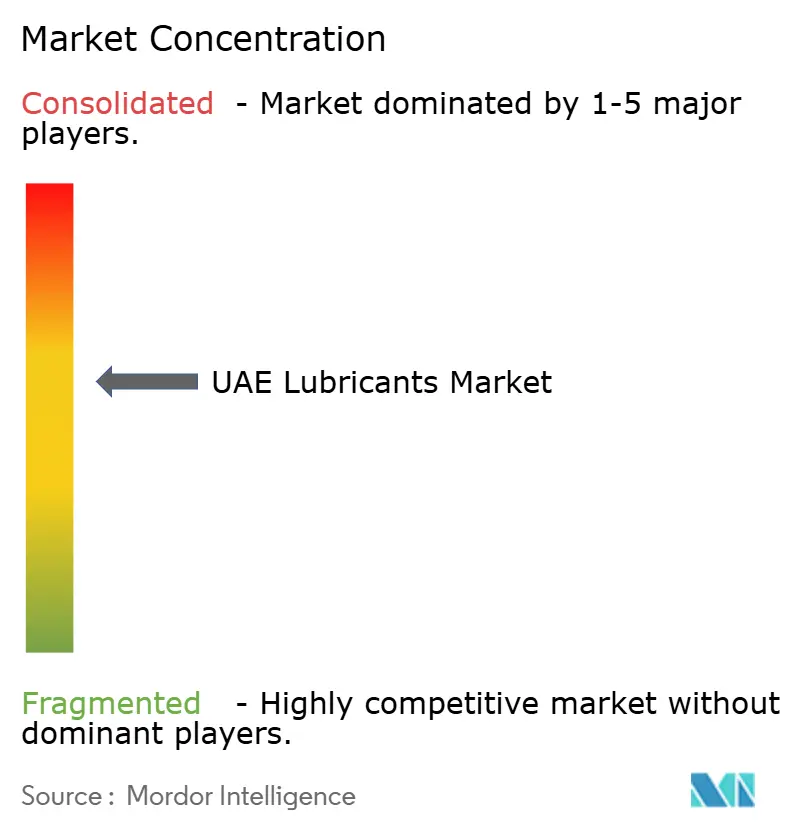
| Market Concentration | Medium |
Major Players *Disclaimer: Major Players sorted in no particular order Image © Mordor Intelligence. Reuse requires attribution under CC BY 4.0. | |
UAE Lubricants Market Analysis by Mordor Intelligence
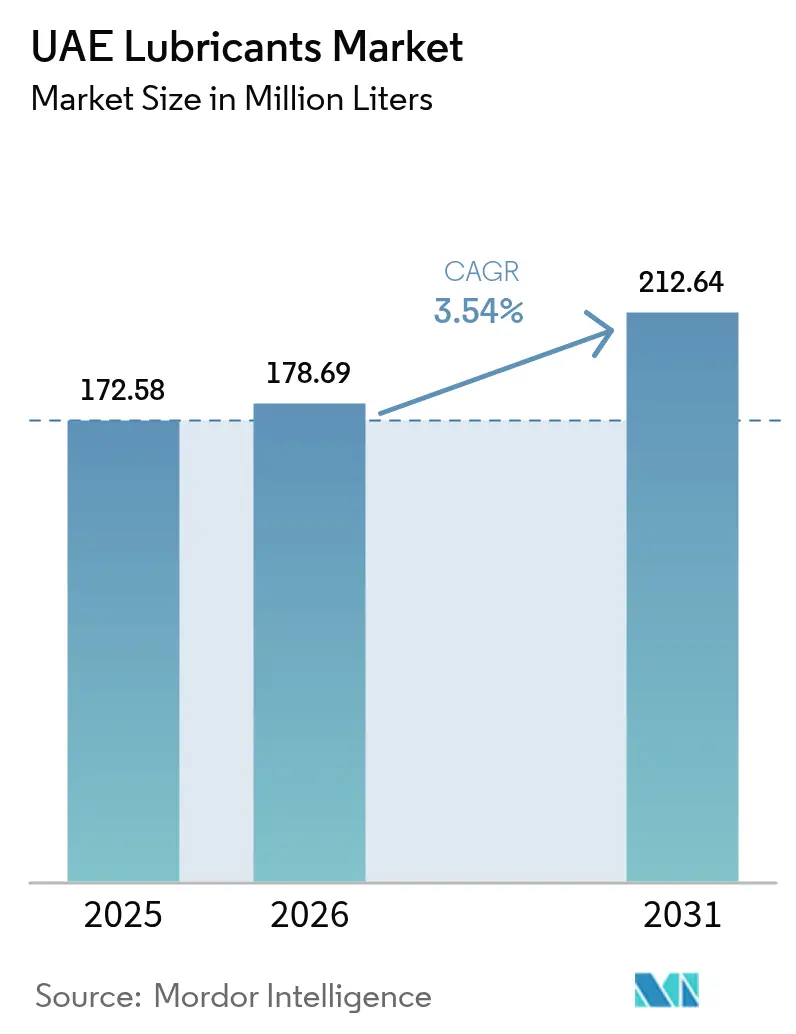
The UAE Lubricants Market size is expected to increase from 172.58 million liters in 2025 to 178.69 million liters in 2026 and reach 212.64 million liters by 2031, growing at a CAGR of 3.54% over 2026-2031. Robust refinery integration at Ruwais is lowering feedstock costs, while Euro-5 regulations that took effect in 2026 are accelerating the adoption of low-SAPS synthetics. Construction and rail projects that followed EXPO 2020 are sustaining demand for hydraulic and gear oils in heavy equipment fleets, and ADNOC’s In-Country Value (ICV) program is channeling industrial procurement toward local blenders. At the same time, the counterfeit trade and volatile Asian freight rates are creating cost pressures that disproportionately affect smaller players. International majors are responding with GTL-derived and bio-based product launches, reinforcing premium positioning in the increasingly competitive UAE lubricants market.
Key Report Takeaways
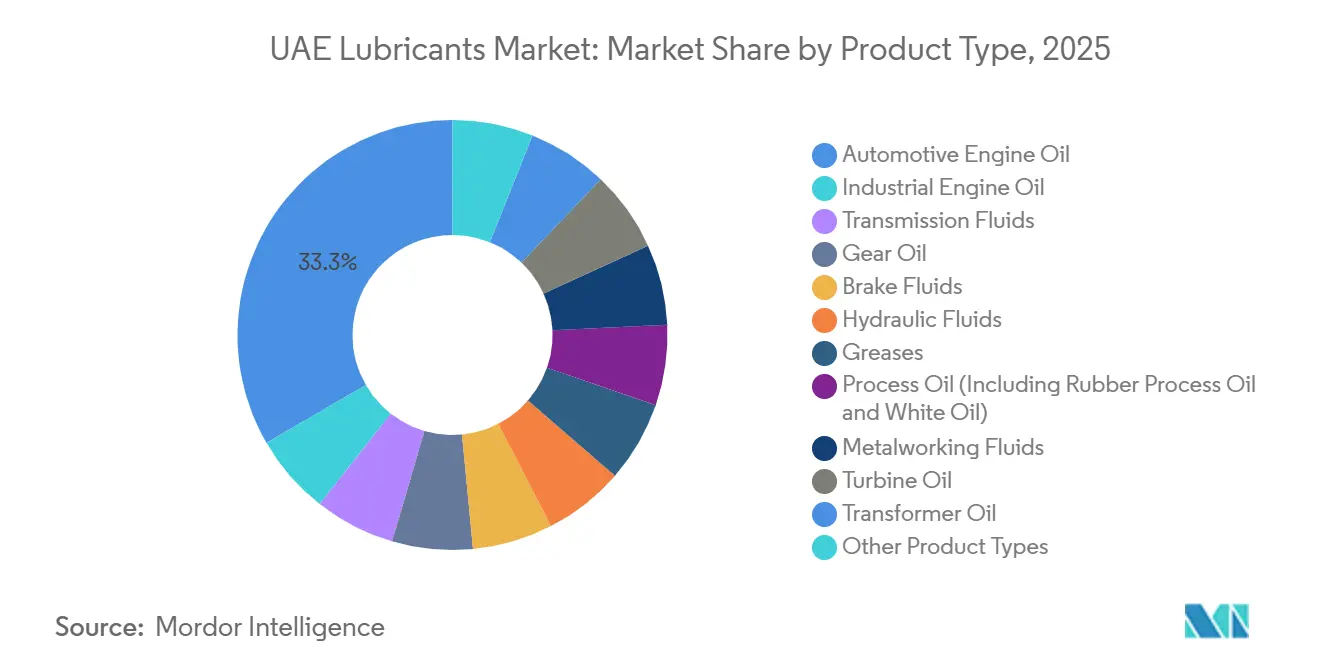
- By product type, automotive engine oil led with 33.35% of the UAE lubricants market share in 2025, while industrial engine oil is forecast to advance at a 3.65% CAGR to 2031.
- By end-user, automotive accounted for 53.12% of the UAE lubricants market size in 2025, whereas industrial is projected to grow at a 3.55% CAGR through 2031.
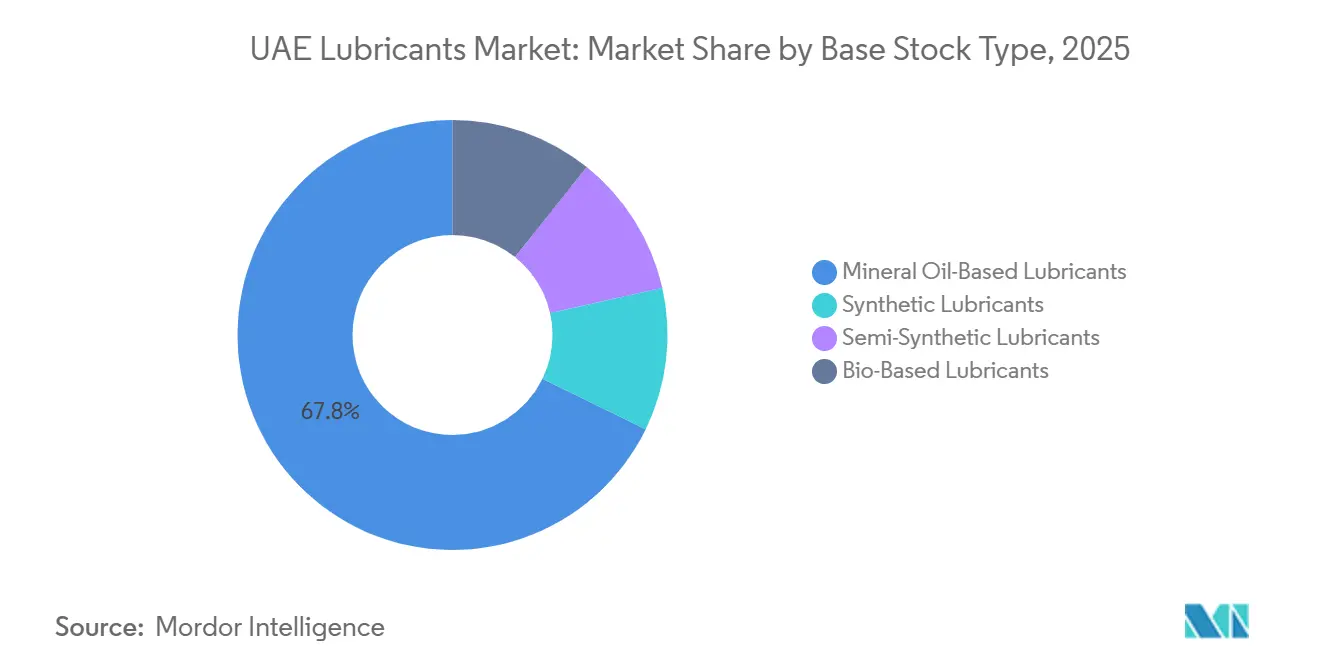
- By base stock, mineral oils held 67.78% of the UAE lubricants market size in 2025; bio-based formulations are expected to expand at a 4.09% CAGR to 2031.
Note: Market size and forecast figures in this report are generated using Mordor Intelligence’s proprietary estimation framework, updated with the latest available data and insights as of 2026.
Market Trends and Insights
Drivers Impact Analysis of UAE Lubricants Market*
| Drivers | (~) % Impact on CAGR Forecast | Geographic Relevance | Impact Timeline |
|---|---|---|---|
| Gradual shift from Group I to Group II/III base-oils in UAE blending plants | +0.8% | UAE (Abu Dhabi, Dubai blending hubs), with export spill-over to GCC and East Africa | Medium term (2-4 years) |
| ADNOC's expansion of Ruwais refinery boosting local base-oil availability | +0.6% | UAE national, with downstream benefits for Jebel Ali and Fujairah re-export terminals | Short term (≤ 2 years) |
| Strong post-COVID rebound in UAE construction equipment parc | +0.5% | UAE (Abu Dhabi, Dubai, Sharjah construction corridors), Northern Emirates industrial zones | Short term (≤ 2 years) |
| Government "Make it in the Emirates" industrialisation push raises industrial-oil demand | +0.7% | UAE national, concentrated in KIZAD, Khalifa Industrial Zone, and Ruwais petrochemical cluster | Medium term (2-4 years) |
| Mandatory Euro-5 import standards driving demand for premium synthetics | +0.9% | UAE national, with accelerated adoption in Dubai and Abu Dhabi fleets | Medium term (2-4 years) |
| Source: Mordor Intelligence | |||
Gradual Shift from Group I to Group II/III Base Oils in UAE Blending Plants
Blending facilities in Abu Dhabi and Dubai are accelerating the migration to hydro-cracked Group II and III stocks as OEMs demand longer drain intervals. ADNOC’s 600,000-ton-per-year Group III project with Neste delivers base oils with viscosity indices above 120, enabling 0W-20 and 5W-30 formulations that meet ACEA C3 and API SP. Localizing supply trims blending costs by up to 12% versus imports and has allowed ADNOC Distribution to extend its Voyager export footprint to 50 countries. Group II uptake is strongest in gear and hydraulic oils, where oxidation stability lengthens equipment life in high-temperature petrochemical applications[1].
ADNOC Expansion at Ruwais Boosting Local Base-Oil Availability
The 420,000 bbl/d crude-capacity expansion at Ruwais added hydrocracking units that supply Group II/III feedstock at transfer prices 10-15% below spot CFR UAE levels. Vertical integration now supports bulk deliveries of turbine and compressor oils to power-generation clients within 48 hours, compared with a week or more for imported material. Proximity to KIZAD and the Ruwais petrochemical cluster cuts logistics costs by USD 15-20 per tonne and strengthens the UAE lubricants market position of domestic producers.
Strong Post-COVID Rebound in UAE Construction Equipment Parc
Large projects such as Etihad Rail Stage 2, Dubai Creek Harbour, and Yas Bay have raised demand for ISO VG 46/68 hydraulic fluids and EP gear oils in excavators and tower cranes. ADNOC Distribution expanded its oil-change network to 230 service points by mid-2025, mirroring higher preventive-maintenance activity in rental fleets that account for roughly 40% of the machinery parc. Cross-segmentation with offshore drilling has also lifted synthetic gear oil sales approved for top-drive gearboxes.
Government "Make it in the Emirates" industrialisation push raises industrial-oil demand
The ICV framework, which reached 86% in 2023, awards procurement preference to domestically blended lubricants, bolstering demand for turbine, transformer and metal-working fluids in aluminum, steel and chemicals plants at KIZAD. ADNOC Distribution’s specialty lineup now includes FDA-grade white oils and ISO 22241 diesel exhaust fluid, meeting the needs of food processing and SCR-equipped power gensets.
Restraints Impact Analysis of UAE Lubricants Market*
| Restraints | (~) % Impact on CAGR Forecast | Geographic Relevance | Impact Timeline |
|---|---|---|---|
| Proliferation of counterfeit lubricants in grey markets | -0.4% | UAE (Ajman, Sharjah free zones), with cross-border flows from South Asia | Short term (≤ 2 years) |
| Rising base-oil freight rates from Asia | -0.3% | UAE import terminals (Jebel Ali, Fujairah), affecting blenders dependent on Singapore/South Korea supply | Short term (≤ 2 years) |
| Carbon-tax considerations inflating re-refined base-oil competitiveness | -0.4% | UAE, affecting the manufacturing of re-refined base oils and influencing prices | Medium term (>2 to 4 years) |
| Source: Mordor Intelligence | |||
Proliferation of Counterfeit Lubricants in Grey Markets
Despite ESMA’s tamper-evidence rules, seizures worth AED 7.46 million in 2024 underscore ongoing counterfeit activity in Ajman and Sharjah. Sub-specification base stocks shorten engine life and jeopardize warranties, prompting ENOC to roll out blockchain-linked QR codes and ADNOC Distribution to leverage its 551-station network to assure authenticity[2].
Rising Base-Oil Freight Rates from Asia
South Korean and Singapore refiners diverted capacity to gasoil in early 2025, lifting Group I SN150 to USD 810 per tonne CFR UAE. Each USD 50-per-tonne freight increase adds roughly 6% to finished-product cost for import-dependent blenders, eroding margins in marine and industrial segments that rely on bright stock and cylinder oils.
*Our forecasts treat driver/restraint impacts as directional, not additive. The impact forecasts reflect baseline growth, mix effects, and variable interactions.
UAE Lubricants Market Segment Analysis
By Product Type:
Industrial Engine Oil Moves Ahead of AutomotiveIndustrial engine oil demand is poised to outgrow automotive counterparts at a 3.65% CAGR as gas-turbine, marine and upstream compressors consume higher‐viscosity formulations. The automotive category is maturing as extended-drain synthetics and growing EV penetration trim per-vehicle oil volume, yet it still retained 33.35% of the UAE lubricants market share in 2025. Turbine, hydraulic and metal-working fluids enjoy policy tailwinds from the “Make it in the Emirates” program, while specialty greases serve quarrying and agriculture in the Northern Emirates. Export approvals such as Siemens Energy for Voyager turbine oil and WinGD for marine cylinder oils reinforce brand credibility abroad. The UAE lubricants market size tied to transmission and gear oils is also expanding due to construction equipment that operates under severe thermal cycles.
Hydraulic fluids used in aluminum smelters, steel rolling mills, and plastic-molding lines benefit from Group II oxidation resistance, supporting up-time in continuous processes. Turbine oils with ≥ 10,000-hour stability are being specified for combined-cycle and solar-hybrid plants that make up the UAE’s new-build generation mix. Meanwhile, brake fluids, though low volume, remain essential for both automotive safety and heavy-equipment hydraulics and are widely retailed through ADNOC’s 157 oil-change centers.

By End-User Industry:
Infrastructure Spend Lifts Industrial GrowthAutomotive end users commanded 53.12% of the UAE lubricants market size in 2025 across passenger cars, commercial vehicles and two-wheelers. However, industrial users—power generation, metallurgy and petrochemicals—are projected to grow 3.55% per year through 2031. Passenger cars are shifting to 0W-20 low-SAPS formulations, while heavy trucks on the Dubai-Abu Dhabi corridor rely on 15W-40 CK-4 oils that balance cost and protection. Two-wheeler demand, although modest, is supported by JASO-approved oils for wet-clutch scooters popular with last-mile delivery fleets.
On the industrial side, turbine and transformer oils serve expanding generation and grid assets, whereas metal-working fluids lubricate CNC machining centers that supply downstream fabrication for construction and renewables projects. Marine lubricants supplied 54,711 m³ through Fujairah in 2025—critical for vessels navigating the Strait of Hormuz—and are moving toward Environmentally Acceptable Lubricants for compliance in protected waters. Aerospace remains a white space requiring MIL-PRF approvals, while heavy equipment in quarrying and agriculture continues to consume EP gear oils.
By Base Stock Type:
Bio-Based Leads Growth, Mineral Still DominantMineral oils retained 67.78% volume share in 2025, but OEM endorsements for bio-based hydraulics and marine oils are driving the fastest 4.09% CAGR. ADNOC’s Voyager PX Green, already exported to 46 markets, showcases an early-mover advantage, and PANOLIN-branded products from Shell broaden the sustainable portfolio. Synthetic PAO and ester oils, including Shell’s Helix Ultra Lightning and ExxonMobil’s Mobil 1 SuperSyn, capture the premium passenger-car niche. Semi-synthetic blends bridge cost and performance for mid-tier fleets, and the local supply of Group III from Ruwais blurs the line between traditional mineral and near-synthetic performance. Re-refined base oils are gaining policy interest as GCC carbon-tax debates intensify, with lifecycle studies showing up to 81% lower greenhouse-gas emissions versus virgin production.
Geography Analysis
Abu Dhabi anchors industrial demand with Ruwais’s 600,000-ton Group III complex and the KIZAD cluster that houses aluminum, steel, and chemical plants consuming transformer, turbine, and gear oils. ADNOC Distribution’s dense retail and logistics network underpins brand penetration and authentication, limiting counterfeit risk. Dubai operates as the re-export hub of the UAE lubricants market, hosting international majors in Jebel Ali Free Zone and capturing high-end passenger-car and marine segments. Construction projects and aviation maintenance at Dubai International and Al Maktoum airports create demand for synthetic ATF and specialty aerospace fluids. Fujairah, the world’s third-largest bunkering port, sold over 54,700 m³ of marine lubricants in 2025, reinforcing its strategic role for cylinder oils that meet IMO 2020 sulfur rules.
Sharjah and Ajman, part of the Northern Emirates, house mid-sized blenders such as SHARLU and United Grease & Lubricants with export footprints that reach Africa and South-East Asia. Weaker customs oversight, however, has encouraged counterfeit inflows, prompting brand owners to invest in anti-tamper packaging and dealer education. Ras Al Khaimah and Umm Al Quwain add incremental demand from quarrying and light industry, rounding out a national profile in which the UAE lubricants market benefits from deep-water ports, free-zone incentives, and fast customs clearance that support re-export into Oman, Saudi Arabia, and East Africa.
Regulatory Landscape
Lubricants are regulated as petroleum derivatives under Federal Law No. 14 of 2017 on trading in petroleum products, which ties market access to compliance with approved safety, security, and environmental requirements for trading and storage. Product quality conformity is enforced through the Emirates Control Scheme for Oil Derivatives under Cabinet Resolution No. (21) of 2015, administered by the Ministry of Industry and Advanced Technology (MoIAT, which absorbed ESMA functions), where regulated lubricants require conformity assessment and certification (ECAS/Form B) for both imports and locally manufactured goods.
Mandatory standards are anchored to UAE and GSO specifications, including UAE.S GSO 1785-2:2023 for internal combustion engine oils, which tightens minimum performance and labeling expectations for passenger-car and commercial-vehicle lubricants. On trade, lubricants operate under the unified GCC customs framework, where the general import duty is 5% of CIF for most goods, and importers typically validate HS classification and any commodity restrictions via the Federal Authority for Identity, Citizenship, Customs and Port Security platform, shaping landed-cost planning for blenders reliant on imported base oils or additives.
Value Chain Analysis
The UAE lubricants value chain starts with base oils and additives supplied through domestic refining and imports, then moves through blending, packaging, testing, and multi-channel distribution. Ruwais-linked feedstock availability supports local blending economics, and integrated players such as ADNOC Distribution and ENOC combine procurement, formulation, and downstream access through company-operated networks and B2B supply relationships with industrial customers across Abu Dhabi, Dubai, and the Northern Emirates.
Quality assurance and compliance are embedded through MoIAT-regulated conformity requirements (ECAS) and testing via accredited laboratories, which adds time and cost for new SKUs but also raises barriers for informal supply. Finished lubricants reach customers through fuel-station retail, quick-lube and service centers, industrial direct sales, marine supply into ports such as Fujairah, and re-exports via free zones including Jebel Ali. This distribution structure tends to favor vertically integrated firms with warehouses and fleet logistics, while smaller blenders face higher exposure to freight volatility on imported base oils and packaging materials.
Competitive Landscape
The UAE lubricants market remains moderately consolidated. ADNOC draws advantage from captive Group III supply, enabling it to price synthetics competitively and extend Voyager exports. ENOC’s blockchain-secured packaging and SKF-based RecondOil service underline a technology-led push to extend drain intervals and reduce waste. Local independents such as Dana Lubricants, SHARLU, and Universal target price-sensitive commercial and industrial sectors with API-compliant products at double-digit discounts, often winning tenders that emphasize up-front cost. White-space opportunities in aerospace and biodegradable lubricants are attracting early investment; Voyager PX Green and Shell’s PANOLIN address sustainability mandates, while MIL-PRF certifications remain scarce among domestic players. Digital disruption is emerging through on-demand services; partnerships reminiscent of ExxonMobil’s mobile-app oil-change pilot overseas are influencing strategy discussions among UAE incumbents seeking to defend share.
UAE Lubricants Industry Leaders
-
Abu Dhabi National Oil Company (ADNOC) P.J.S.C.
-
Emirates National Oil Company (ENOC)
-
Shell plc
-
BP p.l.c.
-
ExxonMobil Corporation
- *Disclaimer: Major Players sorted in no particular order
UAE Lubricants Market Companies Covered in this Report
- Abu Dhabi National Oil Company (ADNOC) P.J.S.C.
- BP p.l.c.
- Dana Lubricants Factory LLC
- Emarat
- Emirates National Oil Company (ENOC)
- ExxonMobil Corporation
- Gulf Oil International Ltd
- Oscar Lubricants LLC
- Petromin Corporation
- Sharjah National Lube Oil Co. (SHARLU)
- Shell plc
- Texol Lubritech FZC
- TotalEnergies
- Universal Lubricants
Market Opportunities and Future Outlook
An actionable opportunity is the expansion of specialty and high-compliance products manufactured domestically for industrial and export demand, supported by localization programs and procurement preferences tied to In-Country Value (ICV). In May 2026, ADNOC Distribution announced lubricant partnerships with Emirates Global Aluminium and Borouge and referenced specialized outputs such as pharma-grade white oil, pointing to a shift from standard automotive SKUs toward higher-margin, specification-driven fluids for metals, chemicals, and sensitive applications.
Manufacturing and export platforms around Fujairah and Abu Dhabi also create room for growth, particularly for marine, industrial, and private-label supply where blending reliability, packaging, and turnaround time influence tender outcomes. ENOC highlighted its Fujairah ENOC Lubricant and Grease Manufacturing Plant (ELOMP) at Make it in the Emirates 2026, including an automated mixing system rated at 50 cubic meters per hour, which emphasizes the role of scale and process control in winning regional supply programs. It also reinforces the case for investments in automation, accredited testing, and anti-counterfeit packaging within the UAE distribution system.
Recent Industry Developments in UAE Lubricants Market
- July 2026: ADNOC Distribution entered into a definitive agreement to acquire 100% of Shell Downstream South Africa for USD 1 billion, a deal that includes Shells lubricants business and is subject to regulatory approvals. The transaction broadens ADNOC Distributions downstream footprint beyond the GCC and adds established lubricant routes-to-market and customer relationships. This can strengthen sourcing leverage and portfolio scale for branded lubricants produced and traded through the wider ADNOC system.
- May 2026: ADNOC Distribution announced lubricant partnerships with Emirates Global Aluminium and Borouge, with deals reported at AED 60 million to deepen localization and supply high-performance, locally blended products to industrial operations. The move aligns lubricant formulations and packaging with domestic manufacturing priorities under Make it in the Emirates and ICV-linked procurement. It also signals higher emphasis on specialized industrial lubricants alongside automotive volumes.
- December 2025: Shell introduced Helix Ultra Lightning, a GTL-derived synthetic lubricant positioned around multiple European OEM approvals at a launch in Abu Dhabi. The introduction reinforces premium synthetic offerings in the passenger-car segment as the market shifts toward lower-SAPS, higher-spec formulations. It also increases competitive intensity for integrated local blenders in the premium retail and workshop channels.
UAE Lubricants Market Report Scope and Research Methodology
Market Definition and Coverage
For this study, the market covers lubricants consumed within the UAE across automotive and industrial usage, measured by the physical volume sold into end-use applications during the year.
Scope exclusions: Re-exports and transit volumes moving through UAE trading hubs are excluded so the sizing reflects local consumption only.
Segments Covered in This Report
- By Product Type
- Automotive Engine Oil
- Industrial Engine Oil
- Transmission Fluids
- Gear Oil
- Brake Fluids
- Hydraulic Fluids
- Greases
- Process Oil (Including Rubber Process Oil and White Oil)
- Metalworking Fluids
- Turbine Oil
- Transformer Oil
- Other Product Types
- By End-user Industry
- Automotive
- Passenger Vehicles
- Commercial Vehicles
- Two-Wheelers
- Marine
- Aerospace
- Heavy Equipment
- Construction
- Mining
- Agriculture
- Industrial
- Power Generation
- Metallurgy and Metalworking
- Textiles
- Oil and Gas
- Other End-Use Industries
- Automotive
- By Base Stock Type
- Mineral Oil-Based Lubricants
- Synthetic Lubricants
- Semi-Synthetic Lubricants
- Bio-Based Lubricants
Data Sources, Market Sizing, and Validation
Desk Research
Desk research was used to set the factual base for the model and to make sure we were not building assumptions in a vacuum. We relied on publicly available sources such as UAE Federal Competitiveness and Statistics Center releases, UAE Ministry of Energy and Infrastructure publications, customs and trade statistics from UN Comtrade, and World Bank trade databases to understand demand drivers and trade direction.
We also reviewed company annual reports, investor presentations, and credible local and regional press coverage to track price movement and product mix shifts (such as higher synthetic penetration in certain fleets). Where useful, we cross-checked selected supplier footprints and import patterns using a paid company financials and intelligence subscription and an import and export shipment-level database to test whether the modeled splits looked realistic. The sources listed above are illustrative, and many additional public documents were referenced to collect, validate, and clarify data points.
Primary Interviews and Surveys
Primary work was used to pressure-test desk findings and fill gaps that are common in lubricants, especially around channel splits and actual drain intervals. We spoke with blenders, distributors, workshop and fleet-side stakeholders, and industrial end users to validate consumption patterns, packaging mix, and typical pricing behavior across major emirates.
Distribution of primary research fieldwork respondents
| Company type | Respondent position |
|---|---|
| Top tier: 26% | CXOs: 19% |
| Mid tier: 54% | Functional/Unit leaders: 26% |
| Smaller Players: 20% | Managers: 55% |
Market-Sizing & Forecasting
The core sizing uses a top-down demand pool build that starts from UAE activity indicators and then converts them into lubricant usage. Inputs that were checked and adjusted include the on-road vehicle parc and utilization, average oil drain intervals by key vehicle groups, industrial output and maintenance intensity in energy and manufacturing, and the mix shift toward synthetic and semi-synthetic grades that changes liters per service event.
Once the demand pool was built, it was corroborated with selective bottom-up approximations, such as sampled pricing by pack size, channel checks on workshop throughput, and supplier-side volume sanity checks in a few high-visibility categories. Where a direct read was missing for smaller applications, gaps were handled by applying conservative penetration rates and then revalidating them through interviews so the total did not drift away from real consumption.
For forecasting, we used scenario analysis supported by expert consensus on variables like vehicle growth, fleet activity in logistics, industrial maintenance cycles, and expected premiumization. The final trajectory was kept consistent with observable signals, where the main clause comes last, so that year-by-year growth stays explainable and repeatable.
Data Validation & Update Cycle
Outputs were checked through multiple steps so the final numbers stayed internally consistent and aligned with external signals. We compared totals against independent indicators such as trade direction, blending presence, and known consumption anchors, and then investigated sharp variances before internal sign-off.
If a major mismatch appeared, analysts revisited key inputs, rechecked units and conversions, and re-contacted relevant respondents for clarification. Reports are refreshed annually, with interim updates when material events occur, and a final pre-delivery review is done so clients receive the most current view possible.
Mordor Intelligence's UAE Lubricants Market Market Size Measured Against Other Published Estimates
Published market sizes for UAE lubricants often differ because the market can be counted by local consumption, by supply into the country, or by trading volumes moving through the UAE. Differences also come from how product scope is drawn, how pricing is applied to convert liters into USD, and how recently assumptions were refreshed.
Re-exported lubricant volumes shipped onward from UAE free zones sit outside Mordor Intelligence scope, which is why some broader trade-linked estimates can look larger even when local end-use demand is steady.
Benchmark comparison
| Source | Market Size | Gaps in Research Methodology |
|---|---|---|
| Mordor Intelligence | USD 0.17 B (2025) | |
| Trade Journal A | USD 1.00 B (2024) | This figure is presented as a value headline without a visible liters-to-USD build, and it likely reflects trading and distribution activity that is not tied to in-country consumption. |
| Industry Consultancy B | USD 0.19 B (2025) | This estimate appears to apply a higher average selling price per liter using a faster shift to synthetic grades, which can lift USD value even when liters are close. |
Across the sources, the biggest drivers of differences are whether re-export flows are counted and how pack size and grade mix are translated into a single average price. We kept assumptions tied to vehicle activity, drain intervals, and industrial maintenance demand, and then used channel feedback to check whether the output still matched real buying patterns.
Key Questions Answered in the Report
How large will the UAE lubricants market be by 2031?
Volume is forecast to reach 212.64 million liters by 2031, reflecting a 3.54% CAGR over 2026-2031.
Which segment grows fastest between 2026 and 2031?
Industrial engine oil is projected to expand at 3.65% per year, outperforming other product categories.
What drives demand for bio-based lubricants in the UAE?
OEM approvals for hydraulic and marine applications and corporate sustainability mandates are pushing bio-based volumes, which grow at a 4.09% CAGR.
How are Euro-5 and Euro-6 standards affecting lubricant formulations?
The regulations are accelerating a shift toward low-SAPS 0W-20 and 5W-30 synthetics that protect particulate filters and improve fuel economy by up to 3%.
Which companies dominate retail channels?
ADNOC Distribution, ENOC and Emarat collectively control about 63% of retail and commercial outlets through integrated fuel stations and blending plants.
Why are base-oil freight rates a risk factor?
Gas-oil margins in Asia reduced base-oil output, lifting freight costs and tightening imports, which raise finished-lubricant prices for UAE blenders that lack a captive supply.