
Market Overview
| Study Period | 2020 - 2031 |
|---|---|
| Forecast Data Period | 2026 - 2031 |
| Base Year Market Size (2025) | USD 4.25 Billion |
| Market Size (2026) | USD 5.02 Billion |
| Market Size (2031) | USD 11.49 Billion |
| Growth Rate (2026 - 2031) | 18.03 % |
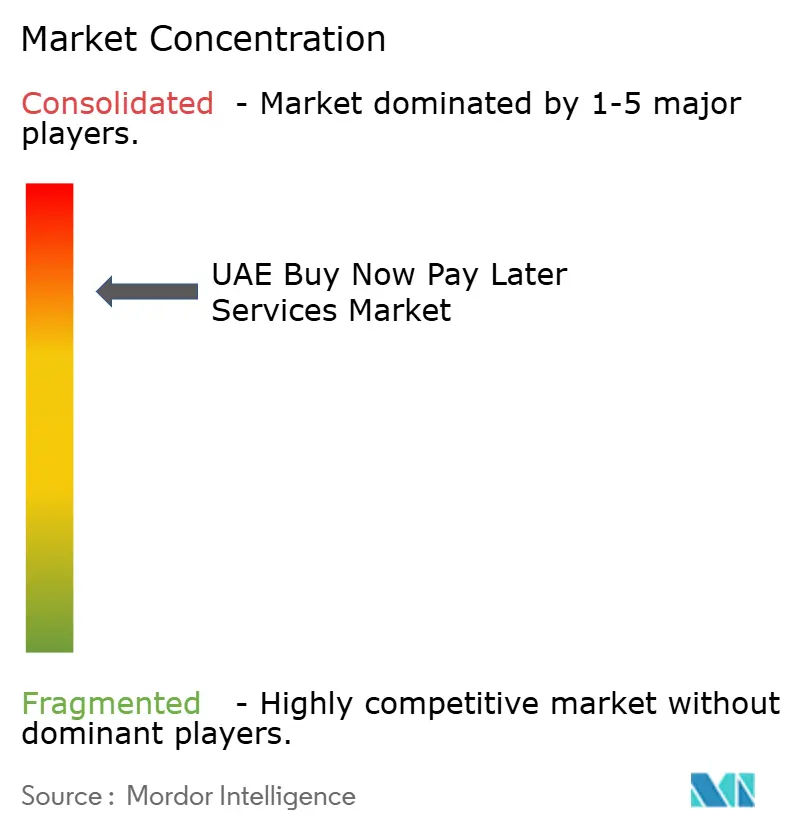
| Market Concentration | High |
Major Players *Disclaimer: Major Players sorted in no particular order Image © Mordor Intelligence. Reuse requires attribution under CC BY 4.0. | |
UAE Buy Now Pay Later Services Market Analysis by Mordor Intelligence
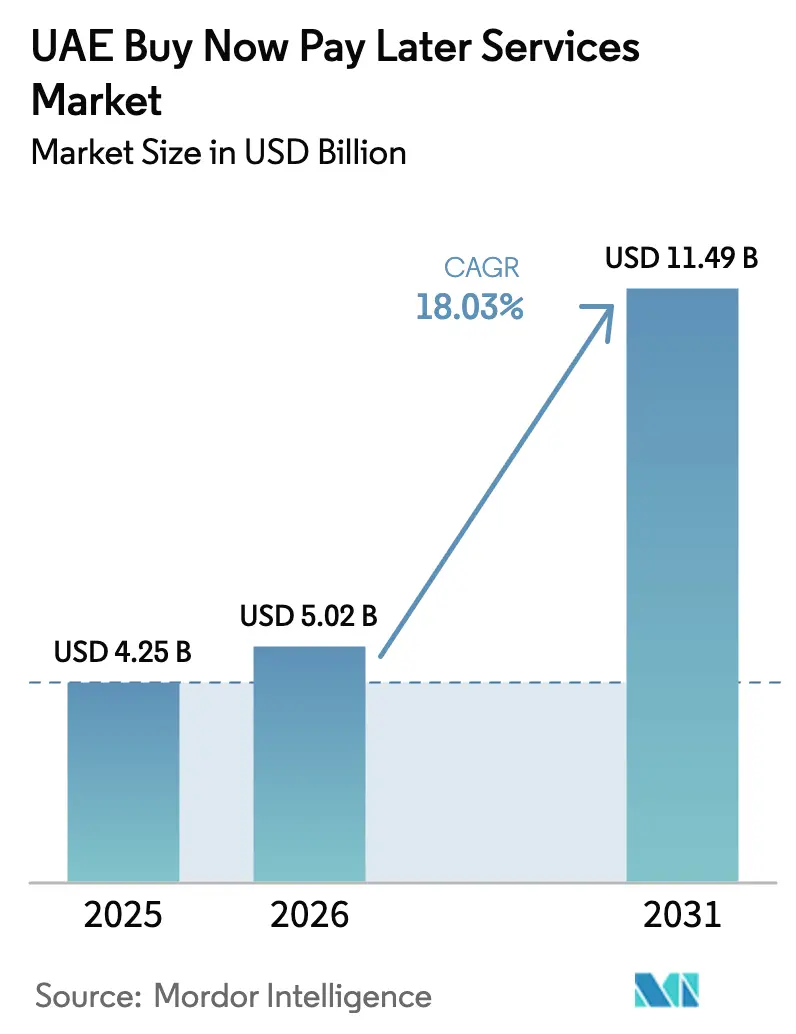
The UAE BNPL services market size was valued at USD 4.25 billion in 2025 and estimated to grow from USD 5.02 billion in 2026 to reach USD 11.49 billion by 2031, at a CAGR of 18.03% during the forecast period (2026-2031). Growth is fueled by high e-commerce penetration, a youthful digital-native population, and a regulatory framework that lends credibility without stifling innovation. Fintech-bank collaborations, the rise of Sharia-compliant installment plans, and luxury retail demand for friction-free high-ticket payments are amplifying adoption across both online and in-store environments. Providers are harnessing data analytics to refine risk scoring, while cross-border shopping from GCC neighbors enlarges the addressable customer base. Competitive intensity remains moderate; however, heightened capital requirements for non-bank lenders and merchant pushback on fees could temper the pace of expansion.
Key Report Takeaways
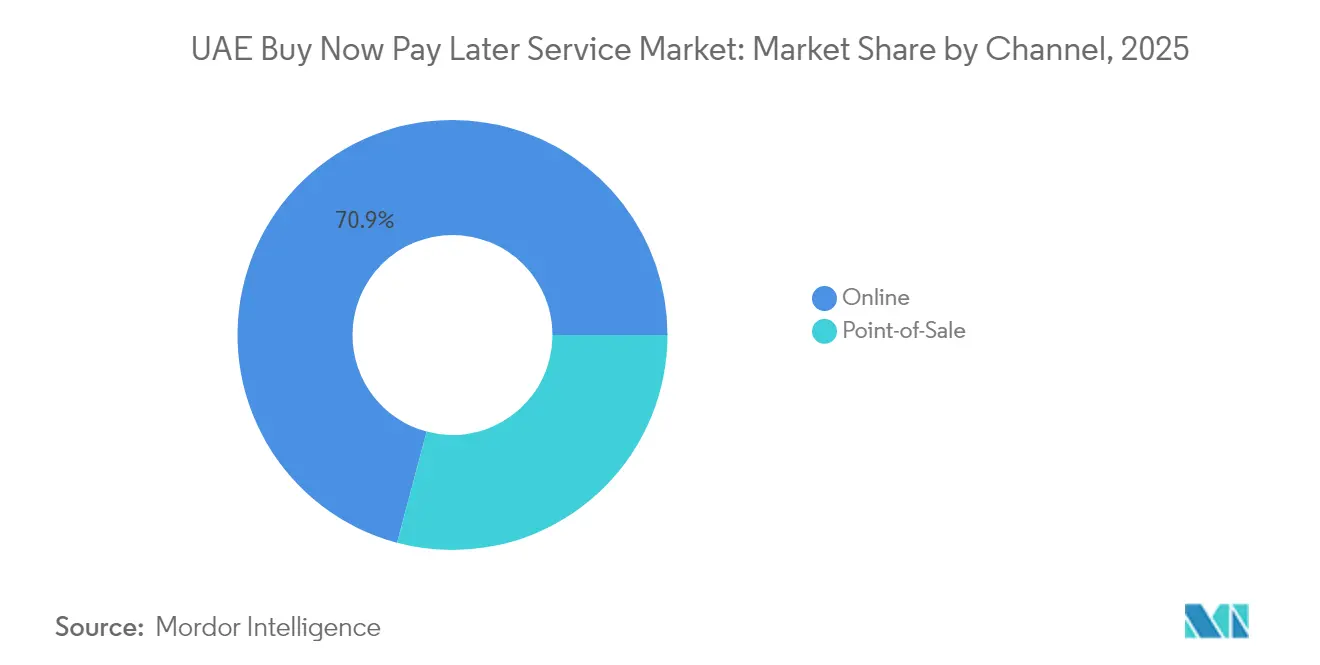
- By channel, the online segment led with 70.85% share of the UAE BNPL services market in 2025, while point-of-sale BNPL is forecasted to expand at a 20.18% CAGR through 2031.
- By end-use industry, consumer electronics accounted for 32.10% share of the UAE BNPL services market size in 2025; healthcare & wellness is projected to grow at 22.35% CAGR during 2026-2031.
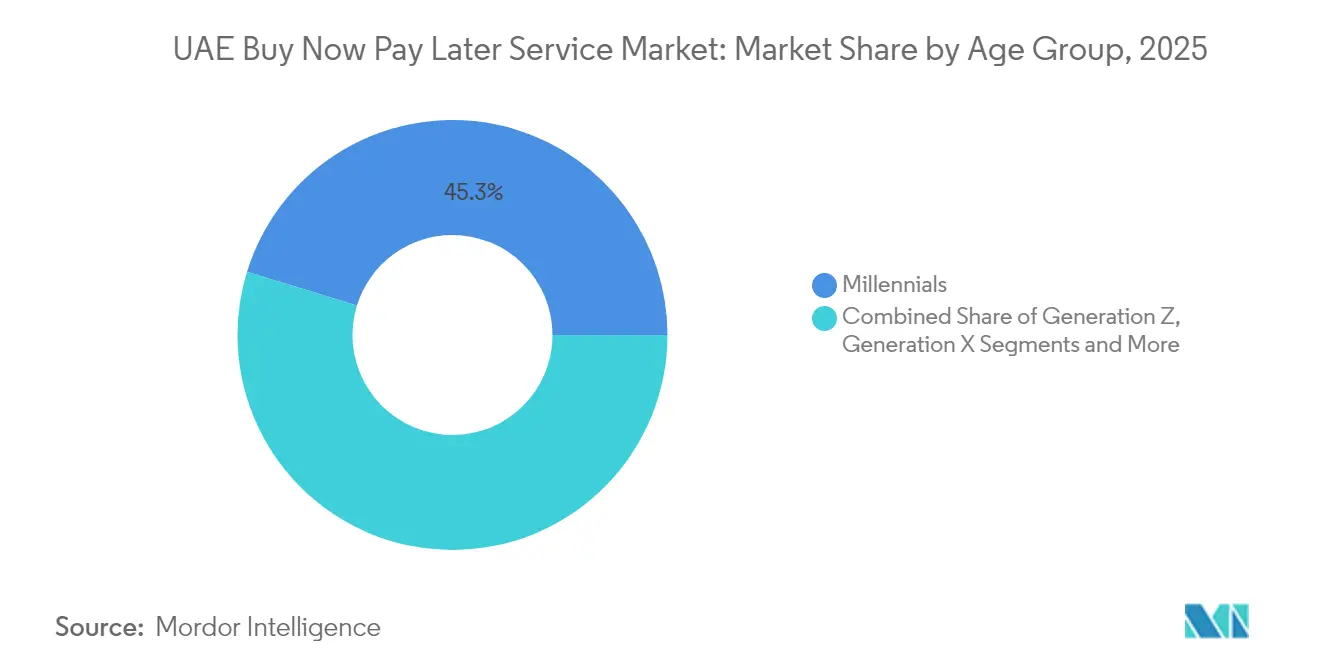
- By age group, millennials captured 45.25% share of the UAE BNPL services market in 2025, whereas Generation Z usage is set to rise at a 21.05% CAGR through 2031.
- By provider type, fintechs controlled 66.85% of the UAE BNPL services market in 2025, yet bank-led offerings are projected to advance at a 20.55% CAGR over the forecast horizon.
Note: Market size and forecast figures in this report are generated using Mordor Intelligence’s proprietary estimation framework, updated with the latest available data and insights as of 2026.
UAE Buy Now Pay Later Services Market Trends and Insights
Drivers Impact Analysis*
| Driver | (~) % Impact on CAGR Forecast | Geographic Relevance | Impact Timeline |
|---|---|---|---|
| Accelerated e-commerce growth among Gen Z & Millennials | +4.20% | Dubai, Abu Dhabi | Short term (≤ 2 years) |
| Retail-bank BNPL API integrations | +3.80% | National | Medium term (2-4 years) |
| Sharia-compliant adoption among unbanked expatriates | +5.10% | Dubai, Sharjah | Medium term (2-4 years) |
| POS financing demand from luxury retailers soaring with tourist inflows | +3.5% | Dubai, Abu Dhabi | Short term (≤ 2 years) |
| Cross-border GCC shopping supported by VAT-free re-export hubs | +2.9% | Dubai, with spillover to other emirates | Medium term (2-4 years) |
| Source: Mordor Intelligence | |||
Accelerated e-commerce growth among UAE Gen Z & Millennials
More than half of Gen Z consumers prefer digital payments, and BNPL is emerging as their favored instrument for discretionary and daily shopping. Retailers report BNPL basket sizes that are 30-50% higher than standard card purchases, prompting merchants to embed the option at checkout to boost conversion. Viral social media endorsements have normalized installment payments as a budgeting tool rather than credit substitution. Merchants now design marketing campaigns around “Pay in 4” offers timed to salary cycles, reinforcing a feedback loop of higher spend and repeat usage. As Gen Z’s purchasing power rises, lifetime customer value becomes a crucial metric for providers courting this cohort.
Retail-bank partnerships integrating BNPL APIs into mobile-bank apps
Incumbent banks are embedding BNPL modules directly inside their mobile apps, giving customers seamless access without downloading a separate fintech platform. Emirates NBD’s collaboration with Tabby showcases how bank compliance frameworks and deep data pools can lower default risk while retaining the nimble user experience of a dedicated BNPL specialist[1]Emirates NBD, “Emirates NBD and Tabby Announce Strategic BNPL Partnership,” emiratesnbd.com. Shared analytics improve credit decision accuracy, and instant installment approvals help banks cross-sell deposits and insurance. For fintechs, partnerships unlock vast customer bases at a fraction of their typical acquisition cost. The model is gaining traction across tier-one banks, signaling an era of hybrid BNPL solutions that blend regulated balance-sheet strength with specialized technology.
High adoption of Sharia-compliant installment products among unbanked expatriates
Roughly 88% of UAE residents are expatriates, many of whom are excluded from traditional credit. Sharia-compliant BNPL structures such as Murabaha and Ujrah offer interest-free flexibility that aligns with Islamic principles. Providers emphasizing religious compliance report markedly higher repeat-use rates and lower acquisition costs, as word-of-mouth spreads quickly within expatriate communities[2]Network International, “Annual Report 2025,” network.ae. The cultural resonance of fee-based rather than interest-based repayment unlocks segments such as grocery and utility payments that were previously cash-only. As GCC neighbors pursue similar regulatory clarity, the UAE model is becoming a regional blueprint for faith-aligned digital finance.
POS financing demand from luxury retailers soaring with tourist inflows
Dubai welcomed 17.15 million visitors in 2024, and luxury outlets now offer BNPL at in-store terminals to capture high-value tourist spending[3]Dubai Department of Economy and Tourism, “Dubai Tourism Performance Report 2024,” det.gov.ae. Average transaction values rise by up to 40% when split-pay options remove currency-conversion worries and card-limit constraints. Retailers gather first-party data from BNPL transactions, enabling targeted outreach once tourists return home. Partnerships with luxury brands such as Cartier and Louis Vuitton underline how BNPL has evolved from a mass-market tool to a premium retail necessity. The trend is expected to intensify as Emirates launches marketing campaigns positioning Dubai as the global capital for “luxury on installments.”
Restraints Impact Analysis*
| Restraint | (~) % Impact on CAGR Forecast | Geographic Relevance | Impact Timeline |
|---|---|---|---|
| Capital-adequacy rules for non-bank lenders | -2.70% | National | Medium term (2-4 years) |
| Merchant discontent over BNPL discount rates | -1.90% | Dubai | Short term (≤ 2 years) |
| Increasing defaults in the consumer-electronics vertical post-pandemic | -2.1% | National | Short term (≤ 2 years) |
| Regulatory Constraints on Interchange Fees for Installment Payment Schemes | -1.8% | National | Medium term (2-4 years) |
| Source: Mordor Intelligence | |||
Rising Central Bank capital-adequacy requirements for non-bank lenders
Revised regulations effective December 2023 compel BNPL firms to secure a Restricted License Finance Company status or partner with licensed institutions, tying up more capital in reserves[4]Central Bank of the UAE, “Short-Term Credit Regulations 2024,” cbuae.gov.ae. Stand-alone fintechs face higher compliance costs that can divert funds from product innovation. Smaller providers may seek buyouts, accelerating consolidation and raising entry barriers for new entrants. While enhanced solvency protects consumers, it reduces competitive diversity and could slow the pace at which niche BNPL use-cases reach the market. Larger banks with ample capital buffers stand to benefit as regulatory demands tilt the playing field in their favor.
Increasing merchant discontent with BNPL discount rates exceeding card fees
Typical BNPL merchant discount rates range from 3-7%, double the standard card fee. Electronics retailers with razor-thin margins have begun passing on BNPL surcharges to consumers or restricting availability to premium product lines. Merchant friction threatens BNPL penetration in categories where price sensitivity overrides the convenience premium. Providers experimenting with tiered fee models risk eroding profitability, especially if forthcoming interchange-fee caps further compress unit economics. Sustaining merchant enthusiasm may depend on demonstrable uplifts in basket size and conversion that offset higher acceptance costs.
*Our forecasts treat driver/restraint impacts as directional, not additive. The impact forecasts reflect baseline growth, mix effects, and variable interactions.
Segment Analysis
By Channel: Online Dominance Meets In-Store Resurgence
The online channel captured 70.85% of the UAE BNPL services market share in 2025 as frictionless digital checkouts matched the high mobile shopping appetite. E-commerce platforms embedded “Pay in 4” widgets that require minimal integration, propelling rapid uptake. Nonetheless, in-store BNPL is growing faster, with a 20.18% CAGR projected through 2031 due to QR-code and virtual-card innovations that eliminate hardware upgrades. Retailers offering unified online-offline installment experiences see higher loyalty, as consumers research online and complete big-ticket transactions in physical outlets.
Momentum toward a “phygital” ecosystem encourages providers to allocate capital to omnichannel APIs. The UAE BNPL services market size for in-store transactions is forecast to rise steeply as luxury and consumer-durable merchants enable tap-to-pay financing via existing terminals. Providers are testing features that let shoppers start a plan on-site and manage repayments in a mobile app, closing the gap between browsing and buying. As retailers add fulfillment options such as click-and-collect, channel distinctions blur, but the underlying installment logic remains central to customer conversion.


By End-Use Industry: Electronics Lead, Healthcare Accelerates
Consumer electronics dominated with 32.10% of UAE BNPL services market size in 2025, thanks to high average order values and rapid device replacement cycles that fit well with short tenures. Exclusive tie-ups with flagship smartphone and laptop brands ensure steady volume, and trade-in programs further anchor BNPL usage. Fashion and apparel follow, driven by impulse buys and high purchase frequency, though margins limit provider room to negotiate fees.
Healthcare & wellness is the fastest-growing vertical at a 22.35% CAGR to 2031, reflecting rising out-of-pocket costs for elective and cosmetic procedures. Multi-month installment plans extend beyond the typical four-payment structure, producing higher lifetime value per user. Providers form alliances with hospital networks, offering instant approvals through patient portals that bypass lengthy paperwork. This diversification reduces dependency on retail cycles and positions BNPL as an integral component of the UAE’s private-health financing landscape.
By Age Group: Millennials Hold Sway While Gen Z Surges
Millennials secured 45.25% UAE BNPL services market share in 2025, combining stable incomes with digital fluency. Their adoption spans essential and lifestyle spending, from groceries to travel, and average ticket sizes surpass other cohorts. Generation X favors BNPL for specific high-value categories, moderating overall momentum but contributing steady volumes.
Generation Z is the quickest adopter, expected to climb at a 21.05% CAGR through 2031. Mobile-first design, transparent fee structures, and gamified rewards align with Gen Z values. Providers emphasize social-commerce integrations that let users spread payments from within influencer storefronts. As this cohort approaches peak earning years, its share of the UAE BNPL services market size is set to expand, compelling providers to pivot marketing budgets toward student and first-job segments.
By Provider: Fintech First Movers, Bank Fast Followers
Fintechs held 66.85% of transaction volume in 2025, leveraging purpose-built platforms optimized for rapid onboarding and flexible repayment management. Product rollouts—virtual cards, open-loop networks, merchant marketplaces—keep customer engagement high. Yet banks are gaining ground with a forecast 20.55% CAGR, integrating BNPL modules into existing credit infrastructures.
This convergence yields hybrid models where banks handle regulatory risk and balance-sheet funding, while fintechs supply front-end agility. For consumers, the distinction blurs as white-labeled solutions surface within banking apps. Over time, the UAE BNPL services market share held by fintechs may decline modestly as universal banks convert cardholders to in-app split-pay plans, tightening competitive dynamics and nudging pricing toward parity.
Geography Analysis
Dubai generates roughly 60% of national BNPL transaction volume, benefiting from dense luxury retail districts, a thriving fintech sandbox, and a tourist influx that values flexible payment options. The emirate’s malls prominently display BNPL at checkout, and major providers maintain headquarters in Dubai, reinforcing the innovation ecosystem. Regulatory support via the Dubai International Financial Centre’s Innovation Hub accelerates pilot programs, making the city a testbed for installment-payment innovation.
Abu Dhabi ranks second, underpinned by higher average incomes and significant government spending on digital infrastructure. Healthcare and education payments represent a sizable share of BNPL usage here, as affluent households finance elective procedures and private-school fees. Hub71’s start-up environment attracts capital for vertical-specific BNPL platforms targeting the emirate’s distinct demographic profile. Consistent federal guidelines ease compliance, enabling providers to scale offerings seamlessly across both major emirates.
Sharjah, Ajman, and the Northern Emirates contribute smaller volumes but exhibit the fastest user-growth rates. Lower retail saturation allows BNPL providers to lock in exclusive agreements with merchants eager for differentiation. Arabic-first interfaces and explicit Sharia compliance resonate strongly with residents, many of whom are first-time users of formal credit. Smartphone penetration continues to rise, and providers leverage social outreach to build trust, propelling uptake in everyday categories such as groceries and household utilities.
Regulatory Landscape
Buy-now-pay-later (BNPL) offerings in the UAE are governed under the Central Bank of the UAE (CBUAE) framework for Short-Term Credit introduced via the Finance Companies Regulation (Circular No. 3/2023), effective 27 December 2023. Under this regime, BNPL providers must operate as a CBUAE-licensed Restricted Licence Finance Company or partner with a licensed bank or finance company, moving BNPL from a lightly regulated model toward supervised lending and consumer protection.
The framework sets product guardrails that affect underwriting and unit economics. These include a maximum credit limit capped at the lower of AED 20,000 or three months of verified net income, and a total fee cap of 30% of the original credit amount (including late charges and commissions). It also introduces operating requirements such as mandatory credit assessment using credit reports for aggregate limits above AED 5,000, alongside prudential standards including minimum capital (AED 20 million or 5% of outstanding lending volume) and liquidity (liquid assets equal to 10% of aggregate liabilities), which favors well-capitalized providers and bank-fintech partnership models.
Value Chain Analysis
The UAE BNPL value chain starts with capital and risk capacity. Licensed banks and finance companies, including Restricted Licence Finance Companies under the CBUAE Finance Companies Regulation, provide the regulated balance-sheet and compliance perimeter for short-term credit. BNPL platforms then run the core orchestration layer, covering customer onboarding, underwriting and decisioning (including credit bureau integration for qualifying limits), merchant settlement, collections, and consumer servicing across app and in-checkout experiences.
Distribution depends on merchant acquisition and integration rails. E-commerce platform plugins and APIs, together with payment gateways and processors, route BNPL at checkout, while in-store enablement uses QR and virtual cards over existing POS infrastructure. Key enabling services include identity and KYC utilities, fraud and risk analytics, and credit reporting. Merchants and marketplaces remain the primary demand aggregator and pricing counterparty through merchant discount rates. Bottlenecks center on regulatory licensing and ongoing capital and liquidity requirements, and on merchant economics where discount rates can face pushback in thin-margin categories, reinforcing the value of scale partnerships, including bank-embedded BNPL delivered through mobile banking apps.
Competitive Landscape
The UAE BNPL services market is moderately concentrated, with a few key providers collectively handling a significant portion of the volume. Tabby leads with the broadest merchant network and top-of-mind consumer awareness, while Tamara’s rapid GCC expansion strengthens regional scale. Competition centers on approval speed, transaction limits, and loyalty ecosystem perks rather than tenure length, which is fairly standardized across the industry.
Strategic partnerships shape market dynamics. Checkout.com’s integration with Tabby embeds BNPL into a wide merchant base, while Emirates NBD’s alliance with Tabby fuses bank-grade compliance with fintech agility. Consolidation is underway: Spotii’s acquisition by NymCard indicates infrastructure providers’ appetite to fold BNPL into broader payment stacks. Artificial-intelligence-driven credit models using alternative data seek to reduce default rates and defend margins amid forthcoming fee-cap regulations. Providers targeting niche verticals—healthcare, education, and B2B trade—could unlock incremental growth and dilute concentration over time.
Legacy card issuers face cannibalization risk and are piloting “split-pay on existing credit limits” to defend wallet share. Meanwhile, global payment networks explore white-label agreements to overlay installment logic on international rails, potentially intensifying rivalry. Rising capital requirements may push undercapitalized fintechs toward mergers, gradually lifting average provider size and solidifying market structure.
UAE Buy Now Pay Later Services Industry Leaders
Tabby
Tamara
Cashew Payments
Postpay
Spotii (Zip Co)
- *Disclaimer: Major Players sorted in no particular order

Market Opportunities and Future Outlook
Regulatory institutionalization has created a pathway for scaled BNPL players to expand beyond checkout-only installment plans into regulated payment-account and card-linked experiences. A concrete signal is the Central Bank of the UAE granting Tabby Payments LLC a Stored Value Facilities license in April 2026. This supports holding customer funds and enables adjacent products such as spending accounts and card issuance, widening monetization options beyond merchant-funded discounting.
Whitespace is also emerging in higher-ticket and longer-tenure deferred payment use cases that fall outside the traditional four-installment format. In April 2026, Mashreq and Cashew announced an embedded lending framework for higher-value purchases (reported up to AED 150,000 with longer tenures), and Cashew followed with the launch of Hazel positioned around high-value pay-later financing. This shift opens additional end-use pockets, including healthcare, education, insurance, and government-related fee payments where installment utility links to essential services. At the same time, the CBUAE short-term credit rules (fee caps, income-based limits, and credit assessment requirements) increase pressure on providers to strengthen risk scoring, collections performance, and merchant pricing structures.
Recent Industry Developments
- July 2026: Tabby launched Tabby Cash in the UAE as a fee-free spending account offering under its stored value permissions. The initiative extends Tabby from merchant checkout financing into everyday money management, increasing customer engagement beyond point-of-purchase BNPL and supporting card- and account-led distribution.
- March 2025: Checkout.com partnered with Tabby to expand BNPL availability for merchants using Checkout.com in the UAE and Saudi Arabia. This strengthened BNPL distribution through a major payment platform integration, lowering merchant integration friction and widening addressable online checkout volume.
- September 2024: Network International partnered with ruya Bank to enhance Islamic banking capabilities through digital payment technology, including Sharia-compliant BNPL options within the bank ecosystem. The collaboration supported faith-aligned installment structures and reinforced bank-led routes to market for BNPL in the UAE.


Research Methodology Framework and Report Scope
Market Definition and Coverage
For this report, the UAE buy now pay later (BNPL) services market is defined as the total value of consumer purchases in the UAE that are completed using short-term installment plans at checkout, across online and in-store channels, and typically settled within 12 months.
Scope exclusions: We exclude B2B invoice financing and longer-tenor consumer credit products that behave like traditional personal loans.
Segmentation Overview
- By Channel
- Online
- Point-of-Sale (In-store)
- By End-Use Industry
- Consumer Electronics
- Fashion & Apparel
- Healthcare & Wellness
- Home Improvement
- Travel & Leisure
- Media & Entertainment
- Other End-Use Industries
- By Age Group
- Generation Z (18-28 Years)
- Millennials (29-44 Years)
- Generation X (45-60 Years)
- Baby Boomers (61-79 Years)
- Silent Generation (80 Years and Above)
- By Provider
- Fintechs
- Banks
- Others
Data Sources, Market Sizing, and Validation
Desk Research
We started with desk research to set the UAE payments context and to avoid over-counting similar products. Public sources such as the UAE Central Bank publications, UAE Federal Competitiveness and Statistics Centre releases, the Telecommunications and Digital Government Regulatory Authority updates, and World Bank and IMF macro series were used to anchor population, income, card usage, and digital commerce signals.
Next, we reviewed BNPL-relevant policy notes, payment licensing cues, and consumer credit discussions available in official statements, along with merchant and payment ecosystem commentary from reputable press. Company annual reports, investor decks, and news disclosures helped map typical fee structures, installment tenors, and merchant category focus, and then a paid subscription for company financials and news intelligence was used to cross-check timelines and major partnerships. The sources listed here are illustrative rather than exhaustive, and many other references were used to collect data, validate assumptions, and clarify open questions during the study.
Primary Interviews and Surveys
Primary interviews and surveys were used to validate the demand pool and the way BNPL is actually deployed at checkout across the UAE. We spoke with BNPL operators, banks and payment intermediaries, large and mid-sized merchants, and logistics and e-commerce ecosystem participants so that assumptions on approval rates, average ticket sizes, repeat use, and offline penetration could be tightened.
Because this is a UAE-specific market, discussions were tuned to local regulatory expectations, merchant onboarding realities, and consumer repayment behavior that do not always show up clearly in public datasets.
Distribution of primary research fieldwork respondents
| Company type | Respondent position |
|---|---|
| Top tier: 28% | CXOs: 12% |
| Mid tier: 53% | Functional/Unit leaders: 37% |
| Smaller Players: 19% | Managers: 51% |
Market-Sizing & Forecasting
Sizing was built using a top-down and bottom-up approach, with the core logic starting from UAE consumer purchase activity that is addressable for short-term installments and then narrowing it using BNPL adoption and usage patterns. In practice, we reconstructed the demand pool by combining e-commerce and in-store card spend direction, the share of merchants offering BNPL at checkout, and the share of eligible consumers who choose installments.
To keep the model realistic, a small set of market fingerprints was tracked and updated, including average order value in BNPL-heavy categories, typical installment tenors (for example, pay-in-3 and pay-in-4), approval and conversion behavior at checkout, delinquency and late fee sensitivity, and the share of transactions happening in-store versus online. These inputs were then tested using selective bottom-up approximations such as sampled merchant volume checks and a simple ticket size times transactions build for a few major merchant clusters, which helped us spot gaps where public data was silent.
Forecasts were developed using scenario analysis supported by trend smoothing on the key drivers, and then adjusted based on what industry participants expected for merchant onboarding pace, regulatory tightening, and consumer credit comfort. Where direct observations were missing, assumptions were filled using conservative ranges agreed during interviews, and the impact was checked so no single variable could swing the total unrealistically.
Data Validation & Update Cycle
Validation was done through repeated cross-checks across independent signals, and then tightened through follow-up calls when numbers did not reconcile. Our analysts compared the model outputs with observable indicators such as UAE digital payment growth, e-commerce expansion direction, consumer credit indicators, and reported merchant partnership momentum, and then investigated outliers before sign-off.
A multi-step internal review was followed so that assumptions, arithmetic, and logic were checked by more than one analyst. Reports are refreshed annually, and interim updates are made when material events occur such as new regulation, major bank partnerships, or a clear shift in consumer repayment behavior. Before delivery, a final pass is completed to ensure the latest public releases and meaningful news developments are reflected in the outputs.
Mordor Intelligence's UAE Buy Now Pay Later Service Market Size Measured Against Other Published Estimates
Published BNPL market values for the UAE can look far apart because the unit of measurement is not always the same, and because some studies treat BNPL as a revenue pool, and others treat it as a transaction value pool. Differences also come from how online and offline checkout are counted, how short-term installments are separated from longer consumer credit, and how aggressively growth assumptions are applied.
Some external estimates narrow the scope to provider revenue or to a limited set of merchant categories, which naturally produces smaller totals. For Mordor Intelligence, the market is counted as BNPL GMV for UAE consumer purchases that are split into short-term installments at checkout (online and in-store), and B2B invoice financing is kept outside scope to prevent mixing with trade credit.
Benchmark comparison
| Source | Market Size | Gaps in Research Methodology |
|---|---|---|
| Mordor Intelligence | USD 4.25 B (2025) | |
| Global Consultancy A | USD 1.17 B (2025) | Uses a narrower counted value that aligns more closely with attributed BNPL program volumes, and may exclude parts of offline checkout and some merchant-led installment offers, which reduces the implied GMV total. |
| Advisory Firm B | USD 2.84 B (2025) | Applies a tighter eligible merchant and user base and can treat BNPL as a tracked payment-method subset, which may not fully capture broader merchant rollout and repeat-use behavior across categories. |
The spread is mainly explained by what each publisher treats as the measured value and which checkout use cases are included. By tying the market total to observable adoption, ticket size, and channel mix inputs, and then re-checking assumptions through primary discussions before final sign-off, we keep the sizing steps repeatable and easy to audit.


Key Questions Answered in the Report
What is the current size of the UAE BNPL services market?
The UAE BNPL services market is valued at USD 5.02 billion in 2026 and is projected to reach USD 11.49 billion by 2031.
Which industry segment uses BNPL the most in the UAE?
Consumer electronics leads, capturing 32.10% of 2025 transaction value, driven by high average ticket sizes and rapid device replacement cycles.
How fast is point-of-sale BNPL growing compared with online BNPL?
In-store BNPL is forecast to expand at a 20.18% CAGR during 2026-2031, outpacing growth in the already-dominant online channel.
Why are Sharia-compliant BNPL products important in the UAE?
They appeal to the country’s large expatriate and Muslim populations by avoiding interest charges, thereby boosting adoption and customer loyalty.
Which age group is the fastest-growing BNPL user segment?
Generation Z users are expected to grow usage at a 21.05% CAGR through 2031, reflecting their digital-native habits and preference for transparent payment plans.
Page last updated on:


 Your data is secure and never sold or shared.


