
UAE Architectural Paints And Coatings Market Size and Share
Market Overview
| Study Period | 2020 - 2031 |
|---|---|
| Forecast Data Period | 2026 - 2031 |
| Base Year Market Size (2025) | USD 623.34 Million |
| Market Size (2026) | USD 644.6 Million |
| Market Size (2031) | USD 762.18 Million |
| Growth Rate (2026 - 2031) | 3.41 % |
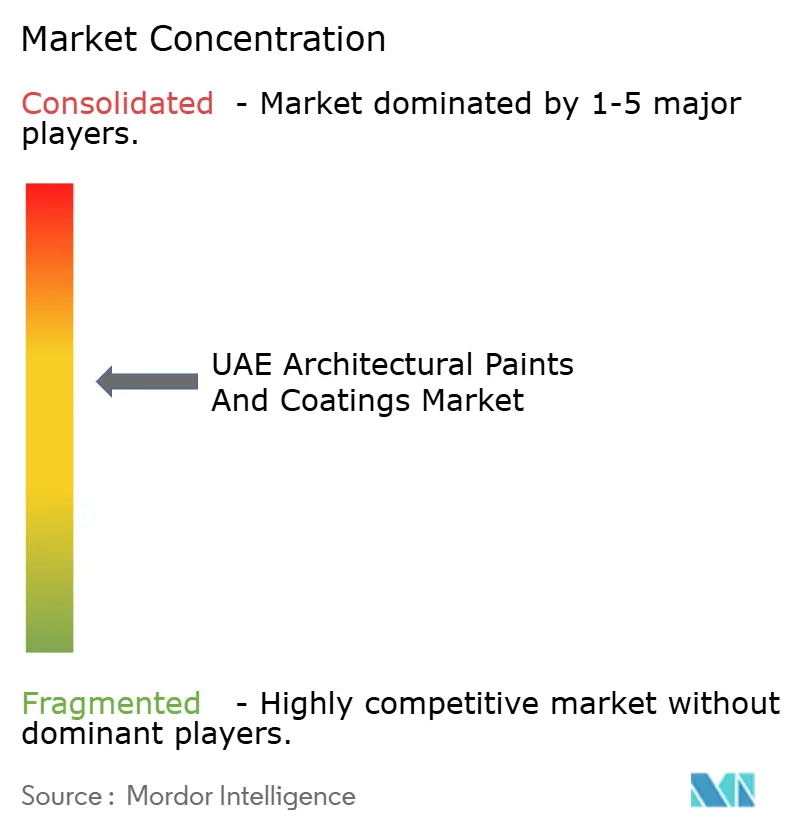
| Market Concentration | Medium |
Major Players *Disclaimer: Major Players sorted in no particular order Image © Mordor Intelligence. Reuse requires attribution under CC BY 4.0. | |
UAE Architectural Paints And Coatings Market Analysis by Mordor Intelligence
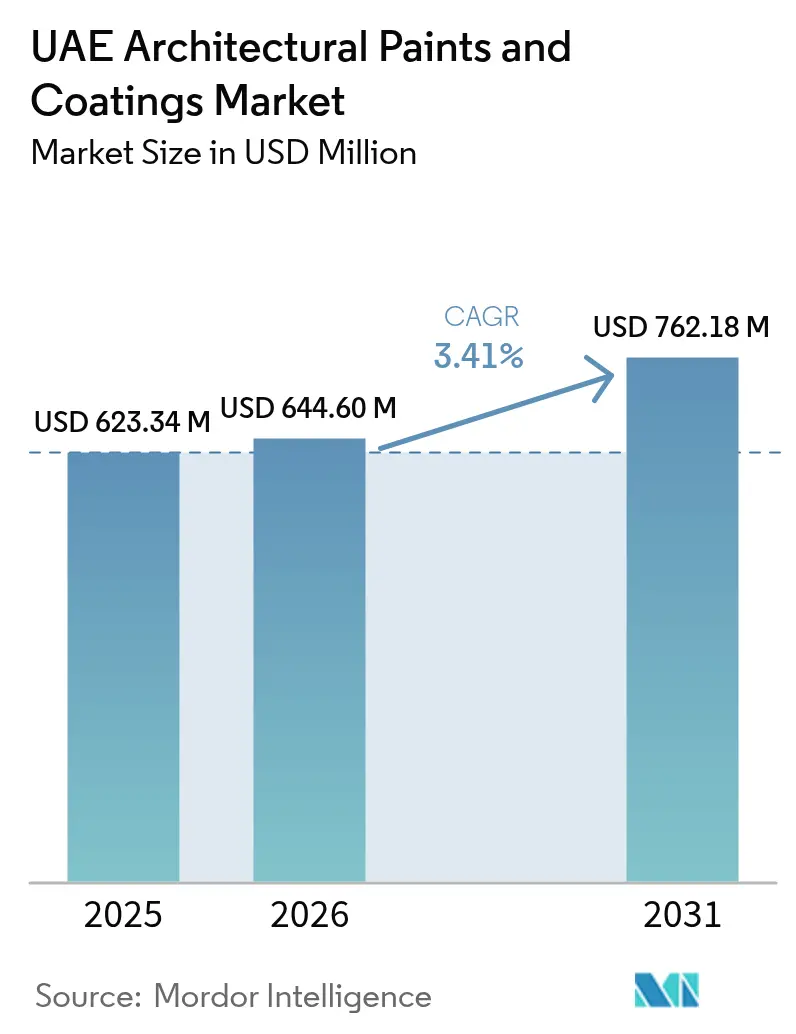
The UAE Architectural Paints and Coatings Market size is expected to grow from USD 623.34 million in 2025 to USD 644.6 million in 2026 and is forecast to reach USD 762.18 million by 2031 at 3.41% CAGR over 2026-2031. This moderated growth pace mirrors a maturing construction sector that now favors premium, compliance-ready formulations over commodity products. Architectural demand remains anchored in Dubai’s mixed-use and residential pipeline, while Abu Dhabi’s retrofit agenda sustains protective and specialty demand despite cyclical slowdowns in new government awards. Waterborne technology continues to expand on the back of stringent indoor-air-quality rules, and acrylic resins dominate due to their UV resistance and alignment with emirate-level VOC limits. Competitive intensity is shifting away from price toward regulatory compliance, local testing infrastructure, and technical service capabilities, giving established regional manufacturers and multinational incumbents a structural advantage.
Key Report Takeaways
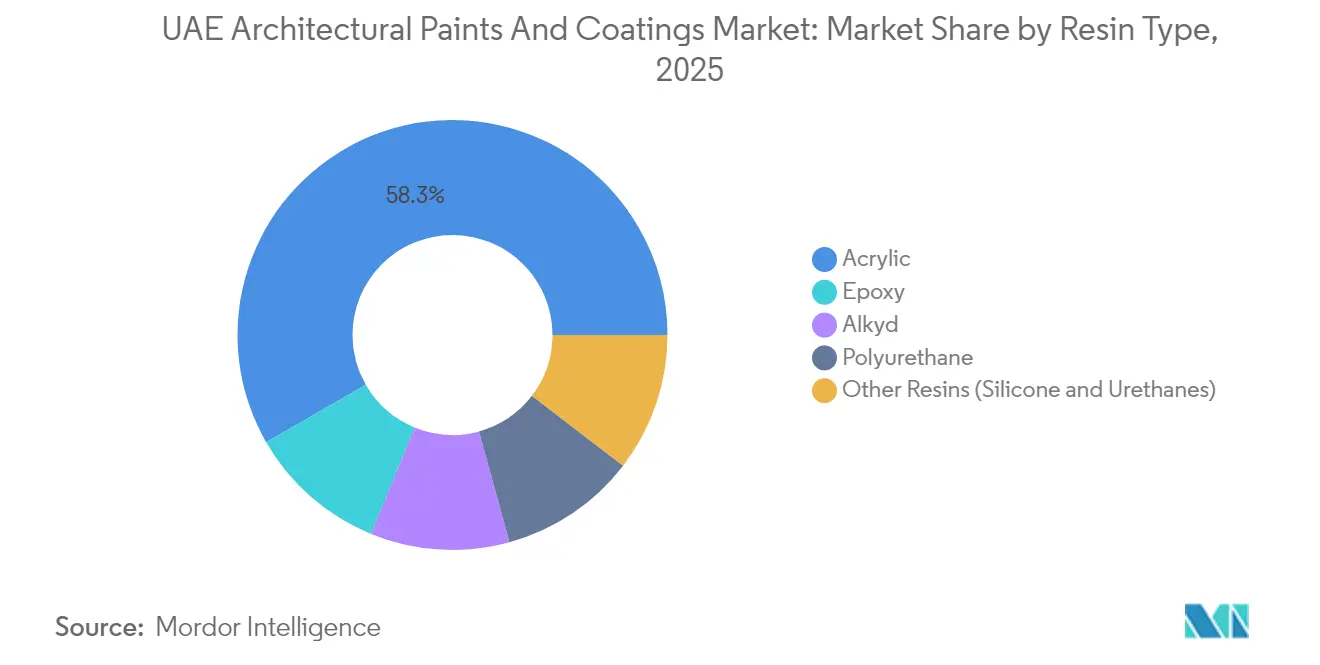
- By resin type, acrylics captured 58.31% of the UAE paints and coatings market share in 2025. Moreover, the share of acrylics is expected to increase with a CAGR of 3.78% during the forecast period (2026-2031).
- By technology, waterborne systems accounted for 71.55% of the UAE paints and coatings market size in 2025 and are projected to grow at a 4.02% CAGR through 2031.
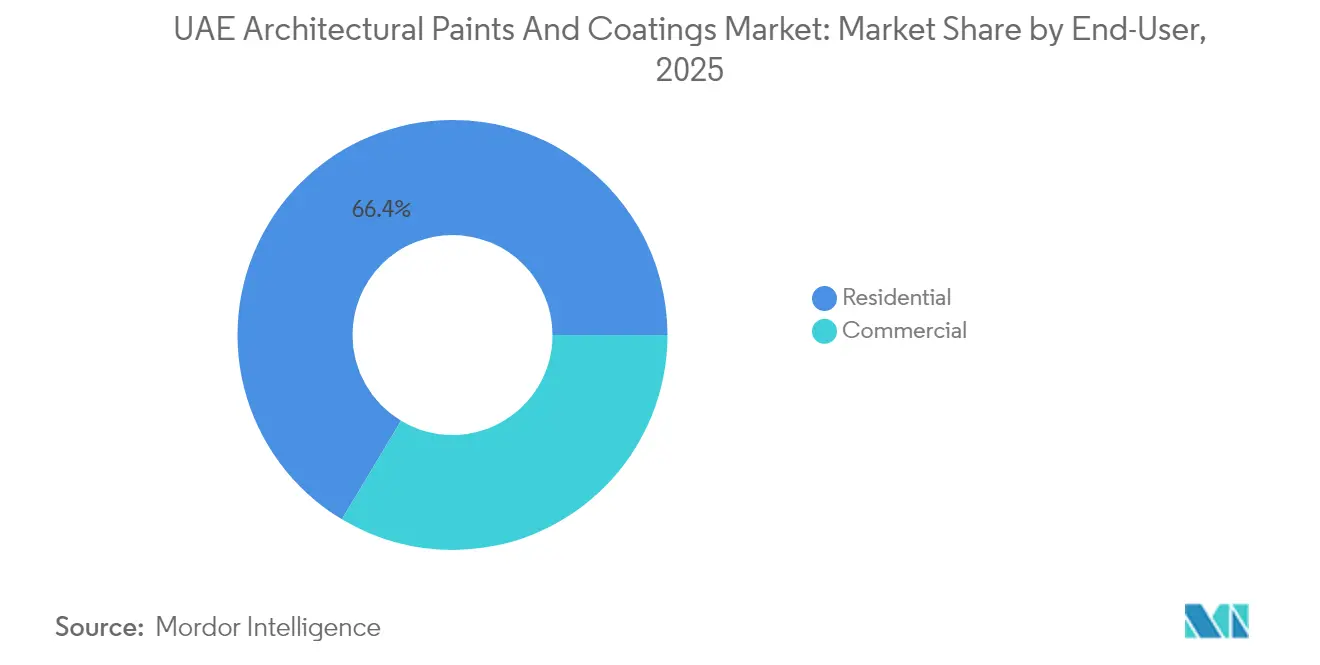
- By end-user, the residential segment led with a 66.40% revenue share of the UAE paints and coatings market size in 2025, while commercial applications are expected to advance at a 3.71% CAGR to 2031.
Note: Market size and forecast figures in this report are generated using Mordor Intelligence’s proprietary estimation framework, updated with the latest available data and insights as of 2026.
UAE Architectural Paints And Coatings Market Trends and Insights
Drivers Impact Analysis*
| Driver | (~) % Impact on CAGR Forecast | Geographic Relevance | Impact Timeline |
|---|---|---|---|
| Residential construction boom in Dubai and Northern Emirates | +1.2% | Dubai, Sharjah, Ajman, Ras Al Khaimah | Medium term (2-4 years) |
| Tourism-led demand for hospitality refurbishments | +0.8% | Dubai, Abu Dhabi coastal areas | Short term (≤ 2 years) |
| Mandatory green-building codes driving low-VOC paints | +0.9% | UAE-wide, strongest in Dubai and Abu Dhabi | Long term (≥ 4 years) |
| Smart-city initiatives fuelling demand for heat-reflective coatings | +0.4% | Dubai, Abu Dhabi urban cores | Medium term (2-4 years) |
| Rise of design-build contracts accelerating specification of premium finishes | +0.6% | UAE-wide, concentrated in major projects | Short term (≤ 2 years) |
| Source: Mordor Intelligence | |||
Residential Construction Boom in Dubai and Northern Emirates
Dubai handed over 10,000 housing units in Q1 2024, with an additional 25,000 units slated by year-end, pushing the emirate’s stock toward 754,000 units[1]. Similar momentum in Sharjah, Ajman, and Ras Al Khaimah stems from affordability programs and population-growth incentives that sustain multisegment demand for interior and exterior finishes. Consistent handover schedules foster predictable coating procurement cycles, favoring suppliers with robust regional distribution. Rising indoor-air-quality testing requirements are steering developers toward water-borne acrylics, reinforcing the segment’s dominance within the UAE paints and coatings market. Turner & Townsend projects a tender-price inflation rate of 3.3% for 2025, supporting the uptake of premium specifications despite material-cost pressures.
Tourism-Led Demand for Hospitality Refurbishments
Dubai added 5,000 hotel keys in 2024, primarily in the five-star category, while Abu Dhabi added 500 keys, intensifying refurbishment cycles that require rapid-cure interior coatings and marine-grade exterior systems. International brands are mandating low-emission certifications, which in turn elevates demand for waterborne and specialty finishes. Caparol’s 35% year-over-year regional sales surge in 2024, driven by projects such as Rove Hotels and Six Senses The Palm, illustrates how premium, compliance-ready paints gain market traction.
Mandatory Green-Building Codes Driving Low-VOC Paints
Dubai’s Al Sa’fat system caps VOC content at 30 g/L for interior matt finishes, while Abu Dhabi’s Trustmark demands ISO 9001 compliance and bans heavy metals, effectively elevating entry barriers. Federal convergence is underway under the UAE National Air Quality Agenda 2031, signaling tighter future ceilings and reinforcing a shift toward water-borne formulations. Field studies report that oil-based coatings emit 30-times higher TVOC levels than water-based alternatives in UAE climates, strengthening the regulatory case for aqueous systems.
Smart-City Initiatives Fuelling Demand for Heat-Reflective Coatings
Abu Dhabi’s retrofit program has upgraded 8,000 buildings toward a 2030 target of 30,000, with cool roofs delivering 3.85% energy savings. Meanwhile, Dubai’s pilot pavements underscore the municipality's interest in reflective surfaces. The Dubai Building Code 2021 establishes Solar Reflectance Index thresholds that encourage developers to adopt high-performance reflective coatings. As the UAE targets net-zero emissions by 2050, thermally efficient paints move from an optional upgrade to a baseline material within the UAE paints and coatings market.
Restraints Impact Analysis*
| Restraint | (~) % Impact on CAGR Forecast | Geographic Relevance | Impact Timeline |
|---|---|---|---|
| Stricter VOC and isocyanate limits | -0.7% | UAE-wide, chiefly Dubai and Abu Dhabi | Medium term (2-4 years) |
| Volatile titanium-dioxide prices | -0.9% | UAE-wide | Short term (≤ 2 years) |
| Cyclical slowdown in Abu Dhabi awards | -0.5% | Abu Dhabi and spillover emirates | Short term (≤ 2 years) |
| Source: Mordor Intelligence | |||
Stricter VOC and Isocyanate Limits Increasing Compliance Costs
Federal Law No. 33/2021 mandates robust hazardous-substance controls, while Dubai requires EC Directive-aligned VOC caps and bans certain biocides, raising formulation, testing, and certification costs[2]. Annual surveillance testing and Dubai Central Laboratory audits can exceed AED 15,000 per product line, disproportionately impacting SMEs. As emirate-level rules converge under a federal framework, additional reformulation cycles loom, trimming margins for solvent-borne players within the UAE paints and coatings market.
Volatile Titanium-Dioxide Prices Squeezing Margins
TiO₂ price swings persisted through 2024 amid global supply disruptions, while freight costs more than doubled year-over-year, eroding profitability for UAE manufacturers that depend on imported pigments. Raw materials already account for roughly 60% of baseline construction costs, and fixed-price contract commitments limit the pass-through capacity. The concentration of global TiO₂ suppliers forces local producers to carry high inventories to ensure continuity, inflating working-capital requirements.
*Our forecasts treat driver/restraint impacts as directional, not additive. The impact forecasts reflect baseline growth, mix effects, and variable interactions.
Segment Analysis
By Resin Type: Acrylic Resins Sustain Leadership
Acrylic resins held a 58.31% share of the UAE paints and coatings market in 2025, driven by their superior UV resistance, rapid cure, and compliance with Dubai’s VOC thresholds of 30–100 g/L for interior work. The segment is projected to track a 3.78% CAGR to 2031, outpacing the overall UAE paints and coatings market. Alkyds remain relevant for exterior durability, while epoxies gain traction in Abu Dhabi’s industrial corridors where chemical resistance supersedes VOC concerns. National Paints expanded its acrylic lineup in 2024 with the introduction of the National Shield Travertine and Touchstone ranges, and the company published an Environmental Product Declaration for powder coatings, signaling a sector-wide emphasis on lifecycle transparency.
Premium acrylic systems also dominate high-rise façade refurbishments, where severe salt-spray exposure and temperature cycling are present. Silicone-modified variants and specialty urethanes retain niche status for coastal landmarks, but premium pricing limits penetration. Strategic investments in R&D by regional players such as Caparol and Asian Paints reinforce acrylic optimization for local climatic stresses, ensuring the resin’s continued leadership within the UAE paints and coatings market.

By Technology: Water-Borne Systems Accelerate on Compliance
Water-borne technology accounted for 71.55% of the UAE paints and coatings market in 2025 and is forecast to grow at a 4.02% CAGR through 2031. Interior projects favor these formulations to meet indoor-air-quality targets of ≤ 300 µg/m³ TVOCs and ≤ 0.08 ppm formaldehyde. A landmark residential study confirmed that water-borne paints release 30 times fewer emissions than oil-based analogs in local climates, cementing their dominance.
Beyond compliance, water-borne systems enable faster re-coat cycles, lower worker safety risks, and simplified waste treatment processes, aligning with federal HSE laws. Caparol’s solvent-free range, launched in 2024, contributed significantly to its 35% surge in Middle East sales. Solvent-borne coatings persist in niche exterior and industrial situations where Dubai permits up to 430 g/L VOC, but the trajectory remains downward as the UAE paints and coatings market moves toward consolidated emission ceilings by 2031.
By End User: Commercial Segment Outpaces Residential Growth
Residential demand accounted for 66.40% of the UAE paints and coatings market size in 2025, underpinned by the consistent delivery of approximately 35,000 housing units per year across Dubai and Abu Dhabi. Yet, commercial activity is growing at a faster rate, with a 3.71% CAGR through 2031, buoyed by hospitality refurbishments, office pipeline additions, and smart-city retrofits. Abu Dhabi’s plan to retrofit 30,000 buildings by 2030 is already 26% complete, driving sustained uptake of reflective and energy-saving coatings.
Five-star hotel upgrades in Dubai demand odor-free, quick-turnaround interior finishes and marine-grade exteriors, while office developers specify low-VOC systems to achieve WELL and LEED ratings. Smart-city requirements for Solar Reflectance Index compliance further expand demand for functional coatings within the UAE paints and coatings market. Suppliers offering bundled product-and-service models, including application training and performance warranties, are poised to capture incremental share from this value-rich segment.
Geography Analysis
Dubai and Abu Dhabi jointly account for most of the awarded contract value since 2020, cementing their status as prime demand centers in the UAE paints and coatings market. Dubai supports architectural demand through a USD 232 billion mixed-use pipeline and USD 125 billion residential backlog, while population targets of 5.8 million by 2040 expand long-term housing requirements. Abu Dhabi complements industrial and petrochemical projects, including ADNOC expansions, which sustain demand for protective and marine coatings even during periods of public spending pauses.
The Northern Emirates—comprising Sharjah, Ajman, and Ras Al Khaimah—are emerging as cost-sensitive yet high-volume zones. Sharjah’s manufacturing base hosts National Paints’ flagship facility and Jotun’s expanding retail network, ensuring close supply for regional contractors. Affordable housing drives, paired with incentives such as long-term visas, maintain a steady residential flow that bolsters baseline decorative volumes across the UAE paints and coatings market.
Fujairah and Umm Al Quwain are positioning themselves as manufacturing nodes. Dubai Industrial City’s 97% occupancy and recent AED 410 million land expansion confirm policy-led localization, reducing import reliance and enhancing supply-chain resilience throughout the UAE paints and coatings market.
Regulatory Landscape
Architectural paints and coatings sold into the UAE construction market sit under the federal UAE Conformity Assessment System (ECAS) administered by the Ministry of Industry and Advanced Technology (MoIAT), with paints and varnishes covered by UAE technical regulations (including Cabinet Resolution No. 6 of 2016) requiring safety, environmental, and performance conformity. A notable recent update is MoIAT's 9 April 2025 action to refresh 12 national conformity marks and efficiency labels, including the Environmental Performance Label for Paints and Varnishes, which reinforces the need for current labeling, documentation, and valid Certificates of Conformity for regulated lines.
At the emirate level, Dubai Municipality enforces Dubai Green Building Regulations and related product acceptance routes via the Dubai Central Laboratory Department (DCLD-CQPS), where conformity can include factory assessment and certification pathways used in project submittals. In Abu Dhabi, the Quality and Conformity Council (QCC) operates technical approval schemes for construction and infrastructure materials (for example, QCC-PCS-ASP045.02 referenced for technical approvals), creating a parallel layer of project-based verification alongside federal MoIAT requirements and pushing suppliers to maintain compliant test reports and quality systems aligned with ISO management standards used in tender qualification.
Value Chain Analysis
The UAE architectural paints and coatings value chain starts with imported and regional feedstocks (notably pigments and additives) moving into local blending and manufacturing, where producers tune formulations to meet emirate-level green-building requirements and federal ECAS conformity needs. Compliance steps are embedded early in the chain, with MoIAT conformity certification for regulated products and Dubai Municipality-related green building controls influencing resin selection (including water-borne and low-emission systems) and shaping the pace of reformulation, testing, and documentation.
Midstream, local manufacturing and finishing capabilities (including automated mixing and color-matching systems used for project-specific shades) connect to a mixed go-to-market model, combining direct-to-project supply for contractors and developers with retail distribution for maintenance and repaint cycles. Downstream, approval and submittal workflows (Dubai Central Laboratory pathways and Abu Dhabi QCC technical approval for specified projects) shape procurement, favoring suppliers that can provide compliant product dossiers, verified test reports, and application support networks to meet fast-turn refurbishment schedules in residential and hospitality assets.
Competitive Landscape
The UAE architectural paints and coatings market is moderately consolidated, with multinational giants and large regional firms sharing the field. Compliance capability and local test infrastructure outweigh mere pricing in bid evaluations, given Dubai Central Laboratory and Abu Dhabi Trustmark mandates. AkzoNobel leverages partnerships with the Kanoo Group to navigate the complexities of distribution and regulation. National Paints counters with a broad acrylic catalog and published EPDs, reinforcing sustainability credentials, while Caparol differentiates through solvent-free innovations and a robust technical-service network.
UAE Architectural Paints And Coatings Industry Leaders
-
Jotun
-
Hempel A/S
-
Caparol Paints
-
AkzoNobel N.V.
-
NATIONAL PAINTS FACTORIES CO. LTD.
- *Disclaimer: Major Players sorted in no particular order
Market Opportunities and Future Outlook
Regulation-led specification uplift is creating whitespace for compliance-ready, documented low-VOC architectural systems in Dubai and Abu Dhabi. Dubai Municipality's green building framework (including Al Saafat) hardwires sustainability into permitting and material selection, increasing the value of verified VOC data and third-party acceptance in project submittals. That shift supports manufacturers that can offer certified water-borne portfolios, stable shade control, and project documentation that fits municipal review practices.
Capacity localization and faster service models are also being reinforced through new investments in the construction supply chain. In January 2026, Jotun Abu Dhabi signed a 50-year land lease with KEZAD Group for an 83,177-square-meter manufacturing facility in ICAD-KEZAD Musaffah backed by an AED 450 million investment, signaling that major suppliers are building local production depth to reduce lead times and support large project pipelines and repaint cycles. This expansion raises competitive pressure for smaller players, while also widening opportunities for contract applicators, tinting and retail concepts, and suppliers of compliant raw materials and testing services that align with the tightened approval environment.
Recent Industry Developments
- July 2026: Hempel A/S announced a strategic partnership agreement with Mabani. The move broadens Hempel's regional collaboration footprint and can improve route-to-market access for coatings specified into large building programs that rely on qualified supplier networks.
- December 2025: Jotun Abu Dhabi announced a plan to invest AED 400 million in a new manufacturing facility at ICAD-III, Abu Dhabi, targeting a 50% output lift to nearly 60 million liters per year. The expansion plan supports shorter fulfillment cycles for contractors and reinforces the trend toward localized production capacity in the UAE.
- May 2024: Jotun reported reaching a milestone of 100 million liters of production in the UAE. The scale milestone underscores the importance of established local manufacturing and supply continuity for servicing high-volume decorative demand and large repaint programs.
Research Methodology Framework and Report Scope
Market Definition and Coverage
For this study, the market means paints and coatings applied on building surfaces in the UAE for protection and appearance, covering both residential and commercial buildings. We account for new construction applications as well as repainting activity during occupancy.
Scope exclusions: We exclude industrial, marine, automotive, and other non-building protective coatings that are not specified for architectural end use.
Segmentation Overview
- By Resin Type
- Acrylic
- Alkyd
- Polyurethane
- Epoxy
- Other Resins (Silicone, Urethanes)
- By Technology
- Water-borne
- Solvent-borne
- By End-User
- Residential
- Commercial
Data Sources, Market Sizing, and Validation
Desk Research
Desk work started with the UAE construction and housing demand pool, because architectural paint demand follows new supply and renovation cycles. We reviewed public statistics and releases such as UAE Federal Competitiveness and Statistics Centre datasets, Dubai Statistics Center publications, and UAE customs trade summaries for paint and coating categories, then checked signals from local building permit and project updates where available.
To keep assumptions grounded, we also used general sources such as company annual reports, investor presentations, association websites, and coverage from reputed business press for capacity, pricing movement, and product mix shifts (for example, water-borne adoption). Paid subscriptions that aggregate company financials, news, and patent activity were used selectively to cross-check revenue ranges and identify formulation trends, which were then validated through interviews. These desk sources are illustrative only, and many other public references were also used for data collection, cross-verification, and clarification during the study.
Primary Interviews and Surveys
Primary inputs were gathered through expert interviews and structured surveys with stakeholders across the architectural coatings value chain, including manufacturers, distributors, contractors, applicators, and large project decision makers. Because this is a UAE-only study, discussions focused on emirate-level demand patterns, repaint frequency, and the price differences between economy and premium grades, which helped us correct desk assumptions and close specific data gaps for the UAE.
Distribution of primary research fieldwork respondents
| Company type | Respondent position |
|---|---|
| Top tier: 29% | CXOs: 18% |
| Mid tier: 52% | Functional/Unit leaders: 33% |
| Smaller Players: 19% | Managers: 49% |
Market-Sizing & Forecasting
Sizing was built using a top-down approach where construction activity and refurbishment spend were translated into an addressable paint demand pool, then filtered by architectural usage and typical coating systems used on walls, ceilings, and facades. Only after the demand pool was formed were volumes and value linked through market-typical consumption rates and price points, and the implied outcomes were cross-checked against what channels and installers report.
Key model inputs included residential handover and occupancy trends, commercial project pipeline movement, repaint cycles in high-traffic buildings, the split of interior versus exterior applications, and the shift toward water-borne systems driven by VOC preferences and site practices. Pricing was handled using a blended ASP logic that reflects product mix differences across economy, mid-range, and premium coatings, and it was pressure-tested through distributor and contractor feedback.
For forecasting, we used scenario analysis around construction starts, renovation intensity, and material cost pass-through, then calibrated the final curve using expert expectations for project timing and repaint behavior. Where bottom-up views were needed, selective roll-ups were prepared from sampled channel throughput and supplier revenue ranges, and missing pockets were filled with conservative penetration assumptions that were revalidated in follow-up calls.
Data Validation & Update Cycle
Outputs were validated through multiple checks, starting with internal consistency tests across volume, value, and implied ASPs so that no single assumption pushed the result out of range. We compared totals against independent signals such as construction completions, trade flow direction, and reported pricing movement, and any large variance was reviewed and corrected before final sign-off.
Anomalies trigger re-checks of key inputs like repaint frequency and product mix, followed by re-contact with respondents when the gap is material. Reports are refreshed annually, with interim updates when major events affect construction activity, regulations, or raw material pricing, and a final pre-delivery pass is completed so clients receive the latest view available.
Mordor Intelligence's UAE Architectural Paints and Coatings Market Estimate Compared With Other Published Estimates
Published market sizes for UAE architectural paints and coatings can differ even when the topic sounds the same, because each publisher makes its own calls on scope, base year, and what is counted as architectural consumption. Variance also comes from how pricing is treated, how repaint demand is estimated, and how often assumptions are updated.
For this estimate, the main gap drivers are whether repaint and remodeling are fully included, how water-borne versus solvent-borne mixes are priced over time, and whether the model anchors on construction activity or uses broader revenue allocation rules. The spread is also influenced by the currency timing year, plus whether the estimate is re-checked against UAE project pipeline movement and channel feedback before publishing.
Benchmark comparison
| Source | Market Size | Gaps in Research Methodology |
|---|---|---|
| Mordor Intelligence | USD 623.34 M (2025) | |
| Market Platform A | USD 558.76 M (2024) | Uses an earlier base year and a different forecast window, and the repaint and remodeling share is not clearly stress-tested against local contractor and distributor checks, which can pull the value down in a high-repaint market. |
| Research Publisher B | USD 1.00 B (2024) | Appears to apply a broader inclusion set or higher blended pricing, which can happen when adjacent non-architectural protective coatings or premium-heavy ASP assumptions get folded into the total without clear separation by end use. |
The table shows that most of the variance is explained by how repaint demand and blended pricing are treated, and whether adjacent coating categories are kept out of the number. By tying demand to UAE construction and refurbishment signals and then validating the implied volumes and ASPs through channel interviews, the architectural-only scope stays cleaner, a choice applied by Mordor Intelligence.
Key Questions Answered in the Report
How large is the UAE paints and coatings market in 2026?
The UAE paints and coatings market size is USD 644.6 million in 2026.
What is the expected CAGR for UAE coatings to 2031?
The market is projected to log a 3.41% CAGR through 2031.
Which resin type holds the biggest share in UAE coatings?
Acrylic resins lead with 58.31% market share in 2025.
Why are water-borne coatings gaining ground in the Emirates?
Strict VOC and indoor-air-quality rules favor water-borne systems that emit far lower TVOCs.
Which end-user segment is expanding fastest?
Commercial applications, including hotels and smart-city retrofits, are growing at a 3.71% CAGR through 2031.