
Market Overview
| Study Period | 2020 - 2031 |
|---|---|
| Forecast Data Period | 2026 - 2031 |
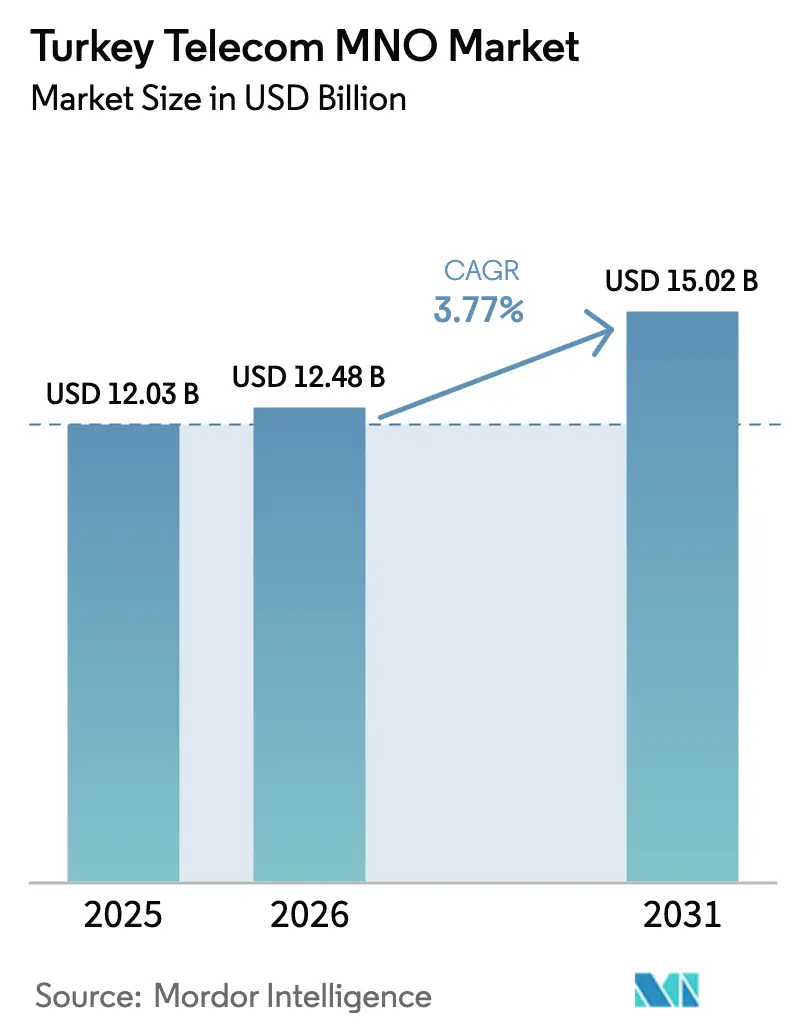
| Base Year Market Size (2025) | USD 12.03 Billion |
| Market Size (2026) | USD 12.48 Billion |
| Market Size (2031) | USD 15.02 Billion |
| Growth Rate (2026 - 2031) | 3.77 % |
| Market Concentration | High |
Major Players *Disclaimer: Major Players sorted in no particular order Image © Mordor Intelligence. Reuse requires attribution under CC BY 4.0. | |
Turkey Telecom MNO Market Analysis by Mordor Intelligence
The Turkey Telecom MNO Market size was valued at USD 12.03 billion in 2025 and estimated to grow from USD 12.48 billion in 2026 to reach USD 15.02 billion by 2031, at a CAGR of 3.77% during the forecast period (2026-2031).
The expansion is propelled by resilient mobile‐data demand, sustained pricing power that has lifted blended ARPU by more than 50% year on year, and the ability of operators to defend margins despite persistent hyperinflation. Robust 4.5G coverage, rapid smartphone adoption, and preparations for the August 2025 5G spectrum auction collectively underwrite long-term revenue visibility for every tier-one carrier. Consolidation around three national players enables disciplined capital deployment, while emergent enterprise-IoT opportunities create fresh addressable revenue pools. The Turkey telecom MNO market continues to benefit from the country’s geographic role as a Eurasian data transit hub, giving operators wholesale upside from new terrestrial and subsea routes.
Key Report Takeaways
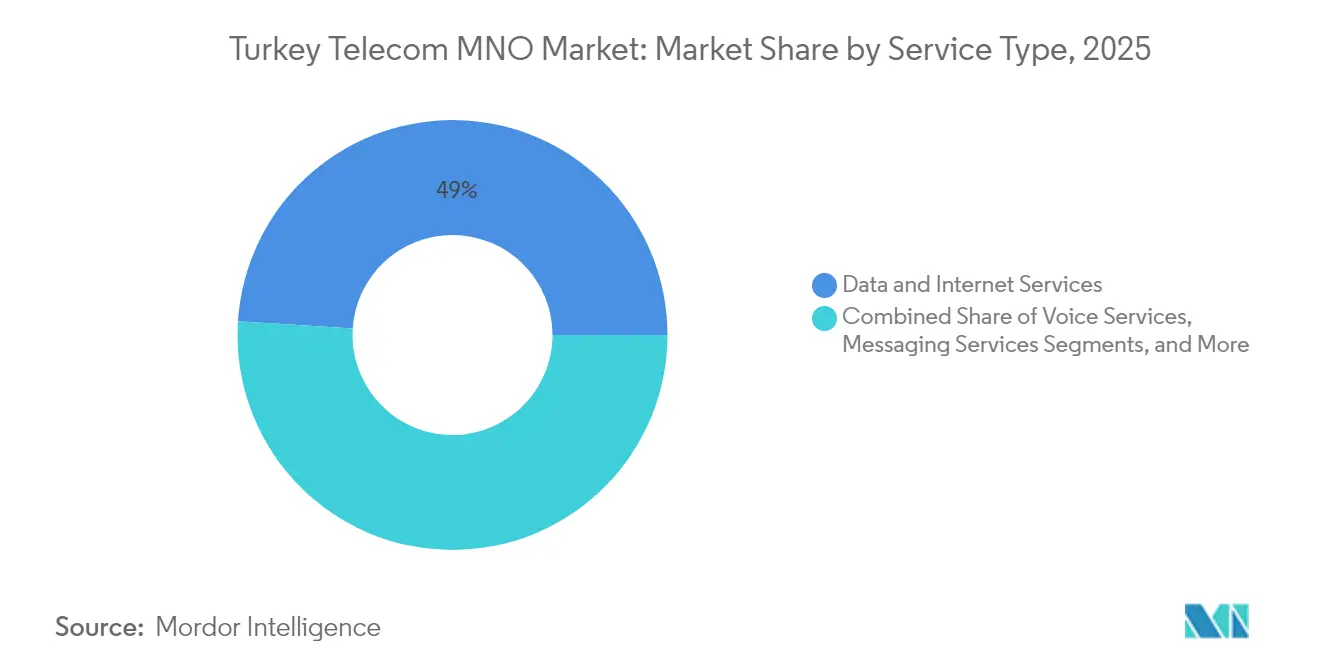
- By service type, data and internet services captured 48.98% of the Turkey telecom MNO market share in 2025, whereas IoT and M2M services are advancing at a 3.84% CAGR through 2031.
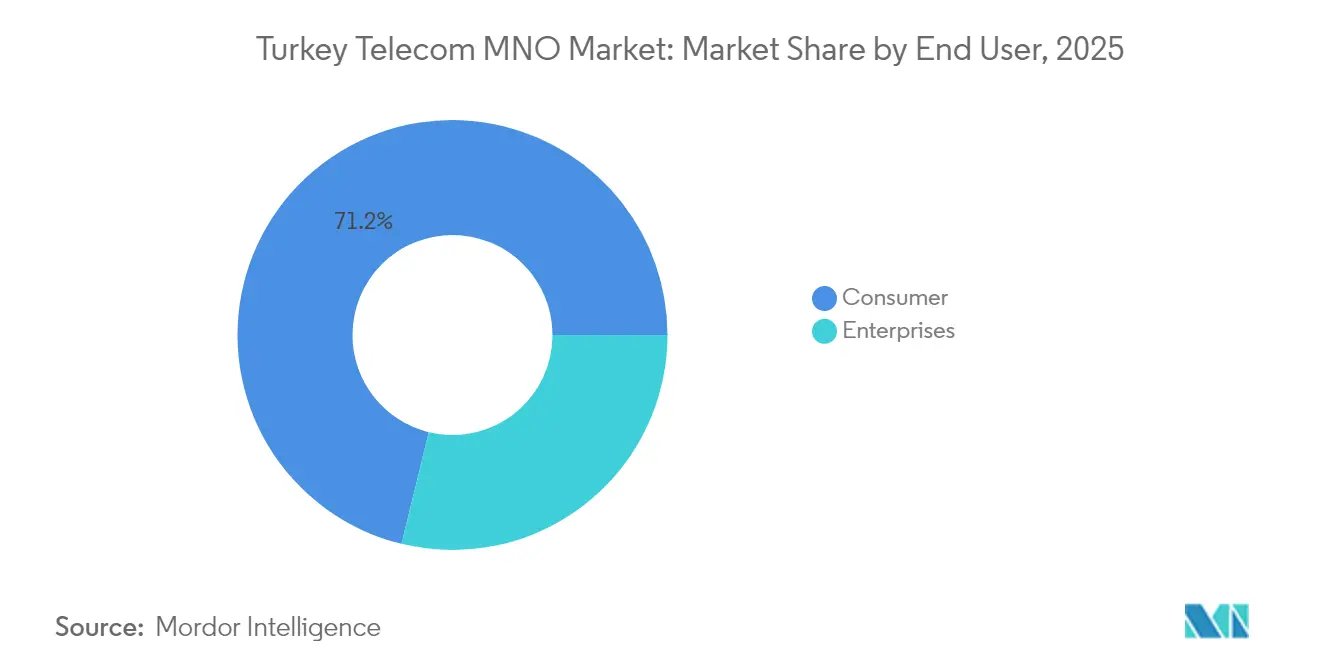
- By end-user, consumer subscriptions accounted for 71.19% of the Turkey telecom MNO market size in 2025; enterprise connections are projected to expand at a 4.05% CAGR through 2031.
Note: Market size and forecast figures in this report are generated using Mordor Intelligence’s proprietary estimation framework, updated with the latest available data and insights as of 2026.
Turkey Telecom MNO Market Trends and Insights
Drivers Impact Analysis*
| Driver | (~) % Impact on CAGR Forecast | Geographic Relevance | Impact Timeline |
|---|---|---|---|
| Mobile data-traffic boom and nationwide 4.5G coverage | +1.2% | National; strongest in Istanbul, Ankara, Izmir | Medium term (2-4 years) |
| Government-led 5G roadmap and 2025 spectrum auction | +0.8% | National; early rollouts in major urban centers | Short term (≤ 2 years) |
| Enterprise digital-transformation demand for IoT connectivity | +0.6% | Nationwide; industrial zones and smart-city pilots | Long term (≥ 4 years) |
| High smartphone penetration lifting data ARPU | +0.5% | National; rural areas catching up fast | Medium term (2-4 years) |
| New Turkey–Europe submarine cables boosting backhaul capacity | +0.4% | National; vital for international traffic | Long term (≥ 4 years) |
| AI-driven network automation cutting OPEX and enabling new B2B services | +0.3% | National; enterprise-service hubs | Long term (≥ 4 years) |
| Source: Mordor Intelligence | |||


Mobile Data-Traffic Boom and Nationwide 4.5G Coverage
Explosive data usage is reshaping revenue composition as carriers pivot from voice toward bandwidth-centric monetization models. Turkcell alone processed more than 6 billion GB over five years, underscoring network stress but also underpinning steady ARPU accretion [1]Bazaartimes Staff, “Over 6 billion GB … with Turkcell’s 4.5G,” Bazaar Times, bazaartimes.com. Comprehensive 4.5G footprints deliver uniform quality-of-service that supports real-time video, mobile gaming, and IoT telemetry, letting operators craft tiered speed plans. Traffic density accelerates the business case for edge-compute nodes that lower latency for augmented-reality and industrial-automation workloads. Continuous capacity upgrades, however, inflate capex, driving a parallel push for sophisticated pricing algorithms and spectrum refarming. The surging traffic also intensifies vendor partnerships focused on massive-MIMO and carrier aggregation to squeeze efficiency from limited spectrum holdings.
Government-Led 5G Roadmap and 2025 Spectrum Auction
The Ministry’s August 2025 auction compresses a decade of spectrum planning into a single milestone that will dictate strategic bandwidth portfolios for all bidders. Pre-qualification criteria encourage domestic R&D links, exemplified by Türk Telekom’s 6G collaboration with Ericsson, to safeguard technological sovereignty. Winning blocks carry rollout obligations across urban and rural zones, adding clarity to business-case modeling and catalyzing capital-market interest. Aligned policy signals also deter fragmentation by choreographing simultaneous nationwide launches, helping operators monetize scale faster than peers in markets with staggered licensing. The auction’s timing amid hyperinflation forces carriers to juggle high spectrum fees with macro-driven funding costs, sharpening focus on network-sharing and neutral-host models to dilute capex shocks.
Enterprise Digital-Transformation Demand for IoT Connectivity
Manufacturers, utilities, and logistics firms are upgrading legacy systems with sensor networks and analytics platforms that depend on carrier-grade connectivity. Dedicated network slices and guaranteed-latency SLAs command premium pricing, lifting enterprise ARPU well above consumer averages. Operators respond by bundling connectivity with device management, cybersecurity, and API integration, thereby moving up the value stack. Smart-city pilots in Izmir and Bursa illustrate the pull-through effect: once connectivity is in place, carriers upsell video analytics and cloud storage. Long-term contracts mitigate churn risk and smooth cash flows, providing a hedge against consumer-segment volatility. BTK’s eSIM compliance rules add clear standards, accelerating adoption and letting carriers lock in recurring license revenue while protecting numbering resources.
High Smartphone Penetration Lifting Data ARPU
Turkey now exhibits smartphone penetration exceeding 90%, transforming traffic profiles toward high-definition video and cloud gaming. Rich device capabilities allow carriers to introduce service-tier differentiation, such as unlimited social-media bundles, that monetize specific usage clusters [2]Digital TV News Editorial, “Inflation driving telecommunication services revenue growth,” Digital TV News, digitaltvnews.net . Improved antenna technologies embedded in flagship handsets boost spectral efficiency, reducing the marginal cost of each additional gigabyte and sustaining gross margins. Saturation shifts the competitive lens to experience quality and loyalty programs rather than net-add races. Consequently, investment emphasis pivots to customer analytics engines that detect churn signals and enable personalized upsell offers. The mature device base also furnishes anonymized sensor data that carriers leverage for network optimization, lowering OPEX and reinforcing the value proposition of premium data tiers.
Restraints Impact Analysis*
| Restraint | (~) % Impact on CAGR Forecast | Geographic Relevance | Impact Timeline |
|---|---|---|---|
| Hyper-inflation squeezing consumer spending on telecom | −0.9% | Nationwide; heavier in rural, low-income districts | Short term (≤ 2 years) |
| Regulatory delays and uncertainty around 5G licensing fees | −0.4% | Nationwide; impacts all carriers’ rollout calendars | Medium term (2-4 years) |
| Rising tower-lease costs from seismic retrofitting mandates | −0.3% | Nationwide; acute in earthquake zones | Long term (≥ 4 years) |
| Emerging LEO-satellite broadband substituting rural mobile data | −0.2% | Sparsely populated eastern provinces | Long term (≥ 4 years) |
| Source: Mordor Intelligence | |||
Hyper-Inflation Squeezing Consumer Spending on Telecom
With headline inflation oscillating above 40%, disposable incomes lag tariff adjustments, pushing prepaid users toward smaller data bundles or opportunistic SIM swapping. Operators have countered with frequent micro-top-up promotions and loyalty perks, yet churn risk remains elevated in low-income cohorts [3]Digital TV News Editorial, “Inflation driving telecommunication services revenue growth,” Digital TV News, digitaltvnews.net . Inflation also inflates energy and site-maintenance costs, eroding EBITDA despite nominal revenue growth. Despite the squeeze, mobile connectivity is deemed essential, enabling carriers to introduce quarterly price revisions without inciting mass disconnections. Successful navigation hinges on advanced segmentation analytics that calibrate price elasticity by region and socioeconomic bracket, allowing revenue yields to outpace CPI while keeping churn within historical norms.
Regulatory Delays and Uncertainty Around 5G Licensing Fees
Elapsed time between policy announcements and final license terms has lengthened business-case paybacks and muddied debt-capital planning. Spectrum cost opacity complicates vendor negotiations, forcing provisional equipment contracts with escalation clauses that add financial risk. Delays defer commercial 5G launches, letting neighboring EU markets steal an innovation march, which can divert multinational enterprise demand toward cross-border roaming or private-network imports. Financing uncertainty dampens appetite among foreign investors for tower-sale-and-leaseback deals that normally release cash for spectrum fees. Operators mitigate by trialing non-stand-alone 5G in existing bands, keeping consumer excitement alive while hedging regulatory timing risk.
*Our forecasts treat driver/restraint impacts as directional, not additive. The impact forecasts reflect baseline growth, mix effects, and variable interactions.
Segment Analysis
By Service Type: Data Services Drive Revenue Transformation
Data and Internet services accounted for 48.98% of the Turkey telecom MNO market size in 2025, reflecting an accelerated pivot from voice to bandwidth monetization. The segment keeps expanding on the back of streaming video, cloud productivity tools, and gaming traffic, and it remains the anchor for upselling unlimited and speed-tiered plans. Voice revenues continue to decline in absolute terms but serve as customer-retention glue inside converged bundles that include messaging, video, and storage add-ons. Messaging sits in structural decline as OTT platforms cannibalize legacy SMS, yet operators have stabilized volumes by promoting RCS for enterprise-to-customer alerts. IoT and M2M services, while still single-digit contributors, outpace every other line with a 3.84% CAGR. The opportunity centers on industrial automation, fleet tracking, and smart-city deployments, each supported by network-slice capabilities under test in Ankara and Izmir. OTT and PayTV solutions round out the portfolio, letting carriers leverage content partnerships to grow average revenue per household and diversify away from pure mobile-only accounts. Other services, such as roaming, cloud storage, and cybersecurity consulting, add high-margin ancillary streams that cushion inflation-driven OPEX spikes.
Sustained data-traffic elasticity means even modest tariff increases translate into outsized revenue gains, underscoring why every operator directs over 60% of annual capex to capacity upgrades and fiber backhaul. Differential quality of service packages give incumbents room to upsell, especially now that traffic management tools embedded in 5G-ready RAN software can guarantee latency for premium mobile-gaming tiers. The impending auction will widen frequency holdings, enabling contiguous spectrum blocks that support 5G Stand-Alone and unlock network-slice monetization for IoT. As ARPU skews higher toward data-heavy postpaid accounts, the Turkey telecom MNO market builds a buffer against future regulatory price caps and recession-induced volume dips. That trajectory anchors investor confidence in sustained free-cash-flow expansion even in an inflationary macro context.


By End-User: Enterprise Growth Accelerates Digital Transformation
Consumer subscriptions still deliver scale, representing 71.19% of the Turkey telecom MNO market share in 2025. Growth, however, is maturing as penetration nears 100% of the addressable population, prompting a shift from acquisition to wallet-share capture. Operators, therefore, bundle mobile with fixed broadband, PayTV, and cloud storage to raise ARPU and lower churn. Loyalty programs and family data pools further reinforce stickiness. Yet competition intensifies on experiential factors such as video streaming quality and gaming latency, areas where network densification and edge caching play decisive roles. Hyperinflation adds complexity, compelling carriers to tailor bite-sized daily data options that cater to compressed consumer budgets while preserving headline ARPU growth.
Enterprises, by contrast, are the fastest-growing cohort, expanding at a 4.05% CAGR owing to Industry 4.0 projects and government smart-city grants. Dedicated connectivity for manufacturing execution systems, real-time asset monitoring, and connected-vehicle platforms attracts premium pricing, raising enterprise ARPU to more than 3× consumer levels. Contract tenures averaging three years reduce revenue volatility and support stable cash-flow projections. Edge-compute nodes sited at industrial parks shorten latency for automated-guided vehicles and robotics, turning operators into strategic partners rather than commodity bandwidth suppliers. These dynamics prompt specialized sales units within each carrier, focusing on verticals such as logistics, energy, and public safety, complete with tailored SLAs and integrated analytics dashboards. As 5G Stand-Alone arrives, private network slices will further entrench operator relevance in enterprise digital roadmaps, consolidating a high-margin pillar within the Turkey telecom MNO market.
Geography Analysis
Istanbul, accounting for more than one-third of the Turkey telecom MNO market size, remains the epicenter of high-value traffic and technology pilots. The city’s dense business districts and affluent consumer base support early adoption of premium 5G handsets and high-throughput enterprise solutions, justifying aggressive small-cell densification and edge-cloud deployments. Ankara and Izmir follow as secondary nodes, driven by a concentration of government agencies, defense contractors, and export-oriented manufacturers that demand resilient, low-latency networks. Seasonal tourism corridors from Antalya to Bodrum boost summer traffic, prompting dynamic capacity reallocation tools that protect user experience while maximizing yield pricing.
Rural Anatolian provinces reveal a contrasting picture where terrestrial build-outs remain economically challenging. Türk Telekom’s fiber push, laying 100 kilometers per day, prioritizes underserved localities, aiming to leverage universal-service funding and minimize BTK penalty exposure for coverage gaps . Where towers are sparse, operators experiment with satellite backhaul and shared-infrastructure consortia to contain costs. Meanwhile, global LEO constellations start to nibble at uncapped rural data demand, nudging carriers toward hybrid-access bundles that combine terrestrial voice with satellite broadband to defend market share.
International connectivity confers strategic leverage. New subsea systems, including the Sparkle–Turkcell link and the BlueMed project, position Turkey as a Mediterranean data crossroads, funneling European and Middle Eastern traffic through carrier landing stations. Terrestrial corridors, such as the 1,850-kilometer SOCAR Fiber route, diversify transit paths, improving resiliency and catering to hyperscale cloud providers seeking multi-region presence. Wholesale revenues from these projects underpin capex for domestic last-mile upgrades, creating a virtuous investment cycle that reinforces Turkey’s role as a digital bridge.
Regulatory Landscape
Turkey’s mobile market is regulated by the Information and Communication Technologies Authority (BTK), which conducts market reviews under the Market Analysis Regulation (Official Gazette dated 27.11.2012, No. 28480). BTK also oversees retail pricing discipline through end-user tariff rules, including a requirement that mobile operators notify BTK at least 7 days before a tariff takes effect and adhere to the Mobile Electronic Communication Services Maximum Fee Tariff, which BTK updates twice a year in line with inflation dynamics.
On spectrum and licensing, BTK’s 5G authorization process moved from planning to allocation with a 5G tender held on 16 October 2025, which allocated 400 MHz and was reported at a tender value of USD 2.945 billion (including frequency packages across the 700 MHz and 3.5 GHz bands). This spectrum milestone, combined with BTK’s ongoing market analyses and tariff governance, shapes operators’ rollout calendars, capital planning, and competitive conduct in a highly concentrated three-operator market structure.
Competitive Landscape
Turkey’s mobile market is an oligopoly: Turkcell, Vodafone, and Türk Telekom collectively command over 95% of subscriptions, driving disciplined competition anchored in technology differentiation rather than price wars. Turkcell leverages aggressive virtualization targets, 40% of network functions by 2025, to lower OPEX and launch cloud-native services rapidly, positioning itself as a digital-services platform. Vodafone Turkey focuses on customer-experience metrics, integrating AI bots for care interactions and rolling out loyalty partnerships such as the Hepsiburada rewards scheme to lock in high-value postpaid users. Türk Telekom leverages nationwide fiber assets to bundle fixed and mobile propositions, exploiting cross-selling opportunities in enterprise ICT contracts and public-sector digitalization projects.
Collaborative R&D is surfacing as the next battleground. The Ericsson-Türk Telekom 6G pact and the Turkcell-Huawei 5G-Advanced MoU exemplify vendor-operator co-innovation aimed at lowering time-to-market for latency-sensitive services such as holographic conferencing. Edge computing footprints, often colocated within carrier central offices, are being opened to third-party developers, signaling a platform approach where revenue is shared across connectivity and application layers. Infrastructure sharing, historically limited, is gaining traction under inflationary pressure; passive tower joint ventures are under evaluation, promising capex savings of up to 30% over standalone builds.
Regulation acts as both a moat and a motivator. BTK’s 0.2% revenue penalty for coverage laps incentivizes incumbents to maintain nationwide service quality, raising a barrier for any would-be entrant lacking large-scale capital reserves. Simultaneously, the looming cybersecurity law mandates data localization and pushes carriers toward domestic cloud partnerships, influencing vendor selection and network-architectural choices. In net terms, sustained high barriers and sticky subscriber bases suggest the Turkey telecom MNO market will remain a three-horse race for the medium term.
Turkey Telecom MNO Industry Leaders
Turkcell Communication Services Inc.
Türk Telekom
Vodafone Turkey
Netgsm
- *Disclaimer: Major Players sorted in no particular order


Market Opportunities and Future Outlook
Commercial 5G service activation from 01 April 2026, following BTK’s October 2025 award of 400 MHz spectrum in the 700 MHz and 3.5 GHz bands, creates a clear monetization runway for higher-throughput mobile broadband and differentiated enterprise connectivity. The strongest near-term whitespace sits in packaging 5G into premium postpaid tiers (speed-based plans, latency-sensitive add-ons) and in converting existing 4.5G-heavy traffic into higher-value ARPU structures, particularly as data and internet services already represent 48.98% of service revenue (2025). Istanbul, Ankara, and Izmir remain the highest-velocity zones for early 5G propositions given their concentration of premium consumers, public-sector workloads, and export-oriented manufacturing clusters.
Regulatory initiatives add incremental opportunity in back-end infrastructure and B2B services. BTK’s 2026 work plan includes technical and legislative regulations for Internet Exchange Points (IXP), security assessments for data centers and cloud computing, and energy labeling/eco-design regulations for smartphones and tablets (timed to October 2026), which can accelerate carrier activity in domestic peering, edge/data-center hardening, and device-portfolio optimization. In parallel, MVNO dynamics offer a secondary growth pocket: Netgsm positions itself as a Full MVNO, and its disclosed operational constraints around onboarding new mobile subscribers due to base-station access conditions highlight room for wholesale access and partnership models to expand addressable segments without adding parallel radio networks, provided commercial and regulatory terms are workable.
Recent Industry Developments
- April 2026: Turkish Telecom Industry announced the official launch of 5G services in Turkey. The launch marks a direct market expansion milestone and signals stronger data traffic growth across the mobile ecosystem. It accelerates data-services growth and capex intensity across operators, shaping near-term network modernization and competitive dynamics.
- March 2026: Turkcell published 2025 results and 2026 strategic goals; target revenue growth 5-7% and investment-to-revenue ratio 25%. The results point to an operator-level growth trajectory for 2026 and underscore expectations for disciplined capital deployment. It guides capital deployment and service-expansion planning for 2026-2027, aligning investments with longer-term revenue opportunities.
- March 2026: Turkcell syndicated USD 1 billion Murabaha financing facility to fund 5G and next-generation investments. The financing supports capex-heavy expansion and accelerates network modernization across the footprint. It provides financial flexibility to advance data-center and cloud initiatives alongside core network upgrades.


Research Methodology Framework and Report Scope
Market Definition and Coverage
For this report, the market is defined as telecom operator service revenues generated in Turkey across mobile and fixed connectivity, including related digital connectivity services that are billed to consumer and enterprise customers.
Scope exclusions: This sizing does not count device sales, standalone IT hardware or software, or non-telecom digital services that do not rely on an operator billed connectivity relationship.
Segmentation Overview
- Overall Telecom Revenue and ARPU
- Service Type
- Voice Services
- Data and Internet Services
- Messaging Services
- IoT and M2M Services
- OTT and PayTV Services
- Other Services (VAS, Roaming and International Services, Enterprise and Wholesale Services, etc.)
- End-user
- Enterprises
- Consumer
Data Sources, Market Sizing, and Validation
Desk Research
Desk research starts with building a clean fact base on sector revenues, subscriber counts, and network rollout signals in Turkey, and then mapping those signals into the variables that can explain service revenue movement. We typically rely on public regulator publications such as ICTA statistics releases, national statistical releases on household internet access, and central bank or finance ministry series that help normalize currency and inflation effects on reported revenues.
We also use sources such as operator annual reports and investor presentations, audited financial statements, and reputable press for major pricing and coverage announcements. When market splits need extra checking, we refer to paid subscriptions that provide company financial intelligence, news and financials screening, and patent databases for tracking telecom technology direction. The desk sources listed here are illustrative only, and many other public and paid references are used for data collection, validation, and clarification during the study.
Primary Interviews and Surveys
Primary work is used to test what the desk numbers cannot fully explain, especially around pricing actions, mix shift between voice and data, enterprise contract behavior, and the pace of network investments translating into monetized usage. We speak with operator and channel-side leaders, network and finance functions, and enterprise buyers so assumptions on ARPU movement, churn pressure, and adoption of higher-speed plans are grounded in how the market is actually behaving across Turkey.
Distribution of primary research fieldwork respondents
| Company type | Respondent position |
|---|---|
| Top tier: 30% | CXOs: 12% |
| Mid tier: 56% | Functional/Unit leaders: 29% |
| Smaller Players: 14% | Managers: 59% |
Market-Sizing & Forecasting
Sizing starts from a top-down build where operator service revenues are reconstructed using subscriber base signals and usage and pricing direction, and then aligned to reported sector totals and regulator-style revenue categories where available. As the model is being built, it is cross-checked with selective bottom-up approximations such as sampled plan pricing, blended ARPU ranges, and channel checks on subscriber mix so the total does not drift away from what operators can realistically bill.
Key inputs used in the model include mobile and fixed subscriber trends, smartphone and broadband penetration direction, ARPU movement by prepaid and postpaid mix, data usage growth that drives plan upgrades, and investment intensity that supports coverage and capacity expansion. Where a bottom-up piece is missing, gaps are handled with conservative proxy ratios tied to subscriber mix or service usage, and then reviewed again with expert feedback.
For forecasting, scenario analysis is applied around inflation-linked pricing behavior, competitive intensity in promotions, and timing of network upgrades that can lift data monetization. These scenarios are anchored in what interviewees expect for plan price progression and adoption of higher-value bundles, and then translated into yearly revenue paths.
Data Validation & Update Cycle
Validation happens in layers so the final number stays consistent with real market signals. We compare outputs against independent indicators such as subscriber additions, ARPU direction, and known price reset periods, and then investigate large year-to-year jumps before internal sign-off. When a mismatch shows up, assumptions are rechecked, and follow-up calls are triggered to confirm whether the change is real or driven by reporting or timing effects.
Each report is refreshed annually, and interim updates are made when material events affect pricing, regulation, or network investment cycles. Before delivery, the model and narrative get a fresh analyst pass so clients receive the most up-to-date view available at that time.
Mordor Intelligence's Turkey Telecom Market Size Measured Against Other Published Estimates
Published market sizes for Turkey telecom can look different even when the topic sounds the same, mainly because the counting rules and the revenue perimeter are not identical. Some estimates emphasize the wider ICT economy, while others aim at operator revenues only, which changes the final total quickly.
The benchmark table shows a clear spread that is mostly driven by scope and currency handling, and then by how forecasts treat price increases versus real usage growth. In Mordor Intelligence's model, the value is limited to telecom operator service revenues in Turkey (with services like data and internet, voice, messaging, and operator-led digital connectivity offerings), instead of combining telecom with the broader ICT sector that includes IT product and service spending.
Benchmark comparison
| Source | Market Size | Gaps in Research Methodology |
|---|---|---|
| Mordor Intelligence | USD 12.03 B (2025) | |
| Industry Association A | USD 36.70 B (2024) | Uses an ICT-wide perimeter that combines communication technologies with information technologies, and the reported USD figure is influenced by the chosen exchange-rate timing, which can inflate or deflate telecom-only comparisons. |
| Regulatory Statistics Digest B | USD 3.90 B (2025) | Often reflects a partial revenue view when quarterly TRY-denominated sector revenues are annualized and converted, and it can omit specific operator-led digital services or apply different treatment for wholesale and interconnect revenues. |
Taken together, the comparison points to two practical drivers of differences, which are what is counted as telecom versus wider ICT, and how local-currency revenues are converted into USD for a single year. By keeping inputs tied to subscriber and ARPU signals and then checking them against reported revenue direction, our estimate stays traceable to repeatable steps that can be re-run when market conditions change.


Key Questions Answered in the Report
What is the current value of the Turkey telecom MNO market?
The market is worth USD 12.48 billion in 2026 and is projected to hit USD 15.02 billion by 2031.
How fast is the market expected to grow?
It is forecast to advance at a 3.77% CAGR between 2026 and 2031.
Which service type generates the most revenue?
Data and Internet services lead with 48.98% share of total revenue in 2025.
Who are the key players?
Turkcell, Vodafone Turkey, and Türk Telekom jointly hold more than 95% of subscriptions.
When will Turkey hold its 5G spectrum auction?
The national 5G auction is scheduled for August 2025.
Which end-user segment is growing the fastest?
Enterprise connections are expanding at a 4.05% CAGR due to IoT and digital-transformation projects.
Page last updated on:


 Your data is secure and never sold or shared.


