
Market Overview
| Study Period | 2020 - 2031 |
|---|---|
| Forecast Data Period | 2026 - 2031 |
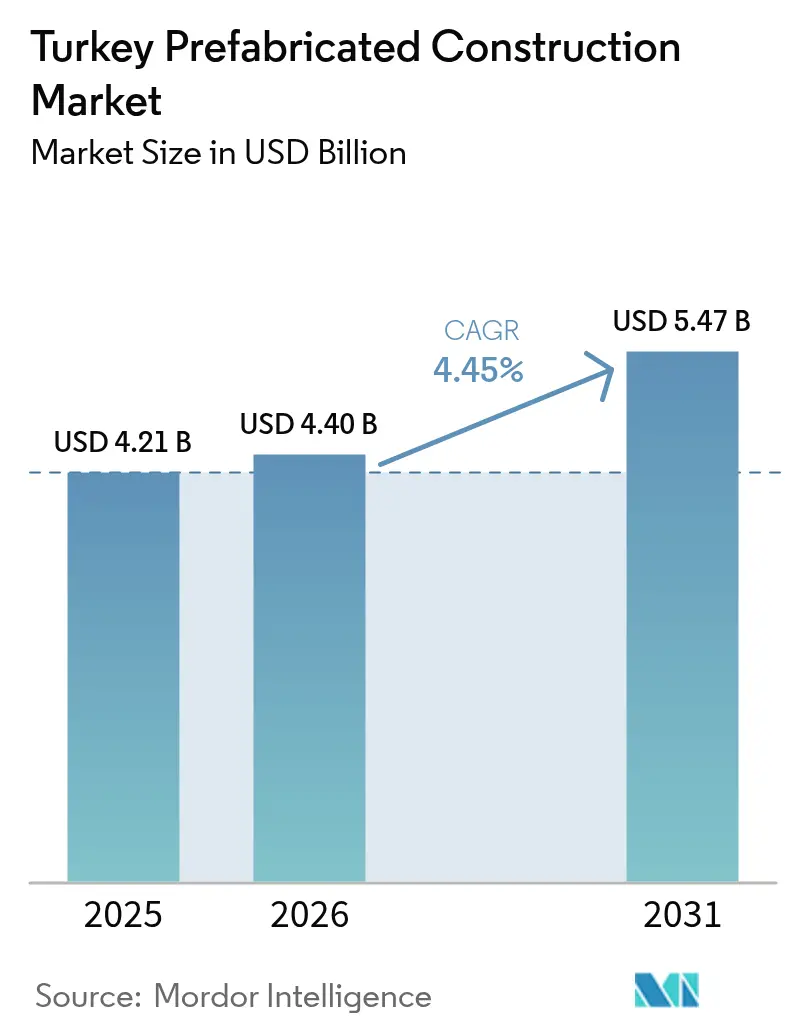
| Base Year Market Size (2025) | USD 4.21 Billion |
| Market Size (2026) | USD 4.4 Billion |
| Market Size (2031) | USD 5.47 Billion |
| Growth Rate (2026 - 2031) | 4.45 % |
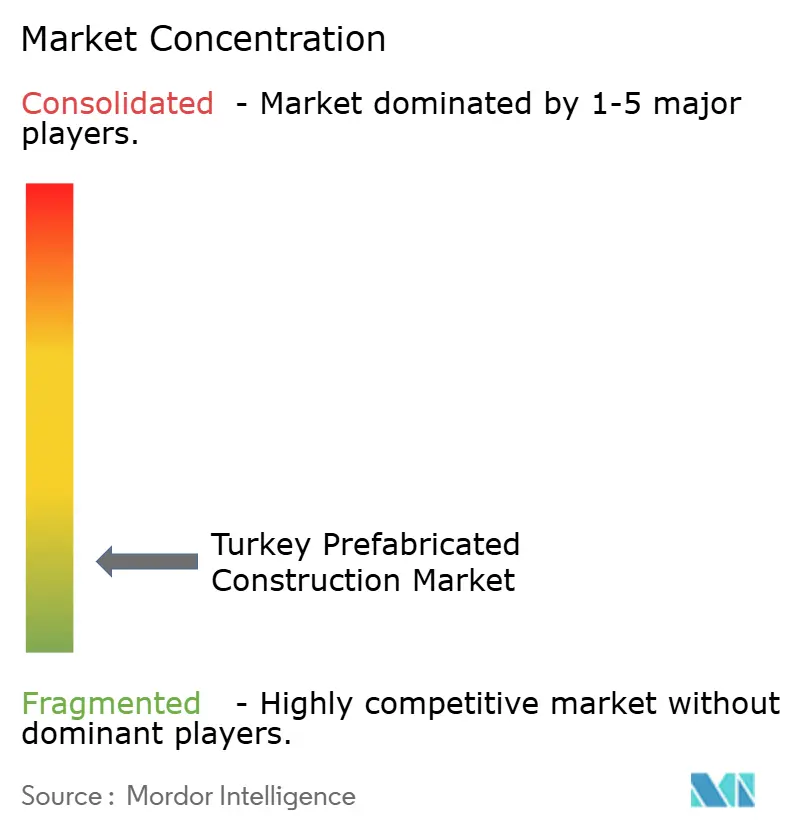
| Market Concentration | Low |
Major Players *Disclaimer: Major Players sorted in no particular order Image © Mordor Intelligence. Reuse requires attribution under CC BY 4.0. | |
Turkey Prefabricated Construction Market Analysis by Mordor Intelligence
The Turkey Prefabricated Construction Market size was valued at USD 4.21 billion in 2025 and estimated to grow from USD 4.4 billion in 2026 to reach USD 5.47 billion by 2031, at a CAGR of 4.45% during the forecast period (2026-2031). Post-earthquake reconstruction mandates, tighter TBEC-2018 seismic rules, and a national pledge to deliver 453,000 replacement homes within two years are anchoring near-term demand. Developers also face the April 2025 rollout of TS 825, which widens Turkey’s climate zones from four to six and raises insulation thresholds, pushing them toward factory-insulated panel systems that eliminate on-site labor bottlenecks. While concrete still dominates structural choices, new timber rules, energy-efficiency incentives, and near-EU supply-chain needs are opening space for steel-frame and modular solutions. Cost control remains pivotal amid 50% policy rates, triple-digit Lira depreciation since 2021, and a construction-cost index that quintupled in three years, steering contractors with hard-currency export books toward the domestic rebuild pipeline.
Key Report Takeaways
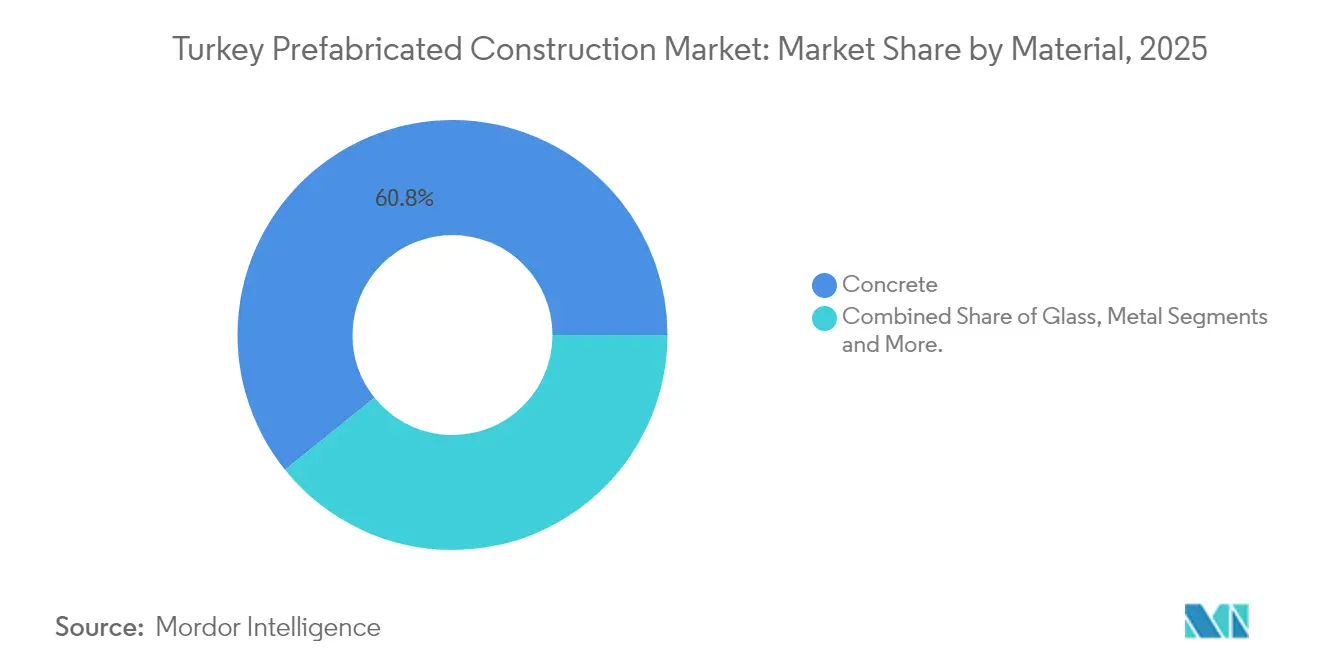
- By material, Concrete captured 60.78% of the Turkey prefabricated construction market share in 2025, while timber is set to expand at a 5.02% CAGR to 2031.
- By application, Residential applications held 44.35% of the Turkey prefabricated construction market size in 2025; the “Others” segment, led by military and disaster-relief demand, is advancing at a 5.37% CAGR through 2031.
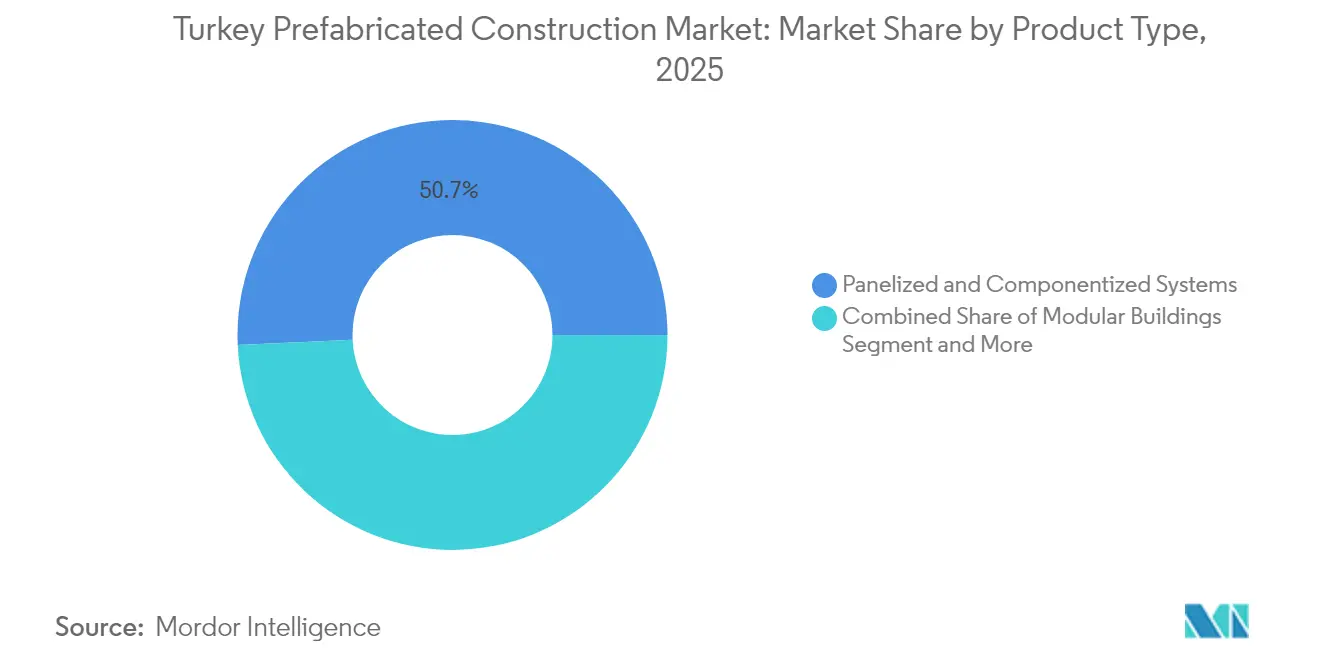
- By product type, Panelized systems commanded 50.74% of the Turkey prefabricated construction market share in 2025, whereas modular units are forecast to rise at a 5.74% CAGR to 2031.
- By geography, Istanbul generated 36.28% of total demand in 2025, yet Izmir is projected to grow fastest at 5.86% CAGR between 2026 and 2031.
Note: Market size and forecast figures in this report are generated using Mordor Intelligence’s proprietary estimation framework, updated with the latest available data and insights as of 2026.
Turkey Prefabricated Construction Market Trends and Insights
Drivers Impact Analysis*
| Drivers | (~) % IMPACT ON CAGR FORECAST | Geographic Relevance | Impact Timeline |
|---|---|---|---|
| Seismic reconstruction under TBEC-2018 | +1.2% | 11 earthquake-hit provinces | Short term (≤ 2 years) |
| Affordable-housing and urbanization push | +0.9% | Istanbul, Ankara, Izmir, nationwide urban zones | Medium term (2-4 years) |
| Near-EU manufacturing & logistics expansion | +0.7% | Marmara and Aegean regions, 18 free zones | Medium term (2-4 years) |
| Rapid-delivery public assets | +0.6% | National, focused on rural clinics, schools, military bases | Short term (≤ 2 years) |
| Energy-efficiency upgrades & export openings | +0.8% | Nationwide; EU and MENA export corridors | Long term (≥ 4 years) |
| Source: Mordor Intelligence | |||
Seismic Reconstruction Under TBEC-2018
Turkey’s 2023 earthquakes damaged 680,000 dwellings, prompting a USD 44 billion reconstruction program that privileges fast, factory-built systems. TBEC-2018 legitimizes prefabricated concrete, steel, and timber by assigning ductility and R-factors distinct from cast-in-place rules. Contractors saving weeks on shell erection are winning TOKİ lots and municipal school tenders, while the World Bank’s SREEP pilot shows retrofitted prefab panels can cut retrofit timelines by half. Provincial tax breaks tied to completion by 2027 compress the project window, heightening urgency. Suppliers that lock in material hedges and scalable logistics are positioned to capture this concentrated demand pulse.
Affordable-Housing and Urbanization Push
TOKİ has delivered more than 1.06 million social units since 2003, embedding panelized and tunnel-form systems into public procurement[1]Housing Development Administration of Turkey, “TOKİ Programs,” toki.gov.tr. Istanbul’s urban-renewal grant of EUR 65,000 (USD 71,500) per flat pulls lower-income households toward standardized floorplates that suit light-steel and sandwich-panel solutions. EY projects building revenue will climb from EUR 61 billion (USD 67.1 billion) in 2024 to up to EUR 77 billion (USD 84.7 billion) by 2027, yet 41-43% mortgage rates pressure buyers to favor smaller footprints. Prefabrication’s cost and speed benefits help bridge the affordability gap. However, concrete’s premium image in mid-rise segments still tempers adoption, indicating prefab suppliers must broaden design palettes to win private developers.
Near-EU Manufacturing & Logistics Expansion
Turkey’s 2024-2028 FDI plan targets 1.5% of global inflows, prioritizing automotive, electronics, and green-energy factories that need quick-build sheds, dormitories, and offices. Karmod’s 3,388 m² Hatay camp, built in 39 days, showcases schedule compression that appeals to export-oriented industrial zones. Railway upgrades capturing 55% of the 2025 logistics budget are spawning warehouse clusters near Izmit and Tekirdağ ports. Prefabricated steel frames and insulated panels dominate these projects because they allow commissioning within one quarter, a key metric for foreign lessees. Captive power modules and PV-ready roofs bundled into volumetric units further sweeten the value proposition for climate-FDI investors.
Rapid-Delivery Public Assets
AFAD’s deployment of 10,000 container homes after the 2023 quakes set a template for off-budget emergency procurements that favor stock designs with pre-approved fire and seismic certificates. Health PPPs, such as the 1,038-bed Elâzığ Hospital carrying USD 337 million MIGA cover, increasingly insist on modular site accommodation to de-risk timelines. Defense-base modernization and NATO infrastructure refreshes add steady demand for volumetric barracks, yet tight security clearances restrict entry to incumbents like Dorce and Tepe. The “Others” application segment, growing at 5.49%, underlines a secular shift toward swift, reversible structures that minimize disruption and capital lock-in.
Restraints Impact Analysis*
| Restraints | (~) % IMPACT ON CAGR FORECAST | Geographic Relevance | Impact Timeline |
|---|---|---|---|
| Currency volatility & high inflation | -0.5% | Nationwide, acute for non-indexed local contracts | Short term (≤ 2 years) |
| Preference for masonry & fragmented permitting | -0.3% | More pronounced in secondary cities and rural districts | Medium term (2-4 years) |
| Uneven quality standards & limited scale players | -0.2% | Segments needing large, repeatable volumes (mass housing, industrial) | Medium term (2-4 years) |
| Source: Mordor Intelligence | |||
Currency Volatility & High Inflation
Producer-price inflation hit 57.68% year-on-year in May 2024, while the construction-cost index quintupled since 2021, eroding fixed-price prefab margins[2]Turkish Statistical Institute, “Producer Price Index,” tuik.gov.tr. Imported CNC lines, insulation cores, and adhesives are invoiced in euros, so every Lira slide pushes break-even higher. Policy rates at 50% raise working-capital costs, delaying progress-payment cycles for SMEs. Export-oriented firms such as Dorce hedge naturally with hard-currency contracts, but purely domestic shops either walk away from TOKİ bids or swallow razor-thin spreads. The squeeze explains why consolidation talks among mid-tier steel-frame makers accelerated in 2025.
Uneven Quality Standards & Limited Scale Players
Apart from a few giants, most Turkish prefab shops run sub-10,000 m² sheds with manual welding and ISO 9001-only certification. Absence of a national quality mark deters foreign developers who require traceable audits. Tepe and ENKA employ robotic lines and BIM-integrated QA, capturing mega-hospital and petrochemical jobs. Smaller firms compete on price, sometimes slipping on tolerances that lead to costly field rework, reinforcing buyer skepticism. Government-supported test labs announced for 2026 may close the gap, yet until scale catches up, reliability concerns will cap market share gains.
*Our forecasts treat driver/restraint impacts as directional, not additive. The impact forecasts reflect baseline growth, mix effects, and variable interactions.
Segment Analysis
By Material: Concrete Retains Lead While Timber Accelerates
Concrete accounted for 60.78% of the 2025 Turkey prefabricated construction market share, anchored by TOKİ’s reliance on tunnel formwork and precast hollow-core floors. Yapı Merkezi’s Panelton® system spans 2.8 million m² of delivered slabs, illustrating deep public-sector ties. Developers choose concrete for perceived fire resistance and acoustic mass, and domestic rebar supply shields costs from forex swings. However, TS 825’s insulation rules force thicker exterior cladding, slightly elongating concrete cycles versus insulated steel panels.
Timber’s regulatory breakthrough via TABY positions it as the fastest-growing material at 5.02% CAGR to 2031. Cross-laminated timber using local black pine and cedar now passes seismic and fire tests, and UNDP pilots totaling 51,800 m² will validate cost models. TeknoWood already presses 22 m long CLT panels in Antalya for export, and domestic orders are emerging for low-rise schools in Çanakkale. While insurance premiums for wood structures remain 10-15 basis points above concrete, carbon-credit monetization under Turkey’s impending ETS could narrow the gap further.


By Application: Residential Dominates, “Others” Gains Pace
Residential kept 44.35% of 2025 revenue as Istanbul’s EUR 65,000 (USD 71,500) per-flat incentive underpinned urban-renewal condos. Light-steel village houses and tunnel-form mid-rises fill the 417,000-unit quake backlog, sustaining panel fabrication lines at near capacity. Yet 41-43% mortgage rates delay first-time buyer decisions, nudging developers to pre-sell smaller units with repeatable layouts that suit the Turkey prefabricated construction market.
The “Others” segment—military, disaster relief, and site infrastructure—will rise fastest at 5.37% CAGR. AFAD’s 10,000 post-quake containers proved that volumetric units can mobilize within three weeks. Ministries now embed similar specs in barracks and rural clinic tenders, guaranteeing baseline throughput for modular yards even when housing cycles cool. Suppliers able to offer integrated water-treatment and PV kits within container footprints are differentiating on lifecycle value.
By Product Type: Panelized Holds Majority, Modular Surges
Panelized systems delivered 50.74% of the 2025 Turkey prefabricated construction market size, thanks to sandwich-panel walls and prestressed slabs tuned to TOKİ’s standardized block designs. Factories in Ankara and Sakarya push out 160,000 m² of panels monthly, shipping flat-packed to nine provinces nightly. Their dominance rests on truck-optimized logistics and local assembly skills that need only light cranes.
Modular buildings, however, are on track for a 5.74% CAGR to 2031 as healthcare PPPs and free-zone factories prize time-to-revenue. Karmod’s Hatay camp, erected in 39 days, cut civil works by 30% and reduced weather downtime to zero. Investors now factor earlier rent commencement into IRRs, offsetting 10-15% higher upfront module costs. Fire-protection rules published in December 2024 clarify insulation and sprinkler spacing, smoothing municipal approvals for taller modular stacks.
Geography Analysis
Istanbul generated 36.28% of 2025 demand, buoyed by the 14 million ft² Istanbul Financial Center and a steady pipeline of seismic-retrofit condos. The metropolis funnels three-quarters of Turkey’s office absorption, enabling large-lot fabrication yards in Gebze to run continuous shifts. While high land prices curb low-rise timber trials, volumetric bathroom pods and MEP risers shave weeks off super-tall schedules, reinforcing prefab’s urban value proposition.
Izmir posts the fastest 5.86% CAGR outlook as 5,061 TOKİ units replace Seferihisar quake losses and the port city pivots to logistics. Light-steel frames cut Bayraklı’s seven-phase rebuild from 24 to 12 months, a timeline local contractors now benchmark. Izmir’s 48,000 m² CLT and steel facility seeks Eurocode accreditation to funnel supplies to Italy and Greece, but until CE labels scale, domestic housing will anchor output.
Beyond the big three, Ankara and the 11-province “Rest of Turkey” block ride USD 44 billion earmarked for quake rebuilds through 2027. Tax holidays and fast-track permits compress bidding cycles, letting SME panel shops in Gaziantep win public dormitory work without big-city competition. Once incentives lapse, demand may normalize, yet a culture of off-site assembly is likely to persist, underpinning steady regional volumes.
Regulatory Landscape
Turkey’s prefabricated construction activity is governed through the mainstream building code and permitting stack, including Zoning Law No. 3194 for building permits, the Turkish Building Earthquake Code (TBDY/TBEC-2018) for seismic compliance, and the Building Inspection Law No. 4708 for third-party control during delivery. Energy performance requirements tightened with TS 825 updates rolled out in April 2025, raising insulation thresholds and increasing the compliance value of factory-controlled insulated panels and systemized envelopes in both housing and industrial builds.
A major standards anchor for steel-based prefabrication was added with the Ministry of Environment, Urbanization and Climate Change publishing the Regulation on the Design, Calculation, and Construction Principles of Light Steel Buildings in the Official Gazette on May 17, 2026. The regulation introduces mandatory technical provisions for light steel buildings, including fire design and corrosion protection tied to regional corrosion classes, and sets January 1, 2027 as the date when compliance becomes mandatory. This creates a defined transition window for engineering, QA, and documentation upgrades across modular and LGSF producers.
Value Chain Analysis
The value chain starts with upstream inputs (cement and aggregates for precast, rebar and galvanized/light-gauge steel for frames, insulation cores and sealants/adhesives for sandwich panels, and timber/CLT where permitted), followed by engineering (structural calculations to TBDY 2018, detailing, and increasingly BIM-driven coordination on large projects) and factory fabrication. Manufacturers typically require an Industry Registry Certificate (Sanayi Sicil Belgesi) under Law No. 6948 and a municipal Workplace Opening and Operating License, and plants operate in industrial and commercial zoned areas, making Organized Industrial Zones (OSBs) important nodes for capacity clustering.
Midstream activities include quality control, packaging, and transport logistics for flat-pack panels, precast elements, or volumetric modules, then site installation using cranes and assembly crews. Commissioning and handover follow through the building inspection framework. Demand aggregation in Turkey is heavily shaped by public procurement and emergency programs, with TOKI and AFAD acting as major buyers for rapid-delivery housing and container solutions after the 2023 earthquakes, and the Urban Transformation Directorate (established October 2023 under the Ministry) shaping a longer-duration pipeline for seismic-risk areas. Industry coordination and standard-setting support is visible through bodies such as the Turkiye Prefabrik Birligi, which held its 42nd General Assembly on April 25, 2026 and elected a new board for a two-year term, signaling continued association-led engagement with OSBs and public institutions to scale repeatable prefabrication deliveries.
Competitive Landscape
Turkey’s prefabricated construction arena remains fragmented; even Dorce’s 100,000 m² Ankara complex holds under 10% domestic revenue. Competitive dynamics pivot on export hedges, with Vefa shipping to 120 countries and Tepe leveraging Bilkent Holding’s procurement muscle. Firms adopting CNC plate lines, robot welders, and BIM-fed QA position themselves for repeat EU work where traceability and CE marks are mandatory.
Strategic moves in 2024-2025 highlight vertical integration and green credentials. Master Builders Solutions bought a 51% stake in MBT Tech, locking in local adhesives supply for panel plants. İzocam’s purchase of Terrawool expands insulation menus just as TS 825 tightens U-values. Dörce’s ISO 14064 pathway and GlobalABC ties help secure carbon-conscious tenders in Germany and the Gulf, while ENKA’s Çimtaş churns 105,000 tons of export steel modules using robotic weld cells.
Quality gaps, however, create a two-tier field. Only a handful of plants boast third-party weld and fire certificates beyond ISO 9001, steering mega projects toward the top five suppliers. Mid-tier workshops survive on price-sensitive village houses and export container offices, risking capacity loss if financing costs stay at 50%. Consolidation chatter suggests the market could tilt toward a more concentrated structure once interest rates ease.
Turkey Prefabricated Construction Industry Leaders
Prefabrik Yapı A.Ş
Karmod Prefabricated Technologies
Module-T
Tepe Prefabrik
Dorce Prefabrik
- *Disclaimer: Major Players sorted in no particular order

Market Opportunities and Future Outlook
The main opportunity for prefabrication in Turkey is in code-driven system upgrades where compliance can be measured and standardized: TS 825 energy-performance tightening rolled out in April 2025 increases the value of factory-insulated panels and integrated envelope packages, and the Light Steel Buildings Regulation published on May 17, 2026 (mandatory from January 1, 2027) creates a defined window for light-gauge steel and modular suppliers to differentiate through documented fire design, corrosion class selection, and traceable QA. Producers that standardize calculations and product documentation around these requirements can reduce approval friction for municipal permits and shorten the iteration cycle with building inspectors.
Public-sector reconstruction and transformation programs continue turning speed and quality into procurement criteria, favoring panelized and modular delivery models used in TOKI and AFAD pipelines, including engineered LGSF and volumetric site accommodation. At the same time, TABY entering force in January 2025 formally approves CLT and light-frame systems, opening a specific opportunity for compliant timber solutions in low-rise public buildings and housing typologies where carbon and build speed are evaluated together. A second opportunity is digitization-led execution control. Evidence of BIM usage reaching 94% among large Turkish construction firms (250+ employees) in 2025, versus very low adoption among micro-firms, points to a service gap for prefab suppliers and subcontractors that can provide BIM-ready libraries, shop-drawing automation, and factory-to-site progress tracking aligned with EPC-style public delivery models.
Recent Industry Developments
- July 2026: Dorce Prefabrik announced the delivery of 600 turnkey housing units in Libreville, Gabon, completed within a six-month period using prefabricated light gauge steel structures. The completion underscores the company’s ability to execute high-volume, fast-cycle housing programs with industrialized systems. Export program wins of this scale reinforce hard-currency order books that can help stabilize procurement and factory throughput.
- March 2026: Karmod delivered a 294-square-meter container-based worker dormitory for an industrial plant project in Tuzla, Istanbul, designed to accommodate up to 40 personnel. The project highlights continued domestic demand for rapid-deployment site accommodation as industrial and logistics builds accelerate. Repeatable container workflows also keep modular yards utilized even when residential cycles slow.
- December 2024: Master Builders Solutions acquired a 51% stake in MBT Tech, expanding local availability of sealants and waterproofing systems used across panelized and modular construction. Strengthening local supply for critical chemical inputs supports consistency and lead-time control for prefab manufacturers. The move also aligns with rising code and performance requirements that increase reliance on certified building-envelope components.


Research Methodology Framework and Report Scope
Market Definition and Coverage
This market covers prefabricated buildings in Turkey that are manufactured off-site (in a factory setting) and then delivered to a project location for final assembly and installation across end-use construction.
Scope exclusions: Pure on-site, stick-built construction activities and general civil works that do not involve off-site fabricated building modules or panels are not counted.
Segmentation Overview
- By Material
- Concrete
- Glass
- Metal
- Timber
- Other Materials
- By Application
- Residential
- Commercial
- Others
- By Product Type
- Modular Buildings
- Panelized & Componentized Systems
- Other Prefab Types
- By City
- Istanbul
- Ankara
- Izmir
- Rest of Turkey
Data Sources, Market Sizing, and Validation
Desk Research
Desk work started by building a simple fact base for Turkey construction activity, trade signals, and building rules that influence prefabrication adoption. We referenced public sources such as TurkStat construction permits and output series, UN Comtrade style trade statistics for relevant components, and official notices tied to seismic and energy performance rules (for example Turkey Building Earthquake Code and TS 825 updates). To keep the model grounded, association websites and conference publications were reviewed to understand typical applications and procurement patterns for modular and panelized systems.
We also used general secondary materials such as listed-company filings, investor presentations, reputable press coverage of post-earthquake reconstruction programs, and tender announcements where project volumes were visible. In a few spots, we used a paid subscription source for company financials and another for shipment-level import-export checks to cross-check revenue direction and pricing ranges, and then adjusted assumptions only when multiple signals aligned. The desk sources listed here are illustrative, and many other public documents and datasets were reviewed for validation and clarification during the study.
Primary Interviews and Surveys
Primary work was used to pressure-test sizing assumptions that are hard to see in public data, especially mix shifts between modular buildings and panelized systems, and typical pricing by use case. We spoke with stakeholders across manufacturing, distribution, contracting, and project ownership so demand drivers in major cities and the rest of Turkey could be reflected in one consistent view.
Distribution of primary research fieldwork respondents
| Company type | Respondent position |
|---|---|
| Top tier: 36% | CXOs: 19% |
| Mid tier: 43% | Functional/Unit leaders: 37% |
| Smaller Players: 21% | Managers: 44% |
Market-Sizing & Forecasting
Sizing is built using a top-down and bottom-up approach, starting from Turkey construction demand pools and then narrowing to the prefabricated share using observable indicators. In practice, the top-down side uses construction spending direction, permitting signals, and post-disaster rebuilding programs to reconstruct how much addressable build activity exists for off-site solutions, and then conversion rates are applied by use case.
To keep the model realistic, the totals are corroborated with selective bottom-up approximations, where supplier revenue bands, channel checks, and sampled average selling price times volume builds are used to validate the overall scale. Inputs that mattered most included the pace of earthquake-led housing replacement, the share of projects using modular or panelized systems, typical project lead times (which affect year recognition), steel and insulation cost movement, and the mix of residential versus commercial orders in large metros. Forecasts were developed using scenario analysis, because demand is sensitive to reconstruction timelines, financing conditions, and public procurement timing, and those variables were aligned to what interviewees see in their forward pipelines. Where company disclosures or trade lines were incomplete, gaps were handled by applying conservative ranges and then tightening them through repeated interview validation and consistency checks against the construction cycle.
Data Validation & Update Cycle
Validation is done in layers so the final number does not depend on a single data point. We compare the model output against independent signals, such as construction activity direction, trade movement for relevant prefabricated components, and any visible project pipeline cues, and then investigate outliers before internal sign-off.
If a sub-assumption shifts materially (for example a change in reconstruction rollout or sharp input-cost swings), the related modules are reworked and selected primary contacts are re-engaged to confirm the new direction. Reports are refreshed annually, and interim updates are made when major policy, currency, or demand events can change the near-term outlook. Before delivery, a final analyst pass is completed so clients receive the most current version available.
Mordor Intelligence's Turkey Prefabricated Buildings Market Size Compared Against Other Published Estimates
Published market values for Turkey prefabricated buildings do not always line up because the scope line can move, and the price and volume assumptions can be refreshed at different times. Differences also come from what gets counted as a prefabricated building versus a prefabricated component, and from whether local currency figures are converted using spot rates or averaged rates.
Some published figures appear to bundle broader prefabricated construction activity, including a wide set of precast elements and related materials that may not translate into delivered building systems in the same year. In Mordor Intelligence, the market total is limited to off-site manufactured building systems that are shipped and assembled for end-use construction, and it is kept consistent in USD with the stated base year pricing and the same definition across the forecast.
Benchmark comparison
| Source | Market Size | Gaps in Research Methodology |
|---|---|---|
| Mordor Intelligence | USD 4.21 B (2025) | |
| Industry Intelligence Publisher A | USD 2.13 B (2025) | The figure is reported in TRY and can shift materially based on the FX conversion timing, and the scope appears to cover a wider prefabricated construction basket that may not map cleanly to delivered building-system value in the same year. |
| Trade Journal B | USD 1.60 B (2024) | This value aligns to container and prefab export performance, which is only one demand channel, and it excludes domestic installations that typically make up a large part of yearly spending. |
The spread mainly comes from scope and currency handling, and then from whether exports are treated as the market or only one input signal. By keeping the unit of measure as delivered prefabricated building systems inside Turkey and then checking it against construction and trade indicators, the estimate stays traceable to clear variables and repeatable steps.


Key Questions Answered in the Report
Which material leads in Turkish prefab construction?
Concrete retains leadership with 60.78% share in 2025, mainly through precast hollow-core and tunnel-form systems.
Which application segment is expanding fastest?
The “Others” category—covering military, disaster, and site facilities—is growing at 5.37% CAGR due to emergency housing and modular clinics.
Why is Izmir expected to outpace other cities?
Post-Seferihisar quake reconstruction and port-centric logistics projects give Izmir a 5.86% CAGR outlook to 2031.
How will TS 825 influence prefab adoption?
Stricter insulation rules effective April 2025 raise traditional build costs 15–25%, steering developers toward factory-insulated panels and modules.
Which companies are dominating exports?
Dorce, Vefa/Vekon, and Tepe Prefabrik lead exports, leveraging ISO-certified plants and CE-ready modules to serve EU and MENA clients.
Page last updated on:


 Your data is secure and never sold or shared.


