
Turkey Mining Equipment Market Size and Share
Market Overview
| Study Period | 2019 - 2031 |
|---|---|
| Forecast Data Period | 2026 - 2031 |
| Base Year Market Size (2025) | USD 100.05 Million |
| Market Size (2026) | USD 106.67 Million |
| Market Size (2031) | USD 146.98 Million |
| Growth Rate (2026 - 2031) | 6.62 % |
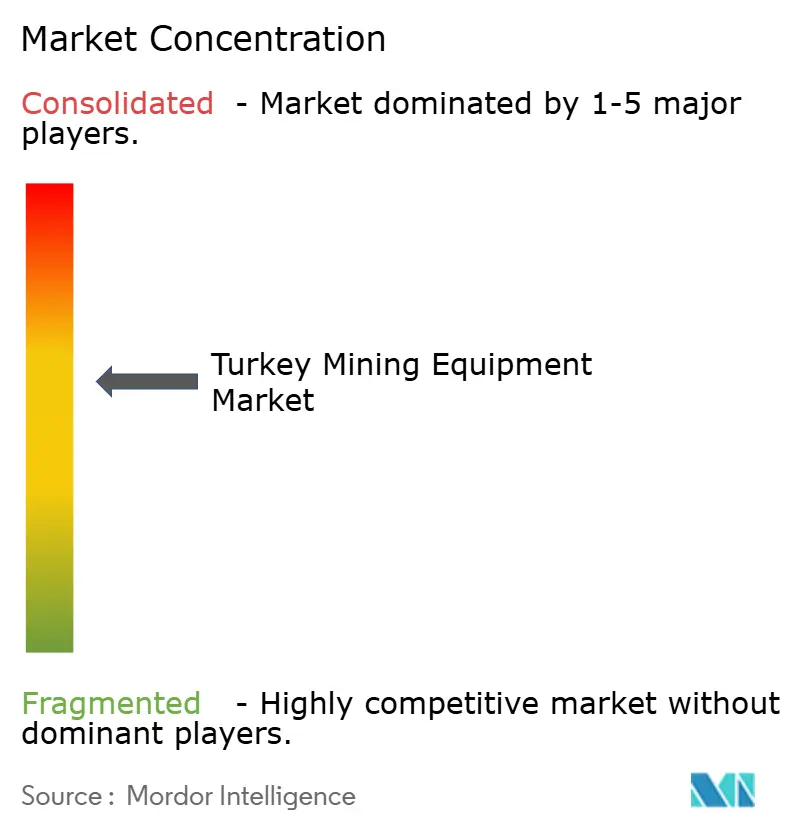
| Market Concentration | Medium |
Major Players *Disclaimer: Major Players sorted in no particular order Image © Mordor Intelligence. Reuse requires attribution under CC BY 4.0. | |
Turkey Mining Equipment Market Analysis by Mordor Intelligence
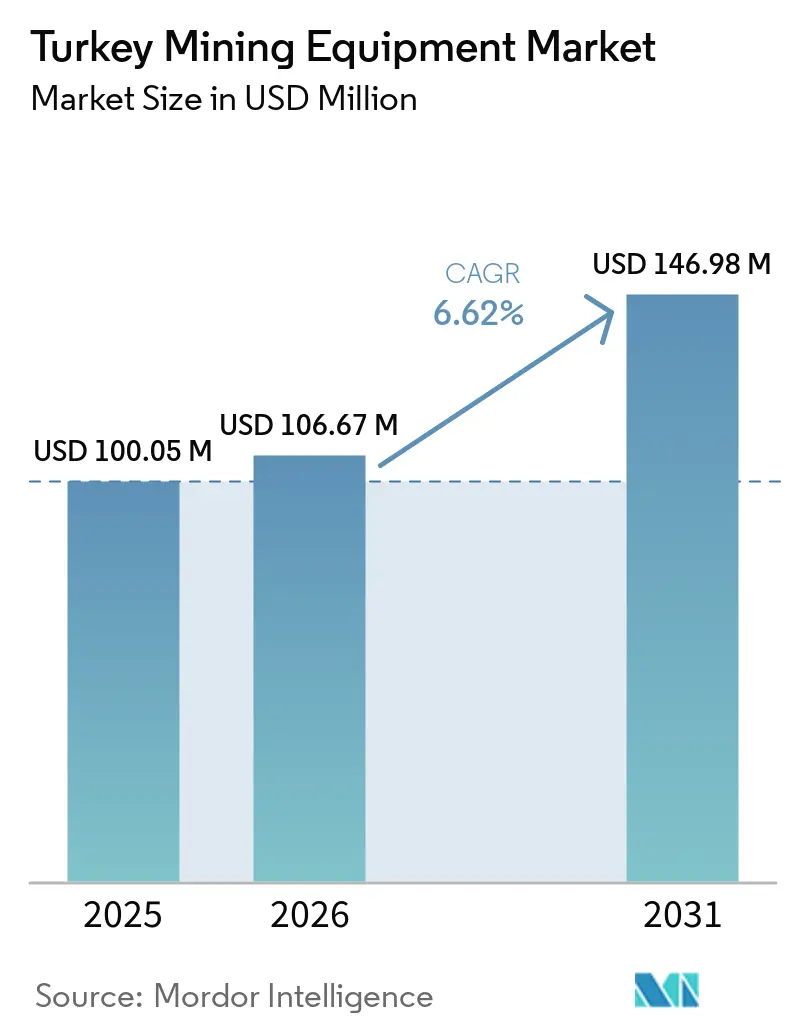
The Turkey mining equipment market size was valued at USD 100.05 million in 2025 and estimated to grow from USD 106.67 million in 2026 to reach USD 146.98 million by 2031, at a CAGR of 6.62% during the forecast period (2026-2031). The market growth is supported by demand from metal mining, industrial minerals, quarrying, and construction-related activity, which together create a mix of equipment requirements rather than a demand base centered on one type of mine or one set of customers. Its broad mineral base reduces reliance on a single commodity. It creates demand across several equipment categories, including mobile fleets for extraction and loading, as well as machines for crushing, processing, and material handling. Equipment replacement is becoming more important as operators improve safety practices, reporting systems, and fleet visibility, because older machines may be harder to integrate with current maintenance routines, operational monitoring, and site-level management requirements. Open-pit projects continue to drive demand for large equipment. At the same time, underground development creates a separate need for specialized machines and services, requiring suppliers to maintain capabilities across diverse mine designs, technical conditions, and customer operating practices. Established suppliers benefit from local parts availability, maintenance capacity, and customer relationships across dispersed mining areas, since operators often prioritize dependable field support and machine availability alongside equipment's initial cost and technical specifications.
Key Report Takeaways
- By equipment type, surface mining equipment held 49.39% of Turkey's mining equipment market share in 2025, while underground mining equipment is the fastest-growing category, with a CAGR of 8.82% through 2031.
- By automation, manual systems were the largest category, accounting for 72.28% of Turkey's mining equipment market share in 2025, while fully autonomous systems are projected to expand at a 10.59% CAGR through 2031.
- By powertrain, ICE equipment was the largest category, accounting for 79.12% of Turkey's mining equipment market share in 2025, while battery-electric equipment is projected to expand at a 12.11% CAGR through 2031.
- By power output, the 500-1,000 HP band held 51.27% of Turkey's mining equipment market share in 2025. The band below 500 HP will be the fastest-growing, at a 7.55% CAGR through 2031.
- By application, metal mining accounted 49.31% of Turkey's mining equipment market share in 2025, while mineral mining applications are projected to expand at a 9.62% CAGR through 2031.
Note: Market size and forecast figures in this report are generated using Mordor Intelligence’s proprietary estimation framework, updated with the latest available data and insights as of January 2026.
Turkey Mining Equipment Market Trends and Insights
Drivers Impact Analysis*
| Driver | (~) % Impact on CAGR Forecast | Geographic Relevance | Impact Timeline |
|---|---|---|---|
| Rising Domestic Demand | +1.8% | Marmara, Western Anatolia, Central Anatolia | Short term (≤ 2 years) |
| Government Incentives | +1.4% | Zonguldak, Bartın, Black Sea Region, Elazığ, Eastern Anatolia | Medium term (2–4 years) |
| Open-Pit Project Expansion | +1.1% | Çanakkale, Balıkesir, Kütahya, Western Anatolia/Aegean | Medium term (2–4 years) |
| Shift Toward Battery-Electric Equipment | +0.8% | Elazığ, Western Anatolia, Zonguldak | Long term (≥ 4 years) |
| Local Rental/Leasing Ecosystem Growth | +0.6% | Marmara, Central Anatolia | Short term (≤ 2 years) |
| Rare-Earth Exploration Financing | +0.5% | Eskişehir, Beylikova, Central Anatolia | Long term (≥ 4 years) |
| Source: Mordor Intelligence | |||
Rising Domestic Demand from Construction and Manufacturing
Construction activity supports demand for aggregates, limestone, and dimension stone across several Turkish regions, because local quarry operators must maintain a dependable flow of material for contractors and manufacturers. These materials require excavation, loading, crushing, screening, and material-handling equipment, and they also create a continuing need for wear parts, repairs, and machine inspections. Ceramics, cement, glass, and chemical producers also rely on industrial minerals from domestic operations, connecting mine equipment requirements with output decisions made by downstream manufacturers. This connection gives the Turkish mining equipment market demand beyond the cycle for copper and gold projects, helping suppliers maintain activity when large metal projects are postponed. Reconstruction needs in southeastern areas can widen the use of quarrying and earthmoving equipment, bringing demand to areas that have historically had a smaller equipment service base. Rental and leasing providers can benefit when operators prefer flexibility over a large upfront purchase, particularly for short-term quarrying work, exploration activity, or uncertain project timing that makes ownership less attractive.
Government Incentives for Modernization and Safety
Safety and modernization requirements are encouraging operators to review older fleets and their reporting capabilities, including whether machines can produce dependable records for internal oversight and regulatory processes. Equipment with compatible monitoring tools can help operators collect operating data and support compliance procedures, while enabling maintenance teams to identify operational issues earlier in the equipment cycle. This can make replacement more attractive than extending the life of older machines, particularly when retrofitting would interrupt production or fail to provide the required monitoring capability. The effect is strongest in underground operations, where safety controls and equipment condition receive close attention because difficult working conditions can quickly affect people, production, and maintenance schedules. Suppliers that combine equipment with training, maintenance, and digital support can build longer customer relationships, as customers may prefer a single partner that understands both fleet performance and site requirements.
Expansion of Open-Pit Copper and Gold Projects
Open-pit copper and gold projects support demand for excavators, loaders, haulage equipment, crushers, and processing systems, creating procurement needs that extend from mine development through the processing plant. Western Anatolia has an important role because several mining areas and related project activities are located there, allowing dealers and service providers to support customers within a relatively connected operating corridor. A new mine can require equipment from the first stage of material handling through processing and filtration, and the selection of one system can influence the specification of later equipment. This creates opportunities for suppliers to coordinate across multiple equipment categories and local support services, reducing the number of separate technical relationships an operator must manage during project delivery. The Soğüt project shows how processing investment can support demand for integrated plant equipment. Digital traceability work at the Çataltepe project also shows that some operators are considering supply chain data alongside physical equipment needs [1]“Tethys And MineSpider Launch First Digital Product Passport For A Mining Site At The Cataltepe Project,” MineSpider, minespider.com.
Shift Toward Battery-Electric Equipment for ESG Goals
Battery-electric equipment is entering mine planning discussions, particularly for underground work, where machine emissions and heat can affect ventilation planning, workforce conditions, and the design of production areas. It can reduce diesel emissions, heat, and ventilation needs in confined mine areas, although the magnitude of these benefits varies with mine depth, equipment use, and existing infrastructure. The financial case depends on mine design, charging access, operating patterns, and the availability of service support, rather than on the equipment price alone. Imported battery systems can pose procurement and supply risks for operators seeking to adopt the technology, especially if delivery schedules or component availability change during project development. Epiroc expanded its safety and sustainability portfolio in 2025 through a partnership that added battery-electric scalers and rescue chambers to its offering[2]“Epiroc Expands Safety And Sustainability Portfolio Through Partnership With Jama: Scalers And Rescue Chambers Now Part Of The Offering,” Epiroc, epiroc.com.
Restraints Impact Analysis*
| Restraint | (~) % Impact on CAGR Forecast | Geographic Relevance | Impact Timeline |
|---|---|---|---|
| Price volatility | -1.8% | Metal-rich provinces | Short term (≤ 2 years) |
| Permit uncertainty | -1.4% | Sensitive areas | Medium term (2-4 years) |
| Battery supply gap | -0.9% | Nationwide | Medium term (2-4 years) |
| Autonomy skill gap | -0.7% | Advanced regions | Long term (≥ 4 years) |
| Source: Mordor Intelligence | |||
Commodity-Price Volatility
Copper and gold prices influence mine operators' willingness to approve project spending because expected revenue shapes project financing, cash-flow expectations, and the timing of equipment commitments. A weaker price outlook can delay feasibility decisions, financing, and equipment procurement, particularly when a project has not yet secured all permits or final processing arrangements. Coal-related activity faces a separate source of uncertainty as energy policy and customer demand change, requiring suppliers to consider a different set of conditions from those affecting metal mines. This means different mining applications can weaken simultaneously rather than offset one another, making customer diversification and an active service business important for equipment providers. Suppliers can reduce this exposure by maintaining strong parts, maintenance, and rebuilding services, and by maintaining regular customer contact, which can sustain revenue when new machine purchases are deferred.
Environmental-Permit Uncertainty
Environmental permits can delay mining projects and equipment orders, leaving suppliers uncertain about when an operator will move from planning to a firm procurement decision. The issue is particularly important for open-pit gold and copper projects in environmentally sensitive areas, where community concerns and review procedures can affect the pace of project preparation. Operators may wait for clearer permit conditions before committing to large equipment purchases, since equipment delivery, site preparation, and financing commitments are often linked to the same project timetable. This can create uneven order timing for suppliers and local dealers. Projects may move quickly from planning to procurement after approval, which can strain delivery schedules and service planning if dealers have not prepared inventory and field resources in advance.
*Our forecasts treat driver/restraint impacts as directional, not additive. The impact forecasts reflect baseline growth, mix effects, and variable interactions.
Segment Analysis
By Equipment Type: Surface Equipment Leads While Underground Demand Broadens
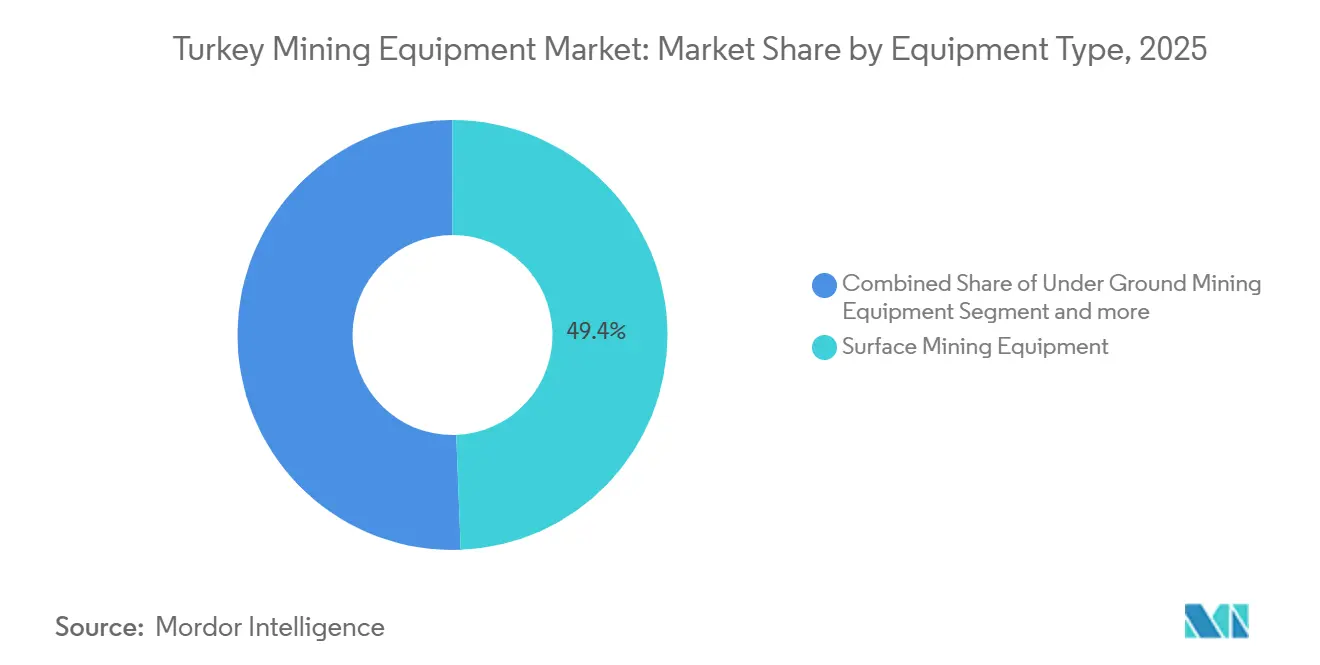
Surface mining equipment held 49.39% of Turkey's mining equipment market share in 2025. Open-pit gold and copper operations support this position across Western Anatolia and other established mining areas, where material movement and processing needs remain closely connected. Quarrying also sustains demand for loaders, drills, breakers, and crushing systems through construction-related activity, especially where local producers supply aggregates and industrial materials. Surface fleets are used across material removal, loading, haulage, and primary processing. This widespread use makes the category important to the Turkish mining equipment market, as operators may depend on surface machines for several linked tasks that must continue uninterrupted throughout the mining and processing cycle. The installed base also supports recurring demand for parts, maintenance, fleet renewal, and practical advice on machine utilization, which is valuable for operators managing varied sites with different material conditions, operating schedules, and maintenance resources.
Underground mining equipment is the fastest-growing equipment category with an 8.82% CAGR through 2031. Deeper development at copper operations and safety investment at underground sites support this direction, while operators also seek equipment that can work reliably with ventilation, monitoring, and ground-support arrangements. Underground fleets need specialized drilling, loading, ventilation, and monitoring equipment, with each system needing to operate reliably in confined, changing conditions. Operators also place more emphasis on machines that can provide reliable operating data and support safer working conditions. Processing equipment remains important because operators increasingly buy connected plant systems rather than isolated machines, allowing suppliers to address several steps in a material flow.


By Automation: Manual Systems Lead While Autonomous Systems Gain Ground
Manual systems were the largest automation category, caturing 72.28% of Turkey's mining equipment market share in 2025. They remain common because many operators use established work practices and have fleets designed around direct machine operation. Manual equipment can also suit smaller sites that lack the infrastructure, technical staff, or communications systems required for advanced controls. Semi-autonomous functions offer a practical middle option for operators that want to improve consistency without replacing the full operating model. Remote control can be useful in selected haulage and drilling tasks where work conditions are difficult, while allowing operators to retain familiar fleet arrangements.
Fully autonomous systems are projected to expand at a 10.59% CAGR through 2031. Safety needs in underground headings are a key driver of operator interest in automated drilling, roof support, and haulage tasks. These systems can reduce worker exposure in areas with challenging ground conditions or operational hazards, while helping operators organize repetitive tasks more effectively and monitor the performance of critical equipment. Their use still depends on training, site connectivity, maintenance skills, and clear operating procedures. Suppliers can support adoption by pairing equipment with training and technical service. The pace of adoption will depend on whether mine operators can build the required workforce and digital capabilities while maintaining equipment availability during the transition.
By Powertrain: ICE Equipment Leads As Battery-Electric Adoption Builds
ICE equipment was the largest powertrain category, accounting for 79.12% of Turkey's mining equipment market share in 2025. It remains widely used because existing fleets, fueling arrangements, spare parts stocks, and maintenance practices are built around conventional machines. Surface operations can continue to use ICE equipment where long operating hours and remote conditions make charging more difficult. Hybrid systems provide another option for operators seeking lower fuel use without changing the complete site infrastructure or moving immediately to a different maintenance model. The choice of powertrain is shaped by mine layout, equipment duty cycles, access to service support, power availability, and the practical ability of a site to accommodate new charging or fueling arrangements.
Battery-electric equipment is projected to expand at a 12.11% CAGR through 2031. Its potential is strongest in underground operations where ventilation, diesel exposure, and heat are operational concerns. Electric equipment can change how operators consider ventilation systems and mine planning. The benefits must be weighed against charging requirements, battery availability, imported-component costs, and the ability of local teams to support new equipment. ABB commissioned mine hoisting systems for Eti Bakır's new underground copper mine in Maden during late 2025, showing continued investment in underground mine infrastructure[3]“ABB Mine Hoists To Support Safe And Efficient Copper Extraction At Eti Bakır's New Underground Mine,” ABB, new.abb.com.
By Power Output: Mid-Capacity Equipment Supports Core Mining Work
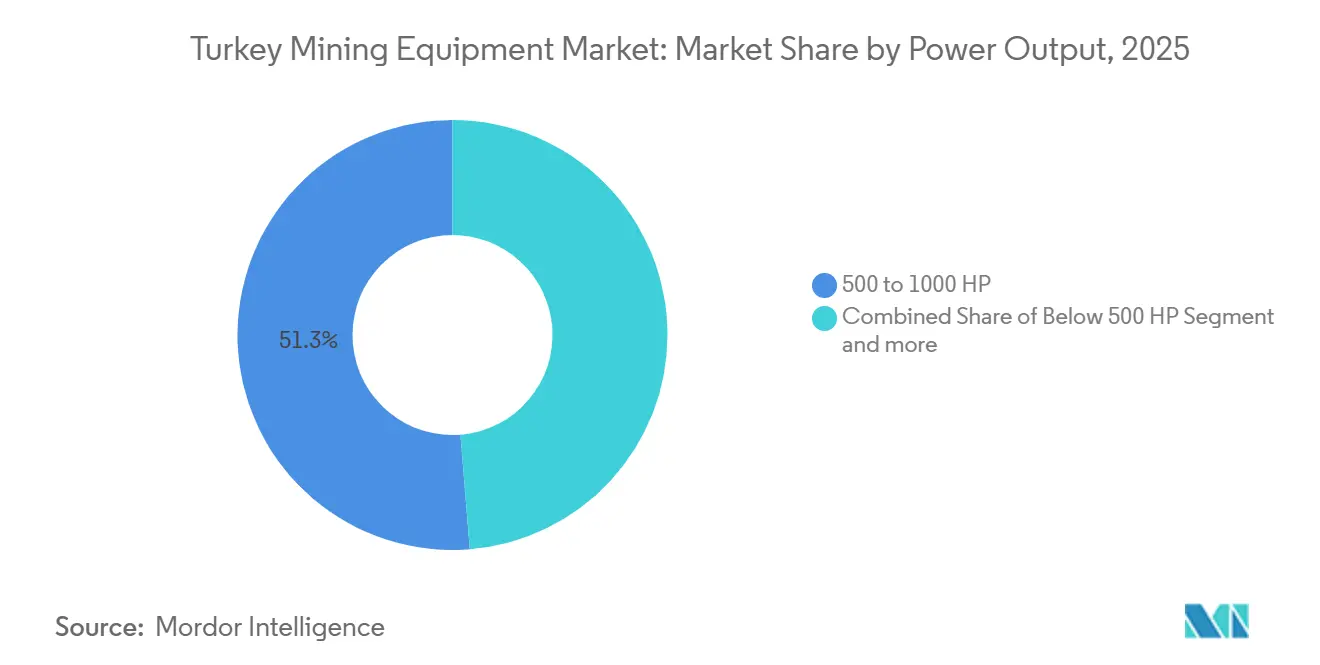
The 500-1,000 HP band held 51.27% of Turkey's mining equipment market share in 2025. This range matches the needs of mid-capacity excavators, crusher drives, mill systems, and large underground loaders used in routine production and processing work. It is relevant to the scale of many Turkish metal mining operations and processing plants. Equipment in this range can support both routine production work and plant expansion, making it relevant to operators with different mine plans. Its broad use also provides dealers with a large base for maintenance and replacement services, as machines in this range are used across several operating stages and may require regular parts support.
Equipment below 500 HP, the fastest growing at 7.55% CAGR, serves quarrying, exploration drilling, narrow-vein development, and smaller mining operations. These machines are valued where maneuverability, transportability, and lower initial commitment are important, particularly for smaller operators and short-duration work. Equipment above 1,000 HP is used at the largest open-pit and processing operations. Demand for that category depends more directly on major project construction, project financing, and processing-plant decisions than on routine fleet replacement. Operators may use rental or leasing arrangements for smaller machines when project conditions are uncertain. This mix allows suppliers to address both large capital projects and shorter-cycle operating needs.
By Application: Metal Mining Leads While Mineral Mining Advances
Metal mining captured 49.31% of Turkey's mining equipment market share in 2025. Gold and copper operations require a wide range of mining, loading, haulage, crushing, and processing equipment. Their needs support demand for high-value systems that are often supplied with technical services, commissioning support, and continuing maintenance arrangements. Open-pit operations can require integrated equipment packages from excavation through material processing, creating a need for suppliers to coordinate machine selection, delivery timing, commissioning, and subsequent field support. Underground copper work requires specialized infrastructure, safety equipment, and reliable technical support throughout the mine's operating life.
Mineral mining applications are projected to expand at a 9.62% CAGR through 2031. Industrial and critical mineral activity can require specialized drilling, beneficiation, separation, and material-handling equipment. These operations may be smaller in scale than major metal mines, but they can require higher-specification equipment for selected processing tasks and material quality requirements. Coal mining has a distinct demand profile that includes underground support, ventilation, and monitoring systems. Its outlook is influenced by energy transition policy and mining conditions. Suppliers that can adapt equipment and service offers to individual applications can address a broader range of customers, from early exploration to established processing sites.
Geography Analysis
The Marmara region serves as the commercial and logistical center of the Turkish mining equipment market. Istanbul supports dealership operations, parts distribution, rental services, and technical support for customers nationwide, linking equipment suppliers with mine sites far from major commercial centers. Bilecik adds direct mining-related demand through processing investment at the Soğüt gold project, while its location also supports links between project areas and the broader Marmara service network. Marmara-adjacent areas also connect suppliers to projects in the Aegean corridor. Their logistics role gives local service networks value beyond the level of mining activity within a single province, since customers can rely on the region for inventory, repairs, training, equipment dispatch, and coordination of specialist support when a mine must address an unexpected technical issue or planned fleet overhaul, while making it easier for operators to schedule preventive maintenance, receive specialist advice, and keep essential machines in service during periods of heavy activity.
Western Anatolia and the Aegean corridor are important areas for open-pit gold and copper activity. Their project base supports demand for excavators, trucks, crushing equipment, and processing systems, with requirements changing as projects move from development to production and plant operations. Commodity price changes are especially relevant because project decisions in these areas are closely connected to metal prices and financing conditions, which can affect project approvals and the size of equipment packages. Central Anatolia has a distinct profile, including exploration drilling, mineral processing, and material handling, offering suppliers opportunities less dependent on large open-pit mine development. Eskişehir and Beylikova are associated with industrial mineral and rare-earth activity, while other provinces contribute to exploration work.
The Black Sea region supports underground coal mining and the equipment needed for longwall work, roof support, ventilation, and gas monitoring, where dependable service is critical due to demanding underground operating conditions. Zonguldak and Bartın remain important locations for these requirements, supporting a continuing need for suppliers familiar with underground safety practices, maintenance planning, and local operating conditions. Eastern Anatolia is gaining relevance for underground copper development, particularly around Elazığ, where mine infrastructure and technical support requirements can differ from those of surface operations. The Maden project shows how underground sites can require advanced mine infrastructure and technical support. The Mediterranean region supports smaller quarrying and industrial-mineral operations that need compact excavation, feeder, conveyor, and crushing equipment, serving a dispersed customer base with varied material and terrain conditions. Together, these areas offer suppliers a national service opportunity rather than a demand base concentrated in a single mining region.
Competitive Landscape
The Turkish mining equipment market is moderately concentrated, led by global equipment suppliers with established local channels. Caterpillar, Komatsu, Epiroc, Sandvik, Hitachi Construction Machinery, and Hidromek participate across different equipment categories. Competition is strongest where operators need reliable service, replacement parts, and specialized technical knowledge, since the cost of a machine outage can be significant for a mine or processing plant. Large suppliers have an advantage when they can support customers across remote mining areas, maintain parts availability, and provide technicians who understand the equipment used at the site. Borusan Cat provides sales, rental, parts, and service support for Caterpillar equipment in Turkey.
Caterpillar's local channel combines equipment supply with rental and parts services, which supports ongoing relationships with operators. MineSpider's work on a digital product passport at the Çataltepe project provides another example of technology being considered alongside mine supply requirements. These actions show that suppliers and project partners are extending their roles beyond the sale of a single machine, linking equipment decisions to safety, operating data, and project-level supply chain requirements. Training, fleet information, safety support, and service coverage can affect customer retention by helping operators use equipment consistently and reducing the burden on internal maintenance teams. Suppliers without a local technical base may find it harder to compete for complex projects, even where their equipment specifications are competitive with those of established suppliers.
Opportunities remain in underground automation, electric equipment support, and specialized mineral processing. These areas require more than just equipment availability; operators also need training, parts, commissioning, maintenance expertise, and confidence that technical support will remain available after the initial equipment delivery. Domestic suppliers can compete in lighter excavation and quarrying where rapid local response is important, especially when smaller operators value accessible service and an understanding of local working practices. International suppliers remain well-placed in large-surface fleets, underground drilling, and advanced rock-processing applications, where established product ranges and global technical experience can support complex customer requirements.
Turkey Mining Equipment Industry Leaders
Caterpillar Inc.
Komatsu Ltd.
Epiroc AB
Sandvik AB
Hitachi Construction Machinery Co., Ltd.
- *Disclaimer: Major Players sorted in no particular order

Recent Industry Developments
- June 2026: Zoomlion showcased its electric excavators, electric loaders, and electric mining dump trucks at KOMATEK 2026, highlighting their energy efficiency, productivity, flexibility, safety, and heavy-duty performance.
- June 2026: SDLG unveiled two models tailored for the Turkish market at KOMATEK 2026, including a pure-electric wheel loader and an excavator for earthmoving, urban construction, and mining infrastructure projects.


Turkey Mining Equipment Market Report Scope
The Turkey Mining Equipment market is segmented by equipment type, automation level, powertrain type, power output, and application.
By Equipment Type, the market is segmented into Surface Mining Equipment, Underground Mining Equipment, Mineral Processing Equipment, Drills & Breakers, Crushing, Pulverizing & Screening Equipment, and Loaders & Haul Trucks. By Automation Level, the market is segmented into Manual, Semi-Autonomous, and Fully Autonomous Equipment. By Powertrain Type, the market is segmented into Internal-Combustion Engine, Battery-Electric Vehicles, and Hybrid Vehicles. By Power Output, the market is segmented into Below 500 HP, 500-1,000 HP, and Above 1,000 HP. By Application, the market is segmented into Metal Mining, Mineral Mining, and Coal Mining.
Market forecasts are provided in terms of Value (USD) and Volume (Units).
| Surface Mining Equipment |
| Underground Mining Equipment |
| Mineral Processing Equipment |
| Drills & Breakers |
| Crushing, Pulverizing & Screening |
| Loaders & Haul Trucks |
| Manual Equipment |
| Semi-Autonomous Equipment |
| Fully Autonomous Equipment |
| Internal-Combustion Engine Vehicles |
| Battery-Electric Vehicles |
| Hybrid Vehicles |
| Below 500 HP |
| 500 - 1,000 HP |
| Above 1,000 HP |
| Metal Mining |
| Mineral Mining |
| Coal Mining |
| By Equipment Type | Surface Mining Equipment |
| Underground Mining Equipment | |
| Mineral Processing Equipment | |
| Drills & Breakers | |
| Crushing, Pulverizing & Screening | |
| Loaders & Haul Trucks | |
| By Automation Level | Manual Equipment |
| Semi-Autonomous Equipment | |
| Fully Autonomous Equipment | |
| By Powertrain Type | Internal-Combustion Engine Vehicles |
| Battery-Electric Vehicles | |
| Hybrid Vehicles | |
| By Power Output | Below 500 HP |
| 500 - 1,000 HP | |
| Above 1,000 HP | |
| By Application | Metal Mining |
| Mineral Mining | |
| Coal Mining |


Key Questions Answered in the Report
What is the current market size and growth rate of the Turkish mining equipment market?
The Turkey mining equipment market size was valued at USD 100.05 million in 2025 and estimated to grow from USD 106.67 million in 2026 to reach USD 146.98 million by 2031, at a CAGR of 6.62% during the forecast period (2026-2031).
Which equipment type leads demand in Turkey?
Surface mining equipment led the equipment-type segment with a 49.39% share in 2025.
Which technology is growing fastest in Turkish mining operations?
Battery-electric equipment is projected to grow at a 12.11% CAGR through 2031, led by its potential use in underground operations.
Why is automation becoming more important in Turkish mines?
Fully autonomous systems are projected to grow at a 10.59% CAGR through 2031 as operators focus on safety, training, and operating consistency.
Page last updated on:


 Your data is secure and never sold or shared.


