
Market Overview
| Study Period | 2020 - 2031 |
|---|---|
| Forecast Data Period | 2026 - 2031 |
| Base Year Market Size (2025) | USD 173.56 Billion |
| Market Size (2026) | USD 183.02 Billion |
| Market Size (2031) | USD 238.63 Billion |
| Growth Rate (2026 - 2031) | 5.45 % |
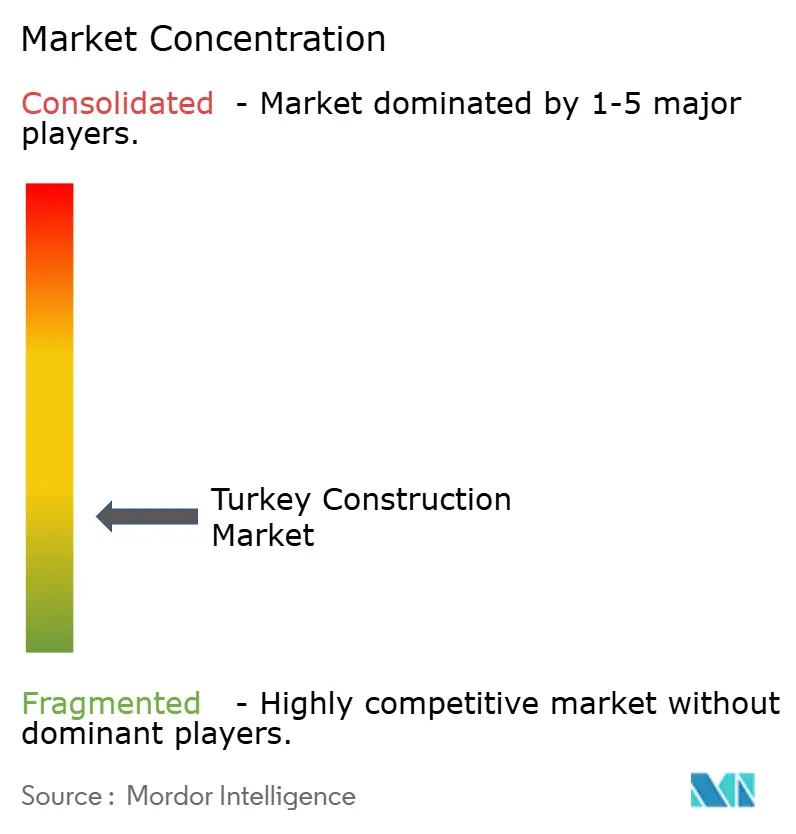
| Market Concentration | Low |
Major Players *Disclaimer: Major Players sorted in no particular order Image © Mordor Intelligence. Reuse requires attribution under CC BY 4.0. | |
Turkey Construction Market Analysis by Mordor Intelligence
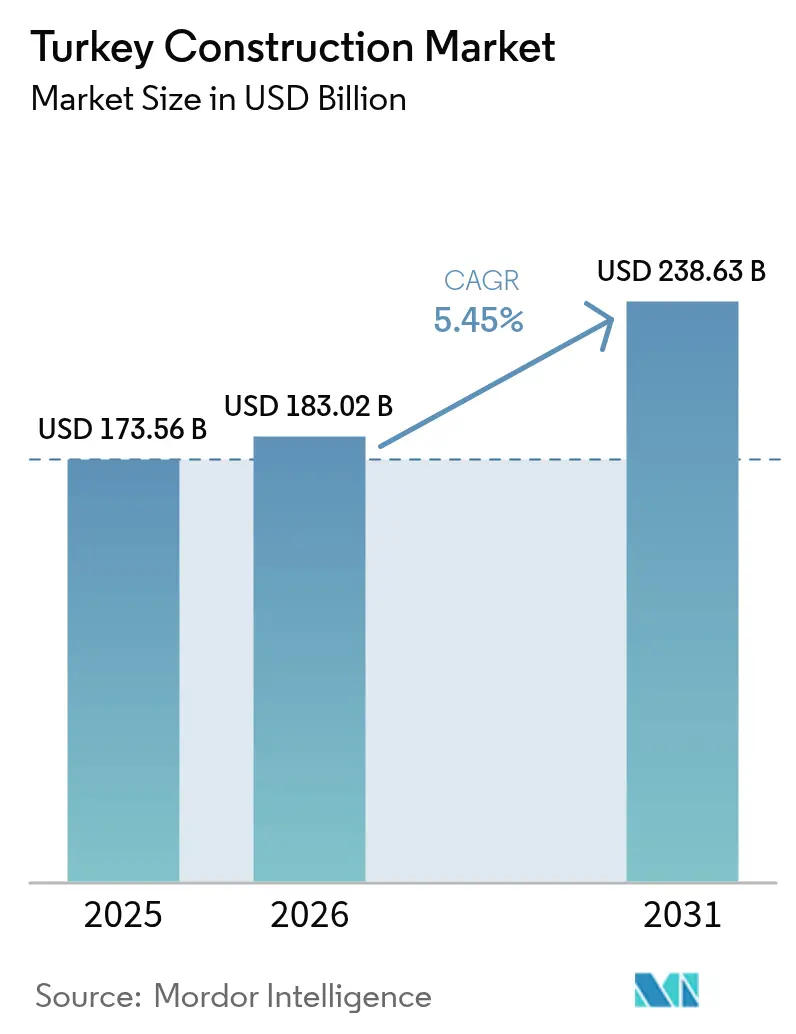
The Turkey construction market size was valued at USD 173.56 billion in 2025 and estimated to grow from USD 183.02 billion in 2026 to reach USD 238.63 billion by 2031, at a CAGR of 5.45% during the forecast period (2026-2031). Multiple tailwinds interact to sustain this trajectory: a USD 46.2 billion public-investment program, record-scale post-earthquake reconstruction, and a widening pipeline of public-private partnerships that already total 270 completed projects worth USD 204 billion. Sector leaders also capitalize on Turkey’s Belt and Road positioning, giving the Turkey construction market unique access to trans-Eurasian trade flows and concessional finance. New seismic codes introduced in 2025 add compliance costs yet simultaneously spur demand for retrofit engineering, while green-cement mandates and ESG-linked loans accelerate uptake of low-carbon building solutions. Further momentum comes from industrial free-zone expansion that compresses permitting time by up to 40%, and a digital-construction push that channels prefabrication to offset skilled-labor shortages.
Key Report Takeaways
- By sector, residential construction led with 61.10% of Turkey construction market share in 2025; infrastructure is set to expand at a 6.92% CAGR to 2031.
- By construction type, new-build activity accounted for 76.35% share of the Turkey construction market size in 2025, while renovation is forecast to progress at a 5.96% CAGR through 2031.
- By construction method, conventional on-site practices held 88.20% of the Turkey construction market size in 2025; prefabricated and modular systems are poised for a 7.64% CAGR over the outlook period.
- By investment source, public funding captured 65.40% of the Turkey construction market share in 2025, whereas private-sector outlays are projected to climb at a 7.41% CAGR to 2031.
- By region, Istanbul commanded 25.80% of the Turkey construction market share in 2025, while the Rest of Turkey region is projected to advance at a 6.78% CAGR through 2031.
Note: Market size and forecast figures in this report are generated using Mordor Intelligence’s proprietary estimation framework, updated with the latest available data and insights as of 2026.
Market Trends and Insights
Drivers Impact Analysis of Turkey Construction Market*
| Driver | (~) % Impact on CAGR Forecast | Geographic Relevance | Impact Timeline |
|---|---|---|---|
| Growing industrial free-zone expansion | +1.2% | Ceyhan, Istanbul, Izmir | Medium term (2-4 years) |
| Surge in green-certified projects & ESG financing | +0.9% | Major metros | Medium term (2-4 years) |
| Rising urban-renewal & earthquake-resilient demand | +0.8% | Istanbul, Ankara, the southeast | Short term (≤ 2 years) |
| Government mega-infrastructure spending pipeline | +0.6% | National corridors | Long term (≥ 4 years) |
| Affordable-housing programs & mortgage subsidies | +0.5% | Nationwide | Short term (≤ 2 years) |
| Source: Mordor Intelligence | |||
Growing Industrial Free-Zone Expansion
Industrial free-zones intensify Turkey’s manufacturing appeal by bundling tax incentives, streamlined permits, and logistics connectivity, all of which expand the Turkey construction market. The Ceyhan Energy Specialized Industrial Zone anchors hydrocarbons processing and trims the nation’s USD 60 billion intermediate-goods import bill. Accelerated approvals that cut development cycles by up to 40% stimulate a continuous flow of factory, warehouse, and utility projects. Foreign investors co-locate suppliers inside zones, magnifying spillover construction demand along the value chain. These clusters dovetail with the 2024-2028 International Direct Investment Strategy, which prioritizes green transformation and supply-chain diversification, ensuring sustained project inflows over the medium term.
Surge in Green-Certified Projects & ESG Financing
Turkey’s 2053 net-zero pledge pushes developers to seek ESG-linked loans that lower borrowing costs in exchange for certified energy performance. The World Bank’s USD 3.2 billion climate framework funds decarbonization measures, while a new Building Sector Decarbonization Roadmap sets zero-carbon standards for all public projects. Cement and steel suppliers confront the EU Carbon Border Adjustment Mechanism, giving rise to green-hydrogen installations targeting 2 GW electrolyzer capacity by 2030. Concurrently, public tenders now require reduced-clinker cement beginning January 2025, channeling R&D toward alternative binders. These converging forces embed sustainability as a core selection criterion across the Turkey construction market[1].
Rising Urban-Renewal & Earthquake-Resilient Demand
Turkey has launched the world’s largest seismic retrofit program, targeting 6.7 million vulnerable structures after the 2023 quakes. Istanbul’s ‘Yarısı Bizden’ campaign offers grants up to USD 54,000 per dwelling, sparking 21,000 active construction sites and 41,000 pipeline projects. Updated performance-based codes elevate building costs by 15-25% but open premium niches for specialized structural engineers. World Bank financing of EUR 219.4 million links resilience with energy efficiency, so upgrades now encompass insulation, HVAC, and renewable integration, broadening revenue layers for contractors. These combined policies turn urban renewal into a multi-decade construction growth engine.
Government Mega-Infrastructure Spending Pipeline
An explicit state objective is to lift motorway stock to 4,728 km by 2028 while devoting 49% of infrastructure outlays to rail in 2024. Flagship projects such as the USD 594 million Orient Express high-speed rail line, co-funded by the EU, embed EU-grade standards in local contracts. Strategic road-bridge packages have already delivered 488 km of bridges since 2003, a 157% surge, reinforcing regional connectivity. The Twelfth Development Plan aligns these ventures to green and digital mandates, ensuring that future bids stipulate low-carbon materials, BIM coordination, and smart-asset management. Continuous mega-project flow sustains multi-year backlog visibility for tier-one contractors.
Restraints Impact Analysis of Turkey Construction Market*
| Restraint | (~) % Impact on CAGR Forecast | Geographic Relevance | Impact Timeline |
|---|---|---|---|
| Volatile lira driving material-import inflation | –0.7% | Import-dependent areas | Short term (≤ 2 years) |
| Tight monetary policy is dampening housing demand | –0.5% | Istanbul & Ankara | Short term (≤ 2 years) |
| Contractor insolvency & payment-delay risks | –0.4% | Small-contractor clusters | Medium term (2-4 years) |
| Source: Mordor Intelligence | |||
Volatile Lira Driving Material-Import Inflation
Turkey sources nearly 40% of its construction inputs abroad, making projects sensitive to currency swings. Lira depreciation amplifies steel, aluminum, and mechanical-equipment costs, compressing margins on fixed-price contracts. Hedging and escalation clauses offer partial relief yet can erode competitiveness in public tenders. Elevated inflation forecast at 43% for 2024 adds further strain by lifting domestic logistics and labor expenses. Some contractors localize supply or invest in domestic plants, but these capital-intensive moves dilute balance-sheet flexibility in the near term.
Tight Monetary Policy Dampening Housing Demand
Aggressive interest-rate hikes reduce mortgage affordability, causing a 6% decline in national home sales during Q2 2024. Developers counter by extending installment plans and partnering with banks to offer below-market loan packages, but overall absorption rates remain below pre-tightening levels. Istanbul is disproportionately affected, holding 40.6% of the national housing surplus, whereas interior provinces fare better due to reconstruction demand. Prolonged credit constraints could delay new residential starts, although retrofit activity partially compensates by targeting existing stock rather than new units. Market sentiment hinges on inflation moderation and eventual monetary easing.
*Our forecasts treat driver/restraint impacts as directional, not additive. The impact forecasts reflect baseline growth, mix effects, and variable interactions.
Turkey Construction Market Segment Analysis
By Sector:
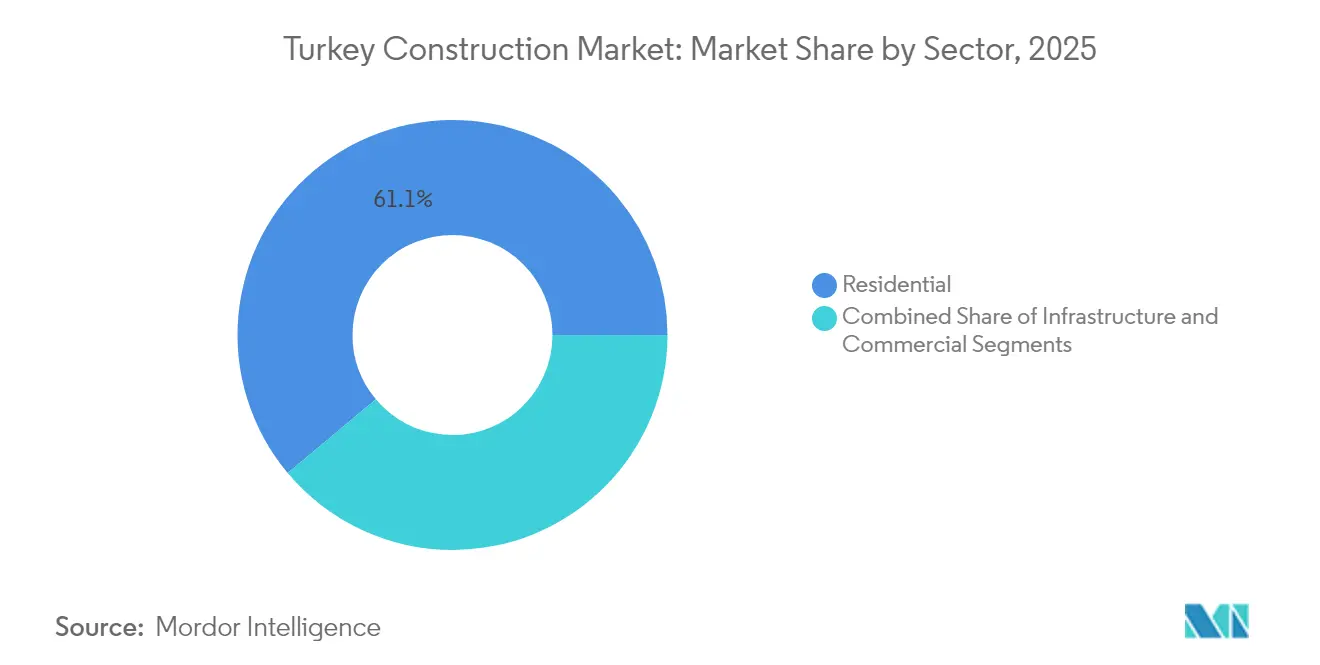
Infrastructure Outpaces Residential DominanceInfrastructure construction accounted for 31.05% of Turkey construction market size in 2025, whereas residential commanded a larger 61.10% share. Yet infrastructure is projected to be the fastest-growing with a 6.92% CAGR through 2031, powered by highway extensions, high-speed rail lines, and energy corridors. Government outlays of USD 16.3 billion for transport alone in the 2025 investment program validate sustained work pipelines. Contractors active in road, rail, and bridge packages gain from multi-year contracts that shield workflows against cyclical housing soft patches.
Rapid scale-up of energy infrastructure adds further depth. The Akkuyu nuclear project’s four 1,200 MW reactors, slated for phased commissioning in 2025, anchor a multi-billion-dollar construction scope. Renewable expansion complements baseload capacity, with utility-scale solar parks and wind clusters embedding smart-grid interfaces. Logistics construction inside industrial free-zones rounds out the opportunity set, while commercial offices in Istanbul gradually pivot toward green-certified retrofits anchored by LEED and BREEAM protocols. Together, these sub-sectors inject diversified volume, reinforcing the upward trajectory of the Turkey construction market.

By Construction Type:
Renovation Becomes a Strategic PriorityNew-build projects held 76.35% of Turkey construction market share in 2025, but renovation is forecast to post a 5.96% CAGR to 2031, mirroring mandated seismic upgrades. The Turkish Building Earthquake Code of 2018 and the 2025 enforcement directive make retrofit compliance obligatory for structures erected before 2000. Istanbul’s ‘Yarısı Bizden’ program alone has catalyzed 106,000 funding applications that translate into USD 69 million in committed works. Shorter permitting cycles for retrofit approvals are now down to six months, accelerating cash conversion for contractors specializing in structural reinforcement.
Retrofit complexity, encompassing base isolation, carbon-fiber wrapping, and HVAC re-specification, commands higher margins than standard shell-and-core construction. World Bank-co-financed energy-efficiency upgrades piggyback on seismic scopes, bundling insulation, glazing, and rooftop solar into single contracts. Although material input inflation challenges cost control, renovation timescales are typically shorter than ground-up builds, limiting exposure to exchange-rate volatility. As a result, renovation forms a counter-cyclical buffer, stabilizing the Turkey construction market during housing-credit slowdowns.
By Construction Method:
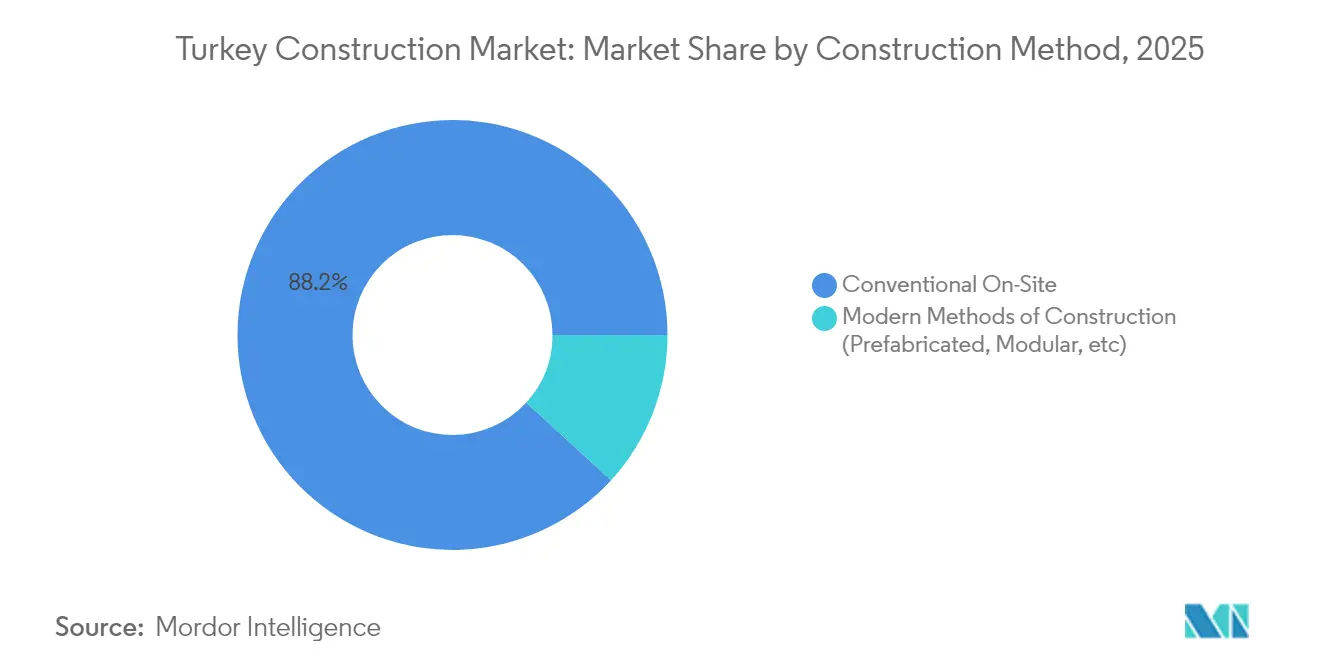
Prefabrication Edges into MainstreamConventional on-site techniques represented 88.20% of Turkey construction market size in 2025; nonetheless, prefabricated and modular systems are poised for a 7.64% CAGR through 2031. Labor shortages and the need for stricter quality control make factory-assembled components attractive, especially in seismic-risk zones where uniform structural integrity is critical. Modular housing can cut schedule duration by 40% while meeting code-mandated performance criteria, a crucial benefit for post-quakes rapid rehousing.
Digitalization is the keystone of modern methods. Building Information Modeling facilitates clash detection before factory production, curbing rework rates. Early movers such as ENKA have piloted hybrid steel-modular units on both domestic and export contracts, signaling an industry shift toward design-for-manufacture. Regulatory bodies have updated approvals to recognize modular standards, reducing certification bottlenecks. Long term, rising adoption of robotics and AI-driven quality inspection across precast yards will narrow the cost differential with conventional builds, increasing the penetration of modern methods in the Turkey construction market.
By Investment Source:
Private Capital Accelerates Under ESG LensPublic funding controlled 65.40% of the 2025 Turkey construction market share, but private investment is forecast to expand at a 7.41% CAGR to 2031. ESG-linked instruments unlock lower interest coupons for green-certified schemes, stimulating commercial developers to exceed baseline sustainability thresholds. World Bank blended-finance mechanisms crowd in private lenders by offering first-loss guarantees tied to carbon-reduction metrics. High-yield prospects in premium residential and office assets, where rent premiums of 15-20% are achievable for certified buildings, further incentivize private allocation.
Public-private partnership (PPP) structures remain a mainstay, covering hospitals, transport corridors, and renewable plants. Turkey’s 270 completed PPPs valued at USD 204 billion showcase mature risk-sharing templates. Equity sponsors increasingly blend mezzanine tranches to optimize capital structures, while construction contractors take minority stakes to secure EPC backlogs. As green-taxonomy rules tighten in Europe, Turkish developers aim to future-proof assets through design alignment, ensuring continued access to cross-border capital pools.
Geography Analysis
Istanbul captured 25.80% of the Turkey construction market in 2025, underpinned by its role as the nation’s finance and logistics nucleus. Its skyline continues to densify through high-rise residential and Grade-A office towers, yet the city also leads retrofitting volume with 21,000 active seismic-upgrade sites. Housing oversupply has eased rents, prompting developers to pivot toward mixed-use and hospitality conversions, while the new mandatory green-cement rule raises material compliance costs that premium projects can absorb.
Ankara and Izmir follow as secondary hubs, benefiting from decentralization incentives that steer government ministries and corporate back offices away from Istanbul. Metro extensions and ring-road upgrades expand urban footprints, spurring suburban housing and retail plazas. Izmir, with its coastal tourism focus, registers higher hotel occupancy conversions, whereas Ankara’s knowledge-economy tilt drives demand for technology parks and research facilities. Both cities leverage smart-city pilots that integrate IoT sensors for traffic and energy management.
Provinces in the southeast represent the fastest-growing geography at a 6.78% CAGR through 2031, driven by massive reconstruction grants and industrial-zone rollouts. Free-zone policy spreads to Gaziantep and Şanlıurfa, triggering demand for logistics sheds and supplier campuses. Rural-urban migration across Anatolia supports incremental residential starts, and donor-funded educational and healthcare facilities round out social infrastructure needs. Collectively, these regional flows balance the Turkey construction market, mitigating reliance on Istanbul while accelerating convergence between core and periphery.
Regulatory Landscape
Turkey’s construction framework is primarily overseen by the Ministry of Environment, Urbanisation and Climate Change (CSB), which sets building standards, manages urban transformation, and oversees construction supervision. Compliance expectations are being tightened under the urban-renewal agenda, with Law No. 6306 (Urban Transformation) and contractor oversight under Law No. 4708 (Building Inspection), alongside procurement rules that determine eligibility for public works. For 2026 public tenders, contractor performance evaluation coefficients and completion-certificate parameters were formalized during February 2026, changing bid participation criteria.
Compliance is increasingly standards and documentation-led, with construction products governed by the Construction Materials Regulation (including CE-marking where harmonized European standards apply). A national conformity route also applies for products outside harmonized coverage, using the G Certificate, and technical baselines are anchored by the Turkish Standards Institution (TSE), which commonly transposes EN standards. On permitting, digital submission via the Electronic Project Management System Platform (e-PYS) is being embedded into approvals, and BIM-aligned information management is referenced through TS ISO 19650-1 and TS ISO 19650-2, reinforcing the push toward verifiable digital records across design-to-permit workflows.
Value Chain Analysis
Turkey’s construction value chain spans land assembly and planning approvals, design and engineering, contractor procurement and execution, and downstream commissioning and facility operations. Project pipelines are set by developers, state sponsors, and PPP authorities, while large contractors coordinate multi-package delivery with specialist subcontractors across structural, MEP, and fit-out scopes. Turkish contractors also leverage cross-border work to build domestic capability, winning 316 projects worth USD 28.6 billion across 57 countries in 2024. After the earthquake-driven reconstruction and urban transformation program, demand for seismic engineering, testing, and inspection services increases, which lifts the importance of documentation, compliance, and construction supervision.
Materials and equipment suppliers influence both cost and schedule outcomes, particularly where import sensitivity affects availability and lead times. The construction materials industry is a major industrial base, recording USD 32.1 billion in exports in 2025 (12% of national exports) and employing about 2 million people (6.4% of total employment), while ready-mix concrete remains central to on-site delivery, with the sector reporting around TRY 293 billion turnover in 2025. Execution interfaces are also influenced by regulatory changes, including amendments published in the Official Gazette on 1 July 2026 that updated the Planned Areas Zoning Regulation, affecting licensing procedures and calculation rules and, in turn, design cycles, approval cadence, and contractor coordination during mobilization.
Competitive Landscape
Turkey's construction market displays moderate fragmentation: the top five firms collectively hold a moderate percentage of the revenue share, leaving ample space for specialized mid-tier players. Leading contractor ENKA leverages strong balance-sheet liquidity to secure EPC contracts in power and petrochemicals domestically and overseas, recently lifting its order book to USD 5.8 billion. Rönesans pursues a design-build-operate model across healthcare PPPs, streamlining lifecycle costs that appeal to government sponsors. Domestic alloy-steel supplier Tosyalı invests in green hydrogen to align with low-carbon mandates, locking in material demand from public projects.
International diversification is a hallmark competitive move. Turkish firms completed 1,800 African projects worth USD 85 billion in 2023, exporting turnkey know-how while buffering lira volatility. Experience with FIDIC contracts and multilateral lenders allows these companies to pivot among markets as currency or demand shifts occur. Conversely, smaller local builders struggle with rising performance-bond premiums and payment delays, occasionally resorting to joint ventures with larger peers to access financing[3].
Digital capabilities emerge as a new battleground. Early adopters deploy BIM-enabled quantity takeoffs and drone-based site analytics that shorten procurement lead times. Prefabrication entrants partner with machinery manufacturers to improve line automation and reduce cycle times. Meanwhile, legal reforms targeting time-bound permit issuance compress competitive advantage windows, rewarding firms that can mobilize quickly. Overall, rivalry favors players able to harmonize cross-border pipeline, technology investment, and sustainability credentials.
Turkey Construction Industry Leaders
-
Rönesans Holding (Renaissance Construction)
-
Limak İnşaat
-
ENKA İnşaat ve Sanayi A.Ş.
-
TAV Construction
-
Alarko Contracting Group
- *Disclaimer: Major Players sorted in no particular order
Turkey Construction Market Companies Covered in this Report
- Rönesans Holding (Renaissance Construction)
- Limak İnşaat
- ENKA İnşaat ve Sanayi A.Ş.
- TAV Construction
- Alarko Contracting Group
- Polimeks İnşaat
- Cengiz İnşaat Sanayi ve Ticaret A.Ş.
- Yapı Merkezi İnşaat
- Kolin İnşaat
- Nurol Construction & Trading Co.
- Mapa İnşaat
- Tekfen İnşaat
- Kalyon İnşaat
- İÇTAŞ İnşaat
- Ant Yapı
- Gap İnşaat
- STFA Construction Group
- Onur Taahhüt
- Gama İnşaat
- Rönesans Endüstri Tesisleri
Market Opportunities and Future Outlook
Public investment intensity and multilaterally financed transport programs create clear demand channels for contractors and suppliers that can meet financing-linked technical and ESG conditions. The 2026 Public Investment Program published by the Presidency of Strategy and Budget (SBB) earmarked TRY 1.92 trillion (about USD 44.36 billion) for 13,887 public projects, with earthquake-related projects receiving TRY 697 billion and allocations concentrated in health, education, and residential rebuilding. These funds support rapid-delivery social infrastructure, standardized school and hospital packages, and reconstruction-linked utilities where schedule certainty and audited quantities are prioritized.
Major rail and corridor works are backed by international funding, expanding the addressable scope for rail civils, tunnels, systems interfaces, and logistics-enabling structures. In March 2026, the World Bank approved a USD 2 billion loan for the Istanbul North Rail Crossing Project (INRAIL) under a coordinated USD 6.75 billion financing package with other multilaterals, and procurement activity began under the Ministry of Transport and Infrastructure for the 127-km greenfield line. The 2026 Presidential Annual Program points to a twin construction shift toward green and digital contracting, with BIM-enabled delivery, AI-based monitoring, and low-carbon material substitution incorporated into public contracting and standards compliance.
Recent Industry Developments in Turkey Construction Market
- March 2026: Rönesans Holding partnered with SJ Group to manage the Eastern Mediterranean Petrochemical Industrial Zone and Port (DAPEK) in Ceyhan, Adana, a 2,750-hectare industrial and logistics hub. The arrangement connects a zone-and-port development model with operational management capability, widening downstream construction demand across utilities, logistics, and petrochemical-linked facilities. It also supports Ceyhan’s positioning for energy and industrial investments that feed multi-year construction packages.
- December 2025: ENKA Insaat signed a contract with Central Termica De Temane S.A. for construction works and services for the 456 MW Temane Independent Power Plant in Mozambique, with a 23-month schedule. The award adds power EPC execution to ENKA’s active portfolio, supporting utilization of engineering and procurement capabilities relevant to Turkey’s energy and utilities buildout. It also strengthens the contractor’s reference base in complex power plant delivery, where quality, safety, and schedule controls are key differentiators.
- April 2024: ENKA Insaat signed contracts with Tupras for the Propylene Splitter Project at the Izmit and Izmir refineries, advancing Turkey's refinery modernization program. The contracts expand ENKA's industrial construction backlog in high-spec process facilities and strengthen capabilities in mechanical, electrical, and instrumentation subcontracting.
Turkey Construction Market Report Scope and Research Methodology
Market Definition and Coverage
For this study, the market covers the total value of construction work delivered within Turkey across major building and civil works activity, counted when on-the-ground execution happens and value is recognized by project owners and contractors.
Scope exclusions: We exclude construction activity delivered by Turkish contractors outside Turkey and we do not treat standalone real estate transactions (land and building sales) as construction market value.
Segments Covered in This Report
- By Sector
- Residential
- Apartments/Condominiums
- Villas/Landed Houses
- Commercial
- Office
- Retail
- Industrial and Logistics
- Others
- Infrastructure
- Transportation Infrastructure (Roadways, Railways, Airways, others)
- Energy & Utilities
- Others
- Residential
- By Construction Type
- New Construction
- Renovation
- By Construction Method
- Conventional On-Site
- Modern Methods of Construction (Prefabricated, Modular, etc)
- By Investment Source
- Public
- Private
- By Region
- Istanbul
- Ankara
- Izmir
- Rest of Turkey
Data Sources, Market Sizing, and Validation
Desk Research
Desk work starts with building a fact base on construction activity and spending signals in Turkey, then mapping them into a consistent value model. Public sources are used to anchor the demand pool and timing, including Turkish Statistical Institute releases on building permits and construction indices, the Central Bank of the Republic of Turkey for macro variables, and the Ministry of Treasury and Finance for budget and public investment direction.
We also refer to sources such as the Ministry of Environment, Urbanization and Climate Change for urban renewal and permitting context, the Ministry of Transport and Infrastructure for transport project plans, and international bodies such as the World Bank and OECD for cross-checkable macro series. To align company-level disclosures with the market model, we review filings, investor presentations, and reputable press coverage, and we can use a paid subscription for company financials and intelligence when financial line items need standardization. The sources listed here are illustrative, and additional references were used to collect data, validate it, and clarify assumptions.
Primary Interviews and Surveys
Primary work is used to test what the desk model implies versus what is happening in tendering, pricing, and project execution across Turkey. We speak with contractors, developers, engineering and project management stakeholders, and materials and equipment-linked participants, then we validate differences by geography (Istanbul and other large cities versus the rest of the country) and by public versus private funding patterns.
Distribution of primary research fieldwork respondents
| Company type | Respondent position |
|---|---|
| Top tier: 31% | CXOs: 15% |
| Mid tier: 48% | Functional/Unit leaders: 33% |
| Smaller Players: 21% | Managers: 52% |
Market-Sizing & Forecasting
We size the market mainly using a top-down build that reconstructs annual construction value from Turkey-specific activity signals and investment flow indicators, then we check the result against selective bottom-up approximations to keep totals realistic. Those cross-checks include sampled project pipeline value by sector, a volume times pricing lens for common work types, and channel checks on capacity utilization to identify gaps.
Key inputs used in the model include building permits and permitted floor area trends, public infrastructure budget allocations and tender pace, residential renewal momentum, construction cost and wage inflation, and the expected mix shift between new build and renovation work. When the forecast is prepared, scenario analysis is applied around macro drivers such as interest rates, currency movements, and public capex prioritization, and scenario weights are adjusted based on what interviewees describe as most likely. Where bottom-up signals are thin for smaller geographies or informal work, we scale using region-level construction indices and apply conservative ranges, then we narrow them after follow-up validation.
Data Validation & Update Cycle
Outputs are validated through structured checks so the final number stays consistent with real-world signals. We compare the modeled total against independent indicators like permit momentum, tender announcements, and cost indices, then we re-check any unusual jumps by sector or region before internal sign-off.
If a variance is found, assumptions are revisited, and respondents may be re-contacted to confirm whether it is a one-off timing issue or a real step change in activity. Reports are refreshed annually, and interim updates are triggered when material events occur, including large policy shifts, major reconstruction programs, or sharp currency moves. Before delivery, we run a final analyst pass so clients receive the most current view available at the time.
Mordor Intelligence's Turkey Construction Market Size Versus Other Published Estimates
Published market values for Turkey construction often differ because the scope and timing rules are not uniform across publishers, and currency handling is also not consistent. Differences usually show up around whether renovation work is included, how public infrastructure is treated, and whether values reflect executed work or only planned project awards.
Another common gap driver is the price logic used to convert local-cost inflation into USD values, since construction input costs can move faster than general inflation. Some estimates lean on optimistic project pipeline assumptions without checking delivery slippage, while others use a conservative case that understates recovery periods after policy shifts. The spread shown below is mainly explained by how adjacent activities are counted and how often assumptions are refreshed, which is handled with tighter execution-linked checks in Mordor Intelligence.
Benchmark comparison
| Source | Market Size | Gaps in Research Methodology |
|---|---|---|
| Mordor Intelligence | USD 173.56 B (2025) | |
| Industry Databook A | USD 45.90 B (2025) | This figure appears to be anchored to a narrower set of building construction categories and may not fully capture civil works like transportation and energy infrastructure, which lowers the total. It also likely relies on a fixed local-currency series with a simplified USD conversion, which can compress values in volatile FX periods. |
| Trade Journal B | USD 28.60 B (2024) | This number aligns with overseas project awards by Turkish contractors, which is a different demand pool than domestic construction executed inside Turkey. Because it reflects contract values for external markets and a single-year award flow, it is not directly comparable to an in-country construction output measure. |
The table shows that scope alignment matters more than minor modeling differences, because mixing domestic output with overseas awards or limiting to a subset of building types changes the total quickly. By keeping the market tied to construction executed within Turkey, and then checking it against permits, public capex signals, and execution timing, the resulting value stays traceable and repeatable year to year.
Key Questions Answered in the Report
What is the 2026 value of the Turkey construction market?
The sector is valued at USD 183.02 billion in 2026, reflecting its post-earthquake reconstruction momentum.
How fast will Turkey’s construction sector grow through 2031?
It is forecast to post a 5.45% CAGR, climbing to USD 238.63 billion by 2031.
Which segment grows fastest within Turkish construction?
Infrastructure shows the steepest outlook with a projected 6.92% CAGR to 2031, fueled by highways and rail corridors.
Why is renovation gaining importance in Turkey?
Mandatory seismic retrofitting for 6.7 million buildings and energy-efficiency funding from the World Bank make renovation a rising strategic priority.
How do green-cement rules affect contractors?
Starting 2025 public tenders require low-clinker cement, compelling suppliers to invest in alternative binders and contractors to adjust mix designs.
What keeps Istanbul dominant despite regional diversification?
The city’s role as the financial and logistics hub, coupled with premium commercial and residential projects, sustains its 25.80% market share despite policy moves to spread growth.