
Tungsten Carbide Powder Market Size and Share
Market Overview
| Study Period | 2020 - 2031 |
|---|---|
| Market Size (2026) | USD 17.06 Billion |
| Market Size (2031) | USD 21.74 Billion |
| Growth Rate (2026 - 2031) | 4.98 % |
| Fastest Growing Market | Asia Pacific |
| Largest Market | Asia Pacific |
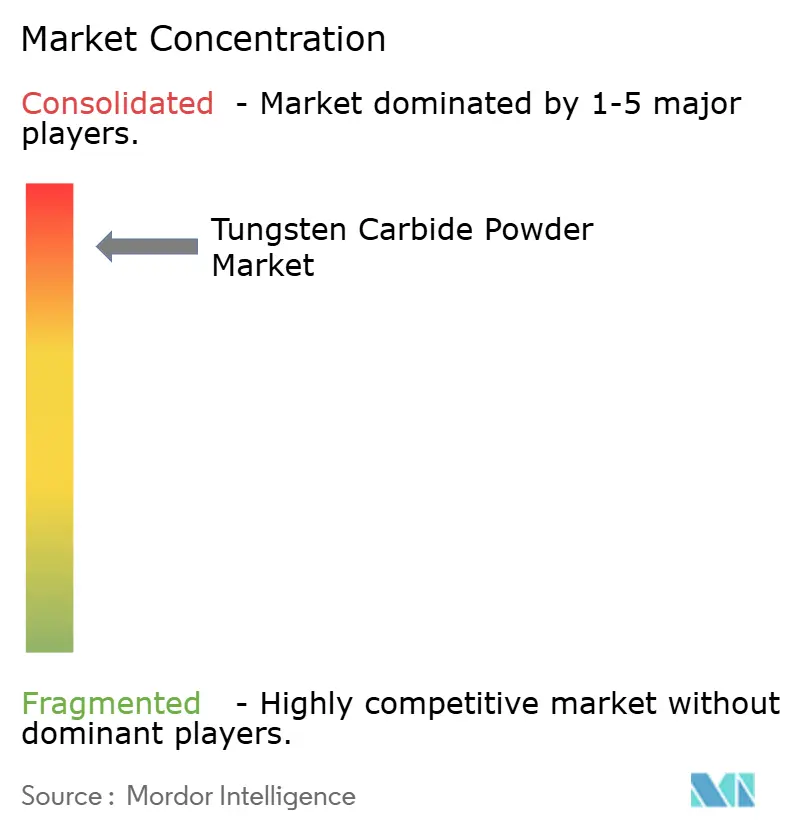
| Market Concentration | High |
Major Players *Disclaimer: Major Players sorted in no particular order Image © Mordor Intelligence. Reuse requires attribution under CC BY 4.0. | |
Tungsten Carbide Powder Market Analysis by Mordor Intelligence
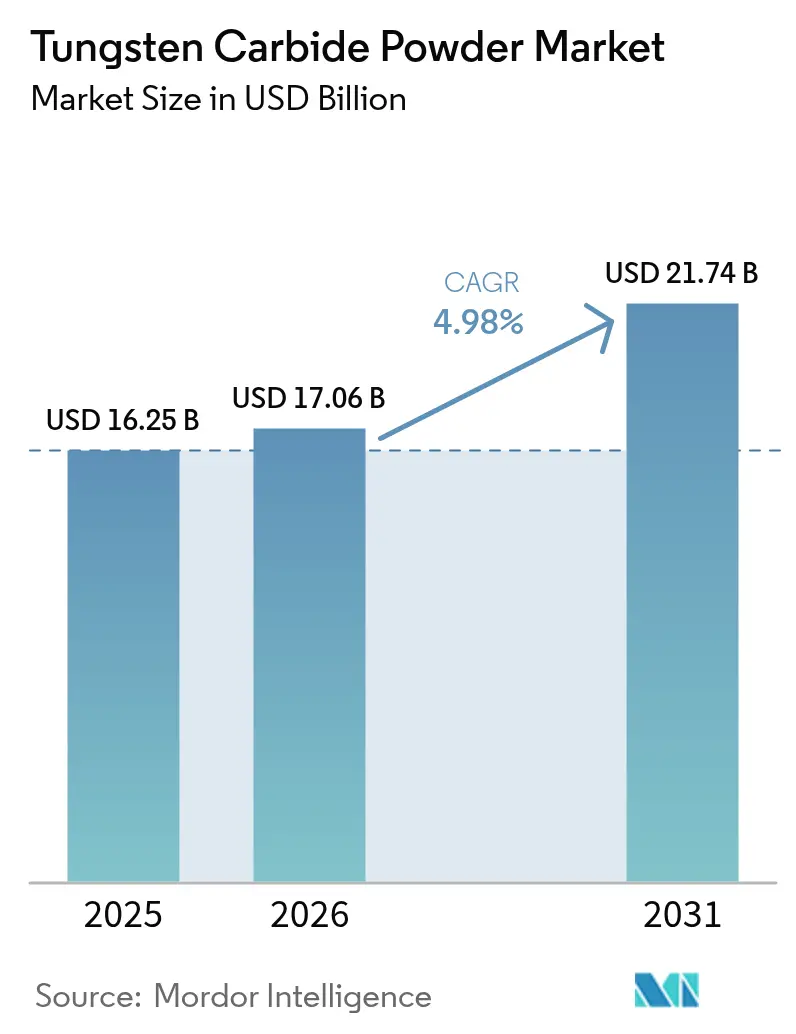
The tungsten carbide powder market size was valued at USD 16.25 billion in 2025 and estimated to grow from USD 17.06 billion in 2026 to reach USD 21.74 billion by 2031, at a CAGR of 4.98% during the forecast period (2026-2031). Sustained capital spending on precision machining, mining equipment, and advanced medical instruments keeps demand resilient even as raw-material prices fluctuate. Growing electrification of transport, expanding renewable-energy installations, and widening adoption of additive manufacturing continue to pull the tungsten carbide powder market into new, higher-value applications. Governments in the United States, Canada, and Australia are underwriting critical-mineral projects, which stabilize long-term supply expectations and support capacity ramp-ups by established powder producers. At the same time, Chinese export controls and six-year-high ammonium paratungstate prices heighten procurement risk, prompting end users to diversify suppliers and favor recycled material streams.
Key Report Takeaways
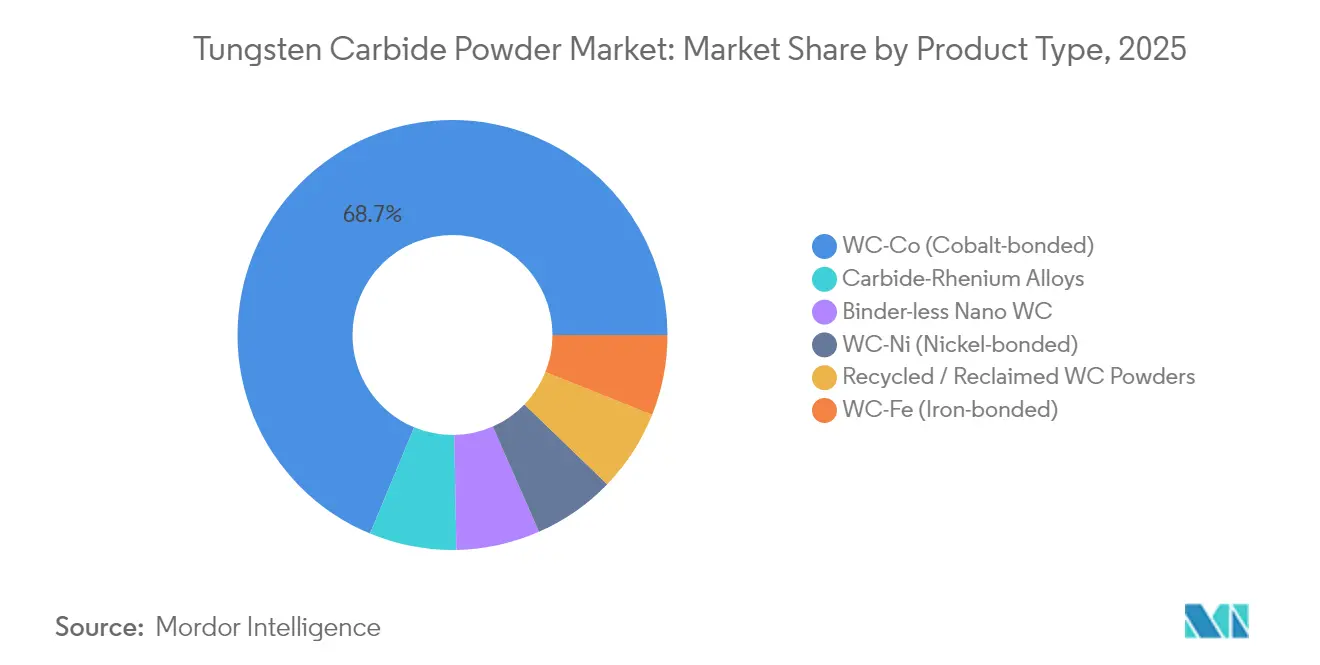
- By product grade, WC-Co (Cobalt Bonded) maintained 68.74% share of the tungsten carbide powder market in 2025; carbide-rhenium alloys register the highest projected CAGR at 6.08% to 2031.
- By application, machining tools held 35.74% of the tungsten carbide powder market share in 2025; other applications, led by additive manufacturing and thermal-spray coatings, are forecast to expand at a 5.92% CAGR through 2031.
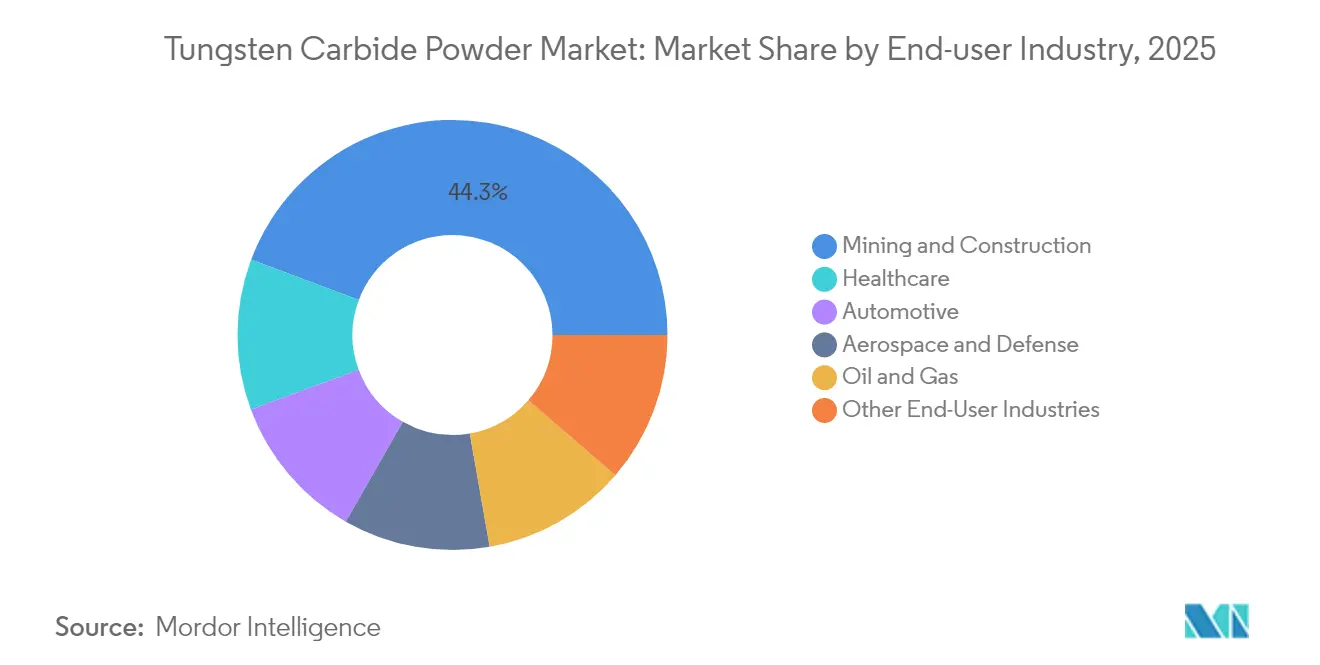
- By end-user industry, mining and construction commanded 44.29% of the tungsten carbide powder market size in 2025, while healthcare records the fastest growth path at 6.10% CAGR to 2031.
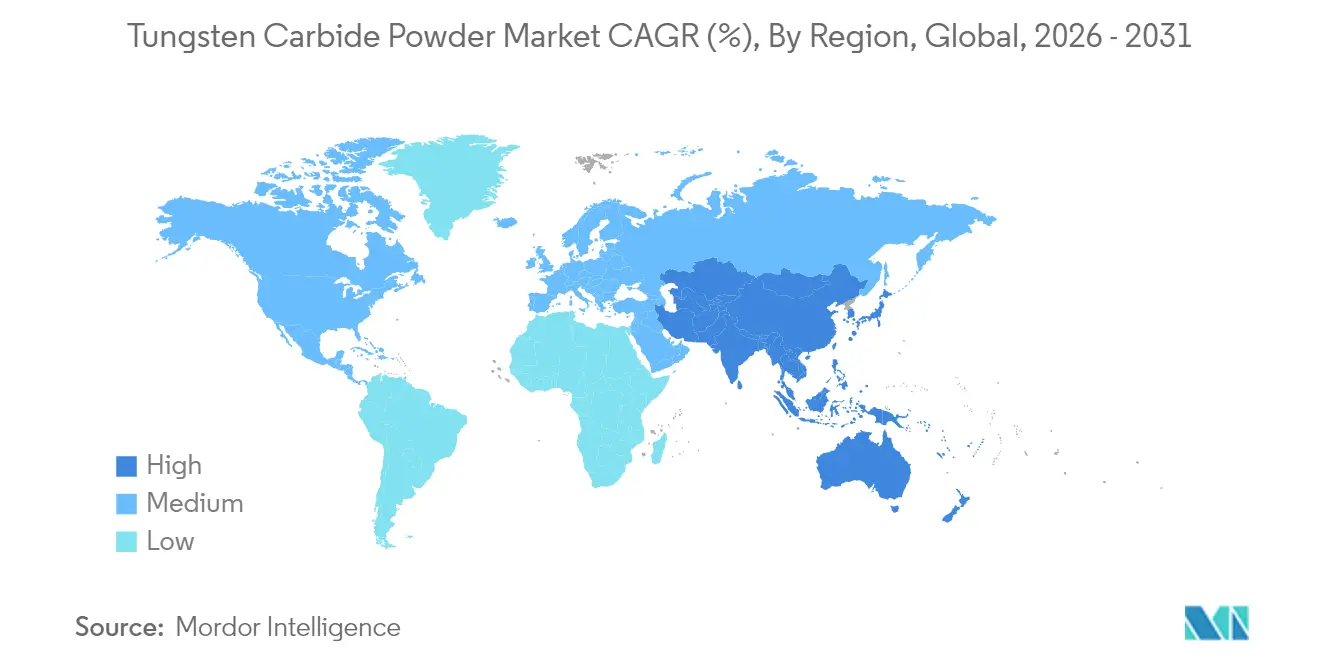
- By geography, Asia-Pacific accounted for 53.82% of 2025 revenue and is poised to lead expansion with a 6.36% CAGR during the forecast window.
Note: Market size and forecast figures in this report are generated using Mordor Intelligence’s proprietary estimation framework, updated with the latest available data and insights as of 2026.
Market Trends and Insights
Drivers Impact Analysis of Tungsten Carbide Powder Market*
| Driver | (~) % Impact on CAGR Forecast | Geographic Relevance | Impact Timeline |
|---|---|---|---|
| Surging demand for precision cutting and machining tools | 1.5% | Global, with a concentration in Asia-Pacific and North America | Medium term (2-4 years) |
| Rapid expansion of EV and renewable energy component machining | 0.8% | North America, Europe, China | Short term (≤ 2 years) |
| Shift toward wear-resistant powders in oil-sand and fracking equipment | 0.7% | North America, Middle East | Long term (≥ 4 years) |
| Integration of tungsten carbide powders in high-speed additive manufacturing | 0.6% | Global, early adoption in developed markets | Medium term (2-4 years) |
| Government-funded critical minerals and defense stockpiling programs | 0.4% | North America, Europe, Australia | Long term (≥ 4 years) |
| Source: Mordor Intelligence | |||
Surging Demand for Precision Cutting and Machining Tools
Manufacturers facing ever-tighter tolerances rely on tungsten carbide inserts to preserve edge integrity during high-speed operations. Longer tool life limits unplanned stoppages and supports continuous, lights-out production. In CNC environments connected through Industry 4.0 networks, consistent insert performance is essential for predictive-maintenance algorithms that trigger tool changes only when statistically justified. Recent TiC surface-engineering techniques have raised Vickers hardness from 1,317 HV30 to 1,496 HV30, extending wear intervals in mass-production lines. Demand clustering in Asia-Pacific and the United States anchors short-term volume growth for the tungsten carbide powder market.
Rapid Expansion of EV and Renewable Energy Component Machining
Battery housings, e-motor shafts, and power-electronic enclosures require micro-tolerance machining that favors cemented-carbide tooling. Wind-turbine gearboxes and solar-tracker drive units add a steady stream of hardened-steel components that conventional HSS tools cannot machine economically. Oak Ridge National Laboratory recently printed crack-free tungsten structures with an electron-beam process, signaling a pathway to fusion-reactor and extreme-environment parts that will use high-purity powder feedstock[1]. Localized EV supply chains in North America and Europe translate that technical success into regional pull for the tungsten carbide powder market.
Shift Toward Wear-Resistant Powders in Oil-Sand and Fracking Equipment
Horizontal wells and oil-sand slurry pipelines impose abrasive loads that can triple maintenance outlays when inferior materials fail. Tungsten carbide-coated drill sleeves extend mean-time-between-failure and compress cost-per-hole metrics over the full well life. Linde Advanced Material Technologies cites strong thermal conductivity and chemical inertness as dual advantages that preserve integrity in high-temperature down-hole zones. Despite crude-price volatility, the resulting Opex reductions keep the tungsten carbide powder market firmly positioned within upstream-service CAPEX plans.
Government-Funded Critical Minerals and Defense Stockpiling Programs
The United States Government Accountability Office estimates USD 18.5 billion is needed to close defense-critical-mineral shortfalls, with tungsten topping the list[2]. The REEShore Act bans Chinese tungsten in military programs from 2026, prompting accelerated funding for North American projects and strategic stockpiles. Joint US-Canadian backing of the Mactung development underpins a hemispheric supply corridor for the tungsten carbide powder market.
Restraints Impact Analysis of Tungsten Carbide Powder Market*
| Restraints | (~) % Impact on CAGR Forecast | Geographic Relevance | Impact Timeline |
|---|---|---|---|
| Volatility in tungsten ore (APT) prices due to supply concentration | -0.9% | Global, particularly affecting Western markets | Short term (≤ 2 years) |
| High manufacturing and processing costs | -0.6% | Global, with higher impact in cost-sensitive markets | Medium term (2-4 years) |
| Capital-intensive powder metallurgy equipment for nano-grades | -0.4% | Developed markets with advanced manufacturing | Long term (≥ 4 years) |
| Competitive threat from advanced ceramics and cermets in wear parts | -0.3% | Global, concentrated in high-performance applications | Medium term (2-4 years) |
| Source: Mordor Intelligence | |||
Volatility in Tungsten Ore (APT) Prices Due to Supply Concentration
Western buyers scramble for long-term contracts, yet alternative mines need multi-year development cycles, limiting near-term relief. Price swings complicate project budgeting for aerospace and defense primes that rely on indexed contracts, creating a drag on the tungsten carbide powder market.
High Manufacturing and Processing Cost
Powder-production furnaces run at 2,700 °C and require refractory linings, high-vacuum systems, and skilled operators. Each energy-intensive batch inflates the per-kilogram cost relative to tool-steel competitors. Precision grades destined for surgical or turbine components demand x-ray diffraction and scanning-electron-microscopy certification, adding further overhead. Sumitomo Electric’s closed-loop recycling cuts virgin-feed consumption but needs extra clean-room powder sorting lines, which raise fixed costs in the near term. These economics factors temper the tungsten carbide powder market growth rate, especially in price-sensitive geographies.
*Our forecasts treat driver/restraint impacts as directional, not additive. The impact forecasts reflect baseline growth, mix effects, and variable interactions.
Tungsten Carbide Powder Market Segment Analysis
By Product Grade:
Cobalt-Bonded Leadership Faces Advanced-Alloy CompetitionWC-Co grades anchored 68.74% of 2025 shipments owing to mature supply chains, broad-spectrum toughness, and an installed base of sintering furnaces optimized for cobalt binders. Even so, binder safety and cobalt price volatility spur the development of nickel-, iron-, and hybrid-binder systems. Carbide-rhenium alloys exhibit a compelling 6.08% CAGR curve as aerospace burners and hypersonic-vehicle parts demand elevated hot-hardness thresholds. Binder-less nano-WC powders push hardness beyond 2,200 HV30 and satisfy micro-tool manufacturers chasing sub-50 µm tip diameters.

By Application:
Machining Tools Drive Precision ManufacturingMachining tools generated the largest slice of the 2025 revenue pool with a 35.74% share of the tungsten carbide powder market. The segment benefits from the continuous growth of CNC machining centers and automated production cells, which depend on predictable insert wear patterns to uphold statistical-process-control targets. Rising investment in electric-vehicle driveline parts and miniaturized medical implants bolsters volume flow, while thermal-spray coatings and additive components registered the quickest 5.92% CAGR, reflecting the design freedom enabled by complex geometries. Ammunition applications maintain a niche yet stable demand for high-density projectiles where kinetic-energy transfer is essential.
By End-User Industry:
Mining Dominance Meets Healthcare InnovationMining and construction consumed 44.29% of global shipments in 2025, reflecting the relentless abrasion and impact loads in rock-removal, crushing, and earth-moving machinery. Capital projects in copper, lithium, and critical-mineral deposits keep mining outfits replenishing drill bits and wear plates even as metal prices gyrate. Healthcare, by contrast, clocks the fastest 6.10% CAGR through 2031 on the back of single-use surgical blades, fine dentistry burs, and exploratory work on tungsten-based implants with superior biocompatibility. Automotive machining transitions from internal-combustion engines to electric-motor components, preserving stable insert demand while raising specifications for surface finish and edge quality.
Geography Analysis
APAC Tungsten Carbide Powder Market
Asia-Pacific held 53.82% of global revenue in 2025 and continues to outpace the field with a 6.36% CAGR through 2031. China’s mine head grades decline, yet process-efficiency gains and state incentives prolong its leadership position, even as export restrictions reshape the destination mix of downstream powders.
North America Tungsten Carbide Powder Market
North America benefits from strategic-mineral legislation and defense sourcing rules that rank tungsten alongside rare earths and niobium. The USD 15.8 million US Department of Defense grant to Fireweed Metals accelerates feasibility studies at Mactung and locks in offtake expectations for domestic powder compaction lines.
Europe Tungsten Carbide Powder Market
Europe, though volume-constrained, preserves a technology-rich customer base in automotive, medical, and precision engineering. The tungsten carbide powder market in Europe remains sensitive to energy-cost spikes, yet the bloc’s net-zero mandates enhance the appeal of long-life carbide tooling that reduces resource intensity over multiple product cycles.
Value Chain Analysis
The tungsten carbide powder value chain begins with upstream mining of wolframite and scheelite concentrates, followed by midstream chemical conversion into ammonium paratungstate (APT) and tungsten oxides. Carburization and powder processing then produce sinter-ready tungsten carbide, including binder-enriched and recycled grades. China dominates primary mine output (about 80% of global supply per commonly cited industry and government statistics), which concentrates supply risk around a limited set of mining and APT conversion assets and increases exposure to export licensing controls on tungsten compounds. Midstream refining (concentrate to APT and oxide) is a recurring bottleneck, as it is capital- and compliance-intensive, requiring tight impurity control and effluent management. This also lengthens qualification cycles for aerospace, medical, and defense powder users.
Downstream, powder producers and vertically integrated hardmetal groups convert tungsten carbide powder into cemented carbide feedstocks and supply machining tool manufacturers, wear-part producers, mining and drilling tool makers, thermal spray formulators, and additive-manufacturing blend suppliers. Large integrated participants, such as Plansee Group, Sandvik, Kennametal, and CERATIZIT, rely on a mix of long-term mine offtake, internal powder production, and hardmetal scrap recycling loops to reduce exposure to APT volatility and logistics shocks. Distribution is typically handled through direct sales to OEM toolmakers and wear-part producers for qualified grades, supported by regional metals distributors for standard powders. The most acute friction points remain midstream refining capacity and the availability of certified recycled streams that meet chemistry and particle-size specifications.
Competitive Landscape
Global supply is consolidated among vertically integrated groups that own raw-material mines, powder-production kilns, and insert-manufacturing lines. Chemical vapor deposition coatings, laser-printed gradient structures, and other process innovations create entry barriers rooted in intellectual property. Sandvik’s 2023 acquisition of Buffalo Tungsten enhances raw-material security for its North American insert factories, lowering logistical risk and shortening customer lead times.
Tungsten Carbide Powder Industry Leaders
-
Global Tungsten & Powders
-
CERATIZIT S.A.
-
Umicore
-
Kennametal
-
Hyperion Materials & Technologies
- *Disclaimer: Major Players sorted in no particular order
Tungsten Carbide Powder Market Companies Covered in this Report
- A.L.M.T. Corp.
- CERATIZIT S.A.
- China Tungsten
- CNPC Powder
- Edgetech Industries LLC
- EQ Resources Limited
- Global Tungsten & Powders
- H.C. Starck Tungsten
- Hyperion Materials & Technologies
- Japan New Metals Co., Ltd.
- Jiangxi Yaosheng Tungsten Co., Ltd.
- Kennametal
- Merck
- Metaltech
- Sandvik AB
- Serena
- Sumitomo Electric Industries, Ltd.
- Umicore
- Wall Colmonoy
- Zhuzhou Cemented Carbide Group Corp. Ltd.
Market Opportunities and Future Outlook
A tangible whitespace is emerging around non-Chinese midstream processing and recycling capacity. Concentrate-to-APT conversion and carbide powder output continue to limit downstream tool and wear-part manufacturing outside Asia. In June 2026, the US International Trade Administration advisory process (ETTAC Recommendation 2026-13) urged support for domestic midstream tungsten processors, aligning with buyers' focus on qualifying alternative supply routes for sinter-ready powders. This policy direction connects to procurement-driven demand for traceable, audited powder supply chains in aerospace, defense, and critical industrial tooling, raising the strategic value of producers that can deliver qualified powders with stable chemistry and documentation.
Circular supply models also offer a near-term opportunity. Recycled and reclaimed WC powders can shift from a cost lever to a supply-security and ESG lever as APT and licensing risks persist. In February 2026, AMERMIN received USD 11.5 million from the US DOE to scale a domestic tungsten carbide recycling facility in Briggs, Texas, highlighting public funding for recovering tungsten and cobalt from scrap and returning it to powder supply. Commercial programs are scaling as well, with CERATIZIT reporting a recycling rate exceeding 90% using a European reverse-logistics network, which supports demand for closed-loop powder offerings and technical services around scrap collection, sorting, and reprocessing. On the supply side, mine restarts and new offtake structures add practical pathways for powder makers to diversify feedstock, including the restarting of production at the Sangdong mine in South Korea in 2026 by Almonty Industries, alongside interest from powder producers in securing long-term concentrate access.
Recent Industry Developments in Tungsten Carbide Powder Market
- July 2026: Global Tungsten & Powders amended its long-term offtake agreement with Almonty Industries for tungsten concentrate from South Korea's Sangdong mine, extending the term and increasing contracted volumes. The update tightens raw-material visibility for North American powder production and supports customer qualification efforts aimed at reducing exposure to China-centric feedstock and licensing risk.
- May 2026: Plansee US Holding Corp. and Manhattan Five Partners LLC formed a joint venture to establish a strategic tungsten oxide stockpile in the United States, alongside an announced capacity expansion at the Global Tungsten & Powders (GTP) site in Towanda, Pennsylvania, to about 12,000 tons per year. The added buffer layer between upstream tungsten volatility and downstream carbide powder users improves supply assurances for critical applications.
- December 2024: Wall Colmonoy launched WallCarb HVOF tungsten carbide powders designed to deposit dense coatings with high wear and corrosion resistance. The product refresh supports higher-value demand from thermal spray and surface engineering customers seeking longer component life in abrasive and corrosive service conditions.
Tungsten Carbide Powder Market Report Scope and Research Methodology
Market Definition and Coverage
This market covers the value of tungsten carbide powder sold as a raw material input for making cemented carbide parts, wear-resistant components, and sprayed coatings. We treat the market as powder sales at the point of sale by producers and distributors, across major producing and consuming regions.
Scope exclusions: We exclude finished carbide tools and inserts, sintered hardmetal parts, and any downstream machining or coating service revenues.
Segments Covered in This Report
- By Product Grade
- WC-Co (Cobalt-bonded)
- WC-Ni (Nickel-bonded)
- WC-Fe (Iron-bonded)
- Carbide-Rhenium Alloys
- Binder-less Nano WC
- Recycled / Reclaimed WC Powders
- By Application
- Machining Tools
- Ammunition
- Wear and Die Parts
- Mining and Drilling Tools
- Other Applications (Additive Manufacturing, Thermal Spray Coatings, etc.)
- By End-User Industry
- Automotive
- Aerospace and Defense
- Mining and Construction
- Oil and Gas
- Healthcare
- Other End-User Industries (Electronics and Semiconductors,Industrial Manufacturing, etc.)
- By Geography
- Asia-Pacific
- China
- Japan
- India
- South Korea
- Rest of Asia-Pacific
- North America
- United States
- Canada
- Mexico
- Europe
- Germany
- United Kingdom
- France
- Italy
- Rest of Europe
- South America
- Brazil
- Argentina
- Rest of South America
- Middle-East and Africa
- Saudi Arabia
- South Africa
- Rest of Middle-East and Africa
- Asia-Pacific
Data Sources, Market Sizing, and Validation
Desk Research
Desk work starts with mapping the tungsten to carbide value chain so the right boundary is used, from concentrates and APT through WC powder into carbide manufacturing. We anchor the model with public datasets such as USGS mineral statistics, UN Comtrade trade flows, World Bank macro indicators, and official customs releases from major trading economies.
We also use sources such as OECD industrial production data, peer reviewed metallurgy journals for processing and recycling yields, and patent databases to track shifts in grades and production routes. Company annual reports, investor presentations, and reputable industry press are then used to cross-check capacity additions, plant utilization commentary, and reported exposure to carbide powders. For continuity, paid subscriptions for company financials and an import/export shipment-level database are referenced selectively where public disclosure is limited. These desk sources are not exhaustive, and we review additional public materials to support data collection, validation, and clarification.
Primary Interviews and Surveys
Primary work is used to confirm which powder grades are actually purchased, how pricing behaves versus APT and scrap, and how demand shifts across tooling, mining, and wear applications. We speak with a mix of powder producers, distributors, recyclers, and industrial buyers across APAC, EMEA, and the Americas, which helps pressure-test assumptions and close gaps that desk sources cannot fully explain.
Distribution of primary research fieldwork respondents
| Company type | Respondent position | Region |
|---|---|---|
| Top tier: 34% | CXOs: 19% | APAC: 46% |
| Mid tier: 47% | Functional/Unit leaders: 21% | EMEA: 34% |
| Smaller Players: 19% | Managers: 60% | Americas: 20% |
Market-Sizing & Forecasting
The main sizing logic is a top-down build where production, trade, and apparent consumption signals are reconstructed for tungsten carbide powder, followed by value conversion using realistic price bands. Those totals are then corroborated with selective bottom-up checks, such as sampled supplier revenue splits, distributor channel checks, and a simple volume times average selling price calculation for key consuming clusters.
Inputs that matter in this market include mined tungsten availability and APT price direction, scrap recovery and recycling penetration, carbide tooling output trends in manufacturing, mining activity indicators that drive wear parts demand, and shifts in powder grade mix (standard, submicron, and recycled blends). Because prices can move quickly, we model average selling prices with lagged raw material drivers and then adjust using primary feedback on contract timing, spot exposure, and typical pass-through behavior. Forecasts are built using scenario analysis around macro industrial production and mining capex, with expert-agreed ranges applied to recycling rates, capacity utilization, and price cycles to keep the outcome practical and repeatable.
Data Validation & Update Cycle
Outputs are validated through multiple checks, including reconciling regional totals with trade balances, screening for outlier price and volume jumps, and confirming that implied consumption stays reasonable versus known end-use activity levels. When large variances appear, analysts re-check underlying inputs, re-run sensitivity cases, and re-contact relevant respondents to determine whether a change is structural or short-term noise.
Reports are refreshed annually, and interim updates are made when material events occur, such as sharp raw material price changes, export restrictions, or major capacity shifts. Before delivery, a final review pass is completed so clients receive the latest updated view aligned to current currency timing and market conditions.
Mordor Intelligence's Tungsten Carbide Powder Market Size Compared Against Other Published Estimates
Published market numbers for tungsten carbide powder can look far apart, even when they are describing a similar material, because the counted revenue pool and the price calendar are not consistent. Differences usually come from what is counted as powder versus finished carbide, how recycled content is treated, and which year average prices and currencies are locked for the final value.
In refresh-led models, the spread often traces back to when raw material moves are captured, since APT-linked price swings and contract lags can shift the annual average meaningfully. By updating the ASP window using recent APT and scrap signals and then re-checking the implied volumes against trade and capacity utilization, the final total stays tied to current-year conditions, a sequence applied by Mordor Intelligence.
Benchmark comparison
| Source | Market Size | Gaps in Research Methodology |
|---|---|---|
| Mordor Intelligence | USD 17.06 B (2026) | |
| Industry Data Publisher A | USD 2.04 B (2025) | This figure appears to keep the scope tighter around specific WC powder sales and may exclude some powder grades and channel markups, which compresses the value versus a wider powder-sales boundary. |
| Newswire Digest B | USD 14.78 B (2023) | The estimate is based on an earlier pricing window and can understate later-cycle price inflation, and it may also use conservative assumptions on recycling penetration and grade mix that reduce the implied average selling price. |
Taken together, the table shows that scope and timing choices can easily swing the total, especially in a commodity-linked powder where annual averages matter. We keep inclusions tied to powder sales only, and we document price and currency timing along with validation touchpoints, so the result is traceable to repeatable inputs.
Key Questions Answered in the Report
What is the current size of the tungsten carbide powder market?
The tungsten carbide powder market is valued at USD 17.06 billion in 2026 and is on course to reach USD 21.74 billion by 2031.
Which application segment leads the tungsten carbide powder market?
Machining tools lead, accounting for 35.74% of 2025 revenue, driven by precision requirements in automated manufacturing.
Why is Asia-Pacific the largest regional market?
Asia-Pacific hosts the majority of global tungsten mining and houses expansive automotive, electronics, and construction supply chains, resulting in 53.82% market share in 2025.
How are governments influencing tungsten supply security?
Legislations such as the US REEShore Act and defense stockpiling programs fund new mines and restrict reliance on Chinese tungsten, fostering diversified supply networks.
Which product grade is growing fastest?
Carbide-rhenium alloys show the highest projected CAGR at 6.08% through 2031 as aerospace and energy sectors seek higher temperature capability.