
Thermal Insulation Coatings Market Size and Share
Market Overview
| Study Period | 2020 - 2031 |
|---|---|
| Market Size (2026) | USD 83.3 Billion |
| Market Size (2031) | USD 107.93 Billion |
| Growth Rate (2026 - 2031) | 5.32 % |
| Fastest Growing Market | Asia Pacific |
| Largest Market | Asia Pacific |
| Market Concentration | Medium |
Major Players *Disclaimer: Major Players sorted in no particular order Image © Mordor Intelligence. Reuse requires attribution under CC BY 4.0. | |
Thermal Insulation Coatings Market Analysis by Mordor Intelligence
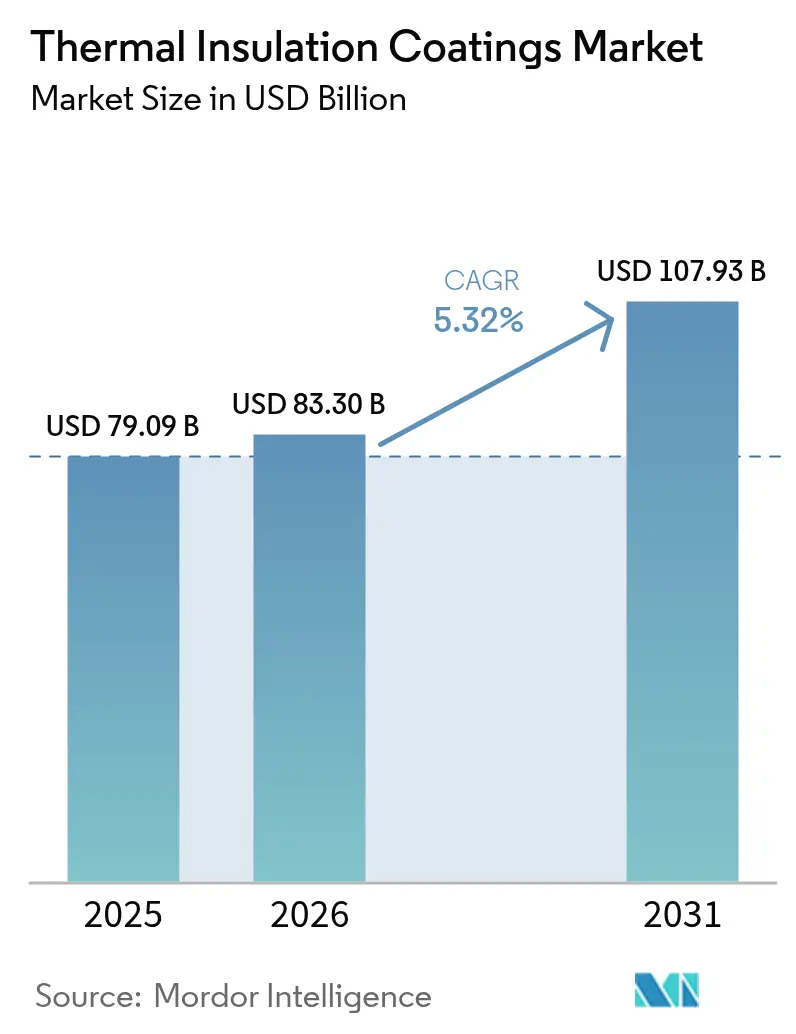
The Thermal Insulation Coatings Market size was valued at USD 79.09 billion in 2025 and estimated to grow from USD 83.3 billion in 2026 to reach USD 107.93 billion by 2031, at a CAGR of 5.32% during the forecast period (2026-2031). This performance signals sustained demand that now stretches far beyond conventional construction use cases and into electrified process-heat systems, LNG infrastructure, and battery thermal management. Enforceable energy-efficiency codes, mounting decarbonization mandates, and the build-out of fourth-generation district-heating grids across Europe are accelerating the adoption of advanced thermal barriers capable of service temperatures above 1,200 °C. In parallel, Asia-Pacific’s industrial expansion is widening the customer base for high-performance coatings in refineries, petrochemicals, and automotive components, while North American aerospace programs are stimulating uptake of ultra-high-temperature yttria-stabilized zirconia (YSZ) systems. The resulting competitive environment rewards suppliers that combine vertical integration with materials science advances, such as hybrid aerogel-epoxy formulations that deliver sub-0.020 W m-¹ K-¹ thermal conductivity.
Key Report Takeaways
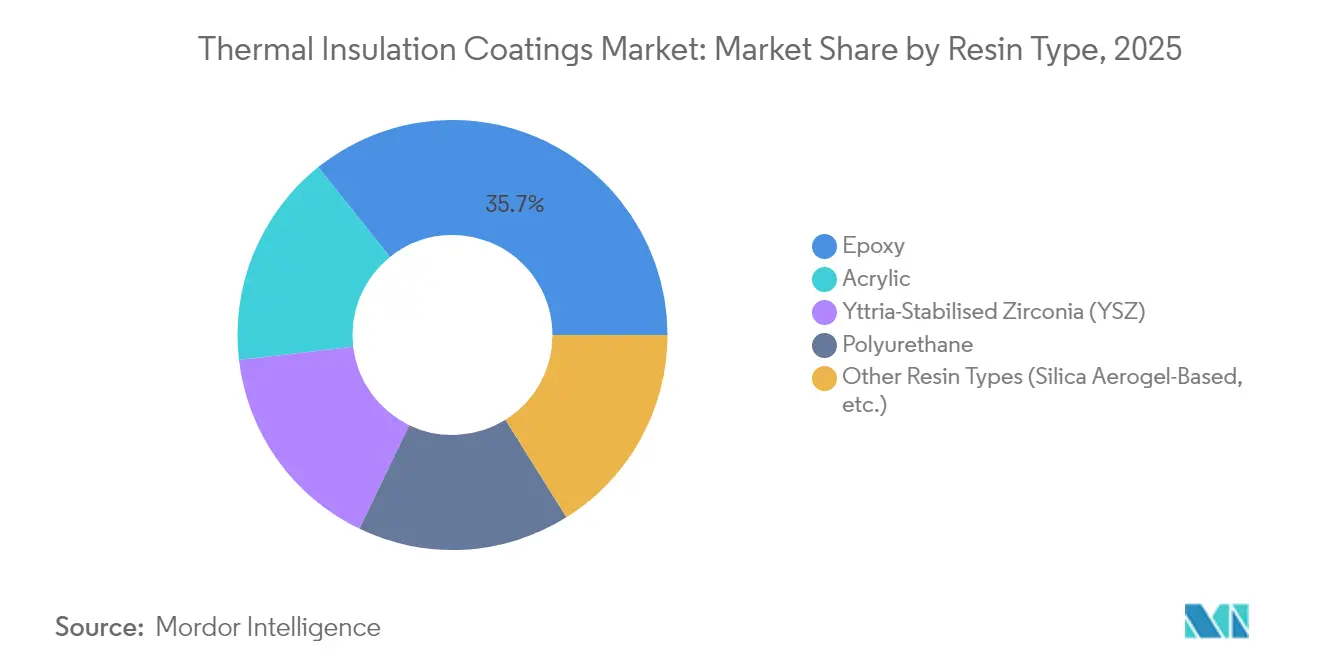
- By resin type, epoxy formulations led with 35.74% of thermal insulation coatings market share in 2025; silica-aerogel coatings are projected to expand at a 5.74% CAGR through 2031.
- By coating form, liquid spray systems accounted for 44.72% share of the thermal insulation coatings market size in 2025 and are growing at a 6.21% CAGR to 2031.
- By application, building envelope solutions held 42.05% of the thermal insulation coatings market share in 2025, whereas automotive components will record the fastest 6.68% CAGR through 2031.
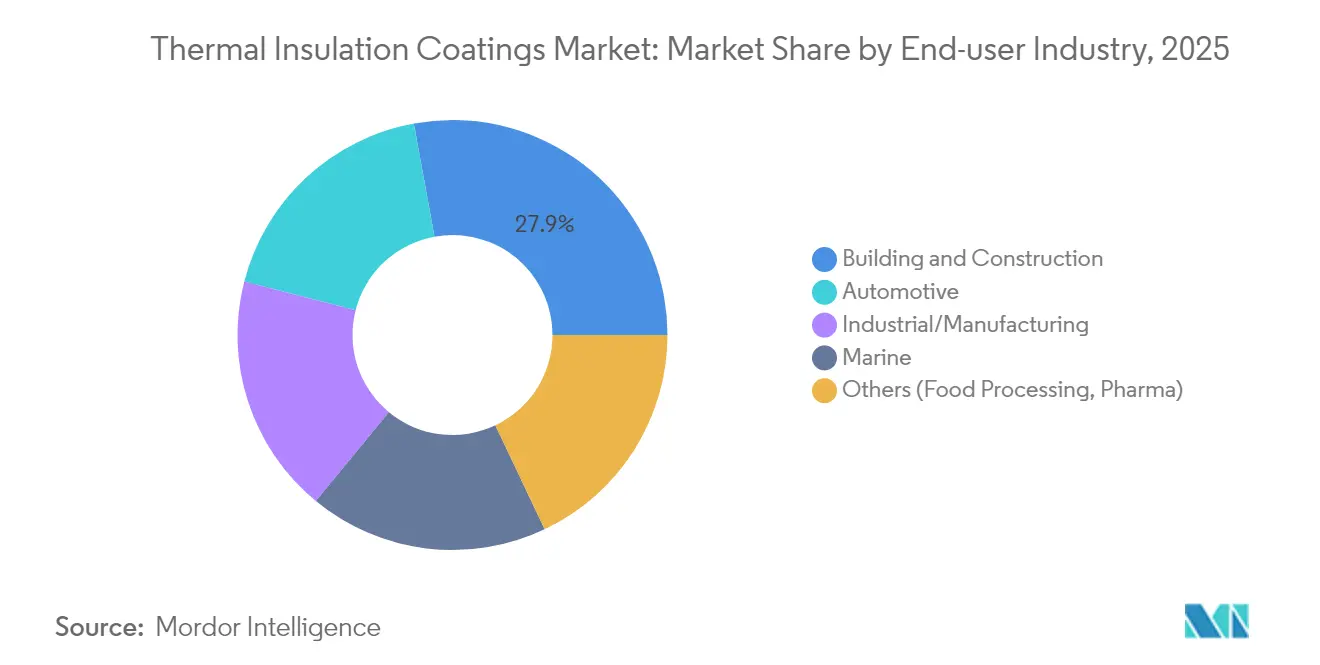
- By end-user industry, building and construction represented 27.88% of the thermal insulation coatings market size in 2025, while other end-user industries are growing fastest at a CAGR of 5.83%.
- By geography, Asia-Pacific commanded 39.62% revenue share in 2025, while also registering the highest regional CAGR of 5.96% to 2031.
Note: Market size and forecast figures in this report are generated using Mordor Intelligence’s proprietary estimation framework, updated with the latest available data and insights as of 2026.
Market Trends and Insights
Drivers Impact Analysis of Thermal Insulation Coatings Market*
| Drivers | (~) % Impact on CAGR Forecast | Geographic Relevance | Impact Timeline |
|---|---|---|---|
| Construction of new refineries | +1.2% | Asia-Pacific, Middle East and Africa | Medium term (2-4 years) |
| Expansion of district heating and cooling networks | +0.8% | Europe, North America | Long term (≥ 4 years) |
| Increasing demand for construction industry | +1.5% | Global | Short term (≤ 2 years) |
| Electrification of process heat in heavy industry | +0.9% | Europe, North America | Long term (≥ 4 years) |
| Surge in LNG cold-chain logistics | +0.6% | Asia-Pacific, North America | Medium term (2-4 years) |
| Source: Mordor Intelligence | |||
Construction of New Refineries
Global refinery buildouts continue to anchor the thermal insulation coatings market. New complexes in India, China, and the Arabian Gulf specify multilayer epoxy barriers for distillation towers and heat-exchanger shells that run between 200 °C and 800 °C. Project owners increasingly bundle corrosion resistance and digital thickness monitoring into the same coating package to curb unplanned outages and extend asset life. Suppliers that can certify systems for both normal and cyclic temperature environments gain access to the largest capital projects pipeline.
Expansion of District Heating and Cooling Networks
Fourth-generation district-heating grids operate at lower supply temperatures, demanding coatings capable of reducing distribution losses while surviving repetitive thermal cycling. Denmark’s municipal energy cooperatives demonstrate that advanced insulation can shave multiple percentage points from annual heat losses, thereby improving heat-pump efficiency. Similar retrofits across Germany and Sweden specify aerogel-infused primers to meet the stricter heat-retention targets.
Increasing Demand for Construction Industry
Stringent 2024 building-energy codes tighten R-value thresholds for wall assemblies and roofing systems. Spray-applied ceramic microsphere coatings meet new prescriptive paths without increasing wall thickness, making them popular in dense urban retrofits. Building-information-modeling workflows now embed coating-layer data to predict summer peak-load reductions and optimize HVAC sizing. Turkey’s two-year payback studies on climate-adaptive envelope strategies further validate commercial viability.
Electrification of Process-Heat in Heavy Industry
High-temperature heat pumps and resistance-heated furnaces alter thermal-cycling profiles, prompting demand for coatings that tolerate rapid ramp-ups to 250 °C. Demonstration plants in the Netherlands apply multilayer alumina-bond-coat systems topped with YSZ to maximize refractory life. Pilot projects use phase-change-material backfills to capture off-cycle heat, positioning coatings as integral to storage performance.
Restraints Impact Analysis of Thermal Insulation Coatings Market*
| Restraints | (~) % Impact on CAGR Forecast | Geographic Relevance | Impact Timeline |
|---|---|---|---|
| High capital requirement | –0.7% | Global | Short term (≤ 2 years) |
| Volatile raw-material (epoxy and PU) prices | –0.5% | Global | Medium term (2-4 years) |
| Limited applicability in ultra-high-temperature assets | –0.3% | Industrial regions globally | Long term (≥ 4 years) |
| Source: Mordor Intelligence | |||
High Capital Requirement
Plasma-spray booths, automated gantries, and controlled-atmosphere curing ovens can cost several million USD, limiting new-entrant capacity. Large integrated producers therefore dominate long-run supply contracts, while smaller applicators face financing hurdles. Portfolio restructuring, as seen in recent divestiture discussions inside diversified chemistry groups, underscores capital intensity pressures.
Volatile Raw-Material (Epoxy and PU) Prices
Epoxy and polyurethane feedstocks track crude-oil price movements, exposing coaters to margin swings. Supply disruptions amplify risks because specialty resins rely on a handful of global producers. Some formulators lock in multi-year supply contracts or pursue backward integration, but such hedging demands sizeable balance-sheet flexibility.
*Our forecasts treat driver/restraint impacts as directional, not additive. The impact forecasts reflect baseline growth, mix effects, and variable interactions.
Thermal Insulation Coatings Market Segment Analysis
By Resin Type:
Epoxy Dominance Faces Aerogel ChallengeEpoxy systems retained a 35.74% share of the thermal insulation coatings market in 2025, buoyed by strong adhesion and chemical resistance that suit refinery piping, marine deck plates, and offshore platforms. They underpin a significant portion of the thermal insulation coatings market size for protective-lining projects scheduled across APAC and the Middle East. Enhanced formulations embed hollow-glass microspheres to bring thermal conductivity below 0.180 W m-¹ K-¹ without sacrificing film toughness.
Silica-aerogel coatings, while holding only single-digit revenue today, record a 5.74% CAGR to 2031. Ultra-low conductivity readings of 0.015 W m-¹ K-¹ unlock ambient-pressure applications that once demanded vacuum-insulated panels. Manufacturers co-disperse aerogel powder into epoxy matrices to combine mechanical strength with near-super-insulating performance, giving the segment outsized influence on future specifications. At the aerospace frontier, entropy-stabilized oxide and YSZ platforms target turbine-blade skins running above 1,200 °C, suggesting further technology crossover opportunities.

By Coating Form:
Liquid Spray Technology Leads InnovationLiquid spray lines captured 44.72% of thermal insulation coatings market share in 2025 and continue to outpace other forms at a 6.21% CAGR. Their chief advantages include seamless coverage on weld seams and radius bends, plus production-rate gains from robot-integrated spray heads. Process yards now deploy vision analytics to gauge wet-film thickness and self-correct gun speed, minimizing overspray and improving yield. Powder lines remain relevant in gridshell architecture and certain pipeline externals where electrostatic attraction ensures uniform film builds.
By Application:
Building Envelope Leadership Amid Automotive SurgeThe building segment controlled 42.05% of the thermal insulation coatings market in 2025 as architects adopt coatings that deliver double-digit surface-temperature drops and contribute toward net-zero-energy targets. High-reflectance ceramic products achieve 10 °C roof surface reductions in peak summer, lowering cooling loads in Mediterranean and Gulf climates.
Automotive systems present the fastest growth path at 6.68% CAGR. Electric-vehicle pack designs favor thin dielectric layers offering both thermal isolation and puncture resistance. Functions extend beyond batteries to motor housings and inverter casings, where low-density ceramic fillers improve acoustic damping. Industrial equipment, storage tanks, and marine shells continue to command staple demand. Advanced deck-coating lines claim measurable fuel savings by pairing drag-reduction topcoats with thermally insulating under-layers.
By End-user Industry:
Oil and Gas Leads Amid DiversificationBuilding and construction accounted for 27.88% of the thermal insulation coatings market size in 2025, supported by sustained refinery maintenance cycles and new LNG export terminals. Mandates to cut fugitive methane emissions elevate pipeline insulation specifications, as cooler external pipe walls reduce soil heating and associated microbial corrosion. Building and construction follow closely, fuelled by stricter code enforcement and green-building certification schemes.
The thermal insulation coatings industry increasingly caters to diversified sectors: advanced manufacturing embraces heat-pump and thermal-storage packages, food processors insulate aseptic tanks to stabilize fermentation profiles, and pharmaceutical freeze-dryers turn to cryogenic-rated layers for sub-zero reliability. Such breadth buffers the market against single-sector downturns and fertilizes cross-disciplinary innovation.
Geography Analysis
APAC Thermal Insulation Coatings Market
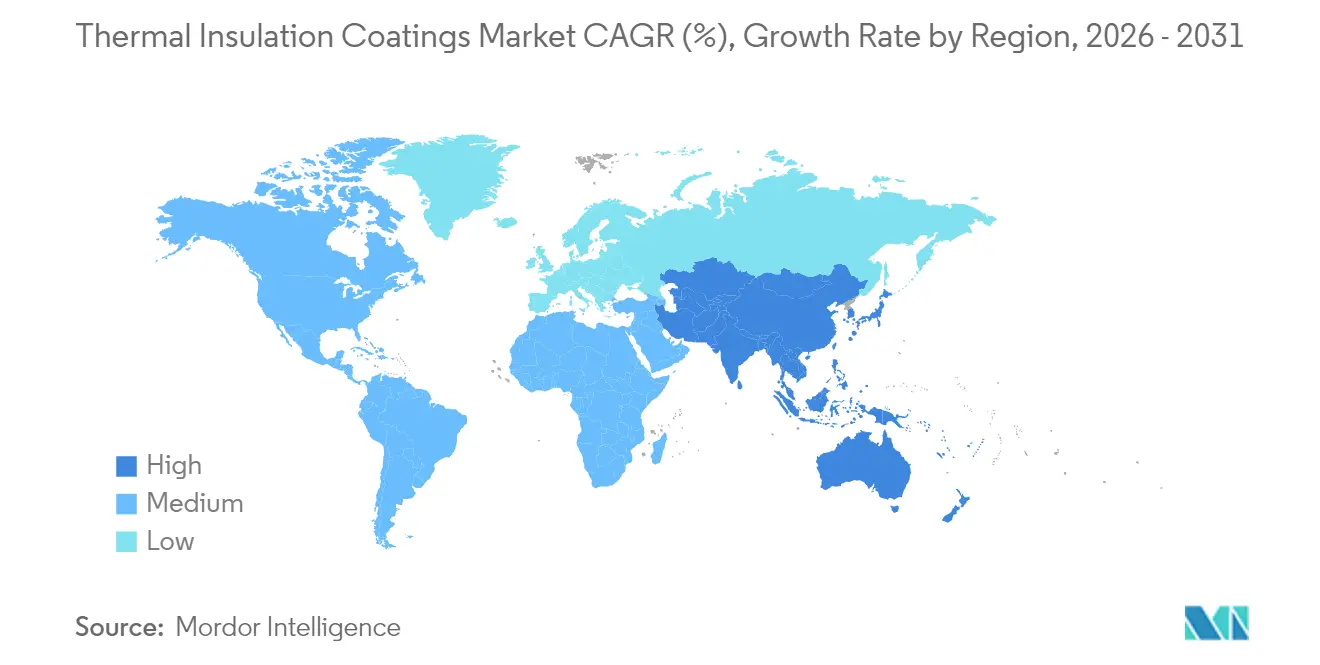
Asia-Pacific holds 39.62% of 2025 revenue, reflecting megaproject pipelines in China, India, and South Korea. Regional governments prioritize refinery self-sufficiency, which directly inflates the thermal insulation coatings market. Added momentum comes from LNG cold-chain terminals in Japan and floating storage regasification units serving Southeast Asian islands.
North America Thermal Insulation Coatings Market
North America is assisted by aerospace propulsion programs and process-heat electrification pilots in heavy industry alleys. Federal stimulus packages encourage district-energy retrofits, steering municipal utilities toward advanced coating overlays that lower distribution losses. Regulations like Canada’s National Energy Code for Buildings 2020, which lifts thermal-resistance requirements for wall assemblies, anchor recurrent demand for spray-applied ceramic microsphere products.
EMEA and South America Thermal Insulation Coatings Market
Europe maintains leadership in policy-driven decarbonization and commands the densest district-heating market, fostering continuous specification upgrades for coatings with validated ex-situ thermal-cycling endurance. Scarcity of new-build heavy industry shifts focus to retrofitting aging industrial parks with high-temperature heat-pump systems, where coatings moderate conductive losses on hot-oil loops. Meanwhile, the Middle-East and Africa leverages oil-capex programs to expand adoption in petrochemical parks, whereas South America’s mining belts employ coatings to buffer process vessels against aggressive acids and wide daily temperature swings.
Value Chain Analysis
The value chain for thermal insulation coatings begins with upstream feedstocks and specialty intermediates, then moves through formulation, manufacturing, application, and end-use validation. Key inputs include binders (epoxy, acrylic, polyurethane, and higher-heat polysiloxane hybrids), insulation fillers (silica aerogel, hollow microspheres, aluminosilicate microspheres), pigments (including infrared-reflective grades), and functional additives (dispersants, rheology modifiers, defoamers). Specialty suppliers are significant in performance differentiation. For example, Evonik supplies TEGO Therm components (such as microporous silica granules and heat-resistant hybrid binder platforms) that are incorporated into finished insulation coating formulations.
In the midstream, formulators and system suppliers convert these inputs into ready-to-apply products and qualified multi-layer systems. Performance is typically validated through thermal conductivity, hydrophobicity, adhesion, and thermal-cycling durability targets that vary by application (building envelope, industrial equipment and pipelines, storage tanks, automotive components, marine, and aerospace or turbine parts). Downstream value is created by applicators and integrators that manage surface preparation, spray or plasma application, and curing. Capital-intensive equipment (spray infrastructure, controlled curing, and automation) can limit smaller applicators and extend qualification cycles for high-temperature and CUI-mitigation use cases.
Competitive Landscape
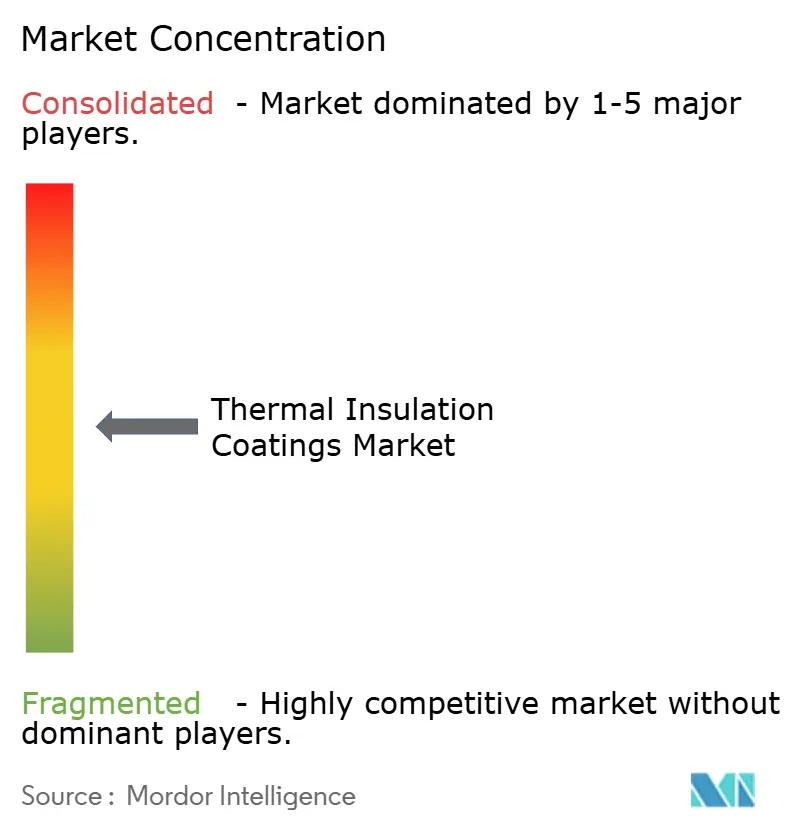
The thermal insulation coatings market is characterized by moderate fragmentation: global multinationals such as AkzoNobel, PPG Industries, and Sherwin-Williams coexist with highly specialized mid-tier firms. Global players leverage branded distribution, integrated raw-material backbones, and digital color-matching suites to command prime positioning on multi-site contracts.
Thermal Insulation Coatings Industry Leaders
-
Jotun
-
AkzoNobel N.V.
-
BASF
-
PPG Industries, Inc.
-
The Sherwin-Williams Company
- *Disclaimer: Major Players sorted in no particular order
Thermal Insulation Coatings Market Companies Covered in this Report
- AkzoNobel N.V.
- BASF
- Behr Process LLC
- DAW SE
- Dow
- Evonik Industries AG
- Hempel A/S
- Jotun
- Kansai Paint Co., Ltd
- Mascoat
- Nippon Paint Holdings Co., Ltd
- OC Oerlikon Management AG
- PPG Industries, Inc.
- RPM International
- Sharpshell Engineering
- Sika AG
- Synavax
- The Sherwin-Williams Company
Market Opportunities and Future Outlook
White-space opportunities focus on multi-functional systems that replace or reduce bulk insulation while also addressing corrosion-under-insulation (CUI), fire protection, and surface temperature management. Recent product activity from major suppliers points in this direction. AkzoNobel introduced a China-focused cooling-oriented coating system that pairs a radiative cooling topcoat with a thermal radiation barrier mid-coat incorporating aerogel materials (May 2025). Jotun launched Jotachar 1709 XT engineered for UL1709 requirements in onshore oil and gas projects (November 2025). Together, these launches reinforce specification-driven demand where owners prefer fewer layers and fewer interfaces on complex assets, while still meeting certification and safety requirements.
Materials and capacity moves also indicate near-term whitespace in localized, higher-performance binder and filler supply, particularly for coatings linked to energy-efficiency and durability mandates in both buildings and industrial assets. BASF introduced ELASTOSPRAY BMB, a biomass balance isocyanate offering for spray polyurethane foam insulation systems in North America (April 2026). This aligns insulation-related input strategies with broader insulation and coating-adjacent solutions. On the technology side, published work on silicate-modified aerogel organic-inorganic composite coatings and fully biomass-based coating concepts highlights pathways to improve thermal stability and flame retardancy, while reducing reliance on conventional petro-derived chemistries. For adoption, performance validation and application robustness remain the key gates.
Recent Industry Developments in Thermal Insulation Coatings Market
- April 2026: BASF introduced ELASTOSPRAY BMB, a biomass balance isocyanate for spray polyurethane foam (SPF) insulation systems in North America. The launch broadens lower-carbon input options in insulation-related chemistries used alongside thermal management solutions, supporting customers seeking footprint reductions without changing installation practices.
- November 2025: Jotun launched Jotachar 1709 XT, an intumescent fire protection coating positioned for onshore oil and gas projects requiring UL1709 certification. This strengthens high-temperature asset protection portfolios where insulation and protective coatings specifications are increasingly bundled around safety and durability requirements.
- February 2024: BASF announced an HFO-blown PIR insulation system targeted at continuous sandwich panel applications, emphasizing improved thermal conductivity and non-flammability characteristics. The move supports building-envelope performance upgrades and adds competitive pressure on insulation and coating solutions used to meet tighter energy-code and safety requirements.
Thermal Insulation Coatings Market Report Scope and Research Methodology
Market Definition and Coverage
For this study, the market covers revenue earned from thermal insulation coatings that are applied on substrates to reduce heat transfer and improve energy efficiency across industrial and building uses, including related insulation performance coating systems sold for hot and cold service.
Scope exclusions: We exclude conventional bulk insulation materials (such as mineral wool and foam boards), standard decorative paints without insulation claims, and installation labor unless it is bundled into the coating sale price.
Segments Covered in This Report
- By Resin Type
- Acrylic
- Epoxy
- Polyurethane
- Yttria-Stabilised Zirconia (YSZ)
- Other Resin Types (Silica Aerogel-Based, etc.)
- By Coating Form
- Liquid Spray
- Powder
- Vacuum-Deposited
- By Application
- Building Envelope (Walls, Roofs)
- Industrial Equipment and Pipelines
- Storage Tanks and Vessels
- Automotive Components
- Marine Hull and Deck Structures
- Aerospace and Turbine Parts
- By End-user Industry
- Building and Construction
- Industrial/Manufacturing
- Automotive
- Marine
- Others (Food Processing, Pharma)
- By Geography
- Asia Pacific
- China
- India
- Japan
- South Korea
- Rest of Asia Pacific
- North America
- United States
- Canada
- Mexico
- Europe
- Germany
- United Kingdom
- France
- Italy
- Rest of Europe
- South America
- Brazil
- Argentina
- Rest of South America
- Middle-East and Africa
- Saudi Arabia
- South Africa
- Rest of Middle-East and Africa
- Asia Pacific
Data Sources, Market Sizing, and Validation
Desk Research
Desk research was used to set the market boundaries, anchor demand drivers, and pressure-test the model outputs against publicly visible signals. We relied on widely accessible sources such as the US Energy Information Administration (industrial energy use and fuel prices), the US Census Bureau and Eurostat (construction and industrial output), UN Comtrade (trade flows for relevant coating and chemical categories), and energy efficiency and building code publications from bodies like the International Energy Agency.
To translate those signals into a practical market model, we also reviewed company annual reports, investor presentations, product technical data sheets, and credible industry press coverage on insulation retrofit activity and industrial maintenance cycles. Select paid subscriptions for company financials and news intelligence, patent databases, and shipment-level import and export data were used to fill gaps where public disclosures were too aggregated. These desk research sources are illustrative, and many other references were used for data collection, validation, and clarification during the work.
Primary Interviews and Surveys
Primary discussions were used to validate adoption levels, typical coating thickness and coverage rates, and realistic price ranges by use case (for example, pipelines versus building envelopes). We spoke with a mix of manufacturers, distributors, applicators, and large end users across APAC, EMEA, and the Americas, and we rechecked assumptions when we saw large deviations by resin type or service temperature.
Distribution of primary research fieldwork respondents
| Company type | Respondent position | Region |
|---|---|---|
| Top tier: 32% | CXOs: 13% | APAC: 43% |
| Mid tier: 52% | Functional/Unit leaders: 30% | EMEA: 34% |
| Smaller Players: 16% | Managers: 57% | Americas: 23% |
Market-Sizing & Forecasting
Sizing starts with a top-down build where construction activity, industrial capex and maintenance intensity, and energy cost pressure are used to reconstruct the addressable demand pool for insulation performance coatings. That demand pool is then converted into value using practical usage rules, which include typical square meter coverage per liter, average dry film thickness ranges, and the share of assets where coatings are preferred over bulk insulation for design or maintenance reasons.
Once the first cut is built, the totals are corroborated with selective bottom-up checks, including sampled price lists and bid quotes to map ASP ranges, channel feedback on sales mix by resin type, and supplier and distributor sense-checks on regional consumption split. Key inputs that move the model include building retrofit rates, industrial piping and tank refurbishment cycles, temperature service requirements, resin and additive cost movements that influence pricing, and the pace of energy efficiency regulation rollout.
Forecasts are developed using scenario analysis supported by short time series smoothing, where macro indicators and resin cost trends are varied within bounds interviewees described as feasible. When bottom-up visibility is weaker in smaller countries, we bridge gaps using per capita construction spend, industrial output proxies, and trade-based availability signals, then align back to regional totals to keep the arithmetic consistent.
Data Validation & Update Cycle
Outputs are checked in several passes so the numbers make sense before they are finalized. We compare results against independent signals such as construction spending trend lines, industrial energy intensity changes, and resin price cycles, and then review outliers at the country and application level to test whether they are real or caused by an input mismatch.
If the variance is material, assumptions are rechecked and the relevant experts are contacted again, especially for ASP steps, adoption curves, and regional mix. The report is refreshed annually, and interim updates are made when major events shift energy prices, regulation enforcement, or industrial operating rates. Before release, analysts do a final update pass so the view reflects the latest available data.
Mordor Intelligence's Thermal Insulation Coatings Market Size Measured Against Other Published Estimates
Published market values for thermal insulation coatings can differ a lot, even when the topic label looks the same, because the underlying counting rules are not uniform. The biggest gaps usually come from what is included as a coating, how regions are rolled up, and how prices are converted and updated over time.
In this market, the spread is often driven by refresh cadence and currency timing, followed by how ASP steps are applied when resin costs move quickly and when the mix shifts between building retrofit and industrial maintenance. Those items are handled through a repeatable update check that re-tests coverage assumptions and price bands by region, which is why Mordor Intelligence reports a larger 2026 value than estimates anchored to 2024 to 2025 snapshots.
Benchmark comparison
| Source | Market Size | Gaps in Research Methodology |
|---|---|---|
| Mordor Intelligence | USD 83.3 B (2026) | |
| Global Consultancy A | USD 10.45 B (2024) | Uses an earlier base year and a narrower value construct that appears closer to product level thermal insulation coating sales, and it can understate later-year ASP changes when currency conversion and resin cost pass-through are not refreshed close to the cut-off date. |
| Industry Publisher B | USD 10.41 B (2025) | Anchors the series to 2025 and applies long-range growth assumptions, but the scope read-through can differ by excluding some industrial and high-temperature coating use cases, and by using broad ASP progression rules rather than application-specific price bands. |
The table shows that year choice and scope boundaries explain most of the difference, before growth rates even come into play. By tying totals to observable demand signals, updating currency and ASP inputs on a consistent cadence, and rechecking outliers with field feedback, the result is a market number that clients can trace back to clear variables and repeatable steps.
Key Questions Answered in the Report
What is the present valuation of the thermal insulation coatings market?
The thermal insulation coatings market is valued at USD 83.3 billion in 2026.
Which resin category commands the largest share?
Epoxy-based coatings lead with 35.74% share in 2025, owing to their robustness in harsh industrial settings.
Which geographic region is expanding fastest?
Asia-Pacific grows at a 5.96% CAGR through 2031, supported by refinery buildouts and LNG infrastructure investments.
What application area is recording the highest growth?
Automotive components exhibit a 6.68% CAGR as electric-vehicle battery packs demand advanced thermal management.
How are district-heating upgrades influencing demand?
Fourth-generation grids require coatings that curb distribution losses, thereby lifting demand for aerogel-enhanced insulation.