
United Kingdom Barbeque Grill Market Size and Share
Market Overview
| Study Period | 2020 - 2031 |
|---|---|
| Forecast Data Period | 2026 - 2031 |
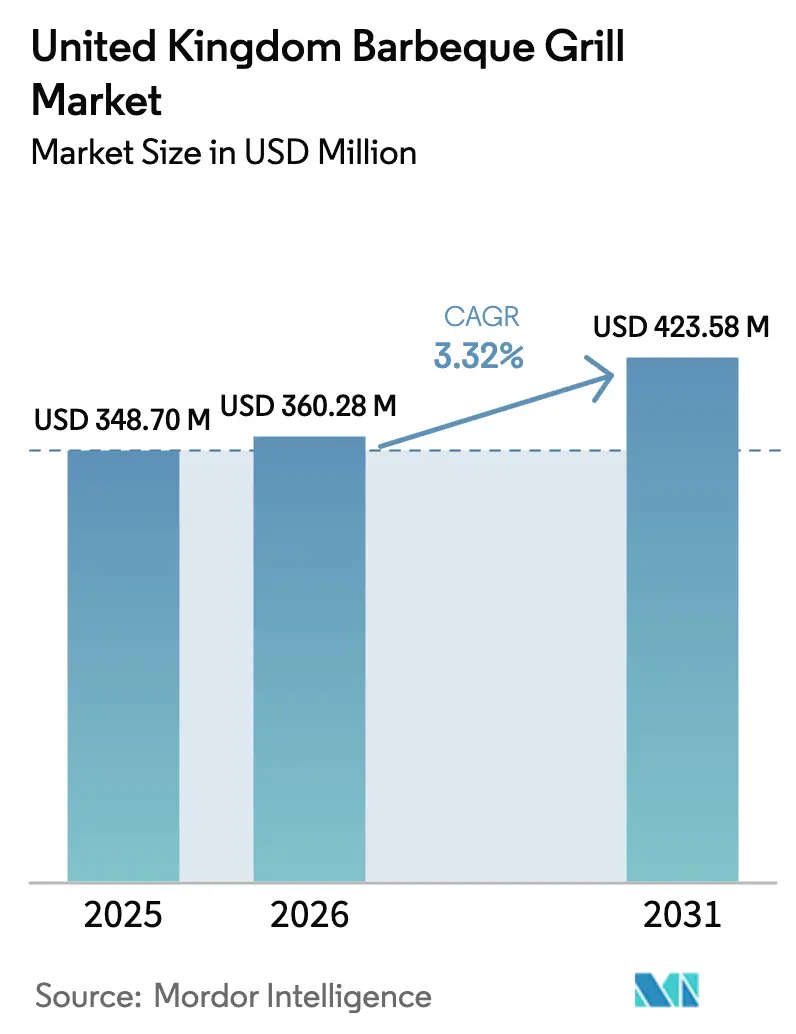
| Base Year Market Size (2025) | USD 348.7 Million |
| Market Size (2026) | USD 360.28 Million |
| Market Size (2031) | USD 423.58 Million |
| Growth Rate (2026 - 2031) | 3.32 % |
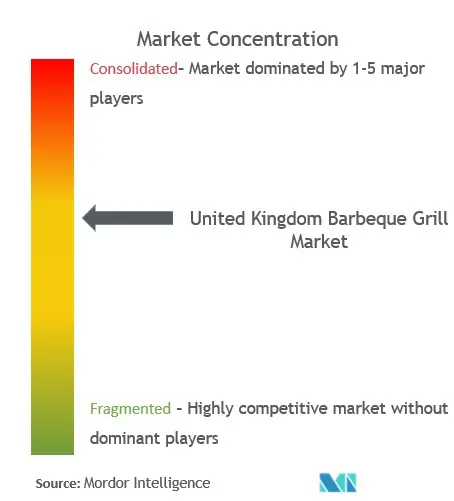
| Market Concentration | Medium |
Major Players *Disclaimer: Major Players sorted in no particular order Image © Mordor Intelligence. Reuse requires attribution under CC BY 4.0. | |
United Kingdom Barbeque Grill Market Analysis by Mordor Intelligence
The United Kingdom barbeque grill market size in 2026 is estimated at USD 360.28 million, growing from 2025 value of USD 348.7 million with 2031 projections showing USD 423.58 million, growing at 3.32% CAGR over 2026-2031. Demand is buoyed by a 54% surge in BBQ equipment turnover at garden centres as staycation spending reshapes home-improvement priorities, while 127.6 million grilling occasions logged in 2022 validate habitual use despite Britain’s variable weather[1]Source: Staff Writer, “BBQ occasions rise as consumers grill through the rain,” thegrocer.co.uk.. Clean-air legislation is accelerating the switch toward electric and pellet models, encouraging manufacturers to embed IoT controls and hybrid fuel that future-proof portfolios against tighter smoke-control enforcement. Consolidation is stirring Weber’s merger with Blackstone amplifies scale in a moderately fragmented arena while preserving distinct brand voices. Growth resilience is further evidenced by new smart-connected flagships such as the Weber SUMMIT gas grill, whose digital dashboards redefine premium positioning.
Key Report Takeaways
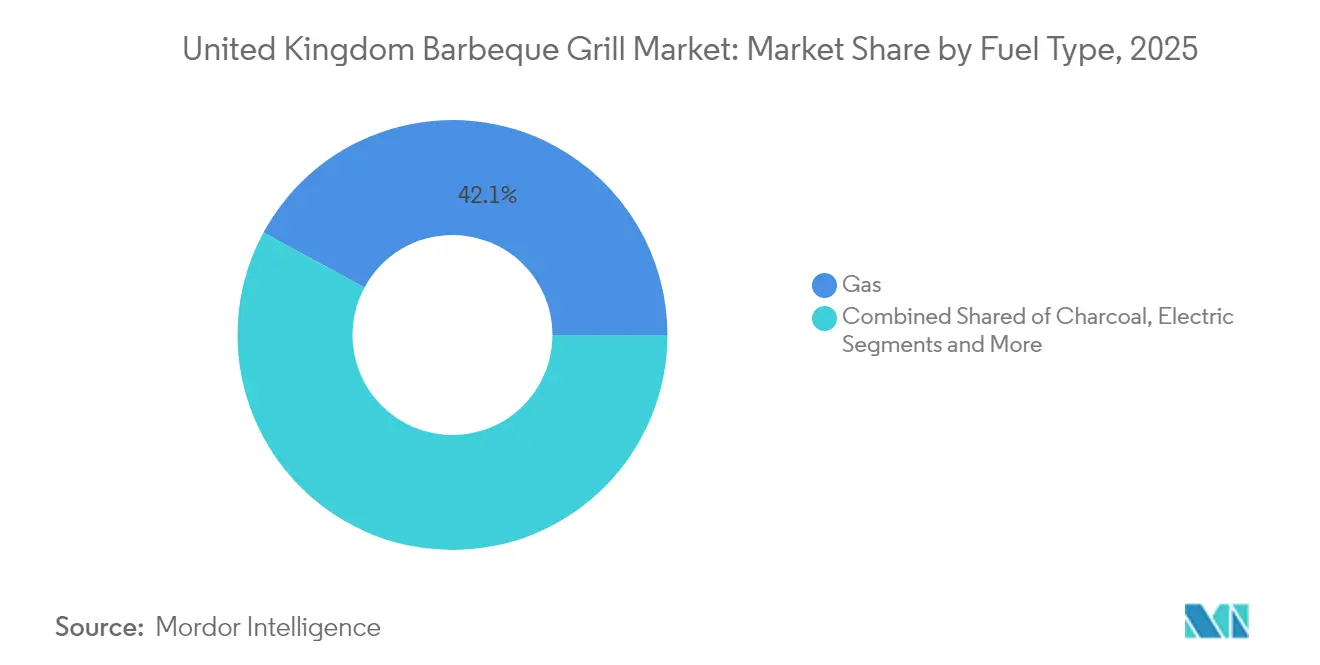
- By fuel type, gas grills led with 42.10% of the United Kingdom barbeque grill market share in 2025, while electric units are forecast to expand at a 4.18% CAGR through 2031.
- By product design, freestanding models secured 47.65% share of the United Kingdom barbeque grill market size in 2025, and portable variants are advancing at a 3.21% CAGR during the same horizon.
- By technology, conventional formats captured 81.85% share in 2025; smart-connected alternatives are poised for a 4.28% CAGR to 2031.
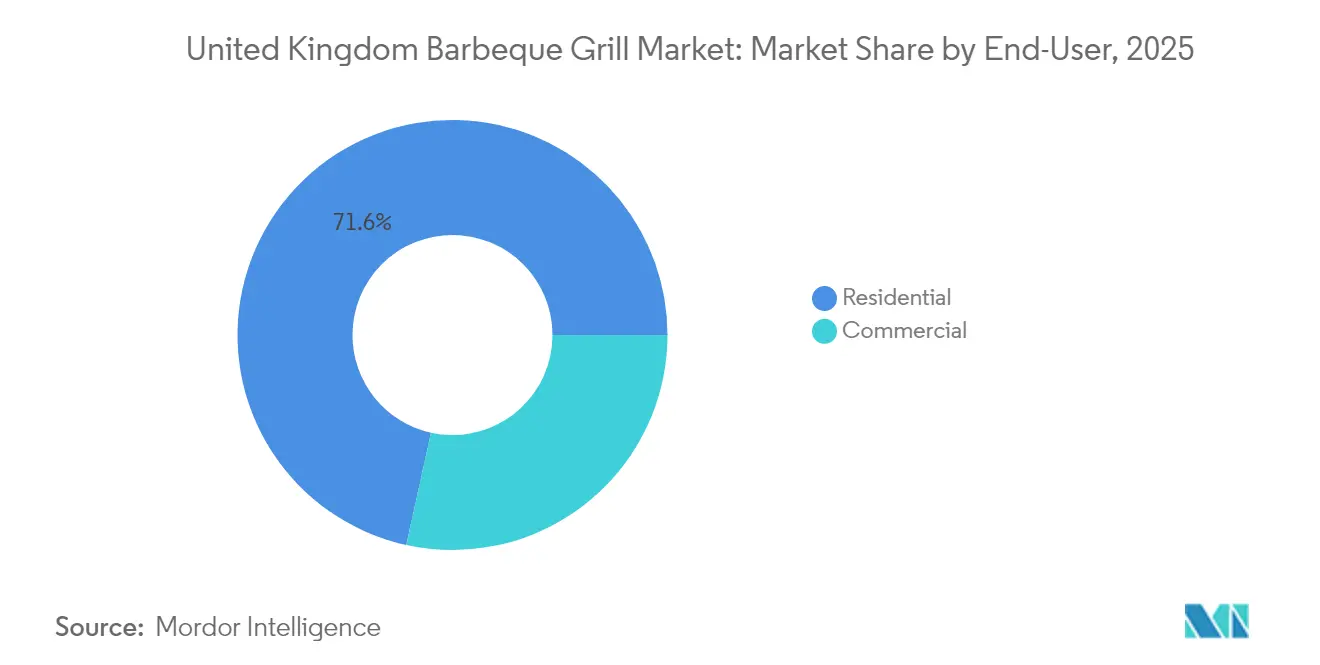
- By end-user, residential buyers accounted for 71.55% of the United Kingdom barbeque grill market size in 2025, whereas commercial demand is recovering at a 3.62% CAGR on the back of hospitality expansion.
- By region, England contributed 28.85% revenue in 2025, whereas Scotland is the fastest-growing geography with a 4.32% CAGR through 2031.
Note: Market size and forecast figures in this report are generated using Mordor Intelligence’s proprietary estimation framework, updated with the latest available data and insights as of 2026.
United Kingdom Barbeque Grill Market Trends and Insights
Drivers Impact Analysis*
| Driver | (~) % Impact on CAGR Forecast | Geographic Relevance | Impact Timeline |
|---|---|---|---|
| Growing outdoor-dining & staycation trend | +0.5% | National, with stronger influence in England and Scotland | Medium term (2-4 years) |
| Rising disposable income & home-improvement spend | +0.4% | England and Wales primarily, urban centers | Medium term (2-4 years) |
| Product innovation toward hybrid & multi-fuel grills | +0.6% | National, early adoption in metropolitan areas | Long term (≥ 4 years) |
| Expansion of e-commerce retail for BBQ equipment | +0.5% | National, accelerated in Scotland and Northern Ireland | Short term (≤ 2 years) |
| Shift to electric & pellet grills driven by Clean-Air Zones | +0.6% | England urban areas, expanding to Scotland and Wales | Long term (≥ 4 years) |
| Smart-connected (IoT) grill adoption | +0.5% | England and Scotland tech-forward demographics | Medium term (2-4 years) |
| Source: Mordor Intelligence | |||
Growing Outdoor-Dining & Staycation Trend
The United Kingdom barbeque grill market continues to reap benefits from a shift toward domestic leisure as 26% of consumers remained loyal to barbecuing even during record rainfall and 40% simply moved grills indoors, proving weather resilience[2]Source: Quality Meat Scotland, “Great British BBQ Report 2024,” qms.scot. . London exemplifies the cultural turn, where 18% of residents barbecue monthly, normalizing year-round usage that underpins equipment replacement cycles. Staycation budgets redirect holiday outlays into patio refurbishments, stimulating sales of premium freestanding islands and complementary accessories that anchor the United Kingdom barbeque grill market. Garden centres pivoted from seasonal racks to permanent grill showrooms, leveraging footfall from landscape shoppers to upselling higher-margin smart units. The net effect is a durable structural uplift expected to sustain segmental expansion beyond macro-economic turbulence.
Rising Disposable Income & Home-Improvement Spend
Garden centre turnover reached GBP 5 billion (USD 6.5 billion) in 2024 as households allocated discretionary cash to property enhancements, reaffirming grills as durable assets rather than impulse purchases. Gender analysis shows women scrutinize costs more closely, prompting brands to blend advanced features with affordability to widen penetration. Disposable-income disparities foster tiered demand: England adopts smart infra-red burners, while Scotland and Northern Ireland favor cost-efficient gas carts, yet both cohorts feed the broader United Kingdom barbeque grill market. Manufacturers tailoring SKUs to these income gradients maximize regional conversion.
Product Innovation Toward Hybrid & Multi-Fuel Grills
Hybrid designs gaining traction combine gas, charcoal, pellet, and electric options in one shell, enabling owners to align fuel choice with local smoke rules or flavor goals. Weber’s SUMMIT SmartControl demonstrates the trend, pairing top-down infra-red broiling with remote monitoring that appeals to tech-savvy chefs. Integrated modular prep stations encourage consumers to scale layouts over time, shrinking initial outlays while future-proofing kitchens—an angle pivotal for upselling within the United Kingdom barbeque grill market. Multi-fuel capability also mitigates supply risk amid gas-price swings, reassuring cost-conscious households. Compact blueprints fold multifunctional prowess into footprints suited to balcony constraints, opening hybrid adoption to renters traditionally sidelined in premium segments.
Expansion of E-Commerce Retail for BBQ Equipment
Digital commerce has become a critical lifeline, granting Scottish and Northern Irish buyers equal access to premium lines once limited to England’s showrooms. Garden centres now fuse online catalogues with click-and-collect bays, boosting cross-sell of cover accessories that protect high-end stainless frames from rain damage. Direct-to-consumer disruptors mine browsing data to design bundle promos, locking in recurring pellet subscriptions that steadily enlarge the United Kingdom barbeque grill industry. Augmented-reality view-in-yard apps reduce hesitation for USD 1,000-plus outlays by helping shoppers visualize space impact. Seasonality is managed through online preorder queues that smooth manufacturing loads and minimize retail stockouts, tightening working-capital cycles.
Restraints Impact Analysis*
| Restraint | (~) % Impact on CAGR Forecast | Geographic Relevance | Impact Timeline |
|---|---|---|---|
| Unpredictable UK weather shortens grilling season | -0.3% | National, particularly Scotland and Northern England | Short term (≤ 2 years) |
| Strict smoke-emission & food-safety rules | -0.2% | England urban areas, expanding to other regions | Medium term (2-4 years) |
| Higher steel/aluminium costs post-Brexit | -0.2% | National, affecting all manufacturers | Short term (≤ 2 years) |
| Meal-kit/delivery services limiting at-home grilling | -0.2% | Urban areas, particularly London and Manchester | Medium term (2-4 years) |
| Source: Mordor Intelligence | |||
Unpredictable UK Weather Shortens Grilling Season
Britain logged its wettest summer on record, eroding spontaneous weekend grilling yet users adapted: 40% relocated cookouts under patio canopies or indoors, cushioning the blow. Manufacturers responded with water-resistant lids, fast-heat burners, and fold-up frames that deploy quickly during dry intervals. Retailers synchronized promotions with meteorological apps, accelerating sales spikes once sunshine was forecasted. Regional variance is stark; Scotland endures longer rain spells and hence favors weather-proof portable units that store neatly in sheds. Resultant CAGR drag is moderate and partially balanced by accessory upsells such as gazebo kits across the United Kingdom barbeque grill market.
Strict Smoke-Emission & Food-Safety Rules
DEFRA-mandated fuel lists constrain charcoal varieties, nudging consumers toward cleaner briquettes or alternate fuels[3]Source: UK Government, “Smoke Control Area Rules,” gov.uk. Compliance certifications inflate R&D budgets as brands integrate catalytic burn chambers and temperature interlocks. Yet first-mover advantage accrues to compliant innovators that lock out lower-spec imports, tilting market share gains to agile domestic makers inside the United Kingdom barbeque grill market. Food-safety codes push probe-port standardization, adding cost but opening premium margins that offset volume softness. Long run, regulatory rigor catalyzes cleaner technology adoption rather than curtailing total demand.
*Our forecasts treat driver/restraint impacts as directional, not additive. The impact forecasts reflect baseline growth, mix effects, and variable interactions.
Segment Analysis
By Fuel Type: Gas Dominance with Electric Momentum
Gas retained 42.10% of 2025 revenue as dependable ignition, controllable flames, and affordable LPG cylinders suit Britain’s changeable climate. Electric variants record the fastest 4.18% CAGR because landlords and Clean Air Zones restrict open-flame devices, positioning plug-in formats as the compliance standard for flats. Charcoal holds nostalgic appeal yet cedes share to pellet models that marry hardwood aroma with automated augers, courting connoisseurs seeking hands-off smoking. Hybrid carts incorporating dual burners and storage for briquettes liberate users from single-fuel dependency—an edge in regions where fuel choice fluctuates with local regulation. Smart gas launches like Weber’s SUMMIT fortify gas leadership by layering Wi-Fi precision onto proven burners, ensuring the United Kingdom barbeque grill market remains multi-fuel rather than single fuel dominated.
Electric adoption does face electricity tariff questions, but total-cost parity improves once gas cylinder delivery fees and charcoal waste disposal are counted. Pellet supply chains mature as domestic sawmills divert residues into food-grade pellets, reducing import reliance. Future product roadmaps show infrared electric coils approaching charcoal sear temperatures, likely narrowing performance perception gaps. Consequently, fuel diversification is both a regulatory hedge and consumer empowerment lever that underpins category vibrancy.


By Product Design: Portables Advance on Space Constraints
Freestanding islands still wield 47.65% share, admired for side tables, warming racks, and cabinetry intuitive for suburban gardens. Yet portable grills escalate at 3.21% CAGR amid rising apartment stock and campsite tourism. Foldable legs, 12 kg carry weights, and integrated butane canisters target balcony dwellers in Manchester high-rises and glamping enthusiasts in Welsh hills. Built-in modules populate outdoor kitchens, reflecting property-value confidence among southern English homeowners. Disposable foil pans ebb under green scrutiny, nudging casual users toward reusable tabletop electrics priced below GBP 100 (USD 130).
Brands now market “mobile freestanding” hybrids, full-size cooking decks atop detachable wheelbases, letting owners winter-store units in sheds. Table-height portables featuring clamp-on legs upgrade picnic ergonomics, opening the United Kingdom barbeque grill market to audiences with physical-comfort needs. Materials innovation sees powder-coated steel swapped for aluminium composites, shaving weight and rust-risk simultaneously. In-store planograms shift to showcase portability solutions adjacent to trunk-friendly coolers, feeding impulse purchases as spring bank holiday road-trips approach.
By Technology: Smart Grills Stretch Premium Envelope
Conventional models dominate at 81.85%, yet smart units rocket at 4.28% CAGR, commanding ASPs double their analog peers. Integrated LCDs, probe-guided cook programs, and firmware upgrades eradicate under- or over-done anxieties for novice pit-masters. App alerts nudge cooks to flip steaks, while AI recipe libraries in Beta promise dynamic heat curve adjustments for cut thickness. Resistance persists among older demographics nervous about connectivity complexity, prompting brands to offer manual override knobs alongside digital UIs.
Connectivity challenges, garden Wi-Fi dead zones, are met with dual Bluetooth mesh that hands off to 4G add-on dongles. Lithium battery packs power controllers during patio outages, minimizing cook disruptions. Data captured, usage frequency, temperature logs, feeds CRM engines that upsell grill covers once rainfall predictions spike in the Midlands, enhancing lifetime value inside the United Kingdom barbeque grill market. Component cost deflation suggests smart penetration could surpass 30% by 2030, redefining baseline consumer expectations just as digital thermostats reshaped indoor ovens.
By End-User: Residential Core, Commercial Revival
Residential ownership drove 71.55% of 2025 revenue as pandemic-era patio builds matured into sustained lifestyle routines. Commercial revival at 3.62% CAGR gains steam alongside hospitality rebound, with pubs extending beer gardens through canopy investments and restaurants adding curbside smoker theatrics to entice passers-by. Professional kitchens demand NSF-certified stainless frames, 24-hour duty cycles, and high-BTU infrareds able to speed-sear 400 burgers nightly. Those advancements trickle down to premium homeowner lines, conditioning buyers to expect cast-bronze burners and rotisserie motors once reserved for steakhouses.
Post-Brexit staff shortages motivate operators to adopt smart dashboards that standardize cook profiles across rotating crews, reducing training costs. Residential DIYers embrace similar convenience, purchasing chef-curated pellet blends identical to restaurants. The cross-pollination tightens product-development feedback loops, with consumer color-palette preferences, matte black, forest green, seeping into commercial aesthetics, spawning a cohesive United Kingdom barbeque grill market design language.
By Distribution Channel: Retail Hub, Omni-Channel Future
Brick-and-mortar B2C still accounts for 74.90% because tactile evaluation of lid heft and grate gauge remains critical for GBP 600+ (USD 780) choices. Specialist grill boutiques deploy live-fire demos, aromatic smoke, and chef Q&A to justify premium tags, a science that online videos struggle to replicate. Home-centre aisles link grills to decking timber, fostering bundled checkout tickets that capture holistic backyard budgets. Mass retailers cater to price-sensitive first-time buyers but lack deep expertise, ceding upselling to niche chains.
E-commerce stores compound at double digits within the retail slice, a path smoothed by free pallet deliveries and 12-month 0% finance. Web-native challengers curate limited SKUs but enrich pages with 4K assembly tutorials, taming intimidation among beginners and expanding the United Kingdom barbeque grill industry audience. Click-and-collect appeals to rural counties where courier windows clash with farm schedules. Loyalty apps issue pellet restock reminders timed to estimated depletion rates, embedding annuity revenue streams and driving overall channel profitability.
Geography Analysis
England anchors the United Kingdom barbeque grill market with 28.85% share, propelled by dense population, London’s 18% monthly grill frequency, and mature retail footprints that ensure after-sales parts availability. Disposable income and home equity gains feed luxury outdoor-kitchen installs featuring gas lines, pizza ovens, and smart lighting. Clean-Air Zones in major cities accelerate electric and pellet swaps, making England a bellwether for regulatory responses and subsequent nationwide rollouts. Commercial activity is vibrant as pubs exploit extended terrace licences to offset indoor crowd caps, driving replacement cycles for high-throughput gas rotisseries.
Scotland leads growth at 4.32% CAGR even with harsher weather, as 40% of enthusiasts shift under awnings during rain, demonstrating persistent usage. Tourism along North Coast 500 fuels portable grill rentals among camper-van fleets. Local pride in Scotch Beef propels demand for high-heat searing surfaces, encouraging stores in Inverness and Aberdeen to stock ceramic kamados. E-commerce fills geographic gaps, ensuring Highlands consumers receive the same smart grills as Edinburgh tech adopters. Government climate pledges create grant schemes for low-emission tourism facilities, indirectly boosting pellet install bases.
Wales contributes steady revenue anchored in caravan culture around Snowdonia and Pembrokeshire, where compact butane portables dominate. Rural broadband upgrades promise to lift smart-grill penetration, an area still nascent. Northern Ireland balances agricultural heritage with cross-border price arbitrage, importing Republic-sourced charcoal variants yet adopting British-made electric units for Belfast apartments. Combined, these regions underscore the diverse mosaic that shapes opportunities across the United Kingdom barbeque grill market.
Regulatory Landscape
Barbeque grills sold in Great Britain fall under multiple compliance lanes, with product safety and market surveillance supported by UK frameworks and designated standards. For gas grills and related components, the Gas Appliances (Enforcement) and Miscellaneous Amendments Regulations 2018 apply, enforcing Regulation (EU) 2016/426 as it has effect in GB law. The government periodically updates the list of designated standards, such as Notice of Publication 0110/25 issued in April 2025, which includes EN 30 series references used for domestic cooking appliances. For electric outdoor barbecues intended for household use, manufacturers and importers align designs and testing to BS EN 60335-2-78:2003+A11:2020.
Operational use also intersects with local smoke-control and clean-air policies, which is reinforcing the shift toward electric, pellet, and other lower-smoke solutions in urban areas. Food handling practices in commercial settings are overseen by the Food Standards Agency (FSA) and Food Standards Scotland (FSS) through inspection and audit activity (with 963 establishments audited in 2024), shaping demand for equipment features that support hygiene and temperature control. At the same time, older legislation such as the Gas Cooking Appliances (Safety) Regulations 1989 has defined scope limitations, explicitly excluding equipment designed for use outdoors or in tents, leaving the primary compliance burden on the newer gas-appliance enforcement regime and applicable standards for products placed on the market.
Value Chain Analysis
The UK barbeque grill value chain begins with raw materials and components, including steel, aluminium, burners, controls, grates, and electronics for connected models. Manufacturing or assembly is often outside the UK, followed by UK and Ireland-based importing, warehousing, and distribution. In-season availability is a key differentiator, and the market places a premium on local stockholding and quick replenishment ahead of peak demand windows such as the May bank holiday period, especially for bulky freestanding grills and built-in modules where lead times and delivery execution influence conversion.
Downstream, brands and distributors draw on specialist grill retailers, home centers and DIY chains, garden centers, and online channels. Installers support built-in outdoor kitchens, while after-sales networks supply parts, covers, pellets, and consumables. Industry bodies also shape go-to-market practices and standards alignment: the Leisure and Outdoor Furniture Association (LOFA) operates a member Code of Practice and includes outdoor cooking-related member brands, while Gardenex supports UK garden and leisure product companies with trade and export facilitation. Together, these associations help structure supplier-buyer relationships and merchandising standards across the outdoor-living ecosystem that bundles grills with furniture, shelters, and accessories.
Competitive Landscape
Market structure is moderately fragmented; top five brands capture roughly 45%, leaving room for nimble entrants focusing on eco credentials or IoT differentiation. Weber and Blackstone’s February 2025 merger pools kettle pedigree with griddle innovations, creating a one-stop catalogue spanning smoker cabinets to breakfast stations[4]Source: GTN Xtra Editors, “Weber and Blackstone to Merge Outdoor Cooking Operations,” gtn-xtra.com.. Traeger leverages its pellet forte to launch balcony-compliant Mini Timberline units, bundling subscription pellets that ensure flavor consistency. Napoleon courts steak purists via ceramic infrared SIZZLE ZONE burners that reach 900 °C in 30 seconds, a spec heavily featured in in-store demos.
Start-ups such as Britain-built Everhot tease solar-integrated electric grills pitched to eco estates, while Ooni cross-sells portable pizza ovens alongside modular grill plates, expanding category boundaries. Supply-chain resiliency carries weight: Brexit-induced port delays punish brands lacking local warehousing, granting domestically assembled lines a speed advantage during peak May bank holiday runs. Compliance mastery—securing DEFRA authorised-fuel stamps—serves as moat against low-cost imports, fortifying premium price realization and fueling R&D reinvestment that widens innovation gaps inside the United Kingdom barbeque grill market.
United Kingdom Barbeque Grill Industry Leaders
Weber-Stephen Products LLC
Char-Broil
Napoleon Grills
Landmann
Outback International UK
- *Disclaimer: Major Players sorted in no particular order

Market Opportunities and Future Outlook
Product opportunities are concentrating around compliance-friendly formats and feature sets that reduce friction for urban and weather-variable use. Clean-air and smoke-control constraints in cities create whitespace for balcony-sized electric and hybrid grills that manage both heat and smoke while staying compact, while premiumization is being reinforced by smart-connected ecosystems highlighted by major brands. Weber’s January 2026 push around a more seamless smart-grilling ecosystem, alongside its connected range refresh, also points to continued investment in app-led cooking guidance and monitoring that can be extended across gas, charcoal, and electric portfolios.
Another opportunity is modular outdoor-kitchen and system selling, with grills positioned as part of broader outdoor living installations rather than purely seasonal purchases. LOFA member activity around outdoor kitchen systems and modular BBQ setups indicates retailer and brand attention on larger-ticket bundles that include prep modules, storage, and accessories, which also lifts attach rates for covers, probes, and fuel subscriptions. On the supply side, Gardenex-backed export and trade support provides a route for UK-based manufacturers and designers to broaden addressable demand beyond domestic seasonality, while strengthening product documentation and compliance positioning that helps brands compete against low-spec imports.
Recent Industry Developments
- June 2026: The publication of Genesis E-335W data for the UK market reinforces Weber's premium gas lineup and connected features in 2026, supporting its position in the high end segment. The data release highlights continued emphasis on smart controls and digital experiences in the United Kingdom barbeque grill market.
- March 2026: Char-Broil launched Patio Bistro E2Coal hybrid electric and charcoal grill in the UK. The introduction expands Char-Broil's footprint with hybrid tech addressing urban space and smokeless regulations.
- February 2026: Napoleon Grills introduced the Apollo Charcoal Water Smoker series 18 inch and 22 inch to the UK market. The move expands Napoleon's portfolio into the UK smoking segment and offers cross selling opportunities with existing grills.


Research Methodology Framework and Report Scope
Market Definition and Coverage
For this study, the market covers revenues generated from barbeque grills sold for use in the United Kingdom, counted in USD value terms for the defined study and forecast period.
Scope exclusions: This sizing does not count fuels, food, outdoor furniture, built-in outdoor kitchens, or repair and installation services unless bundled with a grill sale.
Segmentation Overview
- By Fuel Type
- Gas Grills
- Charcoal Grills
- Electric Grills
- Pellet Grills
- Hybrid/Alternative Fuel
- Infrared
- By Product Design
- Built-In
- Freestanding
- Portable / Table-top
- Disposable / Single-use
- By Technology
- Conventional
- Smart/Connected
- By End-User
- Residential
- Commercial
- By Distribution Channel
- B2B/Direct from the Manufacturers
- B2C/Retail
- Specialty Stores
- Home Centers & DIY Stores
- Mass Merchandisers
- Online
- Other Distribution Channels
- By Geography
- England
- Scotland
- Wales
- Northern Ireland
Data Sources, Market Sizing, and Validation
Desk Research
Desk research was used to set the outside boundaries of demand and to ground the model in repeatable, public signals. We reviewed official trade and macro indicators, together with category level cues on household spending and retail activity, so the starting point was not based on one single dataset.
Common inputs came from non-paywalled sources such as the UK Office for National Statistics, HM Revenue and Customs trade statistics, UK Government legislation and guidance pages relevant to product safety and energy use, British Standards-related public guidance where available, and trade association materials covering garden and outdoor living categories. We also used company filings and investor presentations, retailer communications, and reputable press coverage to cross-check pricing and promotion patterns. In addition, paid subscriptions that compile company financials and news, shipment-level import and export records, and patent databases were referenced selectively to fill gaps on brand activity, sourcing, and product feature direction. The sources listed here are illustrative only, and many other public and paid references were consulted for clarification and consistency checks.
Primary Interviews and Surveys
Primary work focused on validating how buyers move through the purchase cycle and the practical split between entry and premium grills, especially around spring-summer demand and replacement timing. We spoke with a mix of manufacturers, importers, distributors, and retail channel participants, then checked key assumptions with category specialists and experienced end-user viewpoints across the United Kingdom.
Distribution of primary research fieldwork respondents
| Company type | Respondent position |
|---|---|
| Top tier: 27% | CXOs: 18% |
| Mid tier: 53% | Functional/Unit leaders: 34% |
| Smaller Players: 20% | Managers: 48% |
Market-Sizing & Forecasting
The core build used a top-down approach where household ownership trends, outdoor living participation, and retail category movement were translated into an addressable demand pool. That pool was then converted into annual value using observed price ladders.
To keep this practical, we corroborated results with selective bottom-up approximations, such as sampling visible model price points across channels and applying replacement and upgrade shares discussed in interviews.
A few inputs carried the most weight, including the mix shift by fuel type (gas, charcoal, electric, and pellet), the share of portable versus full-size designs, typical selling price bands during peak spring and summer periods, import dependence for finished grills and key components, and how purchases distribute across specialty stores versus online. Where direct volume signals were weak, we used proxy indicators such as trade flows and retailer range breadth, then narrowed the range through interview feedback.
For forecasting, we applied scenario analysis to reflect normal weather variability and shifts in consumer sentiment without forcing the same pattern every year. The final growth path was anchored to forward-looking views on pricing, mix premiumization, and channel shift, and then checked against historical seasonality patterns and recent category momentum.
Data Validation & Update Cycle
Validation was done through multiple checks so the model did not rely on one assumption. Outputs were compared against independent demand signals, and then examined for inconsistencies by looking at year-to-year jumps, implied unit pricing, and mix shifts that did not match what was seen in trade and retail indicators.
Before sign-off, another analyst reviewed the full chain of assumptions and recalculated key steps to catch avoidable errors. If a major variance appeared, we re-contacted respondents or revisited the source inputs to understand the cause. Reports are refreshed annually, and interim updates are made when material events change pricing, sourcing, regulation, or buying behavior, followed by a final pre-delivery check so clients receive the most current view.
Mordor Intelligence's The United Kingdom Barbeque Grill Market Sizing Compared With Other Published Estimates
Published market sizes for UK barbeque grills can look far apart because different studies do not always count the same products, years, and selling channels. Differences also come from how pricing is treated, especially when promotions and mix shifts change quickly during peak season.
Import and export grill-related trade flows, paired with retailer assortment and price band checks, are the evidence used to keep Mordor Intelligence aligned to actual sell-through value in the United Kingdom, instead of counting adjacent outdoor cooking equipment that sits outside grills. Beyond scope, the other recurring gap drivers are the choice of base year, how currency conversion timing is handled, and whether the forecast assumes a steady price ladder or a faster premiumization jump.
Benchmark comparison
| Source | Market Size | Gaps in Research Methodology |
|---|---|---|
| Mordor Intelligence | USD 348.70 M (2025) | |
| Industry Portal A | USD 311.00 M (2024) | Uses an earlier reference year and appears to lean on retail headlines and selective premium range sales, which can undercount mass channel volume and seasonal discounting effects. |
| Regional Consultancy B | USD 350.03 M (2026) | Starts from a forward base year and may include broader outdoor cooking equipment or commercial use, which can lift totals when grills are grouped with adjacent products and categories. |
The spread in the table is mainly explained by product boundary and year choice, and then by how pricing and channel coverage are treated. By tying the model to visible market signals and then pressure-testing assumptions with industry respondents, the estimate stays traceable to clear steps that can be repeated and updated each year.


Key Questions Answered in the Report
What is the current value of the United Kingdom barbeque grill market?
The sector stands at USD 360.28 million in 2026 and is forecast to hit USD 423.58 million by 2031.
Which fuel category is growing fastest?
Electric grills, expanding at a 4.18% CAGR, outpace all other fuel types thanks to Clean-Air Zone compliance.
How popular are smart-connected grills?
Smart units, though only 18.15% of volume, are growing at a 4.28% CAGR as IoT features become mainstream.
Why is Scotland’s growth higher than other regions?
Strong staycation culture, resilient grilling despite rain, and robust e-commerce access fuel Scotland’s 4.32% CAGR.
How will Clean-Air Zones affect future purchasing?
Emission restrictions will continue to shift demand toward electric and pellet models that meet smoke-control standards.
Page last updated on:


 Your data is secure and never sold or shared.


