
Market Overview
| Study Period | 2021 - 2031 |
|---|---|
| Forecast Data Period | 2026 - 2031 |
| Base Year Market Size (2025) | 64.61 gigawatt |
| Market Volume (2026) | 65.98 gigawatt |
| Market Volume (2031) | 73.29 gigawatt |
| Growth Rate (2026 - 2031) | 2.12 % |
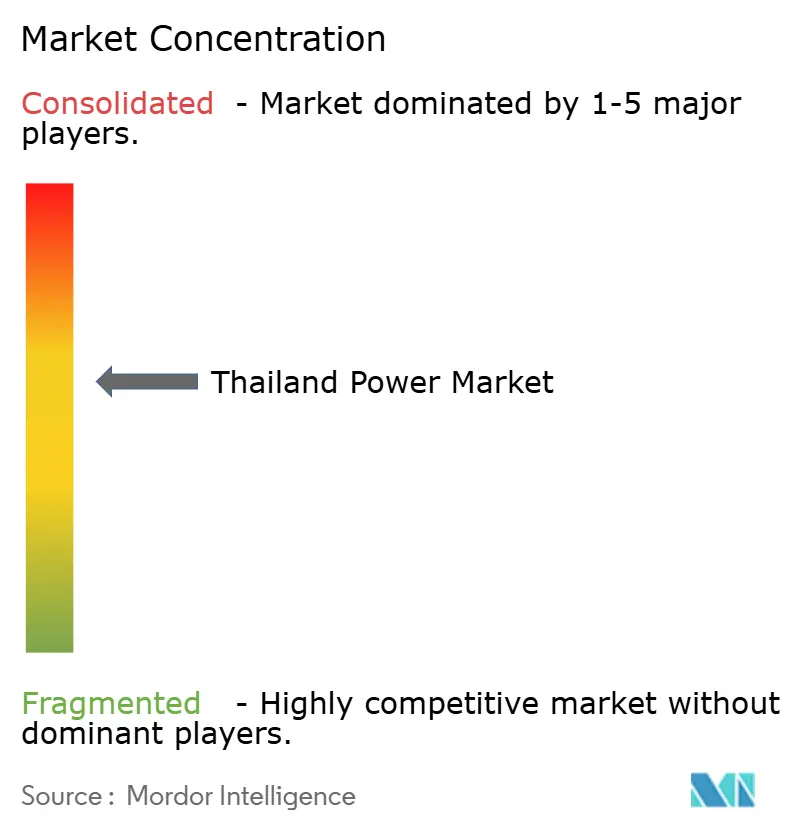
| Market Concentration | Medium |
Major Players *Disclaimer: Major Players sorted in no particular order Image © Mordor Intelligence. Reuse requires attribution under CC BY 4.0. | |
Thailand Power Market Analysis by Mordor Intelligence
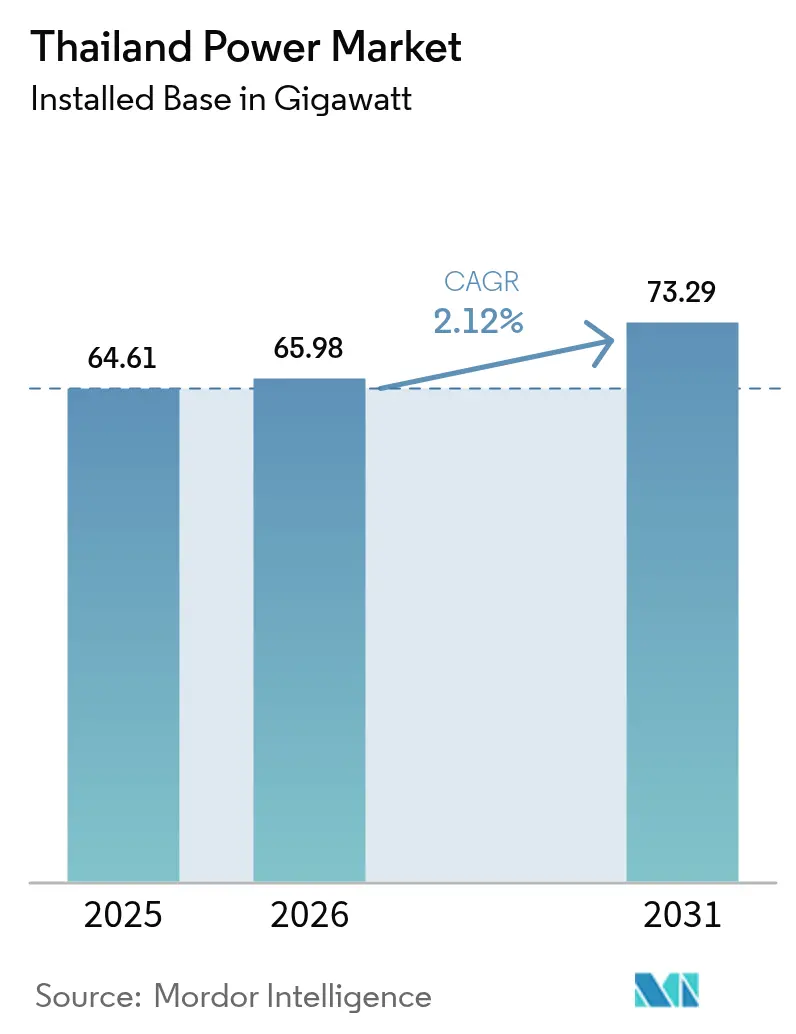
The Thailand Power Market size is expected to grow from 64.61 gigawatt in 2025 to 65.98 gigawatt in 2026 and is forecast to reach 73.29 gigawatt by 2031 at 2.12% CAGR over 2026-2031.
Installed thermal capacity, dominated by natural-gas plants, accounted for 75.6% of the Thailand power market in 2024, yet solar-led renewables are expanding the fastest as equipment prices fall and corporate power-purchase agreements (PPAs) multiply. Battery storage paired with photovoltaic systems outperforms peaking gas units on a levelized cost basis, encouraging independent power producers (IPPs) to advance hybrid portfolios despite the postponement of the Power Development Plan 2024 (PDP-2024). Grid modernization outlays of THB 90 billion (approximately USD 2.6 billion) for pumped-storage dams and high-voltage corridors underscore the imperative for system flexibility as coal retirements accelerate. Meanwhile, Thailand’s 30@30 electric-vehicle (EV) policy and the Utility Green Tariff (UGT) are lifting commercial and industrial (C&I) demand, reinforcing the structural shift toward distributed renewables and direct corporate procurement.
Key Report Takeaways
- By power source, thermal generation held 75.02% of Thailand's power market share in 2025, while renewables are forecast to advance at a 5.05% CAGR through 2031.
- By end user, utilities captured 42.25% of demand in 2025; the C&I segment is projected to expand at a 4.65% CAGR to 2031.
- The Central region accounted for 44.55% of 2025 consumption; the Eastern Economic Corridor is poised to post the fastest growth.
Note: Market size and forecast figures in this report are generated using Mordor Intelligence’s proprietary estimation framework, updated with the latest available data and insights as of 2026.
Thailand Power Market Trends and Insights
Drivers Impact Analysis*
| Driver | (~) % Impact on CAGR Forecast | Geographic Relevance | Impact Timeline |
|---|---|---|---|
| Rising renewables capacity additions | +0.8% | Central plains (solar), Northern provinces (hydro) | Medium term (2-4 years) |
| Modernization of ageing T&D grid | +0.5% | Southern corridor, Eastern Economic Corridor | Long term (≥ 4 years) |
| Steady electricity-demand growth from EV rollout | +0.3% | Urban clusters (Bangkok, Chiang Mai, Phuket) | Medium term (2-4 years) |
| Rapid cost decline of battery-integrated hybrid PV | +0.4% | Industrial estates, nationwide rooftop segments | Short term (≤ 2 years) |
| Rooftop FiT 2025 spurring distributed solar boom | +0.3% | Commercial buildings, industrial facilities | Short term (≤ 2 years) |
| ASEAN LTMS-PIP cross-border power-trade corridor | +0.2% | Regional (Laos imports, Malaysia link, Singapore offtake) | Long term (≥ 4 years) |
| Source: Mordor Intelligence | |||
Rising Renewables Capacity Additions
Thailand installed nearly 3 GW of solar photovoltaic (PV) capacity in 2024, increasing cumulative solar capacity to 11.875 GW and making solar the leading contributor to incremental capacity. EGAT’s floating-solar roadmap spans nine reservoirs totaling more than 2,700 MW, a strategy that sidesteps land constraints and speeds tie-ins via existing hydro grid nodes. The 2022 feed-in-tariff (FiT) auction awarded 5 GW across solar, wind, and battery projects, but southern congestion has delayed roughly 500 MW of grid connections, exposing generation-transmission interdependencies. Biomass and waste-to-energy remain niche, constrained by seasonal variability in feedstock availability despite supportive tariffs. Finalization of Third-Party Access (TPA) codes in 2025 is expected to unlock up to 2 GW of direct PPAs for data centers and export-manufacturing clusters, reducing reliance on utility offtake.
Modernization of Ageing T&D Grid
EGAT adopted Energy Exemplar’s PLEXOS model in January 2025 to optimize dispatch and renewable integration, signaling a digital pivot toward advanced grid analytics.(1)Energy Exemplar, “EGAT Picks PLEXOS for Dispatch Planning,” ENERGYEXEMPLAR.COM A THB 1.72 billion (USD 50 million) upgrade at the Ban Bueng 2 substation underscores capital intensity as voltage levels rise in the Eastern Economic Corridor. Three pumped-storage projects, totaling 2,472 MW, anchor the flexibility build-out, dwarfing the existing 1,531 MW fleet and providing the inertia lost from coal retirements. The Renewable Energy Forecast Center and Demand Response Control Center will coordinate curtailment once smart meter penetration, still below 10%, improves. Hitachi Energy’s grid-forming inverters are being piloted to furnish rapid frequency response compared with synchronous condensers.
Steady Electricity-Demand Growth from EV Rollout
Thailand’s 30@30 policy is expected to spur 150,000 EV registrations by the end of 2024, and EGAT has expanded public chargers from 211 to 321, illustrating the grid’s readiness to absorb the new load. Peak demand reached 36,792 MW in May 2024, and transport electrification could add 1,200-1,500 MW by 2030, comparable to the output of one large combined-cycle plant. Geographic clustering in Bangkok and tourism hubs heightens the risk of transformer overload, prompting the Metropolitan and Provincial Electricity Authorities to accelerate feeder upgrades. Hyperscale data-center developers are negotiating 20-year renewable PPAs, redirecting up to 2 GW of solar-plus-storage capacity toward industrial estates. Absent dynamic pricing, however, off-peak arbitrage remains underutilized, limiting demand-response potential.
Rapid Cost Decline of Battery-Integrated Hybrid PV
Lithium-ion battery prices fell below USD 140 per kWh in 2023, pushing solar-plus-storage hybrids below peaking gas on a levelized cost and widening the addressable dispatch window.(2)International Energy Agency, “Battery Cost Tracking 2024,” IEA.ORG Gulf Energy's 649 MW solar portfolio paired with 396 MWh of batteries drew USD 820 million in ADB financing, validating hybrid bankability under 20-year PPAs. Ember's analysis indicates that scaling hybrids beyond PDP targets could result in USD 1.8 billion in savings in LNG and transmission expenditures between 2026 and 2037.CLIMATE. Sungrow and Huawei Digital Power's local assembly has reduced inverter lead times to six months, enabling B.Grimm Power to commission 323 MW of solar six months ahead of schedule. ERC's forthcoming ancillary-services market will enable batteries to bid for frequency regulation and spinning reserve, monetizing their sub-second response capabilities.
Restraints Impact Analysis*
| Restraint | (~) % Impact on CAGR Forecast | Geographic Relevance | Impact Timeline |
|---|---|---|---|
| High capex for large-scale grid upgrades | -0.4% | Transmission backbone and pumped-storage projects nationwide | Long term (≥ 4 years) |
| Exposure to volatile imported LNG pricing | -0.3% | Gas-fired hubs in Map Ta Phut and Rayong | Short term (≤ 2 years) |
| Southern corridor grid congestion delaying RE projects | -0.2% | Surat Thani, Nakhon Si Thammarat, Songkhla | Medium term (2-4 years) |
| PDP-2024 postponement creating investor uncertainty | -0.2% | National (IPP financing and PPA negotiations) | Short term (≤ 2 years) |
| Source: Mordor Intelligence | |||
High Capex for Large-Scale Grid Upgrades
EGAT’s THB 90 billion (USD 2.6 billion) pumped-storage program implies costs exceeding USD 1 million per MW when civil works and environmental mitigation are included. The utility’s THB 13 billion (USD 380 million) floating-solar plan further stretches the balance sheet, and multilateral financing exposes projects to exchange-rate volatility. Southern 500 kV line reinforcements, priced at THB 20 billion (USD 580 million), are facing land-acquisition delays, stalling 500 MW of renewable connections and forcing developers into curtailment clauses. EGAT’s debt-to-equity ratio is near regulatory ceilings, limiting incremental borrowing unless tariffs rise or equity injections are made. Smaller IPPs cannot self-finance grid extensions, creating stranded generation until Third-Party Access enables private wheeling.
Exposure to Volatile Imported LNG Pricing
Imported LNG met 35.53% of Thailand’s gas demand in 2024, and spot cargo costs can swing 200% quarter-to-quarter, exposing gas-linked tariffs to abrupt hikes. The Map Ta Phut terminal’s 10 million-ton regas capacity covers only 60% of contracted imports, leaving a floating tranche exposed to global volatility. The Hin Kong plant became the first to secure private LNG under a Gulf-RATCH venture, hinting at potential procurement liberalization yet raising credit-risk questions for lenders. EPPO’s concept of a strategic gas reserve remains shelved due to cavern costs and tied-up working capital. Until battery storage reaches the gigawatt-hour scale, baseload gas plants will continue to anchor reliability, thereby sustaining exposure to LNG price shocks.
*Our forecasts treat driver/restraint impacts as directional, not additive. The impact forecasts reflect baseline growth, mix effects, and variable interactions.
Segment Analysis
By Power Source: Thermal Dominance Yields to Renewable Momentum
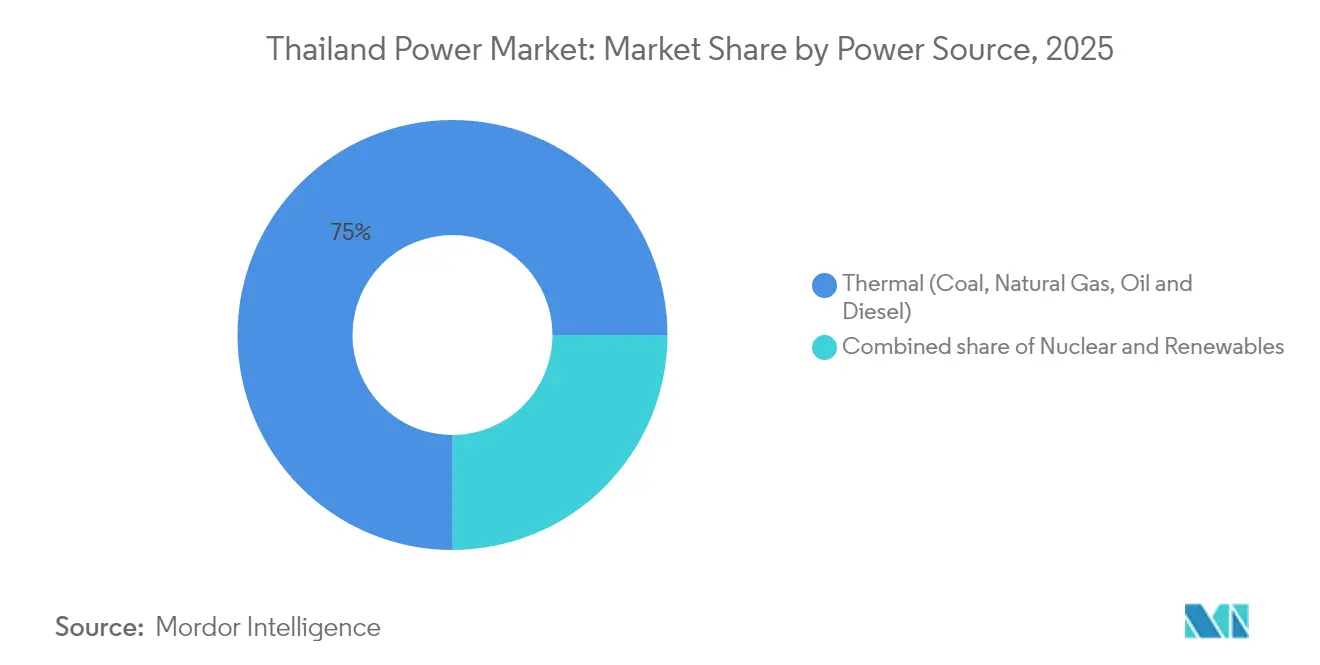
Thermal generation supplied 75.02% of capacity in 2025, yet solar additions lifted renewable output by 5.05% CAGR, signaling a pivot as coal and oil plants retire. Natural gas produced 57.74% of electricity; however, rising LNG dependence and carbon-neutrality targets are pressuring planners to cap new gas builds. Solar reached 11.875 GW on the back of floating-PV tenders totaling 2,656 MW, achieving capacity factors above 18% owing to cooler reservoir temperatures. Hydropower contributed 15.63% via Lao PDR imports, positioning Thailand as a transit hub in the Lao-Thai-Malaysia-Singapore (LTMS-PIP) corridor. Wind remains marginal, although offshore feasibility studies suggest a potential of 2-3 GW post-2028. Biomass and waste-to-energy projects expand slowly due to feedstock constraints. Nuclear and geothermal remain exploratory and are unlikely to influence the Thai power market before 2035.
Energy storage is the fulcrum of the transition: once lithium-ion breaches USD 100 per kWh, solar-plus-battery hybrids will undercut gas peakers, accelerating coal phase-outs and trimming LNG procurement. Consequently, the Thailand power market size for renewable hybrids is projected to grow faster than any thermal category over the 2026-2031 period. Reservoir-based floating solar, bundled with existing hydro tie-ins, offers near-term scale without new rights-of-way, highlighting the role of integrative assets in balancing variable supply.


By End User: Utilities Anchor Demand, C&I Surges
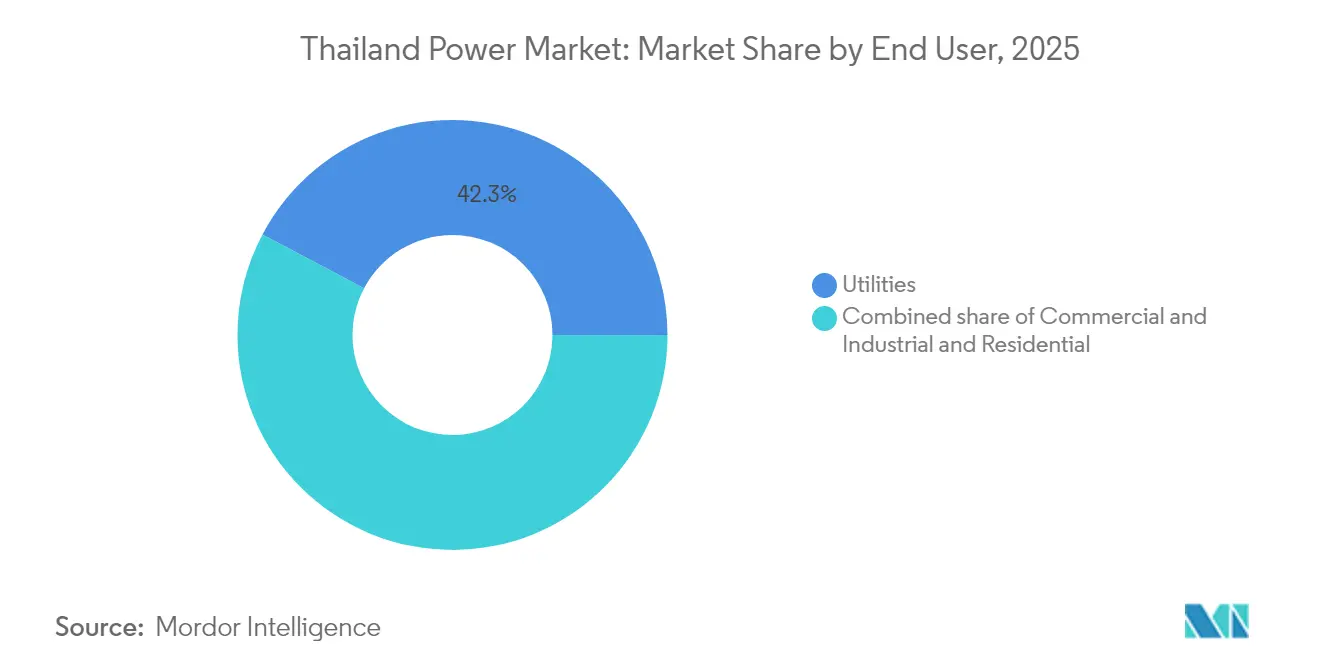
Utilities absorbed 42.25% of 2025 demand, reflecting EGAT’s monopoly over high-voltage transmission and bulk sales to the Metropolitan and Provincial Electricity Authorities. The C&I segment is forecast to grow at a 4.65% CAGR on data-center build-outs, automotive electrification, and petrochemical expansion in the Eastern Economic Corridor. Hyperscale cloud operators are negotiating 2 GW of direct renewable PPAs, bypassing utility offtake and fragmenting wholesale demand. Residential consumption grows just 1.7% CAGR as aging demographics cap load, though rooftop solar under the 2025 FiT refresh converts households into prosumers.
Industrial estates in Rayong and Map Ta Phut consumed approximately 8,000-9,000 GWh in 2024 and are expected to require an additional 1,500-2,000 MW by 2030. The Utility Green Tariff enables multinationals to pay premiums for low-carbon supply, redirecting 500-800 MW of solar toward industry by 2027. Bangkok’s air-conditioning-driven peaks spur demand-response pilots, while solar-powered irrigation pumps dampen agricultural diesel use. This divergence underlines how the Thai power industry must cater to both high-density urban load centers and distributed rural prosumers.
Geography Analysis
Thailand's Central region, including Bangkok, Ayutthaya, and Pathum Thani, accounted for 44.55% of the nation's electricity consumption in 2025, driven by dense residential populations, financial services, and the emergence of data centers. The Eastern Economic Corridor (EEC), spanning Chonburi, Rayong, and Chachoengsao, represents the fastest-growing pocket, expanding at a rate of 6-6.8% annually as EV factories, petrochemical complexes, and hyperscale data centers break ground. EGAT's priority upgrades to Ban Bueng and Pluak Daeng substations illustrate the grid-reinforcement imperative as variable renewables and industrial clusters converge.
Southern provinces, notably Surat Thani, Nakhon Si Thammarat, and Songkhla, offer abundant solar and biomass resources, yet face 500 kV corridor congestion that has deferred 500 MW of contracted renewable energy projects. Transmission upgrades costing THB 20 billion (USD 580 million) are currently under public consultation, but land-acquisition hurdles risk prolonging curtailment penalties. Northern provinces benefit from Lao PDR hydro imports; the Xayaburi dam alone delivers over 1,200 MW, making the region a transit node for the LTMS-PIP corridor.
The Northeast (Isan) region transitions from lignite reliance at the Mae Moh complex toward biomass co-firing and floating solar on irrigation canals, but achieving bidirectional flow requires THB 15-20 billion (USD 440-580 million) in distribution upgrades. Metropolitan Electricity Authority serves 5.8 million Bangkok customers and deploys time-of-use tariffs to shave 15-20% seasonal peaks. Tourist hubs such as Phuket experience 30-40% seasonal swings, prompting mobile substations to avoid overcapitalization. Finally, EEGAT'sfloating-PV pipeline leverages Central and Northern reservoirs, allowing projects to reach commercial operation within 24 months, underscoring geography's role in compressing lead times.
Regulatory Landscape
Thailand's electricity sector is regulated primarily by the Energy Regulatory Commission (ERC) under the Energy Industry Act 2007. The ERC oversees licensing, grid and market codes, and tariff setting across generation, transmission, and retail. In May 2026, the ERC approved a power tariff of 3.95 baht per unit for the May-August 2026 billing cycle, which keeps periodic tariff resets central to utility cash flows and end-user demand.
Policy direction is anchored by national power plans led by the Ministry of Energy and EPPO, including the draft PDP 2024 with a stated target of 51% renewable energy share by 2037. In June 2026, the government implemented a new three-tier progressive electricity tariff for residential users (first 200 units capped at 3 baht/unit, 201-400 units at 3.95 baht/unit, and above 400 units at 5 baht/unit). In July 2026, the ERC initiated a review study covering 593 renewable-energy power purchase contracts to align legacy tariffs with lower current production costs, which can affect PPA pricing norms for new-build renewables and hybrid storage projects.
Competitive Landscape
The Thai power market features a hybrid structure: EGAT monopolizes high-voltage networks and most hydro assets, while IPPs, including Gulf Energy, RATCH Group, EGCO, and B.Grimm Power, have invested over USD 2 billion in new renewables and regional acquisitions since late 2024. Gulf Energy’s USD 820 million ADB-backed hybrid-solar financing exemplifies the multilateral appetite for long-term debt tied to 20-year PPAs. Equipment vendors JinkoSolar, Sungrow, Huawei Digital Power, Vestas, and Siemens Gamesa localize their assembly lines to reduce logistics costs, enabling B.Grimm to deliver 323 MW six months ahead of schedule.
Ancillary-services liberalization slated for late 2025 will let battery operators bid for frequency regulation at sub-second granularity, a market that Gulf Energy and BCPG have pre-positioned for through hybrid portfolios. Corporate PPAs and direct-access frameworks fragment demand, with hyperscale data centers expected to secure 2 GW by 2027, forcing utilities to recalibrate their tariffs and capacity-planning models. EGAT’s adoption of Energy Exemplar’s PLEXOS tool indicates a strategic turn toward data-driven dispatch, while pilot deployments of Hitachi Energy’s grid-forming inverters in the Southern corridor signal technology modernization
Thailand Power Industry Leaders
Electricity Generation Authority of Thailand
Gulf Energy Development PLC
RATCH Group Public Co. Ltd.
Electricity Generating Public Co. Ltd. (EGCO)
B.Grimm Power PLC
- *Disclaimer: Major Players sorted in no particular order

Market Opportunities and Future Outlook
Near-term whitespace in Thailand centers on mechanisms that broaden corporate procurement and speed up distributed renewables, alongside grid investments needed for new load pockets. In June 2026, the Ministry of Energy launched a Direct PPA market mechanism starting at 2,000 MW, giving commercial and industrial buyers (including data centers and exporters) a clearer route to contract clean electricity directly. This complements instruments such as the Utility Green Tariff introduced in 2025.
The same June 2026 policy package increased the household rooftop solar buy-back quota from 90 MW to 1,000 MW (500+500 MW). That expands addressable demand for rooftop EPC, inverters, smart metering, and behind-the-meter storage, particularly where grid congestion and peak charges constrain optimization. System flexibility and decarbonization infrastructure also create investable themes with concrete plan and project anchors. In June 2026, the Ministry of Energy announced PDP 2026-2050, targeting 70% clean energy by 2050 (60% renewable and 10% advanced clean technologies, including SMRs). The Ministry also proposed reclassifying data centers as a distinct consumer category to manage nearly 30,000 MW of power reservation requests, signaling the need for dedicated connection frameworks, transmission upgrades, and energy management solutions in industrial clusters. On the supply side, the December 2025 engineering assignment secured by Technip Energies for Thailand's first CCS pilot at PTTEP's Arthit field points to demand for carbon-management services and related power-sector adjacencies as Thailand balances gas dependency with carbon-neutrality targets.
Recent Industry Developments
- June 2026: EGAT announced infrastructure upgrades to support data center growth, including pilots to improve transmission system efficiency in three areas of the Eastern region. The program strengthens grid readiness in the Eastern Economic Corridor and addresses rising connection requirements from new hyperscale and industrial loads.
- February 2026: Gulf Energy Development secured THB 60 billion (approximately USD 1.9 billion) to invest in renewable energy power projects totaling 939 MW of contracted generation capacity. The financing supports faster build-out of utility-scale renewables and increases competitive pressure on incumbent thermal assets through additional contracted clean capacity.
- November 2024: Asian Development Bank provided USD 820 million in financing to Gulf Energy Development for 649 MW of solar projects paired with 396 MWh of battery storage. The transaction reinforced bankability for solar-plus-storage under long-term PPAs and helped validate hybrid structures as a scalable alternative to peaking gas.


Research Methodology Framework and Report Scope
Market Definition and Coverage
For this study, the Thailand power market is defined as the country level electricity system measured using installed generation capacity, expressed in gigawatts, across grid connected sources supplying national demand.
Scope exclusions: Off-grid captive generation that is not connected to the national system, along with fuel upstream activities, are not counted in the market size.
Segmentation Overview
- By Power Source
- Thermal (Coal, Natural Gas, Oil and Diesel)
- Nuclear
- Renewables (Solar, Wind, Hydro, Geothermal, Biomass & Waste, Tidal)
- By End User
- Utilities
- Commercial and Industrial
- Residential
- By T&D Voltage Level (Qualitative Analysis only)
- High-Voltage Transmission (Above 230 kV)
- Sub-Transmission (69 to 161 kV)
- Medium-Voltage Distribution (13.2 to 34.5 kV)
- Low-Voltage Distribution (Up to 1 kV)
Data Sources, Market Sizing, and Validation
Desk Research
Desk research was used to build a clean fact base on Thailand installed capacity, generation mix, and policy targets, and then to map how those inputs translate into capacity additions and retirements over time. Public and official sources, such as Thailand energy ministry planning releases, national regulator publications, utility annual reports, and international energy statistics bodies, were used to get consistent time series and definitions.
Alongside these, we reviewed company filings, investor presentations, and reputable press coverage to track commissioning timelines, delayed projects, and technology shifts that can change near-term capacity numbers. Patent databases were checked selectively to understand where grid integration and flexibility technologies are being developed, which helped as supporting signals rather than direct sizing inputs. In a few cases, a paid subscription for company financials and intelligence and a news and financials subscription were referenced to validate ownership changes and project status. The sources mentioned here are illustrative only, and many other public references were also used to collect data, validate numbers, and clarify assumptions.
Primary Interviews and Surveys
Primary work focused on validating the practical capacity pipeline and the timing assumptions that desk research can miss, especially around permitting, grid connection readiness, and expected retirements. We spoke with a mix of developers, EPC and O&M stakeholders, grid and utility ecosystem participants, and large power buyers to cross-check additions by technology, while also testing demand and reserve margin expectations that influence capacity planning.
Distribution of primary research fieldwork respondents
| Company type | Respondent position |
|---|---|
| Top tier: 38% | CXOs: 14% |
| Mid tier: 48% | Functional/Unit leaders: 27% |
| Smaller Players: 14% | Managers: 59% |
Market-Sizing & Forecasting
Sizing was built using a top-down capacity reconstruction, where national installed capacity by source is carried forward year by year using planned additions, refurbishment effects, and retirements that are visible in public plans and grid disclosures. To keep the totals realistic, the output was then corroborated with selective bottom-up approximations, such as rolling up announced projects with expected COD windows and sense-checking implied capacity changes against typical unit sizes and known plant schedules.
Key inputs used in the model include installed capacity by technology, commissioning and retirement timelines, expected reserve margin behavior, power demand growth signals, and import reliance trends where relevant. When a project detail was incomplete, a conservative placeholder was applied based on similar projects in the same technology class, and the assumption was later tested in interviews. For forecasting, scenario analysis was used so that changes in policy targets, grid connection pace, and thermal retirement timing could be reflected without forcing a single linear trend. Assumptions were kept explicit so they can be revisited quickly if a major project is delayed or a policy direction shifts.
Data Validation & Update Cycle
Model outputs were checked against independent signals, including publicly stated system capacity totals, generation mix commentary, and major project status updates, and then reviewed for outliers that do not match observed planning logic. Variances that were larger than expected triggered a second pass through the input sheets, followed by targeted re-checks of dates, unit conversions, and whether a plant was counted as operational or still under commissioning.
Before sign-off, the work goes through multi-step analyst review so that definitions and time bases stay consistent across the historical series and forecast years. Reports are refreshed annually, and interim updates are made when there are material events like policy revisions, large capacity awards, or meaningful retirement announcements. Right before delivery, a final sweep is done to ensure the newest public releases are reflected in the narrative and the numbers.
Mordor Intelligence's Thailand Power Market Estimate Compared With Other Published Estimates
Published estimates for Thailand power often do not match because some sources size the market in money terms, while others treat it as a capacity market, and the time horizon and scenario choice can also be different. Differences also show up when one publisher includes transmission and distribution value or downstream billing revenues, even though another is focused only on generation capacity.
The biggest gap driver is the unit of measurement and what is being priced, where Mordor Intelligence keeps the market size anchored to installed generation capacity in GW (64.61 GW in 2025) instead of converting the sector into a USD value that depends heavily on tariff assumptions and revenue allocation across generation and networks. Currency timing, inflation handling, and whether aggressive or conservative build-out cases are used can widen the spread further, even when everyone is looking at the same national planning documents.
Benchmark comparison
| Source | Market Size | Gaps in Research Methodology |
|---|---|---|
| Mordor Intelligence | USD 64.61 B (2025) | |
| Global Consultancy A | USD 58.74 B (2024) | Sizes Thailand power as a USD value that mixes generation, transmission, distribution, and consumption, so results depend on tariff and revenue assumptions rather than installed capacity accounting. |
| Industry Publisher B | USD 242.77 B (2025) | Reports electricity system indicators in energy output terms (GWh) and related projections, which can look like a larger market size if read as value, and it is not directly comparable to a GW installed capacity measure. |
Reading the three figures together, the spread is mainly explained by whether the market is treated as capacity (GW), sector value (USD), or energy output (GWh) that is not a pricing measure. By keeping the sizing steps tied to traceable capacity additions and retirements, and then checking timing through interviews, the estimate stays repeatable even when pricing and tariff assumptions shift.


Key Questions Answered in the Report
How large is the Thailand power market in 2026?
The Thailand power market size reached 65.98 GW of installed capacity in 2026.
What CAGR is forecast for Thailand’s power capacity between 2026 and 2031?
Capacity is projected to grow at a 2.12% CAGR, reaching 73.29 GW in 2031.
Which segment is growing fastest within Thailand’s demand profile?
Commercial and industrial customers are expected to post a 4.65% CAGR through 2031, bolstered by data-center and EV-manufacturing expansion.
Why are floating solar projects important for Thailand?
Reservoir-based floating PV avoids land constraints, leverages existing hydro grid connections, and accelerates commissioning to 18-24 months.
How will battery storage influence Thailand’s generation mix?
Falling lithium-ion costs below USD 140 per kWh make solar-plus-storage hybrids cost-competitive with gas peakers, enabling faster coal retirements and LNG displacement.
What is the role of the Utility Green Tariff?
Introduced in January 2025, the tariff allows large consumers to purchase renewable electricity directly, helping multinationals meet decarbonization targets and redirecting up to 800 MW of solar toward industrial offtake.
Page last updated on:


 Your data is secure and never sold or shared.


