
Market Overview
| Study Period | 2020 - 2031 |
|---|---|
| Forecast Data Period | 2026 - 2031 |
| Base Year Market Size (2025) | 6.23 Million tons |
| Market Volume (2026) | 6.43 Million tons |
| Market Volume (2031) | 7.56 Million tons |
| Growth Rate (2026 - 2031) | 3.27 % |
| Market Concentration | Medium |
Major Players *Disclaimer: Major Players sorted in no particular order Image © Mordor Intelligence. Reuse requires attribution under CC BY 4.0. | |
Thailand Plastics Market Analysis by Mordor Intelligence
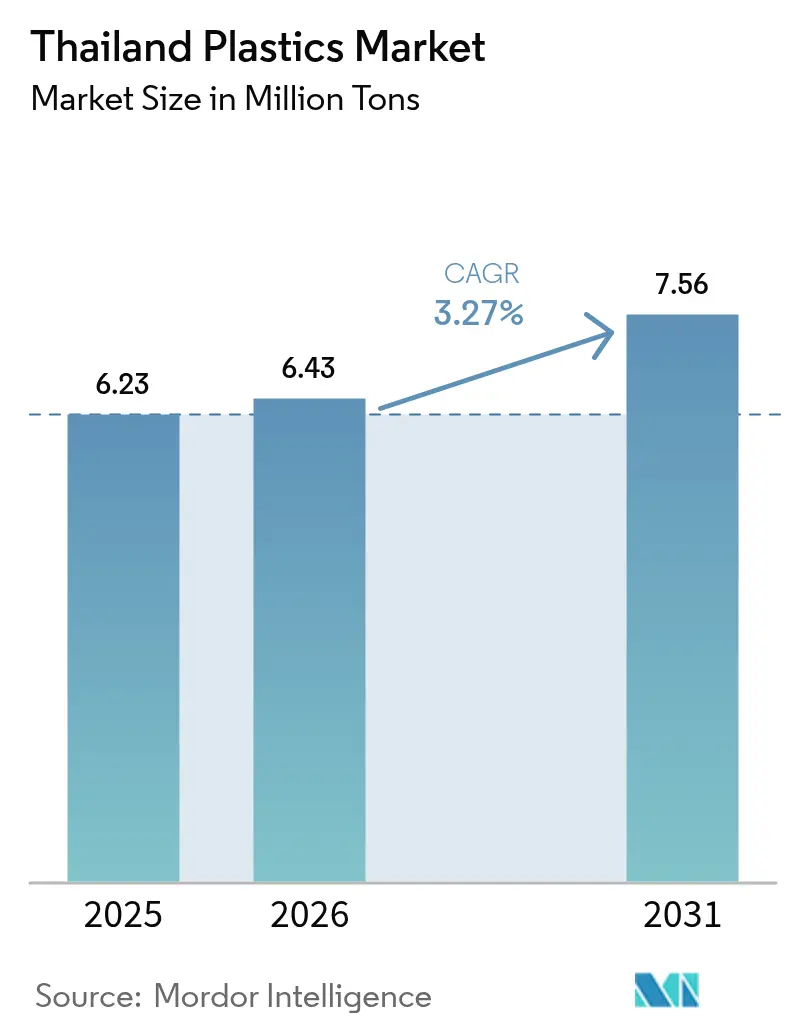
Thailand Plastics Market size in 2026 is estimated at 6.43 million tons, growing from 2025 value of 6.23 million tons with 2031 projections showing 7.56 million tons, growing at 3.27% CAGR over 2026-2031. This moderate headline growth conceals a decisive shift toward low-carbon feedstocks, circular economy practices, and specialty applications that lift margins even as commodity spreads tighten. Traditional resins dominate volumes, yet a rapid pivot to biopolymers is underway because joint ventures are unlocking bio-ethylene and PLA capacity at scale. Demand momentum remains strongest in food, beverage, and e-commerce packaging, but the emergence of an electric-vehicle supply chain and large-scale infrastructure projects creates fresh pull for engineering resins and high-performance compounds. Intensifying Chinese oversupply, volatile naphtha costs, and stricter waste regulations pressure margins; firms that diversify feedstocks and invest in recycling infrastructure are best placed to protect returns in the Thailand plastics market.
Key Report Takeaways
- By type, traditional plastics led with 70.55% of Thailand plastics market share in 2025; bioplastics is projected to expand at a 5.53% CAGR through 2031.
- By application, packaging captured 25.62% of the Thailand plastics market size in 2025 while automotive and transportation is advancing at a 3.56% CAGR to 2031.
Note: Market size and forecast figures in this report are generated using Mordor Intelligence’s proprietary estimation framework, updated with the latest available data and insights as of 2026.
Thailand Plastics Market Trends and Insights
Drivers Impact Analysis*
| Drivers | (~) % Impact on CAGR Forecast | Geographic Relevance | Impact Timeline |
|---|---|---|---|
| Rising demand from food and beverage packaging | +1.2% | National, with concentration in Bangkok and Eastern Economic Corridor | Medium term (2-4 years) |
| Increasing plastics use in building and construction | +0.8% | National, driven by infrastructure megaprojects | Long term (≥ 4 years) |
| Lightweighting needs in automotive and EV components | +0.9% | Eastern Economic Corridor, Rayong province | Medium term (2-4 years) |
| Rapid e-commerce growth boosting protective packaging | +0.6% | Urban centers, Bangkok metropolitan area | Short term (≤ 2 years) |
| Bio-based polymer joint ventures | +0.4% | Map Ta Phut industrial complex, Rayong | Long term (≥ 4 years) |
| Source: Mordor Intelligence | |||
Rising Demand from Food and Beverage Packaging
Domestic beverage consumption continues to expand, locking in steady packaging tonnage. New food-contact standards effective March 2025 encourage converters to adopt recyclable and heat-resistant formulations that command premium pricing. Beverage exports to neighboring Cambodia and Vietnam add incremental volumes, and food-delivery growth has more than doubled since the pandemic, generating multiple plastic items per order. Rising temperatures, rapid urbanization, and a tourism rebound sustain packaging intensity in the Thailand plastics market. Demand for rigid containers grows in parallel with the personal-care segment, where mid-single-digit sales growth of cosmetics and health products boosts specialized packaging uptake.
Increasing Plastics Use in Building and Construction
Government spending across over 150 infrastructure projects underwrites long-run demand for PVC pipes, insulation, and roofing sheets. The Plastic Roads initiative, which incorporates up to five tons of recycled material per kilometer, signals a policy pivot toward circular construction practices that enlarge the addressable market for recycled resin. More than 800 mid- and large-size manufacturers now integrate digital ordering tools and low-carbon processes to satisfy green-building specifications. An expected 1 million new jobs linked to megaprojects will spur residential and commercial builds, reinforcing demand for plastic building products even as energy inflation and cheap Chinese imports squeeze margins.
Lightweighting Needs in Automotive and EV Components
Thailand’s 30@30 policy targets 30% electric-vehicle production by 2030. EV sales climbed from 84,500 units in 2022 to 206,000 units in 2024, creating outsized demand for lightweight battery casings, interior trims, and structural composites. Projects such as BYD’s USD 900 million Rayong plant and BMW’s forthcoming local assembly lines will rely on engineering resins that provide heat resistance and electrical insulation. Localization mandates that set domestic-content thresholds through 2035 further anchor those supply chains inside the Thailand plastics market. As automakers press suppliers to cut vehicle mass and extend range, polypropylene and advanced polyamides gain share in dashboards, under-hood applications, and EV charging components.
Bio-Based Polymer Joint Ventures
The USD 1.54 billion Braskem-SCGC bio-ethylene venture will deliver 200,000 tons a year of renewable polyethylene derived from sugarcane ethanol, cutting cradle-to-gate emissions by as much as 70% versus fossil resin[1]. NatureWorks is adding 75,000 tons of PLA at its Nakhon Sawan complex, backed by USD 350 million in domestic financing[2]. These projects position Thailand as a regional leader in sustainable resins, expand feedstock optionality for converters, and open export windows into premium consumer-goods markets that mandate lower-carbon packaging. The initiatives align with the national Bio-Circular-Green economic model, deepen farmer participation in the plastics value chain, and support the upward revision of renewable-material targets within the Thailand plastics market.
Restraints Impact Analysis*
| Restraints | (~) % Impact on CAGR Forecast | Geographic Relevance | Impact Timeline |
|---|---|---|---|
| Stricter single-use-plastic bans and taxes | -0.7% | National, with enforcement focus on urban areas | Short term (≤ 2 years) |
| Crude-oil/naphtha price volatility | -0.9% | National, affecting all petrochemical producers | Medium term (2-4 years) |
| PP and PE oversupply and low-cost imports from China | -1.1% | National, with particular impact on commodity plastics | Medium term (2-4 years) |
| Source: Mordor Intelligence | |||
Stricter Single-Use-Plastic Bans and Taxes
Thailand’s plastic-waste roadmap phases out imports from January 2025 and tightens quality rules for food-contact articles. Urban centers such as Bangkok generate 1,800 metric tons of single-use waste daily, prompting authorities to fast-track levies and labeling mandates that raise compliance costs for converters. Additional legislation under the Draft Industrial Waste Management Act introduces a dedicated fund to remediate environmental impacts and imposes stricter disposal rules on hazardous scrap. Producers in the Thailand plastics market must invest in certified recyclable or compostable alternatives and enhance traceability systems or face penalties. These rules initially restrict disposable items but ultimately catalyze demand for higher-value sustainable resins.
Polypropylene and Polyethylene Oversupply and Low-Cost Imports from China
China is bringing nearly 5 million tons of additional polyethylene capacity online each year, pushing surplus volumes into Southeast Asia at discounted prices. Spot HDPE film assessments have slipped to multi-year lows, and regional crackers periodically cut rates below economic thresholds. Domestic production indices for packaging and finished goods deteriorated in early 2025, and converters postponed offtake amid margin squeeze. Although Thai exports to the United States temporarily rose because of tariff-driven stock-building, overall throughput in the Thailand plastics market faces cyclical contraction when import pressure peaks. Integrated producers are accelerating recycle and specialty upgrades to defend utilization and value capture.
*Our forecasts treat driver/restraint impacts as directional, not additive. The impact forecasts reflect baseline growth, mix effects, and variable interactions.
Segment Analysis
By Type: Adaptation of Legacy Resins Alongside Renewable Momentum
Traditional resins retained 70.55% of Thailand's plastics market share in 2025 thanks to entrenched infrastructure, scale economics, and diversified end-use exposure. Among them, polyethylene and polypropylene anchor packaging, automotive, and construction demand, while PET has grown beyond bottles into technical yarns and tire fabrics. HMC Polymers surpassed THB 25 billion in sales in 2023, illustrating the continuing commercial relevance of commodity grades. Engineering resins such as polyamides and polycarbonates post mid-single-digit demand gains tied to electronics assembly and EV power-train applications.
Biopolymers are the fastest-expanding category, progressing at a 5.53% CAGR and lifted by the 200,000-ton bio-ethylene venture and the 75,000-ton PLA expansion. Mainstream producers now trial chemical-recycling routes and circular naphtha streams to future-proof their asset bases and preserve relevance under new food-contact rules. The competitive gap narrows as conventional suppliers license bio-based processes, while newcomers differentiate through carbon-footprint declarations and compostability certifications.


By Application: Packaging Scale Leads as Mobility Drives Incremental Value
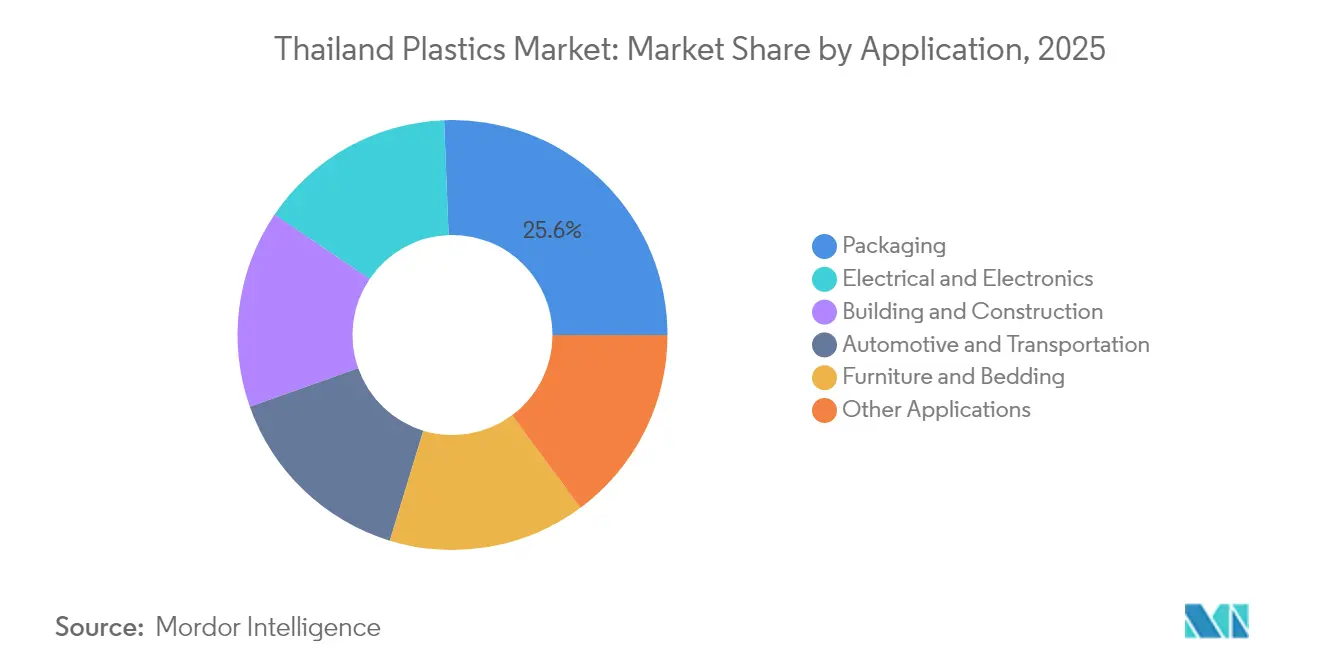
Packaging commanded 25.62% of the Thailand plastics market size in 2025 and is still expanding in line with rising food, beverage, personal-care, and e-commerce volumes. SCGP grew recycling revenue 80% in 2023 as brand owners demanded closed-loop solutions. Converters adopt microwave-safe PP and mono-material laminates to meet new food-contact rules, and smart-label innovations bring additional resin demand for near-field-communication tags embedded in caps and pouches.
Automotive and transportation applications exhibit the highest growth trajectory at 3.56% CAGR through 2031. The country’s pivot to EV assembly amplifies demand for engineering plastics that reduce weight and meet stringent thermal requirements. BYD, BMW, and more than a dozen other automakers have announced localized plants, giving compounders visibility on long-run volumes and justifying investments in advanced mixing lines. Downstream, charging-infrastructure rollouts require weatherable PC housings and flame-retardant PA connectors, further deepening the opportunity pool for the Thailand plastics market.
Geography Analysis
Roughly 80% of upstream and intermediate output feeds domestic conversion, reinforcing a self-sufficient ecosystem that underpins the Thailand plastics market. Bangkok’s metropolitan region is the biggest consumption hub; online retail, tourism, and foodservice platforms collectively generate elevated per-capita plastic use.
The Eastern Economic Corridor clusters assets in Rayong, Chonburi, and Chachoengsao, including mega-investments in bio-ethylene, EV assembly, and gas-to-olefins projects. Co-location reduces logistics costs and anchors high-value downstream processing, enabling rapid commercialization of new resins. Map Ta Phut hosts both fossil and renewable feedstock complexes, giving converters immediate access to diverse polymer grades and recycled pellets.
Regional exports remain a strategic outlet. Thailand leverages ASEAN trade frameworks to supply packaging resin to Cambodia and Vietnam, while tariff arbitrage under the US-China trade dispute unlocked a 61.7% jump in shipments to the United States early in 2025. Yet oversupply from China and shifting polypropylene trade balances require proactive portfolio management and customer diversification to safeguard utilization.
Value Chain Analysis
Thailand's plastics value chain starts with hydrocarbon feedstocks (notably naphtha and gas derivatives) and bio-based inputs such as sugarcane ethanol and lactic acid, then moves through olefins cracking and polymerization into PE, PP, PVC, PET, engineering resins, and emerging bioplastics. Upstream production is concentrated around the Eastern Economic Corridor and the Map Ta Phut industrial complex, where integrated producers supply local converters that serve packaging, construction, electronics, and automotive demand. Distribution runs through domestic resin channels and export routes within ASEAN.
Circularity requirements are increasingly shaping the midstream-to-downstream chain, with collection, sorting, and recycling (mechanical and chemical) becoming core nodes alongside compounding and conversion. In April 2026, PTT Global Chemical and SCG Chemicals signed a non-binding MoU to study a strategic joint venture for olefins and polyolefins in Thailand, which is aimed at strengthening petrochemical supply-chain security and improving operating leverage across upstream assets. Parallel policy work on Extended Producer Responsibility frameworks and Thailand's Plastic Waste Management Roadmap (2018-2030) is accelerating demand for traceable recycled feedstock and tightening linkages between brand owners, converters, and waste-management partners.
Competitive Landscape
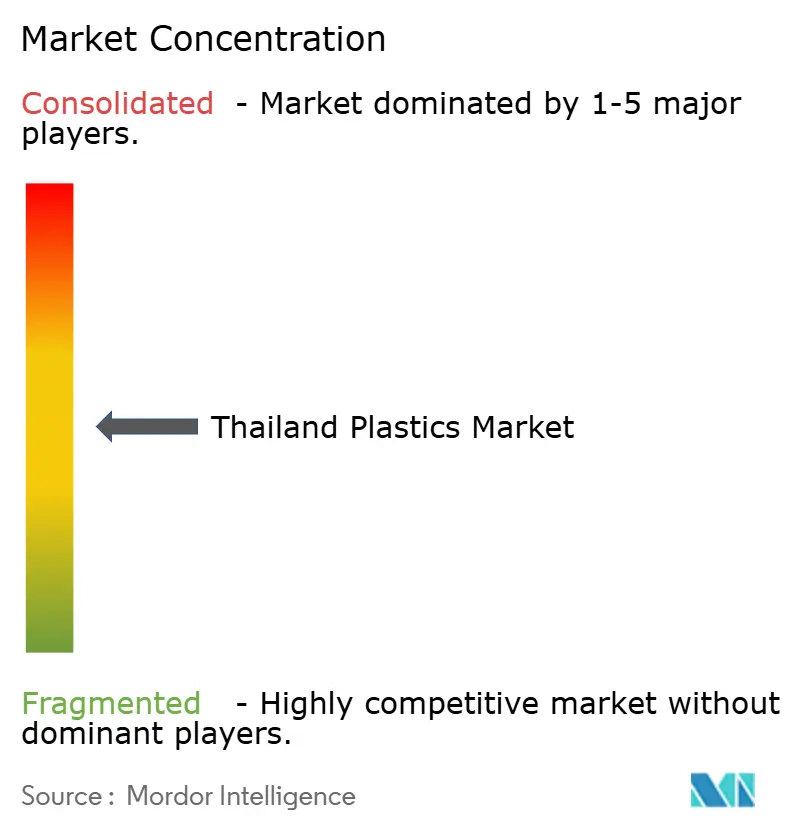
The market demonstrates moderate fragmentation. PTT Global Chemical, SCG Chemicals, and Indorama Ventures anchor capacity through integrated refinery-to-polymer chains and maintain multi-continent customer bases. Competitive advantage increasingly derives from carbon-footprint transparency, closed-loop partnerships, and the ability to co-innovate with brand owners on design-for-recycling. Companies capable of scaling bio-based ventures, integrating mechanical-plus-chemical recycling, and switching feedstocks rapidly are projected to outpace peers within the Thailand plastics market.
Thailand Plastics Industry Leaders
-
HMC Polymers Thailand
-
Indorama Ventures Public Company Limited
-
IRPC Public Company Limited
-
PTT Global Chemical Public Company Limited
-
SCG Chemicals Co. Ltd
- *Disclaimer: Major Players sorted in no particular order
Market Opportunities and Future Outlook
White space is opening around scalable low-carbon and circular polymers that can defend margins when commodity polyolefin spreads compress under import pressure. NatureWorks' April 2026 grand opening of a fully integrated 75,000-metric-ton Ingeo PLA biopolymer facility in Nakhon Sawan supports local-to-local bio-based supply and creates new offtake pathways for packaging and consumer goods that require renewable-content claims. Another anchor is the BOI's FastPass selection (December 2025) for Braskem Siam's 200,000-tpa bio-ethylene project, which reinforces Thailand's investment pipeline for bio-based PE and related downstream conversion.
A second opportunity track is recycling infrastructure and high-quality secondary resin supply, where policy and industrial resilience are converging. In April 2026, Thailand's Ministry of Industry announced urgent measures to accelerate plastic recycling amid petrochemical feedstock supply disruption, supporting incremental demand for collection, sorting, and reprocessing capacity that can deliver consistent recycled pellets for converters. At the same time, producers and compounders are building a case for operational consolidation and reliability in basic resins, reflected in the ongoing PTTGC-SCGC study toward an olefins and polyolefins joint venture. This can reshape local procurement options for converters and improve supply continuity for packaging, construction, and mobility applications.
Recent Industry Developments
- July 2026: HMC Polymers signed an MoU with the Industrial Estate Authority of Thailand (IEAT) to develop a closed-loop resource and waste material management system within the Map Ta Phut Complex Industrial Estate. The initiative formalizes industrial-scale collaboration on segregation and material recovery, supporting higher-quality recycling loops for polymer producers and converters operating in the estate.
- April 2026: NatureWorks announced the grand opening of its fully integrated Ingeo PLA biopolymer manufacturing facility in Nakhon Sawan with 75,000 metric tons of annual capacity. The start-up expands domestic availability of biopolymers for packaging and other applications, reducing reliance on imported specialty materials and strengthening Thailand's position in regional sustainable plastics supply.
- May 2024: Dow and SCG Chemicals signed an agreement to transform 200,000 tons of plastic waste in the Asia-Pacific region into circular products by 2030. The partnership links resin producers with circular feedstock development, supporting downstream brand-owner requirements for recycled content and reinforcing investment momentum in collection and recycling ecosystems.
Research Methodology Framework and Report Scope
Market Definition and Coverage
For this report, the Thailand plastics market is defined as plastic resin demand and supply within Thailand, tracked across the main polymer families and the common end-use application areas where these materials are converted and consumed.
Scope exclusions: It excludes rubber products and non-plastic substitute materials (such as paper, glass, metals, and wood), even when they compete in the same packaging or construction uses.
Segmentation Overview
- By Type
- Traditional Plastics
- Polyethylene (PE)
- Polypropylene (PP)
- Polyvinyl Chloride (PVC)
- Polystyrene (PS)
- Engineering Plastics
- Polyethylene Terephthalate (PET)
- Polyamides (PA)
- Polycarbonates (PC)
- Styrene Copolymers (ABS and SAN)
- Polybutylene Terephthalate (PBT)
- Polymethyl Methacrylate (PMMA)
- Other Engineering Plastics
- Bioplastics
- Traditional Plastics
- By Application
- Packaging
- Electrical and Electronics
- Building and Construction
- Automotive and Transportation
- Furniture and Bedding
- Other Applications
Data Sources, Market Sizing, and Validation
Desk Research
Desk research was used to set the factual base for Thailand, focusing on resin production footprint, trade flows, and demand-side signals. We typically review public statistics and publications such as Thailand customs and trade statistics, Bank of Thailand macro indicators, data releases from Thailand's Ministry of Industry and related agencies, and international references such as UN Comtrade and World Bank data.
To keep the market model grounded in how plastics are actually used, secondary checks were also taken from association websites and standards bodies (for example packaging and recycling related associations), peer-reviewed journals on polymer demand and recycling rates, and public company filings and investor presentations from relevant producers and converters. For selected financial and patent checks, we also referenced a paid subscription database that helps with comparable company financials, news screening, and patent mapping. The sources listed here are illustrative only, and many other public and paid references were consulted for data collection, validation, and clarification.
Primary Interviews and Surveys
Primary work was used to validate the desk assumptions and to fill gaps that public sources do not explain well, such as resin pricing behavior, import substitution patterns, and shifts in application mix. We spoke with a balanced set of stakeholders including resin producers, compounders, converters, distributors, large end users, and sector specialists, and we checked the inputs for consistency across Thailand's main industrial clusters.
These discussions helped us stress-test the demand signals behind packaging, construction, electronics, and automotive use. They also helped confirm how fast recycled and bio-based materials are being adopted in practice in Thailand.
Distribution of primary research fieldwork respondents
| Company type | Respondent position |
|---|---|
| Top tier: 36% | CXOs: 12% |
| Mid tier: 49% | Functional/Unit leaders: 37% |
| Smaller Players: 15% | Managers: 51% |
Market-Sizing & Forecasting
Sizing was built using a top-down approach where national plastics demand is reconstructed from Thailand-level production, net trade, and the split of consumption across major application pools, and then converted into a consistent market volume series. To keep the totals realistic, we corroborated the result with selective bottom-up approximations such as sampled resin price points multiplied by estimated volumes in key applications. We then ran channel checks with converters and distributors to confirm directionality.
A few inputs were treated as the core fingerprints in the model, rather than trying to track every micro use. These include resin output and capacity utilization trends, import and export volumes by key polymer groups, packaging demand indicators linked to food and beverage and e-commerce, construction activity signals tied to infrastructure and housing, and shifts in engineering plastics usage driven by electronics and automotive supply chains. Where bottom-up visibility was weaker, gaps were handled by using conservative proxy ratios from comparable end-use mixes and then re-tested through interview feedback before being locked.
For forecasting, scenario analysis was applied around feedstock cost cycles, recycling and waste regulation enforcement, and downstream industrial growth in Thailand. The base case was aligned to what industry participants consider achievable in the next five years. The final forecast was only finalized after the key price and mix assumptions were checked for internal consistency across types and applications.
Data Validation & Update Cycle
Validation was done through repeated cross-checks, where model outputs were compared against independent signals like trade direction changes, utilization commentary, and application-level demand movement shared by interviewees in Thailand. When large variances appeared, the drivers were isolated, assumptions were revisited, and respondents were re-contacted if the issue was linked to pricing, mix, or a recent policy change.
Before sign-off, the work goes through multi-step analyst reviews, including sense checks across historical growth, year-to-year jumps, and alignment between volume movement and price logic. Reports are refreshed annually, and interim updates are made when material events occur, such as major capacity additions, sharp feedstock swings, or regulatory changes that alter recycling and single-use plastics usage. Right before delivery, we do a fresh pass to ensure the latest public indicators and interview learnings are reflected.
Mordor Intelligence's Thailand Plastics Market Size Measured Against Other Published Estimates
Published market sizes for Thailand plastics can look far apart because the underlying unit of measure, the pricing assumptions, and the timing of updates are not always consistent across published sources. Some figures are shared in revenue terms, while others are anchored in tonnage, and that choice alone can change the reported size when prices move.
A second set of gaps usually comes from how quickly assumptions are refreshed, including currency conversion timing and the way average selling prices are rolled forward across polymer families. In our checks, the spread also showed up when estimates leaned heavily on a single base-year snapshot without re-validating trade, utilization, and application mix shifts in the most recent period, which is where Mordor Intelligence kept the model tied to updated volume signals and a consistent FX timing rule.
Benchmark comparison
| Source | Market Size | Gaps in Research Methodology |
|---|---|---|
| Mordor Intelligence | USD 6.23 M (2025) | |
| Global Consultancy A | USD 10.76 B (2025) | Reported as revenue, which bakes in polymer price levels and product-mix assumptions that can inflate totals versus a tonnage-based view when feedstock-linked prices are elevated. |
| Trade Journal B | USD 36.90 B (2018) | Uses a broader economic contribution framing and an older reference year, so it can include downstream value-add and related activities beyond resin and conversion volumes tracked in this market scope. |
The comparison mainly shows that unit choice, scope boundary, and update timing drive most of the differences. By keeping the sizing steps traceable to current production and trade signals, and then aligning price and currency timing consistently, the market estimate stays easier to repeat and explain when conditions change year to year.
Key Questions Answered in the Report
What is the current production volume of the Thailand plastics market?
Production reached 6.43 million tons in 2026 and is projected to expand to 7.56 million tons by 2031.
How large is packaging within the Thailand plastics market?
Packaging accounted for 25.62% of total volume in 2025 and continues to grow on the back of food, beverage, and e-commerce demand.
What role do electric vehicles play in Thai plastics demand?
EV production targets under the 30@30 policy have lifted demand for lightweight engineering resins, pushing automotive plastics toward a 3.56% CAGR.
How are Thai producers responding to stricter waste regulations?
Leading companies invest in mechanical and chemical recycling, adopt bio-based feedstocks, and collaborate on circular-economy projects to stay compliant and competitive.