
Thailand Oral Anti-Diabetic Drug Market Size and Share
Market Overview
| Study Period | 2020 - 2031 |
|---|---|
| Forecast Data Period | 2026 - 2031 |
| Base Year Market Size (2025) | USD 110.92 Million |
| Market Size (2026) | USD 115.12 Million |
| Market Size (2031) | USD 138.44 Million |
| Growth Rate (2026 - 2031) | 3.79 % |
| Market Concentration | Medium |
Major Players *Disclaimer: Major Players sorted in no particular order Image © Mordor Intelligence. Reuse requires attribution under CC BY 4.0. | |
Thailand Oral Anti-Diabetic Drug Market Analysis by Mordor Intelligence
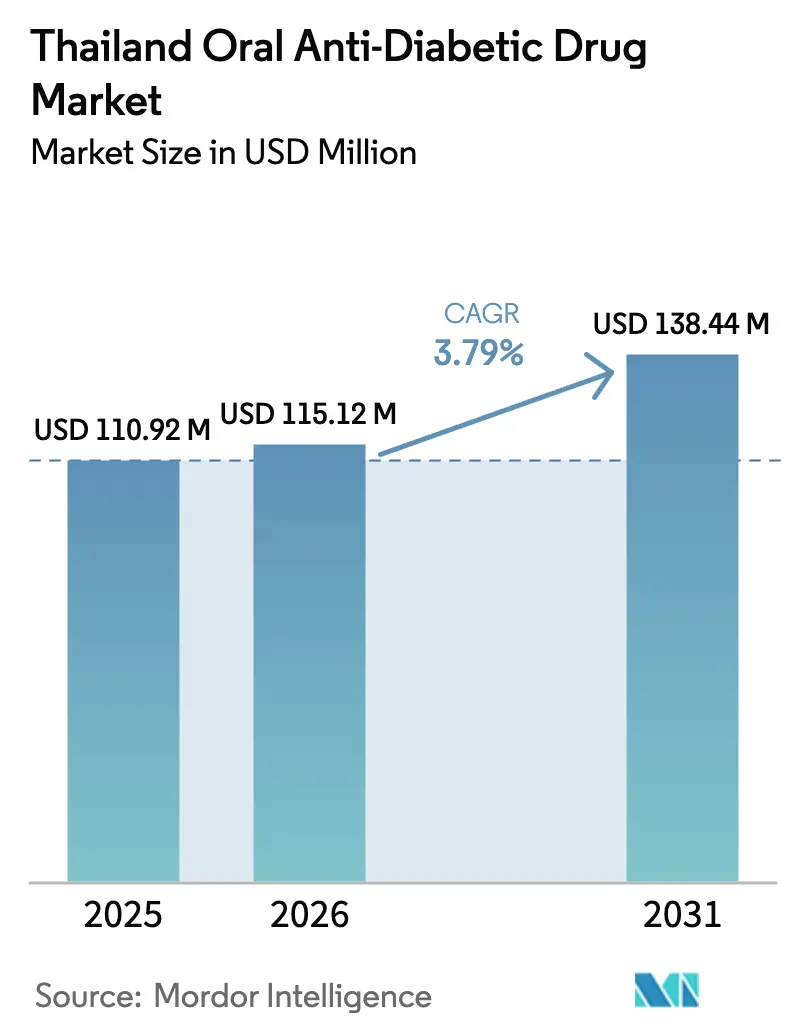
The Thailand oral anti-diabetic drug market size was valued at USD 110.92 million in 2025 and estimated to grow from USD 115.12 million in 2026 to reach USD 138.44 million by 2031, at a CAGR of 3.79% during the forecast period (2026-2031). This steady expansion is supported by Thailand’s shift to value-based universal healthcare, its rapidly aging population, and the clinical preference for cardio-protective drug classes [1]. Digital health infrastructure, medical tourism demand, and local contract manufacturing capabilities further enlarge the Thailand oral anti-diabetic drug market, while health-technology assessment (HTA)–led price caps temper premium pricing. Intensifying competition among global innovators and domestic generic makers encourages combination therapies, extended-release formulations, and real-world evidence generation to secure formulary positions. Online pharmacies and telemedicine platforms widen geographic reach, lifting adherence and enabling differentiated patient‐support programs that underpin revenue growth across therapeutic classes.
Key Report Takeaways
- By drug class, biguanides led with 38.35% of the Thailand oral anti-diabetic drug market share in 2025, whereas SGLT-2 inhibitors are projected to grow at 4.42% CAGR through 2031.
- By age group, adults accounted for 66.02% share of the Thailand oral anti-diabetic drug market size in 2025, while the geriatric cohort is expanding at a 4.45% CAGR to 2031.
- By diabetes type, type 2 diabetes held 94.25% of the Thailand oral anti-diabetic drug market size in 2025 and posts the fastest 4.5% CAGR to 2031.
- By distribution channel, hospital pharmacies captured 67.88% of the Thailand oral anti-diabetic drug market share in 2025; online pharmacies record the highest 4.63% CAGR through 2031.
Note: Market size and forecast figures in this report are generated using Mordor Intelligence’s proprietary estimation framework, updated with the latest available data and insights as of 2026.
Companies active in Thailand may frequently operate across several geographies, linking regional presence to global strategy. Mordor Intelligence captures the entire market landscape of the global oral anti-diabetic drugs industry and how these positions are distributed.
Thailand Oral Anti-Diabetic Drug Market Trends and Insights
Drivers Impact Analysis*
| Driver | (~) % Impact on CAGR Forecast | Geographic Relevance | Impact Timeline |
|---|---|---|---|
| Aging-Population Driven T2DM Prevalence Uptick | +1.2% | National, concentrated in urban centers | Long term (≥ 4 years) |
| Universal Coverage Scheme Drug Reimbursement Expansion | +0.8% | National, with enhanced rural access | Medium term (2-4 years) |
| Cardiovascular-Outcome Data Favouring SGLT-2 & GLP-1 Classes | +0.6% | National, physician-driven adoption | Medium term (2-4 years) |
| Rapid Retail-Pharmacy Channel Growth In Provincial Cities | +0.4% | Provincial cities, rural expansion | Short term (≤ 2 years) |
| E-Commerce Pharmacies & Tele-Consult Start-Ups For Chronic Care | +0.3% | Urban centers, expanding to rural | Short term (≤ 2 years) |
| Local Contract-Manufacturing Cost Advantage For Generics | +0.2% | National, export potential | Long term (≥ 4 years) |
| Source: Mordor Intelligence | |||
Aging-Population Driven T2DM Prevalence Uptick
Twenty percent of Thais are already over 60 years, and epidemiological surveys confirm that age beyond 50 correlates strongly with impaired fasting glucose and insulin resistance [2]. Pharmaceutical firms therefore prioritize extended-release biguanides and lower-dose SGLT-2 inhibitor combinations that reduce pill burden while improving kidney and cardiovascular outcomes. Geriatric-focused dosing schedules lower hypoglycemia risk and are increasingly embedded in hospital formularies that serve Bangkok megahospital networks and emerging provincial centres.
Universal Coverage Scheme Drug Reimbursement Expansion
The 2024 pivot from “Treating All Diseases” to “Treatment Anywhere” connects 5,000 public health units through shared electronic records. Broader reimbursement for novel molecules narrows urban–rural treatment gaps, lifts physician willingness to prescribe SGLT-2 inhibitors, and underpins adherence programs delivered via tele-consults and remote monitoring. Pharmaceutical companies leverage this framework to negotiate outcomes-based agreements that reward real-world HbA1c improvements and hospitalization avoidance.
Cardiovascular-Outcome Data Favouring SGLT-2 & GLP-1 Classes
Thai hospital registries report a 41% reduction in major kidney events among SGLT-2 users relative to conventional therapy, reinforcing recent guideline revisions that position SGLT-2 inhibitors ahead of sulfonylureas for high-risk patients [3]. Cost-utility models show incremental lifetime gains of 0.42–0.52 years despite higher annual drug costs, a profile that resonates with HTA committees when weighed against dialysis avoidance.
Rapid Retail-Pharmacy Channel Growth in Provincial Cities
Investment incentives in the Eastern Economic Corridor catalyse chain-pharmacy build-outs that shorten travel times for chronic refills across Chonburi, Rayong, and Chachoengsao provinces. Cloud-linked dispensing systems allow pharmacists to verify e-prescriptions from tertiary centres, boosting medication pick-up rates and fuelling volume growth for the Thailand oral anti-diabetic drug market in formerly underserved districts.
Restraints Impact Analysis*
| Restraint | (~) % Impact on CAGR Forecast | Geographic Relevance | Impact Timeline |
|---|---|---|---|
| HTA-Driven Price Caps For Novel Molecules | -0.7% | National, affecting premium therapies | Medium term (2-4 years) |
| High Generic Penetration Squeezing Branded Margins | -0.5% | National, intensifying competition | Long term (≥ 4 years) |
| Persistently Low Medication-Adherence Rates Outside Bangkok | -0.4% | Provincial and rural areas | Medium term (2-4 years) |
| Rising Incidence Of Skin & Urogenital ADR-Related Recalls | -0.3% | National, class-specific impact | Short term (≤ 2 years) |
| Source: Mordor Intelligence | |||
HTA-Driven Price Caps For Novel Molecules
Thai FDA appraisal panels demand robust cost-effectiveness dossiers before listing SGLT-2 or GLP-1 agents on the National Essential Medicines List. Ceiling prices agreed in 2025 slash launch premiums by as much as 30%, challenging innovators to bundle clinical-monitoring apps and nurse-led coaching to maintain value perception.
High Generic Penetration Squeezing Branded Margins
Generics constitute 30% of domestic production yet capture over 60% of metformin and sulfonylurea volumes, compressing incumbent margins. Innovators counter by pivoting to triple-fixed combinations and age-tailored oral dispersible tablets that extend lifecycle exclusivity.
*Our forecasts treat driver/restraint impacts as directional, not additive. The impact forecasts reflect baseline growth, mix effects, and variable interactions.
Segment Analysis
By Drug Class: Cardiometabolic Benefits Propel SGLT-2 Uptake
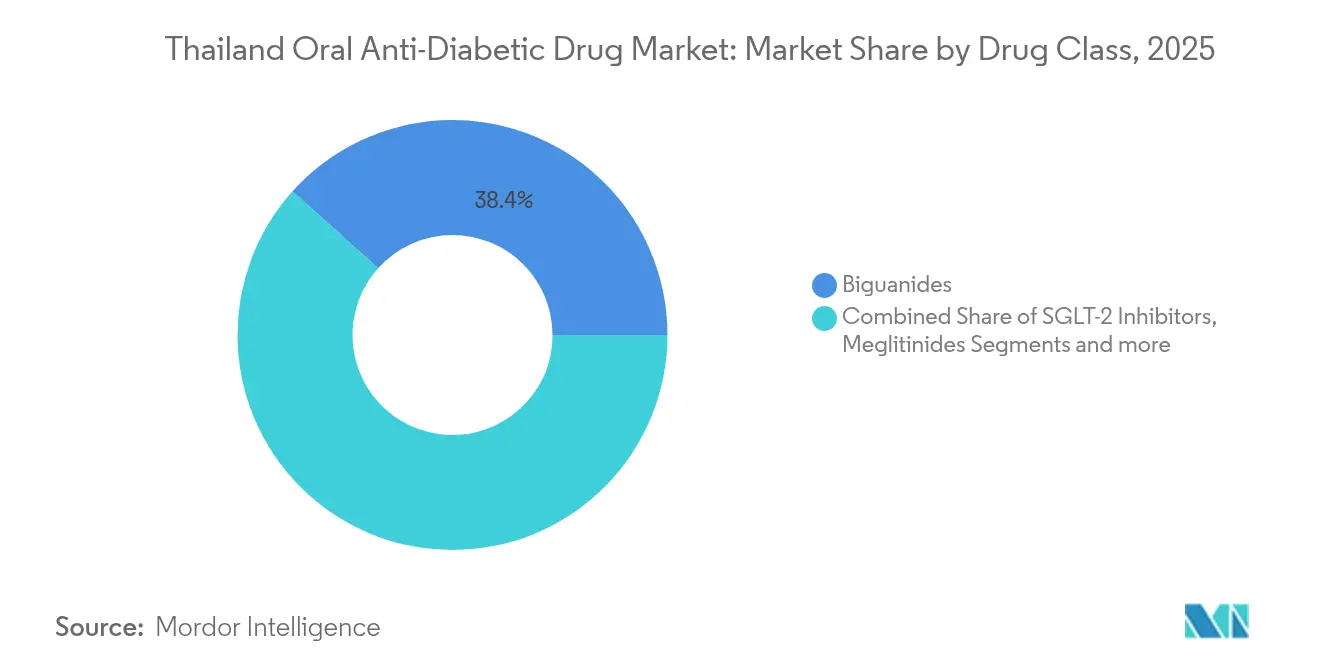
Biguanides retained a 38.35% lead in 2025, underscoring metformin’s entrenched first-line status within the Thailand oral anti-diabetic drug market. SGLT-2 inhibitors, however, post a 4.42% CAGR to 2031 as cardiology societies endorse their reno-protective credentials. Utilization accelerates in urban tertiary hospitals where integrated cardio-metabolic clinics track eGFR decline and upgrade therapy proactively. Sulfonylureas decline amid hypoglycemia concerns, while DPP-4 inhibitors plateau as a tolerable but less cardio-centric option.
Clinical audit data show that SGLT-2 addition trimmed HbA1c by 1.1 percentage points and reduced annual hospitalization by 12% against a conventional biguanide-sulfonylurea backbone. These gains justify higher daily therapy costs and reinforce listing decisions across private insurer formularies. Consequently, the Thailand oral anti-diabetic drug market size for SGLT-2 therapies is forecast to climb from USD 28.74 million in 2026 to USD 35.68 million in 2031, while the class’s Thailand oral anti-diabetic drug market share edges up by 230 basis points.

By Age Group: Geriatric Care Pathways Take Center Stage
Adults generated 66.02% of 2025 revenues, yet the 60+ cohort expands fastest at 4.45% CAGR. Polypharmacy risk management guides prescribers toward once-daily fixed combinations that fuse metformin with SGLT-2 inhibitors or DPP-4 inhibitors, shrink pill burden, and mitigate renal strain.
Digital nutrition counseling offered through universal-coverage portals tailors meal plans for older adults, refining glycemic control and moderating weight. Consequently, the Thailand oral anti-diabetic drug market size attributable to geriatric users is expected to rise from USD 37.55 million in 2026 to USD 46.72 million in 2031. Pilot adherence programs in Chiang Mai and Khon Kaen achieve 15 percentage-point improvements, signalling considerable upside if replicated nationwide.
By Diabetes Type: Type 2 Dominance Shapes Therapy Mix
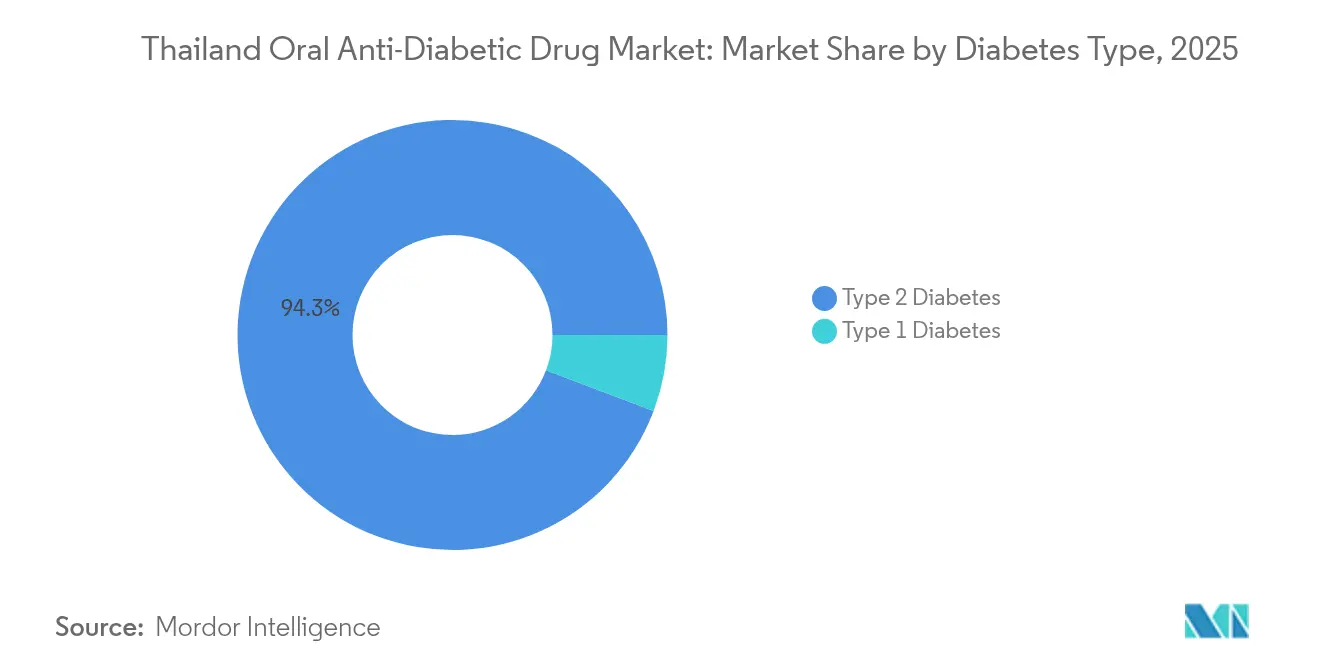
Type 2 diabetes accounted for 94.25% revenue share in 2025 and advances at 4.5% CAGR on the back of urbanisation, dietary westernisation, and sedentary lifestyles. Clinical diet surveys link daily soft-drink intake exceeding 500 ml with a 2.1-fold rise in progression to pharmacotherapy, prompting preventive education embedded in school curricula.
Thailand oral anti-diabetic drug industry innovators therefore design starter packs that bundle metformin XR with lifestyle-tracking apps, aiming to delay escalation to insulin. The Thailand oral anti-diabetic drug market size for type 2 therapies is projected at USD 130.62 million by 2031, while type 1 sales remain marginal yet stable, supported by paediatric specialty centres in Bangkok.
By Distribution Channel: Digital Convenience Redraws Supply Chains
Hospital pharmacies maintained 67.88% share in 2025, reflecting Thailand’s physician-led dispensing model. Nevertheless, online pharmacies accelerate at 4.63% CAGR, buoyed by NHSO-approved tele-consult services launched in January 2024. AI-enabled verification engines authenticate e-scripts, curbing counterfeit risks and winning regulator endorsement.
Rural households in Nakhon Phanom and Satun use drone delivery pilots that reduce refill times by 48 hours versus postal dispatch, lifting satisfaction scores. The Thailand oral anti-diabetic drug market size flowing through online channels is set to surpass USD 9.65 million in 2031, while hospital channels grow modestly as chronic-care pathways decant stable patients to community settings.
Geography Analysis
Bangkok’s contiguous provinces represent the highest per-capita consumption of premium SGLT-2 and GLP-1 therapies, underpinned by specialist endocrinology hubs and private insurer coverage. Yet the 2024 “Treatment Anywhere” policy is flattening historic access disparities by reimbursing oral anti-diabetics across 5,000 interconnected public facilities nationwide. Provincial pharmacy chains in the Eastern Economic Corridor post double-digit same-store sales growth as migrant industrial workers enrol in employer-funded screening programs.
The north and northeast exhibit elevated prevalence rates, with Kalasin Province surveys indicating poor glycaemic control in nearly 80% of diagnosed patients. Tele-endocrinology sessions streamed from Chiang Mai University Hospital cut follow-up appointment travel costs by USD 23 per visit, encouraging adherence. Community health volunteers equipped with point-of-care HbA1c devices capture village-level data that feed into NHSO dashboards, enabling targeted stock re-allocation to avert shortages.
Remote islands and highland districts still suffer under-screening. Drone-enabled medicine drop-offs trialled on Koh Chang demonstrate feasibility under monsoon conditions, with 100% on-time delivery during the 2024 pilot. As 5G towers proliferate, digital adherence nudges and refill reminders reach formerly offline seniors, broadening the Thailand oral anti-diabetic drug market beyond urban strongholds.
The oral anti-diabetic drugs market is assessed by Mordor Intelligence through a multi-layered geographic lens, covering other regions such as North America, Europe, and Asia, along with detailed country-level analysis for India, New Zealand, France, Brazil, Malaysia, and South Korea.
Regulatory Landscape
Oral anti-diabetic drugs in Thailand are regulated by the Thai Food and Drug Administration (Ministry of Public Health). Product registration is generally submitted in ASEAN Common Technical Dossier (ACTD) format and, where applicable, aligned to ICH CTD requirements. The Thai FDA also operates abridged assessment pathways for products already approved by stringently regulated authorities such as the US FDA, EMA, and Japan PMDA, which can reduce time-to-market for selected innovative oral therapies and fixed-dose combinations.
On the supply and post-market side, importation and distribution require licensing, including a license per invoice for imports, and compliance with Good Distribution Practice (GDP). Pharmacovigilance obligations are anchored in Thailand's Ministerial Regulation on Registration of Drugs (2012), including adverse drug reaction reporting. For publicly funded demand, procurement is shaped by the 2017 public procurement framework that routes purchasing to the Maximally Allowable Purchasing Drug Price (MAPDP), reinforcing HTA discipline and price ceilings for novel molecules, alongside listing and reimbursement processes under national schemes.
Competitive Landscape
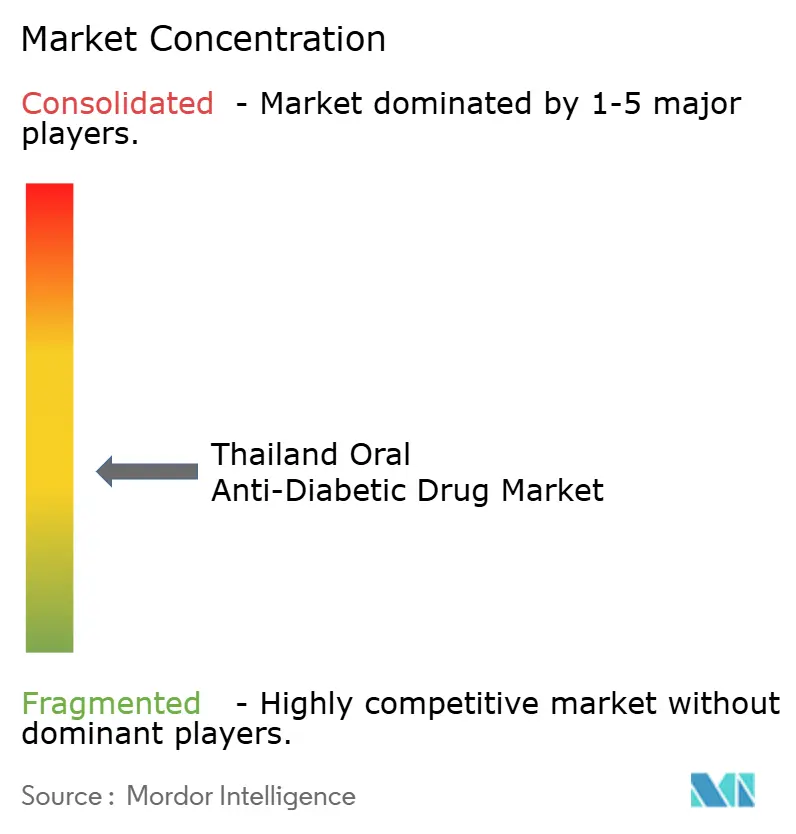
The market remains moderately fragmented, balancing patented innovators with aggressive generic entrants. Multinationals such as AstraZeneca, Boehringer Ingelheim, and Novo Nordisk differentiate through cardio-renal evidence and clinician-education grants, whereas domestic manufacturers including the Government Pharmaceutical Organization and Siam Bioscience emphasize affordability and local supply security.
Strategic moves in 2024-2025 include AstraZeneca’s local fill-and-finish partnership for dapagliflozin, slicing logistics costs by 12% and meeting HTA affordability thresholds. Meanwhile, Siam Bioscience invested USD 42 million in a continuous-manufacturing line for metformin XR, expanding annual capacity by 90 million tablets and securing WHO pre-qualification.
Digital service bundling defines the new front line. Boehringer Ingelheim integrates its remote-coaching app with NHSO tele-consult modules, recording a 17% uplift in 90-day persistence rates. Takeda pilots blockchain-backed supply-chain tracing for its alogliptin franchise, assuring authenticity to e-pharmacy consumers and deflecting parallel-trade erosion. These converging trends reshape competitive moats from molecule patents to data ecosystems and patient-experience design.
Thailand Oral Anti-Diabetic Drug Industry Leaders
-
Astrazeneca
-
Astellas
-
Eli Lilly
-
Sanofi
-
Johnson & Johnson
- *Disclaimer: Major Players sorted in no particular order
Market Opportunities and Future Outlook
The clearest whitespace in Thailand's oral anti-diabetic market is where reimbursement-led access expansion intersects with differentiated therapy value that remains workable under HTA price discipline. Under the Thai FDA ecosystem, the National Drug System Development Committee has signaled wider access to innovative medicines, including diabetes-relevant agents such as sitagliptin, in March 2026. That signal gives companies a practical route to compete on formulary positioning through real-world outcomes packages, adherence support, and fixed-dose combinations, rather than relying only on premium pricing, and it fits the report scope shift toward cardio-renal oriented oral classes and combination regimens used to reduce pill burden in an aging patient pool.
A second opportunity is local or regional supply enablement for high-volume chronic therapies, which can improve tender competitiveness under MAPDP constraints and reduce exposure to import frictions tied to licensing and GDP requirements. Evidence of ongoing regulatory throughput for fixed-dose combination orals is visible in the June 2026 Thai marketing authorization for Mitsubishi Tanabe Pharma's CANALIA tablets (teneligliptin plus canagliflozin). Companies that execute ACTD-ready regulatory submissions while building scalable local distribution, including hospital-to-community refills supported by national schemes, can expand access beyond Bangkok while running persistence programs that address adherence gaps in provincial and rural settings.
Recent Industry Developments
- June 2026: Bangkok Lab and Cosmetic Public Company Limited (BLC) GLUCOVIA (Sitagliptin 100 mg) listed in Thailand’s Innovative Drug List. Domestic oral anti-diabetic drug approved for government procurement. Boosts local manufacturing emphasis and reduces import reliance in Thai market.
- May 2025: LG Chem Introduced Zemidapa (gemigliptin/dapagliflozin) dual therapy in Thailand. Directly expands combination therapy options in Thai market. Signals move toward fixed-dose/dual regimens and value-based management of diabetes in Thailand.
- October 2024: Thai Meiji Pharmaceutical Introduced patient support programs and digital monitoring tools for diabetes management. Enhances patient adherence and real-world data collection. Strengthens brand/framework within digital health-enabled diabetes care in Thailand.
Research Methodology Framework and Report Scope
Market Definition and Coverage
This market covers revenues generated in Thailand from prescription oral anti-diabetic medicines used to manage diabetes (mainly type 2), across channels where patients obtain therapy, and valued in USD at the manufacturer or marketer level.
Scope exclusions: This sizing does not count insulin and other non-oral injectables, diabetes devices, or broader clinical services linked to diabetes management.
Segmentation Overview
- By Drug Class
- Biguanides
- Sulfonylureas
- Meglitinides
- Thiazolidinediones
- Alpha-Glucosidase Inhibitors
- DPP-4 Inhibitors
- SGLT-2 Inhibitors
- Others
- By Age Group
- Adults
- Pediatric
- Geriatric
- By Diabetes Type
- Type 1 Diabetes
- Type 2 Diabetes
- By Distribution Channel
- Hospital Pharmacies
- Retail Pharmacies
- Online Pharmacies
Data Sources, Market Sizing, and Validation
Desk Research
Desk work was used to set the outer boundaries for demand and to avoid double counting across channels. We used public health statistics and epidemiology references to understand diabetes prevalence and treated population patterns in Thailand, and then matched these to therapy mix signals.
Sources referred to include examples such as Thailand Ministry of Public Health publications, National Statistical Office of Thailand demographic tables, World Health Organization diabetes and NCD datasets, International Diabetes Federation country estimates, and peer-reviewed clinical journals that track guideline shifts by oral drug class. To ground pricing and access context, we also reviewed payer and reimbursement announcements, hospital and pharmacy channel notes in reputable press, and public company filings and investor materials where available, with selective use of paid subscriptions for company financials, news and financials, and patent databases. These are illustrative sources only, and many other references were also used for data collection, cross-checking, and clarification.
Primary Interviews and Surveys
Primary work focused on validating what desk sources cannot show clearly, such as class-level uptake, typical titration and switching behavior, and how channel mix is changing across public hospitals, private care, and retail. We spoke with a mix of clinicians, pharmacists, distributors, and business leaders so assumptions on volumes and pricing could be pressure-tested and aligned to real procurement and prescribing behavior in Thailand.
Distribution of primary research fieldwork respondents
| Company type | Respondent position |
|---|---|
| Top tier: 37% | CXOs: 14% |
| Mid tier: 48% | Functional/Unit leaders: 31% |
| Smaller Players: 15% | Managers: 55% |
Market-Sizing & Forecasting
Sizing starts from a Thailand demand pool build-up where prevalence and treatment rates are used to reconstruct the oral therapy patient base, which is then split by diabetes type and typical oral regimen use over time. The total is translated into value using class-level utilization and average price levels, after which results are checked against what would be implied by channel mix and procurement behavior.
To keep the model realistic, a few practical inputs are tracked closely, including adult diabetes prevalence and age profile trends, share of treated patients on oral therapy, class mix shifts toward DPP-4 inhibitors and SGLT-2 inhibitors, average therapy duration and adherence patterns, and price movement driven by reimbursement decisions and generic entry. A top-down and bottom-up check is then applied, where the top-down view is anchored on treated cohort and therapy mix, and selective bottom-up approximations use sampled volume by class times observed price ranges and distributor and pharmacy channel checks. When data is thin for a smaller class or an emerging channel like online pharmacies, gaps are handled through conservative ranges that are validated again in follow-up expert calls.
For forecasting, scenario analysis is used so growth can be linked to clear drivers, such as aging, diagnosis and treatment expansion, and guideline-led class switching, before a base case is finalized. The scenario inputs are aligned to what interviewees expect on formulary access, pricing pressure, and the pace of adoption for newer oral classes.
Data Validation & Update Cycle
Validation is done by cross-checking the model outputs against independent signals, including whether implied per-patient spend looks reasonable for Thailand, and whether class shares align with what prescribers and pharmacists report. Outliers are reviewed step by step, and if a variance cannot be explained by a known event like a price revision or a channel shift, we re-check the assumption and re-contact sources to confirm.
Before sign-off, the full set of calculations is reviewed by another analyst to catch logic breaks, unit errors, and inconsistent price timing, and then the narrative is aligned to the numbers. Reports are refreshed annually, with interim updates when material events occur, and a final pre-delivery pass is completed so clients receive the latest view available at the time of publication.
Mordor Intelligence's Thailand Oral Anti Diabetic Drug Market Size Versus Other Published Estimates
Published values for this market can look different even when they use similar words, because the underlying counting rules vary and the same patient can be reflected in multiple ways across channels and therapy types. Differences usually come from what is treated as in-scope revenue, how pricing is averaged across public and private procurement, and how quickly older inputs are replaced when access policies shift.
The biggest gap drivers here are whether estimates fold insulin and other injectables into the same diabetes drug bucket, whether they treat combination therapy as a separate add-on value or only as oral class revenues, and whether online pharmacy sales are measured as incremental or simply re-routed retail volumes. Currency timing and the assumed pace of switching toward newer oral classes also matter, especially when reimbursement pushes price resets.
Benchmark comparison
| Source | Market Size | Gaps in Research Methodology |
|---|---|---|
| Mordor Intelligence | USD 110.92 M (2025) | |
| Industry Association A | USD 165.00 M (2025) | This figure appears to reflect a wider diabetes drug basket that can include insulin and other non-oral therapies, which expands totals beyond oral-only revenues and can also blend hospital and retail pricing without a clear weighting. |
| Trade Journal B | USD 95.00 M (2025) | This estimate likely applies more restrictive channel capture or a conservative price assumption that over-weights public procurement prices, and it may undercount newer oral classes where uptake is growing but reporting is less visible. |
The table shows a spread that mostly comes from what is counted as oral-only revenue and how class-level pricing is weighted by channel, and in Mordor Intelligence's model only orally administered anti-diabetic drug classes are included, with insulin and other injectables kept out of scope. Once those boundaries and pricing weights are fixed, the remaining variation is easier to explain through adoption speed and update timing, which makes the estimate more repeatable when assumptions are refreshed.
Key Questions Answered in the Report
What is the current size of the Thailand oral anti-diabetic drug market?
The Thailand oral anti-diabetic drug market size stands at USD 115.12 million in 2026 and is on track to reach USD 138.44 million by 2031.
Which drug class is growing fastest in Thailand?
SGLT-2 inhibitors post the fastest 4.42% CAGR owing to their proven cardiovascular and renal benefits.
How big is the geriatric opportunity?
Geriatric patients generate roughly one-third of 2026 revenue but advance at a 4.45% CAGR, reflecting Thailand’s rapid aging.
What role do online pharmacies play?
Online channels, boosted by NHSO telemedicine, grow at 4.63% CAGR and should surpass USD 9.65 million in sales by 2031.
How do HTA price caps affect new diabetes drugs?
HTA evaluations compress launch premiums by up to 30%, compelling innovators to justify value through outcome-based contracts and digital-care add-ons.
Which regions outside Bangkok show the most growth potential?
Provincial cities in the Eastern Economic Corridor and northern highlands drive incremental demand as pharmacy networks and tele-endocrinology services expand.