
Market Overview
| Study Period | 2021 - 2031 |
|---|---|
| Forecast Data Period | 2026 - 2031 |
| Base Year Market Size (2025) | USD 720 Billion |
| Market Size (2026) | USD 751.7 Billion |
| Market Size (2031) | USD 932.2 Billion |
| Growth Rate (2026 - 2031) | 4.41 % |
| Market Concentration | High |
Major Players *Disclaimer: Major Players sorted in no particular order Image © Mordor Intelligence. Reuse requires attribution under CC BY 4.0. | |
Thailand Oil And Gas Downstream Market Analysis by Mordor Intelligence
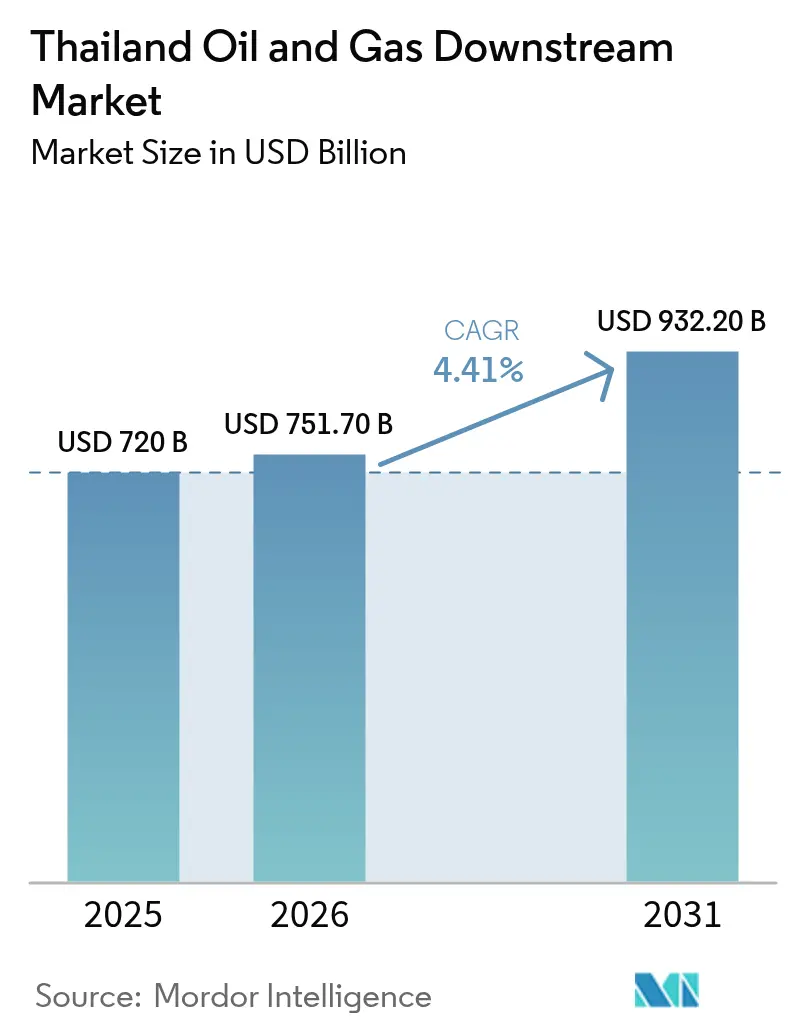
The Thailand Oil And Gas Downstream Market size is expected to grow from USD 720 million in 2025 to USD 751.7 million in 2026 and is forecast to reach USD 932.2 million by 2031 at 4.41% CAGR over 2026-2031.
Tourism rebound, a steady e-commerce logistics boom, and government-backed clean-fuel policies underpin this moderate yet resilient growth path. Integrated refiners are already optimizing utilization rates to capture recovering jet fuel and gasoline demand, while feedstock-flexible petrochemical units are pivoting toward higher-margin specialty chemicals. Policy tailwinds, such as Euro-5 fuel specifications and a national carbon tax, are set to lift product premiums and reward operators that upgrade their desulfurization and octane-boosting units. At the same time, digitalized retail networks with EV-charging bays and data-driven loyalty apps are widening non-fuel revenue streams and partially insulating margins against long-term electrification headwinds.
Key Report Takeaways
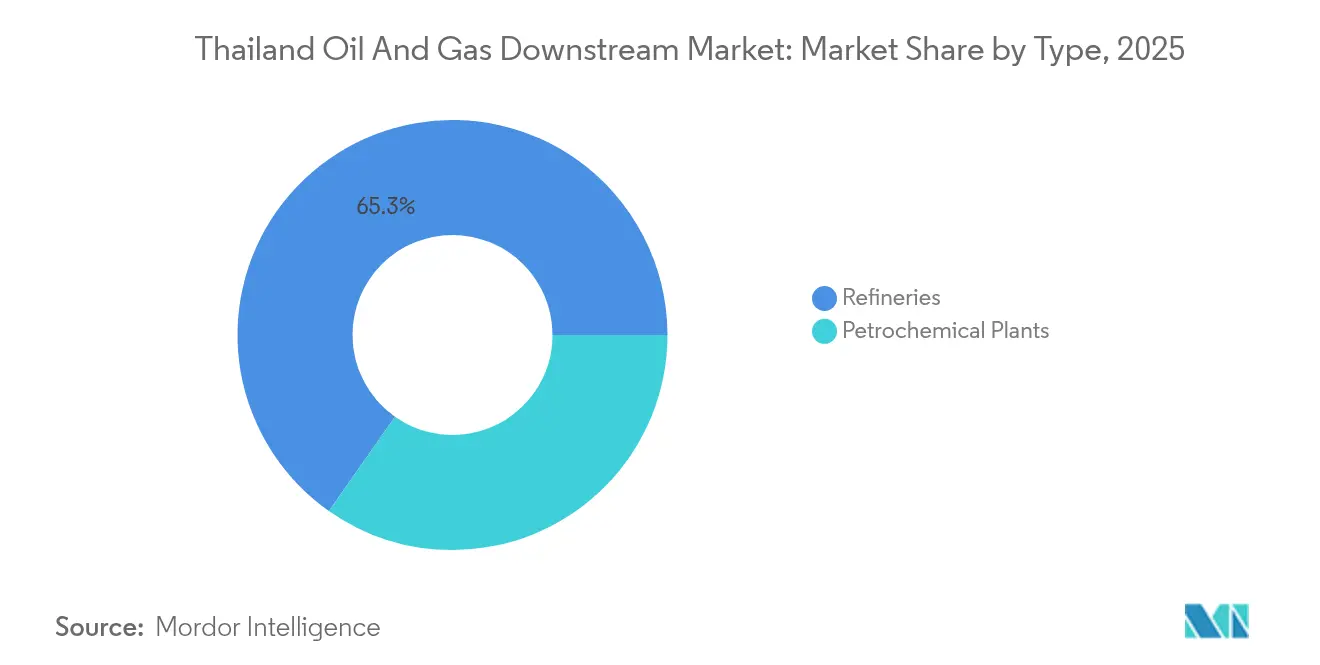
- By type, refineries commanded 65.25% of the Thailand oil and gas downstream market share in 2025, while petrochemical plants are projected to post the fastest growth rate of 4.85% through 2031.
- By product type, refined petroleum products accounted for 69.80% of the Thailand oil and gas downstream market size in 2025; petrochemicals are poised to accelerate at a 5.08% CAGR through 2031.
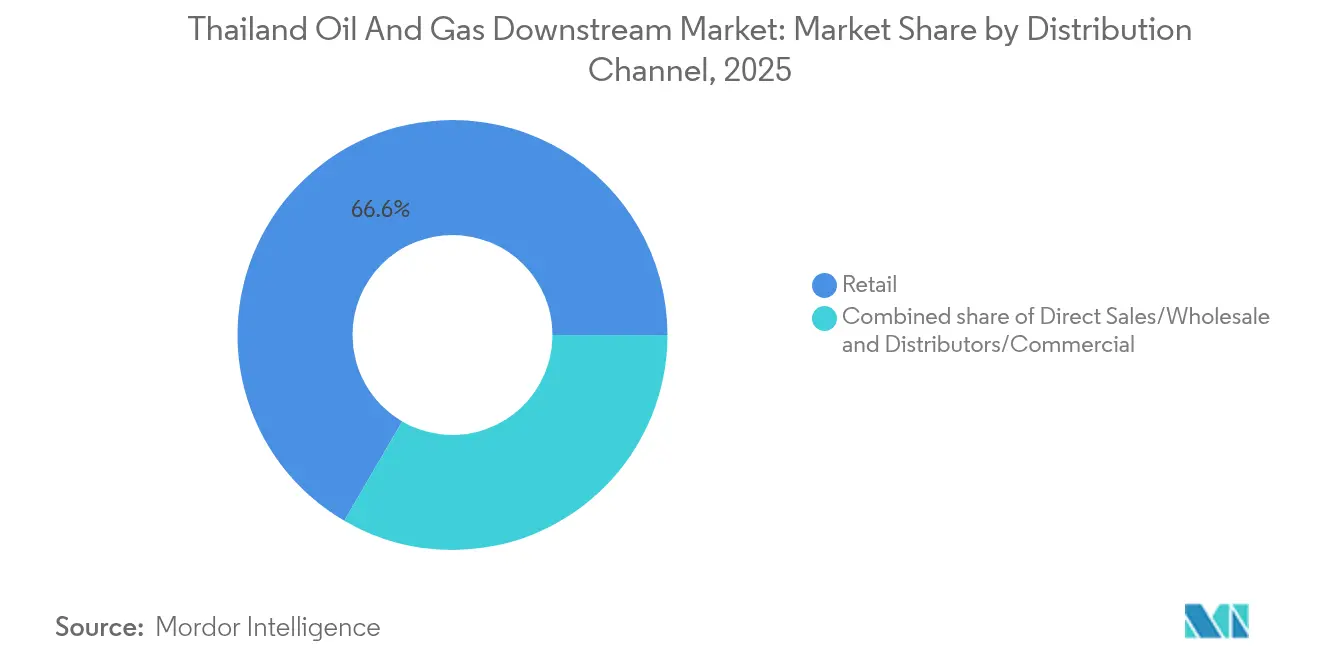
- By distribution channel, retail networks held 66.60% of the Thailand oil and gas downstream market size in 2025, whereas distributors and commercial sales are forecast to advance at a 4.62% CAGR from 2026 to 2031.
Note: Market size and forecast figures in this report are generated using Mordor Intelligence’s proprietary estimation framework, updated with the latest available data and insights as of 2026.
Market Trends and Insights
Drivers Impact Analysis of Thailand Oil And Gas Downstream Market*
| Driver | (~) % Impact on CAGR Forecast | Geographic Relevance | Impact Timeline |
|---|---|---|---|
| Gradual recovery in domestic refined-product demand as tourism returns and e-commerce logistics expand | +1.2% | Bangkok, Phuket, Chiang Mai corridors | Short term (≤ 2 years) |
| Euro-5/clean-fuel upgrades unlocking higher margins post-2026 | +0.9% | Bangkok Metropolitan Region | Medium term (2-4 years) |
| State Oil Plan 2025: carbon-tax phase-in accelerating refinery efficiency projects | +0.7% | Map Ta Phut, Rayong industrial clusters | Medium term (2-4 years) |
| Rapid service-station network digitalization (EV chargers & retail platforms) boosting downstream profitability | +0.5% | Urban centers nationwide | Short term (≤ 2 years) |
| Petrochemical feedstock flexibility projects (propane/ethane) mitigating naphtha price shocks | +0.4% | Map Ta Phut and Rayong complexes | Long term (≥ 4 years) |
| Sustainable aviation fuel (SAF) investments creating a new high-value product pool | +0.3% | With export links to Singapore | Long term (≥ 4 years) |
| Source: Mordor Intelligence | |||
Tourism Recovery Drives Refined Product Demand Resurgence
Jet fuel liftings are nearing pre-pandemic run-rates as international arrivals climb toward the 40 million mark, reviving gasoline and diesel pull through hospitality and logistics services.[1] Last-mile e-commerce fleets add incremental diesel line-haul demand across Bangkok’s peri-urban sprawl, extending the utilization window for mid-complexity refineries. Operators that throttled throughput during the pandemic are now executing planned turnarounds early to maximize availability during the 2025-2026 high season. Compared with peers where inbound travel lags, the Thailand oil and gas downstream market enjoys a first-mover demand recovery that supports crack spreads. The country’s current 10% EV penetration remains too low to significantly impact aggregate liquid-fuel growth before 2027, creating a multi-year cushion for refiners to recoup upgrade capital expenditures.
Euro-5 Standards Create Margin Expansion Pathway
Mandatory Euro-5 gasoline and diesel specifications, effective January 2027, will widen the pricing gap between compliant and non-compliant supplies by an estimated 5-15%. Complex refineries equipped with new resid-upgrading trains and high-capacity desulfurizers can capture this premium while also reducing carbon tax liabilities. Imported middle-distillate demand from non-compliant ASEAN peers offers an additional outlet, positioning Thailand as a clean-fuel export hub. Project timelines, such as the 400,000 barrels-per-day Clean Fuel Project, are aligned to ramp ahead of enforcement, thereby reinforcing economies of scale. Smaller standalone units face upgrade hurdles, accelerating the shift toward integrated refining and petrochemical super-sites that can recycle hydrogen and process heavier crudes at a lower marginal cost.
State Oil Plan 2025 Accelerates Efficiency Investments
The Thai Cabinet’s decision to embed a THB 200-per-tonne CO₂ carbon tax within existing excise structures will fundamentally reshape refinery cost curves starting in July 2025.[2] Efficient sites with less than 27 kg CO₂/boe process emissions will experience only marginal tax exposure, whereas older hydroskimming assets may incur a 10-15% EBIT squeeze unless mitigation projects are fast-tracked. The policy is revenue-neutral to consumers yet funnels predictable cash flows into national decarbonization funds, spurring voluntary carbon market activity linked to downstream abatement. Integrated players are packaging flare-gas recovery, pre-combustion carbon capture, and renewable power purchase agreements into bundled offset plans, creating early compliance cost advantages.
Digital Transformation Enhances Retail Profitability
Mobile-first payment ecosystems and government e-wallet incentives have driven cashless fuel purchases to above 85%, enabling station operators to conduct granular loyalty analytics.[3] New-build flagship sites in Bangkok and Chiang Mai co-locate 150 kW EV fast chargers, coffee franchises, and parcel lockers, pushing non-fuel gross margins above 35%. Dynamic pricing engines adjust pump prices every three hours, optimizing volumes in response to wholesale rack movements. The Thailand oil and gas downstream market, therefore, sees retail chains morphing into multi-energy micro-hubs that bridge the combustion-to-electrification transition. Operators capturing vehicle telemetry data are monetizing insights with insurers and fleet managers, creating cross-industry revenue pools that offset declining gasoline consumption per car after 2030.
Restraints Impact Analysis of Thailand Oil And Gas Downstream Market*
| Restraint | (~) % Impact on CAGR Forecast | Geographic Relevance | Impact Timeline |
|---|---|---|---|
| China-led petrochemical over-capacity compressing cracker/polymer spreads | -0.8% | Map Ta Phut and Rayong | Medium term (2-4 years) |
| Rising single-pool-gas feedstock costs squeezing LPG & GSP margins | -0.6% | Gas-dependent facilities nationwide | Short term (≤ 2 years) |
| Carbon-border measures (EU CBAM, CORSIA) threatening export economics for high-CO₂ fuels | -0.4% | Export-oriented refineries & petrochemical plants | Medium term (2-4 years) |
| Accelerating EV adoption eroding gasoline demand sooner than forecasts | -0.5% | Urban centers with dense charging grids | Long term (≥ 4 years) |
| Source: Mordor Intelligence | |||
China's Petrochemical Overcapacity Pressures Regional Margins
More than 30 million tonnes per annum (mta) of new Chinese ethylene capacity commissioned since 2024 has pulled spot monomer prices toward the bottom quartile of the global cost curve, shrinking Southeast Asian cracker margins to USD 150 per tonne.[4] Thai operators reliant on naphtha feedstock see disproportionate pressure because Chinese complexes run inexpensive coal-to-olefin or ethane-based routes backed by provincial incentives. Margin compression accelerates the strategic pivot toward specialty chemicals, engineering plastics, and downstream integration, where price elasticity is lower, thereby enhancing profitability. While temporary anti-dumping duties offer limited respite, long-run competitiveness hinges on energy-efficiency retrofits and feedstock flexibility—investments already prioritized under the 2023-2027 national petrochemical roadmap.
Carbon Border Measures Threaten Export Competitiveness
The EU Carbon Border Adjustment Mechanism (CBAM) trial phase and ICAO’s CORSIA offset scheme push embedded-carbon reporting obligations onto Thai fuel and polymer exporters starting 2026. In the absence of third-party verified lifecycle assessments, shipments risk facing levies of EUR 80-100 per tonne, which erode price advantages. Export-oriented refiners are therefore fast-tracking the development of digital MRV platforms and bio-content certification to retain market access. While the Thai oil and gas downstream market still enjoys ASEAN demand pull, the loss of EU routes could strand capacity unless operators decarbonize their production or pivot volumes into emerging South Asian markets with less stringent import rules.
*Our forecasts treat driver/restraint impacts as directional, not additive. The impact forecasts reflect baseline growth, mix effects, and variable interactions.
Thailand Oil And Gas Downstream Market Segment Analysis
By Type:
Dominance of Refineries Amid Petrochemical UpswingRefineries captured 65.25% of the Thai oil and gas downstream market share in 2025, as 1.24 million barrels per day of installed distillation capacity met resurging mobility fuel demand. The Thailand oil and gas downstream market size for refineries is projected to increase at a 3.68% CAGR through 2031, as Euro-5 compliance premiums and regional jet-fuel deficits support utilization. Petrochemical plants, growing at a 4.85% CAGR, are underpinned by investments such as PTT Global Chemical’s USD 4.4 billion “3 Steps Plus” program that adds downstream polyurethane and biodegradable PLA lines. Integrated sites leverage shared utilities and hydrogen networks, trimming operating costs by 5-7% and sharpening their strategic focus toward mixed-feed flexibility. Chinese overcapacity remains the chief headwind; however, Thai complexes counter with specialty niches, including bio-ethylene and high-purity ABS, which command resilient premiums.
A parallel differentiation track is unfolding around carbon intensity. New-build hydrocrackers paired with gas-fired cogeneration units emit 12-15% less CO₂ per barrel than decade-old hydroskimmers, thereby cushioning carbon-tax exposure. Retrofits bundling waste-heat recovery and flue-gas desalination further lower compliance costs, attracting green-finance-linked loans at sub-LIBOR spreads. Collectively, these moves help sustain the Thai oil and gas downstream market’s refinery core, even as petrochemical earnings outgrow fuel sales.

By Product Type:
Refined Fuels Lead While Petrochemicals AccelerateRefined products accounted for 69.80% of Thailand's oil and gas downstream market size in 2025, buoyed by a doubling of jet fuel demand from 2022 lows and domestic diesel demand from e-commerce fleets. Structural tailwinds include regional tightening of fuel quality and Myanmar's pipeline export flows, which together keep middle-distillate cracks attractive until at least 2027. Petrochemicals, advancing at a 5.08% CAGR, increasingly tilt toward high-value elastomers and engineering resins supplied to Southeast Asian electronics and automotive clusters. Operators such as IRPC raised their polyolefin nameplate capacity to 931 kta in mid-2024, capturing polypropylene demand linked to consumer goods packaging.
Lubricants form a niche subsector, generating steady mid-single-digit growth through premium synthetics for ride-hailing fleets and industrial MRO segments. Sustainable aviation fuel—though only 0.2 % of national jet demand in 2024—registers the fastest volume growth trajectory, backed by offtake deals with regional carriers under CORSIA. The evolving product mix diversifies earnings and mitigates volatile refinery gross refining margins, reinforcing the shift in Thailand's oil and gas market toward value-added outputs.
By Distribution Channel:
Retail Networks Retain Scale AdvantagesRetail outlets captured 66.60% of the Thailand oil and gas downstream market size in 2025, owing to 13,500 active service stations that embed fuel sales within convenience store footprints. Digital payments, loyalty apps, and cross-selling of food services increased the non-fuel margin contribution above 35% for leading chains, mitigating pressure from flat to declining per-car gasoline volumes after 2028. Distributors and commercial bulk sales, which are growing at a 4.62% CAGR, benefit from industrial restocking in Eastern Economic Corridor zones and mining fuel contracts in neighboring Laos and Cambodia.
Wholesale channels focused on bunker fuel and aviation deliveries offer scale but suffer higher spot-price volatility, pushing traders toward longer-term offtake agreements indexed to Singapore swaps. Integrated players—owning refineries, terminals, and retail—optimize arbitrage by dynamically diverting barrels among channels based on margin signals. In aggregate, distribution-channel diversification reinforces revenue resilience and sustains the profitability of Thailand's oil and gas downstream market as mobility electrifies.
Geography Analysis
Eastern Thailand anchors the Thai oil and gas downstream market, with Map Ta Phut, Rayong, and Sattahip hosting 75% of the nation's refining and petrochemical throughput, thanks to deep-water jetties and extensive pipeline grids that link to Bangkok's vast fuel demand centers. The zone's clustering reduces logistics costs by 18% versus standalone inland assets and supports integration synergies across fuels, olefins, and aromatics. Northern provinces, such as Chiang Mai, see steady fuel uplift from tourism-led mobility, although limited industrial bases keep throughput shares below 5%. Central Thailand, driven by Bangkok's 11 million residents and Thailand's highest vehicle density, accounts for more than 40% of the nation's gasoline demand, thereby anchoring retail margins and sustaining large terminal capacities.
Cross-border flows deepen geographic relevance. Pipeline exports to Laos and tank-truck deliveries into Cambodia translate into roughly 85 kbd of refined-product offtake, cushioning domestic demand cyclicality. On the import side, crude oil delivered via the Strait of Malacca exposes the Thailand oil and gas downstream market to shipping disruptions; hence, the government maintains strategic petroleum reserves equivalent to 180 days of net imports. Renewable power expansion, aimed at 51% of generation by 2037, will reduce gas-oil demand in the power sector while leaving transportation fuels structurally tight until EV adoption surpasses a 30% fleet share, projected for 2032.
Geographic concentration also heightens environmental scrutiny. Provinces hosting large complexes have implemented real-time SOx and NOx monitoring, tying emissions breaches to immediate production curbs. Operators are increasingly securing renewable electricity PPAs from wind and solar farms in Nakhon Ratchasima to lower their Scope 2 emissions, leveraging grid access to green their value chains. The combined geography-driven advantages and constraints create a nuanced landscape in which strategic siting, infrastructure redundancy, and community engagement all play a crucial role in determining long-term competitiveness.
Regulatory Landscape
Thailand's downstream market operates under the Ministry of Energy policy umbrella. The Department of Energy Business (DOEB) oversees fuel-trade licensing and compliance, while the Energy Policy and Planning Office (EPPO) coordinates national energy planning. A key policy anchor is the Cabinet-backed carbon-tax phase-in embedded in excise structures from July 2025 (THB 200 per tonne CO2), which has increased the value of refinery efficiency upgrades and emissions-accounting readiness for refiners and petrochemical operators.
Regulatory oversight tightened further in 2026 through DOEB directives that moved compliance toward high-frequency, digital reporting. In April 2026, DOEB mandated weekly submissions of crude cost, finished-product sales prices, and refining cost data (by noon every Friday), and it required near-real-time reporting of sales and transfer data for gasoline, gasohol, and diesel alongside transport-manifest uploads via the Fuel Transportation Inspection System (Fuel-DM). In parallel, the Ministry of Energy opened public hearings in April 2026 on amendments to the Petroleum Act B.E. 2514 (1971), including provisions linked to infrastructure sharing and a carbon capture and storage (CCS) framework. Revisions to the National Oil Plan were confirmed as underway in December 2025 to reflect demand shifts from EV uptake and growing power demand from data centers.
Competitive Landscape
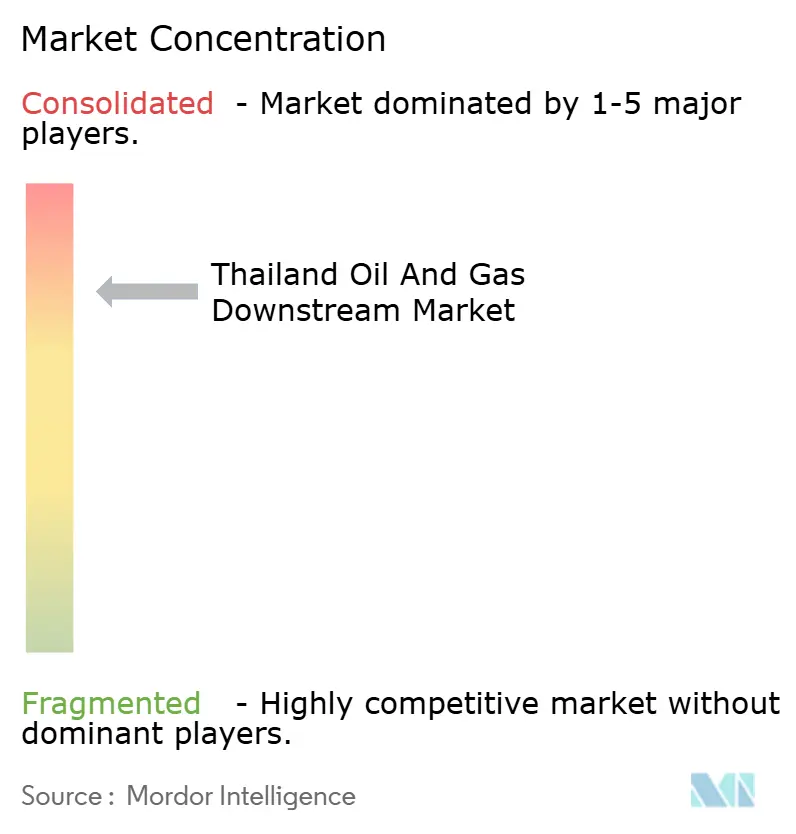
Thailand's downstream sector is moderately consolidated, with the PTT Group, Thai Oil, Bangchak, IRPC, and PTT Global Chemical collectively accounting for approximately 58% of the country's distillation capacity and over 60% of its polymer output. International majors such as Shell and TotalEnergies operate through JV refineries or branded retail networks, adding marketing sophistication and premium-fuel positioning. Integrated value chains, from crude import to retail, give incumbents scale economies that deliver 4-6 USD/barrel operating cost advantages over prospective entrants. Capital-intensive Euro-5 upgrades and the 2025 carbon tax further raise entry hurdles, solidifying incumbents' competitive moat.
Technology deployment is reshaping hierarchy. PTT is piloting a 45 MW green-hydrogen electrolyzer at Rayong, scheduled to start up in 2026, while Thai Oil integrates post-combustion carbon capture into its clean-fuel revamp. Digital twins and predictive maintenance are rolling out across catalytic reformers, slashing unplanned downtime by 25% and boosting effective capacity. On the retail front, Bangchak's "B-eV" platform is bundling subscription-based charging with insurance tie-ups, widening revenue scope beyond fuel. Mid-tier independents leverage strategic alliances to access these technologies via shared services, reflecting a collaborative rather than purely competitive industry ethos.
M&A prospects remain active as smaller standalone refiners navigate compliance and capital expenditures. Rumors of foreign strategic stakes in gas fractionation and aromatics units surface periodically, yet national-interest considerations and energy-security objectives temper full asset sales. Overall, the Thailand oil and gas downstream market balances scale-driven incumbency with innovation-led repositioning, a duality that shapes competitive dynamics over the next decade.
Thailand Oil And Gas Downstream Industry Leaders
-
PTT Public Company Limited (incl. Thai Oil, IRPC, OR)
-
Bangchak Group (Bangchak + BSRC)
-
Esso (Thailand) PCL
-
Star Petroleum Refining PCL (Chevron)
-
SCG Chemicals & PTTGC (petrochemical-heavy)
- *Disclaimer: Major Players sorted in no particular order
Thailand Oil And Gas Downstream Market Companies Covered in this Report
- PTT Public Company Limited
- Thai Oil Public Company Limited
- Bangchak Corporation PCL
- Esso (Thailand) Public Company Limited
- Star Petroleum Refining PCL
- IRPC Public Company Limited
- PTT Global Chemical PCL
- SCG Chemicals Co. Ltd
- Caltex (Chevron)
- Royal Dutch Shell PLC
- TotalEnergies Marketing (Thailand)
- PTG Energy PCL
- Indorama Ventures PCL
- BAFS PCL
- OR (PTT Oil & Retail Business)
Market Opportunities and Future Outlook
Clean-fuel and low-carbon product compliance is creating investable whitespace across refineries, blending, and aviation-fuel value chains. Euro-5 enforcement from January 2027 and the carbon-tax phase-in from July 2025 are pushing refiners toward desulfurization, octane and hydrogen management, and digital MRV capabilities. Export-facing players are also responding to CBAM and CORSIA reporting requirements that begin applying embedded-carbon disclosure from 2026.
A defined near-term pull is tied to Thailand's Alternative Energy Development Plan (AEDP 2024), which mandates a 1% sustainable aviation fuel (SAF) blend in jet fuel for 2026. This requirement supports demand for SAF supply, certification, and logistics, alongside associated bio-content verification systems. Opportunity also extends to import terminals, storage, and downstream gas and power-adjacent services for industrial clusters. The Gas Plan 2024 formalizes liberalization toward a multi-shipper natural-gas market, shifting LNG procurement away from a single-supplier model and supporting demand for open-access capacity and optimization services. On the project pipeline, CTCI Corporation and Saipem's joint venture secured a USD 925 million EPCC contract (April 2026) for the Nong Fab LNG receiving terminal in Rayong, and Map Ta Phut LNG Terminal 3 (Phase 2), led by Gulf Energy Development and PTT Tank Terminal, is designed for 8 mtpa capacity with construction scheduled to begin in Q4 2025. In refining, Thai Oil reaffirmed in January 2026 that its Clean Fuel Project remains active, linking refinery upgrading to higher-value product slates and tighter specifications. Biofuel policy support, including government backing for B20 biodiesel and E20 gasohol announced in June 2026, also sustains blending and distribution-related investment needs as on-road demand patterns evolve.
Recent Industry Developments in Thailand Oil And Gas Downstream Market
- July 2026: PTT Oil and Retail Business PCL (OR) and Bangchak Corporation PCL implemented notable retail fuel price cuts in Bangkok, with reductions effective July 8, 2026 across petrol/gasohol and diesel. The changes highlighted heightened competitive intensity at the pump, while emphasizing the role of scale retail networks, loyalty platforms, and non-fuel earnings in protecting margins during periods of policy scrutiny and demand variability.
- June 2026: Bangchak Corporation PCL, via subsidiary BHK Holding, completed the acquisition of a 100% stake in Chevron Hong Kong Limited. The transaction added 31 service stations plus industrial and marine fuel operations and an oil terminal, extending Bangchak's downstream footprint and logistics optionality beyond Thailand and strengthening its ability to serve cross-border and marine demand centers.
- February 2024: Thai Oil shareholders approved a THB 63.02 billion budget increase for the Clean Fuel Project, supporting the planned expansion to 400,000 bpd and upgrades aligned with tighter fuel-quality requirements. The approval reinforced Thailand's shift toward higher-specification fuels and advantaged integrated operators with the balance sheets and execution capacity to deliver large-scale refinery modernization.
Thailand Oil And Gas Downstream Market Report Scope and Research Methodology
Market Definition and Coverage
This market covers the value generated in Thailand from turning crude oil and natural gas liquids into saleable fuels and related downstream products, and then moving those products through wholesale and retail channels to end buyers.
Scope exclusions: This sizing does not count upstream exploration and production, and it also excludes pipeline transportation and LNG infrastructure when they are treated as stand alone midstream services.
Segments Covered in This Report
- By Type
- Refineries
- Petrochemical Plants
- By Product Type
- Refined Petroleum Products
- Petrochemicals
- Lubricants
- By Distribution Channel
- Direct Sales/Wholesale
- Distributors/Commercial
- Retail
Data Sources, Market Sizing, and Validation
Desk Research
Desk research was used to set the fact base for Thailand's downstream activity, especially around fuel demand, trade flows, and the refinery system context. We leaned on public sources such as Thailand Ministry of Energy releases, the Department of Mineral Fuels, the Energy Policy and Planning Office, and international references like IEA oil market data and UN Comtrade trade statistics for refined products.
To keep assumptions realistic, company annual reports, investor presentations, and stock exchange filings were reviewed for refinery upgrades, utilization commentary, and product mix direction, and then cross-checked against reputable press coverage. A paid subscription focused on company financials and another one focused on patents were used selectively to fill gaps on capacity expansion timing and technology changes that can shift yields and margins. The sources cited above are illustrative only, and many other public references were also used for data collection, validation, and research clarification.
Primary Interviews and Surveys
Primary work was carried out through expert interviews and short surveys with refinery operations and planning professionals, downstream marketers, distributors, and large industrial fuel buyers across Thailand. We used these inputs to validate utilization assumptions, product mix changes (gasoline, diesel, jet fuel, LPG, lubricants), and pricing pass through behavior by channel, and then to align the forecast with what market participants expect under different demand and policy conditions.
Distribution of primary research fieldwork respondents
| Company type | Respondent position |
|---|---|
| Top tier: 35% | CXOs: 16% |
| Mid tier: 46% | Functional/Unit leaders: 33% |
| Smaller Players: 19% | Managers: 51% |
Market-Sizing & Forecasting
The core sizing is built using a top-down approach where Thailand's downstream value is reconstructed from demand for key refined products and the implied throughput needed to supply that demand, which is then aligned with the country's refining capacity and typical utilization patterns. Once the demand pool is formed, price series and channel splits are applied so value can be expressed consistently in USD for the chosen year.
To keep the model grounded, we corroborate totals using selective bottom-up checks such as sampled throughput multiplied by average product price, and cross-check the results against reported product sales and channel indicators where available. Inputs that matter most include refinery capacity in thousand barrels per day, utilization rates, product yield mix shifts, domestic fuel consumption trends by transport and industry, import and export movements for refined products, and the spread between wholesale and retail pricing that affects realized value.
Forecasting uses scenario analysis supported by simple multivariate regression, where demand growth and mix are linked to macro indicators (such as economic activity and vehicle fuel use trends) and to policy-driven changes in fuel specifications and blending. When a variable is not available at the needed frequency, we use proxy indicators observable in public data, then re-check the implied outcome with expert feedback before finalizing the series.
Data Validation & Update Cycle
Outputs are validated through triangulation across capacity, demand, and trade signals so the final value does not depend on a single data series. Variance checks are run on year over year changes, implied utilization, and price movements, and any outliers are reviewed again, followed by a second analyst pass before sign off.
The report is refreshed annually, and interim updates are triggered when material events occur, such as major refinery upgrade milestones, policy changes affecting fuel specifications, or sharp swings in crude and product pricing. Before delivery, we do a last data sweep so the numbers reflect the most recent public releases and any relevant market developments discussed during follow up calls.
Mordor Intelligence's Thailand Oil and Gas Downstream Market Size Measured Against Other Published Estimates
Published market values for Thailand's downstream often do not match because the scope can shift between physical refining and marketing value versus broader revenue pools that include petrochemical chains and storage services. Differences also show up when one estimate is built from capacity and utilization logic, while another leans on financial aggregates that can include pass through effects.
The biggest gap driver is whether the estimate is anchored to Thailand refinery capacity and utilization, where Mordor Intelligence keeps the sizing focused on refineries, petrochemical plants, lubricants, and fuel retail and marketing, instead of counting wider downstream related revenues that can bundle storage and broader petrochemical value chains. Other estimates can also diverge when they mix base year timing, apply different currency conversion points, or assume faster price progression without re-checking it against retail and wholesale spread behavior.
Benchmark comparison
| Source | Market Size | Gaps in Research Methodology |
|---|---|---|
| Mordor Intelligence | USD 720 M (2025) | |
| Global Consultancy A | USD 46.26 B (2023) | Uses a wider revenue pool that can bundle refining, retail, and distribution and storage revenues without separating pass-through value, which inflates the comparable total versus a capacity and demand-aligned build. |
| Industry Publisher B | USD 38.70 B (2026) | Treats integrated petrochemical value chains and downstream commercialization more broadly, and the chosen year can embed different price conditions, which makes the figure difficult to map to a throughput-based demand pool. |
Looking across the figures, the spread is mainly explained by what gets counted as downstream value and how tightly the math is tied back to observable signals like capacity, utilization, and product flows. By keeping the steps repeatable and checking price and volume logic against multiple indicators, the sizing stays easier to trace and more consistent year to year.
Key Questions Answered in the Report
What is the current value of the Thailand oil and gas downstream market?
The Thailand oil and gas downstream market size reached USD 751.7 million in 2026 and is projected to grow to USD 932.2 million by 2031.
How fast is the sector growing between 2025 and 2031?
Aggregate revenue is forecast to rise at a 4.41% CAGR, supported by tourism-led fuel demand and clean-fuel policy incentives, over the 2026-2031 period.
Which segment is expanding the quickest?
Petrochemical plants are expected to post the fastest 4.85% CAGR through 2031, outpacing the refinery segment.
How will Euro-5 standards affect refiners?
Compliance will enable a 5-15 % product premium and favor operators that have already funded desulfurization and octane-boosting upgrades.
What impact does the new carbon tax have on operators?
Facilities with lower carbon intensity gain a cost advantage, while older hydroskimmers could face a 10-15 % EBIT squeeze without efficiency retrofits.
Are EVs a major threat to fuel demand in Thailand?
EV adoption hit 10% in 2023 and will only materially dent gasoline demand after 2027, giving refiners a multi-year window to diversify revenue streams.