
Market Overview
| Study Period | 2021 - 2031 |
|---|---|
| Forecast Data Period | 2026 - 2031 |
| Base Year Market Size (2025) | USD 2.55 Billion |
| Market Size (2026) | USD 2.72 Billion |
| Market Size (2031) | USD 3.74 Billion |
| Growth Rate (2026 - 2031) | 6.60 % |
| Market Concentration | Low |
Major Players *Disclaimer: Major Players sorted in no particular order Image © Mordor Intelligence. Reuse requires attribution under CC BY 4.0. | |
Thailand Luxury Goods Market Analysis by Mordor Intelligence
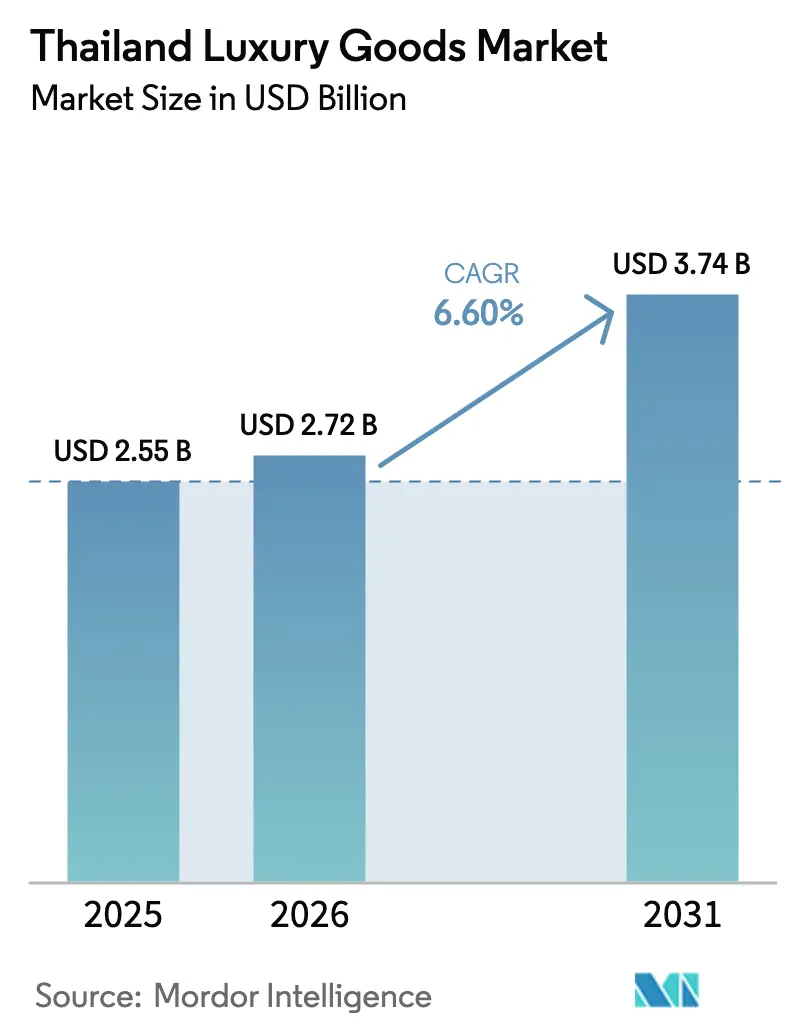
The Thailand luxury goods market size stands at USD 2.72 billion in 2026 growing from 2025 value of USD 2.55 billion and is projected to reach USD 3.74 billion by 2031, reflecting a 6.6% CAGR as the nation consolidates its role as Southeast Asia’s premium‐consumption hub. Thailand's luxury goods market is buoyed by a steady recovery in inbound tourism, rising disposable incomes among Gen-Z, ongoing investments in flagship malls, and the introduction of a long-stay visa program. These factors are driving both traffic and spending, particularly in high-margin categories. While average transaction values face inflationary pressures, strategies like multi-brand retail curation, omnichannel shopping experiences, and influencer-led promotions are broadening the domestic market's reach. Expatriates and medical tourists are increasingly viewing investment-grade jewelry, Swiss watches, and bespoke accessories as portable stores of value. Although challenges like counterfeit proliferation, price sensitivity among the mass affluent, and a subdued demand from Chinese group tours temper volume growth, they haven't derailed the medium-term expansion of Thailand's luxury goods market.
Key Report Takeaways
- By product type, clothing and apparel led with 26.73% of the Thailand luxury goods market share in 2025, while jewelry is projected to expand at a 6.96% CAGR through 2031.
- By end user, women generated 57.32% of 2025 revenue, whereas men represent the fastest-growing segment at a 7.32% CAGR to 2031.
- By distribution channel, single-brand stores held 35.35% of 2025 sales, yet multi-brand stores are forecast to outpace with a 7.86% CAGR over the same horizon.
Note: Market size and forecast figures in this report are generated using Mordor Intelligence’s proprietary estimation framework, updated with the latest available data and insights as of January 2026.
Market Trends and Insights
Drivers Impact Table of Thailand Luxury Goods Market*
| Driver | (~) % Impact on CAGR Forecast | Geographic Relevance | Impact Timeline |
|---|---|---|---|
| Rising affluence among Gen-Z and young professionals | +1.2% | National, with concentration in Bangkok, Chiang Mai, Phuket | Medium term (2-4 years) |
| Inbound tourism rebound and flagship mall boom | +1.8% | National, with peak impact in Bangkok, Phuket, Pattaya, Chiang Mai | Short term (≤ 2 years) |
| Social-commerce and celebrity influence surge | +0.9% | National, with digital-native adoption in urban centers | Medium term (2-4 years) |
| Sustainability-led material innovation | +0.6% | Global, with early adoption in Bangkok luxury districts | Long term (≥ 4 years) |
| Visa-free long-stay programmes attracting HNW expats | +0.7% | National, with concentration in Bangkok, Phuket, Samui, Chiang Mai | Medium term (2-4 years) |
| Medical-tourism hubs driving Middle-East luxury spend | +0.5% | Bangkok, Phuket, Pattaya medical clusters | Short term (≤ 2 years) |
| Source: Mordor Intelligence | |||
Rising affluence among gen-Z and young professionals
As of 2024, data from the Thailand Board of Investment reveals that individuals aged 15-24 constitute 12.24% of the nation's total population[1]. This demographic is reshaping consumption patterns, favoring experiential luxury and digital-first brand interactions over traditional status symbols. In response, brands are shifting focus from heritage narratives to highlight product utility, sustainability, and resale value qualities that resonate with a generation wary of overt displays of wealth. Demand for luxury goods among Thai men is surging at a 7.32% CAGR, fueled by young professionals who view watches, leather goods, and grooming products as markers of career success. According to the Bangkok Post, Gen-Z's discretionary spending on experiences rose to 56% in 2024, up from 45% in 2023. This trend underscores the need for luxury brands to weave in food and beverage, wellness, and cultural elements into their retail spaces. In a move highlighting this shift, Jim Thompson is channeling THB 100-150 million (USD 2.9-4.3 million) over the next 3-5 years to boost its store count from 25 to 30-35. This includes a prominent 500-square-meter duplex at One Bangkok and the introduction of a Maison Jim Thompson homeware line by 2026, signaling a strategic pivot towards lifestyle ecosystems to capture Gen-Z's loyalty.
Inbound tourism rebound and flagship mall boom
Thailand's luxury goods market is thriving, buoyed by a resurgence in tourism. The government, aiming high, targets 39 million international visitors and a foreign tourism revenue of 2.23 trillion THB by 2025, as highlighted by its public relations department in May 2025[2]. The Tourism Authority of Thailand (TAT) Newsroom reports a significant milestone: over 35 million visitors graced Thailand in 2024, underscoring the nation's tourism revival[3]. This resurgence has revitalized traffic at airport duty-free shops, resort boutiques, and urban flagship stores. Illustrating the trend, Central Group's THB 21 billion "The Central", King Power's "One Bangkok", and Prada's expansive 597-square-meter flagship in Central Phuket showcase the collaborative investments of developers and brands. They're keenly targeting a growing mix of tourists, predominantly from the Middle East, India, and independent travelers from China. Resort destinations are elevating their offerings, evident with bespoke services like Cartier's custom eyewear lounge, solidifying their premium market stance. Prime malls in Bangkok are witnessing double-digit rent growth, a testament to landlords' confidence in Thailand's luxury goods market. These strategic investments are not only drawing in tourists but also appealing to resident expatriates, fueling a surge in near-term sales.
Social-commerce and celebrity influence surge
In 2024, Thailand's social-commerce sector reached a valuation of USD 7.5 billion. Dominating the scene, TikTok Shop, Facebook Marketplace, and Instagram Shopping collectively represented 60% of the nation's online luxury sales. Celebrity-led live-stream auctions boasted conversion rates three times higher than traditional e-commerce, shrinking brand-awareness timelines from years to mere months. Luxury brands are now dedicating as much as 30% of their digital budgets to influencer collaborations. This strategy not only accelerates market entry for budding Thai designers but also hinges on the success of their viral product drops. Cafés like Ralph's Coffee have transformed into social-media hotspots, enhancing customer engagement and promoting cross-selling. This vibrant channel is reshaping distribution dynamics in Thailand's luxury goods market, all while pushing brands to safeguard their equity in an environment driven by fleeting trends.
Sustainability-led material innovation
Kering's Environmental Profit and Loss accounting and LVMH's Life 360 program are steering Thai leather and textile suppliers towards traceability and eco-friendly processes, emphasizing the importance of reducing environmental impact across the supply chain. Hermès's trial of mycelium-based alternatives hints at a significant shift in material sourcing, with the potential to redefine supply contracts and industry standards by 2027. Supporting this shift, government entities like the Designated Areas for Sustainable Tourism Administration (DASTA) are bolstering sustainable practices through policy initiatives, further sculpting Thailand's reputation as a conscientious luxury destination[4]. Local entities are capitalizing on Thailand's THB 50 billion Bio-Circular-Green incentives to bolster sustainable production, reduce dependency on imports, and safeguard against tariff and logistics disruptions, ensuring resilience in the face of global uncertainties. Jim Thompson's silk, dyed naturally using traditional methods, is being marketed as a heritage-rich, eco-friendly choice for luxury hotels, blending cultural authenticity with sustainability. Collectively, these moves are setting a new standard of sustainability in Thailand's luxury goods arena, aligning with global trends and consumer expectations for environmentally responsible practices.
Restraints Impact Analysis of Thailand Luxury Goods Market*
| Restraint | (~) % Impact on CAGR Forecast | Geographic Relevance | Impact Timeline |
|---|---|---|---|
| Proliferation of counterfeit goods | -0.8% | National, with concentration in Bangkok, Pattaya tourist districts | Short term (≤ 2 years) |
| Price-sensitive mass affluent segment | -0.6% | National, with higher impact in secondary cities | Medium term (2-4 years) |
| Macroeconomic and inflation volatility | -0.5% | National, with spillover from global economic cycles | Short term (≤ 2 years) |
| Lagging return of Chinese group tours and FX swings | -0.7% | Bangkok, Phuket, Chiang Mai tourist hubs | Medium term (2-4 years) |
| Source: Mordor Intelligence | |||
Proliferation of counterfeit goods
In 2023-2024, authorities seized 4.2 million counterfeit luxury items in Thailand, valued at a staggering THB 12 billion. These fakes siphoned off 8-12% of the market's addressable demand, significantly undermining brand equity and consumer trust. Key vendors have established operations in prominent locations such as Chatuchak, MBK Center, and Patpong, leveraging Thailand's strategic logistics network to facilitate the import of counterfeit goods from China and Vietnam. While blockchain-based authentication solutions, like LVMH's Aura, provide a robust defense against counterfeits, they come at an added cost of USD 5-10 per item. This additional expense tightens profit margins, particularly for entry-level luxury products, making it challenging for brands to maintain competitive pricing. Customs officers, already stretched thin, inspect approximately 2 million parcels monthly, limiting their ability to curb the influx of counterfeit goods effectively. Consequently, counterfeiting continues to pose a significant challenge to Thailand's luxury goods market, emphasizing the critical need for scalable technological innovations and strengthened legal frameworks to address this persistent issue.
Lagging return of Chinese group tours and FX swings
In 2024, Chinese arrivals hit 6.7 million, marking a 40% dip from 2019 figures. This decline reflects the ongoing challenges in the recovery of international travel from China. Concurrently, a depreciation in the yuan led to a 15-18% drop in per-capita luxury spending, further impacting the overall market. While group tours have traditionally accounted for 60% of Chinese visitors, their muted presence has tilted the demographic towards independent travelers, who tend to spend less on duty-free items. This shift in traveler composition has altered spending patterns, requiring brands to adapt their strategies. Brands are now tasked with adjusting their assortments to cater to Middle Eastern and Southeast Asian tourists, given the distinct category preferences of these groups, which differ significantly from those of Chinese tourists. Furthermore, currency volatility has added a layer of complexity to pricing strategies. Absorbing foreign exchange (FX) losses might help maintain volume, but it comes at the cost of profitability, forcing brands to carefully balance pricing and margins. As organized Chinese travel continues its path to normalization, Thailand's luxury goods market grapples with a foundational yet restrained demand, highlighting the need for strategic agility in navigating these evolving dynamics.
*Our forecasts treat driver/restraint impacts as directional, not additive. The impact forecasts reflect baseline growth, mix effects, and variable interactions.
Thailand Luxury Goods Market Segment Analysis
By Product Type:
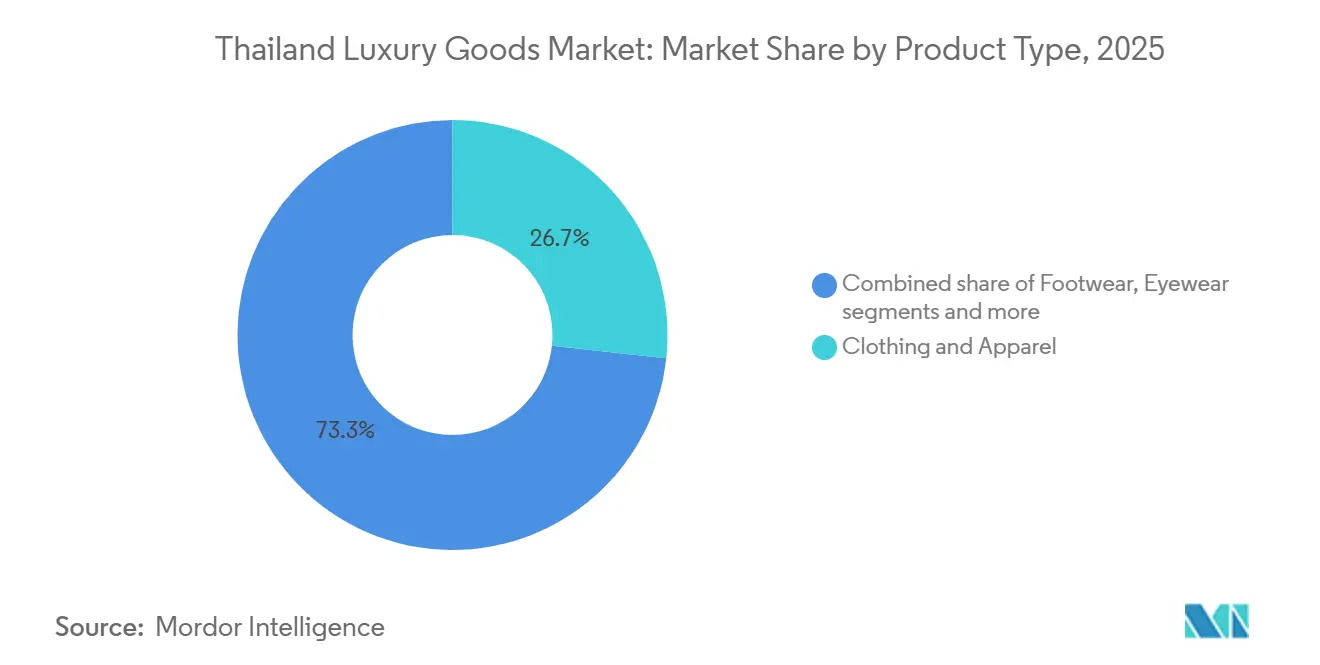
Portable Assets Reshape Luxury MixIn 2025, clothing and apparel dominated Thailand's luxury goods market, seizing 26.73% of total sales, driven by robust demand from both local consumers and tourists in pursuit of premium fashion. Leather goods, seen as aspirational entry points, trailed closely with about 22% of the category's value, thanks to the enduring allure of designer bags and accessories that convey status without exorbitant price tags. Meanwhile, luxury footwear and eyewear capitalized on the rising athleisure and wellness trends. Notably, sneaker resale volumes surged by 18% in 2024, as collectors eagerly pursued limited drops. Swiss mechanical watches, witnessing double-digit volume increases, emerged as coveted safe-haven investments amidst economic fluctuations. These segments, anchored by urban retail expansions and deepening e-commerce penetration in Bangkok and other tourist hotspots, collectively bolster the market's stability.
Jewelry emerged as the fastest-growing segment in Thailand's luxury market, boasting a 6.96% CAGR through 2031. Expatriates, medical tourists, and locals gravitated towards high-value pieces, viewing them as hedges against currency fluctuations, all while honoring a cultural affinity for gold. Duty-free operators sweetened the deal with gemstone-grading kiosks and private viewing lounges, enhancing accessibility at key airports and resorts. Beauty and personal care mirrored this growth with a steady 6.2% rise, driven by K-beauty trends and targeted omnichannel strategies from giants like Estée Lauder and L’Oréal, focusing on younger audiences. Brands capitalized on scarcity, rolling out limited-edition sneaker collaborations and custom eyewear. Apparel, facing slowdowns, pivoted to upcycled fabrics, appealing to eco-conscious shoppers. Watches, bolstered by events like Bangkok Watch Week, reinforced their investment status, underscoring Thailand's burgeoning prominence as a luxury horology hub in the region.

By End User:
Male Demand Narrows the Gender GapIn 2025, women commanded a dominant 57.32% share of Thailand's luxury goods market, driven by a robust appetite for high-end beauty, fashion, and accessories. This demand is deeply rooted in cultural gifting traditions and amplified by social media. High-net-worth women are gravitating towards ultra-premium handbags and exquisite jewelry. In contrast, the mass-affluent demographic leans towards accessible beauty products and small leather goods. This trend is further buoyed by omnichannel expansions from luxury giants like Dior and Chanel. To cement loyalty and enhance lifestyle appeal, these brands are curating in-store experiences, integrating wellness events, and cultural activations. With the backing of e-commerce growth and influencer partnerships, especially on platforms like Instagram and TikTok, female buyers remain the bedrock of market volumes. Their steadfast presence bolsters the market's resilience, even as tourism rebounds and disposable incomes rise.
Men are emerging as the fastest-growing demographic in Thailand's luxury goods arena, boasting a 7.32% CAGR projected through 2031. Executives are increasingly viewing luxury accessories as essential career assets, while younger professionals are leaning into self-expression. Men's grooming is gaining traction, bolstered by department-store shop-in-shops and TikTok tutorials. Boutiques are introducing male-focused lounges, offering private fittings to encourage repeat visits. Merchandising is adapting, with a shift towards larger footwear sizes and darker color palettes. Unisex sneaker collaborations are further blurring gender lines, generating a buzz in social commerce and driving double-digit growth in select categories. In response, retailers are onboarding specialized stylists, positioning men to steadily increase their market share as societal perceptions evolve.
By Distribution Channel:
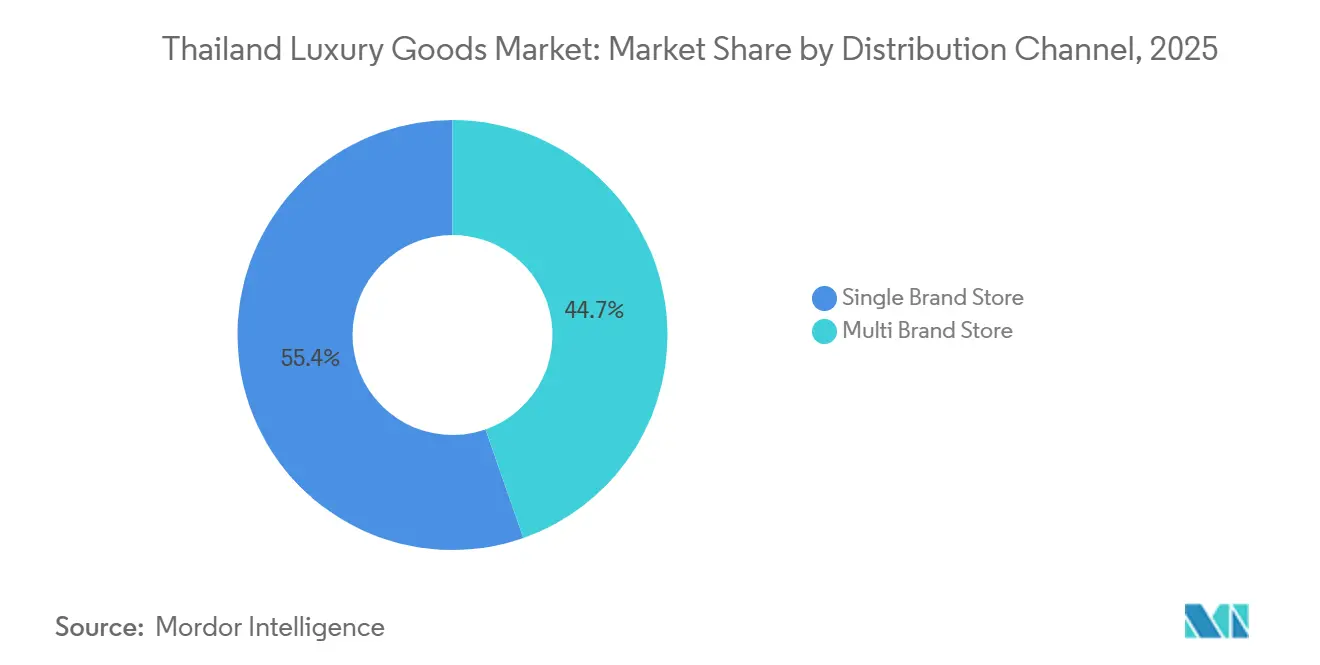
Curation Beats ControlIn 2025, single-brand stores dominated Thailand's luxury goods market, accounting for 55.35% of the revenue. These boutiques, located in prime Bangkok districts, offer exclusive experiences like VIP lounges and customization services, fostering deep brand loyalty among affluent shoppers. They differentiate themselves from aggregated retail formats through immersive storytelling, art installations, and private events. High-net-worth locals and tourists are drawn to the intimacy and prestige of standalone outlets. For instance, Louis Vuitton’s ‘LV The Place Bangkok’ seamlessly blends shopping with dining and exhibitions. As rent pressures mount in key corridors, brands are increasingly turning to shorter-term pop-ups. This strategy allows them to gauge demand before committing to flagship stores, ensuring flexibility in response to evolving consumer paths. The dominance of this channel endures, primarily due to its ability to curate premium atmospheres that remain elusive in multi-brand environments.
Multi-brand store complexes are emerging as the fastest-growing distribution channel in Thailand's luxury market. They are projected to expand at a 7.86% CAGR through 2031. This growth is driven by a shift in footfall towards these venues, seen as one-stop discovery hubs for time-poor shoppers. Multi-brand operators, leveraging data analytics and co-marketing funds, now aggregate over 550 labels. This strategy simplifies access for shoppers and boosts inventory turnover, especially in high-traffic locations like Central Park Bangkok and One Bangkok. Meanwhile, duty-free restructuring is channeling investments into urban and airport hotspots. This move capitalizes on surges in tourism and the allure of tax exemptions for luxury categories. Additionally, curated concept stores within these duty-free spaces are providing emerging Thai designers with accelerated exposure, all without the burden of heavy capital investments. The interplay between these channels not only ensures a broad market reach but also maintains a boutique-like personalization, fueling the overall expansion of the market.
Geography Analysis
In 2025, Bangkok's 200-plus luxury boutiques, spanning Central Embassy, Siam Paragon, and ICONSIAM, accounted for 55% of national luxury goods sales. By late 2026, the upcoming The Central project will add another 1.1 million m² of mixed-use space, including retail, dining, and entertainment options, further enhancing the city's appeal as a luxury shopping destination. The city enjoys a boost from Suvarnabhumi airport's 60 million annual passengers, which ensures a steady influx of international visitors, and the Long-Term Resident visa, which channels expatriate spending towards high-end retail. Landlords, seizing the momentum in Thailand's luxury goods market, have hiked prime rents by 8-12%, solidifying downtown's status as the nation's luxury epicenter and attracting global brands seeking premium retail spaces.
Phuket, with 18% of the national sales in 2025, is projected to grow at an annual rate of 8.2% until 2031. This growth is fueled by resort tourism, yacht chartering, and medical procedures, all seamlessly blending with luxury shopping. Central Phuket's recent renovation introduced Prada's largest store in Thailand and Tiffany & Co.'s first resort boutique, highlighting brands' growing interest in leisure-centric formats. The island's appeal is further enhanced by its reputation as a high-end destination, offering exclusive experiences such as private yacht tours and luxury wellness retreats. Duty-free shops and watch specialists are enhancing their offerings, integrating tax-refund desks and private-viewing apartments to attract Middle Eastern and European patients seeking luxury during their recovery, thereby creating a unique shopping experience tailored to affluent international visitors.
Pattaya and Chiang Mai, holding a combined 15% of the market in 2025, are expanding their presence. Real estate upgrades are boosting average room rates, drawing in more affluent travelers. Pattaya is leveraging its coastal location to attract luxury travelers through upscale resorts and beachfront developments. Chiang Mai is weaving its heritage into silk workshops and wellness retreats, turning artisanal experiences into boutique spending opportunities. The city is also positioning itself as a cultural hub, offering curated experiences that appeal to high-net-worth individuals seeking authenticity. While secondary cities like Udon Thani and Khon Kaen currently account for only single-digit shares, the introduction of high-speed rail by 2028 is poised to invigorate the northeastern corridors, increasing foot traffic in Thailand's luxury market. Retailers are eyeing pop-up rotations in these emerging nodes, viewing them as a strategic, capital-light move for a first-mover advantage, while also testing the market potential in these regions before committing to permanent establishments.
Regulatory Landscape
Thailand’s luxury retail operators work within import and tax rules, foreign ownership restrictions, and active trademark enforcement. Under the Foreign Business Act B.E. 2542 (1999), foreign-owned retail activity can require a Foreign Business License (FBL). A common operating pathway allows companies with at least THB 100 million in registered capital to run up to five retail outlets without an FBL, so market-entry models often combine flagship boutiques with concessions or local partners.
On trade compliance, Thailand has tightened treatment for small cross-border parcels since January 1, 2026, applying import duties and a 7% VAT to de minimis shipments priced from THB 1. Brand protection remains a priority under Thailand’s first-to-file trademark regime, which makes early registration and ongoing monitoring important for luxury houses and local designers. Policy discussion also continues on higher luxury import duties, with the Customs Department considering increases toward statutory ceilings (ad valorem duty rates vary by HS code, with general ranges cited up to 80%), shaping pricing and assortment decisions for imported categories such as watches, jewelry, and leather goods. In parallel, large multinationals with consolidated revenue above EUR 750 million have faced Thailand’s domestic top-up tax regime from 2025, aligned with OECD Pillar Two, which adds to regional profit and transfer-pricing planning for global luxury groups operating in Thailand.
Competitive Landscape
Thailand's luxury goods market exhibits moderate fragmentation, with LVMH, Kering, and others dominating, collectively accounting for the majority of sales, while local heritage and niche designers capture the remainder. LVMH bolsters its position with experiential ventures like Dior’s “Gold House,” a luxury concept space designed to enhance customer engagement, and a resort-centric expansion in Phuket, which caters to high-net-worth tourists. Kering, aiming at Gen-Z, integrates augmented-reality try-ons and mobile-styling apps in Gucci and Saint Laurent to provide an interactive shopping experience, while Bottega Veneta appeals to expatriates with its emphasis on understated craftsmanship and timeless designs. Richemont taps into Thailand’s horology culture, unveiling Cartier’s bespoke eyewear lounge to attract affluent clientele and hosting exclusive collector events at Siam Paragon to strengthen brand loyalty.
Central Group broadens its horizons with a stake in Selfridges, using this leverage to introduce Central Park as a first-in-Thailand offering, thereby enhancing its global footprint. King Power, in collaboration with Avolta, harnesses international loyalty data to tailor offers across 18 nations, enhancing its network effects and creating a seamless shopping experience for international travelers. Thai brands like Jim Thompson, Sretsis, and Disaya harness the power of social commerce to break beyond domestic confines, championing sustainability and bold design as their unique selling propositions to appeal to a global audience.
In Thailand's luxury goods market, where products alone can't secure a foothold, innovations like blockchain authentication, VIP salons, and cross-border loyalty engines have emerged as vital tools. Blockchain authentication ensures product authenticity, fostering trust among discerning customers. VIP salons offer personalized and exclusive shopping experiences, enhancing customer satisfaction and loyalty. Cross-border loyalty engines enable seamless rewards and benefits across regions, catering to the preferences of a global clientele. These advancements bolster customer trust and exclusivity, granting brands a distinct advantage in a swiftly changing landscape. By embracing these cutting-edge strategies, Thailand's luxury brands are not just elevating customer experiences but also establishing new industry standards.
Thailand Luxury Goods Industry Leaders
-
LVMH Moët Hennessy Louis Vuitton SE
-
Kering SA
-
Chanel SA
-
Hermès International SA
-
Prada SpA
- *Disclaimer: Major Players sorted in no particular order

Thailand Luxury Goods Market Companies Covered in this Report
- LVMH Moet Hennessy Louis Vuitton SE
- Kering SA
- Chanel SA
- Hermes International SA
- Compagnie Financiere Richemont SA
- The Swatch Group Ltd
- Prada SpA
- PVH Corp
- Rolex SA
- Ralph Lauren Corp
- Estee Lauder Companies Inc.
- Burberry Group plc
- Capri Holdings Ltd
- Tapestry Inc.
- L'Oréal SA
- Jim Thompson Thai Silk Co.
- King Power International Co.
- Sretsis Co. Ltd
- Disaya Co. Ltd
- Busardi Co. Ltd
- Cortina Watch (Thailand) Co.
- Siam Swiss Co. Ltd
Market Opportunities and Future Outlook
Bangkok’s role as a regional luxury entry point is reinforced by a continued pipeline of first-in-market and flagship-grade openings across prime retail destinations. Savills Research has ranked Bangkok fourth globally for new luxury brand openings, while Siam Piwat-managed hubs such as IconSiam and Siam Paragon have concentrated luxury traffic and tenant demand. IconSiam alone secured commitments from more than 51 brands between mid-2025 and Q1 2026. Announced 2026 openings and entries (including The Row at Siam Paragon in June 2026, plus additional watch and fashion maisons opening across ONESIAM-linked locations) also extend the customer base beyond tourists by supporting repeat visitation from affluent locals, expatriates, and long-stay travelers.
The more immediate opportunity is in category depth and retail format specialization, particularly for portable value categories and experience-led retail where Thailand already shows strong purchase intent. Build-out in horology and high jewelry via boutiques and duplex concepts (including Patek Philippe’s Southeast Asia duplex-format debut at One Bangkok) supports higher-ticket conversion through appointments, private salons, and after-sales services. At the same time, the tighter 2026 import and VAT treatment on low-value parcels increases the incentive for brands and authorized retailers to strengthen local omnichannel fulfillment, authentication, and clienteling in-country, redirecting demand away from informal cross-border channels and toward controlled retail and service ecosystems.
Recent Industry Developments in Thailand Luxury Goods Market
- June 2026: Announced a strategic collaboration with LVMH owned Belmond, Galeries Lafayette, Insignia, and MJETS to expand its global luxury ecosystem and connect services for ONESIAM members. The collaboration expands Siam Piwat's luxury ecosystem and enables cross-brand experiences for high-net-worth travelers, reinforcing Thailand’s role as a regional luxury hub.
- June 2026: Opened its first duplex boutique in Southeast Asia at One Bangkok, in partnership with Cortina Watch. The opening creates a new regional flagship in Bangkok, reinforcing Thailand’s position as a luxury horology destination and flagship market in Southeast Asia. The joint venture with Cortina Watch expands access to exceptional timepieces and drives foot traffic to One Bangkok.
- June 2026: Opened its first boutique in Thailand at Siam Paragon, serving as the Maison’s largest boutique in the Asia-Pacific region. The opening expands Buccellati's footprint in Bangkok's luxury retail cluster and lifts Siam Paragon’s status as a premier luxury destination in APAC.
Thailand Luxury Goods Market Report Scope and Research Methodology
Market Definition and Coverage
For this methodology, the Thailand luxury goods market is counted as the retail value of high-end personal luxury products sold in Thailand, covering both offline and online channels. The purchase base includes Thailand residents as well as inbound travelers.
Scope exclusions: The sizing excludes luxury cars, luxury hospitality experiences, luxury real estate, and alcoholic beverages.
Segments Covered in This Report
- By Product Type
- Clothing and Apparel
- Footwear
- Eyewear
- Leather Goods
- Jewelry
- Watches
- Beauty and Personal care
- End User
- Men
- Women
- Unisex
- Distribution Channel
- Single Brand Stores
- Multi Brand Stores
Data Sources, Market Sizing, and Validation
Desk Research
Desk work was used to map demand signals and set realistic inputs that can be checked year to year. We relied on public macro and sector indicators such as Thailand tourism arrivals and receipts, household income and spending patterns, and consumer price movements that can affect luxury ticket sizes.
To build these inputs, we referenced sources such as the Bank of Thailand and National Statistical Office releases, Ministry of Tourism and Sports reporting, and international datasets like UN Comtrade for trade flows and the World Bank for comparable macro series. Supporting context was also taken from listed-company filings and investor presentations, customs and trade publications, and reputable press coverage of mall expansion, travel retail, and policy changes. Select paid subscriptions were used only to normalize company financials, confirm corporate structures, and cross-check trademark and patent activity where it helped explain new launches. The sources listed here are illustrative, and we used additional public references for data collection, validation, and clarification.
Primary Interviews and Surveys
Primary conversations were used to pressure-test the desk inputs and to fill gaps that do not show up cleanly in public statistics, especially around pricing, channel mix, and traveler versus resident demand. We spoke with a mix of brand-side and retail-side stakeholders, alongside distribution and category specialists, then re-checked assumptions with a smaller set of independent experts.
Because this is a single-country market, the fieldwork was designed to cover the main buying hubs and channels within Thailand (flagship malls, specialty stores, and e-commerce), so the final model reflects how purchases actually occur on the ground.
Distribution of primary research fieldwork respondents
| Company type | Respondent position |
|---|---|
| Top tier: 29% | CXOs: 14% |
| Mid tier: 57% | Functional/Unit leaders: 26% |
| Smaller Players: 14% | Managers: 60% |
Market-Sizing & Forecasting
Sizing starts from a top-down build where consumer demand is reconstructed using Thailand retail and tourism spending signals, then filtered through luxury participation rates by category and channel. To keep the totals realistic, we run selective bottom-up checks, including rolling up a sample of store networks and using sampled price bands and unit movement patterns, which are then used to adjust outliers.
Key inputs that shape the model include inbound visitor volumes and mix, duty-free and travel retail relevance, local disposable income trends, inflation-linked price progression, and the online share of luxury purchases. Where public data is not category-specific, proxies are used (for example, import trends for relevant product groups and mall traffic indicators), then corrected using interview feedback.
For forecasting, scenario analysis is applied around the tourism recovery pace, pricing actions, and consumer confidence, and the chosen scenario is aligned to expert consensus from primary discussions. When bottom-up signals are incomplete for a niche category, we keep assumptions conservative and require at least two independent checks before it is carried forward into the forecast line.
Data Validation & Update Cycle
Validation is done through multiple passes so the final numbers remain consistent with real-world signals. We compare market totals against independent indicators such as tourism spending, retail turnover direction, and category-level trade movements, and then investigate any sharp variance before sign-off.
A second analyst review is used to re-check formulas, year-to-year bridges, and key assumptions like channel mix and price progression. If an assumption shifts materially during review, experts are re-contacted to confirm whether the change is structural or temporary. Reports are refreshed annually, with interim updates when major events occur, and a final pre-delivery check is completed so clients receive the most current view.
Mordor Intelligence's Thailand Luxury Goods Market Estimate Compared With Other Published Estimates
Published estimates for Thailand luxury goods can look different even when the same country is discussed, mainly because the counted product set and the point of valuation are not the same. Differences also show up when one publisher relies more on trade flows, while another leans on consumer surveys, which can shift the implied channel mix and average selling price.
The biggest gap drivers in this market tend to be whether prestige beauty and eyewear are included, how travel retail is treated (counted fully at retail value versus partially through import proxies), and how prices are converted and updated during periods of currency movement. Some estimates also blend in adjacent categories like luxury experiences, which can inflate totals even though those purchases do not sit inside personal luxury product retail sales, a separation enforced in the model used here by Mordor Intelligence.
Benchmark comparison
| Source | Market Size | Gaps in Research Methodology |
|---|---|---|
| Mordor Intelligence | USD 2.72 B (2026) | |
| Industry Association A | USD 2.30 B (2026) | Often tracks market through import and wholesale indicators, which can undercount locally sourced sales, exclude some online transactions, and treat travel retail as a partial pass-through rather than full retail value. |
| Global Consultancy B | USD 3.10 B (2026) | Commonly expands scope by folding in adjacent luxury services or broader premium categories, and may apply more aggressive ASP progression that is not tied back to Thailand-specific price and channel checks. |
Taken together, the spread is mainly explained by scope choices and valuation logic, not by a single missing data point. Our approach stays repeatable because each category is tied back to clear demand signals, channel assumptions, and price checks that can be revisited during every annual refresh.
Key Questions Answered in the Report
What is the current value of the Thailand luxury goods market?
The Thailand luxury goods market size reached USD 2.72 billion in 2026 and is expected to hit USD 3.74 billion by 2031.
Which product category is growing the fastest in Thai luxury retail?
Jewelry leads with a 6.96% CAGR through 2031 as high-net-worth expatriates and medical tourists favor portable investment pieces.
Why are multi-brand stores gaining share over single-brand boutiques?
Curated assortments, lower search costs, and experiential anchors in projects like Central Park are driving a 7.86% CAGR for multi-brand formats.
What factors constrain near-term growth prospects?
Counterfeit proliferation and a slower rebound of Chinese group tours curb volume, offsetting some gains from tourism and Gen-Z affluence.