
Thailand IT And Security Market Size and Share
Market Overview
| Study Period | 2020 - 2031 |
|---|---|
| Forecast Data Period | 2026 - 2031 |
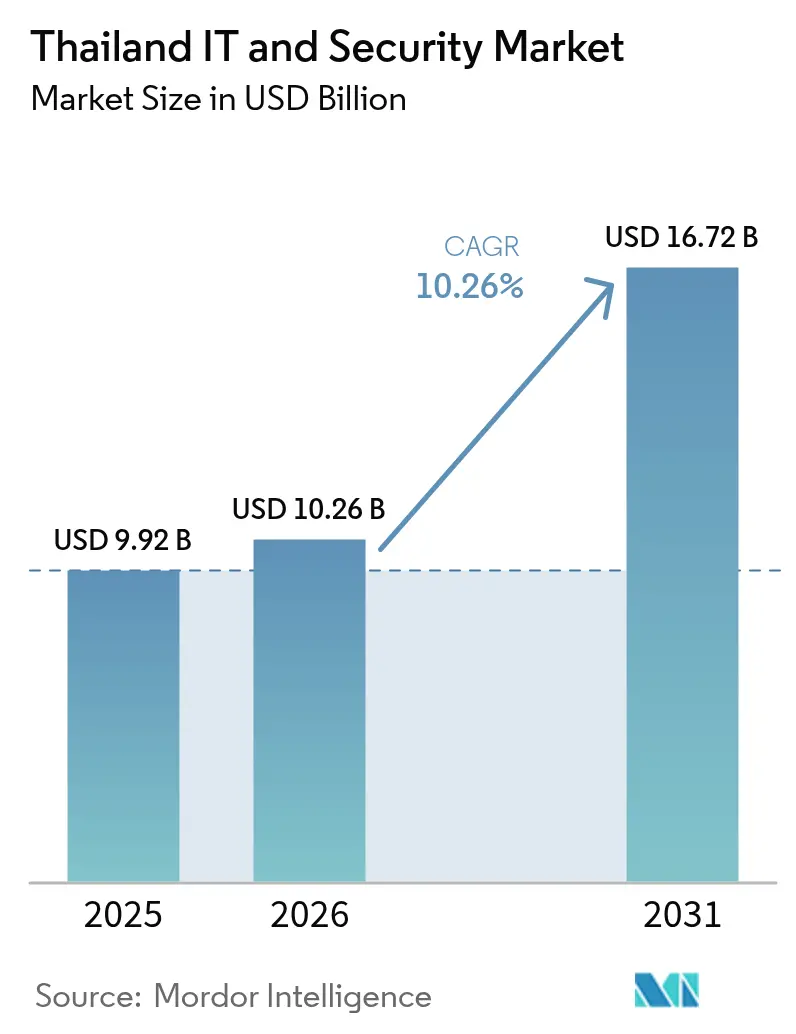
| Base Year Market Size (2025) | USD 9.92 Billion |
| Market Size (2026) | USD 10.26 Billion |
| Market Size (2031) | USD 16.72 Billion |
| Growth Rate (2026 - 2031) | 10.26% CAGR |
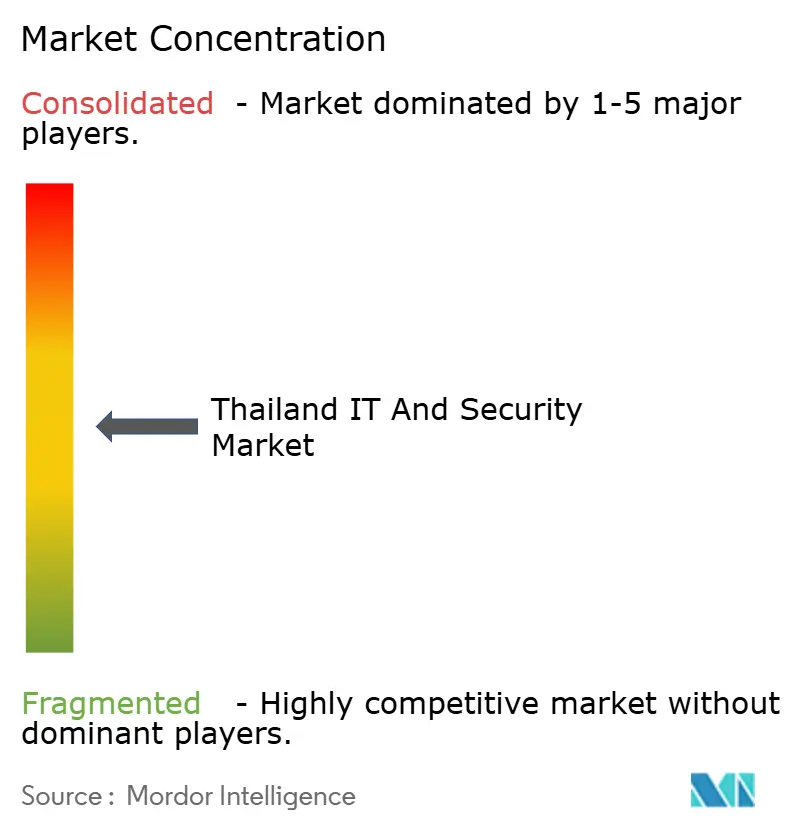
| Market Concentration | Medium |
Major Players *Disclaimer: Major Players sorted in no particular order Image © Mordor Intelligence. Reuse requires attribution under CC BY 4.0. | |
Thailand IT And Security Market Analysis by Mordor Intelligence
The Thailand IT and Security market size was valued at USD 9.92 billion in 2025 and is estimated to grow from USD 10.26 billion in 2026 to reach USD 16.72 billion by 2031, at a CAGR of 10.26% during the forecast period (2026-2031). Heightened cloud migration across 412 government entities, a USD 2.7 billion hyperscale data-center pipeline, and quantum-readiness mandates are pulling forward security investment and deepening the Thailand IT and Security market’s reliance on sovereign infrastructure. Converging 5G standalone coverage, which reached 92% of the population in 2025, is catalyzing edge-to-cloud architectures that demand micro-segmentation and zero-trust controls. Meanwhile, ISO-based compliance frameworks have moved from voluntary best practice to contractual prerequisite, aligning export-oriented manufacturers and digital retailers on the same security maturity path. Talent scarcity, semiconductor import dependence, and elongated procurement cycles in the provinces remain counterweights but have not derailed double-digit expansion of the Thailand IT and Security market.
Key Report Takeaways
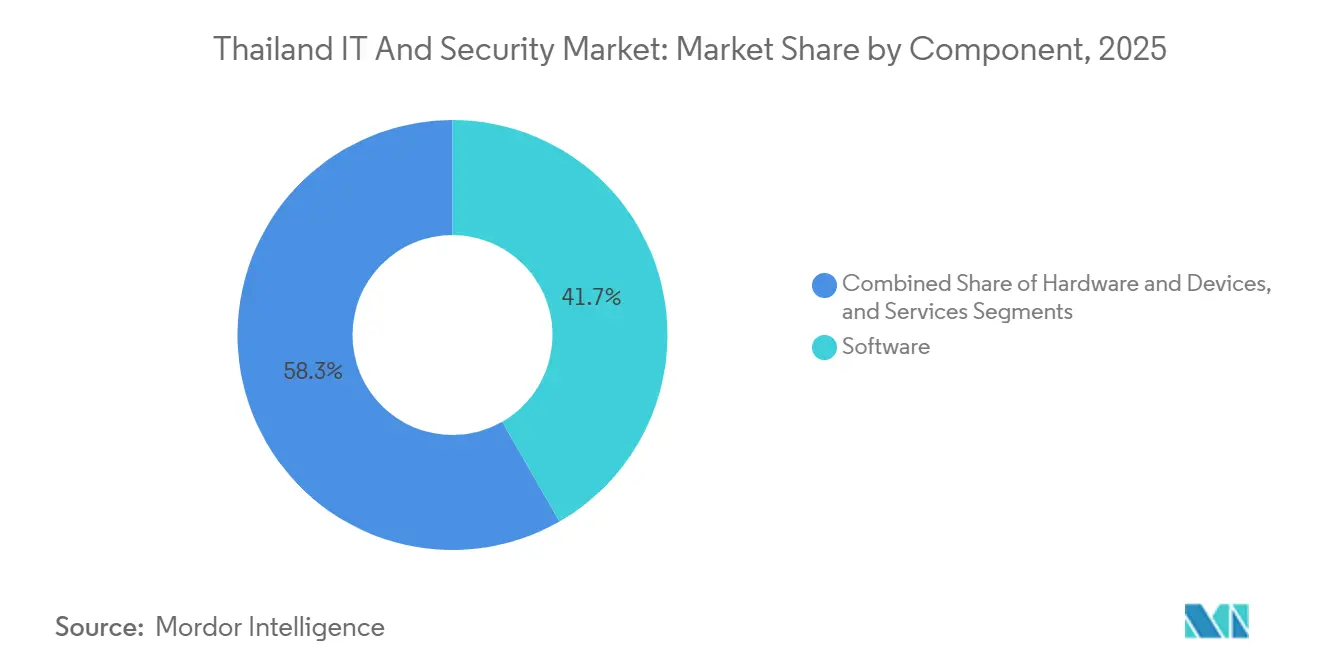
- By component, software led with 41.72% revenue share in 2025, while services are projected to expand at a 10.71% CAGR through 2031.
- By deployment mode, cloud captured 55.84% of 2025 spending, whereas hybrid architectures are forecast to advance at a 10.44% CAGR to 2031.
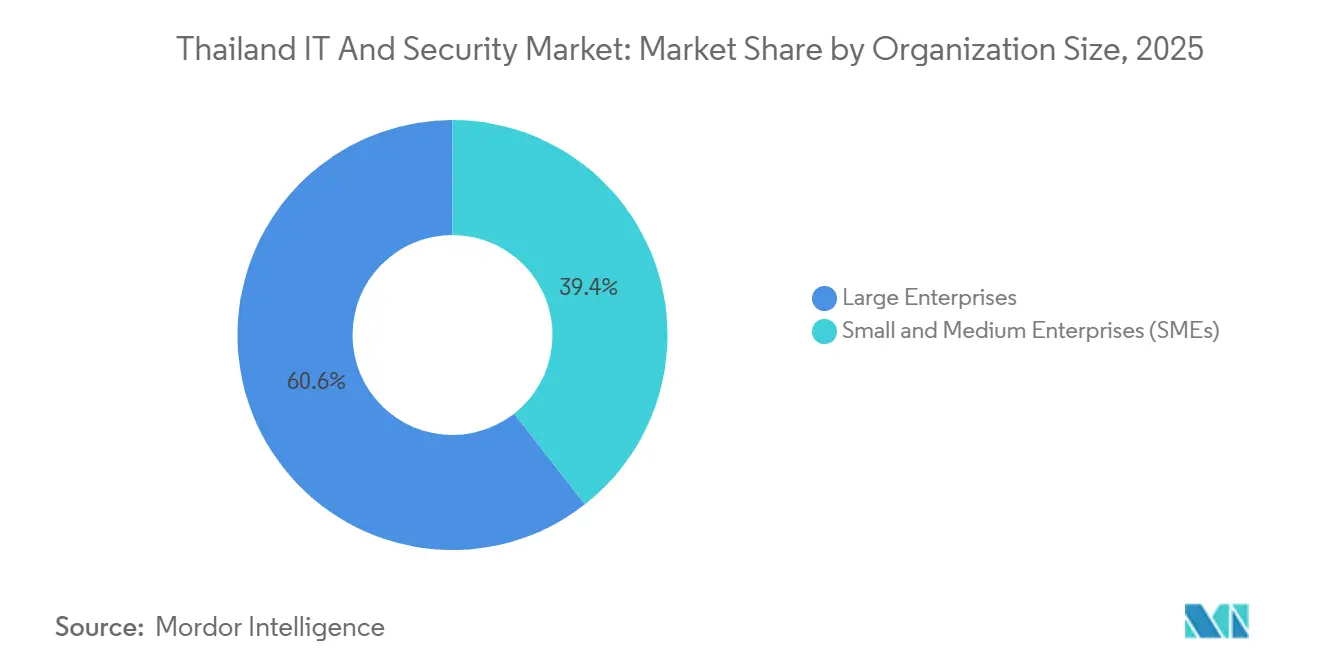
- By organization size, large enterprises commanded 60.57% of outlays in 2025; small and medium enterprises are set to grow at an 11.03% CAGR over 2026-2031.
- By end-user industry, banking, financial services, and insurance held 28.16% share in 2025, but healthcare is poised for the fastest 11.32% CAGR through 2031.
Note: Market size and forecast figures in this report are generated using Mordor Intelligence’s proprietary estimation framework, updated with the latest available data and insights as of 2026.
Thailand IT And Security Market Trends and Insights
Drivers Impact Analysis*
| Driver | (~) % Impact on CAGR Forecast | Geographic Relevance | Impact Timeline |
|---|---|---|---|
| Cloud-first policy in Thai public sector | +1.8% | National, concentrated in Bangkok Metropolitan Administration and 76 provincial Digital Government Centers | Medium term (2-4 years) |
| Acceleration of 5G rollout enabling edge-to-cloud use-cases | +1.5% | National, with early 5G SA deployments in Eastern Economic Corridor (Chonburi, Rayong, Chachoengsao) | Short term (≤ 2 years) |
| E-commerce boom driving hyperscale data-center build-outs | +2.2% | National, with hyperscale facilities in Chonburi, Ayutthaya, and Bangkok suburbs | Medium term (2-4 years) |
| Board-level adoption of NIST CSF and ISO/IEC 27001 to meet export-market mandates | +1.3% | National, prioritized by automotive and electronics exporters in Eastern Economic Corridor and Samut Prakan | Long term (≥ 4 years) |
| Rise of Thailand PLUS near-shoring by Japanese and US manufacturers | +1.6% | National, with investment concentration in Eastern Economic Corridor and Northern provinces (Chiang Mai, Lamphun) | Medium term (2-4 years) |
| FinTech regulatory sandbox pushing open-API security spend | +1.2% | National, led by Bangkok-based banks and e-payment providers expanding to regional branches | Short term (≤ 2 years) |
| Source: Mordor Intelligence | |||


Cloud-First Policy in Thai Public Sector
The Digital Government Development Agency mandated that 70% of new public-sector workloads move to cloud infrastructure by 2027, compelling 412 agencies to migrate at least one mission-critical system before December 2026.[1]Digital Government Development Agency, “Policy Details,” DGA.OR.TH Contracts signed with National Telecom in 2025 already span 18 ministries and include ISO/IEC 27001-certified infrastructure, elevating spend on cloud security posture management and privileged access controls. Annual growth of 41% in public-sector purchases of these toolsets underscores how policy edicts translate into addressable demand. Yet nine-month tender cycles and coexistence with legacy on-premises assets require integrated monitoring across hybrid environments, increasing complexity and fueling uptake of managed security operations centers. The directive’s multi-factor authentication and five-year audit-log stipulations further lock in demand for identity-as-a-service and immutable storage.
Acceleration of 5G Rollout Enabling Edge-to-Cloud Use Cases
True Corporation and Advanced Info Service finished network consolidation in late 2024, resulting in a 5G standalone footprint that covered 92% of the population by mid-2025. Latency dropped below 10 milliseconds for industrial estates in Chonburi and Rayong, enabling machine-vision quality control, autonomous guided vehicles, and remote surgery pilots. These use cases require edge firewalls, micro-segmentation, and encrypted telemetry sync with cloud-based threat analytics, which together accounted for 62% of incremental edge-security budgets in 2025. Network slicing introduces fresh authentication challenges; only 19% of enterprises have deployed network-function-virtualization security, pointing to an untapped services opportunity. The 2G/3G shutdown completed in 2024 accelerated industrial controller upgrades, widening the Thailand IT and Security market as factories rushed to secure new radio gateways.
E-Commerce Boom Driving Hyperscale Data-Center Build-Outs
Thailand’s Board of Investment cleared USD 2.7 billion in data-center projects through 2025, with Google, Amazon Web Services, and Microsoft collectively adding 180 megawatts of capacity in Chonburi and Bangkok exurbs.[2]Board of Investment Thailand, “FDI Filings,” BOI.GO.TH E-commerce gross merchandise value reached THB 5.8 trillion (USD 165 billion) after growing 27.4% annually from 2022-2025, pressuring platforms such as Lazada and Shopee to meet sub-20-millisecond latency targets. Consequently, cloud-native web-application firewalls, API gateways, and distributed-denial-of-service mitigation claimed 34% of incremental security spend among the top-10 online retailers. Hyperscalers embed ISO/IEC 27017 and 27018 clauses into service-level agreements, easing compliance for merchants yet heightening dependency on imported cooling and power systems, 68% of which originate outside Thailand. Currency volatility remains a wild-card cost driver for physical security appliances within these sites.
Rise of Thailand PLUS Near-Shoring by Japanese and U.S. Manufacturers
The Thailand PLUS initiative attracted 127 foreign-direct-investment filings in 2025, including USD 890 million of Japanese-led expansions and a USD 300 million Foxconn electric-vehicle component plant. Automotive and electronics exporters now require ISO/IEC 62443 controls that converge operational-technology and information-technology defenses, spurring orders for industrial firewalls, security information and event management, and zero-trust segmentation. Foxconn’s Chachoengsao operations center monitors 1,200 endpoints and 47 SCADA nodes, illustrating the cyber-physical scale of demand. Nonetheless, only 14% of Thai engineers possess operational-technology security certification, forcing manufacturers to partner with local integrators and foreign specialists, a dynamic that expands the services revenue pool within the Thailand IT and Security market.
Restraints Impact Analysis*
| Restraint | (~) % Impact on CAGR Forecast | Geographic Relevance | Impact Timeline |
|---|---|---|---|
| Fragmented SME IT budget cycles | -1.4% | National, most acute in provincial SMEs outside Bangkok Metropolitan Region | Short term (≤ 2 years) |
| Shortage of 30,000 cyber-security professionals | -1.8% | National, with talent concentration in Bangkok and Chiang Mai | Long term (≥ 4 years) |
| Legacy MPLS contracts delaying cloud migration | -1.1% | National, affecting enterprises with multi-site operations and long-term telecom agreements | Medium term (2-4 years) |
| High dependence on imported semiconductors amid Baht volatility | -1.0% | National, impacting hardware procurement across all sectors | Short term (≤ 2 years) |
| Source: Mordor Intelligence | |||
Shortage of 30,000 Cyber-Security Professionals
The National Cyber Security Agency calculated a 30,000-person talent gap through 2027, while Thailand’s CISSP cohort rose only from 385 to 431 between 2024 and 2025. Median security-operations-center analyst pay in Bangkok jumped 18% to THB 65,000 (USD 1,850) per month, pushing small and medium enterprises toward managed services they often struggle to manage and assess. Outsourcing grew 22% in 2025, but reliance on third-party incident response dilutes institutional knowledge and extends containment times. Limited specialist availability slows adoption of zero-trust network access-implemented by just 11% of organizations as of end-2025-and drags on uptake of security orchestration, automation, and response. Government scholarship programs and vendor-run academies are scaling, yet the lag in advanced certifications will continue to temper the Thailand IT and Security market’s growth trajectory.
Fragmented SME IT Budget Cycles
Small and medium enterprises make up 99.5% of Thailand’s 3.2 million registered firms, yet half lack formal credit lines, forcing 6- to 9-month procurement cycles that delay endpoint detection and response deployments.[3]Asia Foundation, “SME Finance Gaps,” ASIAFOUNDATION.ORG Multiple loan approvals and annual budget ratifications create stop-start purchasing that vendors struggle to forecast. Less than 20% of provincial merchants have adopted security-as-a-service bundles promoted by FinTech sandbox rules, despite rising ransomware threats. External contractors rotate every 12-18 months at most of these firms, resetting security baselines and prolonging exposure. The Office of Small and Medium Enterprises Promotion’s THB 500 million grant program covered 50% of security software costs in 2025, but uptake was constrained by application complexity and limited awareness, reinforcing the bifurcation between heavily secured large enterprises and vulnerable small and medium enterprises.
*Our forecasts treat driver/restraint impacts as directional, not additive. The impact forecasts reflect baseline growth, mix effects, and variable interactions.
Segment Analysis
By Component: Services Surge on Compliance Advisory Demand
Services generated the fastest momentum, poised to rise at 10.71% CAGR to 2031 as enterprises outsource vulnerability assessments, penetration tests, and managed detection and response to local specialists. The Thailand IT and Security market size for professional services reached THB 2.1 billion (USD 60 million) in 2025 following the National Cyber Security Agency’s quarterly audit mandate. In contrast, software maintained the largest slice at 41.72% thanks to subscription-based endpoint protection and cloud-security posture management platforms that match operating-expense budgets. Hardware spent softened amid 14-week firewall lead times and Baht depreciation that inflated imported appliance costs.
Growth in services also mirrors regulatory intricacy. Government tenders require ISO/IEC 27001 certification, pushing agencies to engage third-party auditors and policy architects they lack in-house. Managed detection and response, especially for cloud workloads, expanded 28% in 2025 as small and medium enterprises lacking security-operations centers sought pay-as-they-grow contracts. This dynamic reinforces a structural shift in the Thailand IT and Security market toward expertise-driven offerings over pure technology resale.


By Deployment Mode: Hybrid Gains as Enterprises Balance Legacy and Cloud
Hybrid environments are projected to grow at a 10.44% CAGR, even though cloud held 55.84% of 2025 spending. Banks such as Kasikornbank moved fraud-detection models to Google Cloud while retaining customer databases on-premises, illustrating why secure tunneling, identity federation, and unified logging are indispensable. The Thailand IT and Security market share for cloud workload protection platforms widened as agencies under the Cloud First Policy adopted multicloud strategies that still tether to existing data centers.
Nevertheless, on-premises estates persist in defense, utilities, and healthcare, where sovereignty and latency push workloads to private clusters. Hybrid complexity has 62% of enterprises reporting policy-consistency challenges, fuelling demand for cloud-security posture management that spans Kubernetes clusters and hardware-based firewalls. Identity-as-a-service platforms compliant with the National Cyber Security Agency’s January 2025 standards are bridging these silos, underscoring how hybrid is not a transitional but a durable operating model within the Thailand IT and Security market.
By Organization Size: SMEs Accelerate on Sandbox Mandates
Large enterprises generated 60.57% of 2025 revenue, yet small and medium enterprises are projected to grow at an 11.03% CAGR through 2031. Open-API security rules for 47 licensed e-payment providers have cascaded to millions of merchants, pushing them toward cloud-based secure web gateways and zero-trust services they can activate in minutes. Cloudflare’s Thai customer count for zero-trust network access passed 1,200 in 2025, evidencing traction despite budget restraint.
Managed security bundles priced at THB 15,000 (USD 430) per month are lowering entry barriers, although many provincial firms still lack dedicated IT staff. The Office of Small and Medium Enterprises Promotion subsidy helped cover 50% of software fees, lifting the Thailand IT and Security market size for SME security subscriptions. Moving forward, stricter contractual clauses in supply-chain finance and export documentation are expected to lock security compliance into everyday business operations, shifting demand from discretionary to mandatory.
By End-User Industry: Healthcare Leads Growth on Telemedicine Mandates
Banking, financial services, and insurance retained the top spot with 28.16% of 2025 revenue after the Bank of Thailand tightened recovery-time objectives for critical systems. However, healthcare will post the swiftest 11.32% CAGR, propelled by the Ministry of Public Health’s order that 1,200 telemedicine platforms earn ISO/IEC 27001 certification by December 2026. Ransomware strikes on hospitals jumped 34% in 2025, accelerating network segmentation and off-site backup deployments.
Manufacturing security outlays grew 19% as Industry 4.0 adoption melded operational-technology and enterprise networks, generating new vectors that Foxconn’s Chachoengsao plant illustrated by integrating anomaly detection across 1,200 programmable logic controllers. Government and defense remained 18% of demand, with website firewall mandates across 412 agencies. Retail and e-commerce budgets surged 31% in response to USD 137 million in payment-fraud losses, while energy utilities spent USD 34 million safeguarding 2,400 SCADA endpoints under critical-infrastructure regulations. Each vertical’s regulatory driver cements a multi-lane growth path for the Thailand IT and Security market.
Geography Analysis
Bangkok Metropolitan Region continued to dominate spending, accounting for nearly 62% of the Thailand IT and Security market in 2025 owing to the concentration of headquarters, data centers, and government ministries. Cloud-connectivity density, coupled with a talent pool of 431 CISSP holders, fosters rapid adoption of AI-enabled security analytics. However, soaring office rents are nudging hyperscalers to establish availability zones in peripheral provinces such as Chonburi and Ayutthaya, redistributing capital expenditure while keeping support ecosystems centered in Bangkok.
The Eastern Economic Corridor, covering Chonburi, Rayong, and Chachoengsao, represented 18% of 2025 spending but showed the strongest regional growth outlook at a projected CAGR of 12.1%. Automotive and electronics exporters installing 5G private networks and industrial firewalls are prime contributors. Foxconn’s facility and 31 machine-vision deployments across WHA Industrial estates underscore how manufacturing security requirements integrate deeply into regional planning.
Northern provinces, led by Chiang Mai and Lamphun, are emerging talent hubs as universities collaborate with the National Cyber Academy. Although they held just 6% share in 2025, lower salary costs and government incentives are drawing managed-service providers to locate follow-the-sun security-operations shifts there. Over the forecast horizon, provincial digital-government centers and SME grants are expected to lift the Thailand IT and Security market size outside the capital, smoothing the geographic dispersion of security capability.
Regulatory Landscape
Thailand IT and Security demand is shaped by the Personal Data Protection Act (PDPA) and the Cybersecurity Act, with oversight and guidance coming from bodies such as the Personal Data Protection Committee (PDPC), the National Cyber Security Agency (NCSA), and the Electronic Transactions Development Agency (ETDA). In 2026, the PDPC increased regulatory clarity through multiple public consultations, including draft guidance on personal data protection in the development and use of AI (February 2026) and additional draft guidance covering lawful bases and marketing (July 2026). This tightening affects how organizations document lawful processing, consent, and marketing controls.
Cross-border data governance and platform compliance are also becoming more operational. The PDPC's regulation on the examination and certification of Binding Corporate Rules for affiliated groups took effect upon publication on February 17, 2026, providing multinationals with a defined compliance pathway for internal transfers. ETDA continues to set expectations through digital platform service governance priorities and security-related standards (including website security and digital ID standards), reinforcing audit-ready controls across authentication, logging, and online fraud prevention. This is complemented by sector-specific requirements, such as the Bank of Thailand policy direction on AI risk management for supervised financial institutions (September 12, 2025).
Value Chain Analysis
The Thailand IT and Security value chain begins with global and regional technology vendors (security software, networking, and cloud platforms) and hardware OEMs, then flows through local distributors and systems integrators that design, deploy, and operate hybrid environments for enterprises and government. Delivery increasingly centers on cloud and sovereign infrastructure, where hyperscalers and telecom-led data center providers supply compute, storage, and connectivity. Managed security service providers then run 24/7 monitoring, incident response, and compliance services to help address the national shortage of cybersecurity professionals.
In 2026, large-scale ecosystem building is strengthening upstream infrastructure and downstream managed services. Microsoft announced an investment of more than USD 1 billion for cloud and AI infrastructure across 2026-2028 (March 2026 announcement). The Ministry of Digital Economy and Society assigned National Telecom six digital infrastructure projects (May 2026), including Government Data Centre and Cloud expansion and international traffic balancing, which reinforces sovereign hosting and network resilience. Demand-side requirements are also being reinforced by regulated sectors and critical infrastructure operators, raising the role of auditors, SOC operators, and OT security specialists, while bottlenecks remain around imported components for data centers and security appliances. Long public-sector and provincial procurement cycles further extend time-to-revenue for vendors and integrators.
Competitive Landscape
Competition remains moderately fragmented. The top five vendors, Microsoft, Cisco, Fortinet, Palo Alto Networks, and Trend Micro, captured a considerable share in 2025, leaving headroom for regional integrators. Microsoft’s USD 2.85 billion pledge includes an AI-powered security-operations center built with True Internet Data Center, signalling an arms race to provide sovereign-AI capabilities that satisfy data-residency rules. Google Cloud’s Cybershield program embedded threat-intelligence feeds into 18 sectoral computer-emergency-response teams, fortifying its position within public-sector defense architectures..
Local specialists such as G-Able, MFEC, and SIAMDATA leverage Thai-language support and deep knowledge of Personal Data Protection Act nuances to edge out multinationals in compliance engagements. Elastic’s open-source security information and event management deployment across government agencies demonstrated price-performance disruption that challenges proprietary licensing models. Industrial security is another battleground: Fortinet and Palo Alto Networks tailor ruggedized firewalls for automotive production lines, while Cisco integrates OT-specific anomaly detection into its SecureX platform.
Artificial-intelligence differentiation is intensifying. Kasikornbank’s in-house fraud-detection engine cut false positives by 41% in 2025, illustrating how domain data empowers banks to outclass generic models. Vendors are responding with API-level integrations that allow clients to blend proprietary telemetry with pretrained algorithms. Barriers to entry continue to rise as ISO/IEC 27001 certification and local data-center presence become table stakes, effectively excluding vendors unwilling to invest in Thai approvals.
Thailand IT And Security Industry Leaders
Dell Technologies Inc.
Cisco Systems, Inc.
Advanced Info Service Public Co. Ltd. (AIS)
Microsoft Corporation
True Digital Group Co. Ltd.
- *Disclaimer: Major Players sorted in no particular order

Market Opportunities and Future Outlook
Compliance-led modernization is creating specific opportunities in operational security services, particularly for organizations covered under critical infrastructure and sector oversight. The National Cyber Security Commission closed public consultation in July 2026 on a bill amending the Cybersecurity Act to introduce mandatory cyber incident reporting obligations for critical information infrastructure operators. That change increases demand for always-on detection, evidence-grade logging, incident response retainers, and reporting workflows that many enterprises and provincial operators do not run internally. As a result, managed detection and response, SOC tooling integration, and compliance advisory linked to PDPA and cybersecurity controls are gaining traction.
Sovereign and locally operated cloud is another commercialization path as data residency and audit requirements move from policy into procurement. AIS selection of Oracle Alloy to build a locally owned and operated hyperscale cloud (announced May 2026) and DGA-driven cloud-first migration across public agencies expand demand for cloud security posture management, identity, encryption key management, and cross-cloud policy consistency services. Separately, AI adoption programs and platform governance discussions in 2026 are increasing demand for model and data security controls, including access governance, data loss prevention, and secure API management, while also widening the implementation gap that tends to favor vendors and integrators that can package controls alongside regulator-aligned documentation and audits.
Recent Industry Developments
- July 2026: Cisco highlighted infrastructure gaps affecting AI adoption and expanded engagement with Thai organizations around network modernization and cybersecurity improvements. The focus on refreshing aging networks ties directly to higher demand for secure access, segmentation, and integrated threat controls that can support AI-era workloads across enterprise and telecom environments.
- May 2026: Advanced Info Service (AIS) announced AIS Cloud using Oracle Alloy, positioned as a locally owned and operated hyperscale cloud in Thailand. The move supports data residency and sovereignty requirements associated with the PDPA and the Cybersecurity Act, and it expands the local cloud footprint available for regulated workloads that require stronger control over hosting and auditability.
- October 2025: Microsoft announced a USD 2.85 billion expansion in Thailand that includes an AI-driven cloud security operations center and Azure zones in Chonburi, alongside multi-year skills development for cloud security. The investment strengthens in-country cloud security capabilities and raises competitive pressure on vendors and integrators to deliver ISO-aligned services and sovereign-ready operating models.


Research Methodology Framework and Report Scope
Market Definition and Coverage
For this study, we define the Thailand IT and security market as spending on IT hardware and devices, software, and services that help organizations run, connect, and protect their digital operations within Thailand.
Scope exclusions: Consumer-only gadgets and non-IT physical building security systems are not treated as part of this market sizing.
Segmentation Overview
- By Component
- Hardware and Devices
- Software
- Services
- By Deployment Mode
- On-premises
- Cloud
- Hybrid
- By Organization Size
- Large Enterprises
- Small and Medium Enterprises (SMEs)
- By End-user Industry
- BFSI
- Government and Defense
- Manufacturing
- Healthcare
- Retail and E-commerce
- Energy and Utilities
- Other End-User Industries
Data Sources, Market Sizing, and Validation
Desk Research
Desk research was used to set the market context, build realistic demand drivers, and confirm how Thailand-level IT and security spending typically moves over time. We reviewed public releases and data series such as Thailand's National Statistical Office ICT indicators, Bank of Thailand macro and investment series, the Ministry of Digital Economy and Society policy updates, and National Broadcasting and Telecommunications Commission publications on network and spectrum development.
To keep the inputs grounded, we also checked regulatory and risk signals from sources such as the Electronic Transactions Development Agency guidance, national cyber and data protection announcements where relevant, and referenced peer reviewed articles that track enterprise security maturity and incident patterns. Company annual reports, investor decks, reputable business press, and a paid subscription for company financials and news were used to sense-check revenue exposure and large project timing. These sources are illustrative only, and many other references were also used for data collection, validation, and clarification during the work.
Primary Interviews and Surveys
Primary work focused on validating what is actually being purchased in Thailand and how budgets are split across hardware, software, and services, before assumptions were locked into the model. We spoke with a mix of providers, channel partners, systems integrators, and enterprise buyers across key verticals such as BFSI, government, manufacturing, healthcare, retail, and utilities, and then we used follow-up calls to close gaps on cloud migration pace, managed security adoption, and pricing changes.
Distribution of primary research fieldwork respondents
| Company type | Respondent position | Region |
|---|---|---|
| Top tier: 26% | CXOs: 13% | |
| Mid tier: 58% | Functional/Unit leaders: 37% | |
| Smaller Players: 16% | Managers: 50% |
Market-Sizing & Forecasting
The market was first built using a top-down approach where national IT investment signals and enterprise digitization adoption patterns were converted into a Thailand demand pool across hardware, software, and services, then split into IT versus security-led spends using interview-led mix assumptions. Once the total was shaped, we corroborated it with selective bottom-up checks, including sampled vendor and partner revenue exposure to Thailand, a few large deal benchmarks, and ASP times volume logic for common deployments, which helped us adjust for over-counting and under-counting.
A few inputs that mattered in the model include enterprise cloud adoption and workload migration pace, data center and network build-outs that pull security controls along with them, regulated-industry compliance intensity, the share of spend moving to managed services, and subscription pricing progression for software. When data was thin for smaller players or niche offerings, we filled gaps using conservative penetration rates anchored to buyer interviews, and we avoided extrapolating from a single provider.
For forecasting, we relied mainly on scenario analysis, since Thailand IT and security budgets can shift quickly with policy moves, large infrastructure programs, and major incident cycles. The scenarios were tied to practical variables such as GDP and investment outlook, cloud migration speed, and security requirement tightening, then aligned to what interviewees expect for budget growth and refresh cycles.
Data Validation & Update Cycle
Validation happened through several checks so the final output stayed consistent with real-world buying signals. We compared totals and mix splits against independent indicators, re-checked unusual jumps at the segment level, and then ran variance checks between what the model implied and what interviews suggested for budget allocation.
Before sign-off, the numbers were reviewed in steps by analysts, and follow-up calls were triggered when a key assumption moved the total meaningfully, such as a sharp shift in services share or an unexpected pricing change. The report is refreshed annually, with interim updates when material events occur, and a final pre-delivery pass is completed so clients receive the most current view.
Mordor Intelligence's Thailand IT and Security Market Size Versus Other Published Estimates
Published market sizes for Thailand IT and security rarely match perfectly because the scope line is drawn differently, and because the same spend can be counted at different points in the value chain. Differences also come from the base year used, whether values reflect end-user spending versus supplier revenue, and how cloud and managed services are treated when they are bundled into broader IT contracts.
In practice, the biggest gap drivers are usually whether adjacent ICT items are added in, how hardware refresh cycles are assumed, and whether cloud security and managed services are counted only when contracted locally or also when delivered cross-border. The table shows that the spread is largely explained by scope breadth, the aggressiveness of the growth path, and how pricing is converted into USD and updated through the year.
Benchmark comparison
| Source | Market Size | Gaps in Research Methodology |
|---|---|---|
| Mordor Intelligence | USD 9.92 B (2025) | |
| Global Information Distributor A | USD 8.95 B (2025) | Uses a narrower revenue capture that can undercount project-led services and multi-year security programs when they are bundled inside broader IT contracts, which typically reduces the 2025 total. |
| Trade Journal B | USD 0.45 B (2024) | Tracks cybersecurity only, so most IT hardware, general software, and non-security services are excluded, and the year is different, making it not directly comparable to a full IT and security market total. |
Overall, the comparison shows that scope choices explain most of the variance, especially whether the figure is cybersecurity-only or a full IT plus security spend view. By keeping the model tied to Thailand-wide enterprise purchasing across components and then validating mix and pricing through interviews, the sizing logic stays consistent, a step applied in this study by Mordor Intelligence.


Key Questions Answered in the Report
How fast is spending on cybersecurity services growing in Thailand?
Services revenue in the Thailand IT and Security market is projected to rise at a 10.71% CAGR between 2026-2031, fueled by compliance audits and managed detection and response.
Which sector will see the quickest adoption of advanced security controls?
Healthcare is forecast to post the fastest 11.32% CAGR through 2031 as telemedicine platforms must secure electronic health records under ISO/IEC 27001 mandates.
What drives hybrid deployment demand among Thai enterprises?
Banks and manufacturers must integrate legacy on-premises systems with multicloud workloads, so hybrid architectures are growing at a 10.44% CAGR and require unified security monitoring
Why is the talent shortage a pressing issue for Thai firms?
The National Cyber Security Agency identified a 30,000-person gap, pushing wage inflation and forcing many small and medium enterprises to outsource security operations, which can extend incident-response times.
How are hyperscalers influencing Thailand’s security landscape?
Investments from Microsoft, Google, and Amazon Web Services exceed USD 10 billion and bundle ISO-certified services, embedding hyperscalers into national cyber-defense architecture and accelerating cloud security adoption.
Page last updated on:


