Market Overview
| Study Period | 2021 - 2031 |
|---|---|
| Forecast Data Period | 2026 - 2031 |
| Base Year Market Size (2025) | USD 35.4 Billion |
| Market Size (2026) | USD 38.1 Billion |
| Market Size (2031) | USD 55.03 Billion |
| Growth Rate (2026 - 2031) | 7.62 % |
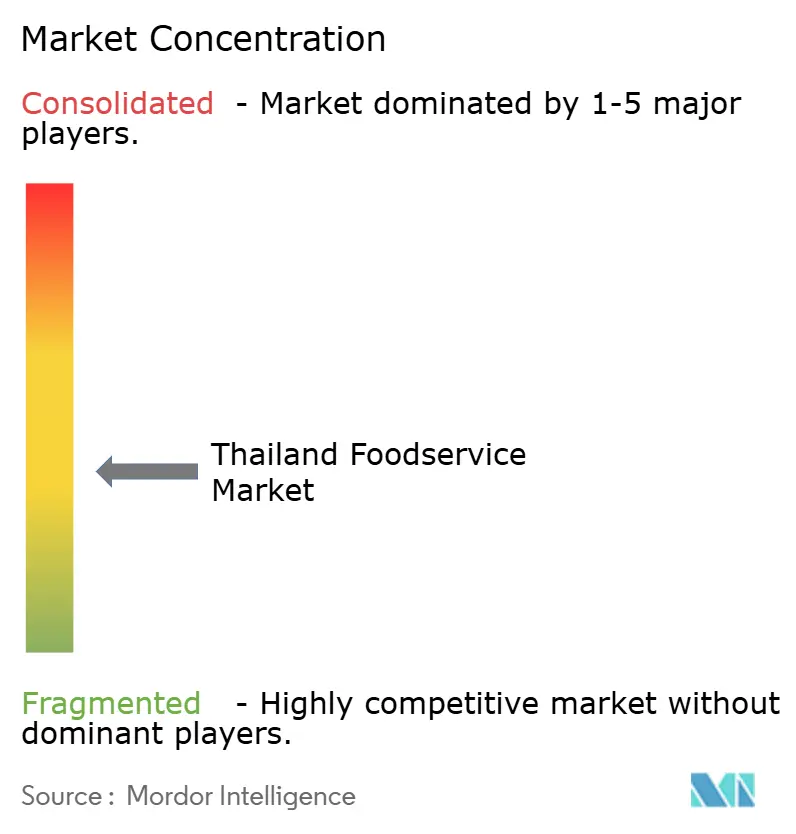
| Market Concentration | Medium |
Major Players *Disclaimer: Major Players sorted in no particular order Image © Mordor Intelligence. Reuse requires attribution under CC BY 4.0. | |
Thailand Foodservice Market Analysis by Mordor Intelligence
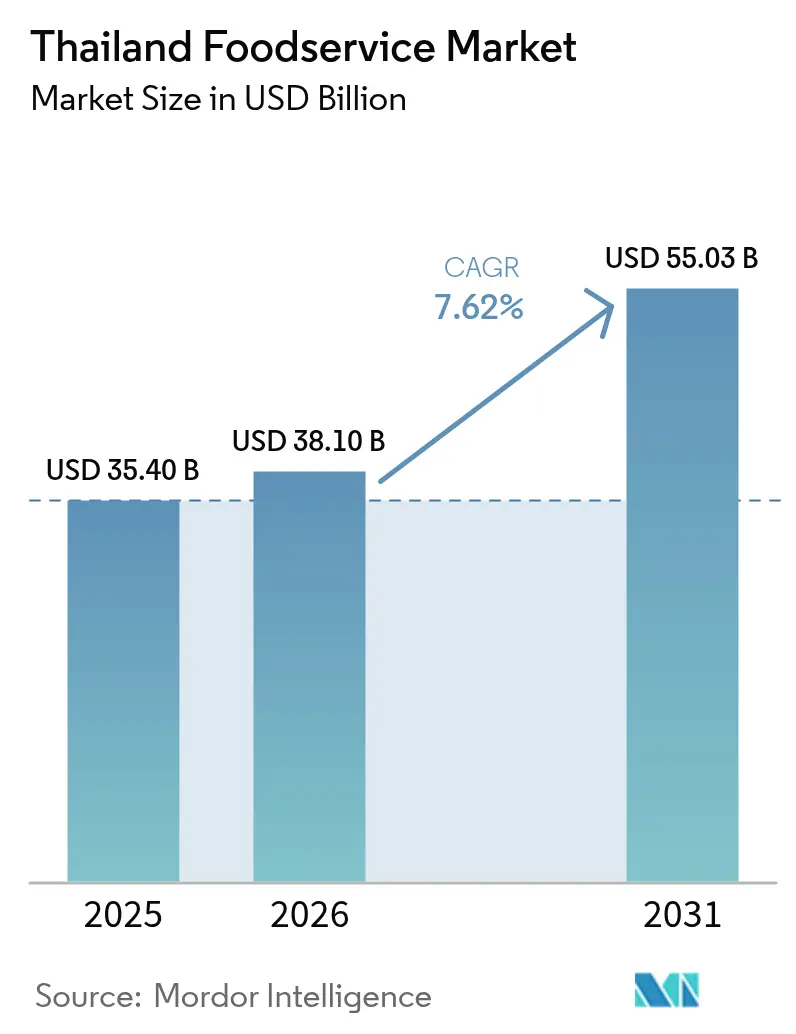
The Thailand foodservice market size is expected to grow from USD 35.4 billion in 2025 to USD 38.1 billion in 2026 and is forecast to reach USD 55.03 billion by 2031 at 7.62% CAGR over 2026-2031. The market growth is driven by tourism recovery, increased adoption of digital ordering platforms, and growing consumer demand for convenience. Cloud kitchens and delivery applications are enabling restaurants to expand their reach beyond traditional physical locations. The market benefits from Thailand's extensive retail network, high smartphone adoption rates, and a growing middle-class population seeking diverse dining options. Competition is increasing as international chains adapt their menus to local preferences, domestic companies enhance their omnichannel presence, and technology-focused businesses use data analytics to predict consumer behavior. However, growth varies across market segments, with rising costs and stricter food safety regulations affecting profit margins despite overall revenue growth.
Key Report Takeaways
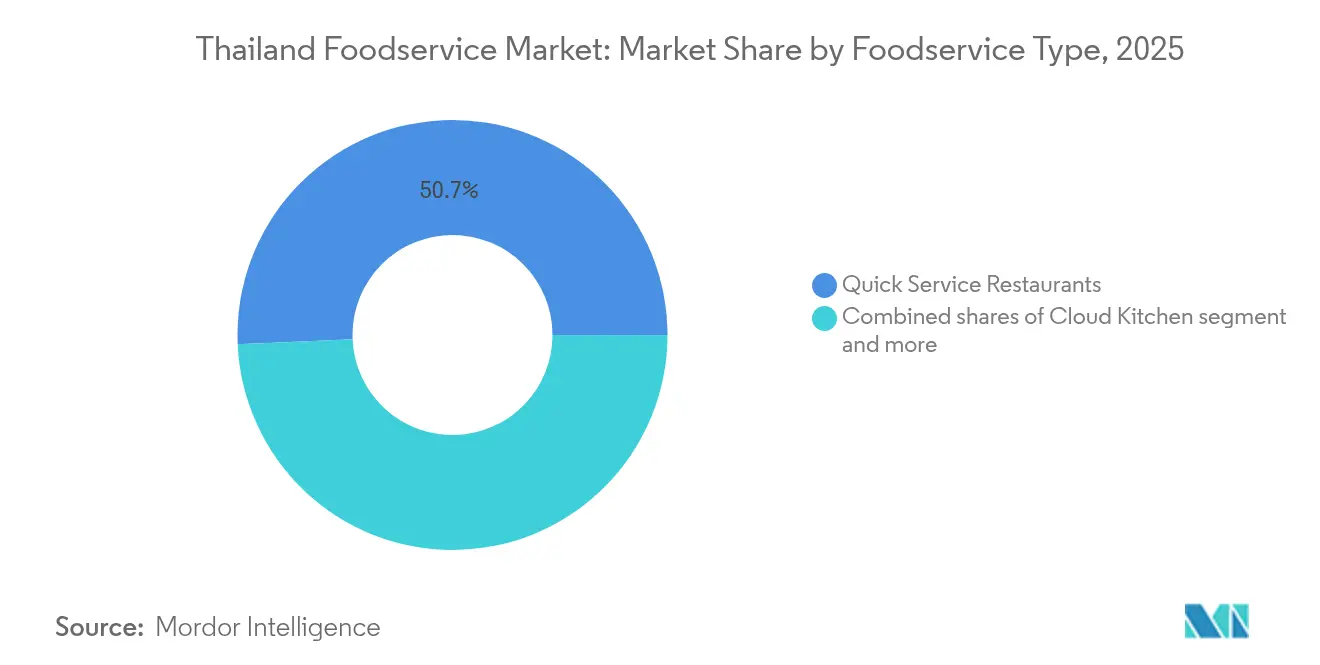
- By foodservice type, Quick Service Restaurants led with 50.68% of the Thailand foodservice market share in 2025, whereas Cloud Kitchens are projected to surge at a 25.08% CAGR through 2031.
- By outlet, independent operators commanded 73.78% of value in 2025, while chained outlets are expanding at an 8.02% CAGR to 2031.
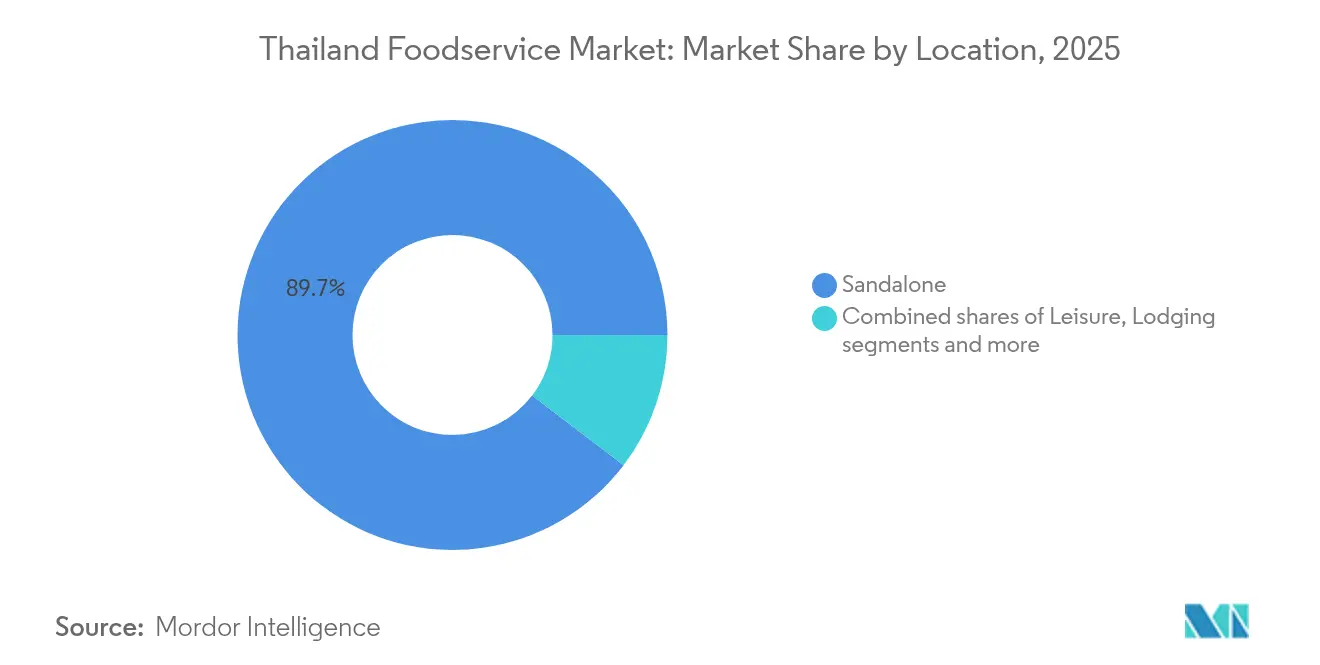
- By location, standalone venues held 89.65% share in 2025; travel-oriented sites are forecast to record the fastest 10.86% CAGR over the same period.
- By service type, dine-in represented 67.54% revenue in 2025, yet delivery is advancing at an 10.88% CAGR to 2031.
Note: Market size and forecast figures in this report are generated using Mordor Intelligence’s proprietary estimation framework, updated with the latest available data and insights as of 2026.
Market Trends and Insights
Drivers Impact Analysis of Thailand Foodservice Market*
| Driver | (~) % Impact on CAGR Forecast | Geographic Relevance | Impact Timeline |
|---|---|---|---|
| Surging demand for convenience and ready-to-eat | +2.1% | Global, with Bangkok and major urban centers leading adoption | Short term (≤ 2 years) |
| Expansion of international/QSR and specialty restaurant brands | +1.8% | National, concentrated in Bangkok, Phuket, Chiang Mai | Medium term (2-4 years) |
| Emergence of plant-based and flexitarian food trends | +1.2% | Urban centers, expanding to secondary cities | Medium term (2-4 years) |
| Rise of food truck, pop-up, and alternative dining models | +0.9% | Bangkok core, spillover to tourist destinations | Short term (≤ 2 years) |
| Strong café and coffee culture—expanding beyond metropolitan areas | +1.1% | National, with rapid provincial expansion | Long term (≥ 4 years) |
| Proliferation of high-quality bakery and dessert brands | +0.6% | Urban centers with premium consumer segments | Medium term (2-4 years) |
| Source: Mordor Intelligence | |||
Surging Demand for Convenience and Ready-to-Eat
Thailand's rapid urbanization and evolving lifestyle patterns have fundamentally transformed how consumers approach their daily meals, with a clear preference for convenient dining solutions. The ready-to-eat segment has experienced remarkable growth, particularly in cloud kitchens, which have emerged as the fastest-growing foodservice category at CAGR through 2030. This transformation directly responds to the demanding schedules of urban professionals and demonstrates how food delivery has become an essential part of daily dining habits. The convenience trend has expanded beyond delivery services to encompass grab-and-go options at convenience stores, where CP All's extensive 7-Eleven network functions as an integral distribution channel for ready-to-eat meals, effectively leveraging Thailand's comprehensive retail infrastructure to adapt to modern consumer behavior.
Emergence of Plant-Based and Flexitarian Food Trends
Thailand's plant-based food market has expanded beyond traditional Buddhist vegetarian offerings to include modern plant-based alternatives. The market growth is driven by health-conscious consumers and environmental sustainability advocates. Urban millennials and Gen Z consumers are shifting their dietary preferences toward wellness and ethical consumption. International companies, including Impossible Foods and Beyond Meat, have formed distribution partnerships with Thai retailers and restaurants. Local manufacturers are developing plant-based alternatives using regional ingredients such as jackfruit, mushrooms, and soy protein. Government health initiatives supporting reduced meat consumption and increased vegetable intake have created favorable regulatory conditions, accelerating adoption across foodservice segments.
Rise of Food Truck, Pop-Up, and Alternative Dining Models
Thailand's alternative dining landscape has evolved dramatically, with food trucks and pop-up restaurants gaining legitimacy as viable business models rather than temporary solutions. Bangkok's food truck regulations were streamlined in 2024, allowing operators to secure permits for designated areas including business districts, universities, and event venues, creating new opportunities for culinary entrepreneurs with limited capital. Pop-up dining concepts are leveraging social media marketing to create exclusive experiences that generate buzz and test market demand before committing to permanent locations. These alternative models appeal to younger consumers seeking unique experiences and Instagram-worthy content, while offering established chefs opportunities to experiment with new concepts without traditional restaurant overhead costs.
Strong Café and Coffee Culture—Expanding Beyond Metropolitan Areas
Thailand's specialty coffee market has experienced significant growth, extending its presence beyond the bustling streets of Bangkok into prominent cities like Chiang Mai, Phuket, and Khon Kaen. This expansion is primarily driven by consumers' increasing purchasing power and their shift toward more sophisticated lifestyle choices. The specialty coffee segment has established its distinct identity through transparent bean sourcing practices, implementation of various brewing techniques, and meticulous preparation methods, which enables businesses to command premium prices while offering experiences distinctly different from traditional Thai coffee establishments. Thai roasters have strategically developed direct partnerships with coffee farmers in the northern provinces, resulting in streamlined supply chains that optimize costs while providing substantial support to local agricultural communities. The expansion of coffee shops complements Thailand's robust tourism infrastructure, effectively serving both international visitors who are well-versed in specialty coffee consumption and local Thai consumers who are gradually developing more refined coffee preferences through their exposure to global coffee culture.
Restraints Impact Analysis of Thailand Foodservice Market*
| Restraint | (~) % Impact on CAGR Forecast | Geographic Relevance | Impact Timeline |
|---|---|---|---|
| Rising costs of imported ingredients and packaging materials | -1.4% | National, with higher impact on international cuisine restaurants | Short term (≤ 2 years) |
| Stringent government food safety and labeling regulations | -0.8% | National, with compliance costs affecting smaller operators | Medium term (2-4 years) |
| Supply chain vulnerability to climate/weather shocks | -0.6% | National, with agricultural regions most affected | Long term (≥ 4 years) |
| Fragmented supplier landscape and distribution inefficiencies | -0.5% | Provincial areas and secondary cities primarily | Medium term (2-4 years) |
| Source: Mordor Intelligence | |||
Rising Costs of Imported Ingredients and Packaging Materials
Thailand's foodservice sector faces significant margin pressure from rising import costs, particularly affecting international cuisine restaurants and premium dining establishments. Ingredient cost inflation has reached double digits in 2024, with imported proteins, dairy products, and specialty ingredients experiencing the highest increases due to global supply chain disruptions and currency fluctuations [1]. The growth in food delivery has driven up packaging material costs, while sustainable packaging requirements add further expenses. Restaurants are implementing menu engineering, portion optimization, and supplier diversification strategies, though these measures often lead to reduced profit margins or increased consumer prices. The Thai Food and Drug Administration's import regulations require extensive documentation and testing for food ingredients, creating additional compliance costs that particularly affect smaller operators who lack economies of scale in procurement.
Stringent Government Food Safety and Labeling Regulations
Thailand's Food and Drug Administration is implementing comprehensive food safety standards and detailed labeling requirements in 2024. The expansion of Hazard Analysis Critical Control Point (HACCP) certification requirements to smaller establishments has created significant financial pressure on independent restaurant owners, who must allocate substantial resources for compliance, while established chain restaurants benefit from their pre-existing quality management infrastructure [2]. Chain restaurants are now required to make considerable investments in professional menu analysis and sophisticated display systems to meet nutritional labeling mandates, though these changes have positively impacted consumer confidence in food quality. The regulatory landscape presents particular challenges for cloud kitchens and delivery-only businesses, which must navigate intricate licensing processes across various local jurisdictions while ensuring strict food safety compliance without traditional restaurant facilities. These complex regulatory requirements have created an operating environment that naturally advantages established foodservice businesses that possess both the regulatory knowledge and financial resources needed for full compliance.
*Our forecasts treat driver/restraint impacts as directional, not additive. The impact forecasts reflect baseline growth, mix effects, and variable interactions.
Thailand Foodservice Market Segment Analysis
By Foodservice Type:
Cloud Kitchens Drive Digital TransformationQuick Service Restaurants maintain their market dominance with a substantial 50.68% share in 2025, reflecting the strong consumer preference in Thailand for cost-effective and accessible dining solutions. This segment's success stems from its ability to meet the demands of urban professionals and families who require efficient meal options in their daily routines. Full Service Restaurants have demonstrated resilience by maintaining their core dine-in operations while strategically expanding into takeaway and delivery services to meet evolving consumer needs.
Cloud Kitchens are experiencing remarkable growth at a 25.08% CAGR through 2031, driven by widespread adoption of digital ordering platforms and changing consumer behavior patterns in food delivery services. The café and bar segment continues to flourish as Thailand's coffee culture matures, particularly with the expansion of specialty coffee establishments. This growth extends beyond the capital, with notable development in key tourist and commercial centers like Chiang Mai and Phuket, where both local and international consumers drive demand for premium coffee experiences and nightlife entertainment.

By Outlet:
Independent Operators Maintain Dominance Despite Chain ExpansionThe Thai foodservice landscape remains firmly in the hands of independent operators, who control 73.78% of the market in 2025. This dominance stems from Thailand's deeply rooted entrepreneurial dining culture and the country's diverse regional cuisine preferences. Independent establishments have successfully maintained their market position by leveraging their operational advantages, including reduced overhead costs, the ability to adapt menus quickly to local tastes, and well-established community relationships that foster customer loyalty.
While independent restaurants continue to lead the market, chained outlets are experiencing significant growth at 8.02% CAGR. These chains are capitalizing on their substantial financial resources, implementing efficient standardized operations, and building strong brand recognition that resonates particularly well with younger demographics and tourism segments seeking reliable dining experiences. The independent sector, however, faces mounting challenges from escalating operational costs and increasingly complex regulatory compliance requirements that naturally favor larger operators with economies of scale. In response to these pressures, independent restaurant owners are adopting collaborative approaches, forming informal networks and purchasing cooperatives to enhance their competitive position while maintaining their unique market identities.
By Locations:
Travel Venues Capitalize on Tourism RecoveryStandalone locations dominate Thailand's foodservice landscape, commanding 89.65% of the market share in 2025. This significant market presence reflects the country's deeply rooted neighborhood-based dining culture, where establishments ranging from street food vendors to local restaurants serve as essential community fixtures. These independent venues continue to form the foundation of Thailand's foodservice market, offering authentic culinary experiences and maintaining strong connections with local patrons.
Travel-related venues demonstrate remarkable growth potential with an 10.86% CAGR, capitalizing on Thailand's robust tourism recovery that brought 28.1 million international visitors in 2024, with expectations of reaching 35 million visitors by 2025 . Meanwhile, foodservice locations integrated within retail spaces, such as shopping malls and department stores, are undergoing strategic transformations. These establishments are responding to evolving consumer preferences by introducing innovative experiential dining concepts and developing food courts that serve as vibrant social hubs, enhancing the overall shopping and dining experience for customers.
By Service Type:
Delivery Accelerates Digital AdoptionDine-in services dominate the market with a 67.54% share in 2025, demonstrating that consumers continue to value the irreplaceable aspects of restaurant dining. This segment, which includes both casual and fine dining establishments, benefits from customers who seek personal connections, professional service, and carefully curated environments. The combination of culinary expertise, hospitality, and social engagement creates an experience that resonates with diners who appreciate the traditional restaurant atmosphere.
The delivery segment shows robust growth at an 10.88% CAGR, driven by technological advancements in ordering platforms and an expanding network of restaurant partnerships. This growth reflects the permanent shift in consumer behavior that originated during the pandemic. Meanwhile, takeaway services occupy a strategic position between dine-in and delivery options, offering cost-effective convenience without sacrificing personal interaction between restaurants and customers. The restaurant industry's technology integration now enables seamless experiences across all service types, with features such as digital ordering, table booking systems, and interactive menus enhancing the overall dining experience.
Geography Analysis
Thailand's foodservice market reflects a complex tapestry of regional differences, each shaped by its unique mix of tourism, economic growth, and cultural preferences. Bangkok stands at the forefront, commanding the highest market value thanks to its wealthy consumer base and strong international business presence. The capital's sophisticated diners have made it the natural testing ground for new restaurant concepts and international brands looking to establish themselves before expanding nationwide.
Beyond Bangkok, cities like Chiang Mai, Phuket, and Pattaya have developed their own distinct market characteristics, balancing the needs of both local residents and tourists. Provincial markets are now experiencing their own growth story as economic prosperity spreads beyond urban centers. These areas typically embrace local cuisine and value-focused dining options, though international brands are steadily making inroads as middle-class consumers emerge. The government's Eastern Economic Corridor initiative has opened new opportunities in Rayong, Chonburi, and Chachoengsao, where industrial development is creating fresh demand for diverse dining options. Each region of Thailand maintains its unique culinary identity, from the coffee culture of the north to the seafood-centric south and the distinctive Isaan cuisine of the northeast. The impact of tourism recovery varies significantly across regions - while island destinations see their restaurant revenues surge with returning international visitors, border provinces continue to face headwinds from reduced cross-border activity. Digital food delivery has found its strongest foothold in urban areas, while rural regions still prefer traditional dining and takeaway options. This diverse landscape requires restaurant operators to carefully balance local market needs with operational efficiency, adapting their strategies to suit each region's unique characteristics while maintaining consistent service standards.
Competitive Landscape
Thailand's foodservice market shows moderate concentration, with established local conglomerates competing alongside international brands and digital-native operators. The market's fragmented nature creates opportunities for companies to expand market share through acquisitions, operational improvements, and new format development. Major companies like CP All, Minor International, and Thai Beverage operate across multiple foodservice segments, from convenience store food to premium restaurants, benefiting from economies of scale and integrated operations.
Companies are increasingly developing omnichannel capabilities, with traditional restaurants expanding their delivery infrastructure and digital ordering systems to compete with cloud kitchen operators. Technology implementation has become a key differentiator, as companies adopt AI-based demand forecasting, automated kitchen equipment, and integrated point-of-sale systems to improve operations and customer service. Growth opportunities exist in premium casual dining, healthy fast food, and experiential dining formats that combine food with entertainment or education.
New market entrants include delivery-only brands using data analytics to optimize menus and ghost kitchen operators that can expand successful concepts across markets without traditional restaurant locations. Line Man Wongnai's planned IPO in 2025 and new research and development center in South Korea highlight how Thai companies are investing in technology and international growth to compete with global platforms.
Thailand Foodservice Industry Leaders
-
Central Plaza Hotel PCL
-
CP All PCL
-
Yum! Brands Inc.
-
Maxim’s Caterers Ltd.
-
McThai Co. Ltd.
- *Disclaimer: Major Players sorted in no particular order
Thailand Foodservice Market Companies Covered in this Report
- Central Plaza Hotel PCL
- CP All PCL
- Yum! Brands Inc.
- Maxim’s Caterers Ltd.
- McThai Co. Ltd.
- Minor International PCL
- MK Restaurant Group PCL
- Panthera Group Co. Ltd.
- Food Capitals PCL
- PTT Oil & Retail Business PCL
- Thai Beverage PCL
- Global Franchise Architects Co.
- Zen Corporation Group PCL
- Starbucks Coffee
- Black Canyon (Thailand)
- S&P Syndicate PCL
- Oishi Group PCL
- AU Bon Pain (Thailand)
- The Pizza Company
- After You Dessert Café PCL
Recent Industry Developments in Thailand Foodservice Market
- May 2025: Robinhood and foodpanda agreed to a strategic transition in Thailand, with foodpanda ceasing operations and Robinhood absorbing its customer, restaurant, and rider network. The move aims to expand Robinhood’s reach, ensuring continuity and community support, while prioritizing service quality, fairness, and digital innovation for sustained growth.
- March 2025: McDonald’s announced plans to open 20 new outlets in Thailand in 2025, aiming to strengthen its national footprint, enhance customer convenience, and meet rising demand through expanded coverage in key metropolitan and provincial locations.
- July 2024: AQUA Corporation has acquired a 204-outlet restaurant network in partnership with Food Factors and PDS Holding, taking a 51% stake. The move diversifies AQUA’s revenue, targets over 1.7 billion baht annual sales, and strengthens its market position for long-term stability and growth in Thailand’s foodservice industry.
Thailand Foodservice Market Report Scope
Segmentation Overview
By Foodservice Type
| Café and Bars | By Cuisine | Bars and Pubs |
| Café | ||
| Juice/Smoothie/Desserts Bars | ||
| Specialist Coffee and Tea Shops | ||
| Cloud Kitchen | ||
| Full Service Restaurants | By Cuisine | Asian |
| European | ||
| Latin American | ||
| Middle Eastern | ||
| North American | ||
| Other FSR Cuisines | ||
| Quick Service Restaurants | By Cuisine | Bakeries |
| Burger | ||
| Ice Cream | ||
| Meat-based Cuisines | ||
| Pizza | ||
| Other QSR Cuisines |
By Outlet
| Chained Outlets |
| Independent Outlets |
By Locations
| Leisure |
| Lodging |
| Retail |
| Sandalone |
| Travel |
By Service Type
| Dine-in |
| Takeaway |
| Delivery |
| By Foodservice Type | Café and Bars | By Cuisine | Bars and Pubs |
| Café | |||
| Juice/Smoothie/Desserts Bars | |||
| Specialist Coffee and Tea Shops | |||
| Cloud Kitchen | |||
| Full Service Restaurants | By Cuisine | Asian | |
| European | |||
| Latin American | |||
| Middle Eastern | |||
| North American | |||
| Other FSR Cuisines | |||
| Quick Service Restaurants | By Cuisine | Bakeries | |
| Burger | |||
| Ice Cream | |||
| Meat-based Cuisines | |||
| Pizza | |||
| Other QSR Cuisines | |||
| By Outlet | Chained Outlets | ||
| Independent Outlets | |||
| By Locations | Leisure | ||
| Lodging | |||
| Retail | |||
| Sandalone | |||
| Travel | |||
| By Service Type | Dine-in | ||
| Takeaway | |||
| Delivery | |||
Market Definition
- FULL-SERVICE RESTAURANTS - A foodservice establishment where customers are seated at a table, give their order to a server and are served food at a table.
- QUICK SERVICE RESTAURANTS - A foodservice establishment that provides customers convenience, speed, and food offerings at lower prices. Customers usually help themselves and carry their own food to their tables.
- CAFES & BARS - A type of foodservice business that include bars and pubs that are licensed to serve alcoholic drinks for consumption, cafes that serve refreshments and light food items, as well as specialty tea and coffee shops, dessert bars, smoothie bars, and juice bars.
- CLOUD KITCHEN - A foodservice business that utilizes a commercial kitchen for the purpose of preparing food for delivery or takeout only, with no dine-in customers.
| Keyword | Definition |
|---|---|
| Albacore Tuna | It is one of the smallest species of tuna found in the six distinct stocks known globally in the Atlantic, Pacific, and Indian oceans, as well as the Mediterranean Sea. |
| Angus beef | It is beef derived from a specific breed of cattle indigenous to Scotland. It requires certification from the American Angus Association to receive the "Certified Angus Beef" quality mark. |
| Asian cuisine | It includes full-service offerings in restaurants that serve cuisines from cultures such as Chinese, Indian, Korean, Japanese, Bengali, Southeast Asian, etc. |
| Average Order Value | It is the average value of all orders made by the customers at a foodservice establishment. |
| Bacon | It is salted or smoked meat that comes from the back or sides of a pig. |
| Bars & Pubs | It is a drinking establishment that is licensed to serve alcoholic drinks for consumption on the premises. |
| Black Angus | It is beef derived from a black-hided breed of cows that don't have horns. |
| BRC | British Retail Consortium |
| Burger | It is a sandwich consisting of one or more cooked beef patties, placed inside a sliced bread roll or bun roll. |
| Café | It is a foodservice establishment serving various refreshments (mainly coffee) and light meals. |
| Cafes & Bars | It is a type of foodservice business that include bars and pubs that are licensed to serve alcoholic drinks for consumption, cafes that serve refreshments and light food items, as well as specialty tea and coffee shops, dessert bars, smoothie bars, and juice bars. |
| Cappuccino | It is an Italian coffee drink that is traditionally prepared with equal parts double espresso, steamed milk, and steamed milk foam. |
| CFIA | Canadian Food Inspection Agency |
| Chained Outlet | It refers to a foodservice establishment that shares brands, operates in several locations, has central management, and standardized business practices. |
| Chicken Tender | It refers to chicken meat prepared from the pectoralis minor muscles of a chicken bird. |
| Cloud Kitchen | It is a foodservice business that utilizes a commercial kitchen for the purpose of preparing food for delivery or takeout only, with no dine-in customers. |
| Cocktail | It is an alcoholic mixed drink made with either a single spirit or a combination of spirits, mixed with other ingredients such as juices, flavored syrups, tonic water, shrubs, and bitters. |
| Edamame | It is a Japanese dish prepared with soybeans (harvested before they ripen or harden) and cooked in its pod. |
| EFSA | European Food Safety Authority |
| ERS | Economic Research Service of the USDA |
| Espresso | It is a concentrated form of coffee, served in shots. |
| European cuisine | It includes full-service offerings in restaurants that serve cuisines from cultures such as Italian, French, German, English, Dutch, Danish, etc. |
| FDA | Food and Drug Administration |
| Fillet Mignon | It is a cut of meat taken from the smaller end of the tenderloin. |
| Flank Steak | It is a cut of beef steak taken from the flank, which lies forward of the rear quarter of a cow. |
| Foodservice | It refers to the part of the food industry which includes businesses, institutions, and companies which prepare meals outside the home. It includes restaurants, school and hospital cafeterias, catering operations, and many other formats. |
| Franks | Also known as frankfurter or Würstchen, it is a type of highly seasoned smoked sausage popular in Austria and Germany. |
| FSANZ | Food Standards Australia New Zealand |
| FSIS | Food Safety and Inspection Service |
| FSSAI | Food Safety and Standards Authority of India |
| Full service restaurant | It refers to a foodservice establishment where customers are seated at a table, give their order to a server, and are served food at a table. |
| Ghost Kitchen | It refers to a cloud kitchen. |
| GLA | Gross Leasable Area |
| Gluten | It is a family of proteins found in grains, including wheat, rye, spelt, and barley. |
| Grain-fed beef | It is beef derived from cattle that have been fed a diet supplemented with soy and corn and other additives. Grain-fed cows can also be given antibiotics and growth hormones to fatten them up more quickly. |
| Grass-fed beef | It is beef derived from cattle that have only been fed grass as feed. |
| Ham | It refers to the pork meat taken from the leg of a pig. |
| HoReCa | Hotels, Restaurants and Cafes |
| Independent Outlet | It refers to a foodservice establishment that operates with a single outlet or is structured as a small chain with no more than three locations. |
| Juice | It is a drink made from the extraction or pressing of the natural liquid contained in fruit and vegetables. |
| Latin American | It includes full-service offerings in restaurants that serve cuisines from cultures such as Mexican, Brazilian, Argentinian, Colombian, etc. |
| Latte | It is a milk-based coffee that is made up of one or two shots of espresso, steamed milk, and a thin layer of frothed milk. |
| Leisure | It refers to foodservice offered as a part of a recreation business, such as sports arenas, zoos, movie theaters, and museums. |
| Lodging | It refers to foodservice offerings at hotels, motels, guesthouses, holiday homes, etc. |
| Macchiato | It is an espresso coffee drink with a small amount of milk, usually foamed. |
| Meat-based cuisines | This inlcudes food items like fried chicken, steak, ribs, etc. where meat is the primary ingredient for the dish. |
| Middle Eastern cuisine | It includes full-service offerings in restaurants that serve cuisines from cultures such as Arabic, Lebanese, Iranian, Israeli, etc. |
| Mocktail | It is an non-alcoholic mixed drink. |
| Mortadella | It is a large Italian sausage or luncheon meat made of finely hashed or ground heat-cured pork, which incorporates at least 15% small cubes of pork fat. |
| North American | It includes full-service offerings in restaurants that serve cuisines from cultures such as American, Canadian, Caribbean, etc. |
| Pastrami | It refers to a highly seasoned smoked beef, typically served in thin slices. |
| PDO | Protected Designation of Origin: It is the name of a geographical region or specific area that is recognized by official rules to produce certain foods with special characteristics related to location. |
| Pepperoni | It is an American variety of spicy salami made from cured meat. |
| Pizza | It is a dish made typically of flattened bread dough spread with a savory mixture usually including tomatoes and cheese and often other toppings and baked. |
| Primal cuts | It refers to the major sections of the carcass. |
| Quick service restaurant | It refers to a foodservice establishment that provides customers convenience, speed, and food offerings at lower prices. Customers usually help themselves and carry their own food to their tables. |
| Retail | It refers to a foodservice outlet inside a mall. shopping complex or a commercial real estate building, where there are other businesses operating as well. |
| Salami | It is a cured sausage consisting of fermented and air-dried meat. |
| Saturated fat | It is a type of fat in which the fatty acid chains have all single bonds. It is generally considered unhealthy. |
| Sausage | It is a meat product made of finely chopped and seasoned meat, which may be fresh, smoked, or pickled and which is then usually stuffed into a casing. |
| Scallop | It is an edible shellfish that is a mollusk with a ribbed shell in two parts. |
| Seitan | It is a plant-based meat substitute made out of wheat gluten. |
| Self-service kiosk | It refers to a self-order point-of-sale (POS) system through which customers place and pay for their own orders at kiosks, enabling totally contactless and frictionless service. |
| Smoothie | It is a beverage made by placing all the ingredients in a container and processing them together, without removing the pulp. |
| Specialty coffee & tea shops | It refers to a foodservice establishment that serves only various types of tea or coffee. |
| Standalone | It refers to a restaurants that have an independent infrastructure setup and not connected to any other business. |
| Sushi | It is a Japanese dish of prepared vinegared rice, usually with some sugar and salt, accompanied by a variety of ingredients, such as seafood—often raw—and vegetables. |
| Travel | It refers to foodservice offerings such as airplane food, dining on long-distance trains, and foodservice on cruise ships. |
| Virtual Kitchen | It refers to a cloud kitchen. |
| Wagyu Beef | It is beef derived from any of four strains of a breed of black or red Japanese cattle that are valued for their highly marbled meat. |
Research Methodology
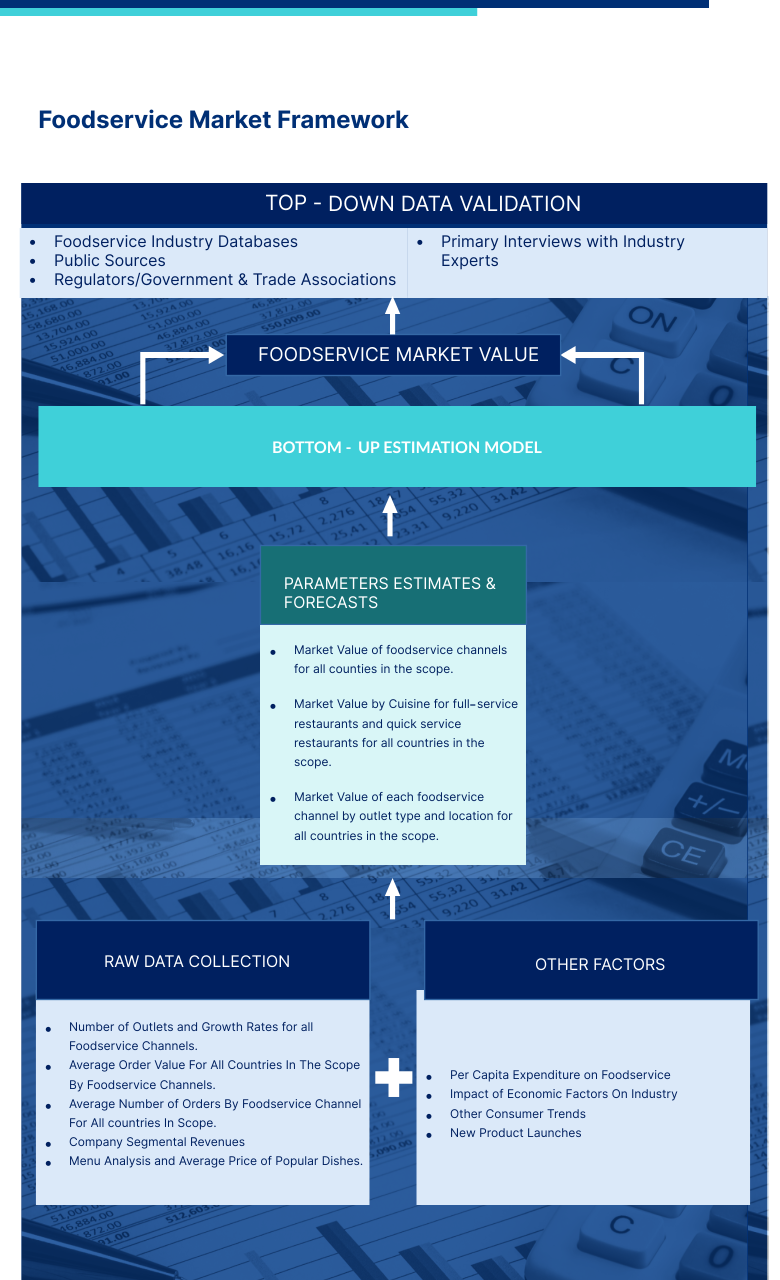
Mordor Intelligence follows a four-step methodology in all our reports.
- Step-1: Identify Key Variables: In order to build a robust forecasting methodology, the variables and factors identified in Step 1 are tested against available historical market numbers. Through an iterative process, the variables required for the market forecast are set, and the model is built on the basis of these variables.
- Step-2: Build a Market Model: Market size estimations for the forecast years are in nominal terms. Inflation is considered for average order value, and it is forecasted as per predicted inflation rates in the countries.
- Step-3: Validate and Finalize: In this important step, all market numbers, variables, and analyst calls are validated through an extensive network of primary research experts from the market studied. The respondents are selected across levels and functions to generate a holistic picture of the market studied.
- Step-4: Research Outputs: Syndicated Reports, Custom Consulting Assignments, Databases & Subscription Platforms