
Market Overview
| Study Period | 2021 - 2032 |
|---|---|
| Forecast Data Period | 2027 - 2032 |
| Base Year Market Size (2026) | USD 163.95 Million |
| Market Size (2027) | USD 170.12 Million |
| Market Size (2032) | USD 204.63 Million |
| Growth Rate (2027 - 2032) | 3.76 % |
| Market Concentration | Medium |
Major Players *Disclaimer: Major Players sorted in no particular order Image © Mordor Intelligence. Reuse requires attribution under CC BY 4.0. | |
Thailand Diabetes Drugs Market Analysis by Mordor Intelligence
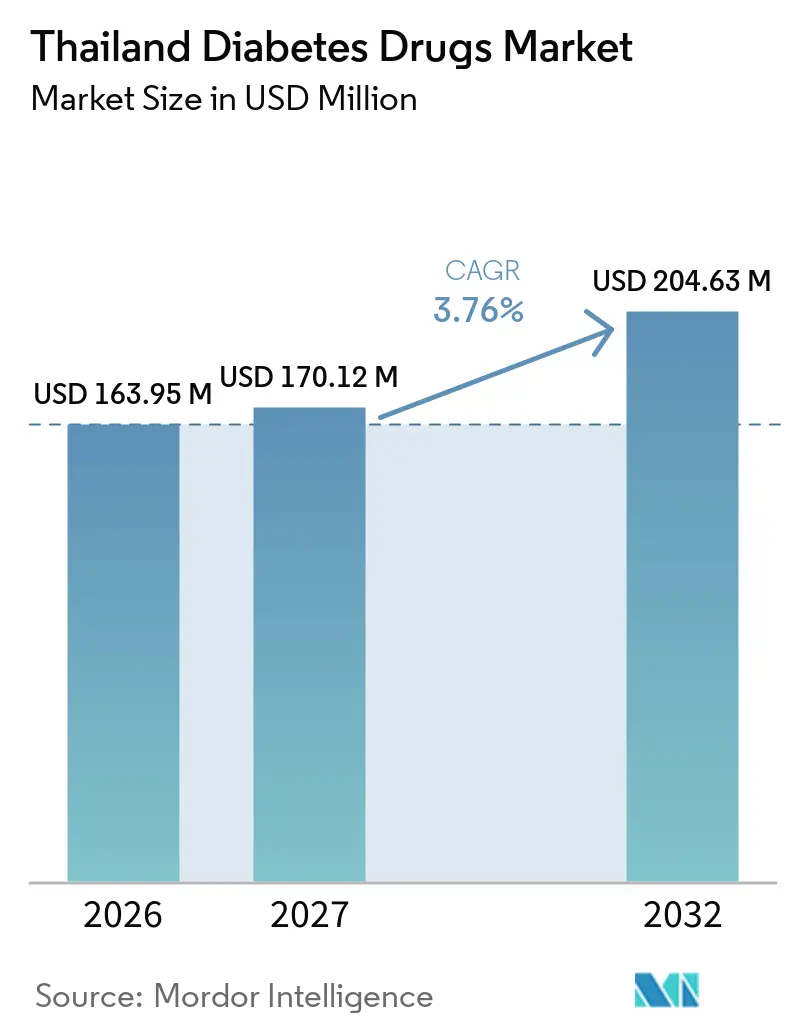
The Thailand Diabetes Drugs Market is expected to grow from USD 163.95 million in 2026 to USD 170.12 million in 2027 to reach USD 204.63 million by 2032, at a CAGR of 3.76% during the forecast period (2027-2032).
The healthcare system was significantly disturbed and pressured during each phase of rapid COVID-19 infection. Several countries, notably the Thai government, introduced home isolation or a home quarantine program to avert healthcare collapse and to ameliorate inadequate healthcare resources. Between July 2021 and October 2021, COVID-19 illness cases in Thailand increased to around 20,000-25,000 cases per day, posing difficulty in treating COVID-19 infection in hospitals. Previous research revealed the viability of a COVID-19 home monitoring program employing telemedicine to reduce the gap in treatment during a healthcare worker shortage in multiple countries. These programs monitored the intensity of symptoms and informed patients to seek additional treatment if necessary.
During COVID-19, there was a shortage of hospital capacity, and a home isolation system was set up. Thailand's government introduced diabetes self-management education and support (DSMES, glycemic management via telemedicine, and outcomes in home-isolated patients with COVID-19 infection. In August 2022, The National Research Council of Thailand (NRCT) introduced a breathalyzer prototype that can detect those infected with COVID-19 with 97% accuracy.
In terms of medicines, the insulin category commands a sizable market share. Over 100 million people worldwide use insulin, including all persons with Type 1 diabetes and 10% to 25% of people with Type 2 diabetes. Insulin production is extremely sophisticated, and only a few manufacturers are on the market. As a result, there is fierce rivalry among these producers, who continually strive to satisfy patients' demands by providing the highest-quality insulin.
Note: Market numbers in this report are based on Mordor Intelligence's proprietary estimation framework, which combines nine months of actuals with Q4 projections for base year 2026.
Thailand Diabetes Drugs Market Trends and Insights
Oral-Anti Diabetes Drugs Segment is Having the Highest Market Share in Current Year
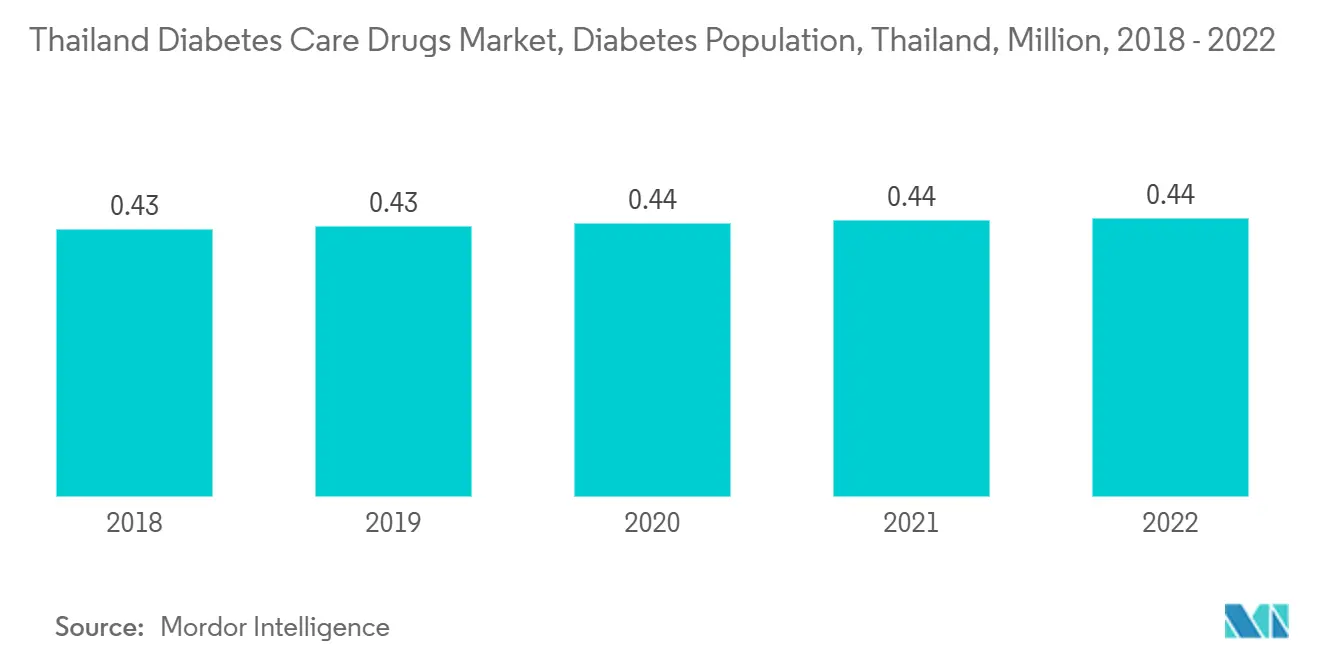
The Oral-Anti Diabetes Drugs segment is expected to increase with a CAGR of over 5 % during the forecast period, mainly due to the demand from the Type-1 diabetes population, which was more than 0.4 million by the end 2022.
Thailand's government, during COVID-19, provided medical supplies, including glucometers, blood glucose test strips, lancets, and urine test strips that were donated or purchased using donated funds. The supplies were stocked at a central location and distributed by volunteers, utilizing same-day commercial delivery services. Disposable prefilled insulin pens, both long-acting and short-acting analogs, were chosen instead of insulin vials to reduce administration errors, particularly in insulin-naïve patients. Insulin pens were kept at a medical clinic and distributed in a temperature-controlled container by a same-day delivery service.
The oral anti-diabetes drugs segment is also benefiting from the continued launch and expansion of novel therapies in Thailand. For instance, sodium-glucose cotransporter-2 (SGLT2) inhibitors and dipeptidyl peptidase-4 (DPP-4) inhibitors are increasingly being incorporated into diabetes treatment regimens due to their proven efficacy and favorable safety profiles. The growing availability of branded and generic oral anti-diabetic drugs through hospital and retail pharmacy channels is enhancing patient access and supporting the segment's dominant market position.
Through Thailand's government encouragement, the usage of Management Devices increased over the forecast period.
Increasing Diabetes population in Thailand
The World Health Organization (WHO) estimates that in 2021, around 11% of the total health expenditure in Thailand is allocated to diabetes care, comparable to other countries in the region. By 2030, this figure is expected to grow by 41%, effectively doubling the societal burden of diabetes. In Thailand, around 4.8 million people have diabetes, and only 272 endocrinologists (or specialists) are available. In Thailand, three out of five people with diabetes who receive care do not achieve the recommended treatment targets.
Thus, the above factors are expected to drive the market growth over the forecast period.
Competitive Landscape
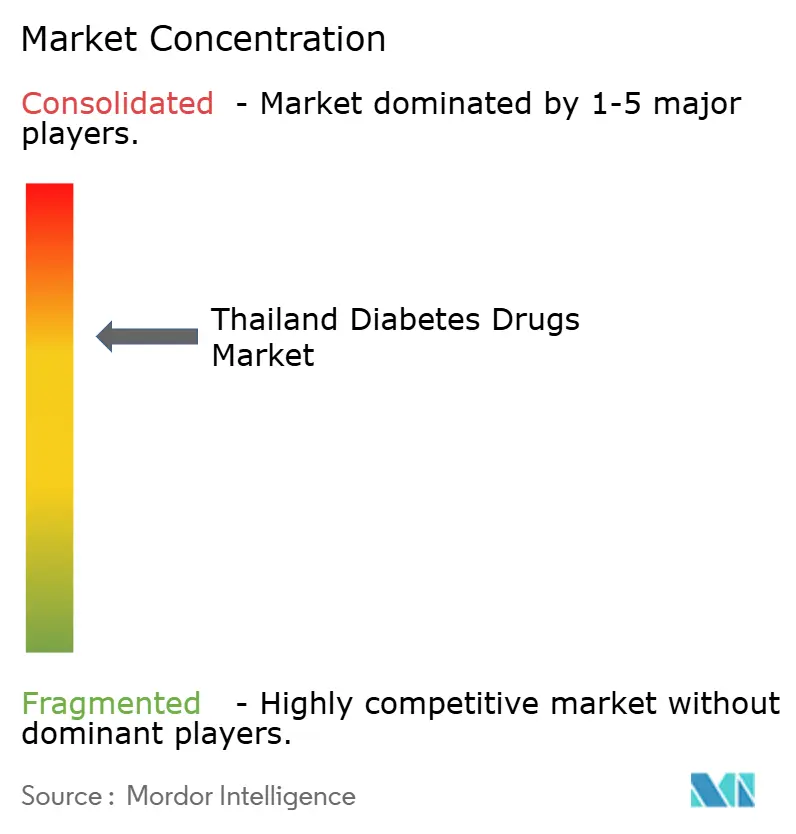
The Thailand diabetes drugs market is moderately consolidated, led by multinational players such as Novo Nordisk, Sanofi, Eli Lilly, AstraZeneca, and Boehringer Ingelheim in the insulin and innovative anti-diabetic drug segments. Competition is increasingly centered on advanced therapies, including SGLT-2 inhibitors and GLP-1 receptor agonists, while generic manufacturers maintain strong positions in conventional oral anti-diabetic drugs through competitive pricing and broad market access.
Thailand Diabetes Drugs Industry Leaders
-
Eli Lilly
-
Boehringer Ingelheim
-
Astrazeneca
-
Sanofi
-
NovoNordisk
- *Disclaimer: Major Players sorted in no particular order
Market Opportunities and Future Outlook
Thailand's diagnosed and treated diabetes population continues to expand the addressable market for anti-diabetic therapies. The International Diabetes Federation estimates adult diabetes prevalence reached 10.2% by 2024, with 6.36 million affected adults, while the report context points to limited specialist availability (272 endocrinologists) and ongoing gaps to recommended treatment targets, which leaves room for therapies and care models that improve titration and adherence.
Opportunities also show up in product mix, particularly as newer mechanisms and fixed-dose combinations gain traction to reduce pill burden and support earlier intensification. With incretin-based therapies building visibility in-country (including Novo Nordisk's Wegovy entry and Eli Lilly's Mounjaro introduction through Zuellig Pharma), and combination regimens supported by Thai FDA marketing authorization for CANALIA in 2026, demand-side momentum is building around multi-drug strategies. On the care delivery side, Thailand's COVID-era telemedicine and DSMES experience provides operational experience that can extend medication access and monitoring, including around injectable initiation, cold-chain handling, and follow-up beyond tertiary centers.
Recent Industry Developments
- June 2026: Mitsubishi Tanabe Pharma (Thailand) Co., Ltd. announced Thai FDA marketing authorization for CANALIA Tablets (teneligliptin + canagliflozin). The approval expands combination-therapy options for diabetes patients in Thailand. The development adds to Mitsubishi Tanabe's local metabolic disease portfolio and market footprint.
- May 2025: Zuellig Pharma/Eli Lilly launched Mounjaro (tirzepatide) for diabetes and obesity management in Thailand. The introduction marks the first in-market GLP-1/GIP dual agonist in the country. It broadens access to advanced metabolic therapy and connects obesity and diabetes management more directly in-country.
- May 2025: LG Chem launched Zemidapa (gemigliptin/dapagliflozin) for type 2 diabetes in Thailand. The fixed-dose combination therapy expands treatment options for patients in the Thai market. It increases competitive pressure on monotherapies and supports broader disease control strategies.
Research Methodology Framework and Report Scope
Market Definition and Coverage
This market covers prescription medicines used to manage diabetes in Thailand, captured in value terms based on drug sales into the healthcare channel for diabetes treatment and ongoing control.
Scope exclusions: Devices (for example glucose meters, strips, CGM, and pumps), diagnostics, and non-drug services are excluded from this market sizing.
Segmentation Overview
- Oral Anti-diabetic drugs
- Biguanides
- Metformin
- Alpha-Glucosidase Inhibitors
- Alpha-Glucosidase Inhibitors
- Dopamine D2 receptor agonist
- Bromocriptin
- SGLT-2 inhibitors
- Invokana (Canagliflozin)
- Jardiance (Empagliflozin)
- Farxiga/Forxiga (Dapagliflozin)
- Suglat (Ipragliflozin)
- DPP-4 inhibitors
- Onglyza (Saxagliptin)
- Tradjenta (Linagliptin)
- Vipidia/Nesina(Alogliptin)
- Galvus (Vildagliptin)
- Sulfonylureas
- Sulfonylureas
- Meglitinides
- Meglitinides
- Biguanides
- Insulins
- Basal or Long Acting Insulins
- Lantus (Insulin Glargine)
- Levemir (Insulin Detemir)
- Toujeo (Insulin Glargine)
- Tresiba (Insulin Degludec)
- Basaglar (Insulin Glargine)
- Bolus or Fast Acting Insulins
- NovoRapid/Novolog (Insulin Aspart)
- Humalog (Insulin Lispro)
- Apidra (Insulin Glulisine)
- Traditional Human Insulins
- Novolin/Actrapid/Insulatard
- Humulin
- Insuman
- Biosimilar Insulins
- Insulin Glargine Biosimilars
- Human Insulin Biosimilars
- Basal or Long Acting Insulins
- Combination drugs
- Insulin combinations
- NovoMix (Biphasic Insulin Aspart)
- Ryzodeg (Insulin Degludec and Insulin Aspart)
- Xultophy (Insulin Degludec and Liraglutide)
- Oral Combinations
- Janumet (Sitagliptin and Metformin)
- Insulin combinations
- Non-Insulin Injectable drugs
- GLP-1 receptor agonists
- Victoza (Liraglutide)
- Byetta (Exenatide)
- Bydureon (Exenatide)
- Trulicity (Dulaglutide)
- Lyxumia (Lixisenatide)
- Amylin Analogue
- Symlin (Pramlintide)
- GLP-1 receptor agonists
Data Sources, Market Sizing, and Validation
Desk Research
Desk work starts by grounding the demand pool in Thailand, and then narrowing it to drug-treated patients, which is later translated into value using price and mix. We use public health statistics and policy documents to understand treated prevalence, therapy pathways, and how coverage rules can shift volumes from one class to another.
For Thailand diabetes drugs, we typically refer to sources such as the World Health Organization, International Diabetes Federation, the Thai Ministry of Public Health, the National Health Security Office, and the World Bank for macro and health system indicators. We also use clinical guidance and peer-reviewed publications to interpret line of therapy and switching patterns, and then cross-check against company filings, investor presentations, reputable press, and regulatory updates where available. In a few places, a paid subscription for company financials and a patent database are used to clarify product lifecycle signals, while the final model still stays anchored to observable demand and pricing logic. The desk sources named here are illustrative only, and other documents were reviewed for data collection, validation, and clarification.
Primary Interviews and Surveys
Primary work focuses on how diabetes therapy is actually used and paid for in Thailand, because that is where desk sources often have gaps. We speak with a mix of hospital pharmacists, endocrinologists, procurement and reimbursement stakeholders, and distributor level participants to confirm class mix, price corridors, and the timing of major formulary or tender changes.
Because this is a single-country market, inputs are also checked across key care settings inside Thailand, including public hospitals, private hospitals, and retail pharmacy pathways, so the pricing and volume assumptions do not lean on one channel.
Distribution of primary research fieldwork respondents
| Company type | Respondent position |
|---|---|
| Top tier: 38% | CXOs: 12% |
| Mid tier: 45% | Functional/Unit leaders: 28% |
| Smaller Players: 17% | Managers: 60% |
Market-Sizing & Forecasting
Sizing is built using a top-down and bottom-up approach, where a treated patient pool is first constructed and then converted into value using therapy mix and pricing. On the top-down side, we rebuild demand from diabetes prevalence, the share diagnosed, the share treated with drugs, and then the split across insulin, oral therapies, non-insulin injectables, and fixed-dose combinations, which are then adjusted for channel mix between public and private care.
To keep totals realistic, selective bottom-up checks are used, such as sampled price per pack multiplied by expected annual packs per patient for common regimens, followed by a sense check against visible import patterns and supplier-level revenue exposure in Thailand where it can be observed. Key inputs that typically move the model include treated prevalence by type, average daily dose and persistence for insulin and GLP-1 therapy, the pace of class switching into SGLT2 and DPP-4, tender and reimbursement price corridors, and the genericization timing that changes average selling prices over time.
Forecasting is done using scenario analysis, where the base case demand grows with aging, diagnosis and treatment reach, and therapy upgrades, while downside and upside cases reflect reimbursement tightening or faster uptake of newer injectables. Assumptions are kept simple enough to be re-run each year, and any gaps in class level detail are handled by anchoring to total treated demand first and then allocating mix using validated interview ranges.
Data Validation & Update Cycle
Validation is done in layers so outliers get caught before totals are finalized. We compare class level totals against independent signals like treated patient counts, reimbursement and tender direction, and public health indicators, and then check whether implied price and volume trends look realistic for Thailand.
If the model shows sudden jumps, pricing compression that looks too sharp, or a mix shift that does not match clinical practice, assumptions are re-checked and targeted re-contact is triggered with relevant experts. Before sign-off, another analyst reviews the logic, the math, and the key inputs so errors and inconsistencies can be corrected. Reports are refreshed annually, and interim updates are made when material events occur, followed by a final pre-delivery pass so clients receive the latest updated view.
Mordor Intelligence's Thailand Diabetes Drugs Market Size Versus Other Published Estimates
Published market sizes for Thailand diabetes drugs can look different even when they appear to describe the same topic, since analysts may start from different patient pools, price points, and timing of updates. Differences also show up when one estimate is closer to list pricing and another leans on reimbursed pricing, or when currencies are converted using different periods.
A practical gap driver in this market is how average selling prices are refreshed when tenders, reimbursement listings, and generic entry change net prices during the year, and then how the USD conversion date is chosen for reporting. By keeping the price mix and currency timing aligned to the latest confirmed tender and channel signals before publishing, Mordor Intelligence reduces drift that can happen when older price points are carried forward into a new year.
Benchmark comparison
| Source | Market Size | Gaps in Research Methodology |
|---|---|---|
| Mordor Intelligence | USD 158.01 M (2025) | |
| Regional Consultancy A | USD 172.15 M (2026) | Uses a later year and appears to apply a higher therapy upgrade pace into newer injectables, which can lift value if net prices are not adjusted down for tender driven resets. |
| Industry Portal B | USD 170.00 M (2026) | Shows limited clarity on net versus list pricing and conversion timing, so the value can move based on whether public reimbursement prices and the latest FX window were used. |
Across the three figures, the spread is mainly explained by year selection and how pricing is treated as reimbursement and tender dynamics evolve. When the demand pool is tied to treated patients and the pricing is updated in line with confirmed channel realities, the result becomes easier to trace and repeat in future refresh cycles.
Key Questions Answered in the Report
How big is the Thailand Diabetes Drugs Market?
The Thailand Diabetes Drugs Market size is expected to reach USD 163.95 million in 2026 and grow at a CAGR of 3.76% to reach USD 204.63 million by 2032.
What is the Thailand Diabetes Drugs Market size in 2027?
In 2027, the Thailand Diabetes Drugs Market size is expected to reach USD 170.12 million.
Who are the key players in Thailand Diabetes Drugs Market?
Eli Lilly, Boehringer Ingelheim, Astrazeneca, Sanofi and NovoNordisk are the major companies operating in the Thailand Diabetes Care Drugs Market.
What years does this Thailand Diabetes Drugs Market cover, and what was the market size in 2025?
In 2025, the Thailand Diabetes Drugs Market size was estimated at USD 158.01 million. The report covers the Thailand Diabetes Drugs Market historical market size for years: 2021, 2022, 2023, 2024, 2025, and 2026. The report also forecasts the Thailand Diabetes Drugs Market size for years: 2027, 2028, 2029, 2030, 2031, and 2032.