
Market Overview
| Study Period | 2020 - 2031 |
|---|---|
| Forecast Data Period | 2026 - 2031 |
| Base Year Market Size (2025) | USD 484.48 Million |
| Market Size (2026) | USD 543.19 Million |
| Market Size (2031) | USD 994.15 Million |
| Growth Rate (2026 - 2031) | 12.85% CAGR |
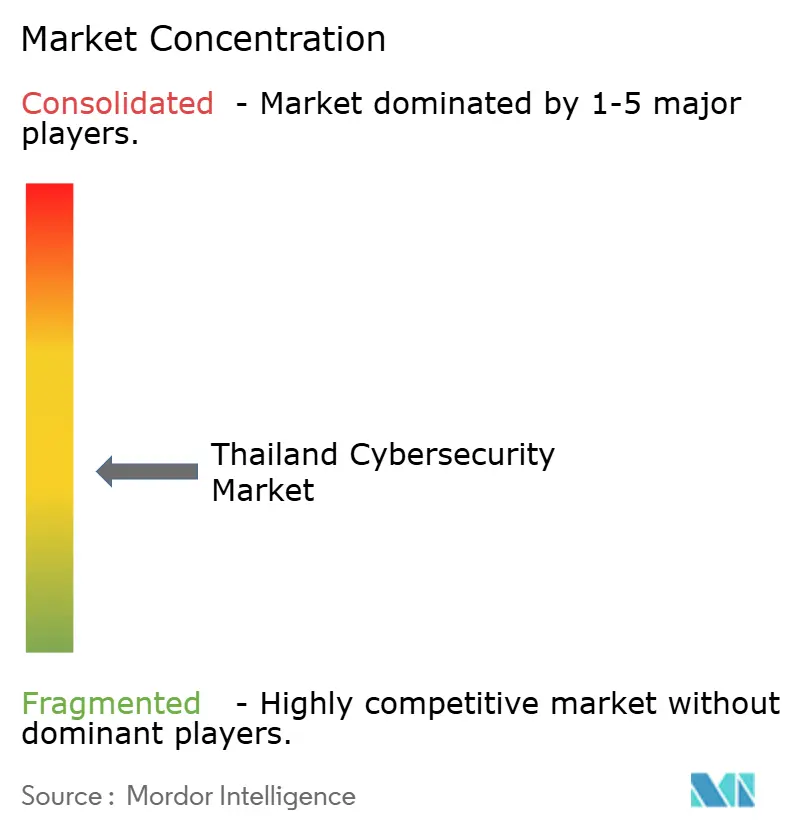
| Market Concentration | Medium |
Major Players *Disclaimer: Major Players sorted in no particular order Image © Mordor Intelligence. Reuse requires attribution under CC BY 4.0. | |
Thailand Cybersecurity Market Analysis by Mordor Intelligence
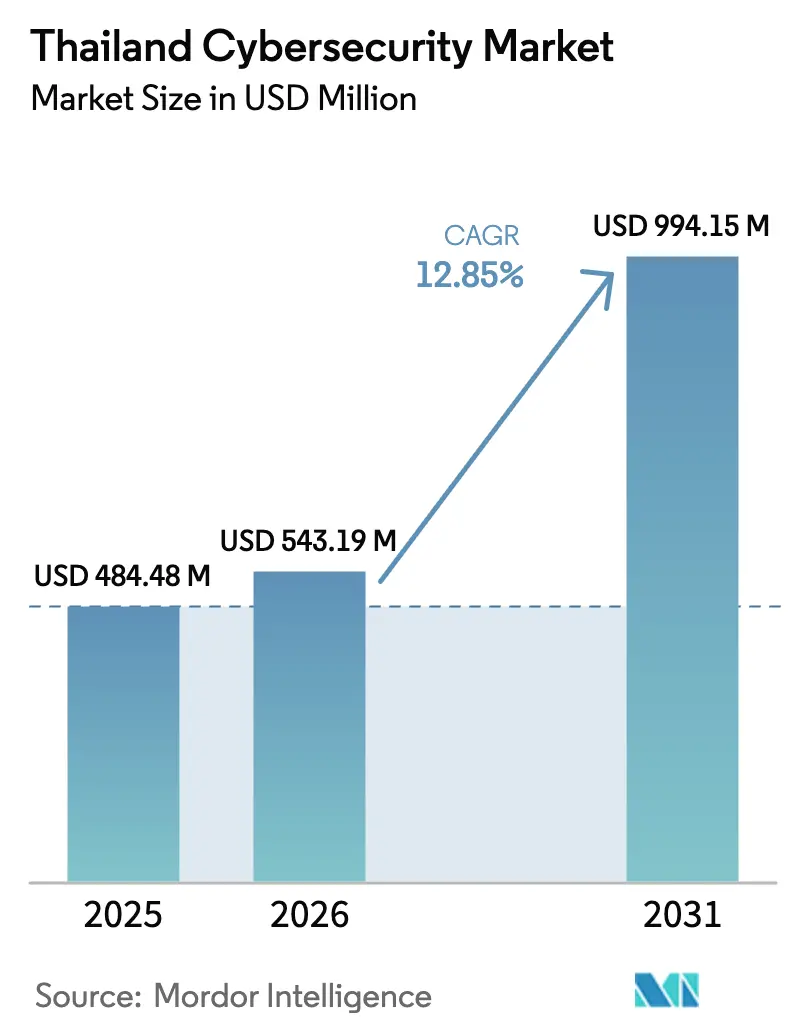
The Thailand cybersecurity market size was valued at USD 484.48 million in 2025 and is estimated to grow from USD 543.19 million in 2026 to reach USD 994.15 million by 2031, at a CAGR of 12.85% during the forecast period (2026-2031). A mandatory shift toward AI-native defenses by banks preparing for virtual-bank launches, strict data-localization clauses tied to the Personal Data Protection Act, and the government’s Cloud First policy are expanding addressable demand faster than local talent pipelines can scale. Hyperscalers that opened in-country regions in 2025 supply the elastic infrastructure needed for real-time payment screening and zero-knowledge authentication, while ransomware-as-a-service syndicates keep breach headlines in the news cycle and sustain urgency around managed detection and response. As telecom operators bundle security into 5G connectivity packages and industrial estates digitize production lines, spend is spreading beyond the Bangkok core into the Eastern Economic Corridor, closing the historical urban-rural usage gap. Overall, competitive intensity is climbing, yet service uptake outpaces product refreshes because enterprises prefer outcome-based contracts that offset skills shortages.
Key Report Takeaways
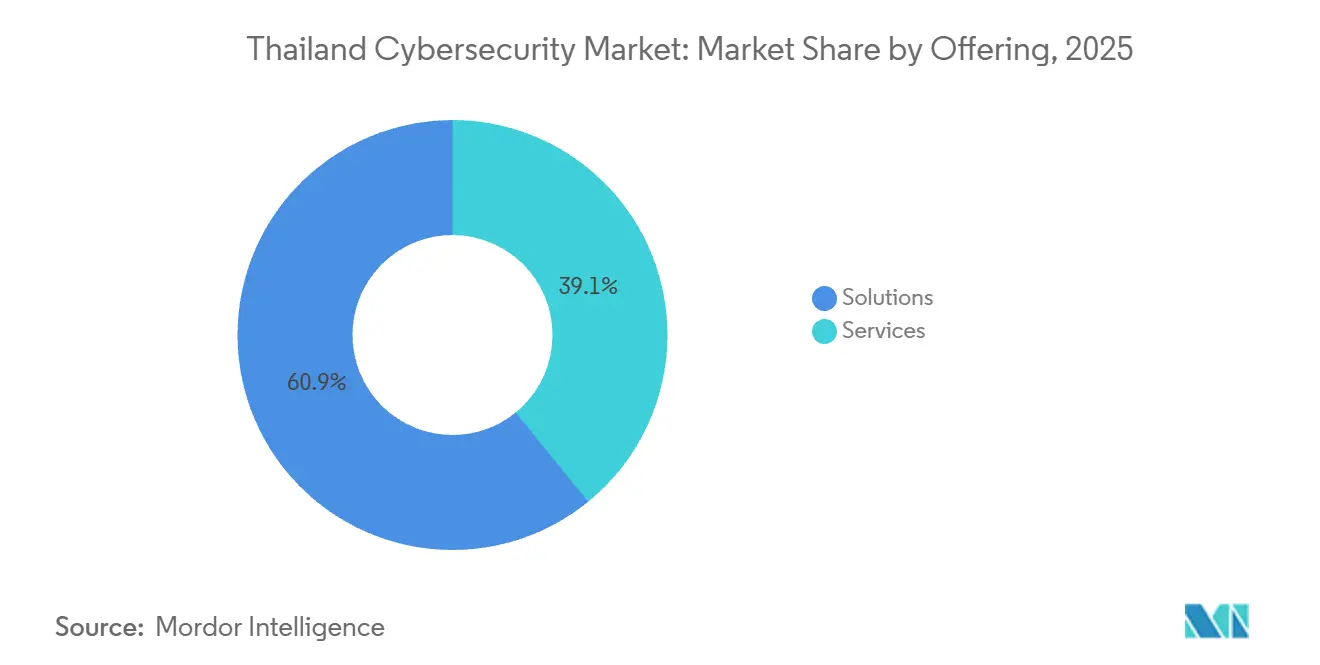
- By offering solutions, the company commanded a 60.88% share in 2025, while services are projected to grow at a 13.64% CAGR through 2031.
- By deployment mode, on-premises installations accounted for 64.27% of the Thailand cybersecurity market in 2025, whereas cloud security is forecast to grow at a 13.71% CAGR through 2031.
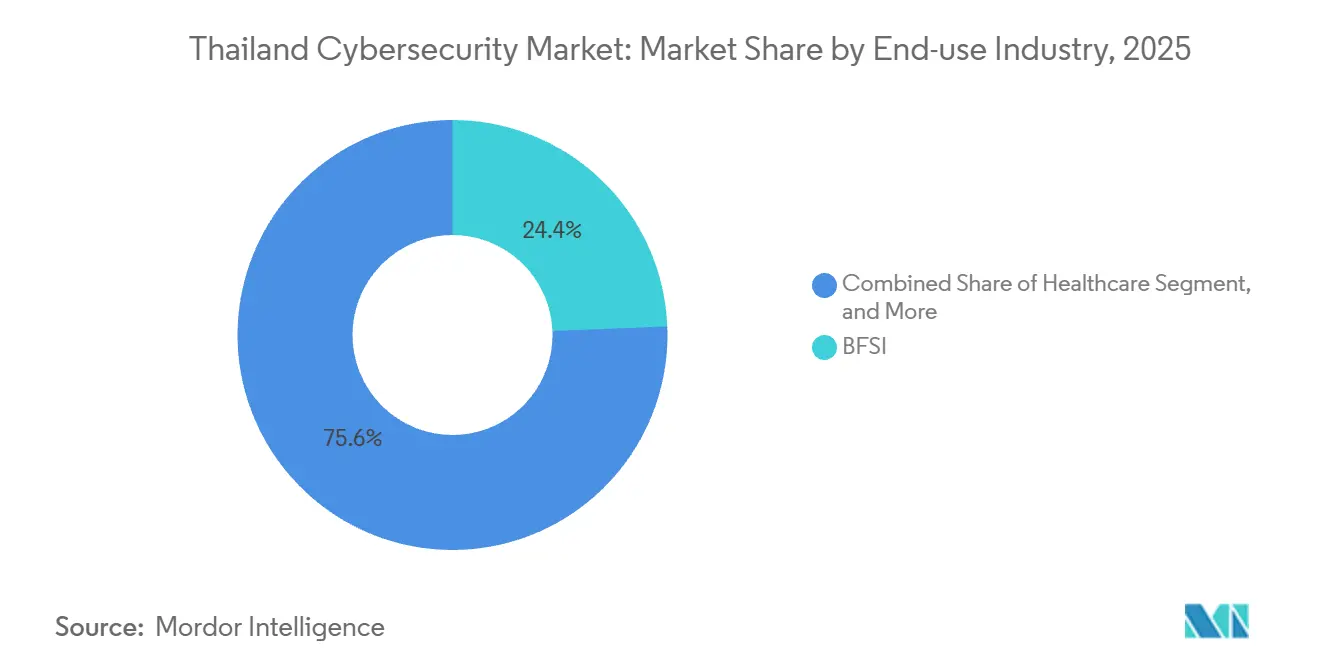
- By end-use industry, BFSI accounted for 24.36% of market share in 2025, while healthcare is expected to register the fastest growth at a 13.26% CAGR over 2026-2031.
- By enterprise size, large enterprises held 65.67% of market share in 2025, whereas small and medium enterprises are projected to post a 13.83% CAGR through 2031.
Note: Market size and forecast figures in this report are generated using Mordor Intelligence’s proprietary estimation framework, updated with the latest available data and insights as of 2026.
Thailand Cybersecurity Market Trends and Insights
Drivers Impact Analysis*
| Driver | (~) % Impact on CAGR Forecast | Geographic Relevance | Impact Timeline |
|---|---|---|---|
| Accelerated Digital-Banking Adoption in Thai BFSI | +2.8% | National, concentrated in Bangkok metropolitan area and provincial banking hubs | Medium term (2-4 years) |
| Fast-Track Government Cloud Migration (G-Cloud and NDID) | +2.3% | National, with early adoption in central government agencies and state enterprises | Short term (≤ 2 years) |
| 5G Rollout Spurring IoT-Edge Security Demand | +1.9% | National, with concentration in Eastern Economic Corridor industrial zones | Medium term (2-4 years) |
| Surge in Ransomware-as-a-Service Attacks on SMEs | +1.7% | National, with higher incidence in Bangkok, Chiang Mai, Phuket commercial districts | Short term (≤ 2 years) |
| Stricter PDPA Data-Localization Enforcement | +1.5% | National, affecting multinational enterprises with regional data centers | Long term (≥ 4 years) |
| Real-Time Payment Fraud Driving AI-Based SOC Demand | +1.4% | National, focused on financial services and e-commerce sectors | Medium term (2-4 years) |
| Source: Mordor Intelligence | |||
Accelerated Digital-Banking Adoption in Thai BFSI
Four virtual-bank licenses issued in 2025 put Thailand on course for commercial launches in Q2-Q3 2026, prompting incumbents to inject AI into fraud-detection workflows so that anomalous transfers are blocked within milliseconds rather than overnight batches.[1]Bank of Thailand, “Virtual Banking Licenses and Digital Transformation Initiatives,” bot.or.th Investment levels support the shift: Siam Commercial Bank and SCBX earmarked a combined THB 18.4 billion for cloud-native platforms that embed security at the API layer.[2]SCBX, “Annual Report 2024,” scbx.com PromptPay already flags more than 1,000 suspicious transactions every day, and the new PCI DSS 4.0.1 clause on continuous control validation further elevates operational visibility standards.[3]PCI Security Standards Council, “Payment Card Industry Data Security Standard Version 4.0.1,” pcisecuritystandards.org Consequently, demand is tilting toward outcome-based managed detection and response as banks hedge against hiring constraints. The trend deepens the Thailand cybersecurity market reliance on service partners that can maintain 24 × 7 security-operations-center coverage.
Fast-Track Government Cloud Migration (G-Cloud And NDID)
The Cloud First directive obliges ministries to default to sovereign cloud unless national-security waivers apply, and a three-tier classification model specifies encryption levels for public, sensitive, and secret workloads. National Telecom’s data-center arm monetized THB 1.49 billion of hosting fees in 2023, showing early fiscal upside for state-owned capacity. Meanwhile, NDID exceeded 40 million verified identities in 2025 and is piloting zero-knowledge-proof log-ins, cutting the data disclosure surface that attackers normally probe. The Electronic Transactions Development Agency’s plan to oblige e-marketplaces to validate seller IDs further lifts demand for identity-verification APIs. Because only a handful of local firms can deliver cryptographic key escrow at scale, global providers entering the Thailand cybersecurity market gain an early credibility boost.
5G Rollout Spurring IoT-Edge Security Demand
True Corporation’s merger with dtac combined 3,650 engineers and pooled 700 MHz plus 2.1 GHz assets, enabling nationwide radio-resource slicing for latency-sensitive industrial internet deployments. The telecom regulator has ordered 2G and 3G sunsets by Q3 2026, pushing legacy machine-to-machine traffic into 5G standalone cores that isolate slices based on risk. Inside the Eastern Economic Corridor, a 200-hectare Digital Park invites cybersecurity pilots ranging from autonomous AGVs to predictive maintenance, yet many factories still segregate operational-technology networks, creating blind spots. True’s CyberSafe package shows how carriers are bundling anomaly detection into consumer and small-business broadband, a move that enlarges the Thailand cybersecurity market without customers procuring separate tools. The National Cyber Security Committee’s new critical-infrastructure rules add urgency by mandating risk classification for OT assets.
Surge In Ransomware-As-A-Service Attacks on SMEs
The Ministry of Labor breach in July 2025, linked to Devman, leaked 300 GB and ended in a USD 15 million ransom note, spotlighting small-budget agencies that still rely on basic firewalls. ThaiCERT’s multiple 2025-2026 alerts on MongoDB and aviation systems underscore that misconfigurations, not zero-day exploits, drive most local incidents. Cross-border scam rings cause daily losses above THB 80 million, and the Royal Thai Police is now correlating call detail records with fraud logs through an AI engine hosted on True’s network. SMEs, which form 99% of businesses, spend just 0.2% of revenue on security, a level Fortinet labels inadequate to fund endpoint detection or round-the-clock monitoring. As ransomware kits commoditize payload delivery, managed detection providers that speak Thai and offer pay-as-you-go models are poised to capture latent demand in the Thailand cybersecurity market.
Restraints Impact Analysis*
| Restraint | (~) % Impact on CAGR Forecast | Geographic Relevance | Impact Timeline |
|---|---|---|---|
| Shortage of Thai-Language Cybersecurity Talent | -1.8% | National, with acute shortages in Bangkok, Chiang Mai, and Eastern Economic Corridor | Long term (≥ 4 years) |
| Price-Sensitive SME Buyer Behavior | -1.3% | National, concentrated in provincial SME clusters outside Bangkok | Medium term (2-4 years) |
| Underinsured Cyber Incidents due to PDPA Liability Gaps | -0.9% | National, affecting enterprises without dedicated risk-management functions | Long term (≥ 4 years) |
| OT Security Integration Complexities in EEC Factories | -0.7% | Eastern Economic Corridor industrial estates in Rayong, Chonburi, Chachoengsao | Medium term (2-4 years) |
| Source: Mordor Intelligence | |||
Shortage of Thai-Language Cybersecurity Talent
By 2025 only 431 professionals in Thailand held CISSP credentials, up by just 12% year on year and nowhere near the 10,000-certificate goal set for 2026. The National Cyber Academy has schooled more than 100,000 people, yet 72% of enterprises still cite staffing gaps as an operational risk. Cloud and AI security expertise top recruiting wish lists, but universities graduate fewer than 2,000 infosec majors annually, and multinationals offer salaries SMEs cannot match. Banks are sponsoring private curricula with Mandiant, keeping skills locked inside finance while healthcare and manufacturing scramble for bilingual analysts. Until more Thai-language threat feeds and playbooks emerge, human capital scarcity will temper the Thailand cybersecurity market growth potential.
Price-Sensitive SME Buyer Behavior
Average security spend at Thai SMEs remains at 0.2% of revenue, a ceiling that limits adoption of endpoint detection, SIEM, or managed SOC subscriptions. The July 2025 ransomware hit on the Ministry of Labor illustrated how budget-constrained entities lean on outdated perimeter defenses that fail against lateral movement. Insurers now insist on continuous control monitoring before underwriting cyber policies, and the resulting audit fees deter cash-strapped retailers from seeking coverage. ETDA’s draft rule compelling e-marketplaces to verify seller IDs imposes further compliance cost that many provincial platforms perceive as punitive. This dual pressure prolongs a two-speed Thailand cybersecurity market in which global enterprises adopt zero-trust while neighborhood firms gamble on minimal defenses.
*Our forecasts treat driver/restraint impacts as directional, not additive. The impact forecasts reflect baseline growth, mix effects, and variable interactions.
Segment Analysis
By Offering: Services Gain As Outsourcing Offsets Talent Gaps
Solutions dominated spending with a 60.88% slice of the Thailand cybersecurity market share in 2025, anchored by long-installed firewalls and endpoint suites. Yet services are projected to outpace products at a 13.64% CAGR as boards confront the 72% operational-risk exposure tied to empty analyst seats. Managed detection, incident response, and vulnerability management contracts provide immediate coverage without HR overhead, and local integrators weave Thai-language threat feeds into dashboards to satisfy auditors. Network and endpoint security remain the largest solution buckets, propelled by True-dtac’s 5G rollout and the regulator’s imminent 2G-3G switch-off that pushes device fleets onto new attack surfaces.
Cloud security is moving at the fastest clip, fueled by the Cloud First mandate and PDPA localization clauses that reroute traffic to sovereign regions. Identity and access management gains extra momentum from NDID’s 40-million-user milestone, spurring banks and e-tailers to federate logins via government APIs. Meanwhile, virtual banks slated for 2026 require AI-native fraud engines that embed security checks directly into the API flow, nudging developers toward DevSecOps. Data-protection tools also benefit as telemedicine platforms expand patient-record exchange, cementing encryption and key-governance requirements in hospital budgets.


By Deployment Mode: Sovereignty Mandates Accelerate Hybrid Adoption
On-premise estates still held 64.27% of Thailand cybersecurity market size in 2025 because critical-information-infrastructure owners rely on physical appliance chains for regulatory comfort. However, cloud-based controls are set to climb at a 13.71% CAGR thanks to ETDA’s stricter localization guidance and the arrival of new hyperscaler regions. AWS committed USD 5 billion to a three-zone Bangkok region, Microsoft is rolling out a sovereign cloud with Gulf and True IDC, and Google Cloud inked a data-residency pact with Gulf Edge.
National Telecom’s government cloud supports ministries, but capacity limits slow migration and force agencies into hybrid topologies that juggle ISO 27001 gear on-premise with SaaS in public cloud. The National Cyber Security Agency’s Cybershield platform, co-engineered with Palo Alto Networks and Google, provides unified telemetry across both domains, helping auditors reconcile alerts in one pane. Financial and healthcare players increasingly view hybrid as a forever state, valuing the elasticity of cloud for compute-heavy analytics while pinning sensitive workloads behind local HSMs.
By End-Use Industry: Healthcare Surges As Telemedicine Expands Attack Surface
BFSI accounted for 24.36% of 2025 spend as real-time payment fraud demanded AI-driven SOC tooling that checks beneficiary accounts against watchlists in microseconds. The increasing sophistication of cyber threats has made it imperative for financial institutions to adopt advanced security measures. Siam Commercial Bank alone invested THB 4.358 billion during 2023-2024 in cloud refits that integrate security at the code level. These investments highlight the growing emphasis on proactive measures to safeguard digital transactions and customer data.
Healthcare is on course for the speed lane, with a 13.26% CAGR to 2031 as the Mor Prom Plus telemedicine app and the Health Link interoperability program widen the clinical data pipe. Provincial hospitals lag in encrypting records, making them ripe targets for ransomware, and the WHO digital-health framework now flags encryption and access control as baseline obligations. IT-telecom spend also stays elevated, buoyed by network operators hardening 5G standalone cores. Manufacturing in the Eastern Economic Corridor edges upward as factory owners integrate OT sensors with corporate IT, but fragmented tooling still hinders unified visibility.

By End-User Enterprise Size: SME Growth Reflects Ransomware Urgency
Large enterprises controlled 65.67% of outlays in 2025, leveraging certified staff and global vendor catalogs. Yet SMEs are forecast to climb at a market-leading 13.83% CAGR, pushed by ransomware-as-a-service blasts that exploit outdated Windows builds. The July 2025 Devman attack on the Ministry of Labor highlighted how mid-tier bodies suffer when incident response is ad-hoc.
Telecom-bundled SOC offerings, such as CyberSafe, lower entry barriers by fusing network telemetry with AI classifiers that roll out across Wi-Fi routers without manual tuning. ETDA’s looming know-your-seller rule also acts as a carrot-and-stick, pushing online shops to adopt identity-verification services or face penalties. Over time, SME spend will narrow the historical gap, reshaping the Thailand cybersecurity market revenue mix toward a more balanced profile.
Geography Analysis
Bangkok and its surrounding provinces generated more than 60% of 2025 cybersecurity spend, owing to the head-office clustering of banks, telecom groups, and ministries. The Thailand cybersecurity market, however, is beginning to decentralize as industrial investors focus on the Eastern Economic Corridor across Rayong, Chonburi, and Chachoengsao. Digital Park Thailand’s 200-hectare campus offers 5G sandboxes for autonomous logistics pilots, incentivizing vendors to set up local SOC extensions.
Provincial adoption remains hamstrung by the Thai-language talent shortage and SME budget caps, but the National Cyber Security Agency and ISC2 are co-funding scholarship programs and open-source playbooks to help level the field. These initiatives aim to address the skill gap and provide accessible resources for smaller enterprises to improve their cybersecurity posture. Despite those efforts, the CISSP population rose only to 431 by end-2025, indicating slow progress and highlighting the need for sustained efforts to build a robust cybersecurity workforce.
Hyperscaler regions in Bangkok shorten latency for fraud-analytics engines and enable compliance with ETDA localization clauses. Meanwhile, True-dtac’s radio network consolidation routes low-latency backhaul into industrial estates, yet OT and IT teams still use separate dashboards, a gap that integrators now target with converged platforms. Cross-border scam traffic entering from neighboring countries continues to drive joint police-carrier operations that deploy call-detail AI scrubbing, adding a public-safety dimension to regional demand.
Regulatory Landscape
Thailand’s cybersecurity obligations are anchored by the Cybersecurity Act B.E. 2562 (2019), enforced through the National Cyber Security Agency (NCSA) and National Cyber Security Committee mechanisms that designate and supervise critical information infrastructure (CII) operators. National standards have been tightened through baseline requirements for data and information systems (Minimum Standards for Data and Information Systems B.E. 2566 (2023), effective from January 2025), alongside platform-facing rules that increase duties around cyber risk controls and fraud prevention under the Digital Platform Royal Decree and related anti-scam enforcement tools under the 2023 technological-crime emergency decree.
Implementation is becoming more prescriptive for public sector and CII. The NCSA’s Website Security Standard 1.0, issued in 2025, is moving into mandatory application for government agencies, regulators, and CII, with a compliance milestone in September 2026. The National Cloud Security Framework and Cloud Cybersecurity Standard also add control expectations for cloud environments, both with an effective date in September 2026. Together, these measures increase demand for auditable controls, including identity, encryption, monitoring, and incident handling, in line with sovereign-cloud and data-localization practices under PDPA-linked guidance.
Competitive Landscape
Thailand cybersecurity market competition remains moderately fragmented. Multinational brands Cisco, Palo Alto Networks, Fortinet, Check Point, Trend Micro, CrowdStrike, and Microsoft retain a significant share of large-enterprise budgets, but local integrators differentiate through Thai-language threat intelligence and on-site incident response. MFEC, for instance, booked THB 994.9 million in cybersecurity revenue for 2023, with a 16.3% gross margin, leveraging Elite Reseller status with Fortinet and Premier Consulting credentials with Microsoft.
Hyperscaler momentum is reshaping go-to-market models. AWS invested USD 5 billion in its Bangkok region, Microsoft committed USD 2.85 billion for a sovereign cloud with Gulf and True IDC, and Google Cloud signed a residency pact with Gulf Edge. These platforms offer native security stacks, GuardDuty, Defender, and Chronicle that partners can resell, intensifying price competition. Concurrently, the National Cyber Security Agency’s Cybershield program standardizes public-sector monitoring on Palo Alto and Mandiant tooling, reducing vendor fragmentation inside government.
White-space opportunities cluster around operational-technology defense for EEC factories and cyber-insurance underwriting frameworks. Telecom operators such as True demonstrate ambition by validating Level 4 network autonomy that self-remediates threats, illustrating how connectivity providers can embed security directly in transport layers. Certification badges, notably ISO 27001 and continuous PCI DSS 4.0.1 compliance, remain table stakes for bidders in banking and payment-processing RFPs. Overall, scale advantages matter, yet local language, sovereign hosting, and managed-service depth increasingly dictate contract wins in the Thailand cybersecurity market.
Thailand Cybersecurity Industry Leaders
IBM Corporation
Cisco Systems Inc
Check Point Software Technologies Ltd.
Trend Micro Incorporated
CrowdStrike Holdings, Inc.
- *Disclaimer: Major Players sorted in no particular order

Market Opportunities and Future Outlook
A near-term opportunity is compliance-led security uplift across government agencies, regulators, and CII operators as NCSA standards move from publication to enforcement, including the Website Security Standard and cloud security controls with September 2026 compliance dates. This shifts security from discretionary refresh cycles into defined implementation programs. It also creates demand for vendors and integrators that can provide assessment-to-remediation packages mapped to Thai public-sector control language, along with managed detection and response support for agencies that lack 24x7 coverage.
Another opportunity is in AI-enabled fraud and threat detection connected to national and sector programs already underway. The Royal Thai Police partnership with True Corporation to correlate call-detail records with fraud reports highlights active operational use of AI for cyber-enabled crime response. Separately, the national push toward “quantum-ready” security planning, including post-quantum cryptography roadmapping, creates whitespace in cryptographic agility, key management, and migration services for high-value systems. Identity-centric work also stands out, as government-backed digital identity platforms, such as ThaID and NDID adoption milestones, drive integration across BFSI, e-commerce, and public services, increasing demand for MFA, identity verification APIs, and continuous monitoring aligned to PDPA and CII oversight expectations.
Recent Industry Developments
- July 2026: Cisco Systems Inc - Cisco reported that 98% of Thai organizations plan to deploy AI agents within the next year, citing infrastructure modernization and deep security integration as critical needs. The expansion points to rising demand for AI driven security solutions and deeper enterprise cybersecurity spend across Thailand. Cisco strengthens its position as a key provider of AI security integration in the Thai market.
- May 2026: Security Pitch Co., Ltd. - Security Pitch signed a Memorandum of Understanding with Saudi Arabia’s Aljazeera Falcons LLC on 29 May 2026 to integrate AI and converged security technologies for expansion into the Middle East. The collaboration broadens Security Pitch’s international footprint and supports cross border deployment of AI based security platforms. The partnership aligns with regional digital trust initiatives and expands regional market access for Security Pitch.
- February 2026: Royal Thai Police & True Corporation - Joint deployment of AI driven threat detection integrating call-detail records with fraud reports. The initiative delivers an operational uplift in Thailand by strengthening public private security collaboration and incident response capabilities. It demonstrates a scalable model for AI enabled threat intelligence within the Thai security ecosystem.


Research Methodology Framework and Report Scope
Market Definition and Coverage
For this study, the market covers cybersecurity solutions and services purchased by organizations in Thailand to prevent, detect, respond to, and recover from cyber threats across IT environments, networks, endpoints, identities, applications, and cloud workloads.
Scope exclusions: Spending that is not primarily for cybersecurity protection, such as general IT infrastructure upgrades with no dedicated security function, is not counted.
Segmentation Overview
- By Offering
- Solutions
- Application Security
- Cloud Security
- Data Security
- Identity and Access Management
- Infrastructure Protection
- Integrated Risk Management
- Network Security
- Endpoint Security
- Services
- Professional Services
- Managed Services
- Solutions
- By Deployment Mode
- On-Premise
- Cloud
- By End-use Industry
- IT and Telecom
- BFSI
- Healthcare
- Industrial Manufacturing
- Retail and E-commerce
- Energy and Utilities
- Aerospace, Military and Defense
- Other End-use Industries
- By End-User Enterprise Size
- Large Enterprises
- Small and Medium Enterprises (SMEs)
Data Sources, Market Sizing, and Validation
Desk Research
Desk research was used to set the market perimeter and to build the first set of demand indicators that can be tracked year over year. We relied on public, non-paywalled sources such as Thailand government policy and statistics releases, central bank and financial sector publications, national CERT-style advisories, telecom and digital economy regulator updates, and international references such as ITU cybersecurity indicators and the World Bank digital development series.
On the commercial side, we reviewed company filings, annual reports, investor presentations, and press releases to understand product mix and Thailand revenue exposure where disclosed. A paid subscription for company financials and intelligence was used selectively to normalize reporting calendars and to map subsidiaries, and a patent database was used to cross-check technology focus areas that can affect solution adoption. The desk research sources listed here are illustrative only, and many other public documents and databases were also consulted to collect, validate, and clarify data points.
Primary Interviews and Surveys
Primary work focused on validating what Thailand-based buyers spend on security outcomes, and how budgets shift between software-led controls and service-led delivery. We spoke with a mix of enterprise security leaders, IT managers, systems integrators, and service providers to confirm adoption patterns for cloud security, identity controls, managed detection and response, and compliance-led projects. Inputs were also used to confirm pricing direction, procurement cycles, and the practical split between on-premise and cloud deployments across key end-use industries.
Distribution of primary research fieldwork respondents
| Company type | Respondent position | Region |
|---|---|---|
| Top tier: 28% | CXOs: 15% | |
| Mid tier: 57% | Functional/Unit leaders: 38% | |
| Smaller Players: 15% | Managers: 47% |
Market-Sizing & Forecasting
Sizing started with a top-down build where national IT and digital spending signals were translated into a cybersecurity spend pool using penetration and budget-share assumptions that were validated in interviews. To keep totals grounded, the model was then cross-checked with selective bottom-up approximations, such as sampling common annual contract values for managed services, multiplying by plausible customer counts by industry, and sense-checking solution spend through sampled seat or asset coverage where applicable.
A few inputs that matter specifically in Thailand were tracked carefully because they can shift the market direction quickly. These included cloud workload migration pace (which moves demand toward cloud security), regulated-sector compliance activity in BFSI and telecom, frequency and severity of reported incidents and advisories (which typically trigger budget releases), the share of managed services in total security delivery, and enterprise size mix between large organizations and SMEs. Where bottom-up inputs were missing, gaps were handled by using anchored ranges from interviews and then normalizing to known adoption levels by deployment mode and end-use industry.
Forecasting relied on scenario analysis supported by short time-series smoothing, since cybersecurity budgets can move in steps after policy changes and major incidents. Growth rates were adjusted by expected cloud adoption, security talent availability, and the pace of managed-service substitution, and then rechecked with interview feedback before finalizing the forecast curve.
Data Validation & Update Cycle
Outputs were validated through several checks to ensure unusual jumps did not show up in the final market time series. We compared modeled totals with independent signals such as cybersecurity program announcements, sector-specific compliance timelines, and the implied per-organization spending levels for major buyer groups, and then reviewed any large variances at assumption level.
Before sign-off, the model goes through an internal review where inputs, formulas, and year-to-year movements are challenged, followed by targeted re-contacts when a key assumption looks weak or contradictory. Reports are refreshed annually, with interim updates when material events occur, such as major regulation changes or large shifts in cloud adoption. Right before delivery, an analyst performs a fresh pass to ensure the latest available public information is reflected.
Mordor Intelligence's Thailand Cybersecurity Market Size Compared With Other Published Estimates
Published market values for Thailand cybersecurity can vary a lot, even when the topic label looks similar, because the scope and counting rules are not consistent. Differences usually come from whether the estimate is tracking end-user spending versus supplier revenue, how cloud and managed services are treated, and whether adjacent IT items are accidentally included.
The main gap comes from mixing broad IT security operations and non-security IT services into the total, where Mordor Intelligence counts only end-user spending on defined cybersecurity solutions and services across the listed offerings and deployment modes, and then validates the split through buyer-side budget checks. A second driver is timing, since some figures use older currency assumptions or do not refresh after policy-led spending changes, which can shift a small country market by a meaningful amount.
Benchmark comparison
| Source | Market Size | Gaps in Research Methodology |
|---|---|---|
| Mordor Intelligence | USD 484.48 M (2025) | |
| Regional Consultancy A | USD 620.00 M (2025) | Often uses supplier-revenue rollups that can count cross-border delivery and regional contracts booked outside Thailand, and may also fold in broader IT risk consulting beyond cybersecurity-specific scopes. |
| Industry Association B | USD 410.00 M (2025) | Typically relies on member-reported sales and conservative participation rates, which can undercount non-member providers and fast-growing managed security services, and may not adjust fully for cloud security spend. |
Taken together, the spread is mainly explained by what gets included as cybersecurity spend and how Thailand revenue is attributed when delivery is regional. By tying assumptions to buyer budgets, deployment mix, and service attachment rates, our estimate stays traceable to clear variables that can be rechecked as the market evolves.


Key Questions Answered in the Report
How fast is spending on managed security services growing in Thailand?
Services revenue is projected to rise at a 13.64% CAGR through 2031, outpacing product sales as boards outsource detection and response to fill talent gaps.
Which sector invests the most in cyber defenses?
BFSI led 2025 spending with a 24.36% share, driven by real-time payment fraud prevention and upcoming virtual-bank launches.
Why is healthcare emerging as the fastest-growing customer group?
The Mor Prom Plus telemedicine app and Health Link data-sharing framework expose more patient records to online channels, pushing healthcare security budgets to a 13.26% CAGR.
What drives cloud-security adoption despite on-premise dominance?
PDPA data-localization clauses and new in-country regions from AWS, Microsoft, and Google enable compliant hybrid architectures that expand cloud security at a 13.71% CAGR.
How are telecom operators capitalizing on cyber demand?
True Corporation bundles its CyberSafe AI engine with broadband and 5G plans, using network telemetry to offer automated threat detection to SMEs.
What is the biggest bottleneck to wider cybersecurity uptake in provincial Thailand?
A shortage of Thai-language professionals and price sensitivity among SMEs limit adoption, keeping talent and budget concentrated in Bangkok.
Page last updated on:


