
Market Overview
| Study Period | 2019 - 2031 |
|---|---|
| Forecast Data Period | 2026 - 2031 |
| Base Year Market Size (2025) | USD 1.07 Billion |
| Market Size (2026) | USD 1.16 Billion |
| Market Size (2031) | USD 1.77 Billion |
| Growth Rate (2026 - 2031) | 8.76 % |
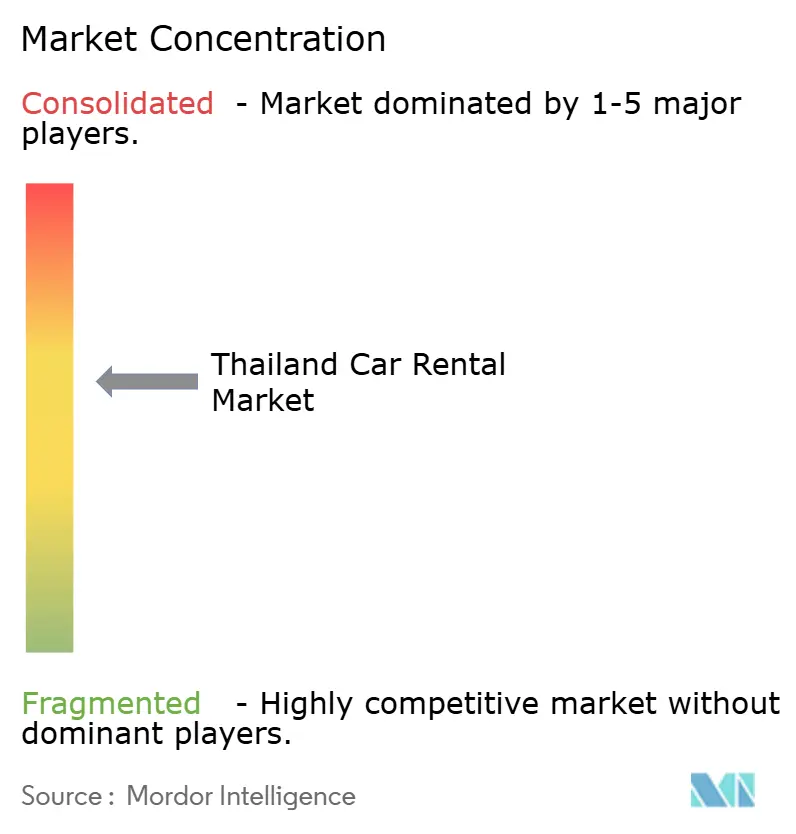
| Market Concentration | Medium |
Major Players *Disclaimer: Major Players sorted in no particular order Image © Mordor Intelligence. Reuse requires attribution under CC BY 4.0. | |
Thailand Car Rental Market Analysis by Mordor Intelligence
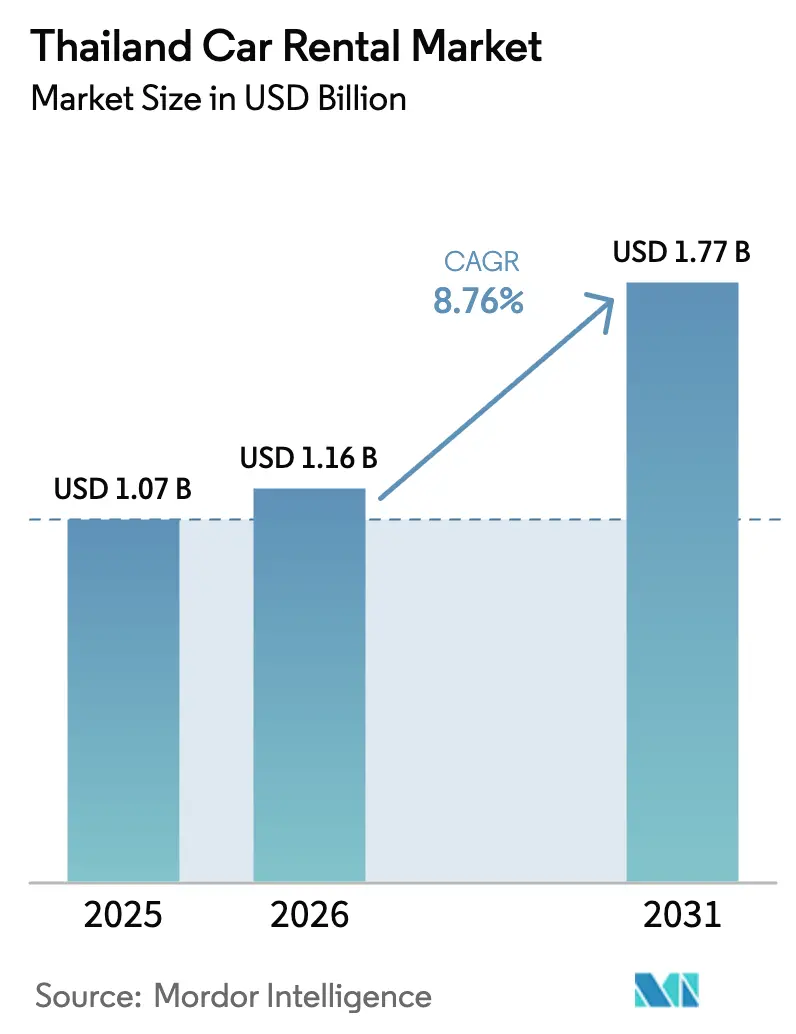
The Thailand car rental market size was valued at USD 1.07 billion in 2025 and is estimated to grow from USD 1.16 billion in 2026 to reach USD 1.77 billion by 2031, at a CAGR of 8.76% during the forecast period (2026-2031). Sustained visa-free entry for major source markets, rapid expansion of low-cost carriers into secondary airports, and accelerated fleet electrification together underpin the long-run growth profile of the Thailand car rental market. At the same time, the sector faces near-term turbulence from a sharp fall in Chinese group tourism, tightening fleet-financing rules, and rising vehicle acquisition costs. Operators are therefore rebalancing toward domestic travelers and long-term corporate subscriptions, deploying digital booking platforms to capture price-sensitive demand, and adding battery electric vehicles (BEVs) to meet government sustainability incentives. Competitive intensity is rising as peer-to-peer platforms and ride-hailing-linked rental schemes squeeze traditional operators’ margins and force them to invest in differentiated service models.
Key Report Takeaways
- By booking type, online channels held 63.16% of the Thailand car rental market share in 2025, and are advancing at a 9.28% CAGR through 2031.
- By rental duration, short-term agreements accounted for 71.26% of the Thailand car rental market share in 2025; long-term contracts are projected to expand at a 9.41% CAGR through 2031.
- By application, leisure and tourism accounted for 65.47% of the Thailand car rental market in 2025, whereas commuting and business rentals are the fastest-growing segment, with a 9.43% CAGR to 2031.
- By vehicle class, economy and mini cars led the Thailand car rental market with 48.72% share in 2025; SUVs and MPVs are forecast to grow at a 9.31% CAGR through 2031.
- By propulsion, internal-combustion engine (ICE) vehicles dominated the Thailand car rental market share with 87.15% in 2025, but BEVs are expanding at a 12.36% CAGR through 2031.
- By rental channel, airport counters commanded 68.31% of the Thailand car rental market in 2025, while downtown and off-airport outlets are growing at a 9.38% CAGR through 2031.
Note: Market size and forecast figures in this report are generated using Mordor Intelligence’s proprietary estimation framework, updated with the latest available data and insights as of 2026.
Thailand Car Rental Market Trends and Insights
Drivers Impact Analysis*
| Driver | (~) % Impact on CAGR Forecast | Geographic Relevance | Impact Timeline |
|---|---|---|---|
| Tourism Rebound | +2.5% | Bangkok, Phuket, Chiang Mai, Pattaya, Krabi, Surat Thani | Medium term (2-4 years) |
| Digital Booking & Price-Comparison Platforms | +1.8% | Bangkok, Phuket, Chiang Mai, Pattaya, Rayong | Short term (≤ 2 years) |
| Expansion of Low-Cost Carriers | +1.5% | Rayong (U-Tapao), Chiang Mai, Khon Kaen, Chiang Rai, Hat Yai, Surat Thani | Medium term (2-4 years) |
| Self-Drive Tourism Surge | +1.2% | Bangkok, Phuket, Chiang Mai, Pattaya | Short term (≤ 2 years) |
| EV-Rental Purchase Incentive Program | +1.0% | Bangkok, Phuket, Chiang Mai, Rayong | Long term (≥ 4 years) |
| Deposit & Damage-Tracking Systems | +0.3% | Bangkok, Phuket | Long term (≥ 4 years) |
| Source: Mordor Intelligence | |||
Tourism Rebound & Visa-Free Schemes
Thailand’s permanent visa-waiver for China, India, and Russia, introduced in 2025, removed a long-standing friction that deterred short-stay travelers. Chinese independent visitors recovered to over 75% of pre-pandemic levels in 2025, boosting multi-day car-hire demand beyond coach-based itineraries. Indian and Russian tourists accounted for around 4.4 million arrivals in 2025 and gravitated toward multi-destination road trips across beach and cultural circuits[1]. The shift toward spontaneous, last-minute digital reservations rewards operators with real-time fleet visibility and flexible pick-up options.
Rise of Digital Booking & Price-Comparison Platforms
Digital booking apps such as Drivemate and Houpcar, along with aggregators embedded in super-apps like Grab and Traveloka, captured 63.16% of the Thailand car rental market transactions in 2025 and are growing at a 9.28% CAGR through 2031. Transparent price discovery pressures margins but vastly enlarges reach, prompting incumbents to integrate application programming interfaces (APIs) that feed real-time rates to multiple portals. Operators differentiate via doorstep delivery, bundled insurance, and loyalty perks, yet must streamline cost structures to remain competitive against asset-light digital platforms.
Expansion of Low-Cost Carriers to Secondary Airports
Airports of Thailand plans to increase Suvarnabhumi's capacity to 70 million passengers by 2031, and U-Tapao's to 16 million by 2026, distributing traveler flows away from Bangkok’s primary gateways[2]. New frequencies to Chiang Rai, Khon Kaen, and Hat Yai create fresh pockets of car-hire demand, but operators face upfront investments in counters, parking, and local fleets before passenger volumes fully materialize. Flexible branch scheduling and inter-city one-way rentals mitigate stranded-capacity risk.
Surge in Chinese Self-Drive Tourism
In recent years, there has been a noticeable increase in the number of free independent travelers from China. This group tends to spend more on their trips and shows a strong preference for self-drive itineraries, often supported by the convenience of Chinese-language GPS applications. While concerns about safety and the limited availability of right-hand-drive vehicles have posed challenges, growing confidence in peer-reviewed platforms like Zuzuche is helping travelers overcome these barriers. This shift reflects a broader trend of Chinese tourists seeking more personalized and flexible travel experiences.
Restraints Impact Analysis*
| Restraint | (~) % Impact on CAGR Forecast | Geographic Relevance | Impact Timeline |
|---|---|---|---|
| Rising Fleet Acquisition | -1.9% | Global, with an acute impact on the premium and EV segments | Short term (≤ 2 years) |
| Competition From Ride-Hailing Apps | -1.4% | National, concentrated in urban centers and tourist areas | Medium term (2-4 years) |
| Stricter Fleet-Financing | -1.1% | National, affecting both operators and consumers | Short term (≤ 2 years) |
| Sparse Charging Infrastructure | -0.8% | National, with rural and intercity gaps most affected | Long term (≥ 4 years) |
| Source: Mordor Intelligence | |||
Rising Fleet Acquisition & Maintenance Costs
The 2026 excise-tax overhaul slashed BEV rates to 2% while lifting taxes on large ICE engines to 50%, inflating upfront prices for conventional cars and forcing rental firms to weigh accelerated electrification against capital constraints. Semiconductor shortages extend delivery lead times, prolonging fleet age and raising maintenance bills. New central-bank supervision of auto leasing since December 2025 has tightened credit standards, lifting borrowing costs for smaller operators. Balancing fiscal incentives with liquidity needs becomes critical for mid-tier companies.
Competition from Ride-Hailing and Super-Apps
Grab, commanding around 70% of Thailand's ride-hailing market, has innovatively integrated rental economics into its platform by leasing electric vehicles (EVs) directly to drivers through a revenue-based financing model. While on-demand mobility services have emerged as alternatives to traditional taxi rentals, they've inadvertently reduced the market size for airport transfers. Furthermore, super-apps, which seamlessly combine services like flights, hotels, and rides, have begun to overshadow traditional operators. This shift has compelled these operators to enhance their offerings, investing in value-added services and corporate subscriptions—areas where ride-hailing services struggle to compete.
*Our forecasts treat driver/restraint impacts as directional, not additive. The impact forecasts reflect baseline growth, mix effects, and variable interactions.
Segment Analysis
By Booking Type: Digital Channels Redefine Distribution
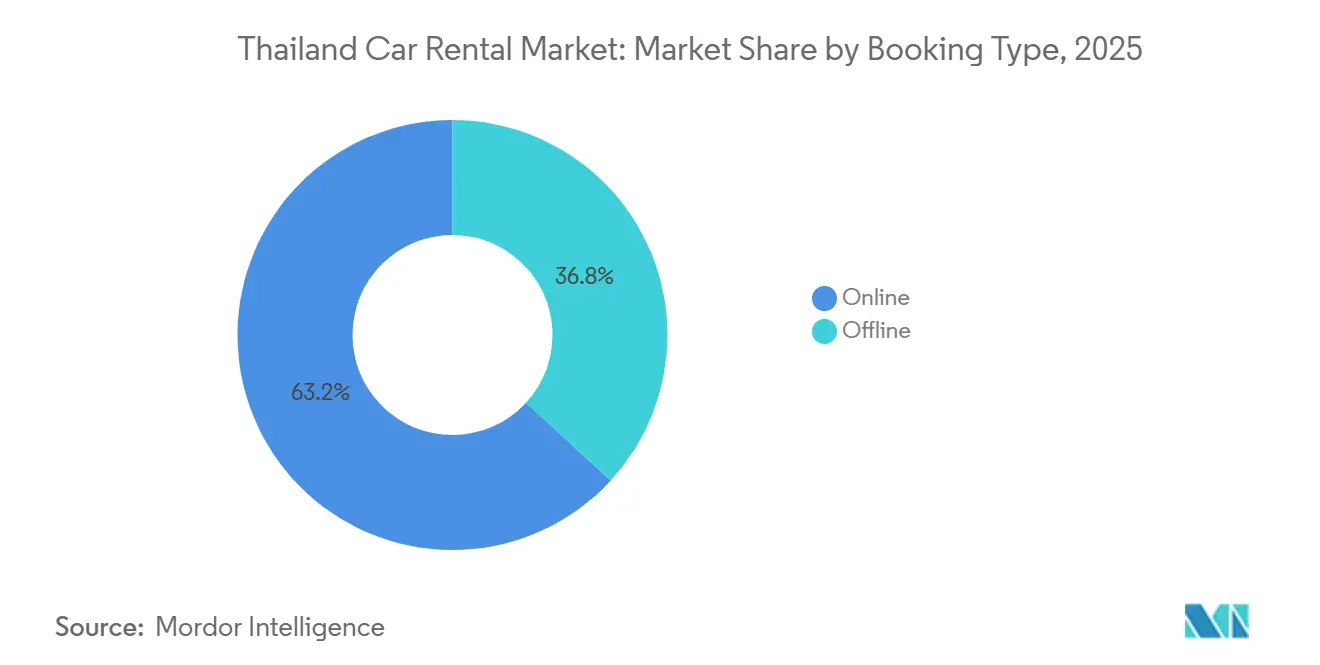
Online reservations accounted for 63.16% of the Thailand car rental market size in 2025 and are projected to grow at a 9.28% CAGR through 2031, driven by metasearch engines and peer-to-peer listings that expose live prices across dozens of operators. Apps embed seamless e-wallet payments, one-click insurance, and user ratings, raising expectations for transparency and convenience. Offline desks still capture last-minute walk-ins at major airports, but their growth lags as mobile-first travelers favor the immediacy of smartphone bookings. Operators experiment with dynamic pricing and loyalty partnerships to retain direct-channel traffic amid aggressive aggregator discounting.
Thairung Group’s acquisition of Drivemate and the immediate infusion of a BEV fleet validated the strategic pivot toward asset-light supply and digital discovery. Super-apps extend reach into food delivery and fintech ecosystems, converting everyday users into rental customers through cross-promotion. Elderly travelers and first-time visitors still value face-to-face service for complex insurance questions, sustaining a residual role for staffed counters. Nonetheless, digital share gains appear durable, underpinning automated check-out kiosks and contactless vehicle handovers in high-volume locations.
By Rental Duration: Corporate Subscriptions Gain Momentum
Short-term hires accounted for 71.26% of Thailand's car rental market share in 2025, driven by leisure-centric traffic at Bangkok, Phuket, and Chiang Mai airports. Daily rates remain the yield driver, yet seasonal volatility exposes cash flow to swings. In contrast, long-term rentals and monthly subscriptions bundled with maintenance and roadside support are set to grow at a 9.41% CAGR through 2031. Multinationals adopt pay-as-you-use fleets to hedge against ownership costs and align with sustainability mandates by swapping ICE units for BEVs.
Corporate accounts prize predictable budgeting and nationwide service coverage, pushing operators to offer fleet portals with usage analytics and centralized billing. Demand also stems from remote-work professionals choosing flexible car access over ownership. Subscription providers optimize asset utilization by redeploying idle corporate cars into weekend leisure pools, smoothing revenue seasonality. For traditional daily-rental players, entering long-term contracts requires re-engineering maintenance operations and credit-risk assessment frameworks.
By Application: Leisure Dominates, Business Segment Accelerates
Leisure travel delivered 65.47% of the Thailand car rental market size in 2025, anchored by inbound visitors and domestic holidaymakers exploiting Thailand’s dense long-weekend calendar. Visa-free policies and LCC route proliferation sustain baseline growth, yet leisure bookings remain vulnerable to exchange-rate shifts and geopolitical shocks such as the 2025 drop in Chinese group tours. Business and commuting rentals, while smaller, are emerging as the growth engine, with a 9.43% CAGR through 2031, as corporates pivot to fleet-as-a-service contracts and ride-hailing drivers lease cars through platform financing.
Enterprise clients spread bookings more evenly across the year, reducing seasonality risk. They also value electric models for corporate social responsibility targets, nudging operators toward BEV procurement. Leisure-focused fleets may diversify into chauffeur-drive and curated-itinerary packages to defend market share against ride-hailing. Creating cross-selling opportunities between leisure and business pools helps raise overall utilization and yields.
By Vehicle Class: Budget Cars Anchor, SUVs Lead Upside
Economy and mini cars accounted for 48.72% of the Thailand car rental market size in 2025, reflecting price sensitivity among tourists and domestic travelers. Compact sedans offer a balance of comfort and affordability, yet SUVs and MPVs are on a 9.31% CAGR trajectory, driven by multi-generation family trips and road-trip tourism. Rental companies leverage higher daily rates on SUVs to offset steeper acquisition and fuel costs, while end-users appreciate ride height and cargo capacity on provincial highways.
Hybrid and plug-in versions of sought-after SUV models are attracting corporate renters who prioritize a reduced carbon footprint but are wary of range limitations. To navigate potential tax increases on larger ICE engines and tap into the premium market segment, operators are curating mixed fleets. This diversification not only supports dynamic yield management but also directs demand toward more profitable models during peak times.
By Propulsion: ICE Predominates, BEV Adoption Accelerates
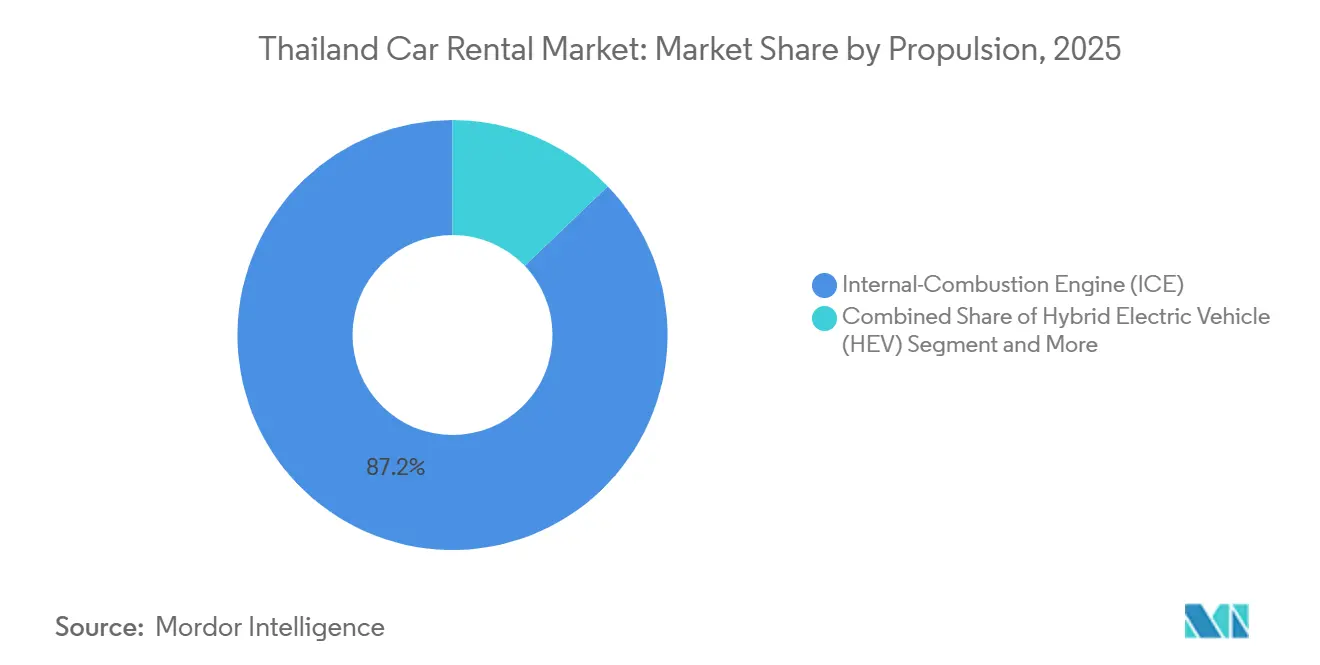
ICE cars accounted for 87.15% of the Thailand car rental market size in 2025, underpinned by established fuel infrastructure and lower sticker prices. Fleet-wide BEV share is climbing at 12.36% CAGR through 2031, accelerated by tax cuts to 2% and subsidies up to THB 100,000 per unit under the EV3.5 program. Operators such as Sixt and Hertz now deploy Nissan LEAF and BYD ATTO 3 units at major airports to serve environmentally mindful travelers and corporate accounts.
However, charging access remains patchy, with only Bangkok, Phuket, and Chiang Mai offering widespread availability, hindering a nationwide shift to electrification. The Provincial Electricity Authority has set its sights on adding 1,000 new chargers at tourist hotspots, and EGAT is on track to match that number by 2030. Until the charging network becomes denser, fleets are leaning towards mixed propulsion systems, with hybrids playing a crucial role in balancing cost and range considerations.

By Rental Channel: Airports Retain Scale, Downtown Networks Rise
Airport counters captured 68.31% of Thailand's car rental market size in 2025 as Suvarnabhumi, Don Mueang, Phuket, and Chiang Mai absorbed the bulk of tourist flows. Planned capacity upgrades through 2031 underpin continued relevance, yet downtown and off-airport branches are growing at a 9.38% CAGR through 2031. City outlets tap domestic weekend travelers, corporate users, and residents seeking doorstep delivery, while also avoiding hefty airport concession fees that erode margins.
Collaborations with hotel chains like ONYX Hospitality seamlessly integrate rental bookings into room reservations, broadening the market reach beyond just airport arrivals. Operators are leveraging mobile handover teams and smart lock boxes to facilitate keyless pickups at condo lobbies and office towers. This widespread network not only enhances service delivery but also shields operators from abrupt declines in tourist numbers, a challenge highlighted by the 2025 downturn in Chinese tourist arrivals.
Geography Analysis
Bangkok remains the nucleus of the Thailand car rental market, hosting the largest concentration of fleets, counters, and maintenance depots. Suvarnabhumi and Don Mueang funnel international and domestic passengers into the capital’s dense downtown network, while corporate headquarters in Sathorn and Sukhumvit generate steady long-term lease demand. Peer-to-peer handovers and ride-hailing driver rentals flourish in the city thanks to high smartphone penetration and abundant charging stations for nascent BEV fleets.
Phuket and Chiang Mai rank next in rental density, each benefiting from strong leisure pull, international air connectivity, and growing expatriate communities. Seasonal peaks tied to the northeast monsoon require agile fleet rotation, and both provinces serve as early test beds for BEV offerings due to supportive local charging grids. However, their dependence on inbound tourism exposes revenue to macro shocks, underscoring the need for diversified domestic marketing campaigns.
Emerging clusters include U-Tapao-linked Pattaya, Rayong’s industrial corridor, and northern cities such as Chiang Rai and Khon Kaen. Low-cost carrier route launches spread rental demand across these secondary hubs, prompting operators to deploy modular counters and shared parking to curb fixed costs. Sparse charging infrastructure and uncertain flight load factors elevate operational risk, yet first movers can lock in airport concession space before rents escalate. Southern gateways Krabi, Hat Yai, and Surat Thani cater to island-hopping tourists and see spike-driven rental usage that rewards advanced yield-management algorithms.
Regulatory Landscape
Thailand's car-rental activity sits within the broader road-transport and vehicle-registration regime overseen by the Ministry of Transport through the Department of Land Transport (DLT). Compliance centers on vehicle registration and roadworthiness, with operators expected to maintain required documentation (vehicle registration, proof of insurance, and driver license validation), and to align rental use with DLT rules as enforced through provincial transport offices.
Mandatory motor insurance under the Motor Vehicle Act B.E. 2535 shapes rental terms and risk management, especially around minimum third-party protections for accident victims and property damage. The market also reflects policy signals that affect procurement economics, including Thailand's 2026 excise-tax overhaul that reduced BEV excise rates to 2% while increasing taxes on large ICE engines, shifting the cost basis between electrified and conventional rental fleets.
Value Chain Analysis
The Thailand car-rental value chain starts with fleet sourcing (OEMs and distributors for ICE, hybrid, and BEV models) and financing, then moves into fleet operations run by international and domestic operators such as SIXT Thailand and Thai Rent A Car. Key activities include branch and counter operations (airport and downtown), maintenance and remarketing, insurance administration, and customer service across leisure short-term hires, long-term corporate leasing, and chauffeur or mobility-adjacent services.
Distribution and demand generation increasingly depend on digital channels and partners, including online booking platforms and super-app aggregators, with payments and promotions supported by financial-services partners such as Krungthai Card (KTC) through credit-card campaigns. Downstream, utilization and yield are shaped by airport concession access, corporate account management, and partnerships with travel ecosystems (for example, airline loyalty programs). For EV rentals, operations add dependencies on charging access and the operator's ability to manage charging, telematics, and damage and deposit processes.
Competitive Landscape
In Thailand's car rental market, a handful of players hold sway. Dominating airport concessions, Thai Rent A Car, Sixt, Avis Budget Group, Hertz, and Europcar capitalize on their substantial brand equity and global reservation platforms. Online aggregator growth has compressed pricing power, compelling incumbents to pursue alliances, such as Thai Rent A Car’s 2024 partnership with Enterprise Mobility, which integrates cross-border bookings and corporate fleet solutions.
Domestic mid-tier players, Bizcar Rental, Chic Car Rent, and Drive Car Rental, capitalize on local knowledge and nimble decision-making to pilot doorstep delivery and smartphone self-check-ins. The Bizcar-Drivemate merger forged a hybrid peer-to-peer plus owned-fleet model, signaling convergence between sharing platforms and conventional operations. Ride-hailing giant Grab inserts itself into the rental value chain by leasing EVs to drivers, eroding short-distance hire volumes and forcing traditional operators to refine propositions around multi-day leisure, premium SUVs, and corporate subscriptions.
Global developments reverberate locally. Avis Budget Group’s USD 518 million impairment on U.S. EV inventories in 2026 prompted a renewed focus on disciplined fleet sizing[3], which may slow its BEV rollout in Thailand and open room for local specialists to seize early-adopter corporate accounts. Meanwhile, VinFast’s 2024 dealer network launch introduces new BEV supply channels that proactive rental companies can tap to diversify electric offerings alongside Chinese marques BYD and Great Wall.
Thailand Car Rental Industry Leaders
-
Sixt SE
-
Avis Budget Group
-
Thai Rent A Car
-
Europcar Mobility Group
-
Hertz Corporation
- *Disclaimer: Major Players sorted in no particular order
Market Opportunities and Future Outlook
Electrification creates a clear whitespace in premium and corporate rentals, supported by Thailand's EV3.5 incentives (subsidies up to THB 100,000 per unit) and the 2026 reduction of BEV excise tax to 2%. The supply-side follow-through is reflected in operator-facing fleet actions and investments: ZEEKR delivered 7X EVs to SIXT Thailand in April 2026, and Synergetic Auto Performance (ASAP) announced a THB 1.2 billion investment in May 2026 to purchase EVs and expand EV showrooms. Together, these steps widen the pool of rental-ready electric vehicles and related retail and service touchpoints.
Embedded distribution and commercial partnerships also support demand capture. Online bookings already account for 63.16% of transactions (2025), while travel and payments ecosystems increasingly bundle rentals into loyalty and card propositions. Programs tied to airline loyalty (Thai Airways Royal Orchid Plus) and card promotions (KTC) give operators a pathway to lower acquisition costs and promote upgrades (SUVs/MPVs and premium EVs). Network build-outs around key gateways and urban nodes also support one-way rentals and mixed leisure-business utilization across Bangkok, Phuket, and Chiang Mai.
Recent Industry Developments
- May 2026: Synergetic Auto Performance Plc (asap) announced a 1.2 billion baht investment to purchase electric vehicles and expand EV showrooms. The investment expands EV fleet capacity and strengthens the network for corporate clients, supporting higher BEV penetration in Thailand's car rental market.
- May 2026: Synergetic Auto Performance Plc (asap) - On 25 May 2026, the company announced a 1.2 billion baht investment to purchase electric vehicles and expand EV showrooms, aiming for a 70% revenue increase in 2026. The investment expands BEV offerings and showroom footprint, supporting accelerated BEV adoption and corporate sales.
- April 2026: Sixt SE / SIXT Thailand delivered ZEEKR 7X EVs to SIXT Thailand to advance fleet expansion. The delivery expands the premium EV fleet in Thai rentals and reinforces corporate ESG alignment while signaling premium EV adoption in the local market.
Research Methodology Framework and Report Scope
Market Definition and Coverage
For this study, the Thailand car rental market is measured as the total value of paid car rentals booked and fulfilled within Thailand, covering both leisure and business use, and across online and offline booking.
Scope exclusions: It excludes ride-hailing trips, chauffeur-only point-to-point services, and informal cash rentals that do not operate as a structured rental offering.
Segmentation Overview
- By Booking Type
- Online
- Offline
- By Rental Duration
- Short-term
- Long-term
- By Application
- Leisure / Tourism
- Commuting / Business
- By Vehicle Class
- Economy & Mini
- Compact & Mid-size
- SUV & MPV
- Luxury & Premium
- By Propulsion
- Internal-Combustion Engine (ICE)
- Hybrid Electric Vehicle (HEV)
- Battery Electric Vehicle (BEV)
- By Rental Channel
- Airport
- Downtown / Off-airport
Data Sources, Market Sizing, and Validation
Desk Research
Desk work started by setting the travel and mobility baseline using public series that can be checked year to year. We relied on official tourism arrival releases (such as Thailand tourism authorities), airport passenger and flight activity publications (such as Airports of Thailand and airport-level updates), and vehicle registration or licensing statistics (such as Thailand transport agencies).
To complete the commercial picture, we reviewed operator disclosures through annual reports and investor presentations, along with reputable business press coverage on pricing and fleet availability. Supporting context was also taken from fuel price time series (such as Thailand energy agencies), consumer inflation indicators (such as Thailand central bank or national statistics publications), and transport and logistics policy notices that affect parking, insurance, and airport concession rules. A paid subscription for company financials and news was used selectively for cross-checking scale and timing, and a paid import-export shipment-level database was used in a limited way to sense fleet sourcing direction. The sources listed above are illustrative only, and many other public documents were used for data capture, validation, and clarification.
Primary Interviews and Surveys
We spoke with rental operators, travel intermediaries, fleet and insurance stakeholders, and corporate mobility buyers to understand how demand shifts between airport and downtown rentals and between short-term and long-term use in Thailand. These discussions were also used to confirm how online bookings are priced versus walk-in bookings, and to test seasonality around peak tourism months, long weekends, and major events. Where inputs conflicted, we re-contacted sources and then aligned assumptions to indicators that can be re-checked over time.
Distribution of primary research fieldwork respondents
| Company type | Respondent position |
|---|---|
| Top tier: 36% | CXOs: 12% |
| Mid tier: 46% | Functional/Unit leaders: 31% |
| Smaller Players: 18% | Managers: 57% |
Market-Sizing & Forecasting
Sizing began with a top-down and bottom-up combination, where travel volume and rental conversion were used to reconstruct the addressable demand pool for Thailand, and this was then translated into revenue using average length of rental and typical daily rate bands. Results were then corroborated with selective bottom-up approximations, mainly sampled checks of fleet size, utilization, and observed price points across airport and off-airport channels, which helped adjust totals when the implied rental days looked unrealistic.
Key inputs used to keep the model grounded included inbound visitor arrivals, domestic trip intensity, airport passenger throughput, the split between short-term and long-term rentals, and daily rate movement by vehicle class. We also tracked the mix shift toward online bookings, plus the share of airport rentals versus downtown locations, because these variables influence realized pricing and utilization. For forecasting, scenario analysis was used to reflect different paths for tourism recovery and corporate travel, and assumptions for rate progression and utilization were validated through primary discussions. If smaller operator coverage was incomplete, it was handled through conservative penetration assumptions tied back to observed travel and booking signals instead of attempting a full supplier roll-up.
Data Validation & Update Cycle
Outputs were checked against independent signals such as tourism growth rates, airport traffic direction, and observed pricing ranges, and then reviewed for outliers that could come from currency timing or one-off demand spikes. Intermediate steps were also tested, like implied rental days and implied fleet utilization, so the final value is not driven by a single assumption.
Before sign-off, the model and its drivers go through a multi-step analyst review, and sources are re-contacted when a key variable moves more than expected or conflicts with other evidence. Reports are refreshed annually, with interim updates when material events affect travel flows, vehicle supply, or pricing. Before delivery, an analyst performs a fresh pass on the latest indicators so clients receive the most current view.
Mordor Intelligence's Thailand Car Rental Market Size Measured Against Other Published Estimates
Published market values for Thailand car rentals can differ because studies select different service definitions, different base years, and different ways to treat pricing and utilization across peak and off-peak seasons. The total can also shift when a number includes only daily rentals, or expands into adjacent contract types.
Some external figures blend car rental, leasing, and subscription revenue into one pool, and some lean heavily on formal operator reporting that may miss online-first supply. Mordor Intelligence limits the count to paid car rental revenue and then stress-tests the output using implied rental days versus tourism and airport traffic, plus channel-based daily rate checks.
Benchmark comparison
| Source | Market Size | Gaps in Research Methodology |
|---|---|---|
| Mordor Intelligence | USD 1.07 B (2025) | |
| Regional Consultancy A | USD 1.16 B (2024) | Often reported as a combined car rental, leasing, and subscription total, so longer-term contract fees are included alongside daily rentals, and the base year and inflation treatment can differ. |
| Industry Association B | USD 0.98 B (2025) | Commonly anchored to formal member reporting and airport counters, which can undercount downtown rentals and online-led operators, and may apply a more conservative average rate build. |
The spread mainly comes from what is included as revenue and how rate and utilization assumptions are carried from the base year into the forecast. A clear split between daily rentals and longer-term mobility contracts, followed by repeatable demand and price checks, keeps the estimate easier to trace and replicate.
Key Questions Answered in the Report
What is the current size of the Thailand car rental market?
The Thailand car rental market size is valued at USD 1.16 billion in 2026, on track to reach USD 1.77 billion by 2031.
Which booking channel is growing fastest in Thailand’s car rental sector?
Online platforms, ranging from peer-to-peer apps to metasearch engines, are expanding at a 9.28% CAGR through 2031, outpacing traditional counters.
How are government policies influencing fleet electrification?
Tax rebates cutting BEV excise rates and subsidies under the EV3.5 scheme are accelerating BEV adoption among rental operators.
Why are long-term corporate subscriptions gaining traction?
Companies favor predictable monthly fees, bundled maintenance, and the ability to scale fleets without heavy capital outlays.
Which vehicle class offers the highest growth potential?
SUVs and MPVs are forecasted to grow at about 9.31% CAGR as multi-generation family travel and road-trip tourism drive demand for larger, more versatile vehicles.