
Market Overview
| Study Period | 2020 - 2031 |
|---|---|
| Forecast Data Period | 2026 - 2031 |
| Base Year Market Size (2025) | 373.07 Million liters |
| Market Volume (2026) | 379.56 Million liters |
| Market Volume (2031) | 413.83 Million liters |
| Growth Rate (2026 - 2031) | 1.74 % |
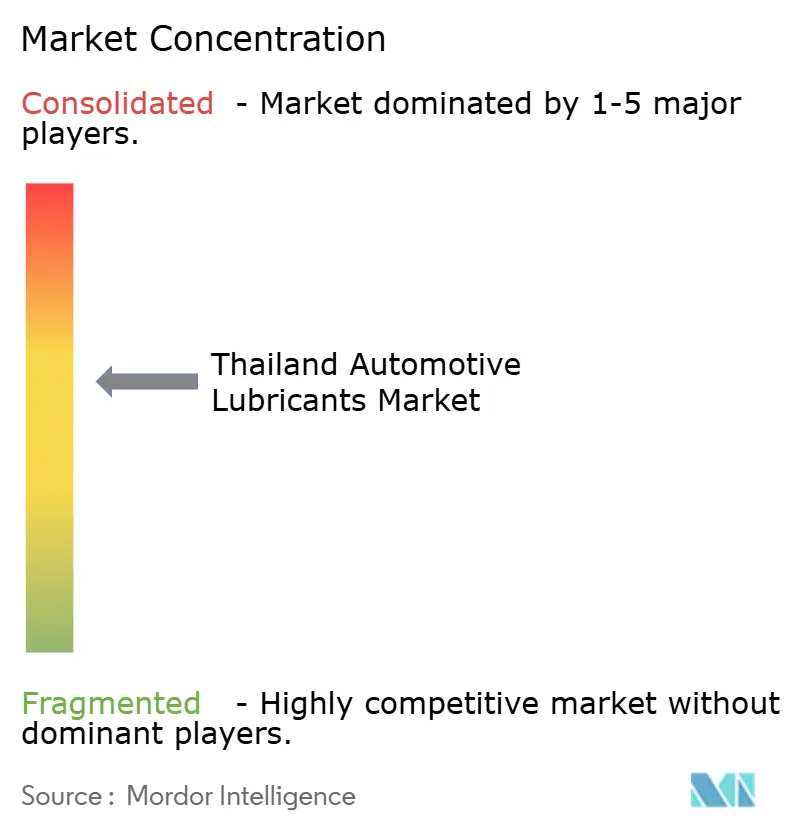
| Market Concentration | Medium |
Major Players *Disclaimer: Major Players sorted in no particular order Image © Mordor Intelligence. Reuse requires attribution under CC BY 4.0. | |
Thailand Automotive Lubricants Market Analysis by Mordor Intelligence
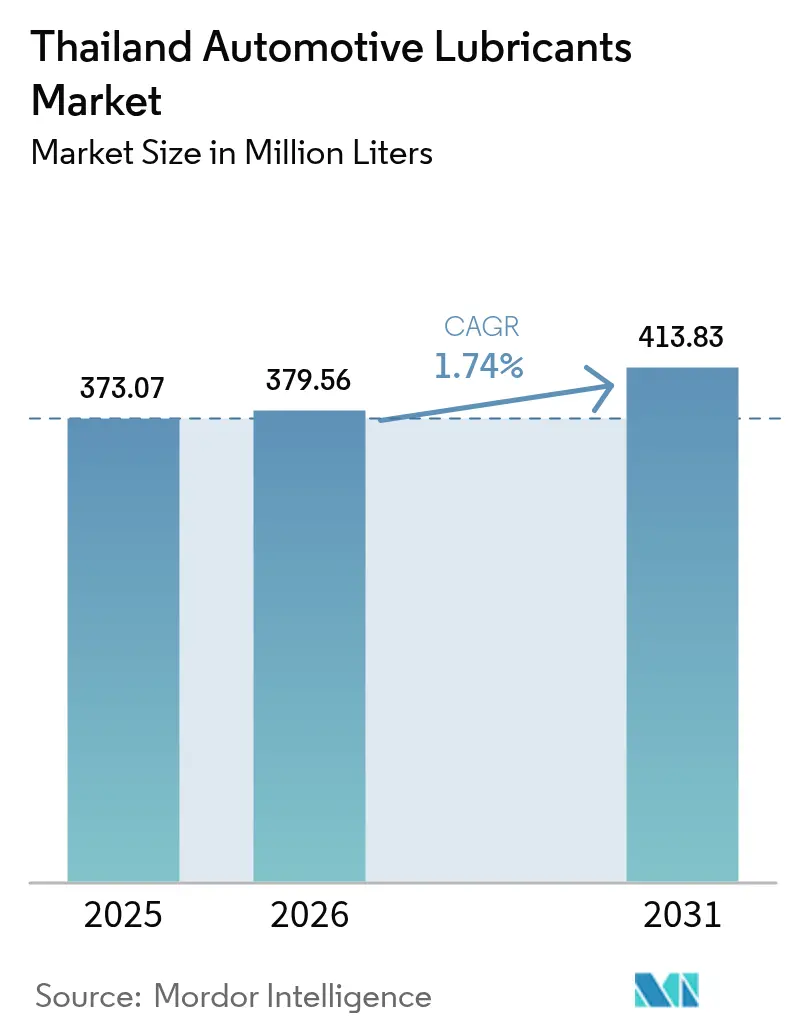
The Thailand Automotive Lubricants Market size is expected to grow from 373.07 million liters in 2025 to 379.56 million liters in 2026 and is forecast to reach 413.83 million liters by 2031 at 1.74% CAGR over 2026-2031. Healthy demand stems from Thailand’s role as Southeast Asia’s leading vehicle production center, the government’s 30@30 zero-emission vehicle target, and the continued dominance of two-wheelers, which together keep lubricant consumption resilient despite pressures from electrification. Switching to synthetic low-viscosity oils, logistics fleet expansion, and rigorous enforcement against counterfeit products are pivotal forces shaping competition. Major suppliers differentiate through OEM-approved formulations, solar-powered manufacturing, and extended-drain technologies that lower the total cost of ownership for fleets. Margin management remains critical as base-oil price swings and foreign-exchange shifts add raw-material risk, prompting smaller blenders to adopt consolidation or partnership strategies to secure scale.
Key Report Takeaways
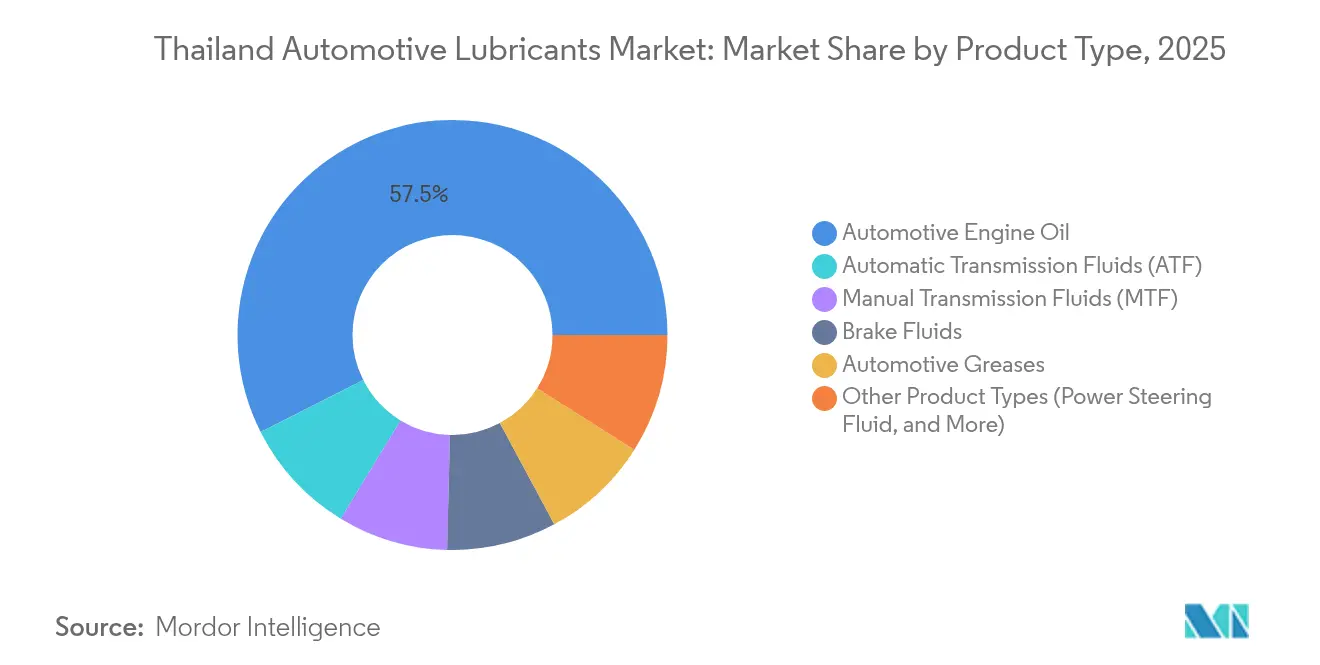
- By product type, automotive engine oil accounted for 57.45% of the market share in 2025; however, the demand for automatic transmission fluids (ATF) is expected to rise at the fastest CAGR of 2.05% during the forecast period (2026-2031).
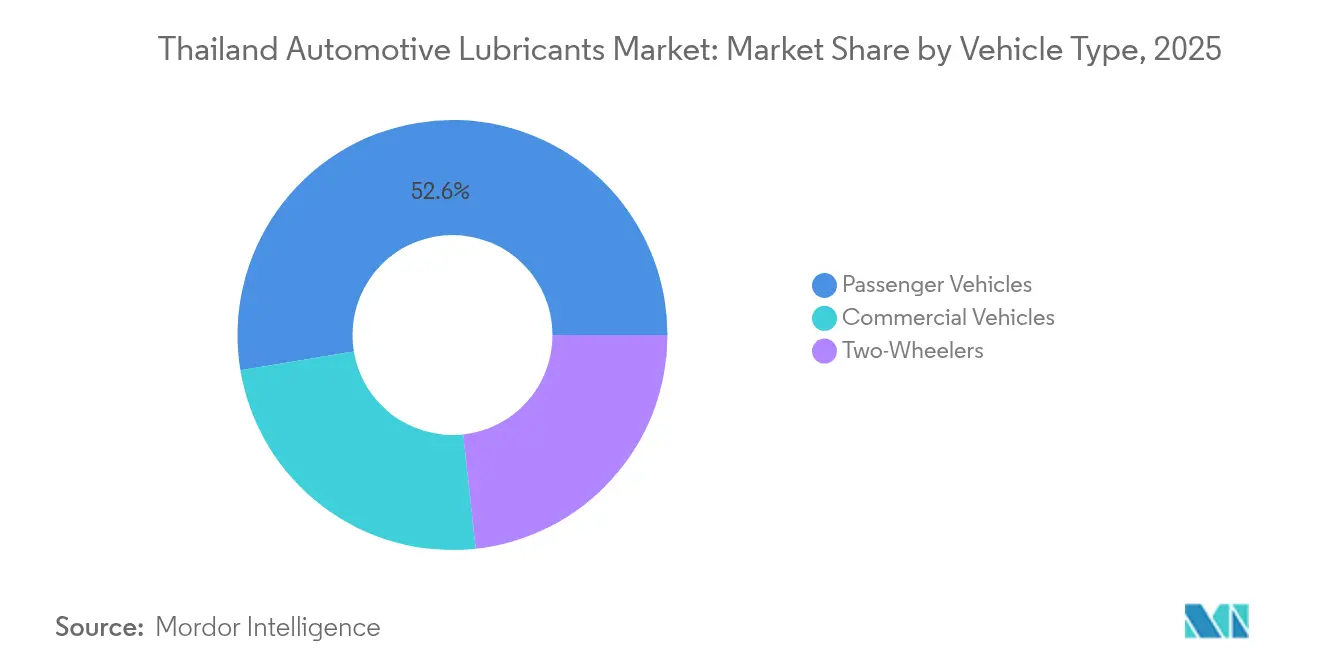
- By vehicle type, passenger vehicles held the largest share of the market at 52.62% in 2025. However, the lubricant demand for commercial vehicles is expected to grow at a CAGR of 2.12% during the forecast period (2026-2031).
Note: Market size and forecast figures in this report are generated using Mordor Intelligence’s proprietary estimation framework, updated with the latest available data and insights as of 2026.
Market Trends and Insights
Drivers Impact Analysis of Thailand Automotive Lubricants Market*
| Driver | (~) % Impact on CAGR Forecast | Geographic Relevance | Impact Timeline |
|---|---|---|---|
| Expanding commercial-vehicle fleet and infrastructure spend | +0.4% | National, with concentration in Bangkok, Eastern Economic Corridor | Medium term (2-4 years) |
| Rising shift toward synthetic, low-viscosity engine oils | +0.3% | National, with premium adoption in urban centers | Long term (≥ 4 years) |
| Growing motorcycle population and ride-hailing mileage | +0.5% | National, with highest intensity in Bangkok, Chiang Mai, Phuket | Short term (≤ 2 years) |
| OEM extended-drain service packages boosting high-margin oil uptake | +0.2% | National, focused on authorized dealer networks | Medium term (2-4 years) |
| Thailand's export-hub strategy for blending and re-export of lubes | +0.3% | Regional, serving ASEAN, India, and broader Asia-Pacific | Long term (≥ 4 years) |
| Source: Mordor Intelligence | |||
Expanding Commercial-Vehicle Fleet and Infrastructure Spend
Commercial freight tonnage continues to rise as rail-road projects and warehouse construction progress inside the Eastern Economic Corridor. Fleet operators demand longer-life, fuel-saving lubricants to reduce downtime, leading to bulk-order contracts that lock in product specifications across mixed truck brands[1]. Suppliers offering digital oil analytics garner a competitive advantage because predictive maintenance shortens workshop visits, a clear benefit for high-utilization route trucks. PTT Lubricants recorded a capacity utilization of over 260 million liters in 2025, driven by procurement from hauling companies linked to e-commerce networks. Foreign majors leverage Thailand’s free-trade access to backhaul packaged products across mainland ASEAN, creating incremental export volume while stabilizing domestic plant throughput. The trend is projected to preserve a positive lubricant demand baseline even as passenger-vehicle oil volumes plateau.
Rising Shift Toward Synthetic, Low-Viscosity Engine Oils
Tighter Euro 5 equivalent standards and rising pump prices are driving a consumer shift toward SAE 0W-20 and 5W-30 multigrade synthetics, which deliver measurable fuel savings. ExxonMobil targets a 10% annual sales growth in Thailand for Mobil 1, highlighting 15,000 km drain intervals and the benefits of improved engine cleanliness. Shell’s solar-powered grease plant exemplifies brand repositioning around sustainability credentials, reinforcing premium price points through environmental messaging. Authorized dealers bundle genuine oil into prepaid maintenance packages to capture aftermarket margins while assuring OEM warranty compliance. Although synthetics command higher shelf prices, the total cost of ownership favors the switch because fewer services offset the upfront expense. This dynamic gradually dilutes the mineral-oil volume share yet raises revenue per liter, supporting value growth within the Thai automotive lubricants market.
Growing Motorcycle Population and Ride-Hailing Mileage
Thailand registered 22.94 million motorcycles in 2024, with sub-125 cc commuters accounting for more than four-fifths of the output, thereby anchoring consistent demand for four-stroke engine oils. Delivery-app riders clock twice the monthly distance of private users, requiring more frequent oil changes that boost workshop traffic and retail sales. Automatic scooter output expanded 8.3% year-over-year, accelerating demand for scooter-specific transmission fluids optimized for continuously variable gearboxes. Lubricant brands with a deep penetration into convenience stores and independent garages remain best positioned, as these channels dominate refill purchases. Value-added packs, such as 1 liter plus a free spark-plug, drive loyalty among cost-conscious riders and reinforce volume resilience despite broader electrification narratives.
OEM Extended-Drain Service Packages
Global automakers competing for showroom share in Thailand promote service intervals of 15,000 to 20,000 km as a lifestyle convenience differentiator. PETRONAS co-developed premium formulations with Mercedes-Benz to meet the standards for turbocharged engine cleanliness, routing those fluids exclusively through branded workshops. Shell’s multi-year BMW contract secures factory fill and aftersales supply across dealerships, locking rivals out of high-margin segments[2]. Extended drains shift lubricant selection authority toward OEMs and away from drivers, rewarding suppliers with formal approvals and penalizing unlicensed blends that cannot document durability claims. While drain-interval lengthening slightly curbs liter demand, elevated per-unit prices compensate and reinforce premiumization within the Thailand automotive lubricants market.
Restraints Impact Analysis of Thailand Automotive Lubricants Market*
| Restraint | (~) % Impact on CAGR Forecast | Geographic Relevance | Impact Timeline |
|---|---|---|---|
| Base-oil price volatility and Foreign Exchange risk | -0.3% | National, with higher impact on import-dependent blenders | Short term (≤ 2 years) |
| Counterfeit / low-quality domestic brands eroding margins | -0.2% | National, with concentration in rural and price-sensitive segments | Medium term (2-4 years) |
| EV-subsidy programmes reducing long-term ICE-oil demand | -0.4% | National, with accelerated impact in urban centers and fleet segments | Long term (≥ 4 years) |
| Source: Mordor Intelligence | |||
Base-Oil Price Volatility and Foreign-Exchange Risk
Imported Group III base oils saw spot premiums widen in early 2025 after upstream refinery outages, squeezing gross margins for small blenders that lack term contracts. A stronger baht lowers import costs, yet currency whiplash complicates selling-price resets, especially in fragmented retail channels that resist frequent list-price changes. Integrated refiners counter swings by swapping cargos internally, whereas non-refining players hedge through futures or pass-through clauses in fleet contracts. Persistent volatility accelerates mergers as scale becomes vital for negotiating supply and absorbing inventory losses, thereby tilting competitive leverage toward major companies.
EV-Subsidy Programs Reducing Long-Term ICE-Oil Demand
Government incentives covering up to THB 10,000 per battery-electric car, along with local content mandates, support a rising share of zero-tailpipe-emission vehicles; penetration reached 19% by May 2025. Pure EVs eliminate the need for crankcase oil, placing a ceiling on future engine oil volume. Hybrid powertrains mitigate the impact by retaining smaller sump capacities; however, the direct electrification of taxi and delivery van fleets cannibalizes diesel oil demand. Lubricant makers respond by funding R&D for EV-thermal-management fluids and reduction-gear greases, aiming to offset declining ICE oil revenue streams after 2030 in the Thai automotive lubricants market.
*Our forecasts treat driver/restraint impacts as directional, not additive. The impact forecasts reflect baseline growth, mix effects, and variable interactions.
Thailand Automotive Lubricants Market Segment Analysis
By Product Type:
Engine-Oil Leadership Sustains, ATF OutpacesAutomotive Engine Oil contributed 57.45% of 2025 volume, underscoring its foundational role inside the Thailand automotive lubricants market size for core maintenance cycles. Motorcycle commuter fleets, passenger cars, and light pickups use multigrade mineral and semi-synthetic blends that accommodate tropical driving temperatures. The Thailand automotive lubricants market share for engine oil is expected to decline slightly as other fluids grow faster, yet absolute volumes remain substantial because the average vehicle age hovers near 11 years, and older models retain short drain intervals. Suppliers refresh portfolios with SP-grade formulations, zinc-phosphorus additives for cam-wear defense, and detergent packages designed for biodiesel blends prevalent in the Thai diesel pool.
Automatic Transmission Fluids posted a leading 2.05% CAGR outlook to 2031 as consumers embrace automatic gearboxes in city traffic. The automatic-scooter boom and rising CVT bikes extend ATF demand beyond passenger cars. Global OEMs jointly engineer proprietary friction modifiers to mitigate shudder and thermal breakdown, prompting Thai assemblers to specify factory-fill series that must be matched at service intervals. Local blenders pursue licensing deals to replicate additive chemistry under OEM code to retain dealership shelf access. Manual Transmission and Brake Fluids keep steady, while specialty steering fluids occupy a niche driven by premium models adding electric-hydraulic assist.

By Vehicle Type:
Passenger Car Dominance, Commercial Fleet MomentumPassenger Vehicles captured 52.62% of 2025 demand, mirroring Thailand’s mature car parc and active used-car trade that drives steady oil changes through independent service outlets. The segment’s Thailand automotive lubricants market size has gradually shifted from mineral 15W-40 toward 0W-20 synthetic, widening unit margins even as liters decline per service. Dealer-backed extended-drain packages and warranty-tied lubricants foster brand loyalty in newer cars, while older vehicles remain price-sensitive, providing independent garages with room to promote private-label blends. Two-wheelers remain volume stalwarts; however, high-mileage ride-hailing bikes intensify per-unit consumption, with several courier fleets adopting branded high-temperature formulations to mitigate the thermal stress caused by frequent stop-starts.
Commercial Vehicles are set to expand at a 2.12% CAGR through 2031, the fastest rate among vehicle classes. Freight modernization and the development of East-West economic corridors require longer-haul trucks to run higher average daily kilometers, compelling fleet owners to prioritize extended drain and fuel-efficient oils. The Thailand automotive lubricants market share of commercial vehicles therefore rises gradually, supported by engine-oil viscosity migration to CK-4 10W-30 that balances fuel savings with wear control. Bus operators in Bangkok’s clean-air program embrace low-ash formulations compatible with particulate filters, another area where suppliers with API FA-4 approvals can differentiate. This vehicle-mix transition underscores momentum toward performance-centric lubricants destined for heavy-duty cycles.
Geography Analysis
Bangkok’s metropolitan cluster accounts for more than one-third of the national lubricant turnover, driven by dense passenger-car ownership, an 8-million-strong motorcycle parc, and a hub-and-spoke freight network that feeds ecommerce warehouses. Dealers in the capital actively upsell synthetics, reflecting higher disposable income and traffic congestion that favors automatic gearboxes, which in turn lifts ATF volume. The adjacent Eastern Economic Corridor hosts engine and transmission plants that consume significant quantities of factory fill and process oils, linking domestic demand to export vehicle volumes. Central Plains provinces supply agricultural machinery that relies on diesel engine oils and hydraulic fluids, ensuring a rural baseline consumption across harvest cycles.
Northern tourist centers, such as Chiang Mai, generate significant turnover through rental scooters and ride-sharing fleets that rack up high mileage. Seasonal haze episodes encourage consumers to adhere to manufacturer drain intervals, bolstering workshop activity. Southern coastal zones, including Phuket, present similar two-wheeler intensity and marine-engine lubricant niches, enabling suppliers to diversify with corrosion-resistant multi-purpose greases. Cross-border trade lines funnel packaged oils into Laos, Myanmar, and Cambodia, making Thai distribution depots pivotal staging points for hinterland markets.
Export orientation further shapes geographic production patterns; Shell’s grease facility in Rayong ships to more than 40 Asia-Pacific destinations, while Thai Oil’s TOPNEXT International channels base oil cargoes to Vietnam and India, integrating Thailand into regional supply chains. Nationwide, the Thai Industrial Standards Institute enforces product quality through the AI-powered TISI Watch tool that flagged nearly 100,000 suspect online listings within five months, leveling the playing field in rural provinces previously vulnerable to counterfeit sales. As digital monitoring extends, legitimate brands gain from homogenous compliance standards across all customer catchments in the Thailand automotive lubricants market.
Regulatory Landscape
Thailand regulates automotive lubricants through the Fuel Trade Act B.E. 2543 administered by the Department of Energy Business (DOEB), Ministry of Energy. Engine oil producers, importers, and trademark holders must notify the regulator on product appearance and quality and obtain a certificate of approval before distribution. DOEB Notification B.E. 2565 (2022) sets technical specifications and restricts low performance categories, including prohibitions on API SA/SB for 4-stroke gasoline and API CA/CB for diesel oils. Renewal submissions are required ahead of expiry, with guidance noting a 60-day window in the DOEB process guidance.
Standards-setting and market surveillance are led by the Thai Industrial Standards Institute (TISI), Ministry of Industry, which maintains automotive lubricant standards including a two-stroke engine oil standard under the TIS system. In June 2024, the Ministry of Energy/DOEB conducted public hearings on the Oil Plan 2024 (B.E. 2567-2580), a national roadmap that includes fuel-management measures such as biofuel integration and the phase-out of certain fuel grades by 2025, reinforcing the need for lubricant suppliers to maintain compatibility with changing fuel and engine requirements alongside ongoing anti-counterfeit enforcement.
Value Chain Analysis
Thailand’s automotive lubricants value chain starts with base oils and additives (with Group II/III base oils often imported and sensitive to price and FX swings), followed by local blending, packaging, and quality control in Thailand, and then domestic distribution plus re-export into neighboring markets. Large suppliers and blenders differentiate with integrated capabilities, including R&D/QC labs, blending vessels, and filling lines; for example, local facilities referenced in the market ecosystem include batch blending and packaging operations designed to serve both retail packs and bulk fleet supply. Compliance is embedded early in the chain because DOEB approval is required for engine oils before distribution under the Fuel Trade Act, making documentation, testing, and traceability part of product launch and ongoing SKU management.
Downstream, distribution is anchored by a multi-channel network spanning fuel-station forecourts, authorized dealer workshops, independent garages, convenience-led retail, and fleet tenders, with exports supporting plant utilization for suppliers with regional reach. The competitive structure highlights the role of branded scale and nationwide retail footprints, while smaller blenders rely on contract manufacturing, private labels, and niche segments to access workshops and price-sensitive channels. Counterfeit risk and enforcement influence channel choices, pushing branded players toward authentication measures and controlled workshop networks where warranty-linked oils and extended-drain service programs lock in repeat demand.
Competitive Landscape
The Thailand Automotive Lubricants Market is moderately consolidated. Shell, ExxonMobil, and PETRONAS contest premium segments by linking lubricant technology to global OEM endorsements, embedding their products within warranty terms for BMW, Mercedes-Benz, and Honda. These alliances secure captive demand streams and raise entry barriers for challenger brands. Counterfeit suppression through TISI Watch tilts the battlefield in favor of brands that can verify authenticity using QR-code bottle seals, thereby narrowing gray-market leakage. Overall, competitive intensity is shifting toward technology, compliance, and multi-channel distribution models, collectively shaping the Thai automotive lubricants market.
Thailand Automotive Lubricants Industry Leaders
-
ExxonMobil Corporation
-
PTT Lubricants
-
Shell plc
-
BP p.l.c.
-
Chevron Corporation
- *Disclaimer: Major Players sorted in no particular order
Thailand Automotive Lubricants Market Companies Covered in this Report
- Bangchak Corporation
- BP P.l.c
- Chevron Corporation
- Exxon Mobil Corporation
- FUCHS
- Idemitsu Kosan Co. Ltd
- LIQUI MOLY
- Motul
- PETRONAS Lubricants International
- PTT Lubricants
- Saudi Arabian Oil Co.
- Shell plc
- Siam Pan Group Public Co.Ltd
- SK Enmove Ltd
- Thai Oil PLC
- TotalEnergies
Market Opportunities and Future Outlook
Premiumization and specification upgrades create whitespace in synthetic low-viscosity engine oils and driveline fluids as Thailand moves toward tighter emissions norms and OEM service strategies. The move toward higher performance categories is visible in Thailand with the adoption of API SQ and ILSAC GF-7A specifications across the market, evidenced by PTT Lubricants' 2025 certification for PERFORMA Super Synthetic 0W-20, enabling OEM warranty alignment and broader portfolio expansion where warranty compliance and extended-drain intervals influence lubricant choice. Automatic transmission fluids and CVT-related fluids also stand out as vehicles shift toward automatic gearboxes, raising the importance of OEM-approved friction-modifier chemistry and dealer-fit service offerings.
Manufacturing localization and export-oriented supply chains are expanding, supported by capacity and footprint additions. LIQUI MOLY began local production of motor oils in Thailand in September 2025, its first motor-oil production site outside Germany, to serve Thailand and broader Asian markets, while EV adoption under Thailand’s 30@30 direction redirects R&D and go-to-market focus toward EV thermal-management fluids and specialty greases, and DOEB and TISI quality frameworks plus digital monitoring against counterfeit products reinforce the advantage of compliant, traceable products across both domestic and cross-border channels.
Recent Industry Developments in Thailand Automotive Lubricants Market
- April 2026: PTT Lubricants launched the Power to Last Longer product line in Bangkok as part of a broader brand repositioning. The rollout strengthens the company's premium lineup across domestic workshops and export channels.
- November 2025: PTT Lubricants secured API SQ and ILSAC GF-7A certification for its PERFORMA Super Synthetic 0W-20 engine oil, enabling OEM warranty alignment and broader market acceptance.
- July 2024: Shell announced an investment to expand and improve its grease manufacturing plant in Thailand, lifting capacity from 5,000 tonnes to 15,000 tonnes per year and connecting regional markets across Asia-Pacific.
Thailand Automotive Lubricants Market Report Scope and Research Methodology
Market Definition and Coverage
For this study, the market covers lubricants and related automotive fluids used to operate and maintain on-road vehicles in Thailand, measured as annual consumption across factory fill and service fill.
Scope exclusions: Lubricants used in industrial machinery, marine, power generation, and other non-automotive equipment are not counted.
Segments Covered in This Report
- By Product Type
- Automotive Engine Oil
- 0W-XX
- 5W-XX
- 10W-XX
- 15W-XX
- Monogrades
- Other Grades
- Manual Transmission Fluids (MTF)
- Automatic Transmission Fluids (ATF)
- Brake Fluids
- Automotive Greases
- Other Product Types (Power Steering Fluid etc.)
- Automotive Engine Oil
- By Vehicle Type
- Passenger Vehicles
- Commercial Vehicles
- Two-Wheelers
Data Sources, Market Sizing, and Validation
Desk Research
Desk research was used to build the starting demand picture and to keep assumptions consistent across vehicle types and lubricant categories. We mainly leaned on public statistics and standards content, such as Thailand vehicle production and registrations reported by government agencies, customs trade series for base oils and additives, and technical specifications published by standards bodies and OEM-facing documents.
To avoid over-counting, secondary sources were also used to map typical drain intervals, sump sizes, and viscosity grade mix that influence annual liters consumed, especially as low-viscosity oils and longer drain practices expand. We also reviewed sources such as academic journals on lubricant performance, association publications on automotive servicing patterns, and publicly available company filings and investor presentations to understand channel structure and the pricing direction at category level. In a few places, paid subscriptions for company financials and shipment-level trade screening were used only for cross-checking, and the sources listed here are illustrative since many other references were used for validation and clarification.
Primary Interviews and Surveys
Primary work was used to pressure-test desk assumptions and fill gaps that public sources do not explain well, such as the split between factory fill and service fill, channel margins, and how quickly synthetics are replacing mineral oils in each vehicle group. We spoke with lubricant blenders and distributors, workshop networks, fleet maintenance heads, and industry specialists across Thailand so the model reflects real servicing behavior and not only production headlines.
Distribution of primary research fieldwork respondents
| Company type | Respondent position |
|---|---|
| Top tier: 31% | CXOs: 12% |
| Mid tier: 55% | Functional/Unit leaders: 41% |
| Smaller Players: 14% | Managers: 47% |
Market-Sizing & Forecasting
Sizing starts with a top-down demand pool build, where Thailand vehicle parc and annual utilization are translated into lubricant consumption using service intervals and typical fill volumes by vehicle class. That demand is then distributed across core automotive lubricant groups used in the country, including engine oils (by viscosity grades), manual and automatic transmission fluids (MTF and ATF), brake fluids, greases, and other supporting vehicle fluids.
A few inputs do most of the work in the model, and they were selected because they are observable and explain liters in plain terms. These include vehicle population by type (passenger, commercial, and two-wheelers), average annual kilometers and duty cycle, oil drain intervals, sump or system fill volumes, and the mix shift toward synthetic and lower-viscosity grades that can change drain behavior. Pricing and value translation are handled with an average selling price build that follows base oil and additive cost direction and the typical premium spread between mineral, semi-synthetic, and synthetic products.
For forecasting, we rely on scenario analysis with a light regression check against mobility and macro indicators, and then the trajectory is adjusted based on interview consensus. Bottom-up approximations are used as a cross-check, such as supplier roll-ups from public disclosures, channel checks on workshop throughput, and sampled price points by product category, and gaps are handled by using conservative ranges that are tightened only after primary feedback confirms the likely case.
Data Validation & Update Cycle
Before numbers are finalized, outputs are triangulated against independent signals, such as vehicle production and registration trends, the implied per-vehicle annual liters the model produces, and the direction of total lubricant demand reported in public commentary. When an input change creates an unusual jump, it is reviewed again and then traced back to the assumption that drove it, followed by follow-up calls if the variance cannot be explained by a known market event.
A second analyst review is completed before sign-off so arithmetic, units, and conversion logic stay consistent across the workbook. The report is refreshed annually, and interim updates are made when material shifts occur, for example sharp base oil price changes, major policy moves, or unexpected swings in vehicle production. Before delivery, an analyst runs a final data pass so clients receive the latest updated view.
Mordor Intelligence's Thailand Automotive Lubricants Market Estimate Compared With Other Published Estimates
Published market numbers for Thailand automotive lubricants can vary, and the gap usually comes from how each publisher defines the product basket and the demand pool being sized. Differences also show up when one source reports volume and another reports value, or when currency timing and price assumptions are refreshed at different points in the year.
Some external estimates describe total lubricants consumption in Thailand, which can include industrial and other non-vehicle uses that lift the headline number. The spread narrows when the count is limited to on-road automotive lubricant categories and then tied back to vehicle parc, drain intervals, and typical fill volumes, a scope filter applied by Mordor Intelligence.
Benchmark comparison
| Source | Market Size | Gaps in Research Methodology |
|---|---|---|
| Mordor Intelligence | USD 379.56 M (2026) | |
| Trade Journal A | USD 456.00 M (2025) | Reported as Thailand total lubricants consumption in kilolitres, so it can include non-automotive demand and does not separate factory fill from service fill before totaling. |
| Industry Journal B | USD 455.70 M (2023) | Uses national total lube consumption as the demand base, and the figure is not reconciled back to vehicle parc, drain intervals, and automotive-only product categories. |
The comparison indicates that scope is the main driver of the spread, since a total lubricants view will naturally be larger than an automotive-only build. By keeping the calculation traceable to vehicle and servicing inputs and then cross-checking with channel and supply signals, the final number stays practical to revisit as Thailand vehicle mix and drain practices change.
Key Questions Answered in the Report
What is the current size of the Thailand automotive lubricants market?
The market recorded 379.56 million liters in 2026 and is projected to reach 413.83 million liters by 2031.
How fast is the market expected to grow?
Volume is forecast to expand at a 1.74% CAGR between 2026 and 2031, supported by fleet expansion and synthetic-oil adoption.
Which product type dominates consumption?
Engine Oil leads with 57.45% share of 2025 sales, driven by Thailand’s large motorcycle and passenger-car parc.
Why are automatic transmission fluids growing faster?
Rising adoption of automatic gearboxes in cars and scooters pushes ATF demand at a forecast 2.05% CAGR through 2031.
How will EV adoption affect lubricant demand?
Electric vehicles cut engine-oil volumes long term, yet new opportunities emerge for EV-specific thermal-management fluids.