
Consumer Goods And Retail Testing, Inspection, And Certification Market Size and Share
Market Overview
| Study Period | 2020 - 2031 |
|---|---|
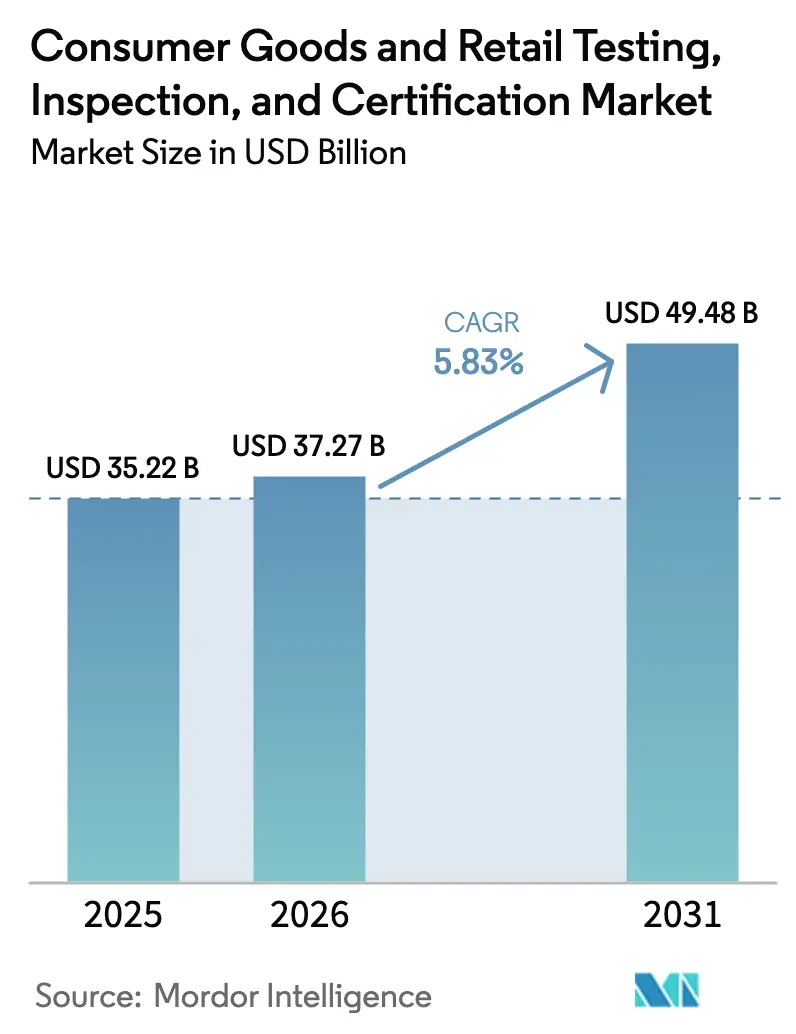
| Market Size (2026) | USD 37.27 Billion |
| Market Size (2031) | USD 49.48 Billion |
| Growth Rate (2026 - 2031) | 5.83 % |
| Fastest Growing Market | Asia Pacific |
| Largest Market | Asia Pacific |
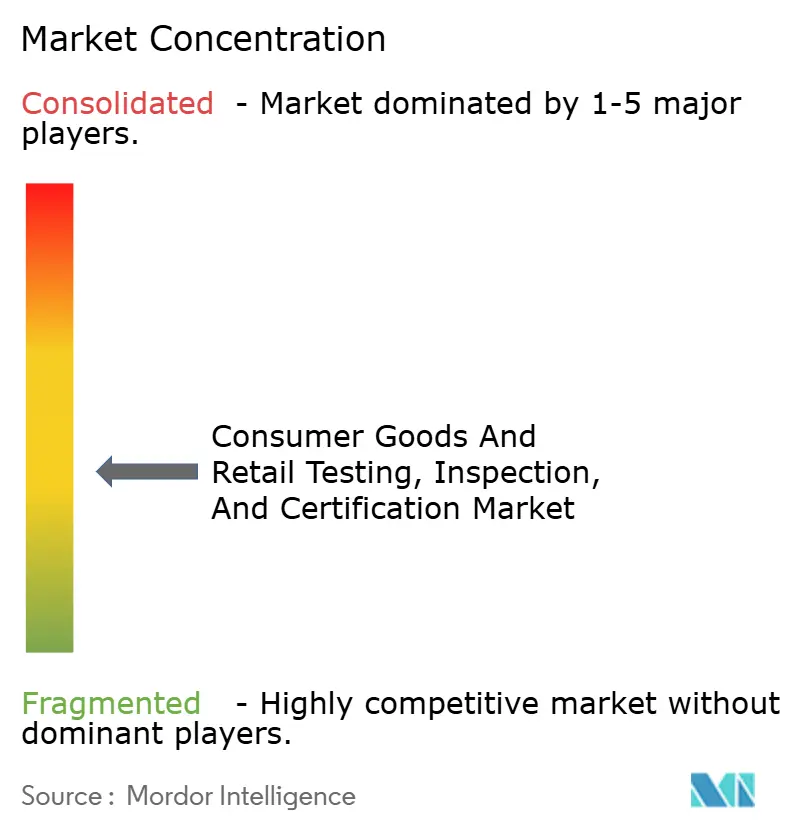
| Market Concentration | Medium |
Major Players *Disclaimer: Major Players sorted in no particular order Image © Mordor Intelligence. Reuse requires attribution under CC BY 4.0. | |
Consumer Goods And Retail Testing, Inspection, And Certification Market Analysis by Mordor Intelligence
The consumer goods and retail testing, inspection, and certification market size is expected to grow from USD 35.22 billion in 2025 to USD 37.27 billion in 2026 and is forecast to reach USD 49.48 billion by 2031 at 5.83% CAGR over 2026-2031. Rising global trade, mandatory product-safety rules, and expanding ESG verification mandates sustain non-discretionary demand, while cross-border e-commerce and novel foods regulation introduce fresh revenue pools for established players. Asia-Pacific’s manufacturing dominance and tightening regional frameworks accelerate service uptake, whereas North America and Europe rely increasingly on digital inspection and sustainability validation to re-ignite growth. Outsourcing persists as the preferred sourcing model because it frees capital and grants rapid access to specialized laboratories. Despite steady consolidation attempts, the sector stays fragmented, encouraging bolt-on M and A that lets global brands fill portfolio gaps in cybersecurity, AI-enabled inspection, and sustainability assurance.
Key Report Takeaways
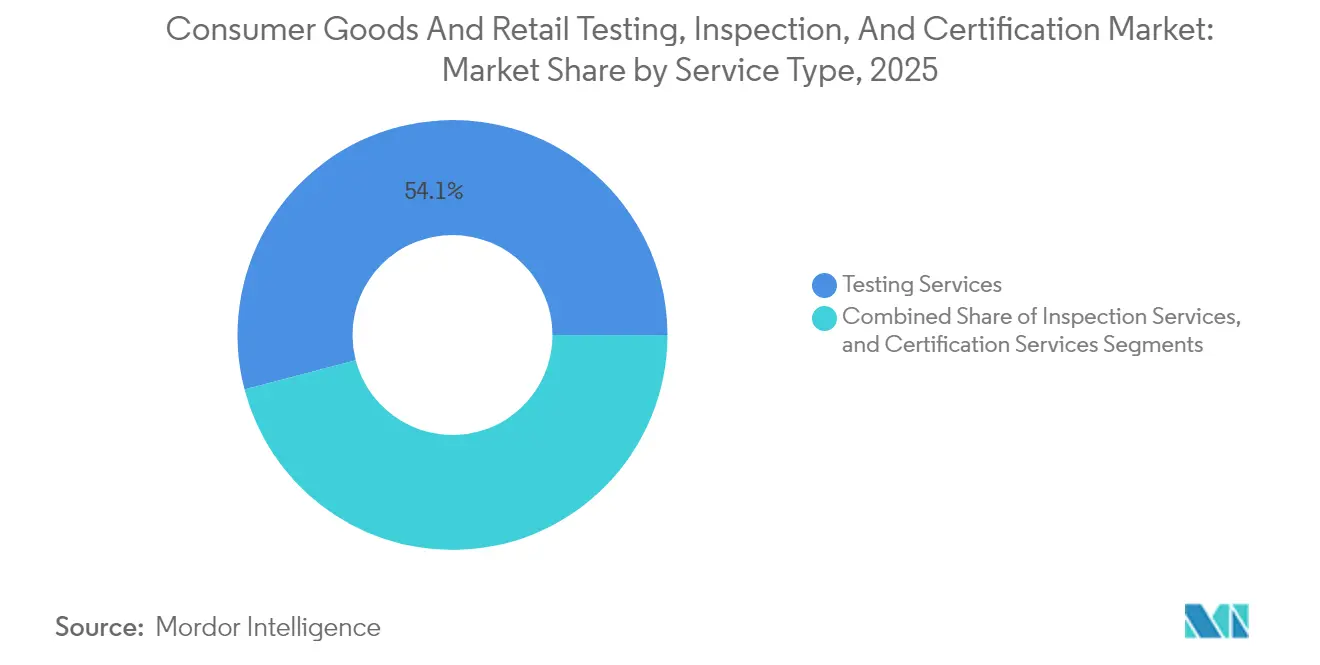
- By service type, testing services led with a 54.07% revenue share in 2025, while certification services are forecast to expand at a 6.28% CAGR through 2031.
- By sourcing type, the outsourced model commanded 63.52% of the consumer goods and retail testing, inspection, and certification market share in 2025, and is advancing at a 6.01% CAGR to 2031.
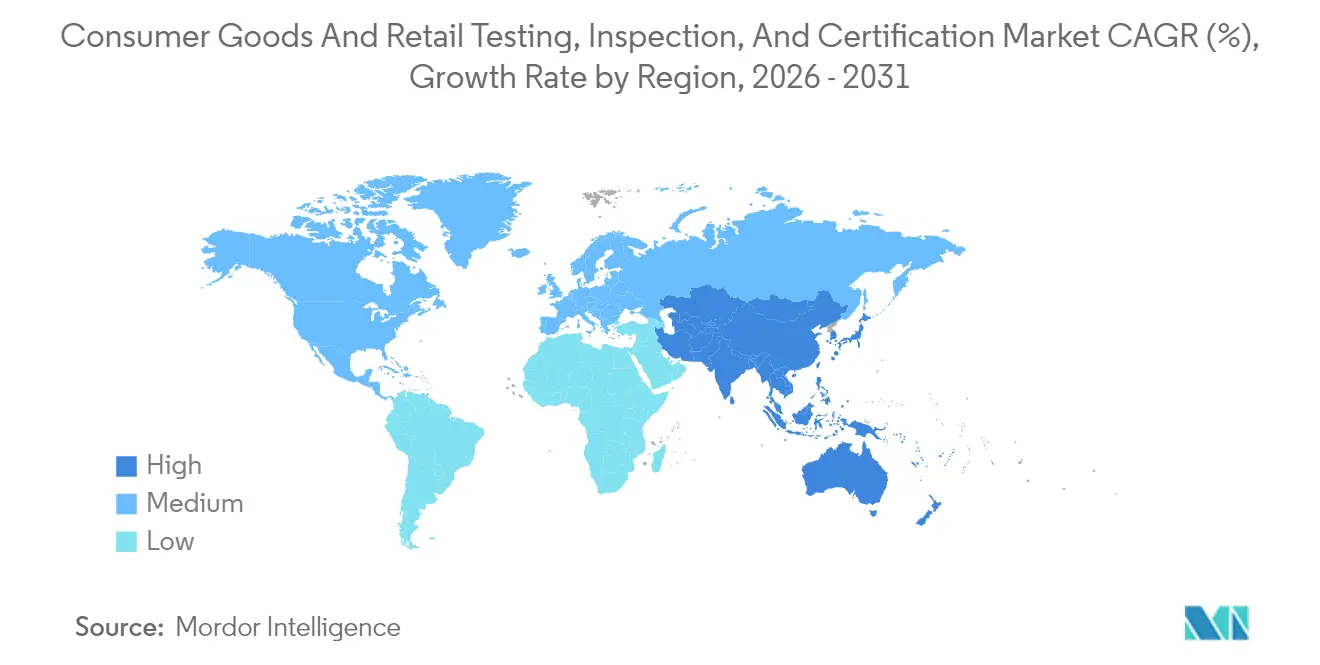
- By geography, Asia-Pacific captured 41.72% of 2025 revenue and is projected to post the fastest 6.41% CAGR through 2031.
Note: Market size and forecast figures in this report are generated using Mordor Intelligence’s proprietary estimation framework, updated with the latest available data and insights as of 2026.
Market Trends and Insights
Drivers Impact Analysis of Consumer Goods And Retail Testing, Inspection, And Certification Market*
| Driver | (~) % Impact on CAGR Forecast | Geographic Relevance | Impact Timeline |
|---|---|---|---|
| Stringent sustainability and traceability mandates | +1.2% | Global, with the EU and North America leading | Medium term (2-4 years) |
| Rise of direct-to-consumer (D2C) private-label brands | +0.8% | Global, concentrated in North America, Europe, Asia-Pacific | Short term (≤ 2 years) |
| Integration of AI-enabled automated visual inspection | +0.6% | Asia-Pacific core, spill-over to North America and Europe | Long term (≥ 4 years) |
| Growth in cross-border e-commerce product flows | +0.9% | Global, with Asia-Pacific export hubs and Western import markets | Short term (≤ 2 years) |
| Expansion of food safety regulations on novel foods | +0.5% | EU, North America, Singapore, China | Medium term (2-4 years) |
| Demand for ESG-verified consumer goods funding access | +0.7% | Global, with emphasis on the EU and North America | Medium term (2-4 years) |
| Source: Mordor Intelligence | |||
Stringent Sustainability and Traceability Mandates
Third-party verification has become pivotal as the EU Corporate Sustainability Due Diligence Directive, the Corporate Sustainability Reporting Directive, and the U.S. Uyghur Forced Labor Prevention Act push companies to document environmental and social integrity throughout supply chains. Supply chains account for nearly 80% of consumer-goods emissions, so upstream audits and lifecycle assessments have shifted from optional to obligatory service lines. TIC providers offering material tracing, forced-labor screening, and biodiversity impact attestations now command long-term annuity-like contracts. These mandates also drive demand for digital chain-of-custody platforms that embed audit data directly into ESG reports, strengthening switching costs for accredited labs. As regulators widen the scope to circular-economy metrics, certification revenues diversify beyond classic safety testing.[1]
Rise of Direct-to-Consumer Private-Label Brands
Thousands of D2C merchants now lean on marketplace dashboards such as Amazon’s Manage Your Compliance, which, since April 2024, requires third-party certification for dietary supplements before listings go live. Lean teams with tight launch calendars favor turnkey bundles that combine specification checks, label reviews, and customs clearance in a single workflow. Platforms like Factored Quality cut typical onboarding by three months and slash compliance costs by USD 10,000 per stock-keeping unit, rewarding TIC firms that provide API-driven documentation feeds. The surge of micro-brands, therefore, transforms the consumer goods and retail testing, inspection, and certification market into a volume business with rapid-response labs.
Growth in Cross-Border E-Commerce Product Flows
Cross-border sellers must juggle U.S. FCC electromagnetic-compatibility reports, EU CE marking, United Kingdom UKCA labels, and packaging producer-responsibility filings, often for a single shipment. Sellers lacking in-house regulatory teams turn to global TIC networks that promise harmonized protocols across 1,000+ accreditations. SGS, operating the world’s broadest authorization portfolio, leverages this edge to secure multi-year contracts with platforms like TEMU that route millions of parcels daily. The complexity of e-commerce rules, therefore, converts fragmented one-off testing orders into recurring engagements, lifting average revenue per client across the testing, inspection, and certification market.
Integration of AI-Enabled Automated Visual Inspection
Machine-learning algorithms embedded in cameras now pinpoint micron-level defects and measure tolerances at line speed, often surpassing human inspectors. TIC companies validate these systems, calibrate sensors, and issue algorithm-performance certificates demanded by regulators worried about opaque AI models. While automation mitigates labor shortages, the constant connectivity of vision systems exposes production lines to cyber risk, spurring new service demand for vulnerability assessments under the EU Cyber Resilience Act. The intertwining of AI accuracy testing and cybersecurity assurance unlocks dual-revenue streams and cements technology governance as a growth pillar.
Restraints Impact Analysis of Consumer Goods And Retail Testing, Inspection, And Certification Market*
| Restraint | (~) % Impact on CAGR Forecast | Geographic Relevance | Impact Timeline |
|---|---|---|---|
| Fragmented regulatory regimes across emerging markets | -0.4% | Africa, Latin America, Southeast Asia | Long term (≥ 4 years) |
| Shortage of qualified TIC talent in specialised verticals | -0.6% | Global, acute in North America and Europe | Medium term (2-4 years) |
| High cost of real-time testing instrumentation | -0.3% | Global, particularly affecting smaller TIC providers | Short term (≤ 2 years) |
| Cybersecurity risks in connected inspection devices | -0.2% | Global, concentrated in IoT-heavy manufacturing regions | Long term (≥ 4 years) |
| Source: Mordor Intelligence | |||
Shortage of Qualified TIC Talent in Specialized Verticals
Food-safety auditors, sustainability verifiers, and cybersecurity testers require multi-year training in HACCP, FSMA, novel foods, ISO 27001, and secure-code review. Surveys show vacancy rates topping 20% in North American food labs, forcing providers to defer projects and lengthen turnaround times.[2]The talent gap widens as ESG and AI validation standards multiply faster than training pipelines. Firms react by acquiring boutique specialists and partnering with universities, yet these measures deliver capacity only after long lead times, capping near-term revenue capture in the testing, inspection, and certification market.
Fragmented Regulatory Regimes Across Emerging Markets
TIC firms entering Africa or Latin America face country-specific standards that duplicate testing and erode scale economies. Nigeria and Kenya require local lab accreditation, while Brazil’s medical-device rule changes obligate fresh audits even for previously cleared products. Duplicate protocols inflate client costs, leading some exporters to bypass smaller markets altogether. Although regional harmonization initiatives are underway, progress remains slow, deferring the efficiencies global players enjoy in more unified jurisdictions.
*Our forecasts treat driver/restraint impacts as directional, not additive. The impact forecasts reflect baseline growth, mix effects, and variable interactions.
Consumer Goods And Retail Testing, Inspection, And Certification Market Segment Analysis
By Service Type – Testing Services Hold Scale as Certification Accelerates
Testing services represented 54.07% of 2025 revenue in the testing, inspection, and certification market, underscoring the enduring priority of verifying electrical safety, chemical composition, and mechanical resilience before goods ship to retailers. Mandatory protocols such as IEC 62368-1 and ISO 10993 compel manufacturers of electronics and medical devices to submit samples, often at multiple production stages. Multinational laboratories capitalize on high fixed-asset utilization, while regional specialists thrive by focusing on fast-turnaround consumer-goods batches. Certification services, however, deliver the fastest 6.28% CAGR, fueled by investors and regulators who now require independent validation of climate claims, ethical sourcing, and circular-design credentials. The pivot toward certification also raises margin profiles: documentation review and factory audits command premium pricing despite lighter capital requirements, widening EBIT spreads for providers that re-train staff into auditors.
Growing anti-greenwashing rules across Europe and California’s Truth in Labeling for Recyclable Materials Act propel demand for cradle-to-gate carbon-footprint stamps, while financial institutions embed third-party ESG ratings into lending covenants. These shifts elevate certification from a compliance afterthought to a gatekeeper for brand access to capital. The consumer goods and retail testing, inspection, and certification market size linked to sustainability credentials could therefore double relative to legacy safety scopes by 2030. Players that combine laboratory test data with auditor insights gain a one-stop advantage, further differentiating themselves from firms confined to physical test reports.

By Sourcing Type – Outsourcing Dominates as Hybrid Models Emerge
Outsourcing accounted for 63.52% of the consumer goods and retail testing, inspection, and certification market size in 2025, confirming that even high-volume manufacturers favor variable cost structures over owning lab assets. Outsourced demand accelerated during pandemic-era supply disruptions, when flexible capacity let brands reroute production without building new clean rooms or EMC chambers. Small and mid-size D2C labels essentially begin life with an outsourced-only mindset, embedding testing fees into cost-of-goods instead of capex budgets. Hybrid models nonetheless gain traction among automotive and semiconductor giants: they maintain pilot-line labs for R and D confidentiality but dispatch full-run samples to accredited partners for formal compliance certificates.
ISO 17025 accreditation and traceability to national measurement institutes remain decisive in vendor selection, because any non-conformance can trigger customs holds. Large TIC providers extend differentiation by integrating lab information management systems (LIMS) that feed real-time dashboards to brand portals, reducing administrative friction. Start-ups focused on AI-driven test data analytics complement the model by offering predictive failure insights based on pooled results, which creates a secondary advisory revenue line inside the testing, inspection, and certification industry.
Geography Analysis
APAC Consumer Goods and Retail Testing, Inspection, and Certification Market
Asia-Pacific anchored 41.72% of global revenue in 2025 and will expand at a 6.41% CAGR through 2031 thanks to manufacturing depth and rising domestic quality expectations. China’s National Health Commission tightened novel-foods safety dossiers in 2024, obliging importers and local innovators to submit toxicology, allergenicity, and nutritional-equivalence data before market entry, driving laboratory backlogs. India’s electronics and textile exporters must now navigate BIS marks plus parallel FCC and CE approvals, boosting demand for multi-jurisdiction bundling. Southeast Asia benefits from supply-chain diversification as brands pivot from single-country sourcing, requiring audits across Vietnam, Indonesia, and Thailand to ensure standard consistency.
Europe and North America Consumer Goods and Retail Testing, Inspection, and Certification Market
Europe and North America exhibit lower absolute growth, yet sustainability and cyber-resilience statutes invigorate specialized services. The EU Corporate Sustainability Reporting Directive obliges roughly 50,000 companies to file third-party-verified ESG statements starting FY 2025. Simultaneously, the forthcoming Cyber Resilience Act sets baseline security thresholds for connected products, creating incremental testing volume for firmware, penetration, and vulnerability assessments. In North America, federal incentives for renewable-energy projects under the Inflation Reduction Act create a pipeline of wind-turbine and solar-module certifications, while the National Institute of Standards and Technology refreshes its cybersecurity framework, raising demand for IoT assurance audits.
MEA and LATAM Consumer Goods and Retail Testing, Inspection, and Certification Market
The Middle East and Africa present nascent opportunities, with Saudi Arabia’s Vision 2030 industrial clusters mandating pre-shipment inspections and factory audits. Nonetheless, fragmented local standards in Africa raise transaction costs as TIC firms must duplicate tests. Regional economic communities consider harmonization, yet implementation timelines remain long-term. Latin America’s story is mixed: Mexico’s automotive hub sustains steady EMC and component-fatigue testing, whereas inconsistent rule changes in smaller economies deter broad laboratory investments.
Regulatory Landscape
Regulation in consumer goods and retail TIC is increasingly shaped by product safety, chemicals, sustainability, and digital-compliance requirements that call for third-party evidence. In the European Union, Regulation (EU) 2023/988 (General Product Safety Regulation, GPSR) replaced the General Product Safety Directive from December 2024, and the European Commission continued operationalizing supporting standards through Implementing Decision (EU) 2026/901 (April 2026). This reinforces demand for harmonized test reports and certification documentation for products sold in the bloc.
In the United States, the Consumer Product Safety Commission (CPSC) framework for General Use Products requires compliance testing and certification, and it is moving administrative compliance toward electronic processes. The CPSC mandated electronic filing of certificates of compliance for general use products starting July 8, 2026, which increases the value of auditable digital documentation flows from accredited laboratories and inspection bodies. Chemical and materials obligations in major importing markets (for example, EU RoHS and REACH substance reporting) continue to draw TIC providers into deeper bill-of-materials verification and supply-chain declarations, not just end-product testing.
Value Chain Analysis
The value chain starts with consumer-goods and private-label brand owners defining product specifications and sourcing through contract manufacturers and multi-tier suppliers. It then moves through pre-compliance support such as requirements mapping, test planning, and sample preparation, before accredited laboratory testing, on-site inspections, and third-party certification. Outputs flow into retailer and marketplace compliance gates, customs clearance, and post-market surveillance workflows, where documentation management increasingly differentiates providers as regulators and platforms ask for structured, verifiable evidence rather than static PDFs.
TIC providers operate in the middle of this chain as orchestrators of test execution, audit programs, and certificate issuance. Instrument OEMs, reference-material suppliers, and accreditation bodies support capacity and credibility. Investments in local lab infrastructure near production clusters shorten lead times and improve responsiveness for trade compliance, including SGS inaugurating a petrochemical laboratory in China (July 2026) to support quality testing and compliance needs in an industrial hub. As electronic certificate filing expands (for example, the CPSC e-filing mandate effective July 2026), integration between LIMS, client portals, and customs-facing documentation pushes software and data-governance capabilities further into the TIC service stack.
Competitive Landscape
The top four providers – SGS, Eurofins, Bureau Veritas, and Intertek – jointly control a majority of global revenue, underlining the fragmented nature of the testing, inspection, and certification market. SGS posted USD 7.9 billion in 2024 revenue, leveraging more than 1,000 government accreditations to win multi-site contracts that smaller firms struggle to replicate. Eurofins matches SGS in turnover but concentrates on bioanalytical and food domains, while Bureau Veritas and Intertek diversify across industrial, consumer, and infrastructure verticals. The collapsed USD 30 billion SGS-Bureau Veritas merger in January 2025 illustrated both appetite and practical limits for mega-deals, particularly due to overlapping client bases and antitrust scrutiny.[4]
M and A strategies therefore tilt toward bolt-on deals: Bureau Veritas bought South Korea’s ONETECH, KOSTEC, and India’s Hi Physix Laboratory in March 2024, enlarging its electronics testing footprint for a combined EUR 20 million (USD 21.6 million). SGS closed 92 small acquisitions since 2019, most recently adding India’s Accutest Laboratories in January 2025 to solidify pharmaceutical and environmental testing capacity. Intertek’s April 2025 purchase of Automation Technology Inc. targets functional-safety and cybersecurity validation for Industry 4.0 control systems. Technology spend focuses on AI-vision platforms, digital client portals, and blockchain traceability tools, with providers racing to automate manual steps and cut chronic talent bottlenecks.
White-space opportunities cluster around sustainability assurance, IoT security, and novel-foods toxicology. Demand outstrips supply, creating pricing power for labs with specialized chemists or ethical-audit teams. However, the capital intensity of advanced instrumentation and the difficulty of hiring subject-matter experts temper expansion speed, suggesting continued fragmentation and ongoing acquisition activity throughout the forecast window.
Consumer Goods And Retail Testing, Inspection, And Certification Industry Leaders
-
Intertek Group PLC
-
SGS SA
-
Bureau Veritas SA
-
TÜV SÜD AG
-
TÜV Rheinland AG
- *Disclaimer: Major Players sorted in no particular order
Consumer Goods And Retail Testing, Inspection, And Certification Market Companies Covered in this Report
- SGS SA
- Bureau Veritas SA
- Intertek Group plc
- TÜV SÜD AG
- TÜV Rheinland AG
- UL Solutions Inc.
- Eurofins Scientific SE
- ALS Limited
- DEKRA SE
- DNV AS
- TÜV NORD GROUP
- Applus+ Services S.A.
- Kiwa N.V.
- QIMA Ltd.
- Cotecna Inspection SA
- Hong Kong Standards and Testing Centre
- NSF International
- China Certification and Inspection Group
- Mistras Group Inc.
- Core Laboratories N.V.
- SGS Taiwan Ltd.
- Baltazar Testing Labs SA
- RINA S.p.A.
- Intertek Testing Services NA Inc.
- UL India Private Ltd.
Read Analysis of Consumer Goods And Retail Testing, Inspection, And Certification Companies
Market Opportunities and Future Outlook
Compliance digitization and proof-of-conformity workflows open whitespace for TIC providers to package testing, certification, and data exchange into retailer- and regulator-ready outputs. The U.S. CPSC shift to mandatory electronic filing of general use product certificates starting July 8, 2026 expands demand for end-to-end documentation services (certificate generation, record retention, and submission support) alongside core testing, particularly for cross-border sellers and marketplace-first brands without in-house regulatory operations.
EU assurance needs are also extending beyond classic safety testing into sustainability, materials, and supply-chain evidence. Enforcement-linked programs create immediate service demand where Notified Body or equivalent conformity assessment is required. Intertek reporting initial compliance certificates tied to the EU Battery Regulation (EU) 2023/1542 (July 2026) indicates growing third-party assessment within battery-related consumer product launch processes. At the same time, the EU GPSR implementation pathway, including Commission Implementing Decision (EU) 2026/901 in April 2026, supports opportunities for providers that can map product categories to harmonized standards quickly and maintain reusable technical files across multi-country distribution. On the supply side, capacity placement near industrial clusters, including SGS opening a petrochemical laboratory in China in July 2026, points to ongoing demand for nearer-to-source testing and inspection that reduces turnaround time for high-volume trade flows.
Recent Industry Developments in Consumer Goods And Retail Testing, Inspection, And Certification Market
- March 2026: SGS SA acquires Murray-Brown Laboratories to expand food safety, nutraceutical testing and related capabilities in North America. The acquisition enlarges food safety and nutraceutical testing capacity in the region. This strengthens SGS's North American footprint and broadens its portfolio in high-margin testing services.
- November 2025: Intertek acquires Suplilab in Costa Rica to broaden ATIC footprint in food safety and medical device testing in Central America. The expansion adds regional testing capacity for food safety and medical devices. It improves coverage in Central America, supporting demand linked to growing cross-border trade and regulatory requirements.
- July 2025: Bureau Veritas signs agreements to acquire Institute For Cyber Risk in Denmark and EcoPlus in South Korea for cybersecurity and Life Cycle Assessment services. The deals add cybersecurity validation and sustainability assessment capabilities. The expansion supports ESG and regulatory-compliance demand through digital and sustainability assurance offerings.
Consumer Goods And Retail Testing, Inspection, And Certification Market Report Scope and Research Methodology
Market Definition and Coverage
This market covers third-party and in-house services that test, inspect, and certify consumer goods and retail products, suppliers, and related processes so they meet safety, quality, and compliance requirements, and can be sold across different channels and countries.
Scope exclusions: We do not count unrelated consulting-only engagements that do not end in a test result, inspection outcome, or certification decision for consumer goods or retail supply chains.
Segments Covered in This Report
- By Service Type
- Testing Services
- Inspection Services
- Certification Services
- By Sourcing Type
- In-house
- Outsourced
- By Geography
- North America
- United States
- Canada
- Mexico
- South America
- Brazil
- Argentina
- Rest of South America
- Europe
- Germany
- United Kingdom
- France
- Italy
- Spain
- Russia
- Rest of Europe
- Asia-Pacific
- China
- Japan
- India
- South Korea
- South-East Asia
- Rest of Asia-Pacific
- Middle East and Africa
- Middle East
- Saudi Arabia
- United Arab Emirates
- Turkey
- Rest of Middle East
- Africa
- South Africa
- Nigeria
- Rest of Africa
- Middle East
- North America
Data Sources, Market Sizing, and Validation
Desk Research
Desk research starts by mapping what types of compliance checks drive demand in consumer goods and retail, and where the spend usually sits across testing, inspection, and certification. We rely on public rulebooks and enforcement signals to keep the scope grounded, such as US CPSC recalls, EU RAPEX (Safety Gate) notices, ISO and IEC standards libraries, and customs and trade statistics from sources such as UN Comtrade.
We also review sector context that affects volumes, such as apparel and textile guidance from associations, food contact and chemical restriction updates, and product category standards for toys, electronics, and homeware that commonly trigger lab work and factory audits. Company filings, investor presentations, and reputable press are used to understand service mix, lab footprint expansions, and pricing direction. Where needed, a paid company financials and intelligence subscription and a patent database are used to cross-check business line disclosures and emerging test methods. These examples are not exhaustive, and many other public sources were used for data collection, validation, and clarification.
Primary Interviews and Surveys
Primary work is used to pressure-test the desk view with people who see real purchase decisions and capacity constraints, including laboratory managers, retail compliance leaders, sourcing and QA heads, auditors, and accreditation-linked specialists. Because the market is global, we split discussions across major manufacturing and consumption regions so assumptions on outsourcing rates, audit frequency, and price movement can be corrected before finalizing the model.
Distribution of primary research fieldwork respondents
| Company type | Respondent position | Region |
|---|---|---|
| Top tier: 25% | CXOs: 12% | APAC: 40% |
| Mid tier: 58% | Functional/Unit leaders: 41% | EMEA: 36% |
| Smaller Players: 17% | Managers: 47% | Americas: 24% |
Market-Sizing & Forecasting
Sizing starts with a top-down build that reconstructs the demand pool from compliance-driven activity in consumer goods and retail, and then translates it into service spend by service type. In practice, the model leans on indicators like export and import intensity for consumer products, product recall and non-compliance events, new or amended safety standards, retailer supplier audit requirements, and the mix shift toward higher-complexity testing (for example, chemical restrictions and electrical safety).
Those totals are then corroborated with selective bottom-up approximations, such as sampled price-per-test and audit day rates multiplied by plausible throughput, plus channel checks on lab utilization and outsourcing share. When data is thin for smaller countries, we use proxy variables like trade exposure, manufacturing base, and regulatory maturity, and then adjust through interview feedback. Forecasting is done using scenario analysis supported by multivariate regression, where drivers like trade growth, regulatory tightening cycles, category growth in high-SKU retail, and sustainability and social audit requirements are varied, and then aligned to what experts expect as the most likely path.
Data Validation & Update Cycle
Validation is done through triangulation across multiple signals, where model outputs are compared with independent markers like reported service revenue mix, observed inspection and audit volumes, and known regulatory event cycles. Outliers are flagged, investigated, and rechecked, and then reviewed again by another analyst before sign-off so a single assumption cannot swing the result unnoticed.
The report is refreshed annually, and interim updates are made if a material event changes demand, such as a major regulation change, a step-up in enforcement activity, or a clear pricing shift. Before delivery, a final pass is performed to revalidate key inputs and currency assumptions so clients receive the latest updated view.
Mordor Intelligence's Consumer Goods and Retail Testing Inspection and Certification Market Size Compared With Other Published Estimates
Published market sizes for consumer goods and retail TIC services often diverge because the line between product testing, supplier audits, and adjacent assurance work is drawn differently, and then updated on different timelines. Differences also show up when one estimate leans more on global TIC totals and applies a flat vertical share, instead of rebuilding demand from consumer product compliance activity.
Some published figures appear to fold in broader conformity assessment work tied to other end-user industries or include wider assurance services beyond classic test, inspection, and certification. In Mordor Intelligence, the total is limited to testing, inspection, and certification spend that is directly attributable to consumer goods and retail products and supply chains, and it is refreshed using the 2026 base year inputs and validation checks described earlier.
Benchmark comparison
| Source | Market Size | Gaps in Research Methodology |
|---|---|---|
| Mordor Intelligence | USD 37.27 B (2026) | |
| Industry Publisher A | USD 36.26 B (2026) | Typically uses a narrower service accounting that underweights inspection and ongoing supplier audit programs in retail, and may apply conservative price progression assumptions across mature categories. |
| Industry Publisher B | USD 34.50 B (2025) | Often anchors on a prior-year base and carries forward a fixed vertical share from the broader TIC industry, which can miss step-changes from newer compliance areas and shifts in outsourcing intensity. |
The table shows that the spread is mainly explained by scope tightness, base-year choice, and how pricing and volume drivers are refreshed. By tying the number to observable compliance triggers, trade exposure, and interview-checked service intensity, the estimate stays traceable to clear inputs and can be replicated and updated in a consistent way year to year.
Key Questions Answered in the Report
What is the current value of the testing, inspection, and certification market in consumer goods and retail industry?
The market is valued at USD 37.27 billion in 2026 and is set to climb to USD 49.48 billion by 2031.
Which region contributes the largest revenue?
Asia-Pacific accounts for 41.72% of 2025 revenue and is also the fastest-growing region with a 6.41% CAGR.
Which service category is growing the fastest?
Certification services, driven by ESG and sustainability verification, are projected to post a 6.28% CAGR through 2031.
Why are companies outsourcing testing functions?
Outsourcing offers capital efficiency, quicker scale-up, and access to accredited expertise across multiple jurisdictions.
How are sustainability rules shaping demand?
EU and U.S. mandates now require third-party verification of environmental and social claims, creating long-term recurring work for TIC providers.
What major challenge could limit market growth?
A shortage of specialized auditors and testers, particularly in food safety and cybersecurity, hampers providers’ ability to meet rising demand.