
Market Overview
| Study Period | 2020 - 2031 |
|---|---|
| Forecast Data Period | 2026 - 2031 |
| Base Year Market Size (2025) | USD 30.49 Billion |
| Market Size (2026) | USD 37.94 Billion |
| Market Size (2031) | USD 113.22 Billion |
| Growth Rate (2026 - 2031) | 24.44 % |
| Market Concentration | Medium |
Major Players *Disclaimer: Major Players sorted in no particular order Image © Mordor Intelligence. Reuse requires attribution under CC BY 4.0. | |
Europe Telehealth Services Market Analysis by Mordor Intelligence
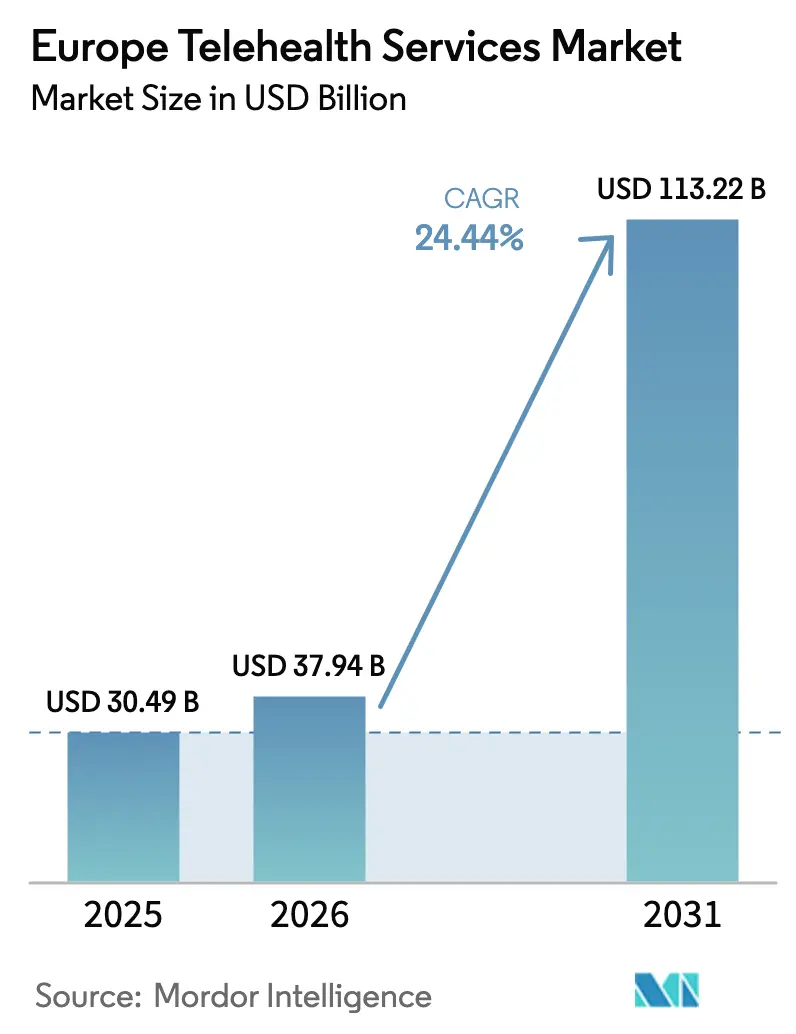
The Europe telehealth services market size is expected to grow from USD 30.49 billion in 2025 to USD 37.94 billion in 2026 and is forecast to reach USD 113.22 billion by 2031 at a 24.44% CAGR over 2026-2031. This growth reflects the continent’s shift from episodic, facility-based encounters to data-rich remote monitoring, which keeps patients connected to clinicians between visits. Germany leads current revenue because statutory insurers integrated teleconsultation into standard benefits, while Italy’s hospital-at-home pilots foreshadow the next wave of demand. Cloud infrastructure, smartphone saturation, and impending interoperability mandates lower technical barriers, and demographic pressure from an aging population further cements telehealth’s role in chronic-care management. Competitive dynamics now favor platforms that integrate into existing clinical workflows and can finance compliance with the European Union’s AI Act, which takes full effect in 2027.
Key Report Takeaways
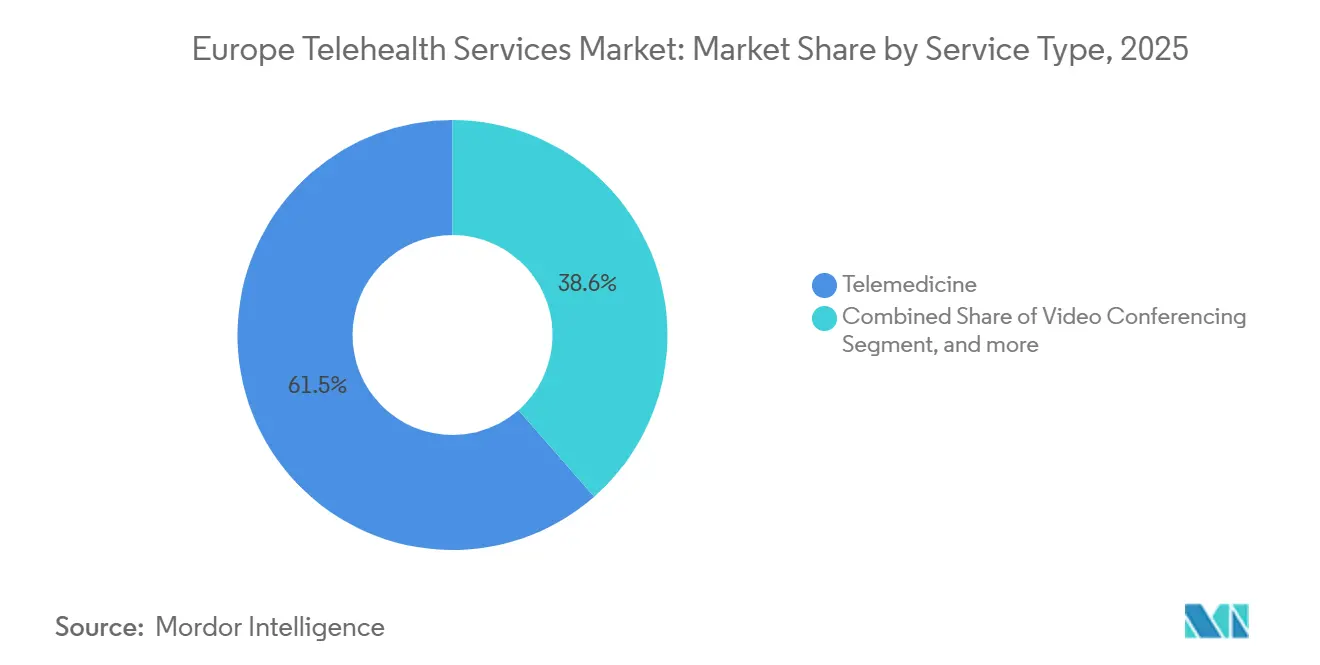
- By service type, telemedicine led with a 61.45% revenue share of the European telehealth service market in 2025, while remote patient monitoring is forecast to expand at a 26.75% CAGR through 2031.
- By application, tele-consultation accounted for 21.43% of the Europe telehealth service market size in 2025; tele-psychiatry is advancing at a 27.45% CAGR to 2031.
- By end user, providers held a 55.34% share of the European telehealth service market in 2025, whereas the patient segment is growing at a 27.32% CAGR.
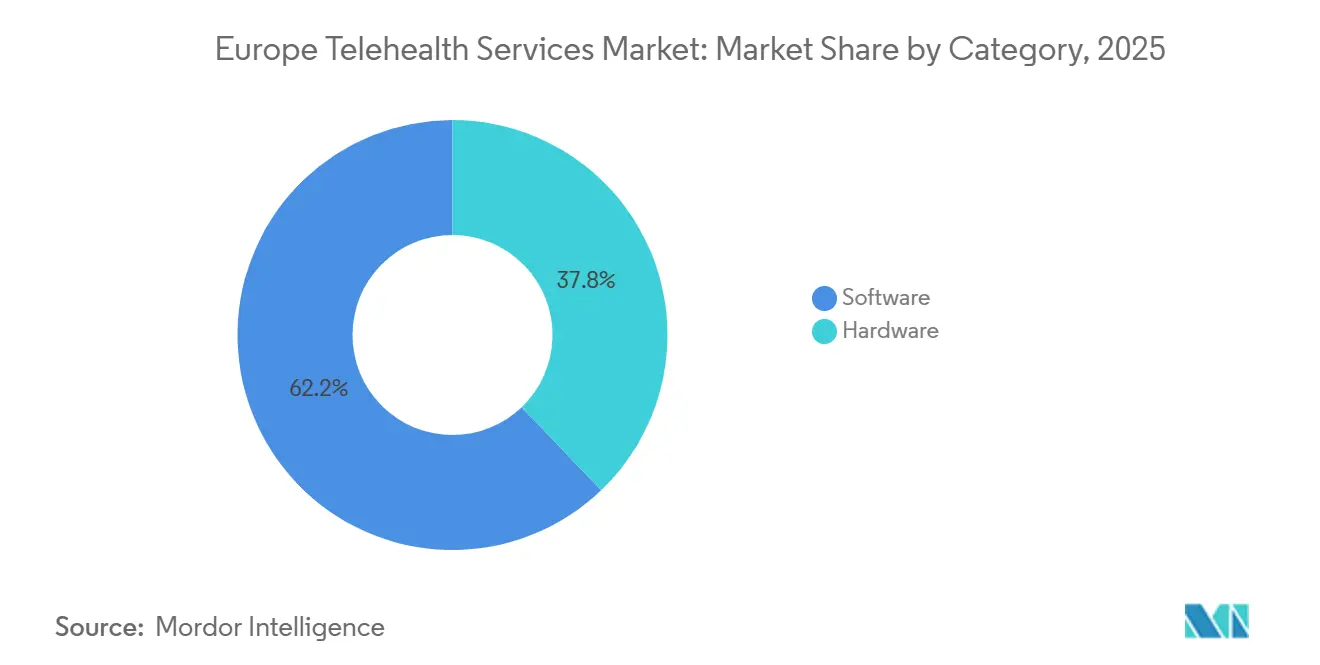
- By category, software captured 62.16% of the European telehealth service market share in 2025 and continues to post the highest 26.54% CAGR.
- By delivery mode, cloud-based platforms commanded 51.45% of revenue in 2025 and are forecast to rise at 26.87% CAGR.
- By geography, Germany contributed 28.54% of regional revenue in 2025; Italy shows the fastest growth rate of 25.65% through 2031.
Note: Market size and forecast figures in this report are generated using Mordor Intelligence’s proprietary estimation framework, updated with the latest available data and insights as of January 2026.
Market Trends and Insights
Drivers Impact Analysis of Europe Telehealth Services Market*
| Driver | (~) % Impact on CAGR Forecast | Geographic Relevance | Impact Timeline |
|---|---|---|---|
| Aging Population & Chronic Disease Burden | +6.2% | Pan-European, acute in Germany, Italy, Spain | Long-term (≥ 4 years) |
| Post-COVID Reimbursement Reforms | +5.8% | France, Germany, UK; uneven in Southern & Eastern Europe | Medium-term (2-4 years) |
| High Smartphone & Broadband Penetration | +3.1% | Northern & Western Europe; lagging in rural Southern Europe | Short-term (≤ 2 years) |
| PSTN Switch-Off and IP Migration | +2.4% | UK-centric, spillover to Ireland, Netherlands | Medium-term (2-4 years) |
| EU Digital Health Data Space | +3.9% | Pan-European, early gains in Benelux, Nordics | Long-term (≥ 4 years) |
| AI-Driven Clinical Decision Support | +4.1% | Germany, France, UK; pilot stage in Southern Europe | Medium-term (2-4 years) |
| Source: Mordor Intelligence | |||
Aging Population & Chronic Disease Burden Escalating Demand for Remote Care
Citizens aged 65 and above represented 21% of Europe’s population in 2023, and projections indicate that the cohort will reach 30% by 2050, with concentrations in Germany, Italy, and Spain. Chronic illnesses already account for 70%–80% of health budgets, and telehealth reduces the need for frequent travel by shifting routine monitoring to patients’ homes. A 2024 WHO tool listed 15 European countries that have embedded telemedicine into their national strategies, underlining policy alignment with demographic realities. Hospital-at-home models, which cut inpatient costs by up to 30%, rely on continuous vital-sign feeds that the Europe telehealth service market now readily supplies. These factors combine to fuel remote monitoring’s status as the fastest-growing service type.
Post-COVID Regulatory Reimbursement Reforms Enabling Teleconsultations
Temporary pandemic measures have become permanent: France now reimburses video visits for established patients, Germany removed prior authorization for remote encounters in 2024, and the UK scaled virtual wards within the National Health Service [1]. Southern Europe remains patchy, but the formal inclusion of teleconsultation codes into fee schedules anchors revenue visibility, inviting platform investment. Divergent fee levels still temper uptake among specialists who rely on procedure-based income. Nonetheless, standardized billing in core markets establishes a foundation for the broader Europe telehealth service market to mature.
High Smartphone & Broadband Penetration Supporting Video Visits
Smartphone penetration exceeded 80% in Germany, France, and the UK in 2024, and 5G will blanket most urban areas, enabling clinician-grade video quality. The 2025 Gigabit Infrastructure Act now obliges member states to extend gigabit coverage to every household by 2030, prioritizing rural zones where specialist scarcity is acute[2]. Familiarity with consumer video apps lowers onboarding friction, accelerating adoption. However, bandwidth gaps in rural Spain, Italy, and Eastern Europe still favor store-and-forward workflows until backhaul upgrades are complete.
PSTN Switch-Off Catalyzing Migration To IP-Based Remote Monitoring Platforms
Ofcom delayed the UK copper network sunset to January 2027 after finding 1.7 million vulnerable residents still depend on analog alarms[3]. Vendors must now retrofit devices with cellular modules, triggering a replacement wave that benefits IP-native monitoring suppliers capable of streaming real-time vitals instead of simple alarms. Similar transitions loom in Ireland and the Netherlands, enlarging the addressable equipment pool for the Europe telehealth service industry.
Restraints Impact Analysis of Europe Telehealth Services Market*
| Restraint | (~) % Impact on CAGR Forecast | Geographic Relevance | Impact Timeline |
|---|---|---|---|
| Fragmented National Reimbursement Frameworks | -4.3% | Pan-European, acute in Southern & Eastern Europe | Medium-term (2-4 years) |
| Data Privacy & GDPR Compliance Costs | -2.1% | Pan-European, enforcement concentrated in Germany, France | Short-term (≤ 2 years) |
| Looming EU AI Act Certification Complexity | -3.2% | Germany, France, Benelux; pilot stage elsewhere | Medium-term (2-4 years) |
| Telehealth Workforce Shortages | -2.8% | UK, Germany, France; spillover to Southern Europe | Long-term (≥ 4 years) |
| Source: Mordor Intelligence | |||
Fragmented National Reimbursement Frameworks Limiting Cross-Border Scaling
Even with shared data rails, payment rules remain local. France underpays video visits relative to in-person care, Germany links reimbursement to diagnosis codes, and Spain’s 17 regions apply separate criteria. Remote monitoring, which requires continuous billing, suffers most. The absence of mutual recognition forces platforms to tailor products market by market, hampering economies of scale and slowing the wider Europe telehealth service market.
Data Privacy & GDPR Compliance Costs Burdening Small Providers
Platforms must secure explicit patient consent, maintain data-processing registers, and appoint data-protection officers. Fines can reach 4% of global revenue, discouraging smaller entrants that cannot amortize compliance overhead. Germany and France levy the highest penalties, prompting some startups to confine launches to less stringent jurisdictions, narrowing competitive diversity inside the Europe telehealth service market.
*Our forecasts treat driver/restraint impacts as directional, not additive. The impact forecasts reflect baseline growth, mix effects, and variable interactions.
Europe Telehealth Services Market Segment Analysis
By Service Type:
Remote Monitoring Outpaces Episodic ConsultationsRemote patient monitoring is projected to expand at a 26.75% CAGR, eclipsing all other modalities, while telemedicine still generated 61.45% of 2025 revenue for the Europe telehealth service market. The combination of continuous vital sign capture and algorithmic alerts enables clinicians to intervene early, reducing hospitalization costs by up to 30%. Hospital-at-home programs anchor payer willingness to reimburse long-term monitoring, thus crystallizing a durable revenue stream.
Telemedicine’s video and phone visits remain indispensable for initial assessment and follow-up. Consumer familiarity with mainstream video apps eases adoption, but reimbursement ceilings temper growth in specialist care. Store-and-forward services, such as tele-dermatology, thrive where broadband is weak, while asynchronous chat attracts younger users who value convenience. The PSTN sunset compels legacy alarm vendors to re-engineer their devices, unlocking a new installed base for platforms that integrate both monitoring and consulting functionality.

By Application:
Mental Health Drives Fastest ExpansionTele-psychiatry is advancing at a 27.45% CAGR, propelled by a lingering post-pandemic mental-health backlog and a limited psychiatric workforce. Chat-based sessions skirt AI Act high-risk rules, easing compliance hurdles and catering to patients who prefer text-based interactions over video. Tele-consultation, by contrast, retained 21.43% of the Europe telehealth service market size in 2025 because it spans broad primary-care use cases.
Cardiology follows as remote ECG and rehabilitation protocols achieve insurer acceptance, buttressed by professional guidelines that codify monitoring thresholds. Pathology and radiology utilize asynchronous uploads, but concerns about malpractice and uneven reimbursement slow growth. The WHO’s 2024 support tool endorses mental health and chronic disease management as top telehealth value areas, reinforcing the focus on investment.
By End User:
Patients Gain Ground on ProvidersProviders generated 55.34% of 2025 revenue; however, the patient segment is forecast to increase by 27.32% annually as direct-to-consumer models proliferate. Mobile apps that sell on-demand care bypass gatekeeper referrals, satisfying users who prize speed and privacy. Payers grow more slowly, leveraging telehealth to trim claims rather than generate revenue.
Integration into electronic health record systems solidifies provider loyalty, whereas patients primarily judge brands based on their interface and price. The European Health Data Space provides patients with formal control over their records, making platform switching easier once the technical rollout is complete. Nonetheless, specialist access still often requires general-practitioner referral, capping the direct-to-consumer ceiling until policy liberalizes.
By Category:
Software Dominates HardwareSoftware secured 62.16% of revenue and posted the highest 26.54% CAGR, confirming a shift toward subscription billing and rapid cloud updates. Hardware, including wearables and diagnostic peripherals, remains essential but is increasingly commoditized. IP migration in the UK sparks a one-time hardware replacement wave, yet long-term value accrues to platforms that interpret data rather than merely collect it.
Analytics modules predict exacerbations, allowing case managers to triage resources. Conversely, the Medical Device Regulation elevates documentation burdens on hardware firms, consolidating supply among larger manufacturers. Open Bluetooth standards further erode brand lock-in, favoring ecosystem-agnostic devices.
By Delivery Mode:
Cloud Infrastructure Enables ScalabilityCloud deployment captured 51.45% of 2025 revenue and is rising at 26.87% CAGR as providers trade capital expenditure for subscription fees. Mobile-first design appeals to younger clinicians and patients, while web-only offerings are losing favor due to their limited offline capabilities. On-premise systems persist in research hospitals that demand direct data access but represent a shrinking niche.
Cloud providers now meet ISO 27001 and GDPR requirements via EU-based data centers, placating sovereignty concerns. The European Health Data Space relies on API interoperability that cloud vendors can deliver through routine updates, whereas on-premise installations need manual patches, slowing compliance. Germany’s cybersecurity agency published 2025 guidance affirming the feasibility of cloud services, further tipping the balance.
Geography Analysis
Europe Telehealth Services Market
Germany generated 28.54% of regional revenue in 2025 as statutory insurers adopted direct billing for teleconsultation and agreed on flat-rate hospital-at-home payments. The United Kingdom scaled virtual wards after 2024 pilots cut inpatient costs by up to 30%. France reimburses video visits at rates below those for in-person visits, making telehealth attractive primarily for general practitioners rather than procedure-driven specialists.
Southern, Northern, Western and Eastern Europe Telehealth Services Market
Italy is the fastest-growing geography, with a 25.65% CAGR, thanks to regional hospital-at-home deployments that alleviate rural physician shortages. Spain’s 17 autonomous communities create reimbursement heterogeneity, fragmenting the potential user base. Nordic and Benelux states leverage mature digital identities and prior cross-border agreements to test pan-European consultations, while Poland and Romania lag behind due to weaker broadband infrastructure.
EU and United Kingdom Telehealth Services Market
The Gigabit Infrastructure Act mandates gigabit connectivity for every household by 2030, aiming to erase rural bandwidth disparities that currently limit the European telehealth service market. Meanwhile, the UK-EU data adequacy decision preserves lawful data flows post-Brexit, sustaining bilateral telehealth activity.
Regulatory Landscape
Europe telehealth services operate under a layered framework that combines EU-wide data and patient-rights rules with nationally defined care delivery and reimbursement. Key anchors include GDPR and Directive 2011/24/EU on patients rights in cross-border healthcare, which treats telemedicine delivered via ICT as cross-border care and generally applies the laws of the Member State where the provider is established. At the same time, Regulation (EU) 2025/327 establishing the European Health Data Space (EHDS) tightens requirements around electronic health data access and interoperability, which constrains platform design choices related to consent, security, and data portability.
Implementation is now shifting from policy to governance. Commission Implementing Regulation (EU) 2026/771 (7 April 2026) sets operational rules for the European Health Data Space Board, supporting coordinated cross-border health data exchange while leaving Member States responsible for organizing healthcare systems and payment models. This split continues to affect go-to-market plans, since vendors need GDPR-grade privacy controls and EHDS-aligned interoperability, while still tailoring workflows, billing, and clinical governance to each country and, in some cases, sub-national payers.
Value Chain Analysis
The Europe telehealth services value chain begins with device and software inputs (remote monitoring peripherals, consumer wearables, communications, and cloud infrastructure), followed by platform development for telemedicine and RPM applications, scheduling, triage, and analytics. Integration layers then connect telehealth workflows with provider IT, and interoperability remains a gating step for scale. Participation in EU cross-border rails such as MyHealth@EU requires standards-based integration, increasing the importance of EHR vendors, systems integrators, and API middleware to embed virtual care into clinical workflows.
Downstream, delivery and monetization depend on provider networks (hospitals, primary care groups, virtual ward programs, and hospital-at-home models), payer reimbursement rules, and patient onboarding channels. As EHDS rolls out, Health Data Access Bodies (HDABs) are new nodes for secondary-use governance, shaping how platforms package de-identified datasets and demonstrate lawful reuse. Within fragmented national frameworks, service providers including AMD Global Telemedicine, Doctolib, Kry, and Immedicare operate at the orchestration layer, combining clinician supply, software, and compliance operations across multiple countries.
Competitive Landscape
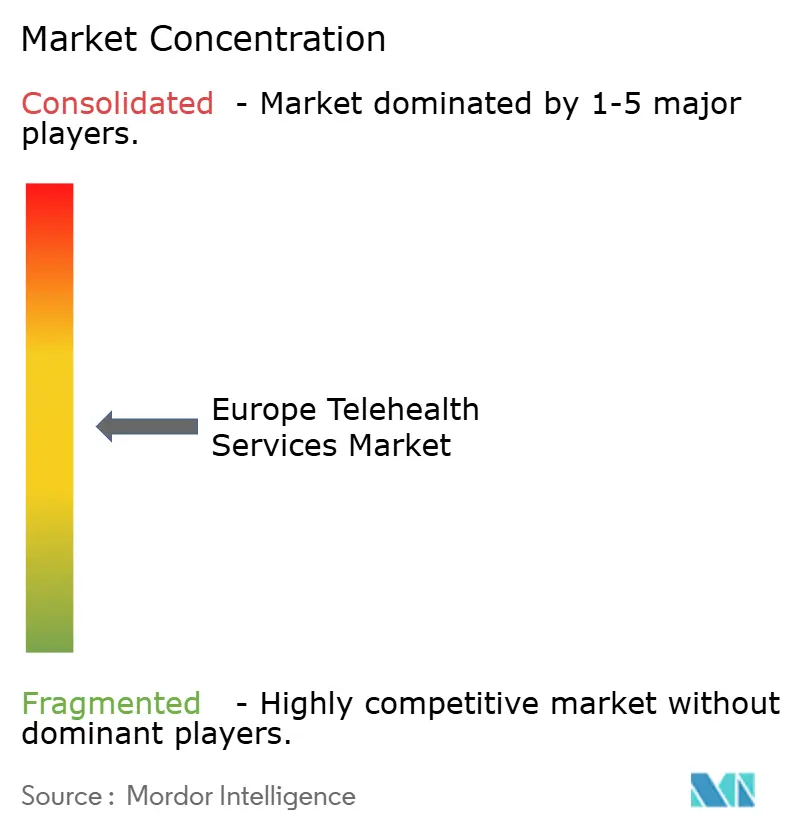
Competition is moderate, with no single model dominant. Large multispecialty platforms rely on physician density and integrated booking systems to secure providers. Hospital-at-home players monetize continuous vitals that generate billable events, while direct-to-consumer brands compete through marketing and user experience. AI tooling differentiates leaders by boosting clinician throughput, but the EU AI Act’s certification costs favor capitalized incumbents.
The PSTN switch-off accelerates consolidation as smaller telecare operators struggle to finance device retrofits, opening acquisition opportunities for digital-native firms. Network effects intensify: more clinicians attract more patients, which in turn draws still more clinicians, creating regional winner-take-all outcomes. Nonetheless, workforce shortages and fragmented payment rules prevent outright monopoly, keeping the Europe telehealth service market competitively balanced.
Europe Telehealth Services Industry Leaders
-
AMD Global Telemedicines Inc
-
Kry
-
Doctolib
-
Immedicare
-
Babylon Health
- *Disclaimer: Major Players sorted in no particular order
Europe Telehealth Services Market Companies Covered in this Report
- AccuRx
- Ada Health
- Babylon Health
- Doccla
- Docplanner
- Doctolib
- eConsult Health
- Huma Therapeutics
- Immedicare
- Kry
- Luscii
- Medgate
- Min Doktor
- Push Doctor
- SHL Telemedicine
- Teladoc Health
- Tunstall Healthcare
- Visionable
- Zava
Market Opportunities and Future Outlook
Regulatory and infrastructure build-outs create specific whitespace for vendors that can industrialize interoperability and compliance across countries. Regulation (EU) 2025/327 on the EHDS makes MyHealth@EU mandatory for all Member States by 2029 for priority categories, including patient summaries and e-prescriptions, and Implementing Regulation (EU) 2026/771 formalizes cross-border coordination through the European Health Data Space Board. This raises demand for telehealth platforms that can ingest, normalize, and exchange clinical data through standards-based APIs, while maintaining GDPR-grade governance and lowering reliance on bespoke country-by-country integrations.
A second opportunity is scalable secondary-use enablement and research-ready data operations built into routine care delivery. EHDS provisions for secondary use begin in March 2029, which supports platforms that already capture longitudinal remote monitoring and teleconsultation data to offer compliant data-access workflows via emerging Health Data Access Bodies. Reimbursement fragmentation still limits cross-border scaling, so vendors that embed local billing logic for teleconsultation, remote monitoring, and hospital-at-home pathways, while maintaining a shared cross-border data layer, can improve rollout efficiency across Europe instead of rebuilding product variants for each market.
Recent Industry Developments in Europe Telehealth Services Market
- July 2026: MedPal AI plc acquires eMARx to complete its digital health ecosystem for care homes. The acquisition adds a telehealth software add-on for care homes in Europe and strengthens care-home workflow automation and digital medication administration across Europe.
- July 2026: VitalHub acquires Buddy Healthcare to expand its patient flow suite and Nordic footprint. The Nordic care-coordination integration extends end-to-end telehealth workflow with Nordic market entry.
- July 2026: Doctolib announced a 125 million USD investment in UK primary-care software provider Medicus. The investment expands Doctolib’s NHS workflows and AI-enabled tools within the UK market.
Europe Telehealth Services Market Report Scope and Research Methodology
Market Definition and Coverage
For this study, the Europe telehealth services market is defined as revenues earned from delivering clinical and care support services remotely using digital communication and monitoring tools, where the service is consumed by patients or care teams located in Europe.
Scope exclusions: We exclude general wellness apps without clinical service delivery, pure hardware-only device sales, and non-health remote support services.
Segments Covered in This Report
- By Service Type
- Telemedicine
- Video Conferencing
- Remote Patient Monitoring
- App-Based Consultation
- Other Service Types
- By Application
- Tele-Consultation
- Tele-Pathology
- Patient Care
- Tele-Psychiatry
- Tele-Cardiology
- Other Applications
- By End User
- Providers
- Patients
- Payers
- By Category
- Hardware
- Software
- By Delivery Mode
- Cloud-Based
- Web-Based
- On-Premise
- Geography
- Germany
- United Kingdom
- France
- Italy
- Spain
- Rest of Europe
Data Sources, Market Sizing, and Validation
Desk Research
Desk work was used to set the guardrails for the model, then to keep country-level assumptions aligned with publicly available healthcare and digital health policy signals. We relied on public healthcare and digital policy references, such as European Commission and EU digital health program pages, OECD health statistics, WHO Europe publications, and national health system guidance from major European countries. Where available, we also used national telemedicine reimbursement notes and public procurement disclosures to understand what is actually reimbursed or contracted, versus what remains in pilot mode.
To translate those signals into usable inputs, we reviewed company annual reports, investor presentations, and credible press coverage for utilization trends, pricing logic, and service mix shifts. Paid subscriptions for company financials and intelligence and news and financials helped in screening active service providers and tracking large contract announcements across Europe. The desk sources listed here are illustrative only, and many other public and paid references were also used for cross-checking and clarification.
Primary Interviews and Surveys
Primary work was run to pressure-test utilization, pricing, and reimbursement assumptions that can appear consistent on paper but vary by country in practice. We spoke with providers, payers, platform and service operators, and channel partners, and we balanced the respondent mix to reflect differences in adoption across Western Europe and the Rest of Europe. Where secondary information was thin, we filled gaps through structured questions on visit volumes, remote monitoring enrollment, typical fees, and the split between public and private payment.
Distribution of primary research fieldwork respondents
| Company type | Respondent position |
|---|---|
| Top tier: 37% | CXOs: 20% |
| Mid tier: 43% | Functional/Unit leaders: 22% |
| Smaller Players: 20% | Managers: 58% |
Market-Sizing & Forecasting
Sizing started with a top-down build that reconstructed the addressable care activity for teleconsultations and remote monitoring by country, then applied adoption and reimbursement realities to arrive at service revenue. To keep the math grounded, inputs were tied to a short list of fingerprints that can be explained and checked, including outpatient visit patterns suitable for virtual care, chronic disease burden linked to monitoring, clinician capacity constraints, broadband and smartphone penetration, and public reimbursement coverage for telehealth encounters.
Those totals were corroborated using selective bottom-up approximations, where sampled provider and operator revenues, typical fee-per-visit ranges, and monitored-patient counts were used to sanity check the country and regional outputs. If a bottom-up view was incomplete because private providers did not disclose revenue, the gap was handled by scaling from verified utilization proxies and adjusting for service mix. Forecasting relied on scenario-based projections supported by expert views, where adoption curves, policy changes, and pricing progression were flexed before a single base case was finalized.
Data Validation & Update Cycle
Outputs were validated through triangulation across independent signals, and the model was refined until country splits and growth rates were internally consistent. We check for variances such as sudden jumps in pricing, implausible penetration levels, and country totals that do not align with known reimbursement or capacity constraints, then rework assumptions when needed.
Before sign-off, the work goes through multiple analyst reviews, and targeted re-contacts are triggered when a key input moves or conflicts with other evidence. The report is refreshed annually, and it is also updated when material events occur, such as reimbursement expansion, major regulatory shifts, or step-changes in provider rollout. Right before delivery, a final data pass is completed so clients receive the latest updated view.
Mordor Intelligence's Europe Telehealth Services Market Size Versus Other Published Estimates
Published market sizes often vary because the underlying definitions are not the same, and because each publisher picks different starting years, price logic, and growth paths. In telehealth, it gets even more sensitive when virtual visits, remote patient monitoring, and care coordination services are bundled differently across countries.
The table shows a wide spread in 2025 values, and the main drivers are scope boundaries, including whether reimbursement-led services are separated from broader digital health activity, and how average selling prices are carried forward under country-specific payer rules. The table indicates a larger 2026 jump in one estimate and a flatter curve in another, which typically happens when adoption is modeled as a single Europe-wide rate instead of reflecting country-by-country rollout timing.
Benchmark comparison
| Source | Market Size | Gaps in Research Methodology |
|---|---|---|
| Mordor Intelligence | USD 30.49 B (2025) | |
| Trade Journal A | USD 24.76 B (2025) | Uses a combined telehealth and telemedicine framing with slower growth assumptions, and it likely undercounts remote monitoring service revenue where payments sit inside broader care bundles. |
| Industry Bulletin B | USD 51.30 B (2024) | Uses a broader telehealth umbrella that can fold in adjacent digital health revenues and earlier adoption uplift, which can inflate the starting year compared with a services-only count. |
In practice, one of the most repeatable ways to reduce the spread is to keep the revenue pool tied to delivered services, then scale by country-level utilization and reimbursement realities. The table also shows why the 2025 value can shift when definitions change, and under Mordor Intelligence's scope the revenue is counted only when a telehealth service is delivered and priced as a service line, rather than being mixed with general digital health or device-only revenue.
Key Questions Answered in the Report
What is the forecast value of the Europe telehealth service market in 2031?
The Europe telehealth service market is projected to reach USD 113.22 billion by 2031.
Which service type is expanding fastest across the region?
Remote patient monitoring shows the highest trajectory, rising at a 26.75% CAGR through 2031.
Why is tele-psychiatry growing so quickly?
A sustained post-pandemic mental-health backlog and limited psychiatric workforce push demand, leading tele-psychiatry to grow at 27.45% CAGR.
Which country currently holds the largest revenue share?
Germany leads with 28.54% of regional revenue thanks to insurer reimbursement that embeds teleconsultation into routine care.
How will the EU AI Act affect telehealth vendors?
Diagnostic AI tools must undergo costly audits and certification by 2027, favoring well-capitalized platforms and likely accelerating market consolidation.
What infrastructure development will most influence rural telehealth adoption?
The Gigabit Infrastructure Act mandates gigabit-speed coverage for every household by 2030, reducing bandwidth constraints that currently limit rural uptake.