
Market Overview
| Study Period | 2020 - 2031 |
|---|---|
| Forecast Data Period | 2026 - 2031 |
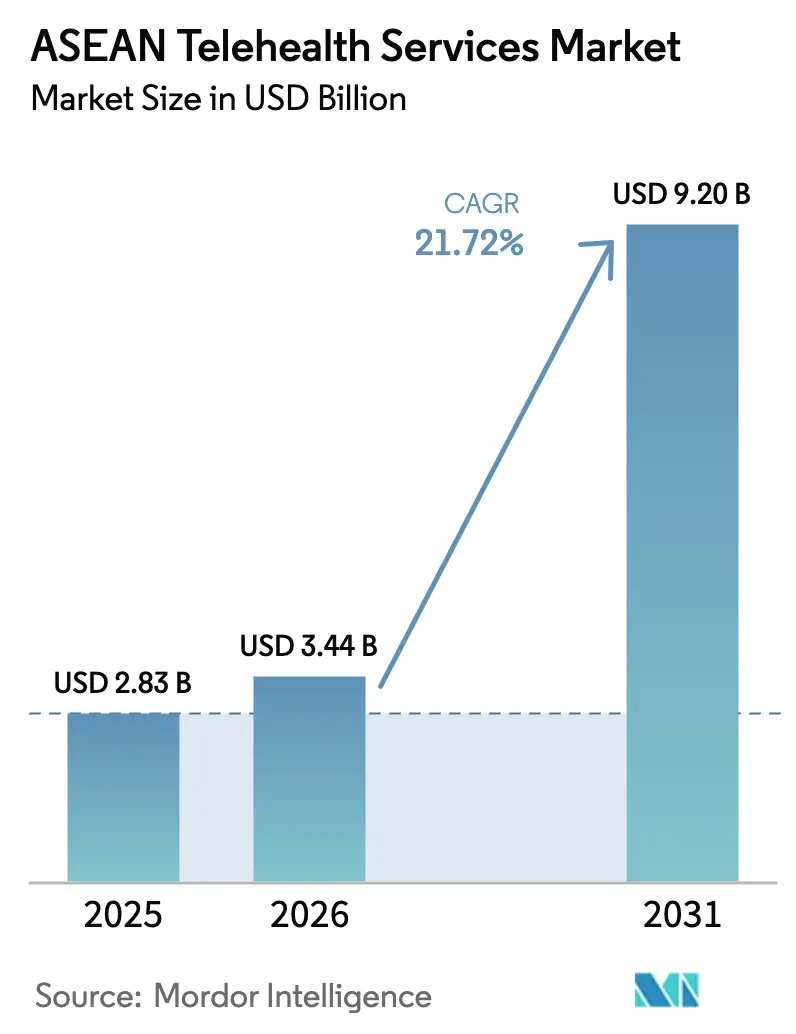
| Base Year Market Size (2025) | USD 2.83 Billion |
| Market Size (2026) | USD 3.44 Billion |
| Market Size (2031) | USD 9.2 Billion |
| Growth Rate (2026 - 2031) | 21.72 % |
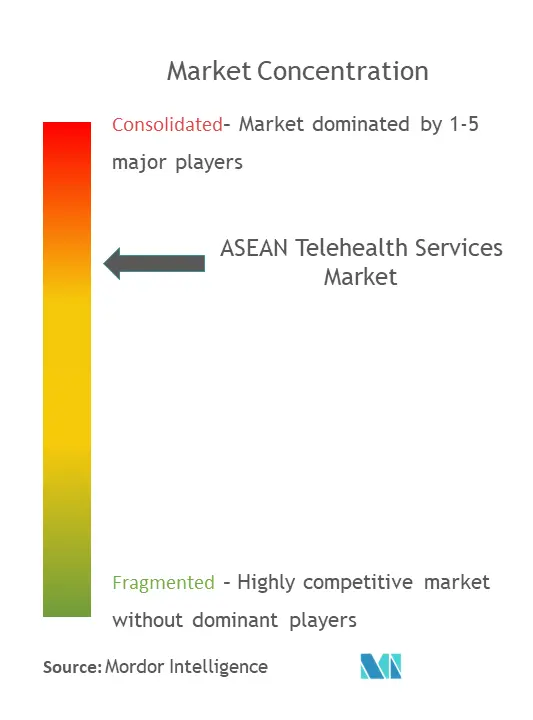
| Market Concentration | Medium |
Major Players *Disclaimer: Major Players sorted in no particular order Image © Mordor Intelligence. Reuse requires attribution under CC BY 4.0. | |
ASEAN Telehealth Services Market Analysis by Mordor Intelligence
The ASEAN Telehealth Services Market size was valued at USD 2.83 billion in 2025 and estimated to grow from USD 3.44 billion in 2026 to reach USD 9.2 billion by 2031, at a CAGR of 21.72% during the forecast period (2026-2031). Growth stems from post-pandemic regulatory parity for virtual care, massive 5G investment, and large-scale digitization programs such as Indonesia’s ‘Cek Kesehatan Gratis’ free-screening initiative covering 280 million citizens.[1] Cloud-first deployment, strong venture-capital inflows, and insurer–platform alliances are aligning incentives across payers, providers, and patients. However, fragmented data-residency rules, rising cybersecurity costs, and physician-licensing hurdles temper scalability, leaving room for consolidation moves like WhiteCoat’s 2024 takeover of Good Doctor Indonesia.
Key Report Takeaways
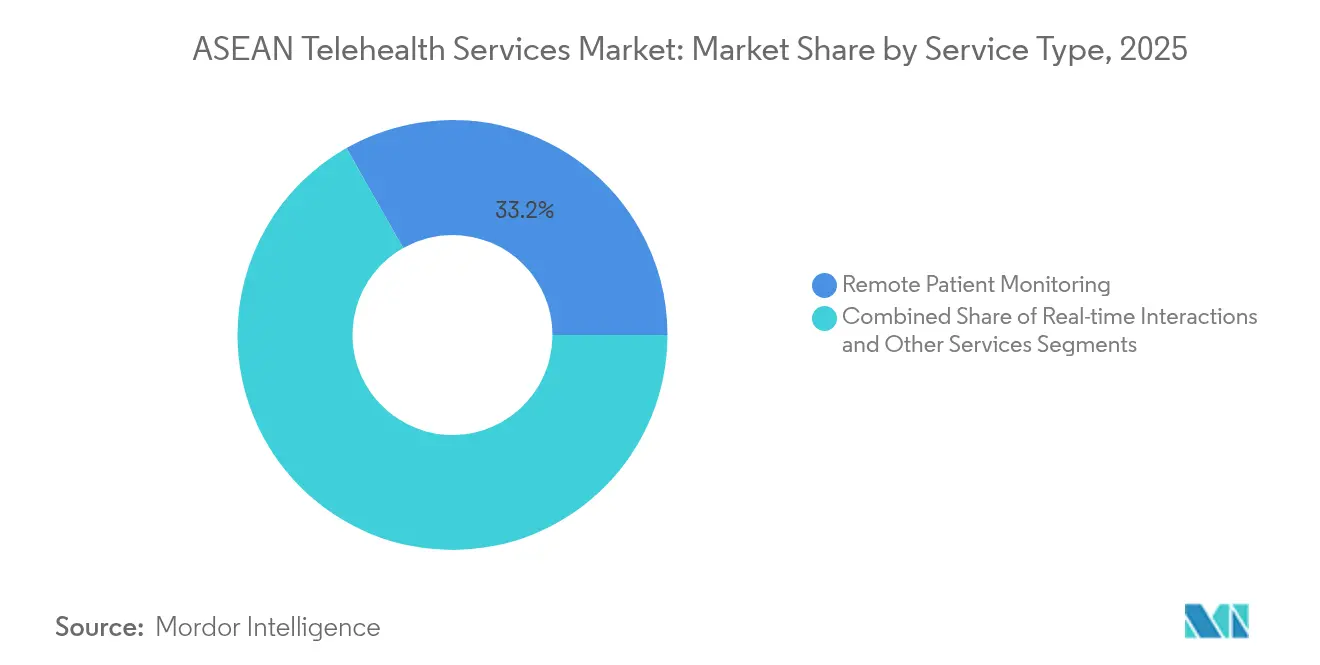
- By service type, remote patient monitoring commanded 33.21% of the ASEAN telehealth services market share in 2025, while real-time interactions posted the highest projected CAGR at 23.11% through 2031.
- By mode of delivery, cloud-based platforms held 47.88% of revenue in 2025; web-based tools are poised for a 22.31% CAGR to 2031.
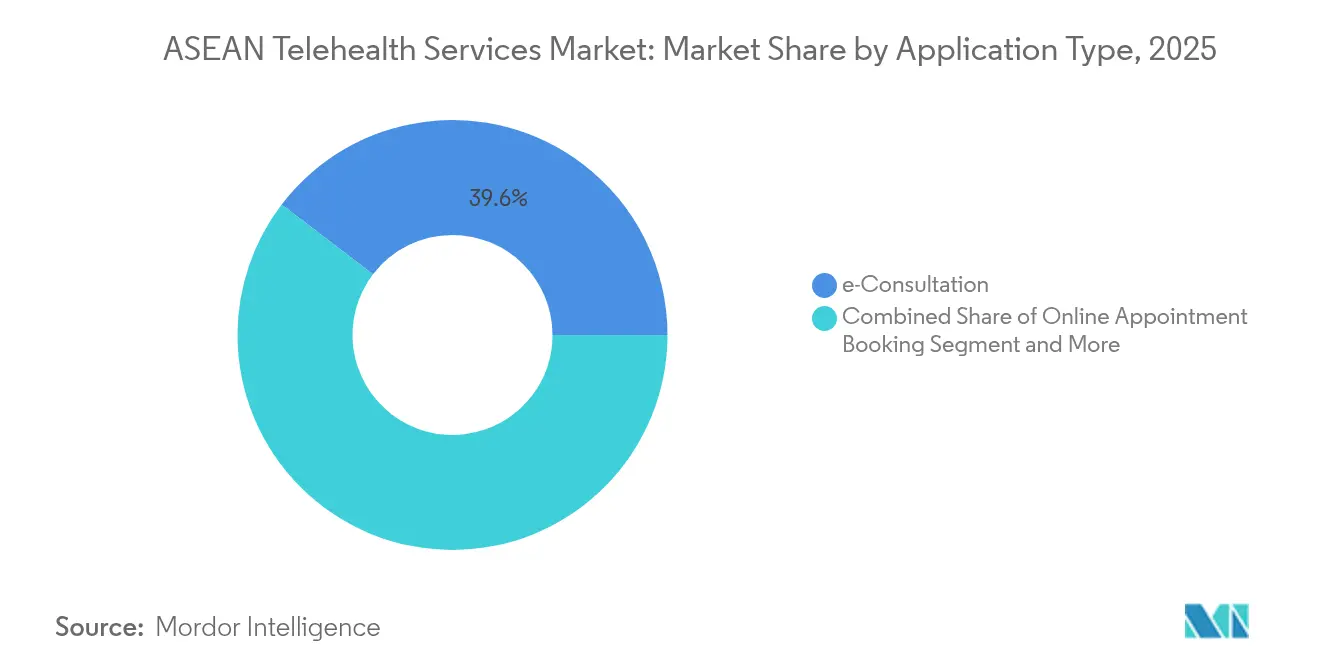
- By application type, e-consultation accounted for 39.62% of the ASEAN telehealth services market size in 2025, whereas tele-pharmacy/e-prescription is set to expand at 23.05% CAGR to 2031.
- By end user, providers retained 48.02% share in 2025; patient-direct services represent the fastest clip at 22.64% CAGR.
- By geography, Indonesia led with 24.89% revenue share in 2025 as Vietnam is forecast to grow the fastest at 22.21% CAGR to 2031.
Note: Market size and forecast figures in this report are generated using Mordor Intelligence’s proprietary estimation framework, updated with the latest available data and insights as of 2026.
ASEAN Telehealth Services Market Trends and Insights
Drivers Impact Analysis*
| Driver | (~) % Impact on CAGR Forecast | Geographic Relevance | Impact Timeline |
|---|---|---|---|
| Post-COVID Reimbursement Parity and E-Prescription Rules | +4.2% | Indonesia, Thailand, Vietnam core markets | Medium term (2-4 years) |
| 5G and Broadband Roll-Outs Boosting Video Quality and Uptime | +3.8% | Singapore, Malaysia, Thailand urban centers | Short term (≤ 2 years) |
| Ageing Population and NCD Burden Raising Chronic-Care Demand | +3.5% | Singapore, Thailand, Malaysia demographic shift | Long term (≥ 4 years) |
| Surge in Venture Capital Funding and Insurer Partnerships | +2.9% | Singapore, Indonesia, Vietnam startup hubs | Medium term (2-4 years) |
| Cross-Border Medical-Tourism "Virtual Second Opinions" | +2.1% | Thailand, Malaysia, Singapore medical hubs | Medium term (2-4 years) |
| AI-Based Mental-Health Triage Chatbots Proving ROI | +1.8% | Urban centers across ASEAN markets | Short term (≤ 2 years) |
| Source: Mordor Intelligence | |||
Post-COVID Reimbursement Parity and E-Prescription Rules
Unified payment frameworks now place telemedicine on equal footing with in-person visits. Indonesia’s Presidential Regulation 59/2024 mandates universal insurance participation, closing historic reimbursement gaps.[2] Thailand’s Ministry of Public Health has followed suit, while Vietnam’s amended pharmacy law enables direct-to-consumer prescription fulfillment from July 2025. These moves support chronic-care monitoring and open cross-border scaling opportunities under consistent pay-rules.
5G and Broadband Roll-outs Boosting Video Quality and Uptime
Network upgrades eliminate historical bandwidth bottlenecks. Telkomsel aims to complete 1,400 5G base stations across Greater Jakarta by February 2025, posting 227 Mbps averages. Singapore’s hybrid 5G trials deliver surgical-grade sub-10 ms latency, while Thailand’s urban speeds of 196 Mbps dwarf outer-city rates yet still sustain HD video. Improved connectivity unlocks remote surgery guidance and continuous monitoring. Cambodia's nationwide 5G approval signals the technology's expansion beyond tier-1 markets, creating opportunities for telehealth platforms to penetrate previously underserved rural populations.
Ageing Population and NCD Burden Raising Chronic-Care Demand
ASEAN’s ≥60-year cohort will hit 22.2% by 2050, straining facility-based care. Non-communicable diseases dominate spending, prompting Indonesia’s BPJS Regulation 3/2024 to fund enhanced screening. Tele-monitoring turns episodic visits into continuous engagement, a model that raises patient lifetime value and supports subscription revenues. The shift toward preventive care models, exemplified by Indonesia's free health screening program for 280 million citizens, generates continuous patient engagement opportunities that telehealth platforms can monetize through subscription-based chronic care management. This demographic-driven demand is particularly valuable because chronic care patients demonstrate higher retention rates and predictable revenue streams compared to acute care episodes.
Surge in Venture-Capital Funding And Insurer Partnerships
Capital allocation patterns reveal strategic shifts toward integrated healthcare ecosystems that combine telehealth platforms with insurance and pharmaceutical distribution. East Ventures’ USD 30 million health fund and Hive Health’s USD 6.5 million pre-Series A confirm robust investor appetite. BPJS Kesehatan’s integration with Halodoc extends platform reach to 221 million Indonesians, proving that insurer hooks drive rapid scale.
Restraints Impact Analysis*
| Restraint | (~) % Impact on CAGR Forecast | Geographic Relevance | Impact Timeline |
|---|---|---|---|
| Fragmented Regulatory and Data-Residency Requirements | -2.8% | Cross-border operations across ASEAN | Long term (≥ 4 years) |
| Heightened Cybersecurity / PDPA Compliance Costs | -2.3% | Malaysia, Indonesia, Vietnam data-sensitive markets | Medium term (2-4 years) |
| Inter-Country Physician-Licence Portability Gaps | -1.9% | Cross-border medical tourism corridors | Long term (≥ 4 years) |
| Low Public-Payer Reimbursement Outside Tier-1 Cities | -1.5% | Rural Indonesia, Philippines, Vietnam | Medium term (2-4 years) |
| Source: Mordor Intelligence | |||
Fragmented Regulatory and Data-Residency Requirements
Indonesia’s Personal Data Protection Law forces local data hosting, while Malaysia’s 2025 PDPA amendments require data-protection officers for large health processors. Vietnam’s privacy rules differ again, compelling multi-instance architecture that raises cost and slows regional scaling. Thailand's telemedicine regulations require patient location verification for licensing compliance, creating technical barriers for platforms serving mobile populations or cross-border medical tourists. These fragmented requirements force telehealth companies to develop market-specific solutions rather than leveraging economies of scale across the region.
Heightened Cybersecurity / PDPA Compliance Costs
Rising data protection standards across ASEAN are substantially increasing operational costs for telehealth platforms while creating competitive advantages for companies with robust cybersecurity infrastructure. New breach-notification protocols and stiff penalties demand enterprise-grade security. Smaller platforms struggle to fund encryption, SIEM, and 24/7 monitoring, accelerating consolidation toward well-capitalized players able to certify resilience. The compliance burden is disproportionately impacting smaller telehealth providers who lack the resources to implement enterprise-grade security infrastructure, creating market consolidation pressures that favor well-funded platforms.
*Our forecasts treat driver/restraint impacts as directional, not additive. The impact forecasts reflect baseline growth, mix effects, and variable interactions.
Segment Analysis
By Service Type: Remote Monitoring Drives Preventive-Care Scale
Remote patient monitoring represented 33.21% revenue in 2025, the largest slice of the ASEAN telehealth services market. Wearable biosensors now deliver 99% vital-sign accuracy, enabling early deterioration alerts that cut readmissions by 25%. Biofourmis’s January 2024 in-home ecosystem shows the shift from single-point devices to integrated care programs. Real-time interactions benefit directly from 5G latency drops below 10 ms, supporting complex remote diagnostics.
The ASEAN telehealth services market size for real-time interactions is poised to grow at a CAGR of 23.11% by 2031 as consumers accept video as default first touch. Platform stickiness rises when monitoring pairs with synchronous visits, creating bundled memberships attractive to insurers seeking outcome-based payment models.

By Mode of Delivery: Cloud Architecture Underpins Scale
Cloud-hosted platforms held 47.88% share in 2025 as hospital groups migrate data to hyperscale providers; IHH Healthcare moved Malaysia and Singapore records to Oracle Cloud in mid-2024. Web-based tools post a robust 22.31% CAGR, popular in low-bandwidth zones that rely on browser access rather than heavy mobile apps.
Southeast Asia's data center capacity is growing by up to 20% annually, with major technology companies committing billions to enhance cloud infrastructure that supports telehealth scalability. Cloud lets smaller clinics tap AI modules without capital hardware, while on-premises systems persist where legislation enforces strict data sovereignty. The ASEAN Digital Masterplan 2025 emphasizes cloud infrastructure development as essential for regional digital integration, creating supportive policy environments for cloud-based telehealth expansion.
By Application Type: E-Consultation Anchors Wider Digital Ecosystems
E-consultation captured 39.62% revenue in 2025, the entry point for most users. Tele-pharmacy and e-prescription, growing 23.05% CAGR, get a boost from Vietnam’s 2025 pharmacy-law amendments that legalize e-commerce drug sales. Zuellig Pharma’s eZRx+ serves 61,000 users across nine markets, illustrating the pharmaceutical pivot to digital.
ASEAN telehealth services market share for tele-pharmacy will climb as cross-border e-scripts allow patients in remote islands to refill chronic meds without traveling. AI-enhanced chatbots triage symptoms, reducing clinician load and funneling patients toward targeted drug regimens.
By End User: Direct-To-Consumer Momentum Accelerates
Providers still generated 48.02% of 2025 revenue, bolstered by large hospital roll-outs and insurer contracts. Yet patient-direct channels are expanding at 22.64% CAGR, driven by mobile apps like Halodoc’s Bidanku that reach maternal-care users directly.
ASEAN telehealth services industry players see higher margins in D2C mental-health subscriptions, where AI chatbots deliver personalized sessions at scale, supported by studies showing 21% symptom reduction. Payers increasingly reimburse these programs, aligning financial incentives for longer-term engagement.
Geography Analysis
Indonesia held 24.89% of 2025 revenue, underpinned by the ‘Cek Kesehatan Gratis’ budget of IDR 4.7 trillion (USD 287.9 million) and BPJS integration that links telehealth portals to 221 million insured citizens. ICT maturity scores of 2.74 across nine provinces reveal ongoing infrastructure gaps, presenting vendor opportunities for low-bandwidth solutions.
Vietnam, the fastest-growing at 22.21% CAGR, benefits from 100% insurance coverage for vulnerable groups and an AI virtual hospital pilot focused on telestroke management. Simplified drug registration encourages tele-pharmacy scale, while Microsoft collaborations advance cloud standardization.
Singapore, Thailand, Malaysia, and the Philippines combine mature digital infrastructure with niche growth catalysts. Singapore champions health-tech startups, Thailand leverages its new medical-tourism visa to spur virtual second-opinion demand, Malaysia tightens data-protection rules favoring cybersecurity-strong platforms, and the Philippines’ Hive Health raises new funding for SME care. Cambodia’s nationwide 5G approval foreshadows rural telehealth expansion across the remaining ASEAN states.
Regulatory Landscape
Telehealth rules across ASEAN continue to be set primarily at the country level, with no unified regional digital-health regulatory framework. That structure keeps licensing, e-prescription, and data-handling obligations largely market-specific. In Indonesia, the Ministry of Health remains a central rule-setter for telemedicine through Regulation No. 20/2019. Presidential Regulation 59/2024 and BPJS-related measures have also reinforced reimbursement and coverage mechanics that shape virtual-care utilization pathways.
Compliance requirements around data protection and cybersecurity are becoming more prescriptive and more divergent by country, which affects architecture choices and vendor eligibility. Indonesia's Personal Data Protection Law supports localized data-hosting approaches, while Malaysia's PDPA amendments taking effect in June 2025 require data-protection officers for large health data processors and tighter breach protocols. ASEAN's Digital Masterplan 2030, finalized in early 2026, promotes adoption of international standards (ISO, ITU, IEC) and stronger cross-border digital trust foundations, but practical interoperability and cross-border care remain constrained by national data-residency and physician licensing rules.
Competitive Landscape
Competition is fragmented but tilting toward scale players. WhiteCoat’s purchase of Good Doctor Indonesia created a 6.8 million-user group with 130 insurer links. Platforms vie on AI diagnostics, end-to-end drug logistics, and insurer APIs rather than head-to-head pricing.
Biofourmis teamed with GE HealthCare to commercialize at-home monitoring, integrating hospital-grade sensors with predictive analytics. Halodoc deepens vertical integration by adding lab services and medication delivery, locking consumers into a single app journey.
Future consolidation is likely in mental-health verticals where direct-to-consumer chatbots operate across borders yet face mounting compliance costs. Players with compliant multi-tenant architectures and insurer alliances will outpace niche apps limited by single-country regulation.
ASEAN Telehealth Services Industry Leaders
-
Doctor Anywhere
-
Halodoc
-
Aldokter
-
SeeYouDoc
-
Viettel
- *Disclaimer: Major Players sorted in no particular order
Market Opportunities and Future Outlook
Near-term whitespace in ASEAN telehealth sits at the intersection of payer-linked scale and compliance-grade platforms. BPJS Kesehatan integration that connects Halodoc to 221 million insured Indonesians illustrates how insurer APIs and claims-ready workflows can accelerate adoption. That creates room for vendors to productize utilization management, chronic-care pathways, and outcomes reporting for both public and private payers. In parallel, Indonesia's Cek Kesehatan Gratis free-screening initiative, designed to cover 280 million citizens, increases follow-up demand for remote monitoring, triage, and medication fulfillment that can be embedded into longitudinal care programs rather than limited to episodic e-consults.
Cross-border interoperability and standardized data exchange also offer an opportunity lane, particularly for multi-country platforms and pharmacy-logistics players operating across ASEAN. The WHO-led initiative launched on March 23, 2026 to expand the use of digital health wallets, using standards such as HL7 FHIR and the International Patient Summary, creates a pathway for interoperable patient-held records that can support second opinions, continuity of care for mobile populations, and multi-country care coordination. Related regional integration efforts, including ASEAN Digital Economy Framework Agreement (DEFA) negotiations accelerated during the 2025 ASEAN Summit and the ASEAN Digital Masterplan 2030, point to demand for vendors that can deliver compliant cross-border architectures, privacy management (for example, ISO 27701-aligned controls), and interoperability tooling that reduces the cost of running separate stacks across ASEAN markets.
Recent Industry Developments
- June 2026: SeeYouDoc founders participated in the Maria 01 event in Helsinki, Finland, for global expansion pitching. The engagement signals an international exposure and a push toward cross-border collaborations with insurers and partners, supporting broader ASEAN-to-global deployment of telehealth platforms. This activity could bolster SeeYouDoc's market reach and help attract strategic alliances as it scales regionally.
- May 2026: Halodoc entered a strategic partnership with PT Takeda Innovative Medicines to combat dengue during World Immunization Week 2026. The collaboration aligns public health initiatives with telehealth capabilities and supports education and access to potential dengue vaccination through a major pharmaceutical partner. This move broadens Halodoc's ecosystem reach and reinforces its role in integrated health campaigns in ASEAN.
- May 2026: SeeYouDoc was chosen as one of 18 startups for the Sisu Launchpad 2026 cohort. The program supports regional telehealth scale-up and increases international market visibility. The selection positions SeeYouDoc for accelerated international expansion and strengthens potential investor and partner interest.
Research Methodology Framework and Report Scope
Market Definition and Coverage
For this report, the market is defined as paid telehealth services delivered to patients and care teams across ASEAN through digital channels, where the service is used for clinical advice, monitoring, prescriptions, or care coordination and is billed to a user, payer, or provider.
Scope exclusions: We exclude general wellness content that is not tied to a healthcare service interaction, along with pure hardware sales where no telehealth service revenue is attached.
Segmentation Overview
- By Service Type
- Remote Patient Monitoring
- Real-time Interactions
- Other Services
- By Mode of Delivery
- Cloud-Based
- Web-Based
- On-Premises
- By Application Type
- e-Consultation
- Online Appointment Booking
- Tele-pharmacy / e-Prescription
- Diagnostics and Fitness Monitors
- By End User
- Providers
- Patients
- Payers
- Others
- By Geography
- Singapore
- Indonesia
- Vietnam
- Thailand
- Philippines
- Malaysia
- Rest of ASEAN
Data Sources, Market Sizing, and Validation
Desk Research
Desk research is used to set the foundation for what demand looks like in each ASEAN country and what supply is realistically able to deliver. We reviewed public health system statistics and digital readiness indicators, then mapped these to telehealth use cases that are commonly reimbursed or paid for.
Examples of sources include WHO and World Bank health and ICT indicators, ASEAN Secretariat publications, national Ministries of Health and regulator notices, and telecom authority releases on broadband and mobile coverage. We also referred to company annual reports and investor decks, reputed press coverage, peer-reviewed journals on telemedicine adoption, and selectively used paid subscriptions for company financials, news screening, and patent lookups to avoid missing smaller but fast growing service lines. The desk sources listed here are illustrative only, and many other materials were used for data collection, validation, and clarification.
Primary Interviews and Surveys
Primary work focused on validating what is actually paid for in telehealth across ASEAN, especially differences in reimbursement, pricing, and visit-to-prescription workflows across markets. We spoke with a mix of provider-side leaders, payer and employer benefit stakeholders, and operational managers, which helped us convert adoption signals into realistic utilization and revenue assumptions.
To reduce single-country bias, inputs were checked across key ASEAN markets and then normalized through common metrics such as consultation volumes, active user rates, and average revenue per encounter (with adjustments when remote monitoring is bundled).
Distribution of primary research fieldwork respondents
| Company type | Respondent position |
|---|---|
| Top tier: 37% | CXOs: 16% |
| Mid tier: 44% | Functional/Unit leaders: 39% |
| Smaller Players: 19% | Managers: 45% |
Market-Sizing & Forecasting
Sizing starts from a demand pool build-up that links outpatient touchpoints and digitally addressable populations to telehealth usage. We estimate the share of patients and providers using remote channels, then convert these into monetized services by applying paid utilization rates and average pricing by care setting.
The top-down approach is constructed using health access indicators and digital connectivity data to reconstruct likely telehealth encounter volumes by country, followed by pricing ladders for common services such as e-consultations, online appointment support, e-prescriptions, and remote patient monitoring programs. To keep totals realistic, we corroborated outputs with selective bottom-up approximations such as channel checks on consultation pricing, sampled volume-to-revenue conversions from disclosed business metrics, and provider-side capacity constraints.
Forecasts are built using scenario analysis, where growth is mainly guided by inputs like smartphone and broadband penetration, policy stability for teleconsultation, payer coverage expansion, clinician participation rates, and chronic disease management demand that increases monitoring services. Where bottom-up signals are incomplete, gaps are handled through country-level proxy ratios and then rechecked through follow-up calls before finalizing the model.
Data Validation & Update Cycle
Outputs are validated through triangulation across multiple checkpoints, where model totals are compared against independent signals like digital health adoption studies, reported platform traction indicators, and country-level healthcare spending context. When a country result looks out of range, drivers such as pricing, utilization, and payer mix are reviewed first, then assumptions are rechecked with additional expert touchpoints.
Before sign-off, the work goes through multi-step analyst review so key inputs and formulas are consistent across countries and service types. Reports are refreshed annually, and interim updates are made when material events occur such as policy shifts, reimbursement changes, or major service consolidation. Before delivery, we run a final update pass so the numbers reflect the latest available public and interview-led inputs.
Mordor Intelligence's Asean Telehealth Services Market Size Compared With Other Published Estimates
Published numbers for ASEAN telehealth often vary because studies do not always measure the same revenue pool, and they also differ on whether values are counted at the platform, provider, or payer level. Timing also matters since this market can change quickly when policy rules, insurer coverage, or care delivery behavior shifts.
The biggest gap drivers usually come down to what gets included as telehealth revenue, how average price per encounter is trended, and whether the forecast assumes faster cross-border scaling than what licensing and data residency rules allow. Currency conversion timing and the treatment of bundled remote monitoring programs versus one-off consultations can also shift totals.
Benchmark comparison
| Source | Market Size | Gaps in Research Methodology |
|---|---|---|
| Mordor Intelligence | USD 2.83 B (2025) | |
| Industry Research Firm A | USD 7.20 B (2024) | This figure appears to use a broader Southeast Asia frame and can also reflect solution value rather than only paid service revenue, which tends to lift totals when platform and adjacent digital health revenues are blended. |
| Regional Consultancy B | USD 15.07 B (2026) | The estimate is substantially higher for the same region-year window, which is commonly linked to more aggressive adoption and price progression assumptions, and to counting multi-service digital health bundles as telehealth without separating non-clinical components. |
The table shows a wide spread mainly because different scopes are being counted. In Mordor Intelligence's model, only paid telehealth service revenue in ASEAN is included, and the result is stress-tested with country-level utilization and pricing checks. When pricing ladders and adoption ceilings are applied consistently by country, the outcome is easier to trace back to a clear demand pool and repeatable steps.
Key Questions Answered in the Report
What is the current value of the ASEAN telehealth services market?
The market stands at USD 3.44 billion in 2026 and is projected to hit USD 9.2 billion by 2031.
Which service type leads the ASEAN telehealth services market?
Remote patient monitoring leads with 33.21% revenue share as of 2025.
How fast is the tele-pharmacy segment growing in Southeast Asia?
Tele-pharmacy and e-prescription applications are forecast to advance at a 23.05% CAGR through 2031.
Why is Vietnam considered the fastest-growing telehealth market in ASEAN?
Progressive pharmacy law reforms, AI-hospital pilots, and universal insurance expansion push Vietnam’s market toward a 22.21% CAGR.
What regulation most affects telehealth data management in Malaysia?
The amended Personal Data Protection Act, effective June 2025, mandates data-protection officers and stricter breach protocols.
How are insurers influencing telehealth adoption in Indonesia?
BPJS Kesehatan’s integration with Halodoc instantly connects telehealth services to 221 million covered citizens, accelerating platform uptake.