
Telecom Tower Land Lease Benchmarking Market Size and Share
Market Overview
| Study Period | 2020 - 2031 |
|---|---|
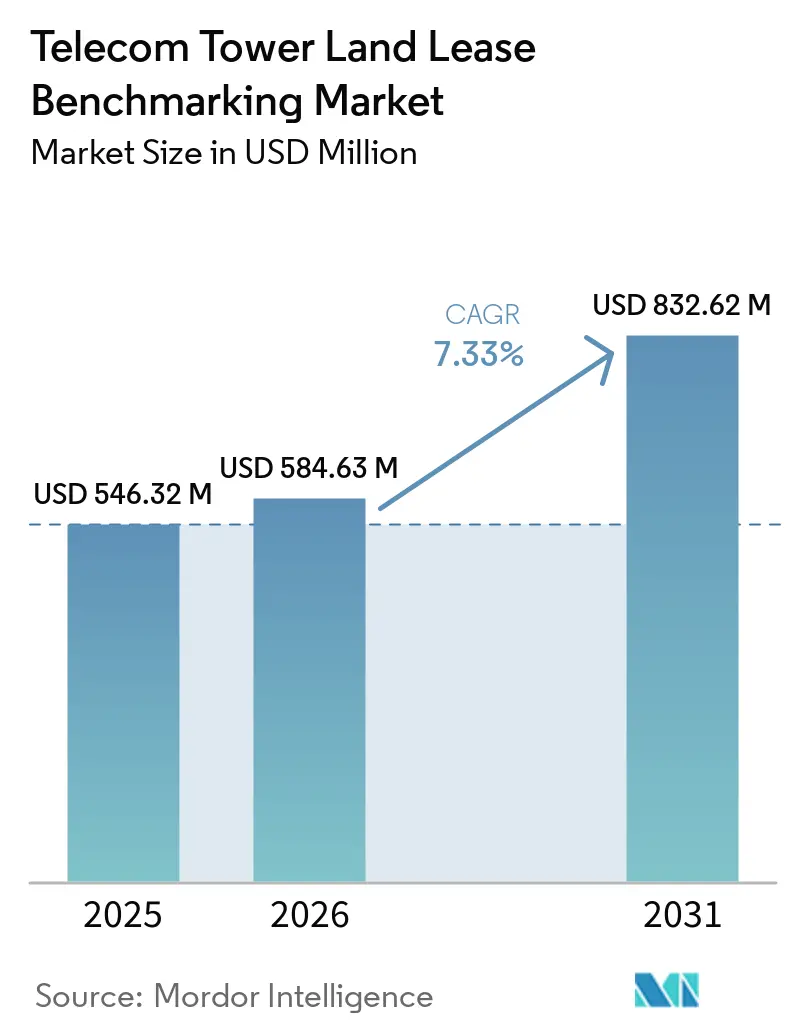
| Market Size (2026) | USD 584.63 Million |
| Market Size (2031) | USD 832.62 Million |
| Growth Rate (2026 - 2031) | 7.33 % |
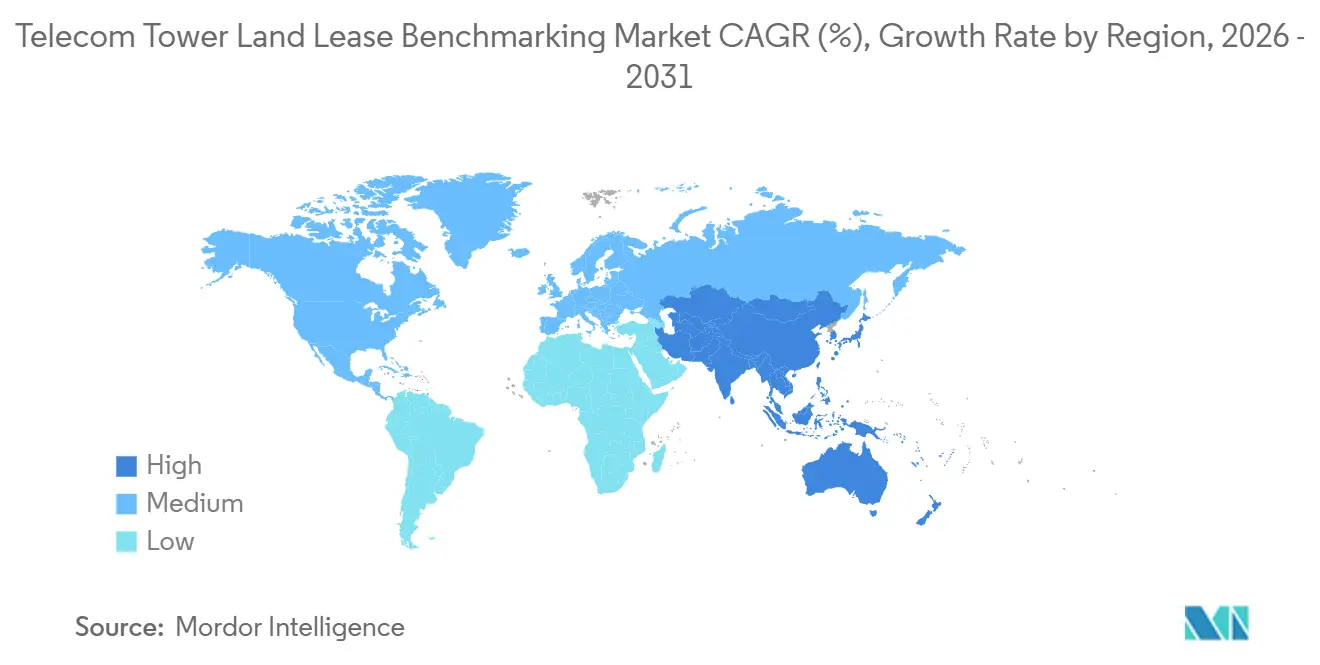
| Fastest Growing Market | Africa |
| Largest Market | Asia-Pacific |
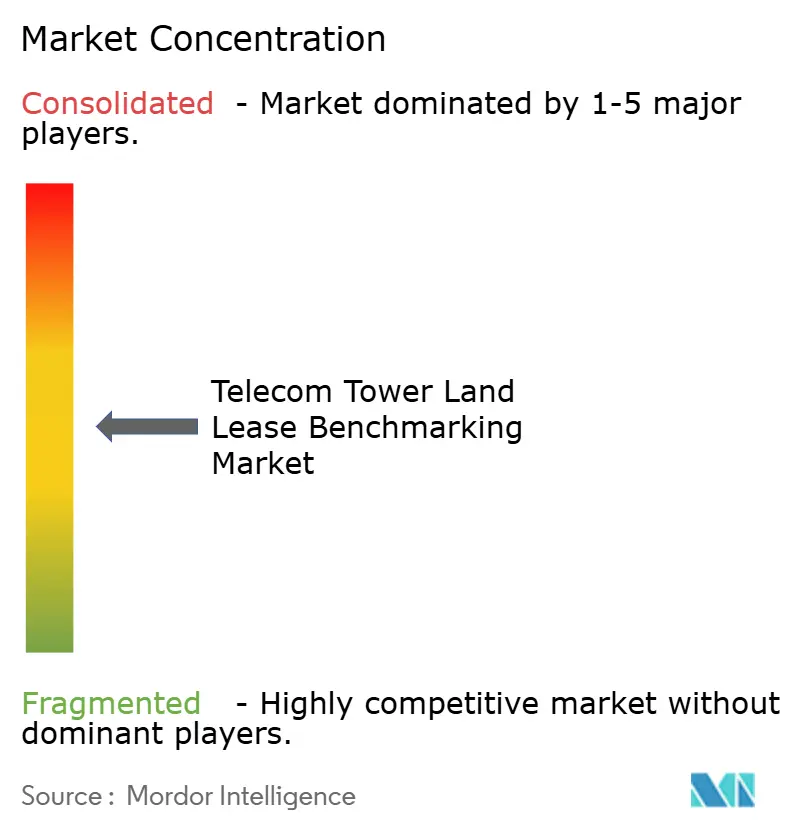
| Market Concentration | Medium |
Major Players *Disclaimer: Major Players sorted in no particular order Image © Mordor Intelligence. Reuse requires attribution under CC BY 4.0. | |
Telecom Tower Land Lease Benchmarking Market Analysis by Mordor Intelligence
The Telecom tower land lease benchmarking market size is projected to expand from USD 546.32 million in 2025 and USD 584.63 million in 2026 to USD 832.62 million by 2031, registering a CAGR of 7.33% between 2026 to 2031. Ground leases, rooftop leases, and easements support most cell-site deployments, and 5G mid-band coverage needs are changing the way tower companies, mobile network operators, and landowners negotiate site access. Larger antenna deployments, tower portfolio transactions, and data-based lease management are extending the need for structured land access agreements. Long contracts of 25 to 50 years, usually with annual escalators, make lease terms financially important for every counterparty over time, because a modest change in rent review language can affect payments, valuation, and negotiating leverage across many future years. Buyout programs are also moving control of some ground interests from landowners to tower companies, which reduces the number of active leases but increases the value of detailed terms for those that remain. The telecom tower land lease benchmarking market therefore depends on accurate comparisons of rent, renewal provisions, escalation methods, and access rights across local markets.
Key Report Takeaways
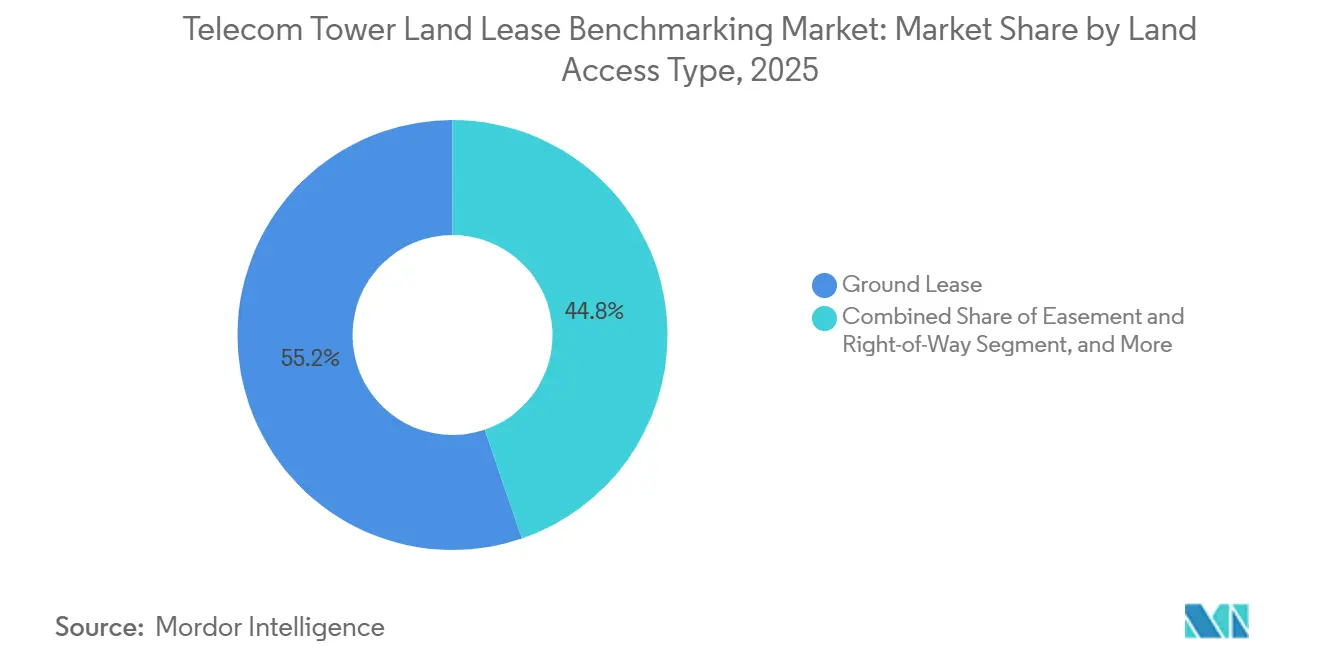
- By land access type, ground leases held 55.24% of the telecom tower land lease benchmarking market share in 2025 and are projected to expand at a 7.66% CAGR through 2031.
- By site configuration, macro tower sites accounted for 58.72% share in 2025, while small-cell sites are projected to expand at a 7.72% CAGR through 2031.
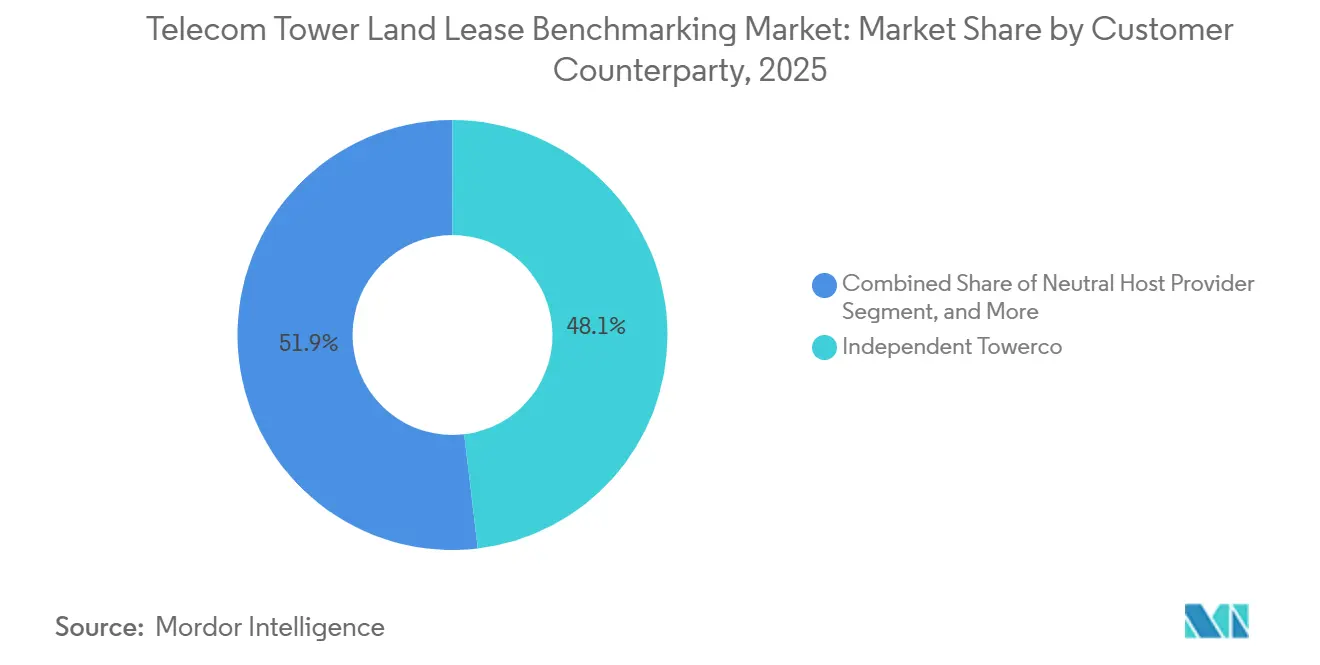
- By customer and counterparty, independent TowerCo operators held 48.13% share in 2025, while private wireless and enterprise networks are projected to expand at a 7.76% CAGR through 2031.
- By lease economics, fixed annual escalator leases held 36.88% share in 2025, while CPI-linked escalators are projected to expand at a 7.92% CAGR through 2031.
- By geography, Asia-Pacific commanded 31.27% share in 2025, while Africa is projected to expand at a 7.88% CAGR through 2031.
Note: Market size and forecast figures in this report are generated using Mordor Intelligence’s proprietary estimation framework, updated with the latest available data and insights as of January 2026.
Market Trends and Insights
Drivers Impact Analysis of Telecom Tower Land Lease Benchmarking Market*
| Driver | (~) % Impact on CAGR Forecast | Geographic Relevance | Impact Timeline |
|---|---|---|---|
| 5G Densification and Network Capacity Expansion | +2.1% | Global | Medium term (2-4 years) |
| Rural Coverage Programs and Public Connectivity Funding | +1.6% | North America, Africa, Asia-Pacific core | Long term (≥ 4 years) |
| TowerCo Sale-and-Leaseback and Asset Monetization | +1.3% | Global, especially Asia-Pacific, Europe, and Africa | Short term (≤ 2 years) |
| Urban Small-Cell and Rooftop Site Scarcity | +1.1% | North America, Europe, and Asia-Pacific core | Medium term (2-4 years) |
| Portfolio-Level Lease Aggregation and Data-Enabled Negotiation | +0.6% | North America and Europe | Medium term (2-4 years) |
| Digital-Twin Screening of Ground-Lease Buyout Targets | +0.4% | North America and Europe | Long term (≥ 4 years) |
| Source: Mordor Intelligence | |||
5G Densification and Network Capacity Expansion
Next-generation mid-band deployment remains the main source of new activity in the telecom tower land lease benchmarking market. Each antenna installation, colocation request, or site upgrade can require a new lease or an amendment to an existing agreement. American Tower reported a substantial year-over-year increase in colocation and total applications, demonstrating the scale of network activity underway. Mid-band spectrum has a shorter propagation range than lower-frequency spectrum, so operators must activate sites that held less value under earlier-generation network designs. This makes comparable rent, access, and escalation data more important for sites that were previously not heavily contested, because the telecom tower land lease benchmarking market needs to separate historical terms from current network value in each location. The preference for colocation over new construction also prolongs the economic life of established locations and increases long-term rent exposure in busy corridors, especially where several operators need the same coverage assets. This keeps lease comparison relevant even when new macro construction is limited in mature areas.
Rural Coverage Programs and Public Connectivity Funding
Public broadband programs are creating demand for site access in areas with limited lease precedents. The U.S. Department of Agriculture is supporting communities without existing broadband service through its Community Connect Grant Program.[1] The BEAD program had provisionally awarded substantial funding across most states, with rural electric and telecommunications providers among the recipients.[2] New sites in rural corridors need locally relevant rental comparisons because established rates may not exist, and the telecom tower land lease benchmarking market needs evidence that reflects local demand, access constraints, and the site’s practical operating role. This work is more demanding where land records are fragmented, local pricing history is limited, and site access is newly negotiated. The resulting need for lease valuation and documentation supports the telecom tower land lease benchmarking market over a longer period. It also places more weight on local records of access rights, lease duration, and rent adjustments.
TowerCo Sale-and-Leaseback and Asset Monetization
Sale-and-leaseback transactions can create new master lease arrangements and prompt reviews of underlying land rights. TELUS formed Terrion and agreed for La Caisse to acquire a minority interest under an initial multiyear master leaseback covering thousands of sites across several Canadian provinces.[3] Such transactions require the buyer and seller to assess site obligations, renewal rights, and rental exposure across entire portfolios, which makes the telecom tower land lease benchmarking market relevant to transaction planning as well as ongoing property administration. They can also realign the return expectations applied to individual ground leases. Reintegration of tower assets by network operators can reduce the number of independently traded agreements. It can still increase the need for transparent pricing because related parties must assess whether internal lease terms reflect local conditions. The telecom tower land lease benchmarking market benefits when portfolios need a consistent basis for such reviews.
Urban Small-Cell and Rooftop Site Scarcity
Urban network capacity requirements are increasing demand for rooftops, street assets, and other nontraditional sites. Suitable host locations are scarce in dense areas, which can place pressure on rent and complicate comparisons with macro tower agreements, so the telecom tower land lease benchmarking market must treat physical access, public approvals, and host responsibilities as material terms. Boldyn Networks deployed an extensive small-cell network in London through a long-term concession with Transport for London that provides access to a broad network of fiber-connected street assets and ducts. This type of portfolio agreement differs from the individual site negotiations common in other cities. Crown Castle completed the sale of its small-cell business to Arium Networks in May 2026, moving a dense urban portfolio to a new owner. The telecom tower land lease benchmarking market must therefore distinguish urban rooftop and street access economics from traditional ground lease structures. It must also reflect the different approval, utility, and access obligations that apply to city sites.
Restraints Impact Table of Telecom Tower Land Lease Benchmarking Market*
| Restraint | (~) % Impact on CAGR Forecast | Geographic Relevance | Impact Timeline |
|---|---|---|---|
| Infrastructure-Sharing Saturation and Tenant Churn | -0.8% | North America, primarily, and Europe | Medium term (2-4 years) |
| Zoning, Permitting and Community-Consent Delays | -0.6% | North America, Europe, and Asia-Pacific core | Short term (≤ 2 years) |
| Land Aggregator Bargaining Power and Rent Repricing | -0.4% | North America and Europe | Medium term (2-4 years) |
| Renewal Valuation Uncertainty Under No-Network Assumptions | -0.3% | North America and Europe | Long term (≥ 4 years) |
| Source: Mordor Intelligence | |||
Infrastructure-Sharing Saturation and Tenant Churn
Infrastructure sharing can limit the number of new colocation events and lease amendments at existing sites. Mobile operators may reduce overlapping network footprints after spectrum consolidation or network integration, which narrows some sources of new work for the telecom tower land lease benchmarking market, even as renewal and exit negotiations become more detailed. The three large U.S. public tower companies reported elevated churn in 2025 and expected continuing pressure during 2026, particularly from Sprint lease terminations and DISH Wireless defaults. This reduces the transaction base that supports lease comparisons even when total tower counts remain high. American Tower reported that churn offset part of contractual escalator gains in 2025. The telecom tower land lease benchmarking market must adapt to fewer active counterparties at some mature sites and more complex renewal discussions at the remaining locations. This shifts attention from volume of transactions toward the quality and comparability of contract records.
Zoning, Permitting and Community-Consent Delays
Permitting delays can prevent planned tower and small-cell agreements from becoming active leases. Local reviews may add costs and uncertainty before a site has been approved for construction. These delays matter most for rooftop and small-cell pipelines in residential areas and scenic corridors. Land option payments and early site work can become unrecoverable if the approval process fails. Operators may delay capital commitments in jurisdictions with unpredictable approval standards, leaving the telecom tower land lease benchmarking market dependent on projects that can progress from early options to signed and usable operating agreements. The restraint reduces near-term lease origination, even when the underlying demand for network capacity remains strong. It can also delay the point at which negotiated option rights become long-term operating leases.
*Our forecasts treat driver/restraint impacts as directional, not additive. The impact forecasts reflect baseline growth, mix effects, and variable interactions.
Telecom Tower Land Lease Benchmarking Market Segment Analysis
By Land Access Type:
Ground Leases Remain the Core Contract StructureGround leases accounted for 55.24% share in 2025 and are projected to expand at a 7.66% CAGR through 2031. This lead reflects the continuing importance of ground-level macro infrastructure in Sub-Saharan Africa and South and Southeast Asia. New towers in these areas frequently require first-generation agreements for land access, and the telecom tower land lease benchmarking market can support discussions where landowners and operators have limited local evidence for setting initial contract terms. American Tower planned additional ground-interest acquisitions following prior investments in U.S. acquisitions. Perpetual easements and prepaid leases can replace recurring rent with a capital commitment. The strategy shows continued confidence in ground-level assets while reducing future rent variability for the tower owner, and it changes the pool of leases available for later comparison.
Rooftop leases are becoming more important in Europe, where restrictions on new mast construction favor existing buildings. The telecom tower land lease benchmarking market must assess building management obligations, structural limitations, and municipal requirements for these sites. Easements and rights-of-way are also expanding with small cells placed on utility poles and street furniture. Their revenue per site is lower than ground or rooftop arrangements in many cases. Other access types include water towers, utility pylons, and nontelecom structures. These arrangements are less standardized, so they require more detailed assessment of local access rights and operating obligations.

By Site Configuration:
Macro Towers Lead While Small Cells Advance FasterMacro tower sites held 58.72% share of the telecom tower land lease benchmarking market size in 2025. Their scale reflects the large installed base and the continued value of colocation at established locations. Macro construction remains important in emerging markets where 4G coverage extension and 5G anchor sites are still needed, so the telecom tower land lease benchmarking market continues to cover both mature asset renewals and new site origination. Indus Towers significantly expanded its tower portfolio in India during 2025, demonstrating that macro towers remain central to network expansion. These sites normally have long-term ground agreements and multiple tenants. Their recurring lease commitments make comparable rental and escalator data important for both landowners and tower companies, particularly when agreements approach renewal or amendment dates.
Small-cell sites are projected to expand at a 7.72% CAGR through 2031, the fastest rate among site configurations. They support dense mid-band and millimeter-wave coverage where macro towers cannot supply sufficient capacity alone. Crown Castle's May 2026 small-cell sale transferred a major urban access portfolio to Arium Networks. Rooftop sites commonly involve building owners, management companies, or municipalities. In-building and distributed antenna system sites serve airports, transit corridors, and stadiums. These sites have high unit values but account for a smaller share of total locations because they need specialized access, design terms, and coordination with property managers or public agencies.
By Customer and Counterparty:
Independent TowerCos Lead as Enterprise Networks ExpandIndependent TowerCo operators held 48.13% share in 2025. This position reflects the transfer of cell-site portfolios from mobile operators to neutral infrastructure owners. Each portfolio transaction can create a large set of land agreements that need consistent review and pricing. Independent TowerCos use site data to verify structural conditions, tenancy information, and lease obligations before completing acquisitions. Digital twin capture can improve the accuracy of this portfolio-level due diligence. It also gives buyers a more consistent record for tracking land access terms, site changes, and contract responsibilities after a transaction closes.
Mobile network operator captive infrastructure has declined as operators monetize assets, although some operators are reconsidering this model in high-inflation settings. Neutral hosts support shared small-cell and in-building systems where carriers do not want to be the sole anchor tenant. Public-sector operators can support rural connectivity, sometimes under lease economics that differ from commercial benchmarks. Private wireless and enterprise networks are projected to expand at a 7.76% CAGR through 2031. The telecom tower land lease benchmarking industry is responding to this newer counterparty group because campus and wide-area private networks use different locations and contract requirements. Their expansion increases the need to compare commercial site access terms beyond the conventional MNO model, including campus locations and wide-area enterprise coverage requirements.
By Lease Economics:
Fixed Escalators Lead While CPI-Linked Terms Gain UseFixed annual escalator leases held 36.88% share in 2025, making them the largest lease economics structure. Fixed annual increases became common in North America and Europe because they are easy to administer over long contracts. American Tower stated that U.S. tenant leases typically include modest fixed annual escalators. These terms give operators predictable costs but may not preserve a landowner's real rental value during periods of higher inflation. Fixed structures, therefore, remain a key reference point for comparable lease analysis. Their long duration makes even small differences in annual escalation commercially meaningful.
CPI-linked escalators are projected to expand at a 7.92% CAGR through 2031. Landowners and infrastructure investors are seeking greater inflation protection at renewal, particularly for agreements with 25- to 30-year terms. Crown Castle has used fixed-dollar, fixed-percentage, and CPI-linked arrangements within its lease portfolio. Hybrid contracts can combine a minimum escalation clause with a CPI ceiling, which limits exposure for both parties. Revenue-share and colocation-linked rent can offer landowners greater upside at high-demand sites. One-time upfront consideration also remains relevant as tower companies seek to reduce recurring lease cost variability and replace uncertain future payments with defined capital commitments.
Geography Analysis
APAC Telecom Tower Land Lease Benchmarking Market
Asia-Pacific commanded 31.27% share in 2025. China Tower operated an extensive tower portfolio and maintained a substantial asset base. India has a more mature next-generation mobile deployment cycle, which shifts attention toward renewal terms and colocation amendments. Indonesia and other Southeast Asian markets remain underserved and continue to need new site access arrangements. edotco operates an extensive tower portfolio across Malaysia, Bangladesh, Cambodia, Myanmar, Pakistan, Sri Lanka, and the Philippines. The region includes state-led, independent, and fragmented landlord models, so national and local comparisons are more useful than a single regional benchmark for rent, term, and escalation discussions.
North America and Europe Telecom Tower Land Lease Benchmarking Market
North America has a mature land lease base, with 25- to 50-year contracts moving into renewal periods. American Tower increased its spending on U.S. ground-lease acquisitions substantially in 2025 compared with the previous year. This regional lease benchmarking activity is supported by complex renewal discussions and ground-interest buyouts. Terrion's formation in Canada created a dedicated tower operator with an extensive site portfolio under a long-term master leaseback with TELUS. Europe is shaped by varied national planning rules, property rights, and lease conventions. Cellnex, Vantage Towers, TOTEM, Deutsche Funkturm, and GD Towers operate in this diverse setting, which requires local regulatory and property knowledge.
MEA and South America Telecom Tower Land Lease Benchmarking Market
Africa is projected to expand at a 7.88% CAGR through 2031, the fastest regional rate. The region is supported by established mobile network consolidation and early next-generation deployments in markets where many rural agreements are newly established. Helios Towers reported an increase in its tenancy ratio. MTN announced a proposed acquisition of IHS Towers that would affect tower ownership across several African markets. South America has lease activity concentrated in Brazil, Colombia, and Central America through major tower portfolios. The Middle East is supported by Saudi Arabia's TAWAL and developing neutral-host frameworks linked to infrastructure investment programs.
Competitive Landscape
The telecom tower land lease benchmarking market is moderately concentrated at the tower company level. American Tower, China Tower, Indus Towers, Cellnex, and Crown Castle manage some of the largest portfolios. Regional and private tower companies still compete actively for individual site rights and local lease terms. Land aggregation funds add another class of counterparty by purchasing ground-rent income from individual landowners. These funds can bring stronger financial resources and more formal valuation methods to negotiations. The result is greater focus on comparable rents, escalators, renewal options, site-specific access restrictions, and the allocation of maintenance or compliance obligations, while counterparties also test whether the agreement records reflect the practical condition and permitted use of each location.
Digital site records have become an important competitive capability for operators reviewing large portfolios. They can improve the documentation of site conditions, lease obligations, and tenant arrangements. American Tower's land optimization program invested significantly in U.S. ground interests and planned continued investment in subsequent periods. The program converts selected rent obligations into owned or prepaid interests. Crown Castle completed the sale of its fiber and small-cell businesses and received substantial cash proceeds after purchase-price adjustments. This repositioned the company around its tower assets and changed ownership of a major urban site access portfolio, with implications for future commercial decisions at dense locations.
Africa and Southeast Asia offer opportunities because lease benchmarks and independent tower company structures are still developing, which allows the telecom tower land lease benchmarking market to address rate setting, contract design, and local precedent formation at the same time. Early entrants can set local precedents for rent, escalation, and renewal terms. MTN's proposed acquisition of IHS Towers shows how vertical integration can reduce the number of independent counterparties. This can make transparent lease references more important for commercial discussions and regulatory review. Phoenix Tower International and edotco compete in markets where many rates and contract standards are still being established. The telecom tower land lease benchmarking market remains competitive because large portfolio owners have scale, while regional operators retain an advantage in local land access, property relationships, and regulatory practice.
Telecom Tower Land Lease Benchmarking Industry Leaders
-
China Tower Corporation Limited
-
Indus Towers Limited
-
American Tower Corporation
-
Cellnex Telecom, S.A.
-
Vantage Towers AG
- *Disclaimer: Major Players sorted in no particular order
Telecom Tower Land Lease Benchmarking Market Companies Covered in this Report
- American Tower Corporation
- Cellnex Telecom, S.A.
- Vantage Towers AG
- GD Towers Holding GmbH
- SBA Communications Corporation
- Crown Castle Inc.
- China Tower Corporation Limited
- Indus Towers Limited
- IHS Holding Limited
- Helios Towers plc
- Phoenix Tower International
- edotco Group Sdn Bhd
- TOTEM
- Vertical Bridge REIT, LLC
- Atlas Tower Group
- TAWAL
- Telesites S.A.B. de C.V.
- Deutsche Funkturm GmbH
- Tillman Infrastructure LLC
- Boldyn Networks
Recent Industry Developments in Telecom Tower Land Lease Benchmarking Market
- August 2026: IHS Holding Limited shareholders voted to approve MTN Group's proposed USD 2.2 billion acquisition of the approximately 75% stake MTN did not already own, valuing IHS at approximately USD 6.2 billion enterprise value and consolidating nearly 29,000 towers across Nigeria, Cameroon, South Africa, Rwanda, Côte d’Ivoire, and Zambia under MTN's direct ownership, the largest tower-sector M&A event in Africa on record.
- July 2026: Saudi Arabia's official Telecom Tower Site Leasing service specifies that telecom tower site rental rates are determined through an approved financial model agreed between the Ministry of Communications and the Ministry of Municipalities and Housing. Sites outside the model can be referred to an Investment Committee for valuation.
- May 2026: Crown Castle closed the USD 8.5 billion sale of its Fiber Solutions business to Zayo Group Holdings and its Small Cell business to Arium Networks, receiving USD 8.4 billion in cash proceeds after purchase-price adjustments. Crown Castle subsequently committed to repurchasing USD 1 billion of shares and reducing debt by more than USD 7 billion, repositioning as the only large U.S. publicly traded pure-play tower company owning approximately 40,000 sites.
- February 2026: MTN Group announced its agreement to acquire approximately 75% of IHS Holding Limited for USD 2.2 billion in cash at USD 8.50 per share, representing a 9.7% premium to the 30-day average share price as of February 4, 2026, in a transaction that unites Africa's largest MNO with one of the continent's largest tower operators.
Global Telecom Tower Land Lease Benchmarking Market Report Scope
Telecom Tower Land Lease Benchmarking Market refers to data, valuation, and advisory services that assess and compare rental rates and contractual terms for land leased to telecom tower companies and mobile network operators. It covers ground leases for macro towers, monopoles, small cells, rooftop compounds, equipment shelters, access roads, power systems, and related telecommunications facilities.
The Telecom Tower Land Lease Benchmarking Market Report is Segmented by Land Access Type (Ground Lease, Rooftop Lease, Easement and Right-of-Way, and More), Site Configuration (Macro Tower Site, Small-Cell Site, Rooftop Site, and In-Building and Distributed Antenna Site), Customer (Independent Towerco, MNO Captive Infrastructure, Neutral Host Provider, Public-Sector Network Operator, and Private Wireless and Enterprise Network), Lease Economics (Fixed Annual Escalator, CPI-Linked Escalator, Hybrid Index and Fixed Escalator, Revenue-Share and Colocation-Linked Rent, and One-Time Upfront Consideration), and Geography (North America, South America, Europe, Asia-Pacific, Middle East, Africa). The Market Forecasts are Provided in Terms of Value (USD).
| Ground Lease |
| Rooftop Lease |
| Easement and Right-of-Way |
| Other Land Access Types |
| Macro Tower Site |
| Small-Cell Site |
| Rooftop Site |
| In-Building and Distributed Antenna Site |
| Independent Towerco |
| MNO Captive Infrastructure |
| Neutral Host Provider |
| Public-Sector Network Operator |
| Private Wireless and Enterprise Network |
| Fixed Annual Escalator |
| CPI-Linked Escalator |
| Hybrid Index and Fixed Escalator |
| Revenue-Share and Colocation-Linked Rent |
| One-Time Upfront Consideration |
| North America | United States |
| Canada | |
| Mexico | |
| South America | Brazil |
| Argentina | |
| Colombia | |
| Rest of South America | |
| Europe | Germany |
| United Kingdom | |
| France | |
| Italy | |
| Russia | |
| Rest of Europe | |
| Asia-Pacific | China |
| India | |
| Japan | |
| Indonesia | |
| Rest of Asia-Pacific | |
| Middle East | Saudi Arabia |
| United Arab Emirates | |
| Turkey | |
| Rest of Middle East | |
| Africa | Nigeria |
| South Africa | |
| Kenya | |
| Rest of Africa |
| By Land Access Type | Ground Lease | |
| Rooftop Lease | ||
| Easement and Right-of-Way | ||
| Other Land Access Types | ||
| By Site Configuration | Macro Tower Site | |
| Small-Cell Site | ||
| Rooftop Site | ||
| In-Building and Distributed Antenna Site | ||
| By Customer / Counterparty | Independent Towerco | |
| MNO Captive Infrastructure | ||
| Neutral Host Provider | ||
| Public-Sector Network Operator | ||
| Private Wireless and Enterprise Network | ||
| By Lease Economics | Fixed Annual Escalator | |
| CPI-Linked Escalator | ||
| Hybrid Index and Fixed Escalator | ||
| Revenue-Share and Colocation-Linked Rent | ||
| One-Time Upfront Consideration | ||
| By Geography | North America | United States |
| Canada | ||
| Mexico | ||
| South America | Brazil | |
| Argentina | ||
| Colombia | ||
| Rest of South America | ||
| Europe | Germany | |
| United Kingdom | ||
| France | ||
| Italy | ||
| Russia | ||
| Rest of Europe | ||
| Asia-Pacific | China | |
| India | ||
| Japan | ||
| Indonesia | ||
| Rest of Asia-Pacific | ||
| Middle East | Saudi Arabia | |
| United Arab Emirates | ||
| Turkey | ||
| Rest of Middle East | ||
| Africa | Nigeria | |
| South Africa | ||
| Kenya | ||
| Rest of Africa | ||
Key Questions Answered in the Report
What is the telecom tower land lease benchmarking market size?
The telecom tower land lease benchmarking market size is USD 584.63 million in 2026 and is projected to reach USD 832.62 million by 2031 at a 7.33% CAGR.
What is driving demand for telecom tower land lease benchmarking?
5G densification, rural connectivity programs, asset monetization, and scarce urban rooftop and street locations are increasing the need for comparable lease data.
Which land access type leads telecom tower lease activity?
Ground leases held 55.24% share in 2025 and are projected to expand at a 7.66% CAGR through 2031.
Why are CPI-linked escalators becoming more common?
CPI-linked escalators are projected to expand at a 7.92% CAGR because landowners seek better inflation protection during long-term lease renewals.
Which region has the fastest expansion in tower land lease activity?
Africa is projected to expand at a 7.88% CAGR through 2031, supported by 4G consolidation and early 5G deployments.
How do tower company transactions affect land leases?
Portfolio sales, leasebacks, buyouts, and vertical integration can alter counterparties, renewal terms, and the value of transparent local lease comparisons.