Talent Acquisition Software Market Size and Share
Market Overview
| Study Period | 2020 - 2031 |
|---|---|
| Market Size (2026) | USD 10.95 Billion |
| Market Size (2031) | USD 14.4 Billion |
| Growth Rate (2026 - 2031) | 5.63% CAGR |
| Fastest Growing Market | Asia-Pacific |
| Largest Market | North America |
| Market Concentration | Medium |
Major Players *Disclaimer: Major Players sorted in no particular order Image © Mordor Intelligence. Reuse requires attribution under CC BY 4.0. | |
Talent Acquisition Software Market Analysis by Mordor Intelligence
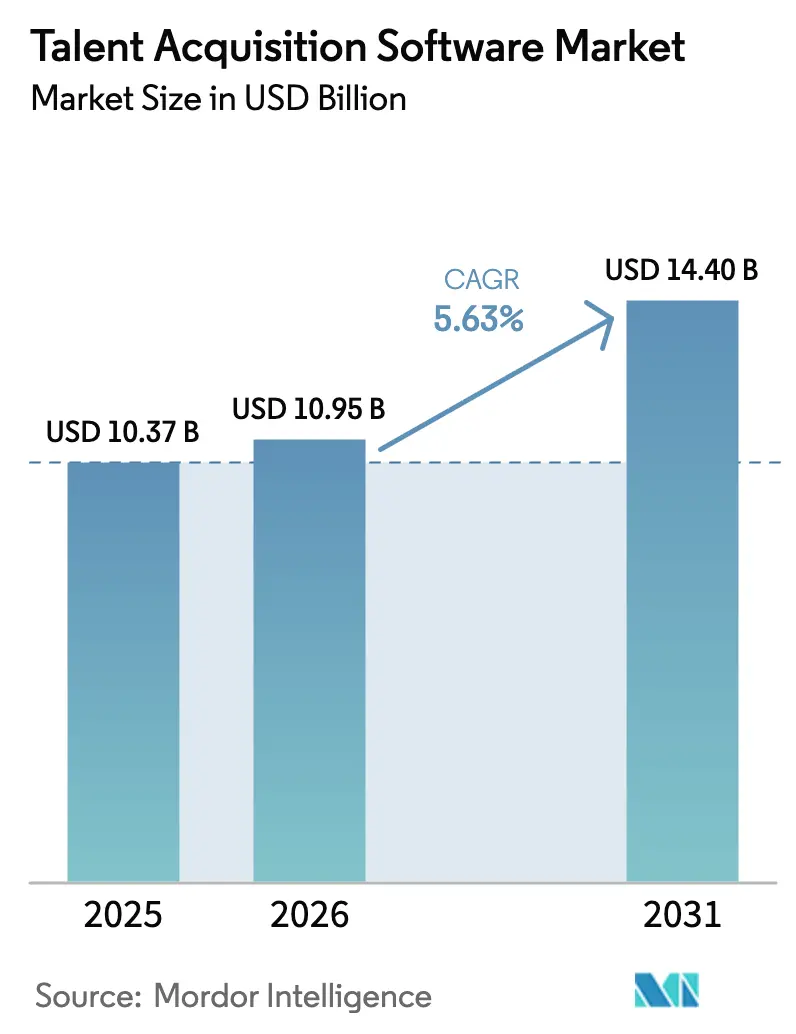
The talent acquisition software market size was valued at USD 10.37 billion in 2025 and estimated to grow from USD 10.95 billion in 2026 to reach USD 14.4 billion by 2031, at a CAGR of 5.63% during the forecast period (2026-2031). Robust enterprise demand for AI-powered candidate matching, coupled with accelerated migrations to cloud-native HR platforms, underpins this expansion. Vendors benefit from the shift away from transactional applicant tracking to integrated talent orchestration that unifies sourcing, screening, and candidate relationship management workflows. Cloud-based deployments already handle more than two-thirds of new installations, helping organizations trim infrastructure costs and deliver faster innovation cycles. Government incentives for digital hiring programs across Asia Pacific, North America, and parts of Europe reinforce adoption momentum, even as compliance costs and economic uncertainty temper short-term spending.
Key Report Takeaways
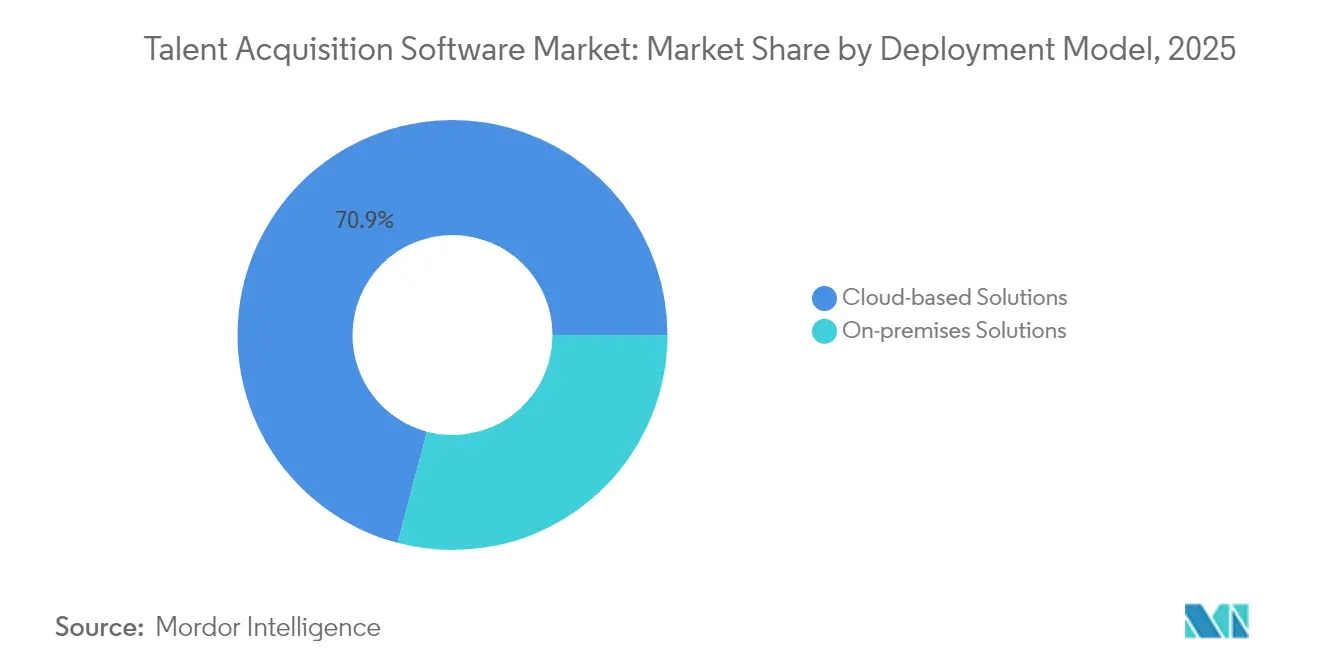
- By deployment model, cloud solutions controlled 70.89% revenue share in 2025 and are progressing at a 6.62% CAGR through 2031.
- By component, applicant tracking systems led with 37.25% of the 2025 talent acquisition software market share, while recruitment marketing suites are projected to post the fastest 6.45% CAGR to 2031.
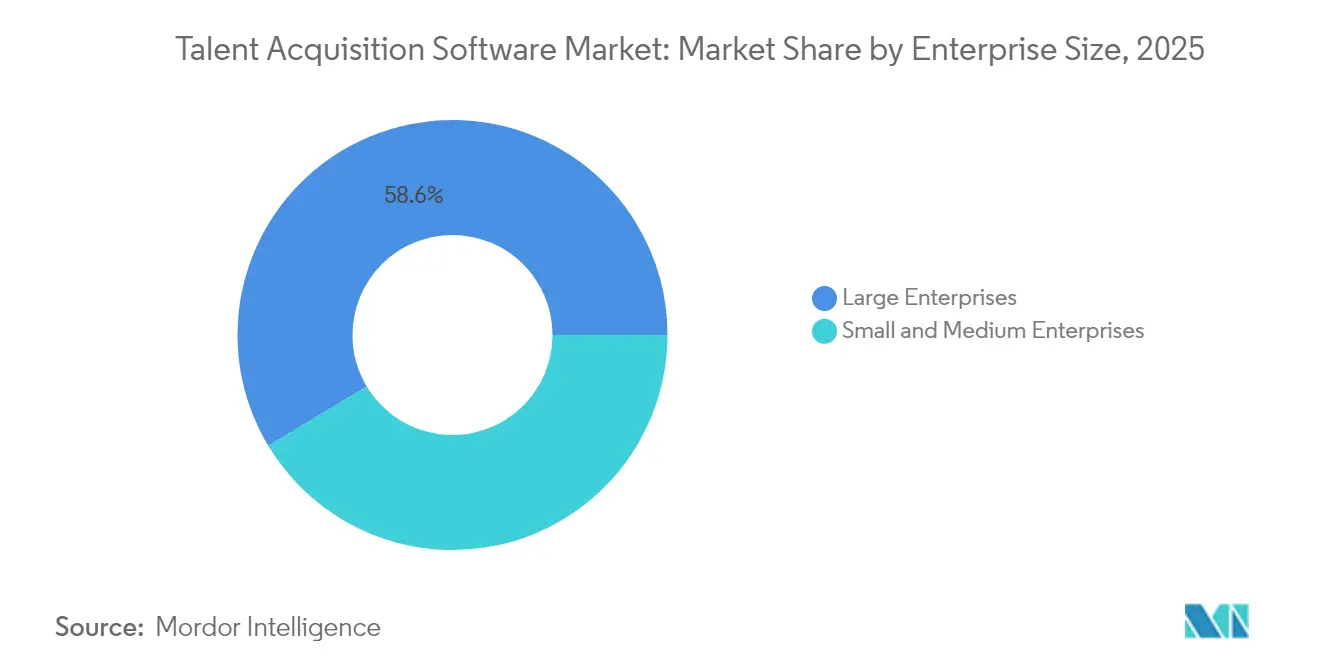
- By enterprise size, small and medium enterprises are anticipated to record a 6.44% CAGR, outpacing large-enterprise growth despite the latter’s 58.62% share in 2025.
- By end-use industry, retail and e-commerce usage is growing at a 6.65% CAGR, challenging IT and telecommunications, which retained 22.11% revenue share in 2025.
- By geography, Asia Pacific is on track for a 6.18% CAGR to 2031, although North America remained the largest regional market at 34.05% share in 2025.
Note: Market size and forecast figures in this report are generated using Mordor Intelligence’s proprietary estimation framework, updated with the latest available data and insights as of 2026.
Global Talent Acquisition Software Market Trends and Insights
Drivers Impact Analysis*
| Driver | (~) % Impact on CAGR Forecast | Geographic Relevance | Impact Timeline |
|---|---|---|---|
| Cloud-migration of HR tech stacks | +1.8% | Global, led by North America and Europe | Medium term (2-4 years) |
| AI-powered candidate matching improving quality-of-hire | +1.5% | North America and Asia Pacific core, spill-over to Europe | Short term (≤ 2 years) |
| Hyper-personalised candidate experience expectations | +1.2% | Global, led by North America and Western Europe | Medium term (2-4 years) |
| Rising contingent workforce penetration | +1.0% | Global, concentrated in Asia Pacific and North America | Long term (≥ 4 years) |
| Talent analytics adoption for DEI scorecards | +0.8% | North America and Europe, expanding to Asia Pacific | Medium term (2-4 years) |
| Government incentives for digital hiring platforms | +0.6% | Asia Pacific core, selective programs in North America and Europe | Short term (≤ 2 years) |
| Source: Mordor Intelligence | |||
Cloud Migration of HR Tech Stacks Accelerates Platform Consolidation
Organizations shifting to cloud-native HR architectures report double-digit cost and performance benefits. Real-time data integration collapses historical silos, improving hiring analytics and enabling enterprise-wide workforce insights. Faster implementation cycles and elastic scalability make cloud deployments especially attractive for high-volume recruiting. API-first designs let employers plug specialized sourcing, assessment, or background-check modules into unified workflows, positioning the talent acquisition software market as the cornerstone of broader HR digital transformation.[1]Oracle, “Why Cloud HR Delivers Faster ROI,” oracle.com
AI-Powered Candidate Matching Transforms Quality-of-Hire Metrics
Machine-learning engines now parse résumés, assessments, and behavioral signals to surface best-fit profiles with greater precision than keyword searches. Leading platforms processed hundreds of thousands of requisitions in 2024, boosting recruiter capacity by more than half. Explainable-AI dashboards and bias audits have become must-have features amid heightened regulatory scrutiny. Despite clear efficiency gains, nearly nine in ten large employers have yet to deploy AI-driven personalization on career sites—an adoption gap that continues to fuel growth opportunities
Hyper-Personalised Candidate Experience Becomes Competitive Differentiator
Jobseekers expect Netflix-style recommendation engines, conversational chatbots, and one-click mobile apply paths. Employers that embed video, social-style content, and skills-forward descriptions see application-completion improvements and shorter hiring cycles. Recruitment marketing automation orchestrates campaigns across TikTok, Reddit, and niche job boards, positioning the talent acquisition software market as a core enabler of brand-led hiring strategies.
Rising Contingent Workforce Penetration Expands Platform Scope
Gig workers, contractors, and fractional specialists now compose a sizable share of global labor pools. Recruiting platforms must therefore handle mixed worker classifications, varied compliance regimes, and integrated payment workflows. Tight integration with vendor management systems, freelancer marketplaces, and skills taxonomies allows employers to balance remote, hybrid, and on-site talent demands without fragmenting data or candidate experiences.
Restraints Impact Analysis*
| Restraint | (~) % Impact on CAGR Forecast | Geographic Relevance | Impact Timeline |
|---|---|---|---|
| Data-privacy compliance costs (GDPR, CPRA) | -1.2% | Europe and California, expanding globally | Short term (≤ 2 years) |
| Legacy HRIS integration hurdles | -0.8% | Global, higher impact in North America and Europe | Medium term (2-4 years) |
| Economic downturn hiring freezes | -0.7% | Global, with heightened sensitivity in developed economies | Short term (≤ 2 years) |
| AI bias and regulatory scrutiny on algorithms | -0.5% | North America and Europe, expanding to Asia Pacific | Medium term (2-4 years) |
| Source: Mordor Intelligence | |||
Data-Privacy Compliance Costs Create Implementation Barriers
Heightened regulatory requirements obligate employers to invest in consent management, breach safeguards, and candidate data governance. Some multinationals now allocate multimillion-dollar budgets for remediation of legacy workflows and cross-border data-transfer controls. These expenditures slow purchase decisions and divert funds away from feature innovation, placing short-term pressure on the talent acquisition software market.[2]IBM, “Cost of a Data Breach Report 2025,” ibm.com
Legacy HRIS Integration Hurdles Constrain Adoption Velocity
Many organizations still operate decades-old HR information systems. Limited APIs, inconsistent data schemas, and duplicate records complicate new platform rollouts. Integration projects often demand custom middleware and robust change-management programs, inflating transition costs and delaying ROI timelines. Small and medium enterprises, lacking enterprise IT resources, therefore gravitate toward plug-and-play solutions that shield them from heavy integration lift.[3]SHRM, “The Many Costs of HR Software Sprawl,” shrm.org
*Our forecasts treat driver/restraint impacts as directional, not additive. The impact forecasts reflect baseline growth, mix effects, and variable interactions.
Segment Analysis
By Deployment Model: Cloud Dominance Drives Rapid Scale
The talent acquisition software market size tied to cloud deployments eclipsed USD 7.35 billion in 2025, underscoring a decisive customer preference for subscription-based delivery. With a future 6.62% CAGR, cloud offerings are poised to capture even greater share by 2031. On-premises installations persist in highly regulated verticals but face steady attrition as security certifications and sovereign-cloud options multiply. Hybrid models serve as interim waypoints for organizations migrating sensitive data in phases, especially in financial services and healthcare. Government funding programs in Singapore, British Columbia, and selected U.S. states further hasten cloud transitions, directly benefiting the talent acquisition software market.
Cloud migration simultaneously unlocks AI capabilities and continuous updates that legacy architectures cannot match. Vendors therefore package advanced analytics, conversational AI bots, and skills-graph technology as standard cloud features. In turn, buyers gain measurable quality-of-hire improvements without capital-expense burdens. These advantages reinforce the long-term gravitational pull toward software-as-a-service delivery, widening the gap between cloud leaders and lagging on-premises incumbents.


By Component: ATS Foundation Evolves into Unified Suites
Applicant tracking systems accounted for the largest 37.25% slice of 2025 revenue, making them the anchoring workflow layer across enterprise and mid-market segments. Yet as recruitment marketing, candidate relationship management, and onboarding modules converge, buyers increasingly source integrated suites from a single provider. This shift propels recruitment marketing functionality to a projected 6.45% CAGR, closely followed by candidate relationship modules that nurture passive talent pools. Services, implementation, and optimization consulting also record healthy growth because complex global rollouts require specialized expertise.
Cross-suite convergence is shaped by recruiter demand for single-pane dashboards, unified analytics, and lower vendor-management overhead. Modern ATS products bundle résumé parsing, interview scheduling, and predictive analytics that once required separate licenses, compressing total cost of ownership and driving consolidation in the talent acquisition software market.
By Enterprise Size: SME Growth Narrows Capability Gaps
While large enterprises still consume 58.62% of spending, SMEs now deliver the fastest 6.44% CAGR, reshaping vendor go-to-market priorities. Subscription pricing, pre-configured workflows, and low-code customization make sophisticated toolsets accessible to resource-constrained businesses. Cloud deployment removes server maintenance burdens, allowing smaller firms to adopt AI-driven matching and automated scheduling that were historically out of reach. Government digital-adoption incentives and pandemic-era remote-work transitions amplified this trend, positioning the talent acquisition software market as a pivotal equalizer in recruiting efficiency.
In contrast, large enterprises focus on deep integration with learning, performance, and compensation suites. Multi-country compliance, skills taxonomies, and internal mobility analytics demand bespoke configurations and robust implementation services. Vendors therefore maintain dual product tiers, balancing enterprise-grade extensibility with SME simplicity.
By End-Use Industry: Retail and E-Commerce Outpaces IT Leadership
The IT and telecommunications sector generated 22.11% of 2025 revenue, leveraging advanced candidate assessments for hard-to-source technical talent. Yet retail and e-commerce now register the highest 6.65% CAGR through 2031, fueled by seasonal hiring swings, gig-economy roles, and customer-facing staffing needs. Automation of job-posting campaigns, chat-based screening, and batch interview scheduling delivers compelling ROI for high-volume retail recruiters.
Healthcare and BFSI continue steady adoption, driven by strict credential tracking and risk-control requirements. Manufacturing demand rises amid skilled-labor shortages and smart-factory rollouts, while hospitality relies on rapid-onboarding functions to manage high turnover. Cross-industry uptake of skills-based hiring expands assessment integrations and taxonomy management features, sustaining broad platform relevance across verticals.
Geography Analysis
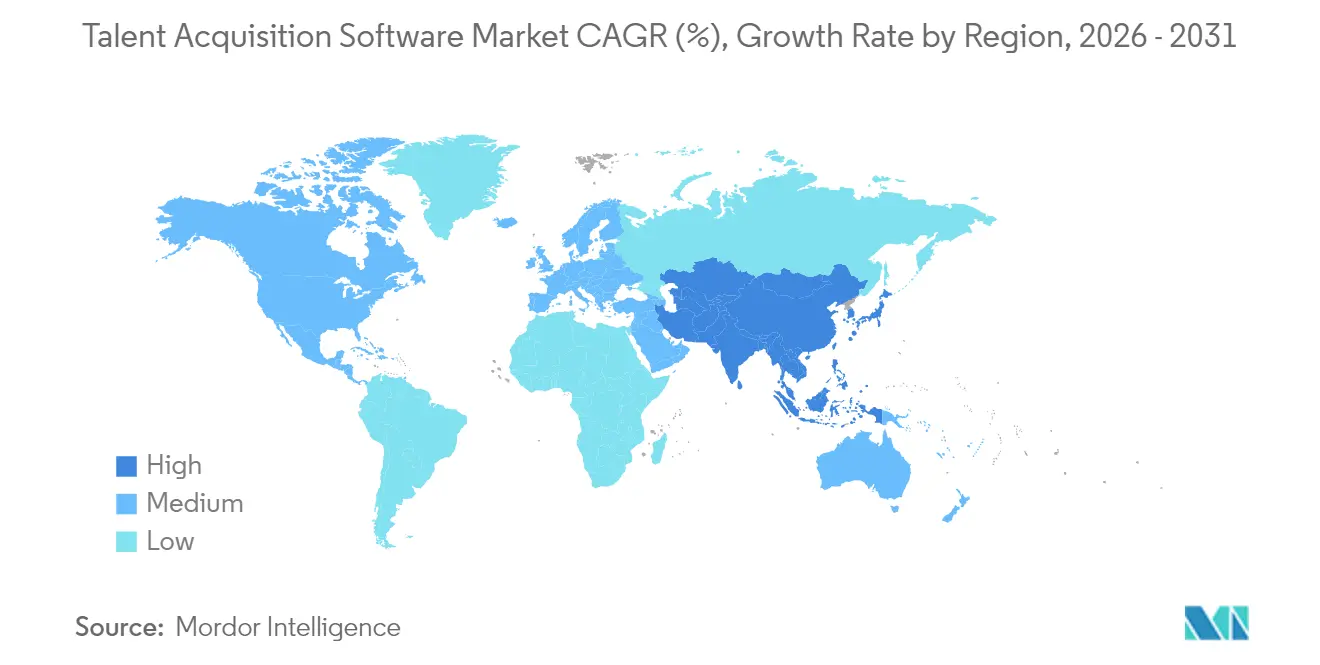
North America captured 34.05% of 2025 spending, reflecting deep SaaS penetration and mature integration ecosystems. U.S. organizations emphasize AI explainability and candidate-experience metrics, whereas Canadian buyers prioritize bilingual workflows and cross-border talent sourcing. Mexico’s expanding manufacturing footprint increases the appetite for scalable recruitment systems that support both skilled trades and engineering roles.
Asia Pacific posts the strongest 6.18% CAGR to 2031, underpinned by India’s triple-digit job-offer growth in 2024 and China’s technology-sector hiring surges. Government programs in Singapore, Malaysia, and Thailand subsidize HR tech adoption, and multi-language localization remains a core requirement. Diverse labor laws and data-residency mandates encourage vendors to maintain flexible hosting and compliance options, lifting the overall talent acquisition software market in the region.
Europe shows durable growth, propelled by GDPR-linked upgrades and cross-border hiring within the single market. Germany and the United Kingdom continue to lead enterprise adoption, while France and Spain focus on multilingual capability and EU talent mobility. The forthcoming EU AI Act adds urgency to demand for transparent algorithms and bias-mitigation reporting, further shaping product roadmaps.
Latin America, the Middle East, and Africa represent emerging demand corridors as economic diversification and foreign investment fuel enterprise digitization. Brazil’s tech ecosystem and Gulf Cooperation Council public-sector modernization projects exemplify new procurement momentum. Vendors that offer light-footprint deployments and regional language support stand to capture incremental talent acquisition software market share in these geographies.

Regulatory Landscape
Talent acquisition software vendors operate under expanding privacy, AI, and employment-compliance requirements that shape product design, including consent capture, retention controls, audit trails, and explainability. In Europe, GDPR remains the baseline for candidate-data processing, while cross-border transfers frequently rely on the EU-US Data Privacy Framework (active since July 2023) alongside localization and data-residency requirements reflected in European hosting considerations. In North America, automated hiring tools face rising scrutiny, including New York City Local Law 144 requirements for annual bias audits for automated employment decision tools, which pushes buyers toward platforms with bias testing, documentation, and reporting.
AI governance is tightening for recruiting use cases, driving compliance-focused upgrades in model transparency and monitoring. The EU AI Act (in force since February 2025) elevates hiring-related AI as a high-risk area, with compliance obligations for relevant systems commencing in August 2026, which increases demand for explainable AI dashboards and standardized risk controls. In Canada, Quebec Law 25 adds privacy impact assessment expectations for certain cross-border data transfers, influencing vendor contracting, data mapping, and hosting choices for multinational deployments. In Asia, India notified rules under the Digital Personal Data Protection Act on 13 November 2025, with compliance due by 13 May 2027, prompting software providers and employers to formalize lawful processing bases, vendor due diligence, and candidate-data governance workflows.
Value Chain Analysis
The value chain starts with product strategy and platform engineering (ATS, CRM, recruitment marketing, analytics, and services), and then extends into cloud infrastructure, security, and identity layers that enable multi-tenant SaaS delivery. Distribution and commercialization increasingly run through enterprise HCM ecosystems and marketplaces that simplify procurement and integration, as seen in ADP Marketplace expanding into a destination for discovering and deploying AI agents that integrate with ADP platforms. Implementation partners and systems integrators remain central for enterprise rollouts, covering data migration, HRIS integration, workflow configuration, and change management.
Downstream, the talent acquisition stack is increasingly completed through embedded partner capabilities delivered as native integrations rather than standalone point tools. Background screening, credentialing, assessments, communications, and worker classification support are commonly enabled through platform-native connectors, exemplified by BambooHR embedding native background checks via its partnership with Turn and staffing-focused platforms such as Bullhorn integrating credentialing management with Asurint for healthcare staffing workflows. Employers and staffing firms sit at the end of the chain as the primary buyers, with outcomes tied to reduced time-to-fill, improved compliance posture, and higher recruiter productivity; data-privacy and AI-audit obligations also lift demand for managed services and ongoing optimization.
Competitive Landscape
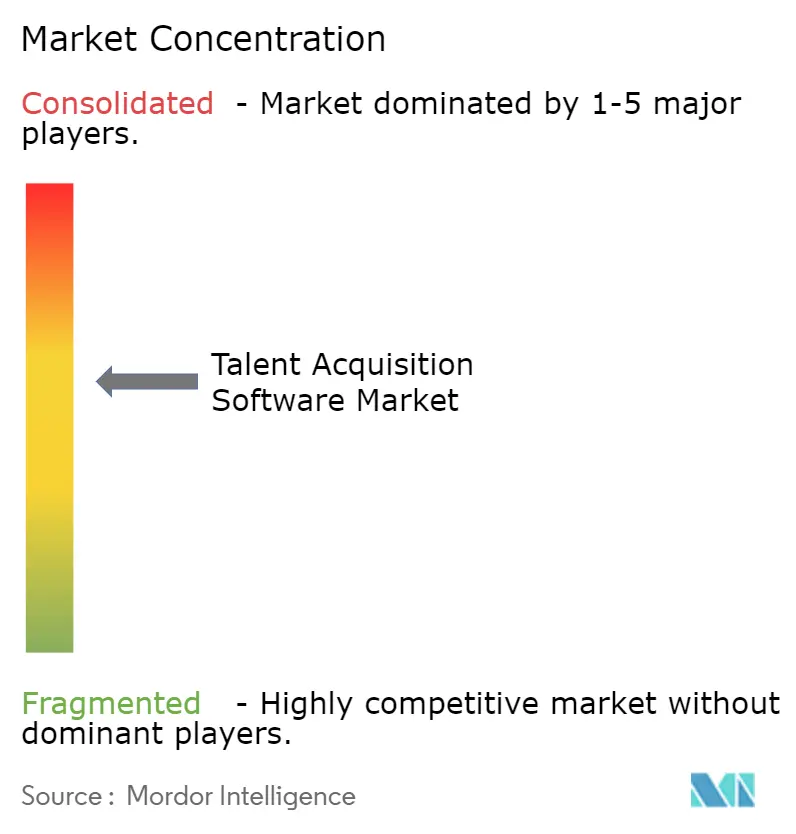
The market remains moderately fragmented, yet consolidation accelerates as full-suite HCM vendors acquire niche innovators. SAP’s plan to fold SmartRecruiters into its human experience management suite and Paychex’s USD 4.1 billion purchase of Paycor highlight the drive to unify recruitment with payroll and workforce management.[4]Paychex, “Paychex Completes Acquisition of Paycor,” paychex.com Partnerships such as Workday’s collaboration with Randstad integrate AI recommendation engines with global staffing networks, blending software and services for end-to-end hiring efficiency.
Competitive differentiation revolves around explainable AI, open APIs, and regulatory-ready data governance. Start-ups focusing on gig-economy workflows, diversity analytics, or skills-graph intelligence attract strong venture funding, evidenced by TechWolf’s USD 42.7 million Series B round. Traditional job-board incumbents, epitomized by the CareerBuilder plus Monster merger, seek unified platforms to reclaim audience share from aggregators.
Market entrants targeting SMEs deploy freemium tiers and rapid-deployment templates, while enterprise-grade platforms emphasize native integrations with learning, performance, and compensation modules. Vendors able to document reductions in time-to-hire, improved quality-of-hire, and superior candidate-experience scores capture disproportionate growth in the talent acquisition software market.
Talent Acquisition Software Industry Leaders
ADP LLC
Applicant Tracking System Inc. (Trakstar)
Bamboo HR LLC
Bullhorn Inc.
Cegid Group SA
- *Disclaimer: Major Players sorted in no particular order

Market Opportunities and Future Outlook
A major opportunity sits at the intersection of cloud migration and governance-ready AI, where buyers want automated hiring that can be audited, explained, and supported by privacy controls across jurisdictions. The EU AI Act compliance start point in August 2026, together with bias-audit requirements such as New York City Local Law 144, creates a concrete upgrade cycle for vendors that can operationalize model documentation, bias monitoring, and candidate-data controls within core ATS and CRM workflows. This compliance pull-through also supports demand for packaged templates, reporting, and services that reduce implementation friction for multi-country enterprises.
Ecosystem-led expansion is also creating whitespace for embedded services that turn talent acquisition platforms into end-to-end hiring and worker lifecycle hubs. In 2026, BambooHR expanded native workflow depth through a multi-year partnership to deliver background checks within the platform and launched Contractor Management powered by Remote, reflecting buyer interest in integrated screening and compliant contractor onboarding without separate systems. ADP Marketplace adding AI agents, and ADP Ventures investing in Ema to scale enterprise-grade agentic AI, highlight a parallel route where marketplaces and agent frameworks let third parties deploy recruiting and HR automations inside incumbent platforms. Specialized vertical workflows continue to open targeted expansion lanes, including Bullhorn and Asurint integrating credentialing management for healthcare staffing, where compliance-heavy credential verification can differentiate staffing-oriented talent acquisition stacks.
Recent Industry Developments
- June 2026: BambooHR LLC launched BambooHR Contractor Management powered by Remote to enable compliant contractor hiring, onboarding, management, and payment. The launch expands the talent acquisition workflow to cover contractors, strengthening the platform ecosystem with fintech and infrastructure services and accelerating contractor lifecycle management within TA workflows.
- May 2026: BambooHR LLC launched BambooHR On-Demand Pay, embedding earned wage access within the BambooHR platform. The feature enhances candidate offer accept rates and employee financial flexibility, adding embedded fintech capabilities to the TA suite and increasing end-to-end hiring and retention capabilities.
- April 2026: BambooHR LLC announced a multi-year Turn partnership to deliver native background checks within the BambooHR platform. The integration streamlines candidate screening with built-in background checks, reinforcing TA workflow integration and reducing time-to-hire by embedding essential screening within the core platform.


Research Methodology Framework and Report Scope
Market Definition and Coverage
For this study, the market includes software platforms used to plan, source, attract, screen, assess, engage, and manage candidates through hiring workflows, including the related subscription and usage-based revenues tied to these modules.
Scope exclusions: Excludes staffing agency service fees, outsourced recruitment services, and general HRIS payroll and timekeeping tools that are not sold as talent acquisition software.
Segmentation Overview
- By Deployment Model
- On-premises Solutions
- Cloud-based Solutions
- By Component
- Applicant Tracking System
- Candidate Relationship Management
- Recruitment Marketing Suite
- Services and Support
- By Enterprise Size
- Large Enterprises
- Small and Medium Enterprises
- By End-use Industry
- Manufacturing
- Healthcare
- BFSI
- Education
- Hospitality
- IT and Telecom
- Retail and E-commerce
- Other End-use Industries
- By Region
- North America
- United States
- Canada
- Mexico
- South America
- Brazil
- Argentina
- Colombia
- Rest of South America
- Europe
- Germany
- United Kingdom
- France
- Russia
- Spain
- Rest of Europe
- Asia Pacific
- China
- India
- Japan
- Australia
- Rest of Asia Pacific
- Middle East
- United Arab Emirates
- Saudi Arabia
- Turkey
- Rest of Middle East
- Africa
- South Africa
- Nigeria
- Kenya
- Rest of Africa
- North America
Data Sources, Market Sizing, and Validation
Desk Research
Desk research helped us set the recruiting activity context and anchor public indicators that influence spending on recruiting software. We referenced labor market and employment series from sources such as the US Bureau of Labor Statistics, Eurostat, and ILOSTAT, and we also reviewed employer and HR practice releases from groups such as SHRM and CIPD.
To connect demand signals with software revenue logic, we reviewed SEC filings and annual reports, investor presentations, official product documentation, and credible press coverage on HR technology budgets and adoption. Where needed, select paid subscriptions were used for company financials and intelligence, news and financials, and patent databases to support cross-checks on product focus and investment cycles. The sources listed here are illustrative and not exhaustive, and many other references were used to collect, validate, and clarify data points.
Primary Interviews and Surveys
Primary work focused on confirming what buyers purchase in talent acquisition software and how pricing is applied across modules, seats, and hiring volumes. We spoke with a mix of software providers, implementation partners, and HR and talent leaders across major regions to validate adoption patterns, renewal behavior, and the triggers for upgrades.
These conversations were also used to tighten assumptions on module attach rates, cloud migration pace, and typical contract structures, then to test the model outputs against real procurement and usage conditions.
Distribution of primary research fieldwork respondents
| Company type | Respondent position | Region |
|---|---|---|
| Top tier: 37% | CXOs: 16% | APAC: 48% |
| Mid tier: 43% | Functional/Unit leaders: 40% | EMEA: 33% |
| Smaller Players: 20% | Managers: 44% | Americas: 19% |
Market-Sizing & Forecasting
The market was sized using a top-down build that starts from hiring activity and recruiting process intensity, which are then translated into software adoption and spend per organization across key geographies. In practice, we linked macro signals like employment growth and job openings with software penetration to reconstruct an addressable spending pool.
To keep the totals realistic, the outputs were corroborated with selective bottom-up approximations such as sampled price points by module, typical seat counts by company size, and a limited roll-up of supplier revenue disclosures where reporting is clear enough. A few gaps were handled through conservative interpolation when pricing or module splits were not disclosed, and then adjusted after interview feedback.
For forecasting, scenario analysis was applied around demand levers that tend to shift year to year and show up in budgeting decisions, and then those paths were translated into revenue growth. Inputs used in the model included hiring volume trends, cloud versus on-premise mix, module adoption for sourcing and candidate engagement, average contract duration and renewal rates, and compliance-driven feature upgrades tied to privacy and bias controls.
Data Validation & Update Cycle
Validation was done through stepwise checks so the final numbers stay tied to observable signals. Model outputs were compared against independent metrics like job openings trends, HR technology budget commentary, and disclosed software revenue performance, followed by variance checks across regions and company-size cohorts.
Anomalies were flagged when growth implied unrealistic changes in penetration or pricing, and then assumptions were revisited and, where needed, respondents were re-contacted to clarify the driver. Before sign-off, the work is reviewed in more than one analyst pass so inputs, calculations, and definitions line up.
Reports are refreshed annually, and interim updates are made when material events affect adoption or spending patterns. Before delivery, a final review pass is completed so clients receive the latest updated view based on the newest available data.
Mordor Intelligence's Talent Acquisition Software Market Sizing Compared With Other Published Estimates
Published market sizes for talent acquisition software often vary because each publisher counts a different set of products and revenues, and they also differ on how they treat bundles, services, and regional currency timing. We use the comparison points below to show which assumptions can widen or narrow the total.
Staffing and RPO service revenues sit outside Mordor Intelligence's scope for this market, which is why some broader estimates look much larger even when they reference similar hiring signals. Differences also come from how module pricing is projected over time, whether adoption curves for matching capabilities are assumed to ramp quickly, and how recently the numbers were refreshed after hiring conditions shifted.
Benchmark comparison
| Source | Market Size | Gaps in Research Methodology |
|---|---|---|
| Mordor Intelligence | USD 10.37 B (2025) | |
| Industry Publisher A | USD 8.70 B (2025) | Uses a narrower definition centered on core applicant tracking and basic recruiting functions, and it applies conservative penetration assumptions for mid-market buyers, which reduces the implied spend pool. |
| Advisory Group B | USD 25.70 B (2024) | Combines software with staffing technology and service-led revenues, and it extends the scope into broader talent management and workforce services, which lifts totals beyond software-only revenue. |
Across the three figures, the spread mainly comes from what is counted as software revenue versus services, followed by how quickly adoption and pricing are allowed to expand. When scope and drivers are made explicit and checked against repeatable demand signals, the final number becomes easier to explain and reuse for planning.


Key Questions Answered in the Report
What is the current value of the talent acquisition software market?
The market is valued at USD 10.95 billion in 2026.
How fast is the market expected to grow?
It is projected to advance at a 5.63% CAGR between 2026 and 2031.
Which deployment model is expanding the quickest?
Cloud-based deployments are growing at a 6.62% CAGR as enterprises migrate from on-premises systems.
Which region is posting the highest growth?
Asia Pacific is forecast to expand at a 6.18% CAGR, driven by government incentives and workforce digitization.
What segment leads component demand?
Applicant tracking systems remain the largest component, holding 37.25% revenue share in 2025.
How are small and medium enterprises influencing adoption?
SMEs are embracing affordable cloud platforms, resulting in the highest 6.44% CAGR among all enterprise-size segments.
Page last updated on: