
Market Overview
| Study Period | 2021 - 2031 |
|---|---|
| Forecast Data Period | 2026 - 2031 |
| Historical Data Period | 2021 - 2024 |
| Market Size (2026) | USD 2.09 Billion |
| Market Size (2031) | USD 3.40 Billion |
| Growth Rate (2026 - 2031) | 10.19 % |
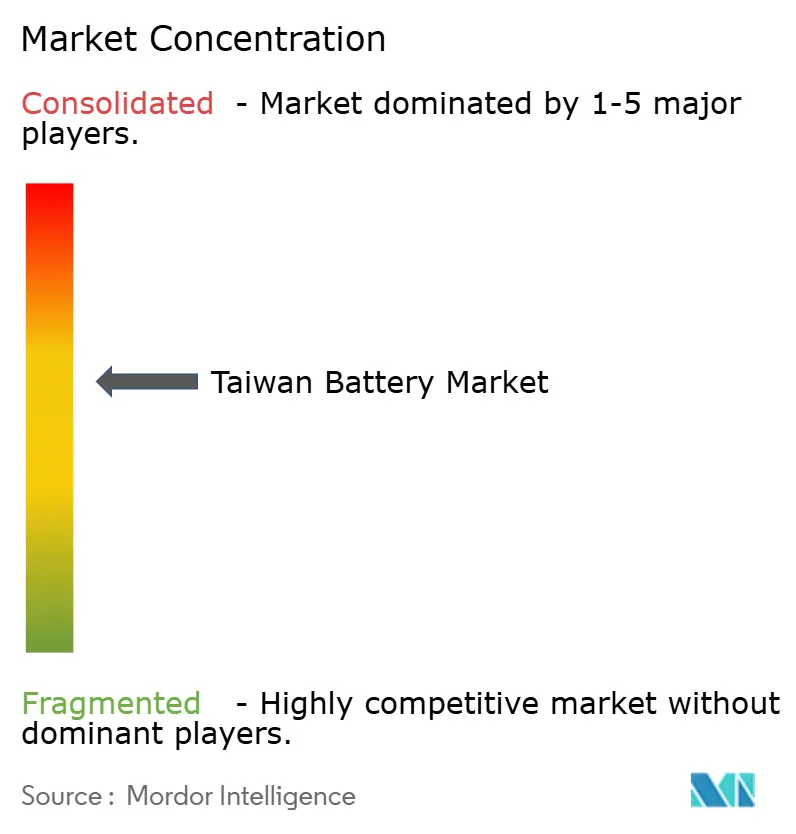
| Market Concentration | Medium |
Major Players *Disclaimer: Major Players sorted in no particular order Image © Mordor Intelligence. Reuse requires attribution under CC BY 4.0. | |
Taiwan Battery Market Analysis by Mordor Intelligence
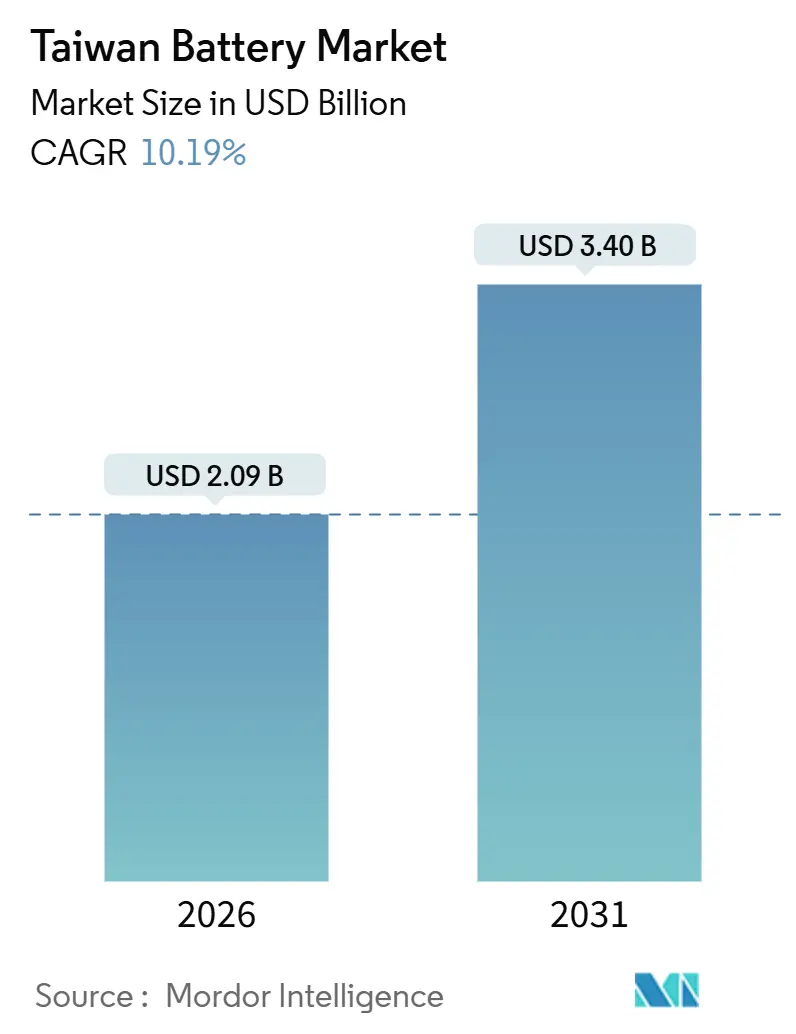
The Taiwan Battery Market size is estimated at USD 2.09 billion in 2026, and is expected to reach USD 3.40 billion by 2031, at a CAGR of 10.19% during the forecast period (2026-2031).
Taiwan’s pivot from mature lead-acid production toward lithium-ion and solid-state chemistries is reshaping domestic supply chains, encouraged by aggressive electric-vehicle (EV) adoption targets and Taipower’s escalating grid-storage procurements. Contract manufacturers, once focused on consumer electronics, are redirecting capital toward automotive-grade modules, while local recycling pilots seek to offset the island’s 85% reliance on imported lithium and cobalt precursors. Rising power-availability quotas and stringent environmental standards are steering new investment into premium niches, solid-state cells for high-end EVs, and vanadium-redox flow batteries for long-duration grid support, where Taiwan can compete on quality rather than cost. Collectively, these trends signal that the Taiwan battery market will grow not only in volume but also in technological sophistication, anchoring the island’s broader energy-transition agenda.
Key Report Takeaways
- By battery type, secondary rechargeable batteries held 74.8% of the Taiwan battery market share in 2025, and the segment is forecast to expand at a 14.8% CAGR through 2031.
- By technology, lithium-ion commanded 60.1% revenue share in 2025, while flow batteries are projected to record the fastest growth at 30.1% CAGR to 2031 as Taipower’s tenders reward long-duration assets.
- By application, automotive batteries accounted for 41.4% of the Taiwan battery market size in 2025 and are advancing at a 15.3% CAGR on the back of Foxtron and Gogoro platform scale-ups.
- Gogoro’s battery-swapping network captured 92% of Taiwan’s two-wheeler EV segment in 2024, underscoring the platform’s first-mover advantage and reinforcing network effects that deter late entrants.
Note: Market size and forecast figures in this report are generated using Mordor Intelligence’s proprietary estimation framework, updated with the latest available data and insights as of January 2026.
Taiwan Battery Market Trends and Insights
Drivers Impact Analysis*
| Driver | (~) % Impact on CAGR Forecast | Geographic Relevance | Impact Timeline |
|---|---|---|---|
| Surging EV-led demand for high-energy lithium-ion packs | +2.8% | National, with concentration in Taoyuan, Kaohsiung manufacturing zones | Medium term (2-4 years) |
| Accelerating grid-scale storage tenders from Taipower | +2.1% | National, prioritizing western coastal industrial corridors | Short term (≤ 2 years) |
| Government "Green Battery Made-in-Taiwan" subsidy scheme (2025-2028) | +1.6% | National, targeting firms with >50% local value-added content | Short term (≤ 2 years) |
| OEM-level localisation push by Apple & Asus for battery modules | +1.2% | Northern Taiwan (Taipei, Taoyuan, Hsinchu tech corridors) | Medium term (2-4 years) |
| Commercial adoption of solid-state R&D spin-offs (ITRI, TDK-CPT JV) | +1.4% | National, with pilot lines in Taoyuan and Tainan science parks | Long term (≥ 4 years) |
| Source: Mordor Intelligence | |||
Surging EV-Led Demand for High-Energy Lithium-Ion Packs
Government rebates of up to TWD 70,000 for battery-electric cars and a 2035 gasoline-scooter sunset are accelerating EV registrations. Foxtron’s Model T sedan entered pilot production in late 2024, sourcing modules from a 2 GWh Kaohsiung line that blends imported CATL cells with locally engineered thermal-management systems. This hybrid localization model lets Foxconn badge vehicles “Made in Taiwan” while sidestepping the capital burden of cathode synthesis. Gogoro’s 640,000 subscribers generated USD 310.5 million in revenue in 2024, proving that energy-as-a-service monetizes utilization more predictably than one-time vehicle sales.[1]Gogoro Investor Relations, “2024 Annual Report,” investor.gogoro.com The firm’s Enel X alliance aggregates swapped batteries into a virtual power plant, foreshadowing dual-use mobility and grid services. ProLogium’s fourth-generation solid-state cell, launched in December 2025, delivers 321 Wh/kg and charges to 80% in 12 minutes, narrowing the performance gap with premium Japanese and European tiers.[2]Bloomberg Newsroom, “ProLogium’s Solid-State Bet Reshapes Taiwan Battery Outlook,” bloomberg.com
Accelerating Grid-Scale Storage Tenders from Taipower
Taipower awarded 120 MW of battery-storage contracts in 2024 under its E-dReg ancillary-service program, paying up to TWD 1,200 per MWh for sub-second response times.[3]Taiwan Power Company, “E-dReg Ancillary Service Tender Results 2024,” taipower.com.tw Projects in Longtan and Dongshan deploy 165 MWh of capacity that stabilizes the grid as intermittent solar tops 10 GW. Delta Electronics and Innolux installed a 40 MW system at Southern Taiwan Science Park in May 2025, combining retired display-fab cells with new lithium-iron-phosphate packs, illustrating a cascading-use model that cuts capital bills by extending battery life. Formosa Smart Energy commissioned a recycling pilot recovering 92% of cathode material in July 2025, a move aimed at insulating producers from lithium-carbonate price spikes. Mandatory co-located storage for new renewables further ring-fences demand for domestic suppliers.
Government “Green Battery Made-in-Taiwan” Subsidy Scheme
The Ministry of Economic Affairs earmarked TWD 12 billion through 2028 to reimburse up to 30% of capital equipment for battery firms achieving ≥50% local value-added content. ProLogium secured TWD 1.8 billion in March 2025, enabling expansion from 2 GWh to 5 GWh of solid-state capacity by 2027 and a ceramic-electrolyte pilot line. Subsidies cover cathode-precursor reactors, anode-coating tools, and formation cyclers, but are disbursed against quarterly production audits that have slowed smaller applicants. ITRI and Largan Precision scaled titanium-niobium-oxide output toward 600 tons by 2026, supplying 1.5 GWh of fast-charging anodes. Policy emphasis on advanced materials over commodity cells signals Taiwan’s bid for high-margin niches where Chinese scale advantages erode.
OEM-Level Localization Push by Apple and Asus
Apple’s 2024 Supplier Responsibility Report added three Taiwan module assemblers to its approved list, diversifying away from Guangdong supply chains constrained by U.S. export controls. Simplo lifted renewable-energy usage to 80% via 10.8 MW of rooftop solar, aligning with Apple’s 2030 Scope 3 neutrality goal. Dynapack’s 2024 revenue fell 19% to TWD 13.91 billion, prompting a pivot toward data-center backup units where lithium-ion is displacing lead-acid on cycle-life grounds. Asus formed eMobility & Energy Solutions to embed proprietary battery-management code in gaming laptops, signaling that module-level intelligence is an emerging differentiator. Collectively, OEM localization drives incremental demand for Taiwan battery market modules integrated with advanced software stacks.
Restraints Impact Analysis*
| Restraint | (~) % Impact on CAGR Forecast | Geographic Relevance | Impact Timeline |
|---|---|---|---|
| Raw-material concentration risk: >85% Li-ion precursor imported | -1.5% | National, affecting all lithium-ion cell producers | Medium term (2-4 years) |
| Tight power-availability quota for new giga-scale plants | -1.1% | National, most acute in central and southern industrial zones | Short term (≤ 2 years) |
| High recycling cost versus mainland China | -0.7% | National, constraining closed-loop business models | Long term (≥ 4 years) |
| Source: Mordor Intelligence | |||
Raw-Material Concentration Risk
Taiwan sources more than 85% of lithium-carbonate, cobalt-sulfate, and nickel-sulfate from Chinese refiners, exposing producers to geopolitical risk as Beijing tightens critical-mineral export licenses.[4]International Energy Agency, “Critical Minerals Market Review 2025,” iea.org A 2025 stockpile mandate requiring 90 days of inventory lifts working-capital needs by nearly 20% and weighs heavier on small firms lacking trade-finance access. Recycling pilots recover 92% of cathode material but remain sub-scale because the island’s EV fleet is still nascent. Until direct procurement deals with Australian or Chilean suppliers mature, the Taiwan battery market will remain a price-taker in volatile raw-material cycles.
Tight Power-Availability Quota for New Giga-Scale Plants
Summer peak demand from chip fabs and data centers leaves minimal grid headroom, forcing battery projects into multiyear connection queues. ProLogium’s 161 kV substation took 18 months to commission, delaying the Taoyuan expansion to Q2 2026. Renewable-energy compliance rules require new industrial users to source 10% green power by 2026, rising to 20% by 2030, but land scarcity pushes firms toward costly offshore-wind PPAs priced around TWD 5.1 per kWh, roughly double the grid average. Smaller assemblers unable to underwrite long-term power contracts are relocating to Southeast Asia, draining potential capacity from the Taiwan battery market.
*Our forecasts treat driver/restraint impacts as directional, not additive. The impact forecasts reflect baseline growth, mix effects, and variable interactions.
Segment Analysis
By Battery Type: Rechargeable Cells Eclipse Disposable Formats
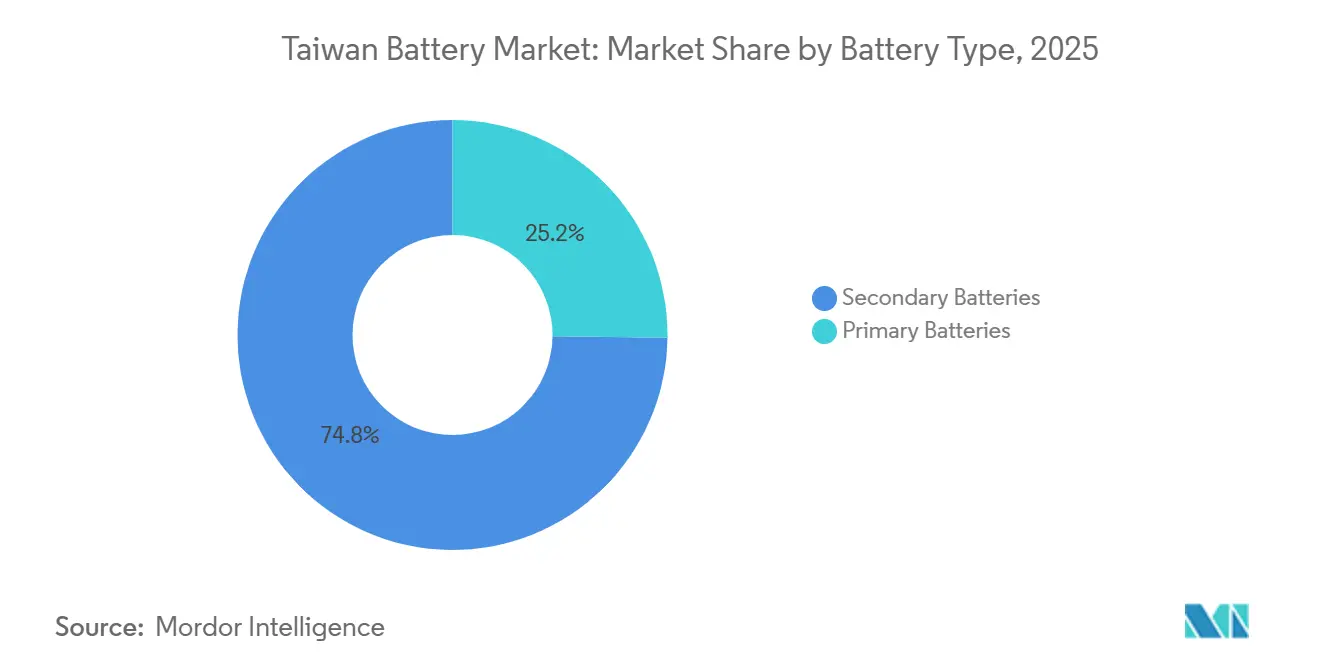
Secondary rechargeable batteries controlled 74.8% of the Taiwan battery market share in 2025 and are forecast to expand at a 14.8% CAGR to 2031. Robust growth stems from mobility electrification, grid-storage mandates, and the phase-out of lead-acid starter batteries in commercial fleets. Gogoro’s subscription model demonstrates that recurring utilization revenue can surpass the value of disposable sales, drawing interest from utilities and ride-sharing operators alike. Meanwhile, primary batteries comprised 25.2% of 2025 revenue but face a secular decline as USB-C charging and sealed-back designs remove user-replaceable compartments.
Policy signals reinforce the transition: Taiwan’s subsidy scheme excludes primary-cell makers, while extended-producer-responsibility fees under the Waste Disposal Act penalize single-use formats. ProLogium’s solid-state roadmap targets 3,000-cycle durability and shelf life that narrows historic advantages enjoyed by primaries, further eroding their addressable demand. As recycling pilots mature, closed-loop economics will favor chemistries amenable to material recovery, adding structural momentum to rechargeable adoption across the Taiwan battery market.


By Technology: Lithium-Ion Leads, Flow Batteries Accelerate
Lithium-ion technologies accounted for 60.1% of 2025 revenue, reflecting entrenched positions in EVs, consumer electronics, and short-duration grids. Yet flow batteries are projected to expand at a 30.1% CAGR, the fastest rate among chemistries, because Taipower’s tenders prioritize four-hour discharge under its ancillary-service framework. The Taiwan battery market size for flow systems is expected to climb sharply once vanadium-redox suppliers secure local electrolyte sourcing.
Solid-state remains in pilot but notable: ProLogium shipped 500,000 cells in 2024 and plans to triple capacity by 2027, targeting premium segments where safety and fast-charging matter more than unit cost. Hybrid deployments, such as Delta’s lithium-iron-phosphate plus second-life-cell configuration, illustrate capital-efficient ways to match duty cycle with chemistry. Lead-acid persists for low-rate backup, but its share declines each year as lithium-ion’s cost curve sinks below USD 100 per kWh, a milestone the island’s assemblers aim to reach by 2028.
By Application: Automotive Leads, Industrial Storage Gains Momentum
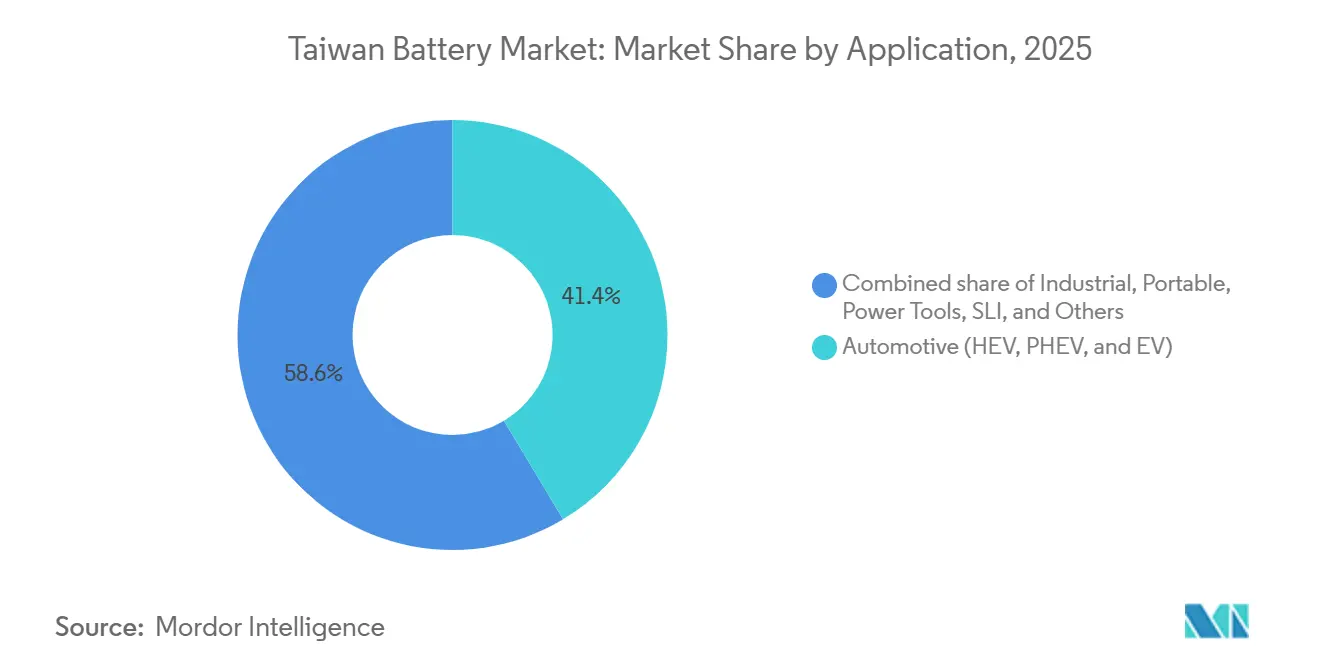
Automotive platforms generated 41.4% of 2025 revenue and are forecast to grow at 15.3% CAGR through 2031, supported by Foxtron’s 2 GWh local module line and Gogoro’s nationwide swap network. Foxtron’s hybrid localization balances cost and branding, while Gogoro’s Enel X virtual-plant tie-up turns mobility assets into grid resources, reinforcing demand for swappable packs.
Industrial storage ranks second, propelled by Taipower’s 120 MW awards and factory micro-grids that hedge against brownouts. Delta and Innolux’s 40 MW project showcases how retired display batteries extend life in stationary roles. Portable consumer electronics face slowing growth as energy-efficient processors dampen capacity needs, causing Dynapack to diversify into telecom backup units. Power-tool and SLI segments remain niche or in decline, together representing less than 10% of the Taiwan battery market.
Geography Analysis
Manufacturing clusters around Taoyuan–Hsinchu in the north, Taichung in the center, and Kaohsiung–Tainan in the south. ProLogium’s 2 GWh solid-state complex and Simplo’s laptop-battery lines anchor the northern corridor, supported by ITRI’s materials labs at Hsinchu Science Park. Southern Kaohsiung hosts Foxtron’s module line and Formosa Smart Energy’s lithium-iron-phosphate plant plus recycling pilot, offering proximity to petrochemical feedstocks. Central Taichung remains smaller but benefits from electronics subcontractor networks that feed automotive harness suppliers.
Cluster advantages - skilled labor, precision tooling, and seaport access - offset higher electricity tariffs yet also magnify exposure to grid bottlenecks during summer demand spikes.
Regulatory Landscape
Taiwan tightened safety, conformity, and recycling obligations for lithium-based batteries across mobility and stationary storage. BSMI mandated inspection requirements for secondary lithium battery packs for road vehicle propulsion effective December 23, 2025, pushing cell and pack suppliers toward formal compliance routes such as Registration of Product Certification (RPC) or Type-Approved Batch Inspection (TABI) as a prerequisite for market access.
In energy storage applications, BSMI extended inspection coverage for stationary lithium battery storage appliances up to 20 kWh starting July 1, 2026, and to systems between 20 kWh and 100 kWh starting July 1, 2027. Regulated electrical and electronic commodities containing secondary lithium cells or batteries also face tightened technical compliance from July 1, 2026, including alignment to CNS 15364 (2013) at the cell level and CNS 62133-2 (2018) at the battery level (including mechanical and vibration robustness). On the circular-economy side, the Ministry of Environment introduced (June 30, 2025) a preferential fee-rate pathway for responsible parties that build their own recycling chains, reinforcing investment incentives for local collection and processing capacity rather than fee-only compliance.
Competitive Landscape
Roughly 20 players vie in a moderately fragmented field where no company exceeds 15% share. ProLogium leads solid-state commercialization, extracting 30-40% price premiums from safety-critical segments. Gogoro controls 92% of two-wheeler battery swapping, leveraging dense station networks and a subscriber lock-in that deters new entrants. Simplo and Dynapack defend portable-electronics franchises by greening power supply and diversifying into data-center modules.
Material localization represents an emerging battleground: ITRI–Largan’s titanium-niobium-oxide joint venture aims to displace Chinese graphite, while Formosa Smart Energy’s recycling pilot seeks to close the LFP loop. The government’s subsidy scheme lowers entry barriers, enticing foreign OEMs to establish Taiwan lines if they meet 50% value-added thresholds. Nevertheless, high grid tariffs and power-quota hurdles constrain mass-market cell projects, nudging the Taiwan battery industry toward specialty chemistries where R&D depth and stringent quality standards create defensible moats.
Taiwan Battery Industry Leaders
E-One Moli Energy (Molicel)
Dynapack International
Kung Long Batteries
Amita Technologies
Simplo Technology
- *Disclaimer: Major Players sorted in no particular order

Market Opportunities and Future Outlook
Policy-linked localization creates near-term whitespace in Taiwan for battery suppliers that can pair domestic cell sourcing with auditable safety compliance. In March 2026, the Ministry of Economic Affairs launched a subsidy program for behind-the-meter industrial energy storage that provides NT$5 million per MWh for projects using domestically manufactured lithium-based battery cells, shifting part of demand toward factory and commercial sites while rewarding local content. This aligns with BSMI’s expanding safety framework (with 24 CNS national standards published by 2025), supporting opportunities for Taiwan-based cell, module, BMS, and system integrators that deliver certified solutions for industrial customers.
Project execution and test infrastructure also support faster product qualification cycles. In February 2026, Recharge Power secured an EPC contract from HEXA Renewables for a 48 MW solar plus 185.7 MWh storage project, reflecting active procurement for solar-plus-storage configurations where bankable ESS suppliers and EPC partners can scale. At the capability layer, the National Center for Energy Storage System Technology (NEST) commenced operations in March 2026 with localized testing that includes 360 kWh capacity combustion tests, reducing reliance on overseas labs and supporting faster compliance iterations for ESS suppliers. For next-generation chemistries, the National Science and Technology Council outlined a Phase IV (2026-2029) Taiwan-Germany battery research framework in May 2026 spanning solid-state batteries, high-energy metal batteries, and recycling, opening collaboration and pilot-line opportunities for firms aligned to advanced materials and safety-driven differentiation.
Recent Industry Developments
- March 2026: Dynapack International announced a plan to triple production capacity for battery backup units (BBU) across its Taiwan and Thailand facilities to address demand from AI data centers. The expansion strengthens its footprint in stationary and critical-power applications and could tighten legacy IT battery supply in other segments.
- January 2026: Kung Long Batteries announced UL 1973 certification for multiple product series (including WXL, WPL, HTP, KPH, CWP, WP, and WPS) targeting stationary energy storage, UPS, and critical power uses. The certification strengthens its ability to compete in export and project-tender channels where third-party safety qualification is a prerequisite for vendor approval and bankability.
- December 2024: E-One Moli Energy (Molicel) advanced its overseas manufacturing footprint through a factory expansion initiative in Canada aimed at producing high-performance cylindrical lithium-ion cells. The expansion supports supply diversification for customers and elevates the competitive benchmark for Taiwan-linked cell suppliers pursuing automotive, power tool, and high-drain applications.


Research Methodology Framework and Report Scope
Market Definition and Coverage
For this study, we define the Taiwan battery market as the value of electrochemical batteries sold for use in Taiwan across rechargeable and non-rechargeable formats, counted at the revenue earned from battery products supplied to end users and channels.
Scope exclusions: We exclude standalone chargers, power management electronics, and broader energy projects that do not have a clearly priced battery component.
Segmentation Overview
- By Battery Type
- Primary Batteries
- Secondary Batteries
- By Technology
- Lead-acid
- Li-ion
- Nickel-metal hydride
- Nickel-cadmium
- Sodium-sulfur
- Solid-state
- Flow Battery
- Emerging chemistries
- By Application
- Automotive (HEV, PHEV, and EV)
- Industrial (Motive, Stationary (Telecom, UPS, ESS), etc.)
- Portable (Consumer Electronics, etc.)
- Power Tools
- SLI
- Other Applications
Data Sources, Market Sizing, and Validation
Desk Research
Desk work starts with building the demand context for batteries in Taiwan, then mapping it to visible supply and trade signals so the model does not drift away from reality. We typically review public statistics and policy releases that influence battery adoption, then connect those points to market-facing indicators such as electrification plans and industrial output trends.
Common public and official references include sources such as Taiwan government energy and transport publications, customs and trade statistics, international energy agencies for storage and grid context, peer-reviewed journals for chemistry and performance trends, and patent databases to track where R and D is moving. We also use company filings, investor presentations, reputable press, and a paid subscription for company financials and news to cross-check capacity moves, expansion timing, and pricing commentary. This list is illustrative, and we use other sources as needed to collect data, validate it, and clarify open questions.
Primary Interviews and Surveys
We conduct expert interviews and surveys with battery manufacturers, pack assemblers, distributors, application specialists, and end-use buyers in Taiwan. These discussions test secondary data, clarify local demand, pricing, chemistry mix, and replacement timing, and help close gaps where public records are delayed or grouped. Findings are compared across respondent types before assumptions and final estimates are accepted.
Distribution of primary research fieldwork respondents
| Company type | Respondent position |
|---|---|
| Top tier: 30% | CXOs: 15% |
| Mid tier: 50% | Functional/Unit leaders: 30% |
| Smaller Players: 20% | Managers: 55% |
Market-Sizing & Forecasting
The market is first reconstructed using a top-down approach where production, import-export flows, and apparent consumption signals are combined to form a Taiwan demand pool in value terms, and the mix is then aligned to observed use patterns. To keep the total grounded, we corroborate results with selective bottom-up approximations, such as sampled ASP multiplied by shipment volumes for key battery groups, plus channel checks on replacement cycles and industrial demand.
Inputs used in the model include indicators such as EV and two-wheeler adoption pace, renewable capacity additions that pull storage demand, lead-acid replacement frequency in SLI uses, price trends for lithium-ion and lead-acid packs, and changes in trade balances for battery-related HS codes. When gaps appear in the bottom-up checks, we fill them using conservative mix assumptions that are validated in interviews, then re-balance the split rather than forcing a full supplier roll-up.
For forecasting, scenario analysis is used because the outlook depends on a few practical variables that can change quickly, such as policy timelines, project commissioning schedules, and pricing pass-through. The final forecast path is selected after aligning these variables with what industry respondents describe as the most likely planning case for Taiwan over the next few years.
Data Validation & Update Cycle
Validation is done in steps so that a single data point does not distort the outcome. We compare the model outputs against independent signals like trade direction, end-use adoption indicators, and observable price ranges, then review unusual swings again until the driver is clear.
Before sign-off, the dataset and calculations go through multi-step analyst checks, and follow-up calls are triggered when responses conflict or when a major variance shows up in a key assumption. Reports are refreshed annually, with interim updates when material events occur, and a final pre-delivery pass is completed so clients receive the latest view available at the time of release.
Mordor Intelligence's Taiwan Battery Market Size Measured Against Other Published Estimates
Published market sizes for Taiwan batteries can differ even when they sound like they cover the same topic, because the scope boundary and the value being counted are not always consistent. Differences usually come from what is treated as a battery product versus an adjacent system, what years are used as the anchor, and whether trade flows are handled carefully for a small, open economy.
By tracking trade-adjusted apparent consumption and refreshing key ASP assumptions from interviews, Mordor Intelligence keeps the Taiwan battery total tied to in-country demand rather than mixing in broader energy storage system revenues. A second gap driver is the mix choice, since some estimates lean heavily on fast-growing chemistries or aggressive EV uptake without checking SLI replacement and industrial demand, which can inflate the near-term base.
Benchmark comparison
| Source | Market Size | Gaps in Research Methodology |
|---|---|---|
| Mordor Intelligence | USD 2.09 B (2026) | |
| Regional Consultancy A | USD 1.10 B (2025) | Uses an earlier base year and a narrower boundary that appears to undercount industrial and replacement-driven demand, which lowers the starting value before forecasting. |
| Industry Publisher B | USD 1.43 B (2026) | Leans on unit volumes with simplified pricing progression and limited adjustment for import-export flows, which can miss the value impact of mix shifts across chemistries and applications. |
The spread mainly reflects what gets included in the revenue line and how Taiwan trade is converted into local consumption, not just different growth expectations. When the scope is kept product-specific and the key drivers are checked against practical signals, the resulting number is easier to trace, explain, and update in a repeatable way.


Key Questions Answered in the Report
How fast is the Taiwan battery market expected to grow through 2031?
It is forecast to expand from USD 2.09 billion in 2026 to USD 3.40 billion by 2031, advancing at a 10.19% CAGR.
Which segment contributes the most revenue today?
Automotive platforms generated 41.4% of 2025 revenue, led by Foxtron sedans and Gogoro's scooter battery-swapping network.
What technology is growing fastest in Taiwan's storage sector?
Vanadium-redox and other flow batteries are projected to rise at a 30.1% CAGR because Taipower's tenders reward long-duration discharge.
How dependent is Taiwan on imported battery materials?
More than 85% of lithium-ion precursors (lithium, cobalt, and nickel compounds) are imported, mostly from China.
What government support exists for local battery manufacturing?
The "Green Battery Made-in-Taiwan" scheme reimburses up to 30% of capital costs for firms achieving at least 50% local value-added content through 2028.
Which company dominates two-wheeler battery swapping in Taiwan?
Gogoro holds 92% of the segment, serving 640,000 subscribers with its island-wide network of swap stations.
Page last updated on:


 Your data is secure and never sold or shared.


