
Market Overview
| Study Period | 2020 - 2031 |
|---|---|
| Forecast Data Period | 2026 - 2031 |
| Base Year Market Size (2025) | USD 10.58 Billion |
| Market Size (2026) | USD 11.03 Billion |
| Market Size (2031) | USD 13.62 Billion |
| Growth Rate (2026 - 2031) | 4.30 % |
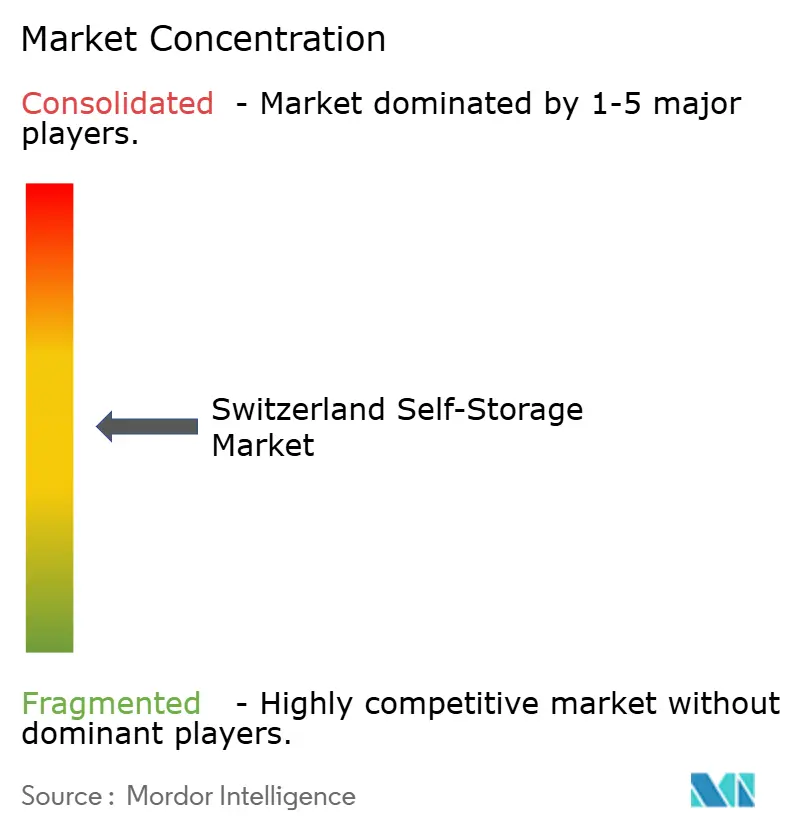
| Market Concentration | Medium |
Major Players
*Disclaimer: Major Players sorted in no particular order Image © Mordor Intelligence. Reuse requires attribution under CC BY 4.0. |
|
Switzerland Self-Storage Market Analysis by Mordor Intelligence
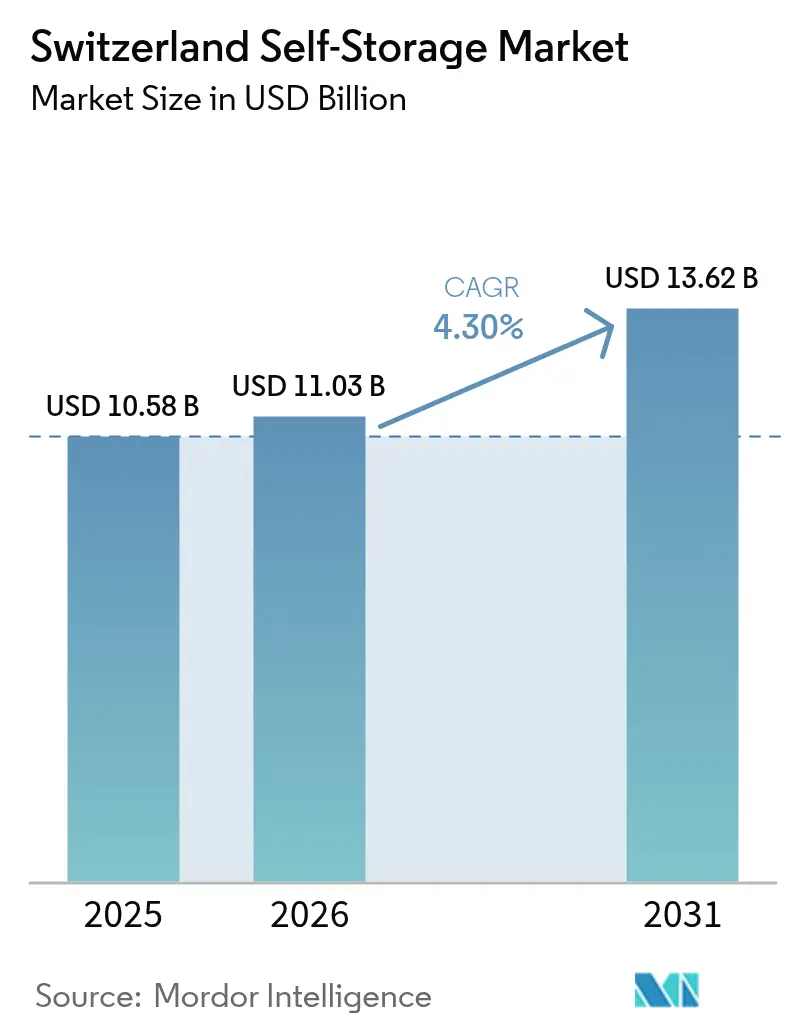
Switzerland self-storage market size in 2026 is estimated at USD 11.03 billion, growing from 2025 value of USD 10.58 billion with 2031 projections showing USD 13.62 billion, growing at 4.30% CAGR over 2026-2031. The growth outlook rests on a chronic housing shortage that drives vacancy rates to 1.08% nationally and an extreme 0.46% in Geneva, forcing residents and businesses to externalize possessions.[1] Alpine geography constrains new construction, yet Switzerland’s safe-haven status keeps capital flowing into real estate, sustaining demand for premium storage space. Businesses accelerate adoption because flexible, small-footprint logistics hubs help them serve cross-border customers under strict Swiss customs rules. Foreign investment in Alpine resorts also fuels large-unit rentals as international buyers secure climate-controlled storage for art, wine and gear. The Switzerland self-storage market therefore benefits simultaneously from residential crowding, corporate supply-chain re-design and the country’s role as a global wealth repository.
Key Report Takeaways
- By self-storage type, consumer applications held 70.35% of the Switzerland self-storage market share in 2025, while the business segment is projected to grow at a 5.90% CAGR through 2031.
- By unit size, 25-50 sq ft small units captured 33.45% of the Switzerland self-storage market share in 2025; units above 200 sq ft are forecast to register a 6.75% CAGR by 2031.
- By rental duration, medium-term contracts of 3-12 months accounted for a 42.40% share of the Switzerland self-storage market size in 2025, whereas short-term rentals below three months will advance 7.05% annually to 2031.
- By application, household and personal goods dominated with 56.20% revenue share in 2025, while micro-fulfillment hubs are set to expand at an 7.55% CAGR during the forecast period.
Note: Market size and forecast figures in this report are generated using Mordor Intelligence’s proprietary estimation framework, updated with the latest available data and insights as of 2026.
Switzerland Self-Storage Market Trends and Insights
Drivers Impact Analysis*
| Driver | (~) % Impact on CAGR Forecast | Geographic Relevance | Impact Timeline |
|---|---|---|---|
| Shrinking Urban Living Space and Rising Rental Prices | +1.2% | National, with acute impact in Geneva, Zurich, Basel | Short term (≤ 2 years) |
| Growing SME and E-commerce Fulfillment Needs | +0.8% | National, concentrated in logistics hubs | Medium term (2-4 years) |
| Aging, Affluent Population Seeking Decluttering Solutions | +0.9% | National, skewed toward urban cantons | Long term (≥ 4 years) |
| Wine and Fine-Art Storage Demand From HNWI | +0.7% | Geneva, Zurich, Zug financial centers | Medium term (2-4 years) |
| Alpine Adventure Gear Lockers for Tourism Operators | +0.5% | Alpine regions, seasonal tourism centers | Medium term (2-4 years) |
| Digital-Nomad Visa Holders Using Storage as "Base-Camp" | +0.4% | Urban centers, tech hubs, co-working spaces | Short term (≤ 2 years) |
| Source: Mordor Intelligence | |||
Shrinking Urban Living Space and Rising Rental Prices
Vacancy rates of 0.07% in Zurich and 0.46% in Geneva place Switzerland at the global extreme of housing scarcity, turning external storage from convenience into basic infrastructure.[2] Federal data warn that current conditions mirror the 2014 crunch but now feature near-zero interest rates that inflate property values beyond middle-class budgets.[3] Tenants discover that paying CHF 200 (USD 225) for a locker costs less than upgrading apartments, which encourages stable demand even during economic slowdowns. Developers respond by designing smaller units to meet rent caps, indirectly funneling overflow items into the Switzerland self-storage market. Operators position inner-city micro-facilities close to public transport so residents can access belongings without owning cars, reinforcing network effects that lock in occupancy.
Growing SME and E-Commerce Fulfillment Needs
Swiss SMEs export niche products that require just-in-time inventory near consumer clusters across the Schengen area. Government SME-Portal programs guide firms toward flexible capacity rather than capital-intensive warehouses. Self-storage units therefore double as micro-fulfillment nodes equipped with parcel drop-rooms, barcode access and customs-ready documentation services, easing cross-border trade compliance outlined by the World Bank. As marketplace sellers promise 24-hour delivery, demand shifts toward facilities along the main north–south corridors that link Basel, Zürich and Ticino. The Switzerland self-storage market gains resilience because business customers sign staggered contracts that smooth seasonal swings in consumer occupancy.
Aging, Affluent Population Seeking Decluttering Solutions
Switzerland’s median age surpasses 44 years, and retirees hold high net wealth but relocate into smaller urban flats to access medical and cultural services. Downsizing families place furniture and heirlooms in climate-controlled rooms rather than selling beloved assets. Storage firms respond with concierge pick-up, insurance integration and digital inventories, creating premium tiers that lift average revenue per square foot. Zurich and Geneva municipalities expect senior-led households to rise 18% by 2030, signaling sustained latent demand. The Switzerland self-storage market thus aligns with demographic trends that favor predictable, low-churn cash flows relative to younger, more transient cohorts.
Wine and Fine-Art Storage Demand from HNWI
Swiss stability, discretion and favorable customs zones attract collectors who require bank-grade security combined with private access. Facilities near Geneva’s free-ports or Zurich’s art quarter provide humidity-controlled vaults, biometric entry and independent valuation services. High-net-worth clients often rent rooms exceeding 200 sq ft to consolidate collections that cannot fit in urban condos. Transaction data on Alpine resort homes worth CHF 14.2 million (USD 15.9 million) purchased by Americans in early 2025 underscore the influx of portable wealth. These buyers seek year-round storage for wine, art and ski equipment, supporting the most profitable slice of the Switzerland self-storage market.
Restraints Impact Analysis*
| Restraint | (~) % Impact on CAGR Forecast | Geographic Relevance | Impact Timeline |
|---|---|---|---|
| Scarcity and High Cost of Commercial Real-Estate | -0.6% | National, acute in urban centers | Short term (≤ 2 years) |
| Restrictive Zoning and Building-Code Approvals | -0.4% | Cantonal variations, strictest in heritage areas | Long term (≥ 4 years) |
| Cooperative Housing Providing Communal Storage | -0.3% | Urban cantons, social housing developments | Medium term (2-4 years) |
| Heritage-Building Regulations Limiting Conversions | -0.2% | Historic city centers, protected districts | Long term (≥ 4 years) |
| Source: Mordor Intelligence | |||
Scarcity and High Cost of Commercial Real-Estate
Switzerland’s limited developable land and environmental safeguards tighten supply for every asset class. Real-estate investors channel abundant liquidity into mixed-use projects, bidding up land values that self-storage operators struggle to match. Inner-city parcels often top CHF 5,000 (USD 5,600) per m², forcing operators toward costlier vertical builds or peripheral sites. Financing risk rises because interest-rate shifts directly affect cap-rates, yet storage rents cannot escalate as rapidly as acquisition costs. The imbalance narrows margins and delays new capacity additions, tempering growth within the Switzerland self-storage market.
Restrictive Zoning and Building-Code Approvals
Cantonal zoning boards prioritize residential units to ease housing pressure, relegating storage projects to industrial zones far from customer catchments. Lengthy approval cycles sometimes stretch beyond three years, exposing developers to cost inflation. Heritage preservation laws in Zurich, Bern and Lucerne restrict façade alterations, complicating adaptive-reuse of urban warehouses for storage. Smaller local operators without specialized compliance expertise often exit the pipeline, which gradually tilts the Switzerland self-storage market toward well-capitalized chains able to navigate complex regulations.
*Our forecasts treat driver/restraint impacts as directional, not additive. The impact forecasts reflect baseline growth, mix effects, and variable interactions.
Segment Analysis
By Self-Storage Type: Business Segment Drives Future Growth
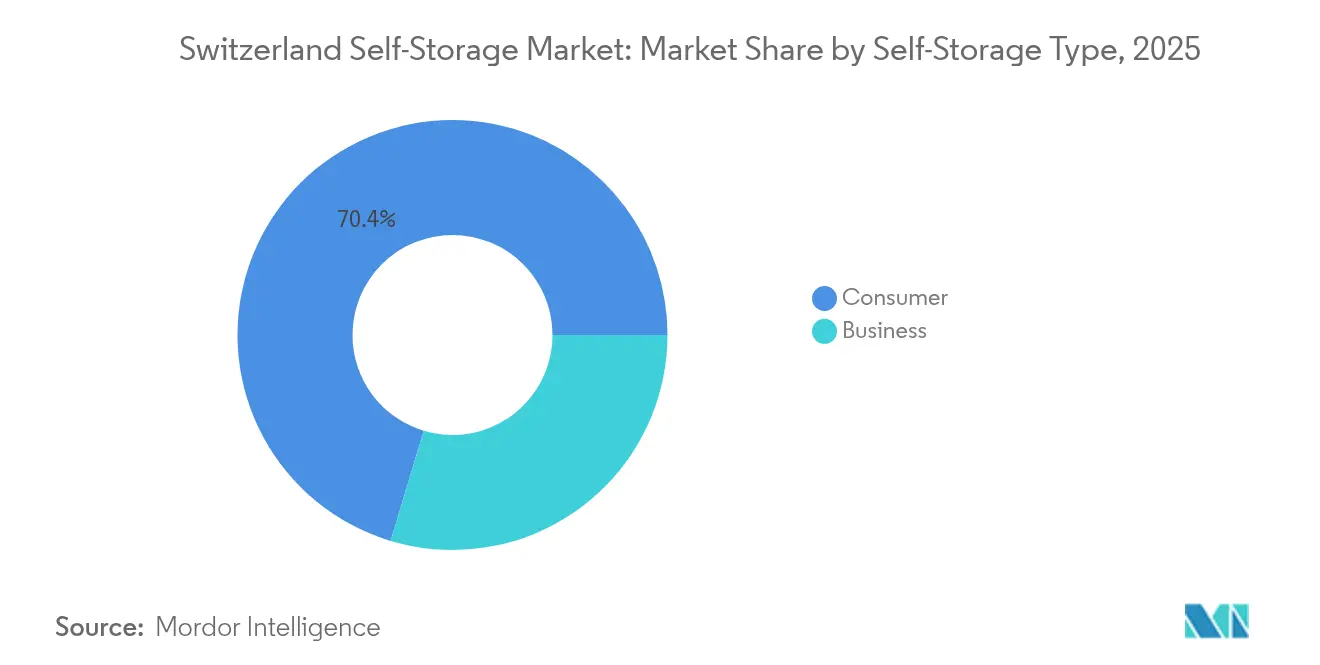
In 2025 the consumer segment generated 70.35% of revenue, illustrating how tight residential space underpins the Switzerland self-storage market. That dominance will remain, yet business demand is projected to expand at a 5.90% CAGR, creating the market’s most dynamic revenue source. SMEs adopt distributed storage to match cross-border shipping requirements and reduce customs clearance times, benefiting operators that can integrate barcode-based inventory services. Large corporate clients, including pharmaceutical and watchmakers, rent entire floors to stage bonded inventory awaiting European distribution, boosting average lease sizes. Consumer uptake continues to increase but at a slower pace because apartment downsizing has plateaued in some cantons where zoning restrictions curb further footprint reduction. However, pervasive vacancy pressure ensures a baseline customer influx, ensuring the Switzerland self-storage market maintains balanced revenue streams over the forecast horizon.
The Switzerland self-storage industry also witnesses hybrid models where a single facility allocates separate wings for private boxes and palletized commercial stock. Business users value clear service-level agreements, weekend access and data-driven reporting, allowing operators to charge premium rates for reliability. Consumer areas prioritize flexible hours and contactless move-in to minimize staffing costs. This dual-focus strategy extends lifetime value across both segments, especially in urban catchments where land scarcity forces operators to maximize revenue per square foot. As supply-chain digitization accelerates, demand for barcode scanning, real-time CCTV and automated invoicing grows, pulling technology partnerships into the center of competitive differentiation across the Switzerland self-storage market.

By Unit Size: Large Units Capture Premium Demand
Extra-large units above 200 sq ft are set to grow at 6.75% annually as wealthy international clients use Switzerland for treasure-class asset storage. These premium rooms command rents up to 2.5 times standard rates, lifting the Switzerland self-storage market size for the upper-tier segment. Geneva free-port operators report waiting lists for climate-controlled vaults designed for wine, paintings and precious metals, encouraging chains to allocate full mezzanine levels to oversized units. Small lockers of 25-50 sq ft still held a 33.45% Switzerland self-storage market share in 2025, anchoring occupancy and hedging volatility from high-end segments. Mid-range rooms between 51-100 sq ft remain vital during residential relocations, especially in German-speaking cantons where job mobility is highest.
Demand stratification allows operators to practice yield management similar to airlines: premium units gain dynamic pricing during art-fair seasons, while economy lockers offer bundled discounts in low occupancy months. Investors recognise that larger rooms attract lower churn because collectors sign multi-year agreements to consolidate multiple asset classes under one roof. Construction plans increasingly layer modular partitions so operators can reconfigure space quickly as the Switzerland self-storage market evolves. This adaptability mitigates risk when macro-drivers—such as currency moves that affect cross-border art flows—shift unit-size mix unexpectedly.
By Rental Duration: Short-Term Storage Reflects Economic Dynamism
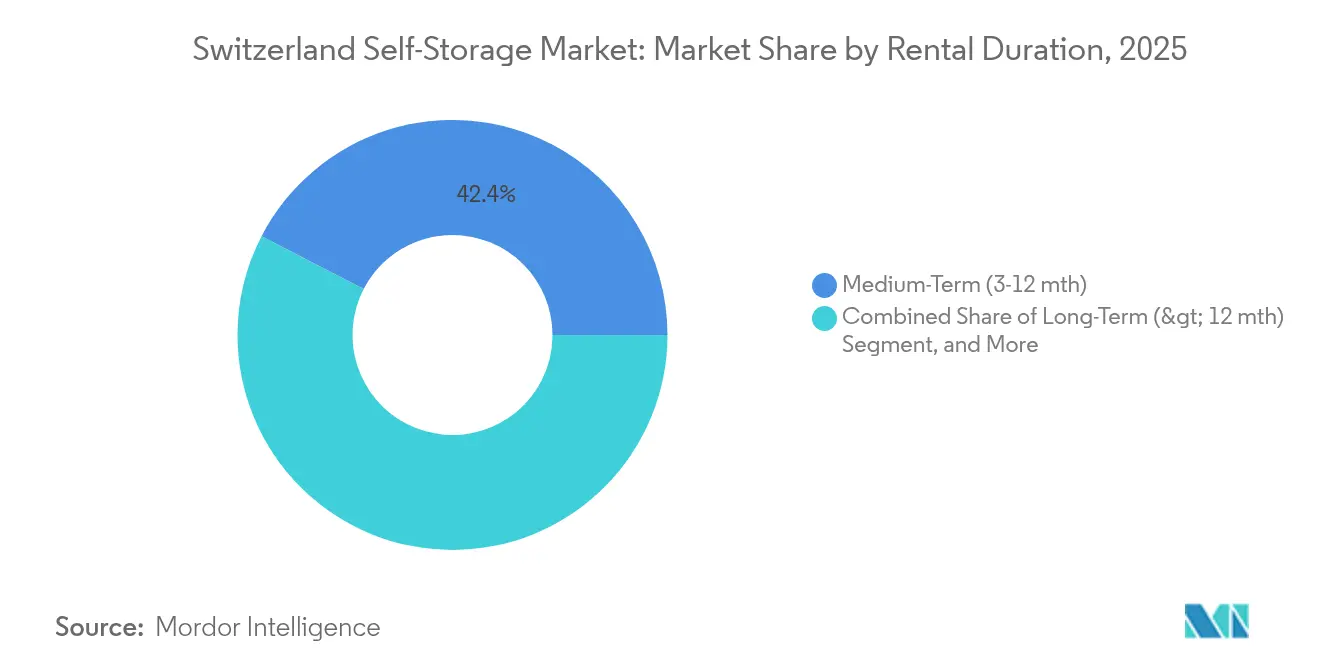
Short-term contracts under three months will post a 7.05% CAGR, underscoring Switzerland’s agile economy. Start-ups, expats and digital nomads take advantage of contactless move-in via mobile app, turning storage into an on-demand utility. Seasonal tourism further boosts under-90-day occupancy for outdoor gear lockers in Alpine cantons. Medium-term rentals spanning 3-12 months maintained a commanding 42.40% share of the Switzerland self-storage market size in 2025, reflecting standard apartment lease turnover cycles. Operators optimise revenue by charging time-based premiums rather than square-foot premiums for customers seeking flexibility.
Long-term agreements exceeding one year remain attractive for retirees and SME archival needs because operators often offer graduated discounts. Yet the trend toward asset-light lifestyles favours shorter commitments, nudging product design toward pro-rated billing, digital identity verification and cross-facility access privileges. This shift compels operators to refine revenue-management algorithms capable of balancing higher churn with price elasticity, keeping overall yields steady across the Switzerland self-storage market.
By Application: Micro-Fulfillment Hubs Lead Innovation
Micro-fulfillment hubs will grow at 7.55% annually as e-commerce firms re-design last-mile logistics to comply with Swiss consumer-protection and customs regimes. Facilities retrofit individual boxes with IoT sensors that capture temperature and humidity, allowing food-grade or cosmetic items to remain within regulatory thresholds during short holding periods. Household and personal goods still dominated with 56.20% market share in 2025, highlighting how living-space scarcity remains the core demand driver. Document archiving experiences steady demand from legal and fiduciary firms obliged to keep hard copies under strict privacy laws, while student storage peaks around university breaks in Lausanne, Basel and Zurich.
Wine and specialty items storage illustrates Switzerland’s premium curve. Collectors insist on 12°C constant environments with vibration control, pushing operators to install redundant HVAC and smart monitoring. These capital-intensive improvements justify lease rates several multiples above standard boxes, contributing disproportionally to profit. Convergence across applications allows operators to convert under-used areas seasonally—for example, shifting student boxes into micro-fulfillment racks during summer—maximising utilisation within the Switzerland self-storage market.
Geography Analysis
Urban cantons constitute the demand epicenter. Geneva’s Lake region posts the greatest per-capita uptake because the vacancy rate of 0.46% forces even affluent tenants to externalize possessions. Zurich follows with a 0.07% vacancy rate, translating into waiting lists for centrally located facilities. Basel leverages its life-sciences cluster to drive specialised cold-chain storage, blending corporate and consumer use within the same footprint. German-speaking cantons bordering Germany house cross-border commuters who store goods in Switzerland to avoid customs delays, sustaining an above-average occupancy profile.
Alpine regions anchor premium demand tied to tourism and luxury real estate. Property purchases in Andermatt illustrate how inbound wealth creates spill-over storage needs for art, sports equipment and seasonal vehicles. Central Switzerland—especially Zug—capitalises on tax advantages that draw commodity traders and crypto firms requiring secure document and hardware storage. Ticino serves as a commercial gateway to Italy, increasing throughput for micro-fulfillment parcels moving south while still adhering to Swiss security expectations. Rural municipalities offer cheaper land that enables large-format builds; digital access panels reduce staffing, allowing these sites to price aggressively and pull overflow demand from urban cores.
Federalism influences growth because cantonal zoning rules vary widely. Bern fast-tracks conversions of redundant military depots into storage, whereas Lausanne imposes strict aesthetic rules on new builds near heritage zones, slowing capacity expansion. Operators that develop multi-cantonal portfolios can balance risk by offsetting regulatory delays in one region with quicker openings elsewhere. Switzerland’s efficient rail and road network connects these distributed assets, ensuring customers accept a short commute in exchange for lower rents, preserving elasticity across the Switzerland self-storage market.
Regulatory Landscape
Self-storage development and conversions in Switzerland sit within the country’s spatial planning framework, anchored by the Federal Act on Spatial Planning (LAT/RPG) and implemented through cantonal and municipal zoning, master plans, and permitting. The Federal Office for Spatial Development (ARE) sets federal spatial development objectives, while approvals and use classifications for storage facilities are handled locally. This produces meaningful inter-cantonal variation in timelines and feasibility for new builds or adaptive reuse.
On the operations side, customer onboarding, CCTV, access logs, and digital booking platforms bring operators under Switzerland’s Federal Act on Data Protection (FADP), which emphasizes transparency, security measures proportionate to risk, and retention practices for personal data. Many industry participants also cite the Swiss Movers Association (SMA) general storage terms and conditions as a common contractual baseline. Where cross-border business users interact with customs processes, operators may interface with SECO’s import platform depending on their operating model and documentation needs.
Value Chain Analysis
The Switzerland self-storage value chain starts with site sourcing (industrial or commercial assets, brownfield plots, and mixed-use redevelopments) and navigating cantonal and municipal approvals shaped by the Federal Act on Spatial Planning. Development and fit-out typically include modular unit construction, fire and safety compliance, and installation of secure access systems. Demand generation then follows through digital marketing, broker and relocation channels, and enterprise sales, particularly for SMEs using units as micro-fulfillment or equipment staging space.
Operations are increasingly technology-led, combining remote management platforms with access control and sensor layers. The value chain includes operators such as Zebrabox and specialist suppliers such as Janus (facility layout and hardware components), Terad (digital platform capability), and keynexis AG (access control and sensor-based monitoring). October 2025 marked a step in this chain with Zebrabox opening a purpose-built 550-unit (3,900 m2) facility in Bussigny with fully digitalized access control, reinforcing standardized, lower-labor operating models. Industry coordination and supplier-operator alignment are supported by the 3SA Swiss Self-Storage Association, which provides a forum for standards and market development.
Competitive Landscape
The Switzerland self-storage market features moderate fragmentation with early signs of consolidation. Shurgard leads capacity expansion, adding 405,000 m² by 2026 and recording 10.8% revenue growth in 2024. Its scale affords marketing clout and automated KYC enrollment, capturing affluent urban customers willing to pay for reputational assurance. Zebrabox defends share through personalised services, including white-glove transport for art pieces, while placeB differentiates with fully digital access and dynamic pricing that adjusts every six hours. These models highlight technology adoption as the primary strategic lever.
Local players exploit deep knowledge of cantonal permitting. In heritage-sensitive cities, regional firms win approvals faster by incorporating façade conservation and mixed-use community spaces. Some boutique operators specialise in wine cellaring and partner with insurance underwriters to issue asset-specific coverage at the point of rental. Such micro-niches command outsized margins, balancing the volume advantages enjoyed by multinationals.
Acquisition opportunities remain abundant because a long tail of single-facility owners lacks resources to modernise. Chains with institutional backing pursue roll-ups, standardising operating systems and introducing cross-selling such as moving supplies and last-mile logistics services. Fragmentation coexists with high customer switching costs, so first movers that upgrade IT platforms lock in subscribers. In this context, the Switzerland self-storage market encourages scale yet still rewards specialised value propositions, keeping rivalry robust without tipping into price wars.
Switzerland Self-Storage Industry Leaders
-
Zebrabox AG
-
Casaforte (SMC Self-Storage Management) SA
-
Secur’Storage SA
-
Homebox Switzerland SA
-
MyPlace Self-Storage GmbH
- *Disclaimer: Major Players sorted in no particular order
Market Opportunities and Future Outlook
White space is most visible where land scarcity and approval complexity constrain supply in high-demand urban catchments, including opportunities for adaptive reuse of existing industrial or commercial stock and mixed-use projects that can secure local permits. The clearest fit tends to be for operators that can package compliant security, climate control, and premium services for higher-value use cases such as wine, fine art, and collectibles, while also maintaining dense networks of small units for residential overflow demand in cities with extreme housing tightness.
Digitization offers a practical scaling lever in the near term, supported by moves toward cloud-managed security and automated access. placeB’s use of a cloud security platform (Verkada), along with QR-code access, sensor monitoring, and centralized oversight promoted by vendors such as keynexis AG, reduces reliance on on-site staffing and supports 24/7 operating models for both consumer and SME patterns. Capacity additions that embed this approach, including Zebrabox’s October 2025 Bussigny opening with fully digitalized access control, show a replicable pathway for multi-site expansion. These facilities also enable service layers such as parcel handover, identity verification, and inventory visibility for micro-fulfillment users.
Recent Industry Developments
- June 2026: Zebrabox AG partnered with PXL Vision to integrate the PXL Ident digital identity verification service into its storage booking process. This supports remote, app-led onboarding and enables scalable 24/7 operations while improving access and auditability for digitally managed facilities.
- March 2026: Ardian announced an agreement to acquire a majority stake in Casaforte (SMC Self-Storage Management) SA, aimed at building a pan-European self-storage platform. The transaction points to rising institutional interest in the sector and may increase competitive pressure on independent operators through faster consolidation and standardized operating playbooks.
- December 2024: Zebrabox partnered with Swiss Post to pilot parcel-handover lockers within storage corridors, positioning facilities as last-mile nodes for SMEs and e-commerce users. The integration expands storage site use cases beyond long-stay unit rentals and supports higher visit frequency and ancillary service revenue.
Research Methodology Framework and Report Scope
Market Definition and Coverage
For this study, the market covers revenue earned in Switzerland from renting self-storage space to customers, including private households and organizations, for short or long periods, under a self-service access model.
Scope exclusions: It excludes traditional warehousing and 3PL storage contracts, household moving services, and document management services when they are priced and delivered as non-self-storage offerings.
Segmentation Overview
-
By Self-Storage Type
- Consumer
- Business
-
By Unit Size (sq ft)
- < 25 (Locker)
- 25-50 (Small)
- 51-100 (Medium)
- 101-200 (Large)
- > 200 (Extra-Large)
-
By Rental Duration
- Short-Term (< 3 mth)
- Medium-Term (3-12 mth)
- Long-Term (> 12 mth)
-
By Application
- Household and Personal Goods
- Business Inventory and Equipment
- Student Storage
- Document and Records Archiving
- Wine and Specialty Items
- Micro-Fulfilment / Last-Mile Hubs
Data Sources, Market Sizing, and Validation
Desk Research
To set the market boundaries and build the first set of demand and price assumptions, we start with public industry and macro indicators for Switzerland. This includes, for example, European self-storage supply and occupancy statistics from a regional industry association, Swiss Federal Statistical Office population and housing indicators, and building and construction releases that signal new space additions.
We also review official and non-paywalled sources that help us cross-check business activity and customer drivers, such as the Swiss Federal Customs Administration trade statistics for storage-related equipment flows, patent databases to understand facility technology adoption (access control, security, climate control), and peer-reviewed urban planning and real estate journals for space constraints in major cities. These are complemented with company filings, investor presentations, reputable press, and selective paid subscriptions for company financials and news, plus an import-export shipment-level database when it helps validate equipment and fit-out cycles. The sources listed here are illustrative only, and many other public documents were used for data collection, validation, and clarification.
Primary Interviews and Surveys
In Switzerland, we use expert interviews and surveys with storage operators, property professionals, facility managers, and commercial decision makers. Their responses help validate occupancy, achievable rent, new facility openings, customer demand, and the treatment of smaller facilities in secondary data. We recheck unusual responses and use the findings to adjust model assumptions and final analysis.
Distribution of primary research fieldwork respondents
| Company type | Respondent position |
|---|---|
| Top tier: 30% | CXOs: 15% |
| Mid tier: 45% | Functional/Unit leaders: 30% |
| Smaller Players: 25% | Managers: 55% |
Market-Sizing & Forecasting
Market sizing is built using a top-down approach where supply-side capacity and utilization signals are reconstructed into revenue potential for Switzerland, and then checked against observed pricing behavior. The core build starts from facility count and net rentable area proxies, which are then adjusted using occupancy rates and effective rent per square meter to arrive at annual revenue.
Several market fingerprints are used as inputs, such as net rentable area additions from new facility launches, occupancy movement by city clusters, advertised versus realized rent (including promotions), share of climate-controlled space, and typical lease duration splits between household and business users. Where the public picture is incomplete, we apply conservative gap-handling by using ranges from interviews and applying them only to the portion of supply that can be evidenced through listings and facility disclosures.
For forecasting, scenario analysis is used so near-term demand shifts (housing tightness, small business inventory behavior, and real estate cost pressure) can be translated into occupancy and rent trajectories in a transparent way. Results are corroborated with selective bottom-up approximations, such as sampled site-level rent cards multiplied by estimated occupied area, and then totals are adjusted when the cross-checks disagree.
Data Validation & Update Cycle
Each key assumption is validated in more than one way, so the model does not rely on a single data series. We compare outputs against independent signals like facility stock changes, vacancy and occupancy commentary, and rent movement seen in listings, and then investigate anomalies at the city and national level before sign-off.
A multi-step review is followed, where a second analyst checks calculations, unit conversions, and year alignment, and then re-contacts are triggered if interview feedback diverges meaningfully from desk inputs. Reports are refreshed annually, with interim updates when material events occur, and a final fresh pass is completed before delivery so clients receive the most current view.
Mordor Intelligence's Switzerland Self Storage Market Size Compared With Other Published Estimates
Published market numbers for Switzerland self-storage can vary a lot, even when the topic name looks the same, because the counted revenue pool is not always consistent. Differences usually come from what is treated as self-storage versus general storage, what is counted for pricing (list rents or effective rents), and how quickly assumptions are updated.
FEDESSA facility stock, occupancy signals, and country-level rent benchmarks are the checks that keep Mordor Intelligence's estimate anchored to rentable self-storage area and realistic utilization, instead of mixing in broader warehousing revenue or one-time real estate transactions.
Benchmark comparison
| Source | Market Size | Gaps in Research Methodology |
|---|---|---|
| Mordor Intelligence | USD 10.58 B (2025) | |
| Market Research Publisher A | USD 10.60 B (2024) | Uses a different base year and appears to rely on broad demand drivers without clearly separating effective rent from advertised pricing, which can inflate revenue when discounting is common. |
| Industry Data Portal B | USD 0.23 B (2025) | Looks closer to a revenue potential built from reported floor area and rent in local currency, but the scope likely captures only a portion of listed facilities and may omit corporate demand and multi-site operators, leading to a smaller total. |
The spread in values is mainly explained by scope boundaries and how rent and utilization are treated in the math. When facility coverage, occupancy, and effective pricing are tied back to observable signals and then rechecked through interviews, the resulting number is easier to trace and repeat for future updates.
Key Questions Answered in the Report
What is the current size of the Switzerland self-storage market?
The Switzerland self-storage market is worth USD 11.03 billion in 2026.
How fast is the market expected to grow?
Industry revenue is projected to rise at a 4.30% CAGR, reaching USD 13.62 billion by 2031.
Why are Swiss vacancy rates influencing storage demand?
Urban vacancy rates as low as 0.07% in Zurich leave residents without in-home space, forcing them to rent external units.
Which self-storage segment is expanding fastest?
Business applications lead with a 5.90% CAGR, driven by SMEs that need flexible logistics hubs.
Where is geographic demand strongest?
Geneva and Zurich top the list due to extreme housing scarcity, while Alpine resort areas attract premium demand tied to luxury property buyers.