
Market Overview
| Study Period | 2020 - 2031 |
|---|---|
| Forecast Data Period | 2026 - 2031 |
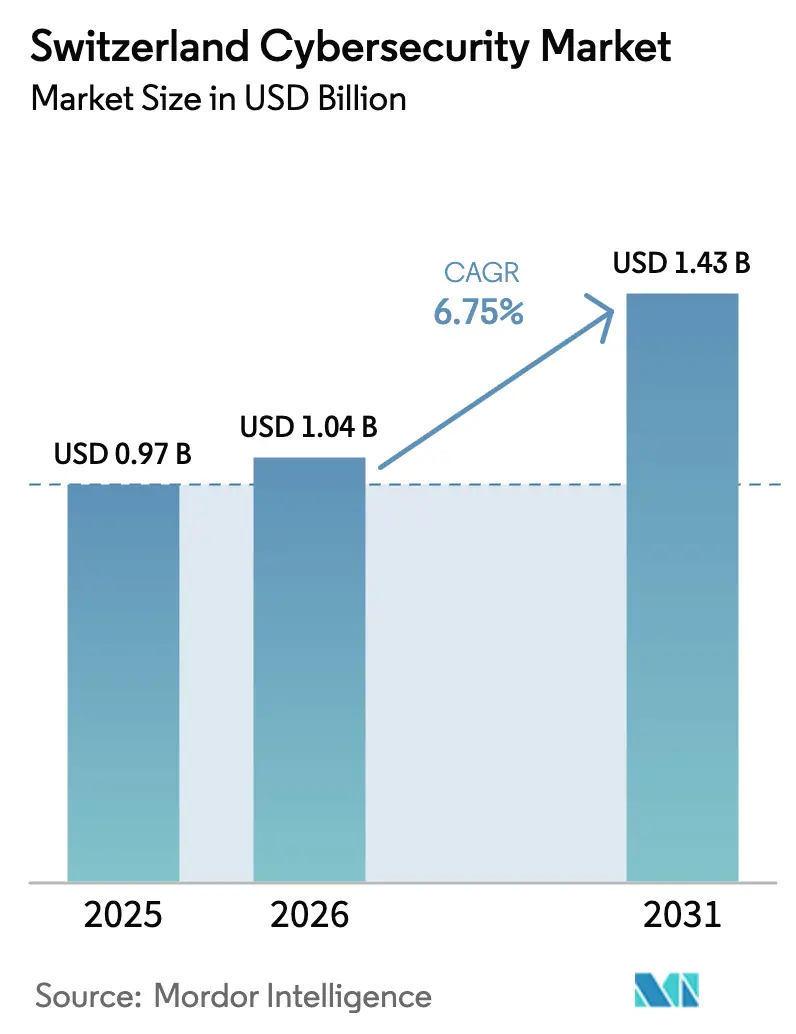
| Base Year Market Size (2025) | USD 0.97 Billion |
| Market Size (2026) | USD 1.04 Billion |
| Market Size (2031) | USD 1.43 Billion |
| Growth Rate (2026 - 2031) | 6.75 % |
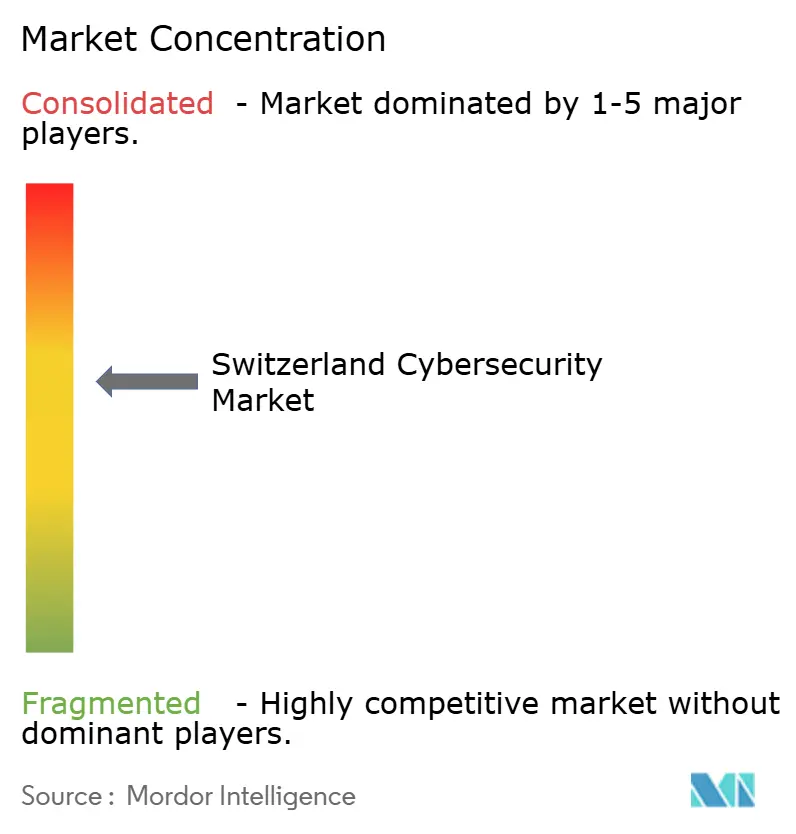
| Market Concentration | Medium |
Major Players *Disclaimer: Major Players sorted in no particular order Image © Mordor Intelligence. Reuse requires attribution under CC BY 4.0. | |
Switzerland Cybersecurity Market Analysis by Mordor Intelligence
The Switzerland cybersecurity market size was valued at USD 0.97 billion in 2025 and estimated to grow from USD 1.04 billion in 2026 to reach USD 1.43 billion by 2031, at a CAGR of 6.75% during the forecast period (2026-2031). A confluence of regulatory mandates, rapid digitalization across core industries, and the nation’s longstanding focus on data privacy propel this consistent expansion. Cloud-first strategies, particularly those hosted in Swiss data centers, are accelerating even as on-premise deployments retain primacy among highly regulated banks. Simultaneously, managed detection and response services are gaining favor with organizations that lack in-house expertise. In parallel, the launch of real-time payment rails, the roll-out of connected pharmaceutical manufacturing, and heightened awareness of hybrid threats are each deepening the addressable opportunity for providers across the Switzerland cybersecurity market.
Key Report Takeaways
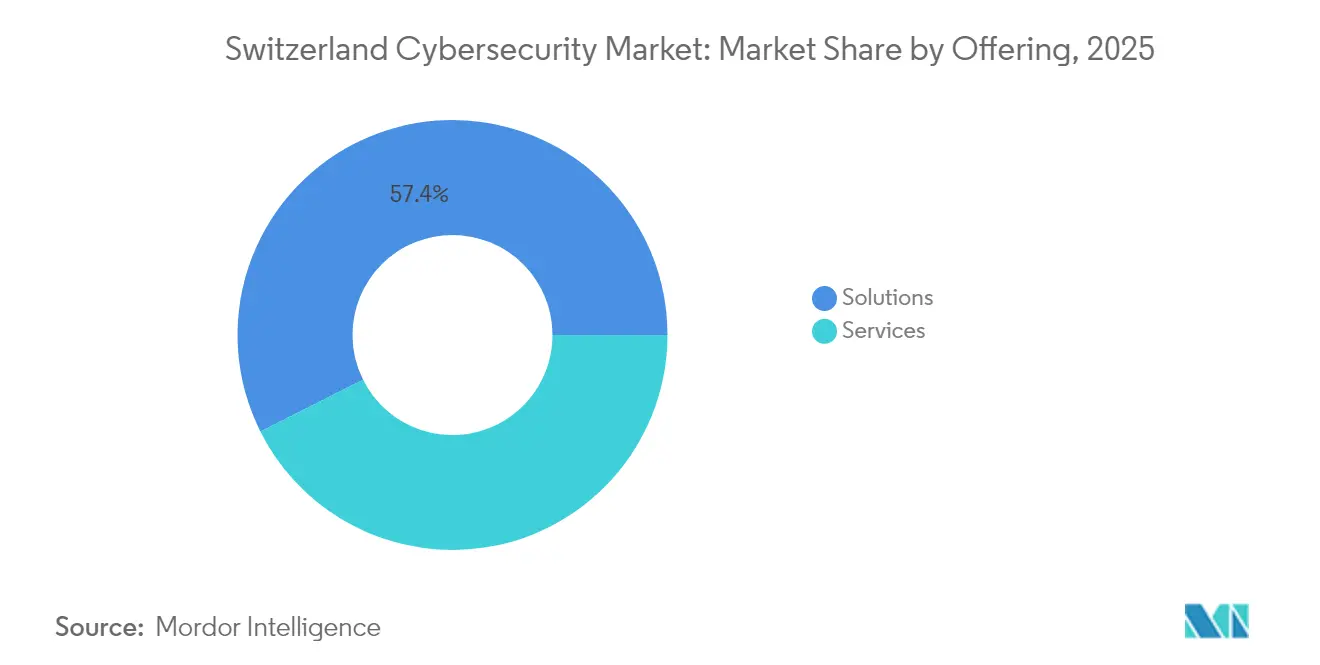
- By offering, solutions led with 57.40 % Switzerland cybersecurity market share in 2025, while services are on track to grow at a 13.20 % CAGR to 2031.
- By deployment mode, on-premise still commanded 64.10 % of the Switzerland cybersecurity market size in 2025; cloud deployments are expanding at a 11.60 % CAGR through 2031.
- By end user industry, the BFSI segment held 28.10 % of the Switzerland cybersecurity market size in 2025, while healthcare exhibit the fastest 12.70 % CAGR to 2031.
- By end-user enterprise size, large enterprises accounted for 69.70 % revenue share in 2025, whereas SMEs are poised for an 10.60 % CAGR between 2026-2031.
Note: Market size and forecast figures in this report are generated using Mordor Intelligence’s proprietary estimation framework, updated with the latest available data and insights as of 2026.
Switzerland Cybersecurity Market Trends and Insights
Drivers Impact Analysis*
| Driver | (~) % Impact on CAGR Forecast | Geographic Relevance | Impact Timeline |
|---|---|---|---|
| Rapid digitalization across banking, pharma and manufacturing | +2.1 % | Zurich, Basel, Geneva | Medium term (2-4 years) |
| Revised Federal Act on Data Protection (FADP) | +1.8 % | National | Short term (≤2 years) |
| Surge in sophisticated ransomware attacks | +1.2 % | Cantonal governments & SMEs | Short term (≤2 years) |
| Switzerland’s crypto-asset hub momentum | +0.9 % | Zug, Zurich, Geneva | Medium term (2-4 years) |
| Accelerated cloud and SaaS adoption | +0.8 % | National | Medium term (2-4 years) |
| Government-backed CYD Campus initiatives | +0.4 % | Academic centers | Long term (≥5 years) |
| Source: Mordor Intelligence | |||
Rapid Digitalization Across Swiss Banking, Pharma and Manufacturing Elevates Threat Surface
The accelerated rollout of real-time payments, connected drug-production lines and smart factories has expanded the national threat surface. Banks handling SIC Instant Payments manage up to 10,000 daily transactions that must clear fraud and sanctions filters in milliseconds, driving uptake of zero-trust verification at each hop. Pharma plants in Basel now link clinical-trial data with global partners, which forces segmentation of laboratory networks from administrative IT. Likewise, industrial firms merging operational technology with IT understand that a single misconfigured sensor can halt an entire batch, prompting widespread deployment of predictive-monitoring analytics. Collectively, these use-cases advance the Switzerland cybersecurity market toward integrated defense platforms instead of isolated point tools.
Stringent Swiss Federal Act on Data Protection Revision Driving Mandatory Security Spend
The 2023 FADP revision raised executive accountability by imposing personal fines up to CHF 250,000 (USD 313,600) for serious negligence, thereby making cybersecurity spend a board-level necessity [1]. Foreign entities processing Swiss residents’ data must appoint an in-country representative, instantly opening niche advisory demand inside the Switzerland cybersecurity market. Because auditors now test for “privacy by design” controls, solution vendors that can map safeguards to legal clauses enjoy shorter sales cycles. The law’s swift enforcement cadence also explains why managed services with built-in compliance reporting are outgrowing traditional appliances.
Surge in Sophisticated Ransomware Attacks on SMEs and Cantonal Governments
The Play ransomware gang’s 2023 compromise of IT provider Xplain exposed 65,000 classified files and demonstrated how supplier breaches ricochet through federal systems [2]. In response, the National Cyber Security Centre made 24-hour breach reporting mandatory for critical infrastructure beginning April 2025, with fines. The directive spurs firms—especially cantonal agencies and SMEs—to formalize incident-response playbooks and onboard managed detection partners. Remarkably, attackers now craft Swiss German and French phishing lures using AI text models, raising defense complexity and propelling email-security subscriptions across the Switzerland cybersecurity market.
Switzerland’s Crypto-Asset Hub Status Necessitates Advanced FinTech Security
Home to more than 1,100 blockchain ventures, Zug’s “Crypto Valley” attracts sophisticated adversaries seeking to exploit smart contracts and wallet infrastructure. FINMA guidance now anticipates end-to-end key-management controls for tokenized assets, pushing vendors to embed crypto-specific safeguards into conventional banking platforms. Banks experimenting with digital securities increasingly request offerings that marry ISO 27001 frameworks with on-chain analytics, blending two historically separate domains and enlarging total addressable spend within the Switzerland cybersecurity market.
Restraints Impact Analysis*
| Restraint | (~) % Impact on CAGR Forecast | Geographic Relevance | Impact Timeline |
|---|---|---|---|
| Acute shortage of certified cyber-talent | −1.5 % | Rural cantons > cities | Medium term (2-4 years) |
| High cost sensitivity among SMEs | −1.0 % | National | Short term (≤2 years) |
| Data-residency concerns for cloud workloads | −0.8 % | National | Medium term (2-4 years) |
| Fragmented federal vs cantonal compliance layers | −0.5 % | Varies by canton | Long term (≥5 years) |
| Source: Mordor Intelligence | |||
Acute Shortage of Certified Cyber-talent in Swiss Regions
An ENISA survey found 89 % of Swiss organizations anticipate adding cybersecurity staff, yet vacancies persist for months, inflating wages and delaying projects. Rural cantons struggle most, compelling firms to automate baseline monitoring and lean heavily on managed detection services. Universities and the CYD Campus expand graduate pipelines, but near-term relief is limited, a dynamic that directs incremental budget into day-one-operational offerings across the Switzerland cybersecurity market.
High Cost Sensitivity Among SMEs Toward Advanced Solutions
Three in five Swiss SMEs that suffer a major breach cease operations within six months, yet budget ceilings still deter adoption of comprehensive defenses. Vendors respond with modular, pay-as-you-grow bundles that cover essentials: endpoint protection, cloud email security and encrypted backup. Insurance carriers have begun discounting premiums for SMEs that meet baseline security-control checklists, effectively subsidizing adoption and partially offsetting this restraint for the Switzerland cybersecurity market.
*Our forecasts treat driver/restraint impacts as directional, not additive. The impact forecasts reflect baseline growth, mix effects, and variable interactions.
Segment Analysis
By Offering: Services Race Ahead of Solutions
Solutions held 57.40 % Switzerland cybersecurity market share in 2025, but ervices are on track for a 13.20 % CAGR through 2031. Growth correlates with a 60,000-person skills gap that drives buyers toward outcome-based contracts. Identity and access-management suites now ship natively in SaaS form, and new MDR offerings promise sub-15-minute containment windows, delivering measurable reductions in dwell time. Vendors that couple consulting, implementation and MDR under one invoice report renewal rates above 95 %, underscoring the value of integrated portfolios.
The surge in services also reflects boardroom comfort with opex budgeting. Kudelski Security’s FusionDetect™ XDR platform delivered a 249 % four-year ROI according to an independent study, energizing demand for outsourced detection . Government agencies likewise tender multi-year MDR contracts to satisfy 24-hour reporting rules, widening public-sector revenue channels. Overall, managed offerings are poised to command an even greater portion of the Switzerland cybersecurity market by decade’s end.

By Deployment Mode: Cloud Acceleration Balances Sovereignty
On-premise deployments controlled 64.10 % of the Switzerland cybersecurity market size in 2025, yet cloud-hosted controls are advancing at a 11.60 % CAGR. Healthcare providers lean into Swiss-hosted clouds that meet FADP data-residency provisions while enabling cross-hospital record sharing. The hybrid model—sensitive data on premises, analytics in the cloud—emerges as the dominant architecture, letting CISOs fine-tune risk tolerance by workload.
Organizations also adopt SCION-based path-aware networking, funded by ventures such as Anapaya Systems, to guarantee data stays on Swiss soil during cloud hops. As native cloud controls prove audit-ready and hyperscalers add Swiss regions, cultural resistance erodes and incremental spend gravitates toward subscription-based security tools, reinforcing cloud’s climb inside the Switzerland cybersecurity market.
By End-user Industry: Healthcare Outpaces Traditional Banking Leadership
BFSI retained a 28.10 % slice of the Switzerland cybersecurity market size in 2025, reflecting decades of security investment. Yet healthcare & life sciences outstrip all verticals with a 12.70 % CAGR to 2031. Programs like DigiSanté that mandate interoperable electronic health records compel hospitals to invest in encryption, multi-factor authentication and continuous compliance tooling.
Banks meanwhile confront tokenization and open-banking APIs. They pilot blockchain custody modules that merge SWIFT-level controls with smart-contract audits, deepening vendor requirements. Manufacturers on the other hand focus on OT segmentation and AI-based anomaly detection across factory floors. Collectively, these divergent needs keep the Switzerland cybersecurity market diversified by end-user spend, reducing over-reliance on any single sector.

By End-user Enterprise Size: SMEs Narrow the Protection Gap
Large enterprises contributed 69.70 % of Switzerland cybersecurity market revenue in 2025. However, SMEs are accelerating at an 10.60 % CAGR, spurred by regulatory obligations that now apply to supply-chain partners. Secnovum’s “cyber-fitness” campaigns and simplified questionnaires help smaller firms identify priority controls without drowning in jargon.
Peer recommendations inside regional chambers of commerce often dictate purchase lists, so vendors invest in multilingual collateral to win trust. Consumption-based licenses that start below CHF 1,000 per month lower entry barriers, and once an SME onboards basic protection, upsell conversations pivot on concrete metrics such as phishing click-through reductions. The trend draws fresh entrants specializing in right-sized packages, thereby broadening competitive intensity across the Switzerland cybersecurity market.
Geography Analysis
Zurich anchors the Switzerland cybersecurity market, housing global banks, fintech incumbents and a dense start-up ecosystem. Strong university pipelines feed research labs, yet competition from financial institutions means independent vendors must offer equity or remote flexibility to secure talent. Regulatory bodies headquartered in the city facilitate rapid feedback loops between law drafts and product designs, giving local providers a home-field advantage. Demand concentrates on identity-first security, driven by real-time payments and open-finance APIs.
Basel follows, propelled by life-sciences titans that treat intellectual-property leakage as existential risk. Here, biomedical cybersecurity consultancies embed bio-ethicists alongside security engineers, reflecting dual obligations to protect patient privacy and trade secrets. Cross-border workforce flows with Germany and France introduce multilingual spear-phishing vectors, so companies showcase tri-lingual awareness programs. Pilot deployments of zero-trust micro-segmentation inside laboratory environments are later replicated in production plants, reinforcing ecosystem learning.
In Geneva and neighboring cantons, international organizations and commodity traders demand dual compliance with Swiss and EU regulations. Vendors fluent in both legal frameworks command premium retainers. The city’s status as a diplomatic hub heightens fear of espionage, leading to above-average investment in data-loss-prevention suites and secure collaboration platforms. Rural cantons lag, yet federal subsidies and shared Security Operations Centers aim to close this gap, expanding the Switzerland cybersecurity market’s geographic footprint.
Regulatory Landscape
Switzerland’s cybersecurity compliance posture is anchored by the revised Federal Act on Data Protection (FADP, effective 2023) and the Information Security Act (ISA) with its Cybersecurity Ordinance (CySO). Under the ISA/CySO regime, a mandatory cyberattack reporting obligation for operators of critical infrastructure has been in force since 1 April 2025, requiring notification to the National Cyber Security Centre (NCSC) within 24 hours of discovery. This shift has moved incident response readiness, evidence retention, and SOC coverage from best practice into a compliance requirement.
Policy development is also progressing on product and infrastructure resilience. The Federal Council tasked the NCSC, OFCOM, and SECO with preparing a bill on the cyber resilience of digital products for consultation by autumn 2026, aligned with the EU Cyber Resilience Act. Two additional bills aimed at binding resilience standards for critical infrastructure and data protection for sensitive federal and cantonal data are targeted to be finalized by end-2026. In parallel, Parliament increased the NCSC budget in late 2025 to strengthen operational capacity and staffing, reinforcing a regulatory environment that increasingly favors providers offering auditable controls and continuous compliance reporting.
Value Chain Analysis
The Switzerland cybersecurity value chain runs from technology providers (software, appliances, and cloud security) to integrators and consultancies, and then to managed security service providers (MSSPs) that operate day-to-day monitoring and response. Global vendors such as IBM, Cisco, Microsoft, and Fortinet typically serve Swiss buyers through local subsidiaries and partner ecosystems. Domestic players such as Swisscom, Kudelski Security, and Swiss Post Cybersecurity AG compete strongly where Swiss hosting, multilingual service desks, and canton-aware compliance support factor into buying decisions.
Public-private coordination supports information exchange across the ecosystem. The NCSC, positioned as the central coordinating body within the Federal Department of Defence, Civil Protection and Sport (DDPS), manages the National Cyberstrategy (NCS) implementation portfolio with more than 90 projects and around 70 implementation partners spanning federal bodies, cantons, and industry. In finance, the Swiss Financial Sector Cyber Security Centre (FS-CSC), founded 5 April 2022, links industry with entities such as FINMA, the SNB, and SIX. On delivery, sovereign operations and monitoring capabilities are a recurring differentiator, including Swiss Post Cybersecurity AG offerings such as Cyber Defense Centres. Supply-chain security is also becoming more structured, with NCSC guidance promoting supplier self-assessments and inspection regimes.
Competitive Landscape
Global suppliers such as IBM, Cisco and Microsoft maintain broad product portfolios that appeal to multinational clients, yet they must localize for strict Swiss data-sovereignty rules. Domestic champions—including Swisscom, Kudelski Security, InfoGuard AG and Exeon Analytics—capitalize on canton-specific compliance know-how and bilingual service desks, often edging multinationals in public-sector bids. The resulting equilibrium prevents any firm from exceeding 15 % revenue share, signaling moderate concentration within the Switzerland cybersecurity market.
M&A activity underscores an appetite for cloud-native and service-centric expansion. Swiss Post’s 2024 acquisition of Open Systems integrated secure access service edge (SASE) capabilities into its existing communication portfolio, aligning with the surge in remote work and hybrid cloud adoption [4]. VINCI Energies’ purchase of Fernao Group added 600 cybersecurity consultants across the DACH region, boosting bench strength for complex infrastructure projects. Such deals highlight a race to combine scale with specialized expertise.
Investment flows mirror strategic bets on automation and quantum-resilient encryption. Kudelski Security’s USD 166 million funding round in 2024 accelerates deployment of its FusionDetect™ XDR across Europe. Meanwhile, start-ups in Zug raise seed capital to fuse on-chain analytics with ISO-aligned controls, bridging gaps between crypto custody and traditional finance. Competitive differentiation thus hinges on cross-domain skill sets, continuous compliance reporting and rapid threat-intel integration—all increasingly non-negotiable for winning share in the Switzerland cybersecurity market.
Switzerland Cybersecurity Industry Leaders
-
Swisscom
-
Kudelski Security
-
IBM Corporation
-
Fortinet Inc.
-
Cisco Systems Inc.
- *Disclaimer: Major Players sorted in no particular order
Market Opportunities and Future Outlook
Compliance-led operationalization is opening sustained whitespace for managed services, breach readiness, and reporting automation tied to NCSC workflows. Since the 1 April 2025 reporting obligation for critical infrastructure took effect, the NCSC has recorded 222 reports, which is pushing regulated operators and their service providers toward 24/7 monitoring, incident triage, and standardized post-incident documentation. Providers that combine MDR/XDR, forensic readiness, and compliance-ready reporting can map their offerings directly to this cadence, especially for cantonal bodies and mid-sized critical-service operators that lack internal SOC depth.
Two additional opportunity pockets are supply-chain risk and sovereign security operations. The NCSC’s C-SCRM pilot resources, developed with Planzer Transport AG, point to practical demand for supplier assurance, third-party risk scoring, and audit support as enterprises extend security obligations to partners. Separately, Swiss-hosted and Switzerland-operated security services are being productized by providers such as Swiss Post Cybersecurity AG, addressing buyer needs for local operations and data-residency controls. AI-focused security work is also moving into enterprise roadmaps, following the Federal Council’s ratification of the Council of Europe Convention on AI and the NCSC’s identification of AI as a 2026 priority. That emphasis is broadening demand for governance, model-risk assessment, and controls for AI-enabled workflows beyond traditional endpoint and network protection.
Recent Industry Developments
- June 2026: Bitdefender integrated its Smart Home Security technology into Swisscom's home network protection offering. The collaboration expands consumer and home network protection in the Swiss market and strengthens Swisscom's sovereign security capabilities while increasing Bitdefender's foothold in Switzerland's SME and retail cyber hygiene segment. The alignment may drive cross product adoption and broaden Swiss consumer security outcomes.
- April 2026: IBM launched new cybersecurity measures and an assessment service delivered by IBM Consulting to help enterprises identify vulnerabilities and mitigate risks associated with weaponized frontier AI models. The offering targets frontier AI risk in Switzerland and reinforces IBM's position in Swiss enterprise security services and frontier AI risk assessment capabilities. The initiative enlarges Swiss enterprise security coverage and accelerates the adoption of AI risk management practices.
- February 2026: IBM released the 2026 X-Force Threat Intelligence Index reporting a 44% increase in attacks exploiting public facing applications, exacerbated by AI enabled vulnerability discovery. The rise in AI enabled threat activity impacts Swiss organizations and vendors, signaling greater demand for threat intel and proactive defense services. This underscores the need for enhanced threat intelligence partnerships and continuous monitoring capabilities.
Research Methodology Framework and Report Scope
Market Definition and Coverage
For this study, the market covers cybersecurity products and services purchased by organizations in Switzerland to prevent, detect, respond to, and recover from cyber threats across IT and connected operational environments.
Scope exclusions: We exclude consumer-only security tools, general IT hardware spending that is not security-led, and internal labor costs that are not billed as external cybersecurity services.
Segmentation Overview
- By Offering
- Solutions
- Application Security
- Cloud Security
- Data Security
- Identity and Access Management
- Infrastructure Protection
- Integrated Risk Management
- Network Security
- End-point Security
- Services
- Professional Services
- Managed Services
- Solutions
- By Deployment Mode
- Cloud
- On-Premise
- By End-user Industry
- BFSI
- Healthcare
- IT and Telecom
- Industrial and Defense
- Retail and E-commerce
- Energy and Utilities
- Manufacturing
- Others
- By End-user Enterprise Size
- Large Enterprises
- Small and Medium Enterprises (SMEs)
Data Sources, Market Sizing, and Validation
Desk Research
Desk research was used to set the Swiss country context, demand signals, and the policy environment shaping cybersecurity spending. We relied on public, non-paywalled sources such as the Swiss Federal Office of Statistics for macro and industry structure indicators, and official Swiss cyber guidance and reporting bodies for threat and incident patterns.
To anchor market behavior, we also reviewed sources such as OECD digital economy statistics, ITU cybersecurity indicators, and peer-reviewed security journals that discuss common attack vectors and control adoption. These were complemented with company annual reports and investor presentations for revenue mix cues, and with trusted press and association websites for deal activity and service model shifts. Where needed, paid subscriptions were used for company financials and intelligence and for patent database lookups to validate innovation focus. The examples above are illustrative, and many additional sources were referenced to collect, cross-check, and clarify data points.
Primary Interviews and Surveys
We use expert interviews and surveys with Swiss cybersecurity buyers, IT and risk leaders, managed security specialists, and public-sector technology users. Respondents help clarify budget direction, buying triggers, deployment choices, pricing movement, and service adoption, particularly where public data combines security spending with wider IT expenditure. Analysts compare these findings with the desk model and revisit material differences before sign-off.
Distribution of primary research fieldwork respondents
| Company type | Respondent position |
|---|---|
| Top tier: 25% | CXOs: 15% |
| Mid tier: 55% | Functional/Unit leaders: 30% |
| Smaller Players: 20% | Managers: 55% |
Market-Sizing & Forecasting
The sizing starts with a top-down build where national IT spending and digital intensity are reconstructed into an addressable security demand pool, and then filtered by Switzerland-specific adoption and compliance needs. From there, we corroborate results with selective bottom-up approximations like sampled vendor revenue splits, channel checks on managed services, and ASP x volume logic for common security subscriptions.
Key inputs used in the model include public indicators such as enterprise cloud migration pace, security headcount availability, incident reporting pressure, and the share of regulated industries that typically hold stricter control requirements. We also track the shift toward managed detection and response, typical contract duration, and the mix between on-premise and cloud deployments, since those choices influence recurring revenue and service attach rates. When bottom-up signals are missing for smaller suppliers, we handle the gap through conservative share allocation based on interview-guided channel structure, and then re-check totals against the top-down demand pool.
For forecasting, we use scenario analysis supported by a short set of measurable drivers, then tune it with expert feedback on budget cycles and procurement timing. This keeps the forecast explainable and repeatable, while still responding to policy changes and material threat events that can push spending ahead of a smooth trend line.
Data Validation & Update Cycle
Outputs are validated through triangulation across independent checks, including implied cybersecurity spend per employee for major industries, consistency of service mix with procurement patterns, and the direction of security budget change shared in interviews. Outliers are flagged early, and the assumptions behind them are reviewed again before sign-off to reduce the risk of one-off news items overstating the market.
Reports refresh annually, and interim updates are made when major events materially shift threat levels, regulation, or stated spending intent. Before delivery, an analyst performs a fresh pass on key inputs and currency consistency so clients receive the most current view available at the time of publication.
Mordor Intelligence's Switzerland Cybersecurity Market Size Versus Other Published Estimates
Published market sizes for Switzerland cybersecurity can differ even when the topic label is the same, because analysts use different spend boundaries, timing, and what they count as security-led revenue. Variance also comes from how managed services are treated, how cloud security is separated from broader cloud operations, and whether public sector programs are counted at contract value or recognized revenue.
By tracking contract mix shifts, checking deployment changes, and refreshing currency timing assumptions, Mordor Intelligence keeps the model tied to Switzerland-only enterprise cybersecurity spending while avoiding adjacent IT outsourcing revenue that is not security-specific.
Benchmark comparison
| Source | Market Size | Gaps in Research Methodology |
|---|---|---|
| Mordor Intelligence | USD 0.97 B (2025) | |
| Industry Association A | USD 1.10 B (2025) | This estimate commonly folds broader IT risk and compliance services into cybersecurity, which can pull in consulting and audit work that is not security product or managed security revenue. |
| Global Consultancy B | USD 0.85 B (2025) | This figure is typically closer to a narrow run-rate view that emphasizes licensed tools and may undercount managed detection, response, and incident services when delivered under bundled contracts. |
The spread across the three values mainly reflects what is counted as security-led revenue and how bundled services are split across categories. Our approach makes those boundaries explicit, and the final number is cross-checked against demand signals and provider-side mix so the result stays traceable and repeatable year to year.
Key Questions Answered in the Report
What revenue will the Switzerland cybersecurity market generate by 2031?
The market is expected to reach roughly USD 1.43 billion by 2031, growing at a 6.75% CAGR from 2026.
Why is healthcare driving fresh demand for cybersecurity solutions?
Digitization of patient records and telemedicine under frameworks like DigiSanté requires encryption, multi-factor authentication and strict audit controls, fueling a 12.70 % CAGR in healthcare spend.
How do Swiss data-sovereignty rules influence cloud adoption?
They encourage hybrid architectures that retain sensitive datasets on Swiss soil while running analytics in domestic cloud regions, spurring local data-center investment.
Are SMEs actively investing despite cost pressures?
Yes. Tiered, pay-as-you-grow bundles and insurance premium discounts motivate smaller firms to adopt baseline defenses, leading to an 10.60 % CAGR in SME security outlays.