
Surgical Microscopes Market Size and Share
Market Overview
| Study Period | 2020 - 2031 |
|---|---|
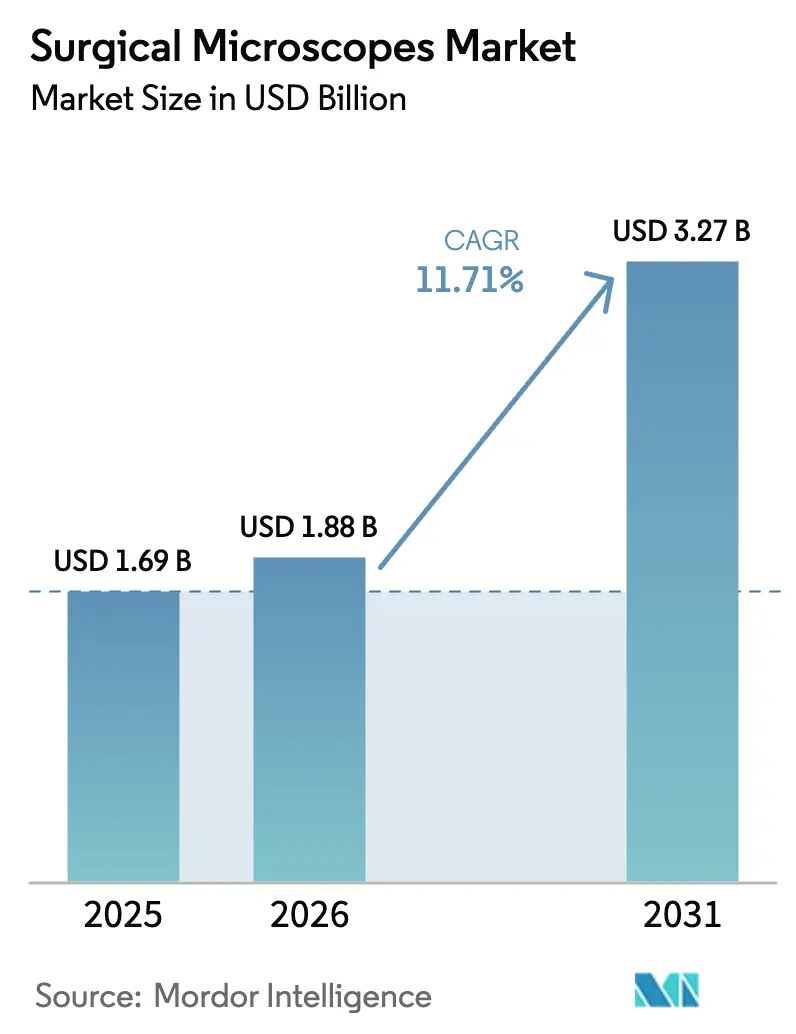
| Market Size (2026) | USD 1.88 Billion |
| Market Size (2031) | USD 3.27 Billion |
| Growth Rate (2026 - 2031) | 11.71 % |
| Fastest Growing Market | Asia Pacific |
| Largest Market | North America |
| Market Concentration | Medium |
Major Players *Disclaimer: Major Players sorted in no particular order Image © Mordor Intelligence. Reuse requires attribution under CC BY 4.0. | |
Surgical Microscopes Market Analysis by Mordor Intelligence
The surgical microscopes market size is estimated to reach USD 1.88 billion in 2026 and is projected to climb to USD 3.27 billion by 2031, growing at an 11.71% CAGR. The expansion is driven by the rapid adoption of hybrid operating rooms, increasing fluorescence-guided tumor resections, and the integration of robotic navigation, which is rendering legacy optical systems obsolete. Aging populations and the growing burden of chronic diseases continue to drive up procedure volumes; however, the decisive catalyst is the convergence of digital imaging, artificial intelligence guidance, and intraoperative optical coherence tomography, which unlocks replacement demand, especially in precision-dependent specialties. Competitive intensity is increasing as 3D exoscopes erode the traditional share in ENT and spine cases, pushing incumbents to accelerate the development of digital features. Meanwhile, government subsidies in Europe and Asia-Pacific are shortening upgrade cycles in secondary hospitals, and dental service organizations are standardizing microscope protocols to improve clinical outcomes. Taken together, these elements signal an industry shifting from unit expansion toward technology-driven value capture, a dynamic that sustains double-digit growth for the surgical microscopes market.
Key Report Takeaways
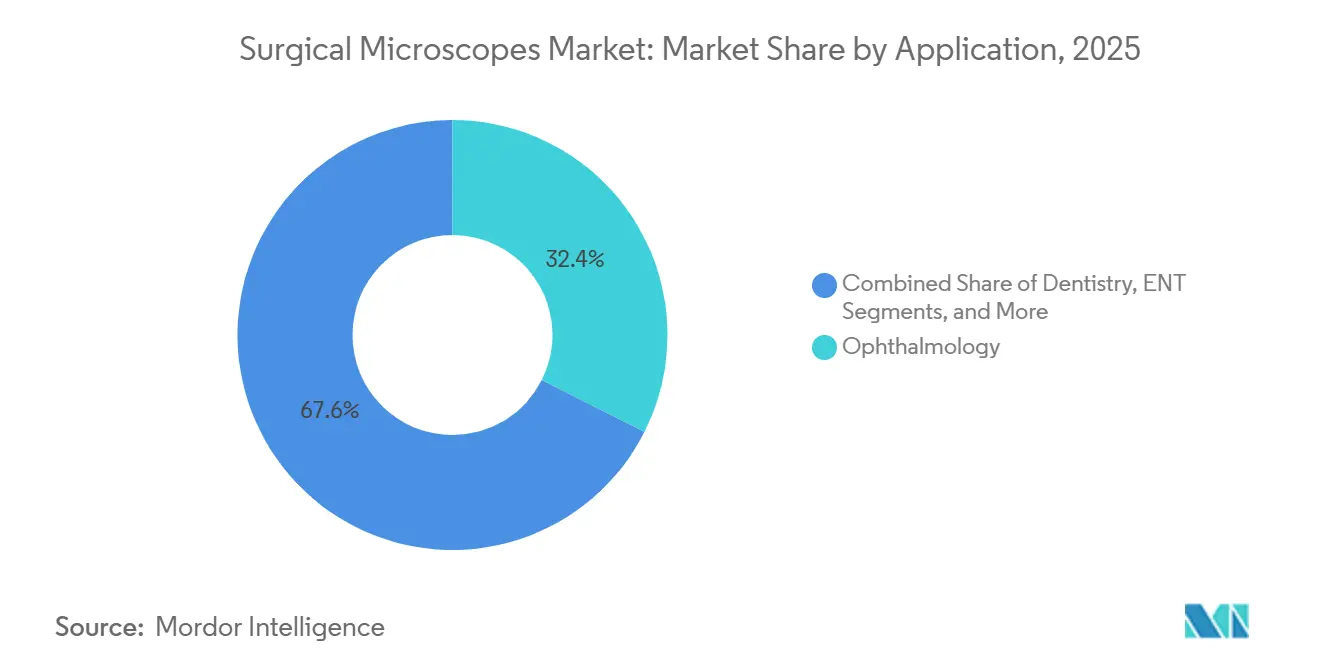
- By application, ophthalmology led with 32.45% revenue share in 2025, while dentistry is projected to post a 13.54% CAGR through 2031.
- By end user, hospitals accounted for 54.56% revenue share in 2025, whereas ambulatory surgical centers are forecast to expand at a 14.67% CAGR through 2031.
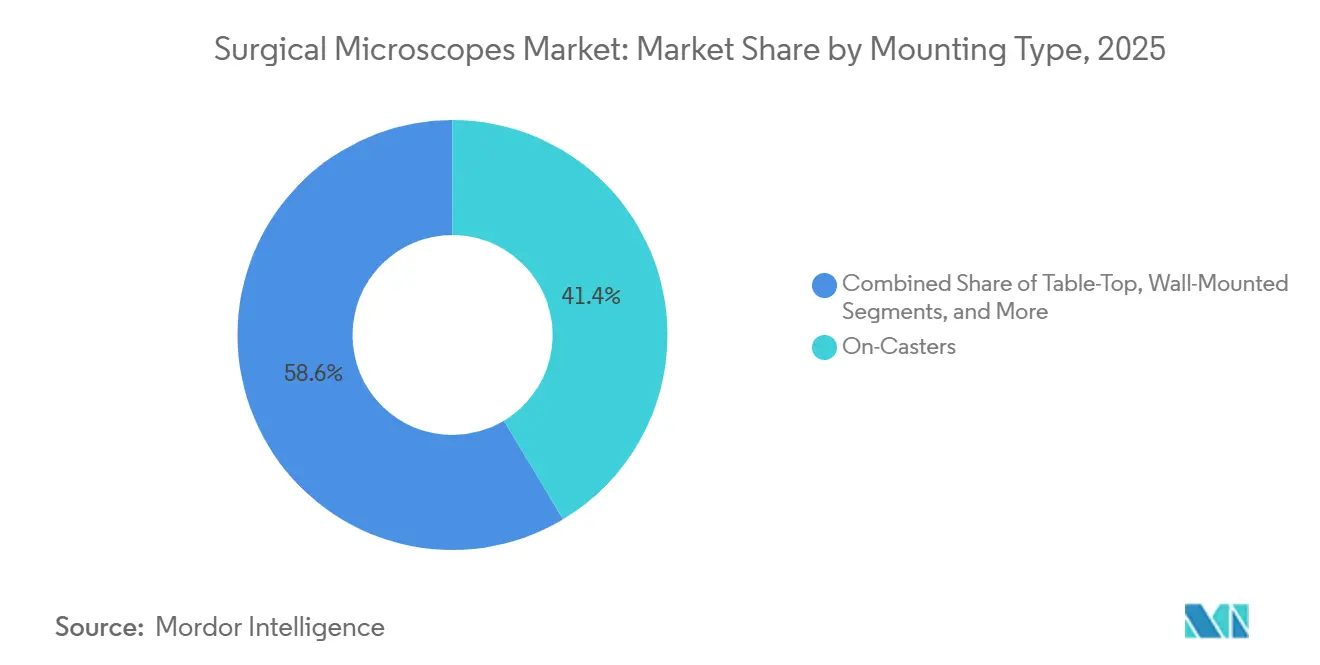
- By mounting type, on-caster systems captured 41.45% of installations in 2025; however, ceiling-mounted platforms are projected to grow at a 13.32% CAGR through 2031.
- By 2025, conventional optical microscopes held a 37.45% unit share, and AR/VR-enhanced systems are expected to advance at a 14.01% CAGR through 2031.
- By geography, North America accounted for 41.45% of the 2025 surgical microscopes market size, whereas the Asia-Pacific region is expanding at a 12.43% CAGR during the forecast period.
Note: Market size and forecast figures in this report are generated using Mordor Intelligence’s proprietary estimation framework, updated with the latest available data and insights as of January 2026.
Market Trends and Insights
Drivers Impact Analysis of Surgical Microscopes Market*
| Driver | (~) % Impact on CAGR Forecast | Geographic Relevance | Impact Timeline |
|---|---|---|---|
| Rising surgical volumes and minimally invasive procedures adoption | +2.8% | Global, with APAC and Middle East leading volume growth | Medium term (2-4 years) |
| Aging population and chronic disease burden | +2.1% | North America, Europe, Japan core; spillover to urban APAC | Long term (≥ 4 years) |
| Technological advancements in digital imaging, 4K/3D, and fluorescence visualization | +3.2% | North America and Western Europe early adoption; APAC tier-1 cities following | Short term (≤ 2 years) |
| Government programs subsidizing hybrid OR upgrades in secondary hospitals | +1.6% | Europe (Italy, Spain), APAC (China, India), select Middle East markets | Medium term (2-4 years) |
| Emerging dental service organizations standardizing microscope use | +1.4% | North America DSO consolidation; early adoption in Australia, UK | Medium term (2-4 years) |
| Integration with surgical robotics and AI-driven navigation unlocking replacement cycles | +2.3% | North America, Germany, Japan; premium tertiary centers globally | Short term (≤ 2 years) |
| Source: Mordor Intelligence | |||
Rising Surgical Volumes and Minimally Invasive Procedures Adoption
Global surgical procedures exceeded 310 million in 2024, and more than 40% of elective cases in high-income countries used minimally invasive techniques. Smaller incisions drive demand for higher magnification, which directly lifts the surgical microscopes market. The Asia-Pacific and Middle East regions are experiencing double-digit case growth, driven by expanding insurance coverage, whereas North America and Europe are showing modest volume growth but increasing complexity, which favors fluorescence-guided visualization. Early adopters of 4K digital microscopes reported a 15-20% reduction in procedure time for complex spine fusions, thereby increasing operating room throughput. Hospitals view these gains as integral to value-based care metrics, encouraging replacement of optical systems before end-of-life.
Aging Population and Chronic Disease Burden
Cataract procedures reached 32.9 million globally in 2024 and are projected to surpass 50 million by 2030, driven by demographic aging in China, India, and Southeast Asia. Older patients present comorbidities that heighten the need for precision visualization to minimize surgical trauma, favoring microscopes with OCT and heads-up displays. Fluorescence-guided oncology resections are also climbing; a 2024 Neuro-Oncology study showed gross total resection rates rising from 65% to 85% when 5-ALA visualization was used. Such evidence accelerates replacement demand in tertiary centers.
Rapid Technology Upgrades (4K, Fluorescence, AR)
Suppliers now embed voice control, AI-assisted depth cues and 4K-3D sensors into flagship models such as the KINEVO 900 S. Comparable platforms from Olympus merge 3D optics with infrared fluorescence so that a single tower supports multiple specialties. Hospitals that invested five years ago face a capability gap versus new systems, prompting accelerated replacement even when existing microscopes remain functional. The result is a technology-driven upswing that keeps average selling prices firm despite rising volumes.
Technological Advancements in Digital Imaging, 4K/3D, And Fluorescence Visualization
Carl Zeiss introduced the KINEVO 900 S in 2024, combining 5-ALA fluorescence, infrared angiography, and 4K optics in one platform[1]. Leica’s ARveo 8 overlays pre-operative MRI scans in real time, shortening navigation setup by up to 15 minutes. European neurosurgery departments adopting 5-ALA rose from 42% in 2022 to 68% in 2025, illustrating rapid technology diffusion. Recorded 4K streams are training AI models for automated margin detection, creating a cycle whereby data capture and analytics reinforce equipment upgrades.
Government Programs Subsidizing Hybrid OR Upgrades In Secondary Hospitals
Italy allocated EUR 500 million (USD 545 million) in 2024 for secondary hospital hybrid OR retrofits, while India earmarked INR 12,000 crore (USD 1.44 billion) for surgical infrastructure in 2025. Ceiling-mounted microscopes are eligible for reimbursement, thereby accelerating their adoption in facilities that previously favored mobile systems. Vendors are tailoring configurations with simplified workflows and bundled training to meet procurement rules, ensuring that the surgical microscopes market directly benefits from stimulus funds.
Restraints Impact Analysis of Surgical Microscopes Market*
| Restraint | (~) % Impact on CAGR Forecast | Geographic Relevance | Impact Timeline |
|---|---|---|---|
| High capital and maintenance costs | -1.9% | Global, acute in emerging APAC, Latin America, and Africa | Short term (≤ 2 years) |
| Shortage of microscope-trained surgical personnel | -1.3% | Emerging APAC, Middle East, Latin America; pockets in rural North America and Europe | Medium term (2-4 years) |
| Competitive displacement by 3D exoscopes and heads-up displays | -1.1% | North America, Western Europe, Japan; premium segments globally | Short term (≤ 2 years) |
| Stringent sterilization and sensor failure risks leading to downtime | -0.8% | Global, with higher impact in high-humidity tropical regions | Medium term (2-4 years) |
| Source: Mordor Intelligence | |||
High Capital and Maintenance Costs
A fully configured fluorescence microscope exceeds USD 500,000, and annual service contracts add USD 40,000-60,000. Inflation in 2024-2025 increased component prices, prompting 54% of U.S. hospitals to defer planned purchases[2]. Leasing and refurbished channels expand access yet introduce utilization risk when case volumes fall short. Import tariffs and currency swings inflate prices by up to 35% in India and Southeast Asia, slowing penetration outside tier-1 cities. Digital platforms incur software fees and sensor recalibration costs, thereby widening the total-cost-of-ownership gap compared to optical systems and limiting their uptake in resource-constrained settings.
Competitive Displacement By 3D Exoscopes and Heads-Up Displays
Olympus ORBEYE and Karl Storz VITOM 3D undercut entry-level microscopes by 30-40% in the USD 150,000-250,000 price tier. A 2025 Spine study showed exoscopes cutting surgeon neck and back strain by 40%, resonating with aging workforces. However, exoscopes struggle to achieve magnifications above 25× and lack integrated fluorescence, which limits their appeal in neurosurgery. Incumbent vendors are bundling heads-up modules to replicate ergonomic gains while retaining optical excellence, a tactic expected to slow exoscope encroachment through 2028.
*Our forecasts treat driver/restraint impacts as directional, not additive. The impact forecasts reflect baseline growth, mix effects, and variable interactions.
Surgical Microscopes Market Segment Analysis
By Application:
Dentistry Surges as DSOs Standardize ProtocolsThe dental segment of the surgical microscopes market is forecasted to grow at a 13.54% CAGR through 2031, the fastest among all applications. Ophthalmology contributed a 32.45% revenue share in 2025, supported by high cataract and retinal procedure volumes; however, its pace is moderating in developed economies, where penetration is nearing saturation. Neurosurgery and spine surgery benefit from fluorescence-guided resections, which increase gross total resection rates to 85%, especially after the adoption of 5-ALA in 2024-2025. ENT applications face cost-driven substitution from exoscopes, while gynecology and urology employ microscopes primarily in fertility and reconstructive procedures. Oncology segments rely on intraoperative fluorescence to cut positive-margin rates, supporting adoption despite budget pressures.
Bulk procurement by DSOs is reshaping price elasticity, allowing manufacturers to lower per-unit costs and still preserve margins through volume. The average installed system age in U.S. ophthalmology clinics reached 8.2 years in 2025, indicating a potential near-term replacement surge for 4K and OCT-enabled platforms. These forces collectively sustain growth in the surgical microscopes market size for clinical specialties that prioritize visualization clarity.

By End User:
ASCs Capture Outpatient MigrationHospitals generated 54.56% of revenue in 2025; however, the surgical microscopes market share is shifting to ambulatory surgical centers as outpatient models gain traction. ASCs are projected to advance at a 14.67% CAGR through 2031, driven by payer incentives and patient preference for lower-cost care settings. Dental clinics reinforce momentum as DSO consolidation scales microscope deployment. Specialty outpatient centers and fertility clinics are adopting compact table-top units to match constrained floor plans.
Manufacturers are responding with ceiling-mounted systems optimized for quick turnover and lower service complexity. A 2024 study by the Ambulatory Surgery Center Association found that ASCs with more than 1,000 cataract cases per year achieved payback within 24 months. Hospitals, meanwhile, concentrate on complex glioblastoma and retinal procedures that require high-end fluorescence and robotic integration. Such differentiation keeps hospitals the dominant shareholder even as growth tilts to ASCs, balancing the surgical microscopes market size across care settings.
By Mounting Type:
Ceiling Systems Gain in Hybrid ORsOn-casters systems captured 41.45% of installations in 2025, valued for portability and lower upfront cost. Nevertheless, ceiling-mounted microscopes are projected to grow at a 13.32% CAGR, driven by government-funded hybrid operating room retrofits in Europe and the Asia-Pacific region. Wall-mounted and tabletop designs serve ENT, plastic, and dental clinics, while robotic-arm mounts are used in specialized neurosurgery and spine suites.
Italy’s EUR 500 million upgrade fund and India’s Ayushman Bharat allocation accelerate ceiling-mount uptake, shortening replacement cycles by up to three years. Facilities appreciate workflow gains—such as rapid sterility maintenance and unobstructed floor space that justify the added capital. Mobile systems will keep relevance in ASCs and smaller hospitals, but ceiling infrastructures will dominate incremental installations, underpinning growth in the surgical microscopes market.
By Technology:
AR/VR Platforms Redefine VisualizationConventional optical systems held 37.45% unit share in 2025, but AR/VR-enhanced platforms are expected to log a 14.01% CAGR to 2031, the fastest trajectory in the surgical microscopes market. Optical and fluorescence units remain workhorses in neurosurgery and oncology. Digital 4K microscopes are gaining popularity in ophthalmology and ENT for their teaching and recording benefits, whereas OCT-integrated systems are serving the niche of retinal surgery. Robotic-ready offerings gain traction in tertiary centers that value AI-guided navigation.
Leica’s ARveo 8 overlays MRI data, cutting setup time and improving tumor-margin detection. A 2025 Journal of Neurosurgery report revealed AR microscopes halve positive-margin rates in skull-base tumors, strengthening the value proposition. Conventional optics retain a foothold in budget-sensitive clinics; however, declining component costs and growing evidence will likely shift demand toward digital features, expanding the surgical microscopes market size for premium configurations.
Geography Analysis
North America and Europe Surgical Microscopes Market
North America contributed 41.45% of the revenue in 2025, supported by robust reimbursement for fluorescence-guided procedures and early adoption of 4K technology, but growth is slowing as penetration in tertiary centers plateaus. The region is expected to face a replacement wave in 2026-2027, with installed microscopes averaging 7.8 years of age, indicating an imminent need for upgrades to AR-enabled units. Europe shows moderate expansion, aided by subsidy programs in Italy, Spain, and Eastern Europe that fund hybrid or retrofits of older ORs. Brexit-related supply chain challenges and elevated energy costs temper investment in the UK and Germany, yet public stimulus offsets private hesitation.
APAC Surgical Microscopes Market
The Asia-Pacific region is the fastest-growing, with a 12.43% CAGR from 2026 to 2031. China is expected to invest over USD 1 trillion in healthcare infrastructure by 2025, adding 1,200 tertiary hospitals since 2020, each requiring multiple microscopes. India’s Ayushman Bharat drives a 12-15% annual growth in surgical volume in tier-2 and tier-3 cities, where microscope penetration remains below 30%. Japan’s aging population sustains demand for ophthalmology and neurosurgery, although procurement shifts to refurbished units to contain costs. Emerging regional suppliers are filling value-segment gaps as tariffs inflate Western pricing, thereby broadening competitive dynamics within the surgical microscopes market.
MEA and South America Surgical Microscopes Market
The Middle East and Africa benefit from medical tourism investments; the UAE and Saudi Arabia invested USD 8 billion between 2023 and 2025 to attract international patients. Adoption remains urban-centric, with premium units installed in centers of excellence. South American growth is hindered by currency volatility; Brazil’s real depreciation in 2024 increased import costs, prompting hospitals to postpone upgrades. South Africa’s private hospital groups continue to make selective purchases, while most public budgets prioritize primary care over advanced imaging. Overall, region-specific catalysts and constraints create a patchwork of growth rates, yet the collective momentum keeps the global surgical microscopes market on a steady double-digit trajectory.

Regulatory Landscape
Surgical microscopes are regulated as medical devices, with market access shaped by jurisdiction-specific pathways and documentation requirements. In the United States, surgical microscopes are generally regulated under the FDA medical device framework and, for common configurations, are typically treated as Class I devices under 21 CFR 878.4700 with broad 510(k) exemption, while still requiring compliance with labeling, quality system expectations, and UDI where applicable.
In Europe, EU MDR 2017/745 remains the governing framework for CE marking, with greater emphasis on technical documentation and post-market obligations for opto-digital systems and software-enabled features. Trade policy also affects practical compliance and pricing for globally sourced optical and imaging subassemblies, where optical and medical instruments are covered under HTS Chapter 90 and a base MFN duty structure can be modified by additional tariff actions, including proposals discussed by USTR under Section 301 during 2026.
Value Chain Analysis
The surgical microscope value chain begins with specialized inputs, including medical-grade optical glass, precision lenses and coatings, CMOS/4K-3D image sensors, illumination and fluorescence modules, and high-tolerance mechanical assemblies such as arms, mounts, and counterbalances. These components then feed assembly, calibration, and verification steps that depend on clean manufacturing environments and metrology, especially for digital visualization, fluorescence, and intraoperative OCT-enabled configurations.
Manufacturing and R&D footprints are increasingly regionalized around key hubs that can serve local demand and reduce lead times. ZEISS opened a new R&D and manufacturing site in Suzhou, China (July 2024), and a modernized research and production facility in Chesterfield, Missouri (October 2024) with an ISO 7-certified clean room. Leica Microsystems operates a USD 60 million facility in Singapore for global production, while Haag-Streit produces surgical microscope systems in Switzerland. Downstream, premium systems are commonly sold through direct sales with trained field application specialists and installation teams, supported by service contracts for preventive maintenance, sensor calibration, and software updates, alongside channel partners that expand coverage in smaller European and emerging-market accounts.
Competitive Landscape
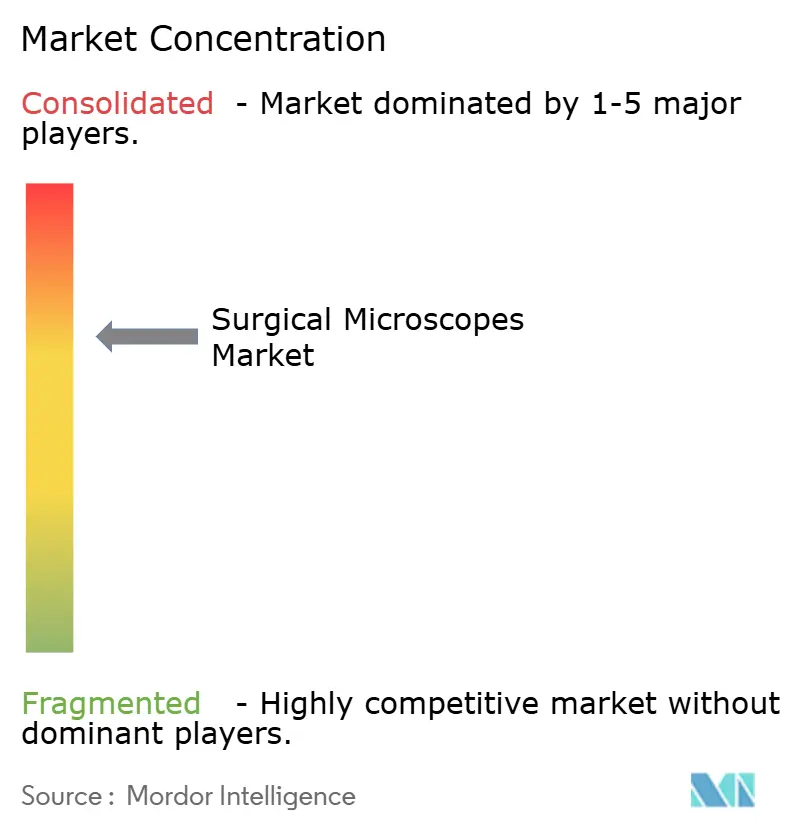
The surgical microscopes market demonstrates moderate concentration. Carl Zeiss Meditec, Leica Microsystems, and Alcon collectively hold roughly 55-60% of the global revenue, while regional manufacturers and exoscope suppliers dilute their dominance. Platform strategies that bundle fluorescence, AI navigation, and robotic interfaces raise switching costs; however, they expose incumbents to price-sensitive segments where stripped-down optical systems meet basic needs. Patent filings underscore digital priorities: Zeiss submitted 14 patents on fluorescence and AR visualization, and Leica filed 9 patents on OCT integration and robotic interfaces between 2024 and 2025.
White-space opportunities abound in dental clinics and ASCs where incumbents lack distribution depth. Smaller vendors, such as Global Surgical Corporation and Seiler Instrument, leverage direct sales and flexible financing to win market share. Meanwhile, Olympus ORBEYE and Karl Storz VITOM 3D disrupt the USD 150,000-250,000 tier, forcing microscope manufacturers to accelerate the development of heads-up displays.
Regulatory agility is a differentiator; vendors securing CE marks within nine months of FDA clearance gain a one-year head start in Europe. Chinese manufacturers, such as Zhenjiang Zhongtian, undercut Western pricing by up to 50%, especially in the Asia-Pacific region, thereby tightening margins. Competitive dynamics, therefore, hinge on balancing premium feature integration with cost-competitive offerings to serve diverse buyer profiles across the surgical microscopes market.
Surgical Microscopes Industry Leaders
-
Carl Zeiss AG
-
Topcon Corporation
-
Alcon Inc.
-
Haag-Streit (Metall Zug Group)
-
Danaher Corp. (Leica Microsystems)
- *Disclaimer: Major Players sorted in no particular order
Surgical Microscopes Market Companies Covered in this Report
- Alcon
- Alltion
- ARI Medical Technology
- ATMOS MedizinTechnik
- Bausch + Lomb Corp.
- Carl Zeiss
- Danaher Corp. (Leica Microsystems)
- Ecleris S.A.
- Global Surgical
- Haag-Streit (Metall Zug Group)
- Karl Kaps GmbH & Co. KG
- Mitaka Kohki Co. Ltd
- Moller-Wedel GmbH
- Olympus
- Optofine Instruments Pvt Ltd
- Seiler Instrument
- Synaptive Medical
- Takagi Seiko
- Topcon
- Zhenjiang Zhongtian Optical Instrument Co., Ltd.
Market Opportunities and Future Outlook
Digitization creates whitespace for vendors that position microscopes as workflow platforms rather than standalone optics, particularly where 4K/3D heads-up surgery, fluorescence-guided visualization, and intraoperative OCT are being adopted across multiple specialties. Product and access milestones in 2026 support near-term openings: ZEISS received NMPA approval in China (February 2026) for ARTEVO 750 and ARTEVO 850 ophthalmic microscopes, and Olympus announced the U.S. launch of the VISERA ELITE III surgical imaging platform (March 2026) with 4K 3D imaging and fluorescence-guided surgery support, supporting broader integration with OR video and documentation stacks.
A second opportunity area is hospital and ASC standardization around training, data capture, and fleet interoperability, where serviceability and software governance can differentiate suppliers under EU MDR expectations for software-controlled features. The global launch of Haag-Streit’s Metis 3D Digital Heads-Up Module (March 2026) and Heidelberg Engineering’s commercialization push for the Heidelberg OPERA digital surgical visualization platform with swept-source intraoperative OCT (April 2026) point to upgrade paths that add digital capability to existing surgical visualization ecosystems. For suppliers, these upgrade-focused pathways support recurring revenue through software, visualization workflows, and analytics while aligning with buyer scrutiny on total cost of ownership through modular upgrades, bundled training, and local service coverage.
Recent Industry Developments in Surgical Microscopes Market
- May 2026: ZEISS reported that Mexico’s COFEPRIS approved the ARTEVO 850 ophthalmic microscope and MICOR 700. The clearance expands ZEISS access to a sizable Latin American installed base that is upgrading to digital visualization and standardized ophthalmic surgical workflows.
- July 2025: ZEISS announced that the PENTERO 800 S surgical microscope received approval from China’s NMPA. This broadened ZEISS participation in neurosurgery and ENT-capable microscope tenders in a market where procurement decisions increasingly weigh integrated digital connectivity and advanced visualization options.
- July 2024: ZEISS opened a new R&D and manufacturing site in Suzhou Industrial Park, China. Adding regional production and engineering capacity supports faster localization, shorter lead times, and supply-chain resilience for optical and opto-digital surgical visualization systems sold across Asia-Pacific.
Surgical Microscopes Market Report Scope and Research Methodology
Market Definition and Coverage
This market covers revenue generated from surgical microscopes used in operating rooms and procedure settings to provide magnified, illuminated visualization during surgery. It includes optical and opto-digital systems sold as complete microscope platforms and commonly used across major surgical specialties.
Scope exclusions: Excludes exoscopes, loupes, and general laboratory or pathology microscopes that are not designed and marketed as surgical microscopes.
Segments Covered in This Report
- By Application
- Dentistry
- ENT
- Gynecology & Urology
- Neurosurgery & Spine
- Ophthalmology
- Plastic & Reconstructive
- Oncology
- By End User
- Hospitals
- Ambulatory Surgical Centers
- Dental Clinics
- Specialty & Outpatient Facilities
- Academic & Research Institutes
- By Mounting Type
- On-Casters
- Table-Top
- Wall-Mounted
- Ceiling-Mounted
- Robotic-Arm Integrated
- By Technology
- Conventional Optical
- Optical + Fluorescence
- Digital / 4K Microscopes
- AR / VR-Enhanced
- OCT-Integrated
- Robotic-Ready
- Geography
- North America
- United States
- Canada
- Mexico
- Europe
- Germany
- United Kingdom
- France
- Italy
- Spain
- Rest Of Europe
- Asia-Pacific
- China
- Japan
- India
- South Korea
- Australia
- Rest Of Asia-Pacific
- Middle East And Africa
- GCC
- South Africa
- Rest Of Middle East And Africa
- South America
- Brazil
- Argentina
- Rest Of South America
- North America
Data Sources, Market Sizing, and Validation
Desk Research
Desk work started with public healthcare and device signals that can be checked and repeated, and we used them to form the first demand pool for surgical microscopes before calling experts. Sources used include US FDA device databases for product and clearance context, the World Health Organization for health system indicators, the OECD for hospital activity and spending series, and the World Bank for macro and population inputs that influence procedure volumes.
To make the model more practical, we also reviewed manufacturer annual reports, investor presentations, and press releases for product positioning and regional exposure clues, followed by medical society publications and peer-reviewed journals for procedure trends in ophthalmology, ENT, and neurosurgery. In a few places, paid subscriptions for company financials and intelligence, patent databases, and a shipment-level import/export database were referenced to sanity check supply footprints and pricing direction. This desk list is illustrative only, and many other public sources were also used during data collection, validation, and clarification.
Primary Interviews and Surveys
Primary work was used to confirm how hospitals and surgical centers prioritize microscope upgrades, which features are moving average selling prices (for example, integrated cameras and fluorescence), and how purchase cycles differ by specialty. We spoke with manufacturers, distributors, service partners, and clinical users so the assumptions from desk research could be corrected, and we then closed remaining gaps with follow-up checks across the Americas, EMEA, and APAC.
Distribution of primary research fieldwork respondents
| Company type | Respondent position | Region |
|---|---|---|
| Top tier: 28% | CXOs: 16% | APAC: 50% |
| Mid tier: 52% | Functional/Unit leaders: 30% | EMEA: 29% |
| Smaller Players: 20% | Managers: 54% | Americas: 21% |
Market-Sizing & Forecasting
Sizing was built using a top-down method where procedure volumes and operating room infrastructure indicators were translated into an addressable installed base, then filtered through microscope adoption rates by specialty and replacement timing. To keep the totals realistic, the output was cross-checked with selective bottom-up approximations like sampled price points for common configurations, channel feedback on unit shipments, and a limited roll up of reported device revenue where disclosures were available.
Key inputs used in the model include elective and inpatient surgery volumes, cataract and ENT procedure trend direction, hospital and ambulatory surgery center counts, replacement cycles tied to optical system obsolescence, and feature-driven ASP movement (for example, digital imaging upgrades and fluorescence modules). Where a country-level variable was missing, a proxy was applied using nearby markets with similar care access and procedure rates, and it was later re-validated during interviews.
Forecasting was done using scenario analysis supported by short series trend smoothing, because purchase timing can shift with hospital budgets and tender cycles. The forecast path was adjusted only when experts consistently pointed to measurable changes such as faster upgrade activity, reimbursement-driven procedure growth, or delayed capital spend.
Data Validation & Update Cycle
Results were validated through multiple checks so the final totals do not rely on a single data stream. We compared outputs with independent signals like procedure growth patterns, import activity direction for key manufacturing hubs, and public financial commentary on surgical visualization demand, and then any unusual jumps were reviewed and recalculated.
Before sign-off, the work is reviewed in steps by another analyst, with re-contact triggered when a key assumption moves beyond an expected range, such as ASP inflation or replacement cycles. Reports are refreshed annually, and interim updates are made when material events occur, including policy changes, major product launches, or visible shifts in hospital capital spending. Right before delivery, a fresh pass is done to ensure the latest public data and market events are reflected.
Mordor Intelligence's Surgical Microscopes Market Size Compared Against Other Published Estimates
Published market values for surgical microscopes can look different across sources, even when everyone is talking about the same broad device family. The differences usually come from what device types are counted, which year is treated as the starting point, and how pricing and replacement cycles are assumed.
Exoscopes are not counted in this market, and that exclusion sits outside Mordor Intelligence's scope, which keeps the model tied to microscope platforms sold and serviced as surgical microscopes rather than adjacent visualization systems. Other gaps typically come from using aggressive upgrade timing after new feature launches, mixing hospital and lab microscope demand together, or applying a single global ASP change without checking specialty mix shifts and currency timing.
Benchmark comparison
| Source | Market Size | Gaps in Research Methodology |
|---|---|---|
| Mordor Intelligence | USD 1.88 B (2026) | |
| Global Consultancy A | USD 1.97 B (2025) | Uses a 2025 base year and does not clearly state device exclusions, which can let adjacent visualization tools or broader microscope definitions inflate the near-term total when compared with a microscope-only count. |
| Industry Publisher B | USD 2.01 B (2025) | Relies on a 2025 market value with a broader application and end-user lens, and the published snapshot does not show how replacement cycles, specialty mix, and module-led ASP uplift were validated by region. |
Across the table, most of the spread can be traced back to year alignment and whether only surgical microscopes are counted versus a wider visualization basket. By keeping inputs tied to procedure demand, installed base signals, and realistic upgrade timing, our estimate stays easier to reconcile with observable healthcare activity and repeatable price and volume assumptions.
Key Questions Answered in the Report
What is the current value of the surgical microscopes market?
The market is valued at USD 1.88 billion in 2026 and is projected to hit USD 3.27 billion by 2031.
Which clinical area leads demand for surgical microscopes?
Ophthalmology holds the lead, contributing 32.45% of 2025 revenue.
Which end-user segment is expanding fastest?
Ambulatory surgical centers are forecast to grow at a 14.67% CAGR through 2031.
How are AR/VR features reshaping adoption?
AR/VR-enhanced platforms deliver real-time overlays and reduce setup time, driving a 14.01% CAGR to 2031.
What regional market shows the highest growth rate?
Asia-Pacific is advancing at a 12.43% CAGR, led by investments in China and India.