
Surgical Loupes Market Size and Share
Market Overview
| Study Period | 2020 - 2031 |
|---|---|
| Market Size (2026) | USD 407.30 Million |
| Market Size (2031) | USD 539.90 Million |
| Growth Rate (2026 - 2031) | 5.80 % |
| Fastest Growing Market | Asia-Pacific |
| Largest Market | North America |
| Market Concentration | Medium |
Major Players *Disclaimer: Major Players sorted in no particular order Image © Mordor Intelligence. Reuse requires attribution under CC BY 4.0. | |
Surgical Loupes Market Analysis by Mordor Intelligence
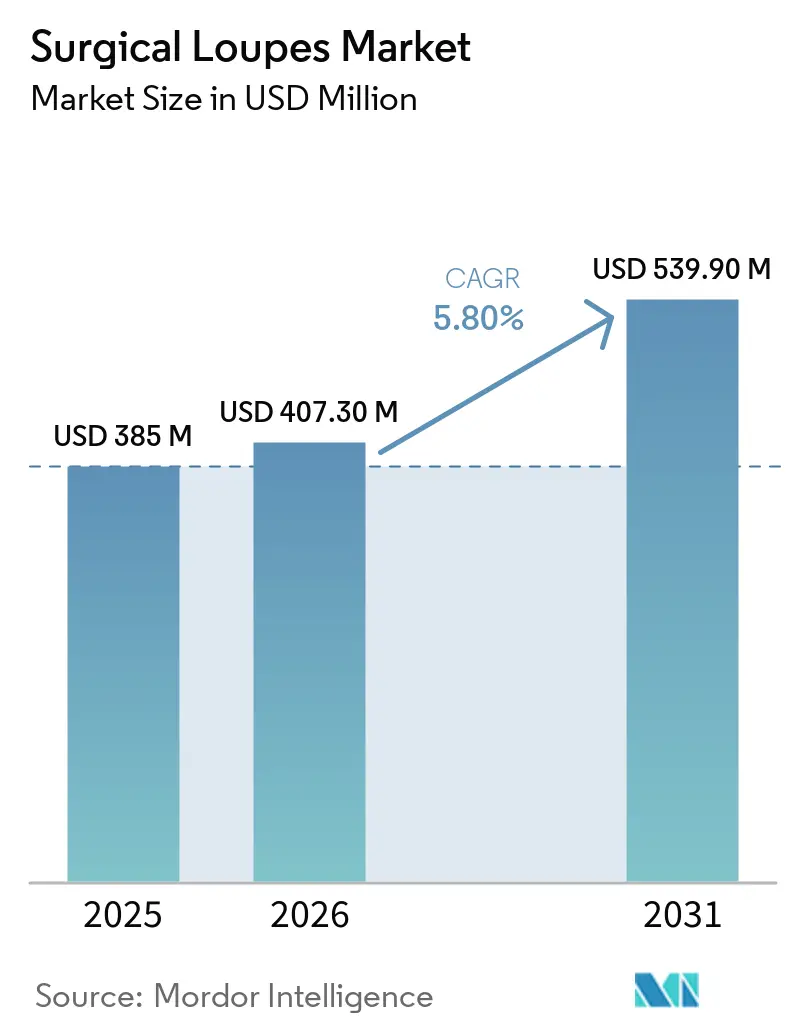
The Surgical Loupes Market size is expected to increase from USD 385 million in 2025 to USD 407.30 million in 2026 and reach USD 539.90 million by 2031, growing at a CAGR of 5.80% over 2026-2031.
The surgical loupes market is supported by the movement of more procedures into ambulatory and office settings, where clinicians need portable magnification rather than operating microscopes. Demand also reflects greater attention to neck and shoulder strain among dentists and surgeons. Dental practices have a clear reason to update equipment because national dental care expenditure reached USD 189 billion in the United States in 2024, and consumer dental spending rose 4% in the 12 months through January 2026. Manufacturers are responding with ergonomic optical systems, integrated illumination, and digital fitting services. These changes create room for premium products, but they also make service capacity and product affordability more important in the surgical loupes market.
Key Report Takeaways
- By product type, through-the-lens loupes led with 42% of the surgical loupes market share in 2025, while the same product type is expected to record the highest CAGR at 7.6% through 2031.
- By lens type, Galilean lenses held 39.3% of revenue in 2025, while prismatic lenses are forecast to grow at an 8.1% CAGR through 2031.
- By wearing style, spectacle frames accounted for 34.4% of revenue in 2025, while headbands are expected to advance at a 6.6% CAGR through 2031.
- By application, dentistry accounted for 51.3% of revenue in 2025 and is forecast to expand at an 8.5% CAGR through 2031.
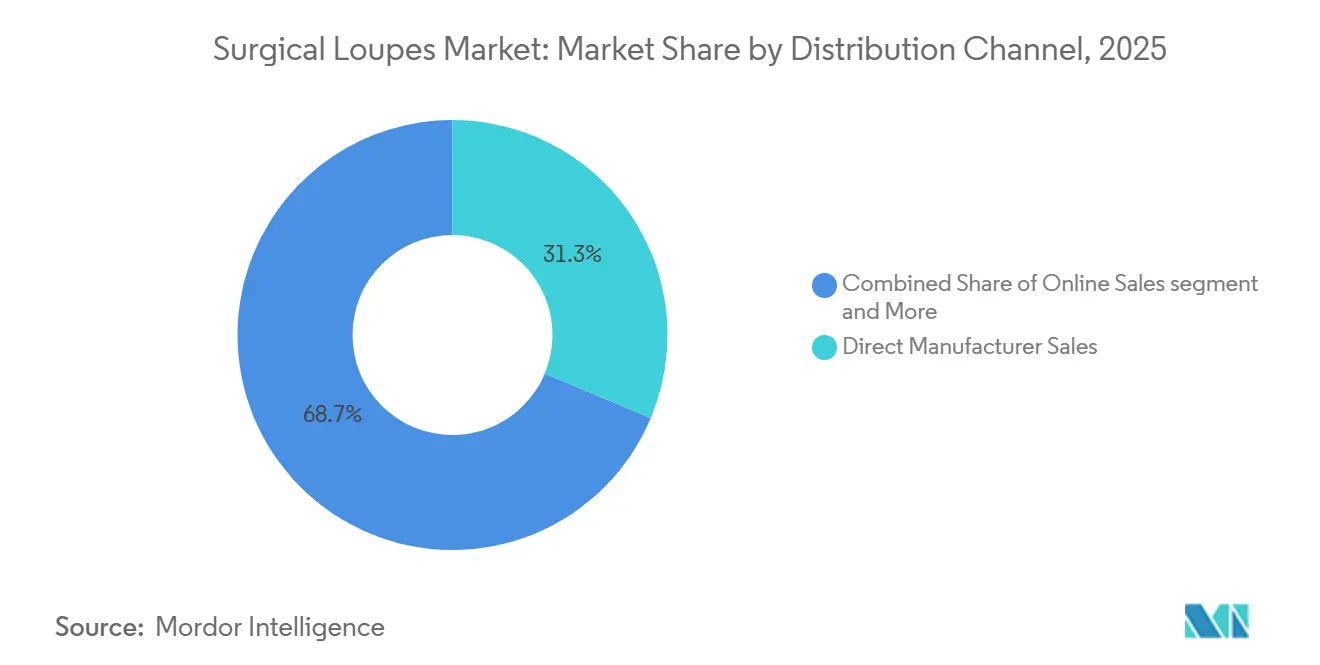
- By distribution channel, direct manufacturer sales held 31.3% of revenue in 2025, while online sales are projected to grow at a 7.2% CAGR through 2031.
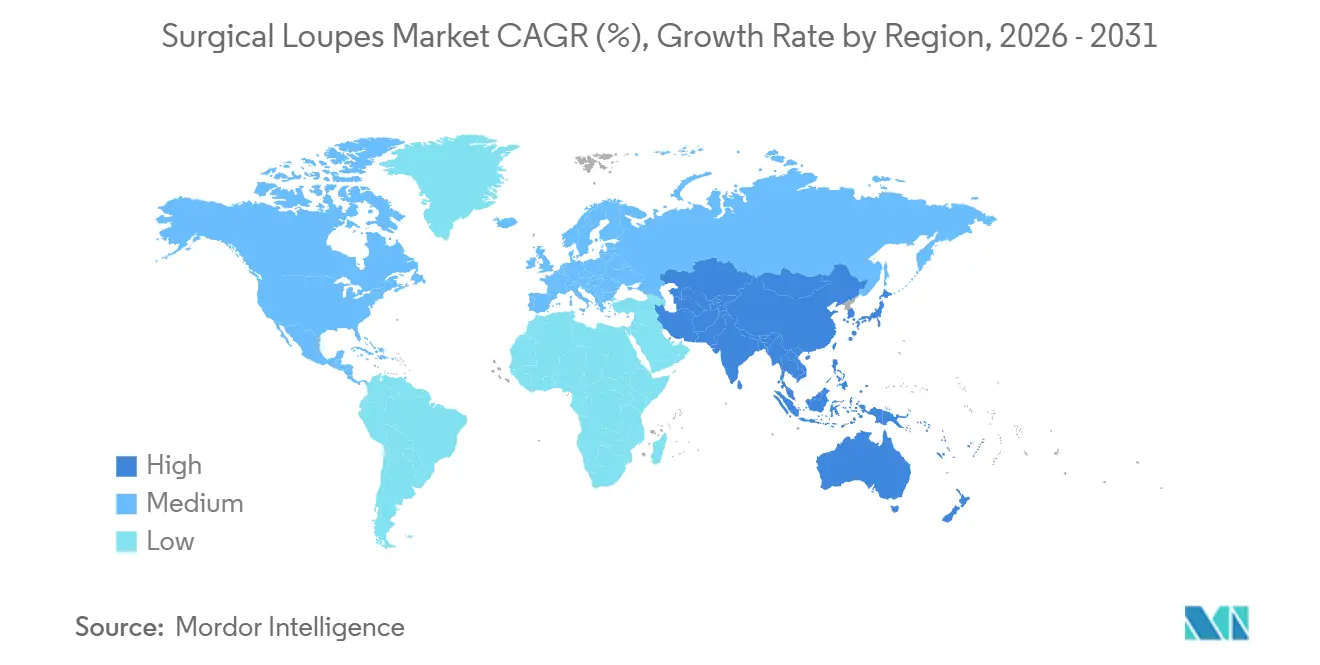
- By geography, North America held 39.2% of revenue in 2025, while Asia-Pacific is forecast to expand at an 8.7% CAGR through 2031.
Note: Market size and forecast figures in this report are generated using Mordor Intelligence’s proprietary estimation framework, updated with the latest available data and insights as of January 2026.
Market Trends and Insights
Drivers Impact Analysis of Surgical Loupes Market*
| Driver | (~) % Impact on CAGR Forecast | Geographic Relevance | Impact Timeline |
|---|---|---|---|
| Rising Procedure Precision Requirements | +1.2% | Global | Medium term (2-4 years) |
| Growth in Dental and Microsurgical Procedure Volumes | +1.5% | Global, with early gains in North America and Asia-Pacific | Short term (≤ 2 years) |
| Clinician Demand for Neutral-Posture Ergonomics | +0.8% | North America, Europe, Japan | Medium term (2-4 years) |
| LED Illumination and Lightweight Optical Innovation | +0.7% | Global | Short term (≤ 2 years) |
| Expansion of Ambulatory and Office-Based Surgery | +0.9% | North America, GCC, Asia-Pacific | Short term (≤ 2 years) |
| Digital Fitting, Virtual Try-On, and Customization Workflows | +0.4% | North America, Europe | Long term (≥ 4 years) |
| Source: Mordor Intelligence | |||
Rising Procedure Precision Requirements
Minimally invasive and tissue-sparing techniques are making magnification more important in dental, ophthalmic, and ENT practice. Restorative and implant dentistry can require margin preparation tolerances below 100 microns, which are difficult to manage with unaided vision. A 2025 Scientific Reports study found that dental loupes improved posture during nonsurgical periodontal therapy, including head, neck, and shoulder positions.[1]
The evidence supports the use of loupes as both visualization and ergonomic tools. More complex outpatient work extends this requirement into neurosurgery, plastic surgery, and cardiovascular microsurgery. This wider clinical use gives the surgical loupes market a demand base that is not limited to general dentistry, and it makes precise visualization relevant to clinical teams that perform increasingly specialized work outside conventional hospital operating rooms.
Growth in Dental and Microsurgical Procedure Volumes
Oral diseases affect nearly 3.5 billion people worldwide, which sustains demand for dental care and related clinical equipment. United States dental care expenditures reached USD 189 billion in 2024, while consumer spending increased 4% in the 12 months through January 2026.[2] This spending gives dental practices greater capacity to consider optical equipment upgrades. The growth of outpatient surgery also brings more clinicians into settings where portable magnification has direct practical value. More specialties are performing complex procedures outside traditional hospital operating rooms. These conditions support first-time loupe purchases among practitioners who work in high-volume settings, where clearer visualization can support treatment consistency, clinical confidence, and more comfortable working positions across a full day of patient care.
Clinician Demand for Neutral-Posture Ergonomics
Work-related musculoskeletal problems remain a concern for dentists and surgeons who maintain fixed postures during procedures. A 2025 Applied Ergonomics study found higher upper trapezius and sternocleidomastoid muscle activity with through-the-lens loupes than with ErgoPrism loupes after 30 minutes of use.[3] A peer-reviewed study of surgeons also reported lower head inclination, neck muscle activity, and neck discomfort with prismatic loupes, without a significant increase in errors.
This evidence gives institutional buyers a clearer basis for specifying ergonomic features. It also favors manufacturers that can provide proprietary deflection-prism systems. Commodity Galilean suppliers face a harder task when buyers place more value on a neutral posture, because established optical familiarity alone does not address the evidence-based concerns that affect clinician comfort during prolonged treatment sessions.
Expansion of Ambulatory and Office-Based Surgery
The expansion of ambulatory surgery centers brings more magnification-intensive procedures into outpatient environments. CMS approved 537 procedures for the 2026 ASC Covered Procedures List after adding 573 codes in 2025, which expanded outpatient options for multiple specialties. MedPAC reported that Medicare-certified ASCs numbered 6,436 in 2024, after 248 facilities opened during the year.[4]
ENT, ophthalmology, and orthopedic care can require close visualization in these environments. Surgeons in independent centers often influence or directly make equipment purchases. This shortens procurement paths and supports surgical loupes market adoption among outpatient clinicians, particularly where an independent surgeon can select equipment that directly suits the procedure mix, work pattern, and available room infrastructure.
Restraints Impact Analysis of Surgical Loupes Market*
| Restraint | (~) % Impact on CAGR Forecast | Geographic Relevance | Impact Timeline |
|---|---|---|---|
| High Customization and Procurement Cost | -1% | Global, more acute in the Middle East, Africa, and South America | Medium term (2-4 years) |
| Adjustment and Adaptation Period for New Users | -0.5% | Global | Short term (≤ 2 years) |
| Fitting, Training, and Service-Capacity Constraints | -0.6% | Nonurban areas globally | Long term (≥ 4 years) |
| Battery, Lens, and Prescription Supply-Chain Delays | -0.4% | Global, most acute in Asia-Pacific and South America | Medium term (2-4 years) |
| Source: Mordor Intelligence | |||
High Customization and Procurement Cost
Premium prismatic and through-the-lens loupes require individual calibration for interpupillary distance, working distance, declination angle, and prescription correction. Entry-level Galilean products begin at USD 200 to USD 400, while customized prismatic systems with LED illumination can exceed USD 2,500 to USD 4,500 per clinician. This difference creates a barrier for early-career practitioners and buyers in price-sensitive markets. The American Dental Association identifies affordability as a major barrier to dental care access, and the same financial pressure can affect equipment investment by solo practices. Lower-specification Asian alternatives, therefore, attract interest in middle-income markets. This pricing pressure challenges established European and United States suppliers that do not have similar cost structures, especially when buyers compare an initial purchase price without fully accounting for fitting quality, service access, or replacement-part availability.
Battery, Lens, and Prescription Supply-Chain Delays
Surgical loupes combine precision glass, cordless LED illumination, lithium battery cells, and proprietary electronic components. High-index prism glass comes from a limited group of specialized optics suppliers, which creates supply risk for prismatic systems. Custom prescription elements can also lengthen delivery times. These delays matter most where users are far from fitting and service centers. Warranty turnaround and replacement parts access can raise the ownership burden beyond the initial purchase price. The issue can weaken demand for premium products when public procurement cycles are short and budgets are constrained, because delayed delivery, repair uncertainty, and limited local support can become more important than stated optical specifications.
*Our forecasts treat driver/restraint impacts as directional, not additive. The impact forecasts reflect baseline growth, mix effects, and variable interactions.
Surgical Loupes Market Segment Analysis
By Product Type:
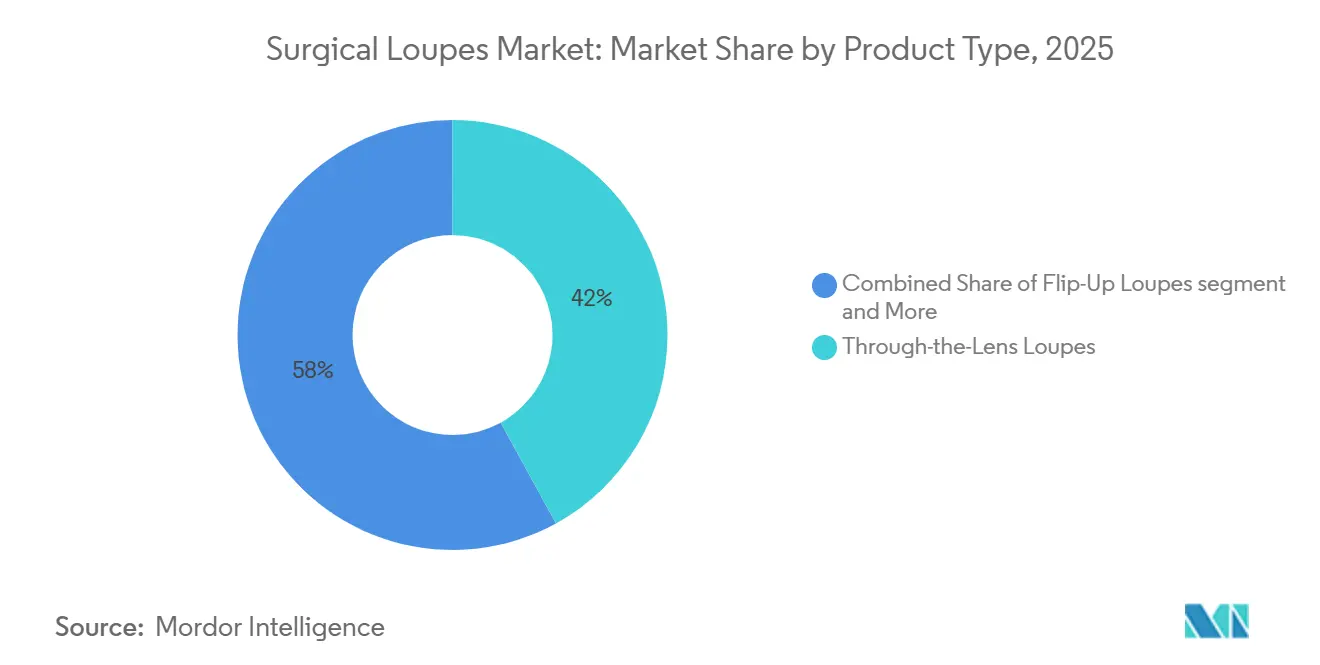
TTL Loupes Anchor Premium Revenue, Ergo Variants Gain GroundThrough-the-lens loupes held 42% of revenue in 2025, making them the leading product format in the surgical loupes market. Their telescope barrels pass through the carrier lens, which limits movement between the optics and frame during procedures that use high magnification. This stable optical alignment matters in microsurgical work, where small shifts can impair the operative view and interrupt the clinician’s posture. Through-the-lens loupes are also projected to grow at a 7.6% CAGR through 2031, because the premium format suits procedures requiring 3.5x to 6.5x magnification. The surgical loupes industry also retains flip-up, clip-on, and headband-mounted formats for practitioners whose workflow, prescription needs, or training requirements do not justify a fully customized through-the-lens system.
Flip-up models can be moved away during patient conversations, while headband-mounted products can serve users who prefer prescription independence and a different weight distribution. Clip-on loupes remain useful in training and triage because they provide a lower-commitment option for clinicians who do not need custom fitting. The product mix, therefore, supports different price points without removing the performance advantage of premium systems in demanding procedures.

By Lens Type:
Galilean Leads by Volume, Prismatic Accelerates on Clinical EvidenceGalilean lenses held 39.3% of revenue in 2025 and remained the leading lens type in the surgical loupes market. Their long clinical history, lower manufacturing cost, and suitable performance at 2x to 3x magnification support continued use in general dental appointments and basic surgical examinations. The compact optical path also reduces frame weight, which remains useful for clinicians working through long procedure days. Prismatic lenses are projected to grow at an 8.1% CAGR through 2031 as microsurgery expands, and ergonomic prism designs become more widely available. Their Keplerian beam-folding architecture allows higher magnification within a lighter barrel profile, helping users maintain workable clinical distances without carrying a larger optical unit.
Galilean's share of leadership increasingly reflects its installed base rather than a premium optical advantage in the higher-magnification tier. Keplerian and hybrid systems serve procedures above 4x, where beam folding can combine greater magnification with acceptable working distance and instrument weight. A 2025 study comparing LumaDent, Designs for Vision, Univet, and Q-Optics found measurable postural differences across Galilean and ergonomic loupe configurations in preclinical tooth preparations. This type of evidence supports early-career dentists who enter practice with stronger expectations around ergonomics and may choose prismatic systems at their first purchase.
By Wearing Style:
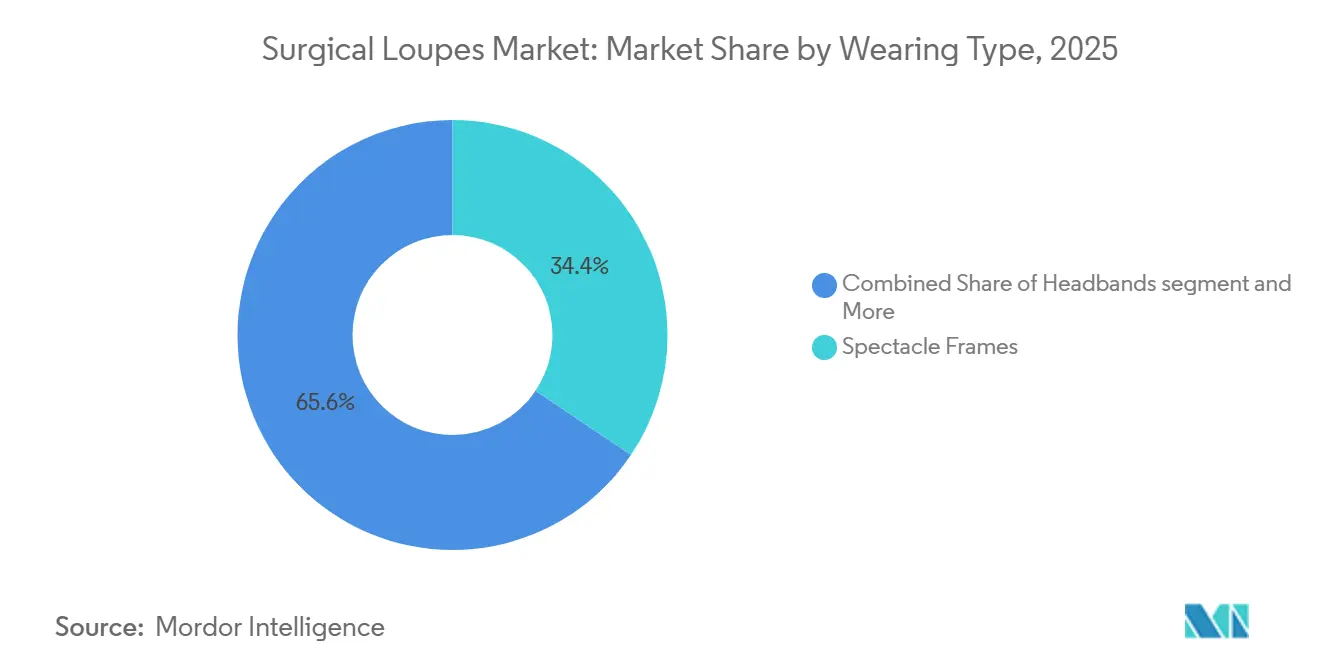
Spectacle Frames Lead, Headband Formats Attract New EntrantsSpectacle frames accounted for 34.4% of the surgical loupes market size in 2025 and were the leading wearing style. Their familiar eyeglass form, compatibility with prescription correction, and broad surface for interpupillary adjustment support use across a wide range of custom lens configurations. The surgical loupes market continues to rely on spectacle frames because they fit established clinical habits and can accommodate premium optical systems without adding a separate support structure.
Headbands are forecast to grow at a 6.6% CAGR through 2031, driven by operating-room use and the benefit of distributing instrument weight across the cranium rather than the nose bridge. Clips remain a cost-accessible option for clinicians who are not ready to commit to frame-integrated custom optics or who need a simple tool for limited use. Headband innovation is attracting entrants that focus on cranial load, illumination control, and user comfort during extended procedures. Z-Loupes secured USD 150,000 in seed funding in 2025 to commercialize a zero-tilt prism headband loupe with gesture-controlled illumination and planned export activity in the Middle East and North Africa in 2026. Orascoptic introduced the Rydon loupe with Rudy Project in March 2026, using an eyewear collaboration to focus on personalized frame fit, comfort, and optical alignment. These developments show that spectacle-frame and headband suppliers are pursuing different design routes while responding to the same need for reliable optics and less physical strain.
By Application:
Dentistry Dominates, Precision Sub-Specialties Drive UpsideDentistry accounted for 51.3% of revenue in 2025 and is forecast to advance at the highest application CAGR of 8.5% through 2031. This dual position reflects the established dental user base and the continued expansion of higher-value procedures that need clear magnification. Oral diseases affect nearly 3.5 billion people worldwide, creating a large treatment base for dental professionals and related equipment. Implantology, endodontics, and cosmetic restoration can support per-clinician loupe investments above USD 3,000, while United States consumer dental spending rose 4% in the 12 months through January 2026.
General surgery is the second-largest application area, with use concentrated in microsurgery, plastic reconstruction, and vascular anastomosis, where 4x to 6x magnification has practical value. Ophthalmic surgery has distinct ergonomic needs because practitioners can experience work-related musculoskeletal pain regardless of loupe use. A 2025 Saudi Journal of Ophthalmology study assessed loupe use, workplace ergonomics, and musculoskeletal disorders among ophthalmologists. The other application category includes ENT surgery and plastic surgery, where more complex tissue work is moving into ambulatory settings without ready access to operating microscopes.
By Distribution Channel:
Direct Sales Anchors Premium Tier, Online Disrupts the Mid-MarketDirect manufacturer sales held 31.3% of revenue in 2025 and were the leading distribution channel in the surgical loupes market. This position reflects the fitting requirements of custom through-the-lens prismatic systems, where prescription, declination angle, working distance, and interpupillary distance must be set for the individual clinician. In-person manufacturer representatives have traditionally managed these measurements and coordinated delivery, adjustment, and after-sales service. Digital measurement tools and smartphone-based facial scanning increasingly support remote workflows, although they do not fully remove the need for clinical confidence in the fit.
Online sales are forecast to grow at a 7.2% CAGR through 2031 as digital fitting improves, direct-to-practitioner brands grow, and independent clinicians compare specifications with greater price transparency. Premium manufacturers can use online sales to secure higher-margin independent-clinician orders, while third-party marketplaces expand lower-specification Asian options for buyers with tighter budgets. The resulting split means the channel serves both premium customization and value-oriented purchasing, rather than replacing the direct model with a single approach. SurgiTel’s interchangeable working-distance caps demonstrate how product design can reduce reliance on a traditional fitting appointment while retaining a customized clinical proposition.
Geography Analysis
North America Surgical Loupes Market
North America held 39.2% of revenue in 2025 and remained the largest regional contributor to the surgical loupes market. High dental spending, developed outpatient surgery infrastructure, and a clinician workforce familiar with occupational ergonomics support this position. MedPAC reported 6,436 Medicare-certified ASCs in 2024, after 248 facilities opened during the year.
Europe and APAC Surgical Loupes Market
Europe remained the second-largest regional area in the surgical loupes market. The EU Medical Device Regulation creates compliance work and common quality expectations. Asia-Pacific is forecast to grow at an 8.7% CAGR through 2031 and is the fastest-growing regional area. China and India are expected to make the largest absolute contributions to growth. Carl Zeiss Meditec reported solid global volume growth for multifocal intraocular lenses and strong demand in China in fiscal year 2024/25, aligning with wider growth in precision eye care.
Competitive Landscape
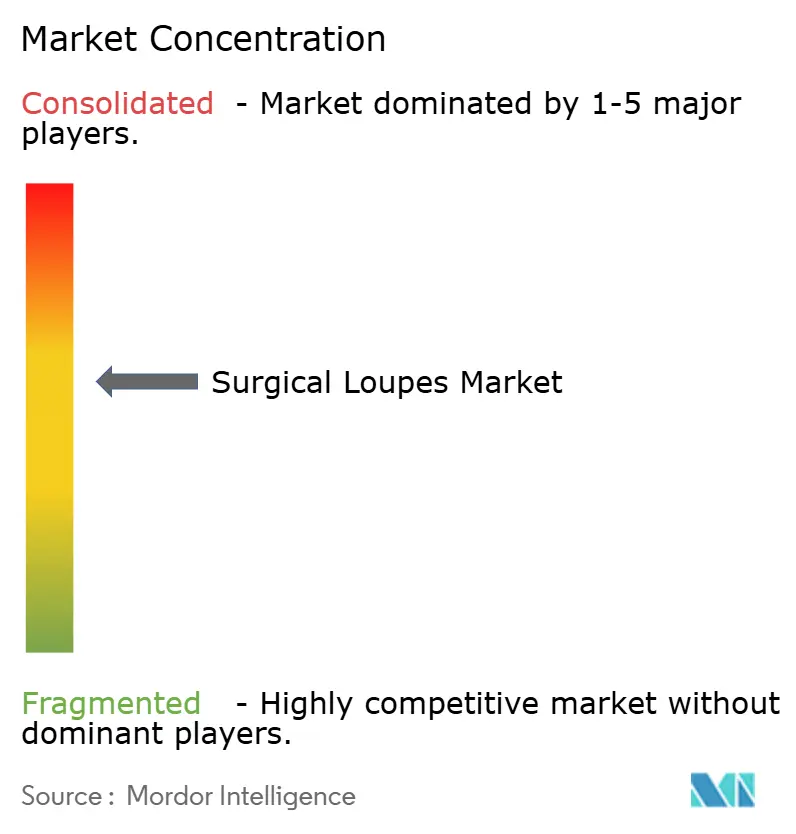
The surgical loupes market is moderately fragmented. Competition increasingly includes fitting services, connected illumination, and customization software. Rural and mid-market areas in North America and the Asia-Pacific have less fitting and service capacity. Digital fitting can help suppliers reach these areas without building a full physical network. In June 2026, SurgiTel launched Ergo IQ with a deflection prism, interchangeable working-distance caps, and 3x to 4.5x configurations.
The SurgiTel move places the company more directly in the ergonomic premium segment. Z-Loupes also targets this segment with a zero-tilt prism and gesture-controlled illumination. Orascoptic introduced the Rydon loupe in March 2026 after collaborating with Rudy Project on fit, comfort, and optical alignment. Nuview integrated Swarovski Optik loupes in December 2025, including the ErgoLine Refractive Solution that shifts the optical axis to support neutral neck posture.
Asian alternatives challenge standard through-the-lens and Galilean suppliers as optical quality improves. Proprietary deflection-prism designs provide more protection because they require specialized manufacturing and can be patented. Service reach, customization, and proprietary optics will shape competitive positions in the surgical loupes market.
Surgical Loupes Industry Leaders
-
Carl Zeiss Meditec AG
-
Orascoptic
-
Designs for Vision, Inc.
-
SurgiTel, a Division of General Scientific Corporation
-
Univet S.r.l.
- *Disclaimer: Major Players sorted in no particular order
Surgical Loupes Market Companies Covered in this Report
- Admetec Solutions Ltd.
- Bio-Art Equipamentos Odontológicos Ltda.
- Carl Zeiss
- Designs for Vision, Inc.
- Enova Illumination
- ErgonoptiX
- HEINE Optotechnik
- KaWe Medizintechnik GmbH
- Keeler Limited
- L.A. Lens
- LumaDent, Inc.
- NEITZ INSTRUMENTS CO., LTD.
- Orascoptic
- PeriOptix, Inc., a Den-Mat Holdings, LLC Company
- Q-Optics
- Rose Micro Solutions LLC
- Rudolf Riester
- SurgiTel, a Division of General Scientific Corporation
- Univet S.r.l.
- Xenosys Co., Ltd.
Recent Industry Developments in Surgical Loupes Market
- April 2026: SurgiTel, a division of General Scientific Corporation, launched the Ergo IQ next-generation ergonomic loupe platform. Available in 3x, 3.5x, and 4.5x magnifications, the system features a patent-pending deflection prism, interchangeable working-distance caps, and a lightweight, low-profile design intended to support neutral head and neck posture.
- December 2025: UK-based Nuview officially integrated Swarovski Optik loupes into its curated clinical product range, partnering with one of Europe's most recognized precision-optics brands.
Global Surgical Loupes Market Report Scope
As per the scope of the market, surgical loupes are magnification devices worn by surgeons and dentists to enhance precision, visualization, and ergonomics during medical and dental procedures.
The surgical loupes market report segments the market by product type, including through-the-lens loupes, flip-up loupes, clip-on loupes, and headband-mounted loupes. It also categorizes the market by lens type, covering Galilean lenses, prismatic lenses, and single lens and hybrid lenses. The wearing type segmentation includes spectacle frames, headbands, and loupe clips. The application segmentation includes dentistry, general surgery, ophthalmic surgery, and others. The distribution channel segmentation includes direct manufacturer sales, online sales, and others. Geographically, the market is segmented into North America, Europe, Asia-Pacific, the Middle East & Africa, and South America. The market report also covers the estimated market sizes and trends for 17 countries across major regions globally. For each segment, the market size and forecast are provided in terms of value (USD).
Segmentation Overview
| Through-the-Lens Loupes |
| Flip-Up Loupes |
| Clip-On Loupes |
| Headband-Mounted Loupes |
| Galilean Lenses |
| Prismatic Lenses |
| Other Lens Types (Single Lens and Hybrid Lenses) |
| Spectacle Frames |
| Headbands |
| Loupe Clips |
| Dentistry |
| General Surgery |
| Ophthalmic Surgery |
| Others (ENT Surgery and Plastic Surgery, among others) |
| Direct Manufacturer Sales |
| Specialty Medical and Dental Distributors |
| Online Sales |
| Others (Dealer and Group Purchasing Channels, among others) |
| North America | United States |
| Canada | |
| Mexico | |
| Europe | Germany |
| United Kingdom | |
| France | |
| Italy | |
| Spain | |
| Rest of Europe | |
| Asia-Pacific | China |
| India | |
| Japan | |
| Australia | |
| South Korea | |
| Rest of Asia-Pacific | |
| Middle East and Africa | GCC |
| South Africa | |
| Rest of Middle East and Africa | |
| South America | Brazil |
| Argentina | |
| Rest of South America |
| By Product Type | Through-the-Lens Loupes | |
| Flip-Up Loupes | ||
| Clip-On Loupes | ||
| Headband-Mounted Loupes | ||
| By Lens Type | Galilean Lenses | |
| Prismatic Lenses | ||
| Other Lens Types (Single Lens and Hybrid Lenses) | ||
| By Wearing Style | Spectacle Frames | |
| Headbands | ||
| Loupe Clips | ||
| By Application | Dentistry | |
| General Surgery | ||
| Ophthalmic Surgery | ||
| Others (ENT Surgery and Plastic Surgery, among others) | ||
| By Distribution Channel | Direct Manufacturer Sales | |
| Specialty Medical and Dental Distributors | ||
| Online Sales | ||
| Others (Dealer and Group Purchasing Channels, among others) | ||
| By Geography | North America | United States |
| Canada | ||
| Mexico | ||
| Europe | Germany | |
| United Kingdom | ||
| France | ||
| Italy | ||
| Spain | ||
| Rest of Europe | ||
| Asia-Pacific | China | |
| India | ||
| Japan | ||
| Australia | ||
| South Korea | ||
| Rest of Asia-Pacific | ||
| Middle East and Africa | GCC | |
| South Africa | ||
| Rest of Middle East and Africa | ||
| South America | Brazil | |
| Argentina | ||
| Rest of South America | ||
Key Questions Answered in the Report
What is driving demand for surgical loupes?
More dental and outpatient procedures, stricter precision needs, and growing concern about clinician posture are supporting adoption. The surgical loupes market also benefits when ambulatory centers need portable magnification for specialty work outside traditional hospital operating rooms.
How large is the surgical loupes market?
The surgical loupes market is estimated at USD 407.3 million in 2026 and is forecast to reach USD 539.9 million by 2031 at a 5.8% CAGR. Growth depends on wider procedure volumes, ergonomic product upgrades, and access to fitting and after-sales service.
Which product type leads surgical loupe sales?
Through-the-lens loupes led with 42% of revenue in 2025 and are also forecast to grow at a 7.6% CAGR through 2031. Their fixed optical alignment and suitability for high-magnification work support the premium position of this surgical loupes market segment.
Why are prismatic loupes gaining adoption?
Prismatic systems support higher magnification and a more neutral posture, and they are forecast to expand at an 8.1% CAGR through 2031. Peer-reviewed ergonomic studies provide a clearer clinical basis for the move away from conventional designs in the surgical loupes market.
Which clinical application has the strongest demand?
Dentistry held 51.3% of revenue in 2025 and is expected to grow at an 8.5% CAGR through 2031. High procedure volumes and the need for precise visualization in implantology, endodontics, and cosmetic restoration support demand in the surgical loupes market.
Which region is growing fastest for surgical loupes?
Asia-Pacific is forecast to grow at an 8.7% CAGR through 2031, supported by expanding healthcare capacity in China and India. The surgical loupes market in the region combines demand for premium products with price-sensitive purchasing and a growing clinician base.