
Global Surgical Lasers Market Size and Share
Market Overview
| Study Period | 2020 - 2031 |
|---|---|
| Market Size (2026) | USD 10.26 Billion |
| Market Size (2031) | USD 17.48 Billion |
| Growth Rate (2026 - 2031) | 11.25 % |
| Fastest Growing Market | Asia Pacific |
| Largest Market | North America |
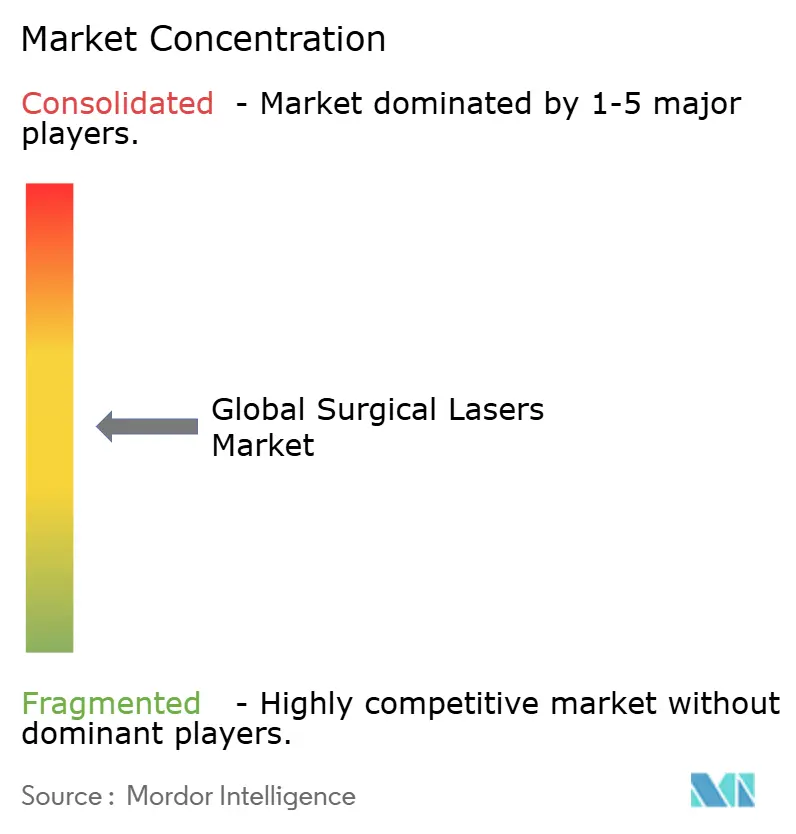
| Market Concentration | Medium |
Major Players *Disclaimer: Major Players sorted in no particular order Image © Mordor Intelligence. Reuse requires attribution under CC BY 4.0. | |
Global Surgical Lasers Market Analysis by Mordor Intelligence
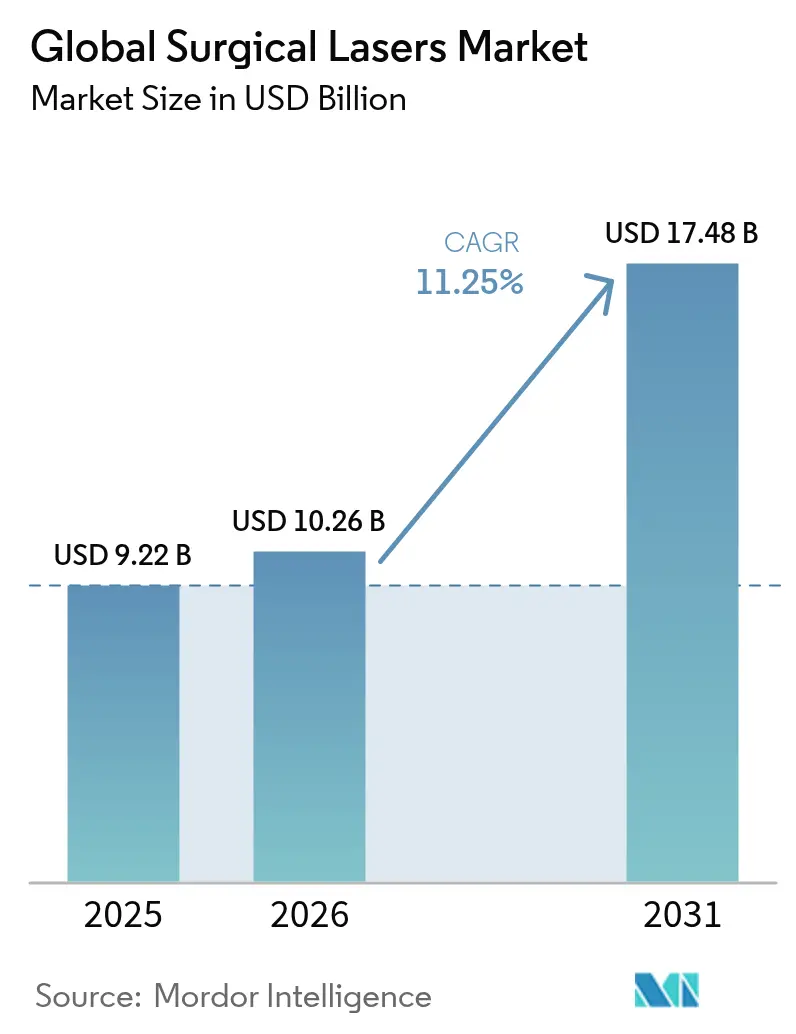
The surgical laser market size is expected to grow from USD 9.22 billion in 2025 to USD 10.26 billion in 2026 and is forecast to reach USD 17.48 billion by 2031 at 11.25% CAGR over 2026-2031. Robust growth is underpinned by faster adoption of AI-assisted beam-shaping optics, rising outpatient procedure volumes and regulatory alignment with IEC safety norms. Hospitals and large ambulatory surgical centers are refreshing equipment to meet stricter plume-safety rules, while vendors compete on workflow software that matches laser energy to tissue type in real time. North American reimbursement stability, alongside Asia-Pacific infrastructure upgrades, keeps demand broad-based. Technology convergence with robotic platforms is widening the surgical laser market addressable base, particularly in complex urology and ophthalmology cases.
Key Report Takeaways
- By laser type, carbon dioxide units led with 34.18% surgical laser market share in 2025; diode lasers are forecast to expand at a 12.18% CAGR to 2031.
- By procedure, open surgery retained 32.30% of the surgical laser market size in 2025, while robot-assisted surgery is advancing at a 12.36% CAGR through 2031.
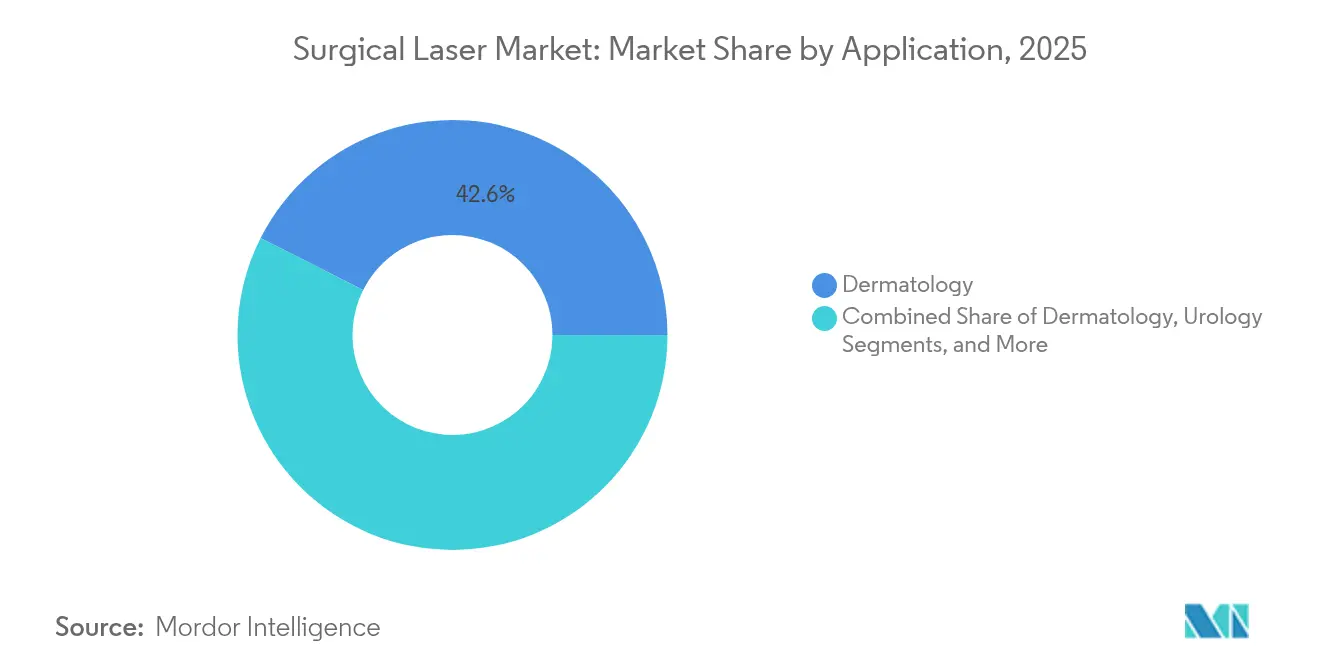
- By application, dermatology captured 42.55% revenue in 2025 and dentistry is the fastest mover at 11.92% CAGR to 2031.
- By end user, hospitals commanded 57.95% of the surgical laser market size in 2025; ambulatory surgical centers are growing at a 12.08% CAGR.
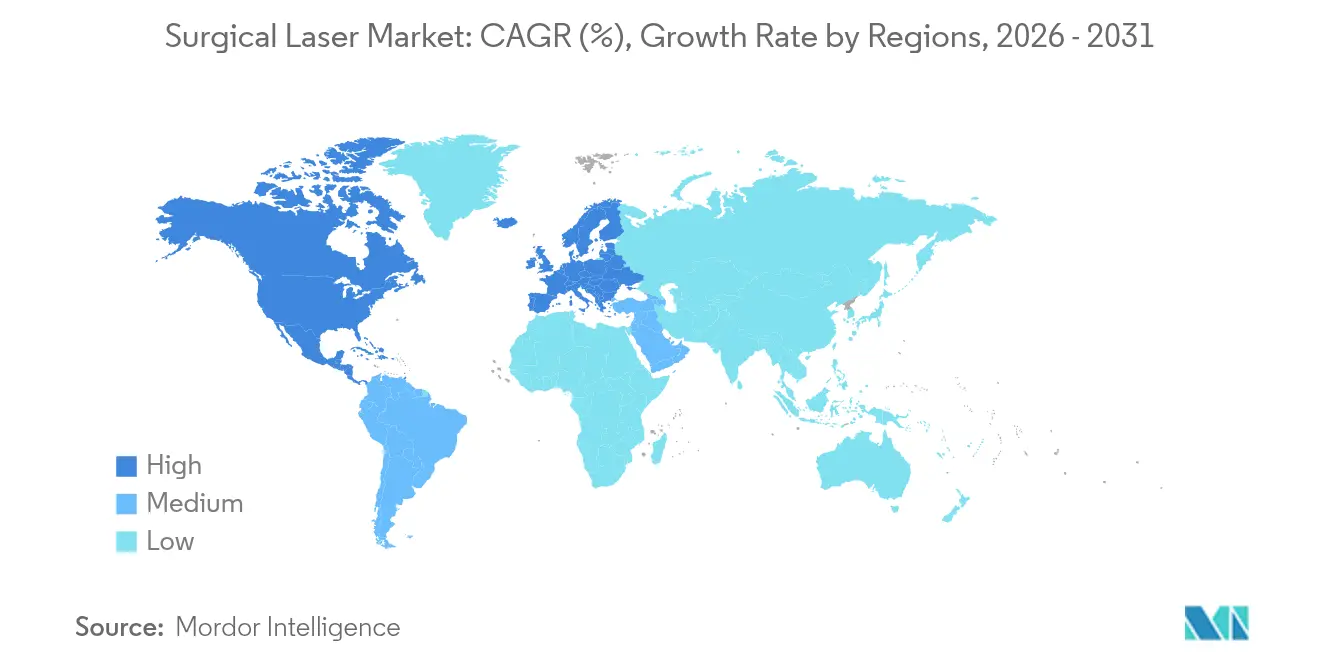
- By geography, North America accounted for 44.72% revenue in 2025, whereas Asia-Pacific is set to grow at 12.89% CAGR to 2031.
Note: Market size and forecast figures in this report are generated using Mordor Intelligence’s proprietary estimation framework, updated with the latest available data and insights as of 2026.
Global Surgical Lasers Market Trends and Insights
Drivers Impact Analysis*
| Driver | (~) % Impact on CAGR Forecast | Geographic Relevance | Impact Timeline |
|---|---|---|---|
| Technological advancements in beam-shaping optics | +2.1% | Global, with early adoption in North America & EU | Medium term (2-4 years) |
| Preference for minimally-invasive & day-care surgeries | +2.8% | Global, led by North America, expanding to APAC | Short term (≤ 2 years) |
| Rising incidence of ophthalmic & urologic disorders | +1.9% | Global, accelerated in aging populations (North America, EU, Japan) | Long term (≥ 4 years) |
| Regulatory approvals expanding clinical indications | +1.7% | North America & EU core, spill-over to APAC | Medium term (2-4 years) |
| Rapid adoption of outpatient laser suites (ASC model) | +2.3% | North America dominant, emerging in EU & APAC | Short term (≤ 2 years) |
| AI-driven real-time laser dosimetry & workflow gains | +1.6% | Global, with technology hubs leading adoption | Medium term (2-4 years) |
| Source: Mordor Intelligence | |||
Technological Advancements in Beam-Shaping Optics
Liquid-lens modules now correct focal drift inside flexible fibers, enabling steady ablation at depths past 700 µm—more than triple previous limits [1]. Fiber shapers developed at MIT tailor beam patterns that cut scattering by half and preserve native tissue architecture, which is crucial for intra-operative imaging. When paired with optical coherence tomography, surgeons receive real-time cross-sections that guide submillimeter resections. Efficiency gains also reduce average pulse energy, lowering thermal damage margins. Collectively, these advances enhance patient safety and shrink operative time, giving the surgical laser market a measurable quality edge that hospitals can monetize through faster case turnover.
Preference for Minimally-Invasive & Day-Care Surgeries
Ambulatory facilities now perform a majority of cataract and gall-bladder cases under local anesthesia, encouraged by a 2025 CMS rule that raises ASC payments by 2.6%. Patients benefit from same-day discharge and 20% shorter wait lists, while payers save up to 45% on facility fees, reinforcing a volume shift into the surgical laser market. Laser platforms with plume-capture and quick-swap fiber handpieces fit ASC workflows and minimize room turnaround time. As outpatient centers invest in robotic carts that combine endoscopy and laser cutting, procedure complexity gradually rises without eroding cost efficiency.
Rising Incidence of Ophthalmic & Urologic Disorders
The prevalence of cataract is set to double in the United States within three decades, boosting demand for femtosecond and excimer lasers that deliver sub-5 µm capsulotomies [2]. In urology, thulium-fiber sources achieve faster stone “dusting” at 50% lower power than holmium systems, cutting retropulsion and scope wear. FDA clearance of the VISUMAX 800 platform brings small-incision lenticule extraction to high-volume centers and demonstrates agency confidence in next-generation optics. Together, aging demographics and superior clinical outcomes continue to widen the surgical laser market.
Regulatory Approvals Expanding Clinical Indications
In March 2025, FDA Laser Notice No. 56 took effect, synchronizing U.S. rules with IEC 60825-1 and IEC 60601-2-22 and obligating manufacturers to file revised product reports. A spate of 2024-2025 clearances—including the da Vinci 5 robot and TENEO excimer platform—has validated multipurpose lasers for ENT, spine and gynecology use. Updated ANSI Z136.3 guidelines supply hospitals with unified hazard controls, simplifying credentialing for staff and accelerating purchasing decisions. Greater clinical breadth moves lasers from niche to standard toolkits, fortifying long-term surgical laser market expansion.
Restraints Impact Analysis*
| Restraint | (~) % Impact on CAGR Forecast | Geographic Relevance | Impact Timeline |
|---|---|---|---|
| High capital & procedural costs | -1.8% | Global, sharper in emerging regions | Long term (≥ 4 years) |
| Reimbursement gaps in developing markets | -1.4% | APAC, MEA, Latin America | Medium term (2-4 years) |
| Global helium shortage | -0.9% | Worldwide CO₂ laser supply chain | Short term (≤ 2 years) |
| Stricter plume-safety mandates | -0.7% | North America & EU | Medium term (2-4 years) |
| Source: Mordor Intelligence | |||
High Capital & Procedural Costs
State-of-the-art femtosecond workstations can exceed USD 500,000, a hurdle for smaller clinics whose reimbursements remain technique-agnostic. Cost-utility studies confirm visual gains but note payback periods beyond five years in low-volume settings. Mandatory laser safety officer training and ventilation upgrades add overhead. Where humanitarian cataract missions operate at USD 276 per eye, capital intensity underscores adoption gaps [3]. Price sensitivity in emerging economies dampens unit sales and tempers the global surgical laser market trajectory.
Reimbursement Gaps in Emerging Economies
Out-of-pocket payment remains common for laser prostate or refractive surgery in large parts of Asia, limiting rural diffusion despite urban flagship programs. India hosts more than 170 robotic surgery systems, yet installations cluster in metro hospitals where private insurers reimburse advanced procedures. China’s 12% annual expansion in robotic platforms shows that when public insurance widens coverage, laser volumes follow. Absent unified reimbursement codes, many facilities defer acquisition, softening surgical laser market growth in price-sensitive geographies.
*Our forecasts treat driver/restraint impacts as directional, not additive. The impact forecasts reflect baseline growth, mix effects, and variable interactions.
Segment Analysis
By Laser Type: CO₂ Stability Meets Diode Momentum
Carbon dioxide systems held 34.18% of 2025 revenue, owing to their reliability in ENT and gynecology. At USD 10.26 billion, the surgical laser market size continues to rely on CO₂ for precise vaporization with minimal bleeding. Yet diode units, projected to expand at 12.18% CAGR, are eroding entry-level CO₂ share as 445 nm wavelengths cut soft tissue efficiently while consuming less power. Manufacturers emphasize portable chassis and lower consumable costs, aligning with ASC budgets. As photonic-crystal fibers mature, diode beam quality improves, allowing ENT surgeons to achieve 1 mm cut depths with limited collateral heat. The trend suggests incremental but persistent diversification, safeguarding supply chains from helium scarcity that threatens glass-tube CO₂ capacity.
Carbon dioxide suppliers counter with hybrid systems that embed mid-infrared modules to expand dermatology and oncology use cases. Excimer platforms remain irreplaceable for corneal reshaping and now incorporate active-eye tracking to compensate for micro-saccades, boosting outcome predictability. Fiber and Er:YAG designs pair with robots for spine decompression, reflecting a strategy to widen the surgical laser market by tying hardware to procedure-specific software.


By Procedure: Robots Re-engineer Workflows
Open surgery retained 32.30% of 2025 procedures as legacy protocols and surgeon familiarity persist. Nonetheless, robot-assisted cases are climbing at 12.36% CAGR and already represent a quarter of prostatectomies in leading U.S. centers. Force-feedback sensors integrated into laser end-effectors trim tissue damage by 43%, supporting surgeon confidence. As software updates roll out remotely, installed robots gain new laser modalities without hardware swaps, pushing the surgical laser market toward service-based revenue.
Laparoscopic laser adoption grows steadily, bolstered by high-resolution imaging and plume suction filters that preserve visibility. Percutaneous lithotripsy benefits from thulium-fiber efficiency, shortening operative times and lowering anesthesia exposure. Together, these shifts point to a surgical suite where lasers, robots and imaging platforms operate as a single digital ecosystem, raising entry barriers for newcomers.
By Application: Dermatology Commands, Dentistry Accelerates
Dermatology captured 42.55% of 2025 demand as fractional resurfacing, scar revision and pigment correction remain high-volume indications. AI-driven parameter presets now adjust pulse density to skin phototype in seconds, reducing trial shots and consumable spend. Dentistry, advancing at a 11.92% CAGR, gains from diode and erbium devices that debulk soft tissue with minimal anesthesia, enlarging chairside productivity. With AI guidance, operators cut operative time for crown lengthening by 30%, a strong hook for fee-for-service practices.
Ophthalmology holds share through femtosecond cataract systems whose sub-micron precision lowers posterior capsule rupture rates. Urology benefits from faster lithotripsy, while cardiology explores pulsed-field ablation for arrhythmia management after Boston Scientific’s recent regulatory wins. As each clinical silo matures, cross-specialty laser adoption deepens, diversifying the surgical laser market.
By End User: Hospitals Lead, ASCs Surge
Hospitals retained 57.95% of the 2025 surgical laser market size thanks to capital budgets and 24/7 support teams. Yet ambulatory surgical centers are set to grow 12.08% annually as payers steer low-risk cases to lower-cost sites. Federal reimbursement of USD 7.4 billion for ASCs in 2025 underscores a structural shift. Lasers that combine plume evacuation, small footprints and quick sterilization cycles resonate with ASC throughput goals.
Specialty clinics leverage direct-pay cosmetic and dental procedures to bypass insurance friction. Academic centers stay pivotal in training and clinical trials, accelerating evidence that mainstreams laser indications. State-level smoke-evacuation statutes raise compliance spending, driving smaller ASCs to affiliate with chains that can amortize upgrades, thus concentrating demand among large buyers within the broader surgical laser market.
Geography Analysis
North America generated 44.72% of 2025 revenue on the back of early technology adoption, favorable payer policies and a dense ASC network. FDA approvals of the da Vinci 5 robot and TENEO excimer laser set clinical precedents and underpin replacement cycles. Large device firms report double-digit U.S. revenue gains as hospitals refresh fleets to comply with Laser Notice No. 56. Persistent helium cost inflation, however, nudges providers toward fiber-based alternatives, illustrating a regional pivot that influences global supply strategies.
Asia-Pacific is poised for 12.89% CAGR through 2031. Public insurance expansion in China has spurred double-digit growth in robotic-laser procedures, and Japan’s 97.3% success rate in office-based vitreoretinal work validates outpatient complex surgery. India’s urban hospital chains invest in multi-specialty lasers even as reimbursement lag restrains rural penetration. Government-funded cancer centers in South Korea and Singapore are installing dual-wavelength suites, signaling sustained investment momentum within the surgical laser market.
Europe shows balanced progress. Harmonization with IEC standards simplifies cross-border trade, and energy-efficient fiber lasers align with the region’s sustainability regulations, consuming roughly one-third of the electricity of legacy CO₂ models. Eastern European nations leverage EU structural funds to modernize ORs, though reimbursement ceilings temper high-end adoption. The Middle East and South America represent emerging corridors, where medical tourism and private hospital groups drive premium equipment purchases, yet currency volatility and spot helium shortages present operational hurdles.
Regulatory Landscape
Surgical laser manufacturers operate under dual compliance regimes in major markets: medical device rules and laser radiation safety requirements. In the United States, FDA oversight covers device classification and premarket pathways (including 510(k) where applicable), alongside radiation-emitting product controls under 21 CFR 1040.10 and 1040.11, reinforcing design controls, labeling, and reporting expectations for laser products.
Recent rule and standards alignment has raised the compliance bar across jurisdictions. FDA implemented the Quality Management System Regulation (QMSR) effective February 2, 2026, which increases quality-system alignment for device manufacturers, and FDA Laser Notice No. 56 (effective March 2025) synchronized U.S. expectations with IEC 60825-1 and IEC 60601-2-22 while requiring updated product reporting. In Europe, the Medical Device Regulation (EU) 2017/745 (MDR) continues to tighten clinical evidence and post-market surveillance. Equipment such as certain high-intensity light/laser systems without an intended medical purpose falls under MDR Annex XVI with implementing rules, adding documentation and conformity assessment steps for suppliers that address aesthetic use cases.
Value Chain Analysis
The surgical laser value chain begins with upstream photonics components, including high-power semiconductor diode bars, specialty optical fibers, and laser gain media such as Nd:YAG and Ho:YAG crystals. These elements move through module assembly (beam delivery, cooling, electronics, and software) and final system integration into procedure-ready platforms. OEMs then sell through direct hospital and ASC teams, supported by specialized distributors. Downstream revenues come from installation, preventative maintenance, service contracts, fibers and handpieces, and procedure-specific disposables where applicable.
Bottlenecks concentrate in component qualification and compliance-led validation. New diode modules and beam-delivery assemblies undergo extended verification before clinical release, and EU MDR documentation and testing requirements can extend product development and change-control cycles. Supply risk is amplified by reliance on a limited set of global suppliers for critical photonics inputs, and the report-cited helium-related pressure on CO2 laser supply chains encourages dual-sourcing, strategic inventory for long-lead optics and diodes, and selective vertical integration of diode packaging and sub-assemblies to support throughput and service readiness.
Competitive Landscape
The surgical laser market tilts moderately concentrated, with multinationals deepening technology moats through acquisitions and R&D intensity. Cynosure’s merger with Lutronic fuses U.S. distribution with Korean engineering, offering dual platform roll-outs that shorten product cycles. Alcon’s planned Lensar buy strengthens its cataract franchise and secures femtosecond IP crucial for premium intraocular lens alignment. Boston Scientific’s deal for Bolt Medical injects laser-atherectomy tech into its cardiovascular suite, positioning the firm to cross-sell disposables to existing cath-lab customers.
Technology leadership remains a key differentiator. Intuitive Surgical embeds haptic feedback and ten-fold data throughput, translating to gentler tissue manipulation and predictive instrument wear monitoring. IPG Photonics pushes >50% wall-plug efficiency in mid-IR fiber engines, trimming OR energy bills and carbon footprints. Smaller innovators focus on AI-driven treatment planning; AVAVA’s MIRIA platform, for example, integrates dermal imaging with algorithmic fluence maps to personalize aesthetics. Regulatory convergence raises compliance hurdles, favoring incumbents that can amortize testing and documentation costs across broad portfolios, thereby reinforcing competitive positioning within the surgical laser market.
Global Surgical Lasers Industry Leaders
-
Cynosure
-
Lumenis
-
IPG Photonics Corporation
-
biolitec AG
-
Alma Lasers Ltd
- *Disclaimer: Major Players sorted in no particular order
Market Opportunities and Future Outlook
Opportunity is concentrated in workflow- and compliance-driven replacement and upgrades, as providers refresh fleets to meet stricter safety and quality expectations while aligning with higher outpatient throughput. In the United States, FDA Laser Notice No. 56 (effective March 2025) and the shift to QMSR (effective February 2, 2026) increase the value of vendors that can document IEC-aligned safety performance and maintain robust quality systems. The ASC shift is also supported by payment dynamics cited in the report, including CMS raised ASC payments by 2.6% for 2025, and ASC reimbursement reached USD 7.4 billion in 2025. Together, these factors support demand for compact, plume-controlled, fast-turnover platforms, and for bundled service models aimed at high-volume ambulatory settings.
Technology and procedure mix are also widening addressable demand as lasers integrate with digital surgery ecosystems. The report points to AI-assisted beam shaping and real-time dosimetry, alongside convergence with robotic platforms (including FDA-cleared da Vinci 5), as pathways to expand utilization in complex urology and ophthalmology and to standardize parameter selection across sites. On the supply side, helium constraints affecting CO2 systems increase the strategic appeal of fiber-based and diode architectures, and of multi-wavelength platforms that can cover dermatology, dentistry, and outpatient ENT without frequent hardware swaps. This creates room for vendors that can deliver validated performance across multiple indications while meeting harmonized IEC and hospital safety protocols, including ANSI Z136.3-aligned controls and plume mitigation.
Recent Industry Developments
- July 2026: Cynosure Lutronic announced the European launch of the XERF monopolar RF platform. While RF is adjacent to lasers, the move reinforces the company’s multi-energy portfolio strategy in aesthetic clinics that are also major buyers of dermatology laser systems. The broader installed base can support cross-selling, service bundling, and room-level workflow standardization across energy-based devices.
- March 2025: Alcon signed a definitive agreement to acquire Lensar, strengthening its femtosecond laser position in ophthalmic surgery. The deal expands access to cataract-focused laser IP and can tighten platform integration with Alcon’s broader surgical workflow and premium IOL planning. Consolidation at this level increases competitive pressure on standalone ophthalmic laser suppliers.
- March 2024: Intuitive Surgical secured FDA clearance for the da Vinci 5 system, adding force-feedback and higher processing capability to its robotic platform. The upgrade supports tighter energy control and instrument handling in procedures where lasers are integrated into minimally invasive workflows. It also raises expectations for software-enabled upgrades and service-led revenue models around installed robotic ecosystems.
Research Methodology Framework and Report Scope
Market Definition and Coverage
This market covers laser-based surgical systems used to cut, ablate, or coagulate human tissue in clinical procedures, across hospital and outpatient care settings. It includes major surgical laser platforms used across medical specialties.
Scope exclusions: Veterinary laser devices and non-medical cosmetic-only laser equipment are not counted in this market size.
Segmentation Overview
- By Laser Type
- Carbon Dioxide (CO₂) Lasers
- Nd:YAG Lasers
- Diode Lasers
- Holmium:YAG Lasers
- Fiber & Er:YAG Lasers
- Excimer Lasers
- Other Lasers
- By Procedure
- Open Surgery
- Laparoscopic Surgery
- Percutaneous Surgery
- Robot-assisted Surgery
- By Application
- Dermatology
- Ophthalmology
- Urology
- Dentistry
- Gynecology
- Cardiology
- Gastroenterology
- Oncology
- Other Applications
- By End User
- Hospitals
- Ambulatory Surgical Centres
- Specialty & Aesthetic Clinics
- Other End Users
- By Geography
- North America
- United States
- Canada
- Mexico
- Europe
- Germany
- United Kingdom
- France
- Italy
- Spain
- Rest of Europe
- Asia-Pacific
- China
- Japan
- India
- South Korea
- Australia
- Rest of Asia-Pacific
- Middle East
- GCC
- South Africa
- Rest of Middle East
- South America
- Brazil
- Argentina
- Rest of South America
- North America
Data Sources, Market Sizing, and Validation
Desk Research
Desk research was used to build the first market structure and to anchor the model to measurable healthcare and device signals. We relied on public, non-paywalled sources such as the US FDA device databases, the US Centers for Medicare and Medicaid Services procedure and payment references, the World Health Organization health statistics, and OECD health indicators to understand procedure environments and adoption conditions.
In parallel, we reviewed manufacturer annual reports, investor presentations, and regulatory announcements to map product positioning and typical buying cycles. Where it was useful, we also used paid subscriptions for company financials and intelligence, news and financials, and patent databases to cross-check launch timing and technology direction. These desk research sources are illustrative and not exhaustive, and many additional public materials were reviewed to collect, validate, and clarify specific data points tied to surgical laser uptake.
Primary Interviews and Surveys
Primary work focused on interviews and structured surveys with stakeholders across device manufacturing, distribution, and clinical use, so assumptions could be checked against what is happening in real purchasing and utilization. We covered major geographies and mixed respondent profiles, and then used follow-up calls when a data point did not line up with desk signals or with regional procedure trends.
Respondent input was used to clarify how hospitals evaluate installation versus service needs, how procurement lead times vary by region, and how quickly specific surgical laser platforms convert from trials to routine use.
Distribution of primary research fieldwork respondents
| Company type | Respondent position | Region |
|---|---|---|
| Top tier: 28% | CXOs: 14% | APAC: 51% |
| Mid tier: 58% | Functional/Unit leaders: 38% | EMEA: 29% |
| Smaller Players: 14% | Managers: 48% | Americas: 20% |
Market-Sizing & Forecasting
Market sizing was built using a top-down and bottom-up approach, where procedure intensity and specialty adoption signals were first translated into a demand pool, and then the total was checked using supplier and channel reality checks. In practice, the top-down build leans on how surgical and minimally invasive procedure volumes evolve by specialty, and how fast laser penetration changes in those workflows.
To keep the model grounded, we used inputs such as surgical procedure volumes by specialty, installation base replacement cycles, typical capital equipment utilization patterns, pricing movement of key platforms (including service and consumable attachment where applicable), and the pace of hospital and ambulatory center technology upgrades. When a variable was not consistently visible across countries, we filled gaps with region-level proxies and then stress-tested the impact through sensitivity checks before finalizing the totals.
For forecasting, scenario analysis was applied around adoption speed and pricing pressure, and it was paired with trend smoothing on the historical series so year-to-year changes stay realistic. The final forecast path was adjusted only after primary feedback confirmed whether planned expansions, reimbursement sentiment, and procurement lead times supported the assumed growth rates.
Data Validation & Update Cycle
Validation is done through triangulation across independent signals, including procedure trends, regulatory activity, and supplier commentary, and then checked again at the regional split level so totals do not hide local inconsistencies. We run variance checks to flag outliers, review any sharp shifts in implied pricing or penetration, and re-contact sources when a key assumption moves the result more than expected.
Before sign-off, the model and narrative go through multi-step analyst reviews so inputs, calculations, and outputs remain consistent. The study is refreshed annually, and interim updates are triggered when material events occur, such as major regulatory changes, sizable product launches, or visible pricing resets in comparable platform categories. Right before delivery, a final pass is performed to incorporate the latest public and primary signals available at that time.
Mordor Intelligence's Surgical Lasers Market Size Versus Other Published Estimates
Published market sizes for surgical lasers can look far apart even when they are talking about similar clinical uses, because the counting rules are not always the same. Differences usually come from what is treated as a surgical system versus an adjacent medical laser device, how service and consumables are handled, and which year is used as the anchor for currency and inflation.
By tracking procedure-linked demand indicators and then refreshing key pricing and replacement-cycle assumptions, Mordor Intelligence keeps the estimate tied to human surgical use cases and avoids folding in broader aesthetic or general medical laser revenues that can inflate totals. Some estimates also start from a different base year and then project forward using a single growth rate, which can miss near-term slowdowns or spikes that were visible in interviews and regulatory signals.
Benchmark comparison
| Source | Market Size | Gaps in Research Methodology |
|---|---|---|
| Mordor Intelligence | USD 10.26 B (2026) | |
| Global Consultancy A | USD 8.28 B (2024) | Uses an earlier anchor year and a shorter forecast window, and its scope can be broader in how surgical laser revenue is grouped with adjacent medical laser categories, which shifts the starting total. |
| Industry Research Group B | USD 8.48 B (2024) | Publishes a 2024 starting value and a longer horizon to 2032, and its segment framing by multiple procedure types and applications can lead to wider inclusion of settings and revenue components than a surgery-only definition. |
The comparison shows that year selection and scope boundaries explain most of the spread, not just arithmetic differences. When the scope stays limited to human surgical use and the model is cross-checked against procedure and adoption signals, the resulting market size is easier to trace back to clear, repeatable inputs.
Key Questions Answered in the Report
What is the current Global Surgical Lasers Market size?
The surgical laser market size was USD 10.26 billion in 2026 and is forecast to reach USD 17.48 billion by 2031, translating to an 11.25% CAGR
Who are the key players in Global Surgical Lasers Market?
Cynosure, Lumenis, IPG Photonics Corporation, biolitec AG and Alma Lasers Ltd are the major companies operating in the Global Surgical Lasers Market.
Why are ambulatory surgical centers important for growth?
ASCs offer lower facility fees and faster scheduling; they also integrate compact, plume-controlled lasers, driving a 12.08% CAGR for the end-user segment through 2031.
Which region has the biggest share in Global Surgical Lasers Market?
In 2025, the North America accounts for the largest market share in Global Surgical Lasers Market.
What technological trend will shape future product design?
AI-assisted beam-shaping and real-time dosimetry are set to become standard, enabling personalized energy delivery that enhances outcomes and reduces collateral tissue damage.