
Surgical Gloves Market Size and Share
Market Overview
| Study Period | 2020 - 2031 |
|---|---|
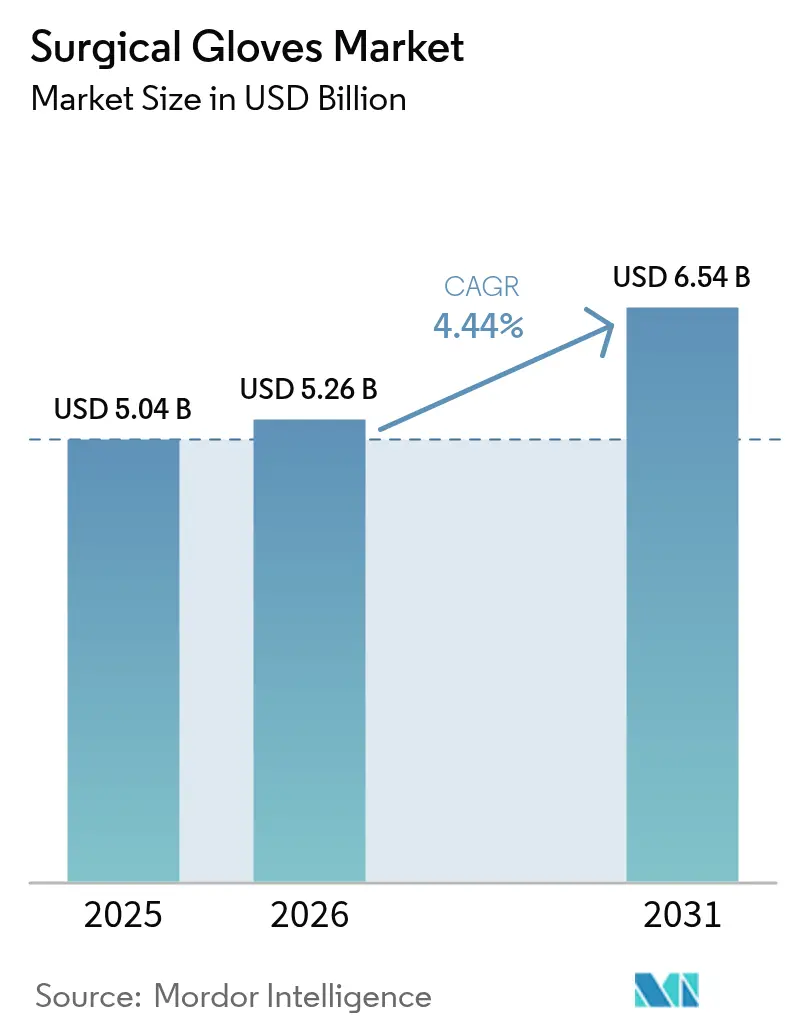
| Market Size (2026) | USD 5.26 Billion |
| Market Size (2031) | USD 6.54 Billion |
| Growth Rate (2026 - 2031) | 4.44 % |
| Fastest Growing Market | Asia Pacific |
| Largest Market | North America |
| Market Concentration | Medium |
Major Players *Disclaimer: Major Players sorted in no particular order Image © Mordor Intelligence. Reuse requires attribution under CC BY 4.0. | |
Surgical Gloves Market Analysis by Mordor Intelligence
The surgical gloves market size was valued at USD 5.04 billion in 2025 and estimated to grow from USD 5.26 billion in 2026 to reach USD 6.54 billion by 2031, at a CAGR of 4.44% during the forecast period (2026-2031). Stable growth rests on an aging world population that undergoes a rising volume of elective and trauma surgeries, an enduring post-pandemic focus on infection control, and continued product innovation that balances safety and tactile performance. North America remains the revenue anchor, but Asia-Pacific sets the growth pace on the back of rapid healthcare investment, wider insurance coverage, and expanding surgical volumes. Material trends pivot toward low-allergy polyisoprene, while form factors skew heavily to powder-free variants following global regulatory bans on powdered gloves. Hospitals will keep their purchasing clout, yet ambulatory surgical centers (ASCs) are creating new logistics and pricing pressures that favor suppliers with digital ordering portals and just-in-time delivery.
Key Report Takeaways
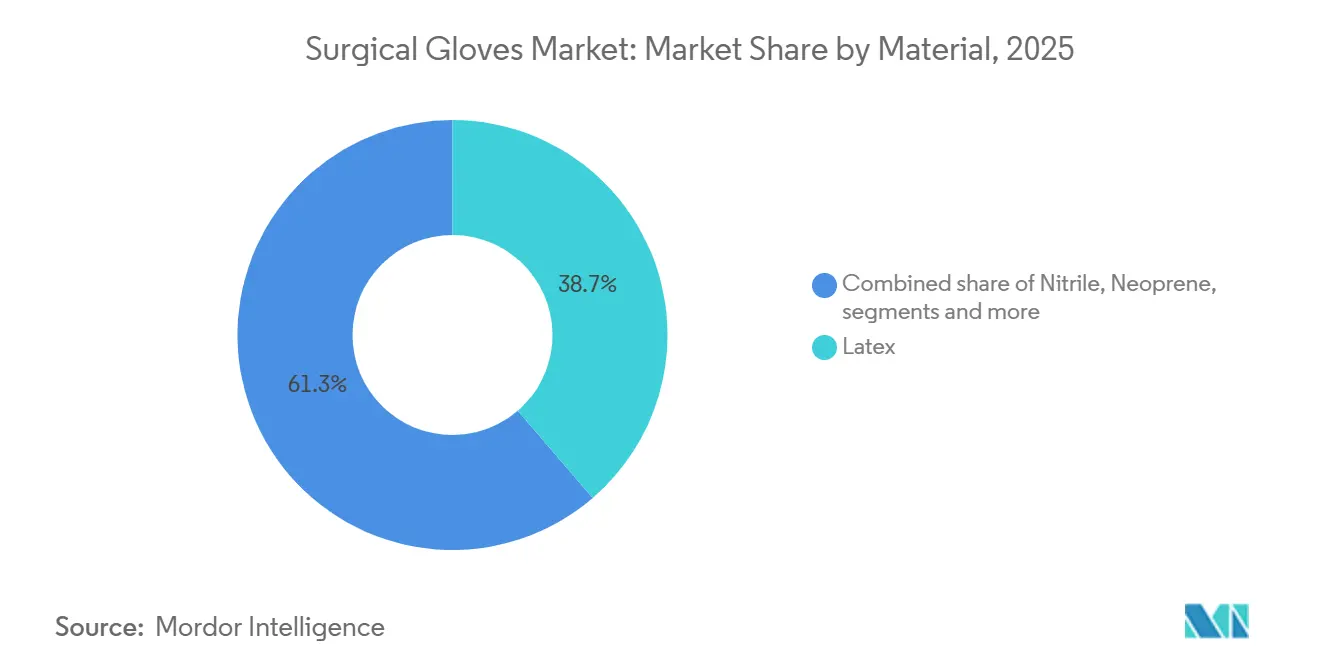
- By material - latex held 38.70% of surgical gloves market share in 2025; polyisoprene is projected to post the fastest 4.96% CAGR to 2031.
- By form - powder-free variants commanded 87.65% share of the surgical gloves market size in 2025 and are expanding at a 5.92% CAGR through 2031.
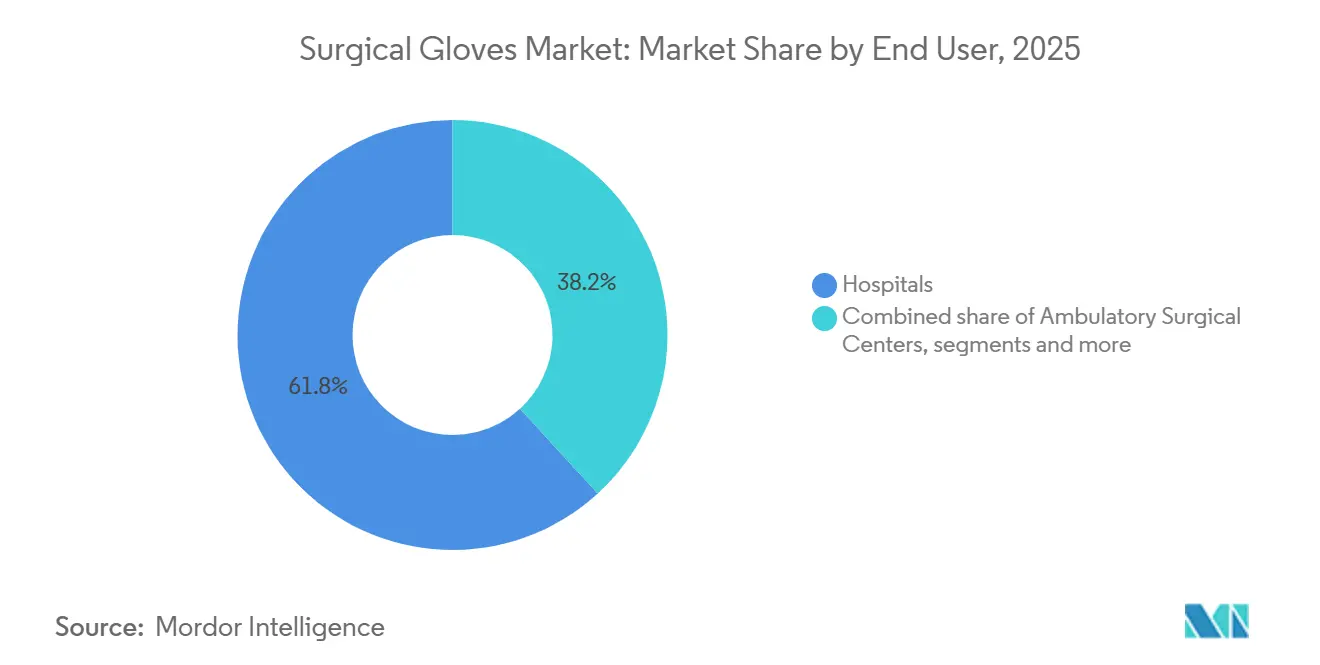
- By end user - hospitals accounted for 61.80% of the surgical gloves market size in 2025, while ASCs are advancing at a 5.41% CAGR to 2031.
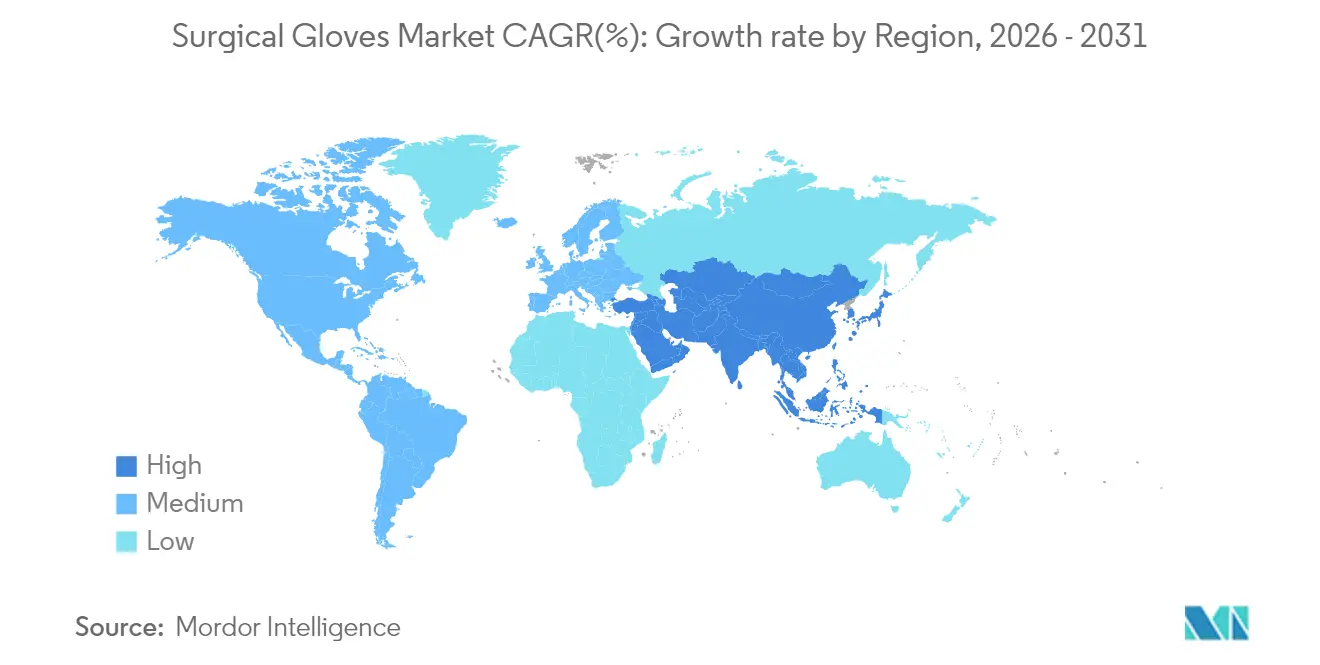
- By geography - North America led with 34.10% revenue share in 2025; Asia-Pacific is forecast to expand at a 5.26% CAGR to 2031.
Note: Market size and forecast figures in this report are generated using Mordor Intelligence’s proprietary estimation framework, updated with the latest available data and insights as of 2026.
Market Trends and Insights
Drivers Impact Analysis of Surgical Gloves Market*
| Driver | (~) % Impact on CAGR Forecast | Geographic Relevance | Impact Timeline |
|---|---|---|---|
| Surge in global surgical procedures | +1.2% | Global, with concentration in North America & APAC | Medium term (2-4 years) |
| Stringent workplace safety mandates in emerging markets | +0.8% | APAC core, spill-over to MEA | Long term (≥ 4 years) |
| Shift toward powder-free & accelerator-free chemistries | +0.6% | Global | Short term (≤ 2 years) |
| Adoption of e-commerce procurement by hospitals & ASCs | +0.4% | North America & EU | Medium term (2-4 years) |
| Blockchain-enabled provenance tracking for latex sourcing | +0.2% | Global, early adoption in North America | Long term (≥ 4 years) |
| Robotic surgery expansion driving demand for high-tactility gloves | +0.3% | North America & EU, expanding to APAC | Medium term (2-4 years) |
| Source: Mordor Intelligence | |||
Surge in Global Surgical Procedures
Elective, trauma, and outpatient surgeries continue to climb as life expectancy rises and minimally invasive techniques shorten recovery time. Sg2 projects that ASC procedure volume will expand 21% to hit 44 million cases by 2034, more than offsetting lower glove consumption per case than inpatient settings [1]Sg2, “Impact of Change Forecast 2024,” ascfocus.org. Orthopedic and spine operations dominate this wave, demanding gloves with high puncture resistance and tactile feedback. Despite tight global supplies, the Malaysian Rubber Glove Manufacturers Association (MARGMA) forecasts a shortfall of 80 billion pieces in 2024. Demand is set to reach 500 billion pieces, but installed capacity is only at 420 billion. This gap not only sustains pricing power but also encourages measured capacity additions, steering clear of speculative oversupply. Hospitals keep complex cases, preserving premium glove demand, while cost-sensitive ASCs lean toward bulk purchasing contracts that bundle high-usage items. Overall, the surgical gloves market benefits from volume growth even as unit cost pressure intensifies.
Stringent Workplace Safety Mandates in Emerging Markets
Governments from India to Indonesia are tightening personal protective equipment (PPE) rules that parallel European norms, making certified surgical gloves mandatory in operating theaters and high-risk industrial zones. The World Intellectual Property Organization (WIPO) records a 26.4% CAGR in occupational-health tech patents between 2018 and 2023, underscoring regulatory momentum. Enforcement is shifting from paper audits to digital monitoring, creating steady rather than sporadic glove demand. Domestic-content stipulations encourage local manufacturing, yet quality variances across plants necessitate strict supplier audits by global buyers.
Shift Toward Powder-Free & Accelerator-Free Chemistries
Polyisoprene and advanced nitrile formulations now mimic latex elasticity without protein allergens, but production complexity lifts factory conversion costs by up to 20%. A systematic review shows that double-gloving reduces inner-glove perforation rates by 80%, prompting hospitals to standardize thin, high-performance variants. The change accelerates innovation cycles and fattens demand for premium chemistries that command higher average selling prices.
Adoption of E-Commerce Procurement by Hospitals & ASCs
Supply chain shocks have pushed healthcare providers to cloud-based purchasing portals that support demand forecasting, automatic replenishment, and real-time pricing. Cardinal Health’s USD 340 million robotics-enabled distribution center in Fort Worth cuts order-to-ship time by 40–60% and illustrates the infrastructure underpinning e-commerce uptake. ASCs, operating with lean staff and limited storage, favor vendors that can guarantee small, frequent shipments. Suppliers that integrate inventory data with hospital ERP systems gain stickiness, reinforcing digital platform investment across the surgical gloves market.
Restraints Impact Analysis of Surgical Gloves Market*
| Restraint | (~) % Impact on CAGR Forecast | Geographic Relevance | Impact Timeline |
|---|---|---|---|
| Raw-material price volatility (NRL, nitrile) | -0.9% | Global, acute impact in APAC manufacturing hubs | Short term (≤ 2 years) |
| Latex allergy concerns & regulatory bans on powdered gloves | -0.5% | Global, concentrated in developed markets | Medium term (2-4 years) |
| ESG scrutiny on Southeast-Asian glove factories | -0.4% | APAC manufacturing hubs, global supply impact | Medium term (2-4 years) |
| Supply-chain concentration risk in Malaysia & Thailand | -0.3% | Global, originating from APAC manufacturing base | Long term (≥ 4 years) |
| Source: Mordor Intelligence | |||
Raw-Material Price Volatility
Natural rubber latex (NRL) surged to a 13-year price high in October 2024 after heavy rains hammered Thai and Chinese plantations, squeezing margins for glove makers reliant on Southeast Asian supply. Simultaneous shortages of nitrile butadiene rubber in the United States prompted federal waivers for foreign sourcing until at least late 2025. Producers pass some costs to buyers, yet long-term contracts cap price flexibility, pressuring EBITDA margins. Diversifying into guayule or Scorzonera tau-saghyz remains at pilot scale, leaving the surgical gloves market exposed to commodity swings.
Latex Allergy Concerns & Regulatory Bans
Healthcare worker sensitization rates of 8–12% keep pressure on hospitals to minimize latex exposure. Clinical evidence shows latex-free gloves incur 4.24-times higher perforation risk, creating a procurement trade-off between allergy avoidance and barrier integrity. The rupture risk drives demand for premium polyisoprene, priced 15–20% above conventional latex. Manufacturers must run parallel production lines to serve diverging customer preferences, adding capital overhead and operational complexity.
*Our forecasts treat driver/restraint impacts as directional, not additive. The impact forecasts reflect baseline growth, mix effects, and variable interactions.
Surgical Gloves Market Segment Analysis
By Material:
Polyisoprene Innovation Drives Premium SegmentThe surgical gloves market have latex occupying 38.70% of surgical gloves market share on the strength of low cost and proven performance. Yet hospitals are migrating toward latex-free operating rooms, propelling polyisoprene to a 4.96% CAGR through 2031. Molecular-dynamics studies peg polyisoprene’s glass-transition temperature at 204.2 K, balancing flexibility and tear resistance—traits valued in microsurgery. Manufacturers add antioxidant packages to curb discoloration, and accelerator-free curing lowers Type IV allergy risk. Nitrile keeps traction in examination settings, while neoprene fills chemical-resistant niches such as oncology compounding. Sustainable sourcing is gaining ground; Top Glove’s BioGreen nitrile gloves biodegrade under anaerobic landfill conditions, aligning with hospital waste-reduction mandates .
In procurement bids, buyers now score materials on a weighted matrix of allergenicity, tactile response, environmental footprint, and price. This shift favors vertically integrated suppliers that control latex tapping, compounding, and finished-goods molding because they can adjust formulations quickly. Regional contract awards in India and Indonesia increasingly require localized raw-rubber content, nudging multinationals to joint ventures or toll-manufacturing deals. The resulting tactical alliances will shape capacity additions over the next cycle in the surgical gloves market.


By Form:
Powder-Free Dominance AcceleratesPowder-free variants captured 87.65% share of the surgical gloves market size in 2025 after powder ban mandates swept across major economies. Surface-coating chemistries such as polyurethanes or chlorination now give gloves a silky feel that speeds donning without cornstarch, while micro-texturing boosts grip in wet fields. Capital expenditure to retrofit production lines can reach USD 20 million per plant, erecting barriers that have quickened consolidation as smaller Asian manufacturers exit. Buyers benefit from reduced granuloma risk and lower intra-operative particle counts, which translate into shorter surgical times and fewer post-operative infections.
Conversely, remaining powdered glove users cluster in small industrial segments where surgical-grade sterility is unnecessary, but even these markets face imminent restrictions as occupational-safety regulations tighten. Automation technologies, such as Ansell’s DERMASHIELD spray-on polymers, accelerate throughput and shrink defect rates, improving plant OEE to the mid-80% range. Such efficiency gains blunt the cost penalty historically associated with powder-free processing, allowing suppliers to defend margins amid rising energy and labor expenses.
By End User:
ASCs Drive Structural Market ShiftHospitals consumed 61.80% of surgical gloves market size in 2025, but the compound effect of payer incentives and physician ownership structures is redirecting simpler procedures to ASCs, which are growing at a 5.41% CAGR. ASCs standardize trays and pursue vendor consolidation, favoring suppliers that can bundle gloves with drapes, gowns, and antiseptics under a single-source contract. They also require digital dashboards that reconcile case costing with supply usage in near-real time, pushing glove makers to integrate EDI and bar-code serialization.
The hospital channel still dominates revenue thanks to longer procedure times and higher glove changes, especially in transplant and cardiothoracic specialties. Teaching facilities increasingly adopt double-gloving for resident training, lifting per-procedure utilization. Over in primary-care clinics, demand holds steady, but margin pressure remains acute as reimbursement cuts persist. Dental and veterinary offices offer modest niche growth driven by infection-control accreditation requirements. Collectively, these patterns underscore the need for segmented sales strategies within the larger surgical gloves market.
Geography Analysis
North America Surgical Gloves Market
North America generated 34.10% of global revenue in 2025 and remains the procurement standard-setter due to a mature hospital network, robust infection-control guidelines, and group-purchasing organizations that mandate ASTM compliance. U.S. federal agencies alone ordered 55.5 million boxes of nitrile gloves in 2025 as part of domestic-stockpile programs. Tariff pressures and geopolitical risk from China have revived interest in near-shoring to Mexico and Puerto Rico. To fortify resilience, Cardinal Health invested USD 340 million in an automation-heavy distribution hub that supports one-day delivery to 80% of U.S. surgical sites.
APAC Surgical Gloves Market
Asia-Pacific is advancing at a 5.26% CAGR through 2031, reflecting rising surgical infrastructure and the region’s dual identity as both supply base and demand center. Malaysia and Thailand produce roughly two-thirds of the world’s surgical gloves, yet Thai research flags persistent labor shortages and climate-change exposure that could disrupt latex tapping seasons . China’s elective-surgery rebound post-zero-COVID adds a substantial incremental volume, while India’s Ayushman Bharat insurance scheme continues to unlock latent demand in tier-2 cities. Local content rules in Indonesia and Vietnam encourage foreign brands to build or partner in-country, altering the competitive map of the surgical gloves market.
EMEA and South America Surgical Gloves Market
Europe maintains stable mid-single-digit growth, driven by sustainability regulations and a push for circular-economy compliance. Mölnlycke’s EUR 50 million Malaysian plant includes biomass boilers and solar rooftops to satisfy EU carbon-footprint reduction targets. The bloc’s EcoDesign directive will likely require material passports, amplifying interest in blockchain traceability. South America and the Middle East & Africa trail but offer long-run potential once macroeconomic volatility settles; Brazil’s new PPP program for hospital upgrades and Saudi Arabia’s Vision 2030 private-hospital wave represent catalysts, albeit from a low base. Logistics bottlenecks and currency swings remain obstacles that suppliers must price into long-term contracts.

Regulatory Landscape
In the United States, surgeon's gloves are regulated by the FDA under 21 CFR 878.4460 (Product Code KGO) as medical devices, with manufacturers operating under FDA device controls and quality-system requirements. A key recent shift is the FDA Quality Management System Regulation (QMSR), taking effect on February 2, 2026, which incorporates ISO 13485:2016 by reference and tightens alignment between US and international quality expectations. In practice, sterile surgical gloves also map to recognized consensus standards used in procurement and compliance programs (for example, ASTM D3577 and ISO 10282:2023), reinforcing performance and sterility benchmarks demanded by hospitals and group purchasing organizations.
In the European Union, surgical gloves fall under Regulation (EU) 2017/745 (MDR) and must meet the applicable General Safety and Performance Requirements, along with conformity assessment expectations for the device class. The harmonised standards framework continues to be refreshed through Official Journal updates, including Commission Implementing Decision (EU) 2025/681, which updated citations such as EN 455-1:2020+A2:2024 and EN 455-2:2024 for medical gloves. This raises the importance of keeping test-method and documentation up to date for suppliers competing in cross-border tenders.
Competitive Landscape
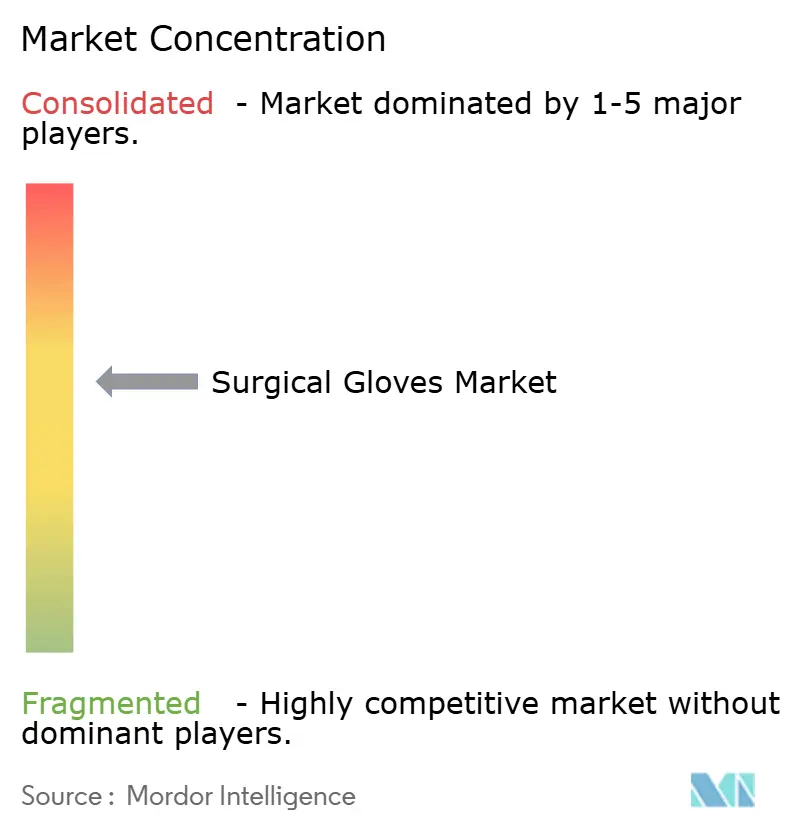
The competitive landscape is moderately concentrated, featuring several dominant manufacturers. In Q1 FY2025, Top Glove experienced a significant revenue increase, swinging its net profit back to positive territory. This rebound, fueled by normalized demand and enhanced utilization rates, is reshaping share positions in the surgical gloves market.
Technology is emerging as a pivotal differentiator. Meanwhile, experimental haptic-feedback gloves for VR surgical training suggest potential new revenue avenues. In a nod to food-traceability initiatives, Mayo Clinic and a consortium of Midwest suppliers are piloting blockchain projects to verify the origins of latex. Proponents of these systems anticipate lower recall costs and improved ESG ratings.
As demand stabilizes, capacity rationalization is in full swing. Kossan Rubber's investment in robotics for stripping lines has reduced labor requirements by 1,000 gloves per shift. Meanwhile, smaller, less automated plants in Malaysia and Thailand have either shut down or shifted focus to domestic industrial-glove production. Leveraging their financial strength, larger manufacturers are securing long-term contracts for butadiene and latex, shielding themselves from raw material price fluctuations. In Europe and North America, sustainability credentials, whether through EcoVadis ratings or commitments to science-based targets, are increasingly crucial in tender awards.
Surgical Gloves Industry Leaders
Ansell Limited
Top Glove Corporation Bhd
Hartalega Holdings Berhad
Kossan Rubber Industries Bhd
Cardinal Health Inc.
- *Disclaimer: Major Players sorted in no particular order
Surgical Gloves Market Companies Covered in this Report
- Ansell
- Asma Rubber Products Pvt. Ltd.
- Cardinal Health
- Cranberry Global
- Dynarex
- Globus (Shetland) Ltd.
- Hartalega Holdings
- Kanam Latex Industries
- Kossan Rubber Industries
- Medline Industries
- Molnlycke Health Care
- Shandong Intco Medical Products
- Sri Trang Gloves Plc
- Supermax
- Top Glove
- Unigloves (UK) Ltd.

Market Opportunities and Future Outlook
Supply diversification and localization programs are creating clear whitespace for capacity placed closer to demand centers, and for suppliers that can meet local-content and resilience-driven sourcing goals. This is already visible in announced projects, including Supermax Corporation Bhd's BRL 250 million investment in May 2026 to establish a medical glove manufacturing facility in Parana, Brazil (2.4 billion gloves per year), Top Glove Corp Bhd pursuing capacity expansion in Thailand in June 2026 (including a block for 14 double-former lines), and U.S. Medical Glove Company (USMGC) advancing onshoring with a large Ohio manufacturing facility lease announced in May 2025, alongside subsequent overseas investment that signals a multi-hub build-out. These moves align with buyer priorities exposed during recent supply shocks, particularly for hospitals and fast-turn ambulatory surgical centers that place weight on continuity of supply and shorter replenishment cycles.
A second opportunity set is emerging in tenders through product and process differentiation that is already becoming a selection criterion: powder-free compliance at scale, lower-allergen material mixes (notably polyisoprene), and auditable sustainability attributes that help providers respond to ESG scrutiny around glove supply chains. Top Glove's June 2026 independent verification of a product carbon footprint for nitrile powder-free gloves points to a measurable pathway for suppliers to compete on environmental metrics, while the FDA-recognized standards ecosystem (ASTM and ISO 10282:2023) offers a structured route for new formulations and performance-enhancing features to be specified and qualified. Alongside this, academic work on antimicrobial and biodegradable material approaches supports a pipeline for premium SKUs where providers aim to balance infection-control outcomes with waste-reduction mandates.
Recent Industry Developments in Surgical Gloves Market
- June 2026: Top Glove Corporation Bhd announced it achieved independently verified Product Carbon Footprint (PCF) measurement for its nitrile powder-free gloves, quantifying emissions per 1,000 gloves. This type of third-party verification supports eligibility in sustainability-weighted tenders and gives procurement teams a comparable metric across suppliers.
- May 2026: Supermax Corporation Bhd announced a BRL 250 million investment to establish a medical glove manufacturing facility in Parana, Brazil, targeting annual capacity of about 2.4 billion gloves. The project expands production geography beyond Southeast Asia and strengthens regional supply resilience for the Americas.
- May 2025: The master lease for a 638,000 square-foot manufacturing facility in Ohio was executed by U.S. Medical Glove Company (USMGC) as part of building an American-made supply chain for medical and surgical gloves. The scale of the site supports domestic availability goals tied to institutional purchasing and stockpile strategies.


Surgical Gloves Market Report Scope and Research Methodology
Market Definition and Coverage
This market covers sterile, single-use surgical gloves that are cleared and used for invasive procedures in operating rooms and similar surgical settings, valued at the point of sale from manufacturers through standard healthcare channels.
Scope exclusions: We exclude examination gloves, cleanroom or industrial gloves, and reusable glove alternatives.
Segments Covered in This Report
- By Material
- Latex
- Nitrile
- Neoprene
- Polyisoprene
- Others (Vinyl and Synthetic blends, among others)
- By Form
- Powdered
- Powder-free
- By End-user
- Hospitals
- Ambulatory Surgical Centers
- Clinics & Physician Offices
- Dental & Veterinary Facilities
- Others (Emergency Centers, among others)
- By Geography
- North America
- United States
- Canada
- Mexico
- Europe
- Germany
- United Kingdom
- France
- Italy
- Spain
- Rest of Europe
- Asia-Pacific
- China
- Japan
- India
- South Korea
- Australia
- Rest of Asia-Pacific
- South America
- Brazil
- Argentina
- Rest of South America
- Middle East and Africa
- GCC
- South Africa
- Rest of Middle East and Africa
- North America
Data Sources, Market Sizing, and Validation
Desk Research
Desk work starts by setting guardrails on what counts as a surgical glove and what does not, then pulling public signals that indicate demand and supply direction. We typically reference the US FDA (device listings and safety notices), CDC and WHO infection prevention guidance, OECD health statistics, the World Bank health indicators, and UN Comtrade trade data for rubber articles, which together help frame procedure intensity, import reliance, and regional momentum.
We then triangulate with non-paywalled material such as company annual reports and investor decks, hospital procurement notes, and reputable medical device press to track pricing cycles and capacity additions. Where consistency across countries is hard to maintain, we also use paid company financials and intelligence, shipment-level trade visibility, and patent databases to cross-check material shifts (for example latex to synthetic) and product claims. These examples are not exhaustive, and other public and proprietary sources are used to collect, verify, and clarify inputs.
Primary Interviews and Surveys
Primary work is used to pressure-test desk assumptions and close gaps that public data often leaves, especially around sterile glove ASPs, tender behavior, and what portion of volume is actually used in surgery. We speak with a mix of manufacturers, distributors, hospital procurement teams, and clinicians, then tune assumptions until the demand story aligns with real ordering patterns across APAC, EMEA, and the Americas.
Distribution of primary research fieldwork respondents
| Company type | Respondent position | Region |
|---|---|---|
| Top tier: 28% | CXOs: 13% | APAC: 41% |
| Mid tier: 57% | Functional/Unit leaders: 31% | EMEA: 34% |
| Smaller Players: 15% | Managers: 56% | Americas: 25% |
Market-Sizing & Forecasting
We size the market using a top-down build that starts from the global pool of surgical procedures and sterile glove use norms, then converts these into annual glove volumes by region before applying price ladders. To keep totals realistic, we corroborate the output with selective bottom-up checks, such as sampled ASP times volume for key materials, distributor channel checks, and a limited roll-up of reported glove revenues where product mix is clear.
A few inputs that matter in this market include surgical procedure growth by region, average gloves used per procedure (including double-gloving practice), the share of surgeries done in hospitals versus ambulatory centers, material mix shifts between latex and synthetics, and observed tender cycles that move pricing up or down. When a data point is missing for a country, we bridge the gap using peer-country procedure rates and healthcare spend context, then re-check it with interview feedback so the implied consumption does not jump unnaturally.
For forecasting, we use scenario analysis built on procedure volumes, facility expansion, and expected ASP movement tied to raw material and compliance costs. Where the signal is stable, smoothing is applied to avoid over-reacting to short-term price spikes, and then final growth paths are adjusted to align with what suppliers and procurement teams expect in their forward contracts.
Data Validation & Update Cycle
Outputs are validated through multiple checks so the final number can be traced back to straightforward drivers. We compare implied glove volumes against procedure counts and double-gloving penetration, and we also review whether regional pricing trends match what tenders and trade flows suggest.
Before sign-off, anomalies are flagged and reworked, and the team is re-contacted when a large variance appears versus a known signal such as major capacity change or a sudden policy shift in infection control. Reports are refreshed annually, with interim updates when material events occur, and an analyst completes a final pre-delivery pass so clients receive the most current view.
Mordor Intelligence's Surgical Gloves Market Size Compared Against Other Published Estimates
Published market sizes for surgical gloves can look far apart because the scope is not always aligned, and key assumptions are handled differently. The biggest swings usually come from whether exam gloves get mixed in, how procedure volume is translated into glove usage, and how pricing is averaged across tenders and spot buys.
The main gap comes from mixing surgical and examination gloves, where Mordor Intelligence counts only sterile, surgery-certified single-use gloves and then ties demand to procedure volume and double-gloving practice before applying region-level ASPs that are refreshed with procurement feedback.
Benchmark comparison
| Source | Market Size | Gaps in Research Methodology |
|---|---|---|
| Mordor Intelligence | USD 5.26 B (2026) | |
| Trade Journal A | USD 2.29 B (2023) | Uses an earlier base year and a narrower captured revenue pool, and it may under-count distributor markups or exclude parts of hospital channel spend outside direct manufacturer reporting. |
| Industry Bulletin B | USD 5.46 B (2024) | Appears to cover disposable surgical gloves broadly and can include adjacent sterile glove use cases, which shifts the counted volume and changes the blended ASP versus a surgery-only definition. |
The table shows that most of the spread is explained by scope and timing, not by arithmetic. Once the counted glove type is kept strict and the demand pool is anchored to procedures and realistic usage, the estimate becomes easier to reproduce and easier to audit when assumptions change.


Key Questions Answered in the Report
What is the current size of the surgical gloves market?
The Surgical Gloves Market size is expected to reach USD 5.26 billion in 2026 and grow at a CAGR of 4.44% to reach USD 6.54 billion by 2031.
Which material segment is growing fastest?
Polyisoprene gloves are growing quickest at a 4.96% CAGR because they match latex feel without protein allergens.
Why are powder-free gloves dominant now?
Regulatory bans on powdered gloves and hospital infection-control protocols have pushed powder-free variants to 87.65% market share in 2025.
How are ambulatory surgical centers affecting demand?
ASCs shift routine surgeries out of hospitals, expanding glove volume while emphasizing cost-efficient digital procurement and standardized products.
What risks threaten surgical glove supply?
Price spikes in natural rubber latex and nitrile feedstocks, plus geographic concentration of plantations in Southeast Asia, create ongoing supply-chain vulnerability.
Page last updated on:


 Your data is secure and never sold or shared.


