
Global Surgical Drills Market Size and Share
Market Overview
| Study Period | 2020 - 2031 |
|---|---|
| Market Size (2026) | USD 1.16 Billion |
| Market Size (2031) | USD 1.51 Billion |
| Growth Rate (2026 - 2031) | 5.42 % |
| Fastest Growing Market | Asia Pacific |
| Largest Market | North America |
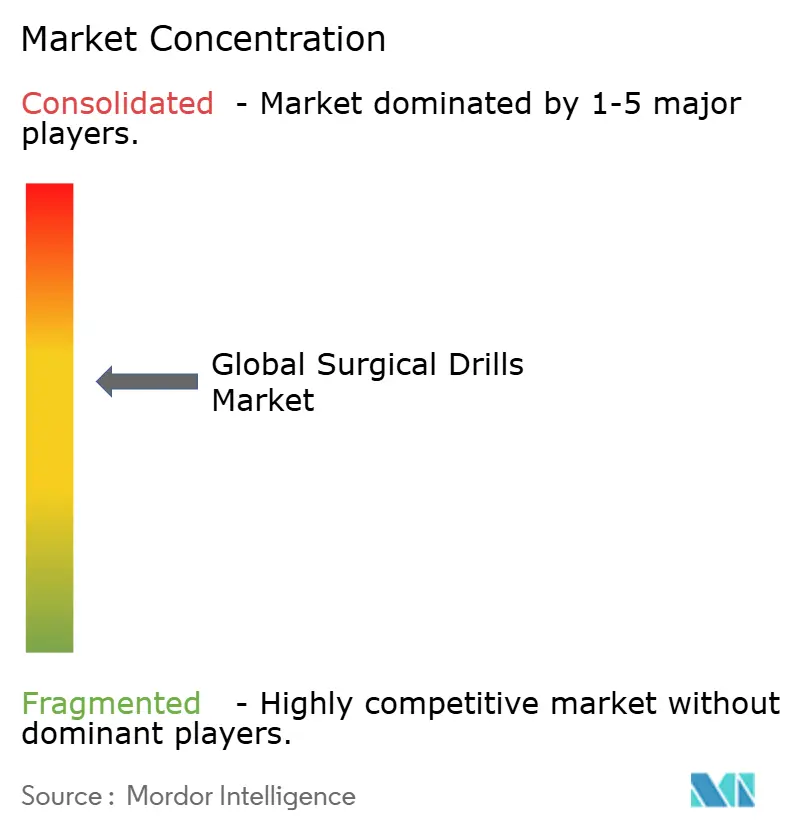
| Market Concentration | Medium |
Major Players *Disclaimer: Major Players sorted in no particular order Image © Mordor Intelligence. Reuse requires attribution under CC BY 4.0. | |
Global Surgical Drills Market Analysis by Mordor Intelligence
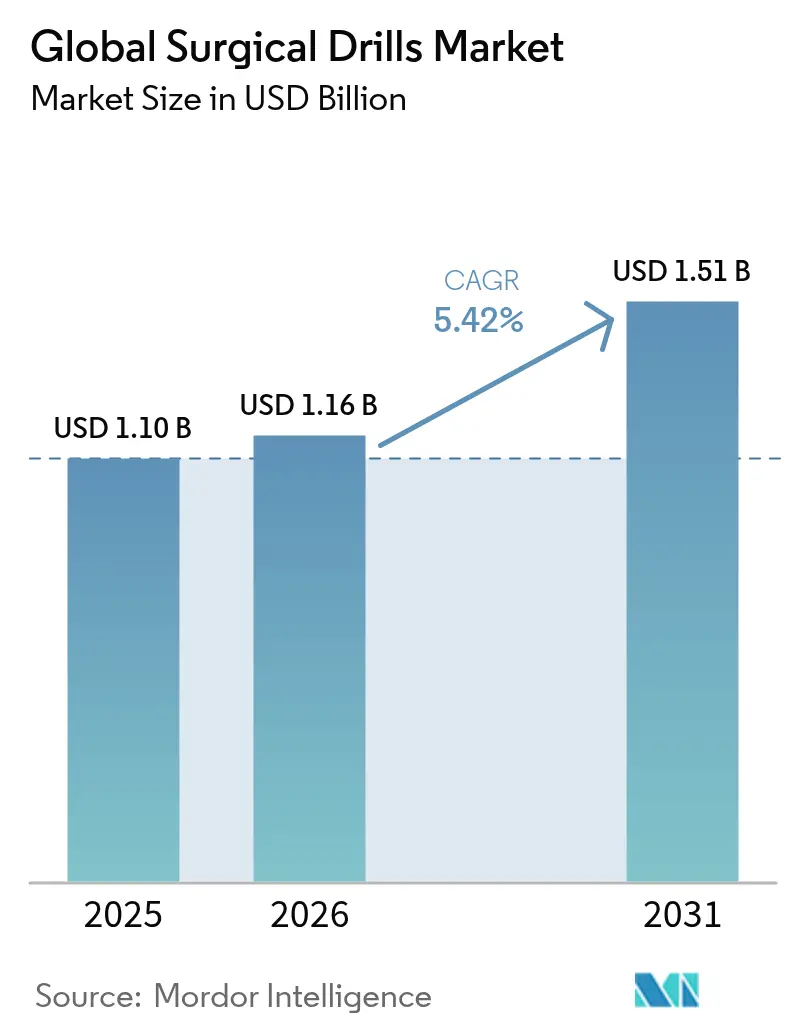
The surgical drills market size is expected to grow from USD 1.10 billion in 2025 to USD 1.16 billion in 2026 and is forecast to reach USD 1.51 billion by 2031 at 5.42% CAGR over 2026-2031. Demand is powered by climbing surgical volumes, rapid improvements in battery chemistry, and the migration of procedures toward minimally invasive techniques that call for ever-tighter drilling tolerances. Hospitals are shifting capital budgets from pneumatic lines to cordless systems because smart batteries cut turnover time, while software-guided drill profiles give surgeons repeatable accuracy regardless of bone density. Rare-earth–efficient motors, lighter composite housings, and autoclavable lithium packs have pushed performance parity with corded gear, setting the stage for cordless dominance. Aging demographics and the steady rise of robotic and navigation platforms further tighten the link between drill performance and overall surgical workflow efficiency, elevating engineering quality over simple unit sales growth.
Key Report Takeaways
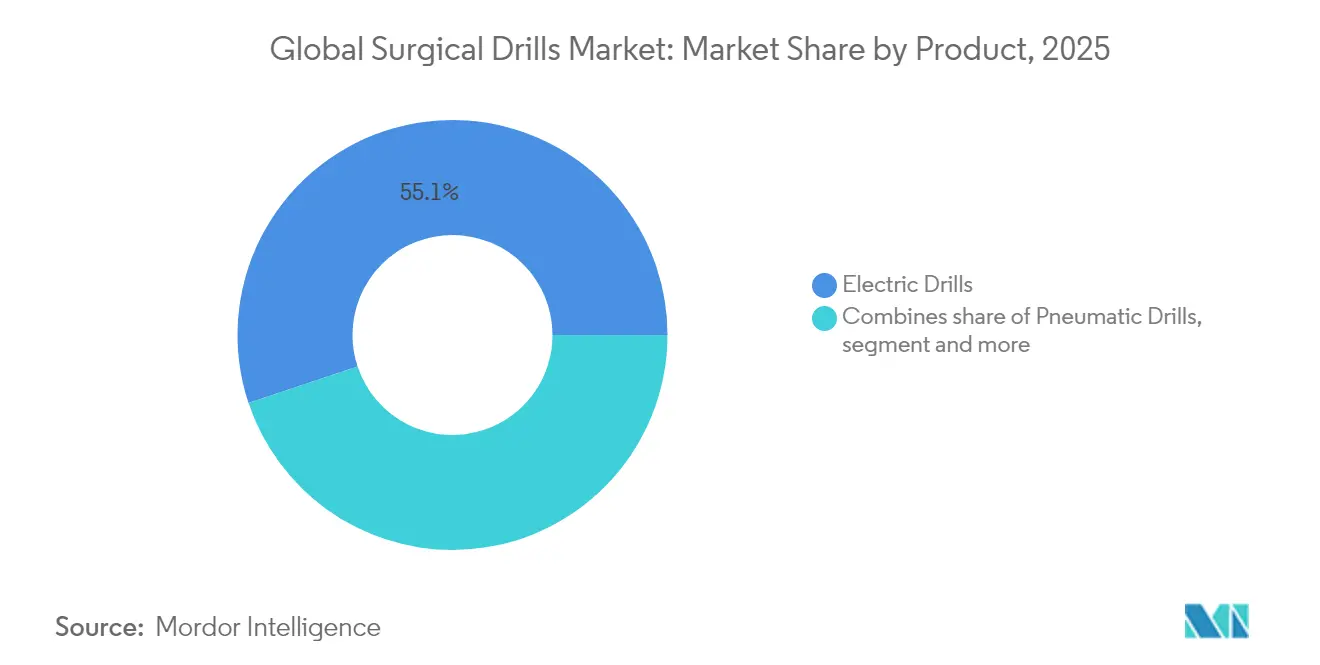
- By product, electric drills led with 55.12% revenue share in 2025; battery-powered drills are projected to expand at a 6.12% CAGR to 2031.
- By speed, high-speed (above 60,000 rpm) commanded 60.85% of the surgical drills market size in 2025, also high-speed (above 60,000 rpm) is forecast to post the fastest 5.98% CAGR to 2031.
- By application, orthopedic surgery accounted for 66.05% of the surgical drills market share in 2025, while dental surgery is advancing at a 6.48% CAGR through 2031.
- By end-user, hospitals and clinics commanded 69.05% of the surgical drills market size in 2025, whereas ambulatory surgery centers are growing quickest at 6.84% CAGR.
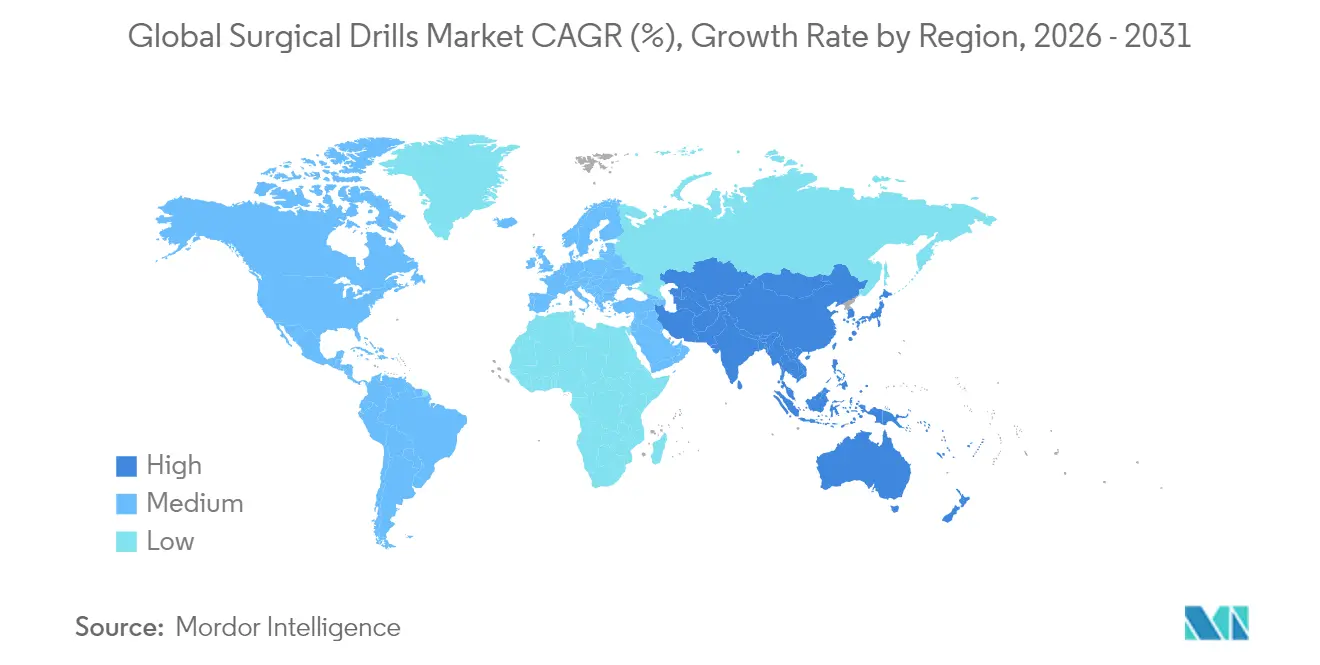
- By geography, North America held 40.20% of the surgical drills market share in 2025; Asia-Pacific is forecast to post the fastest 7.15% CAGR to 2031.
Note: Market size and forecast figures in this report are generated using Mordor Intelligence’s proprietary estimation framework, updated with the latest available data and insights as of 2026.
Market Trends and Insights
Drivers Impact Analysis of Global Surgical Drills Market*
| Driver | (~) % Impact on CAGR Forecast | Geographic Relevance | Impact Timeline |
|---|---|---|---|
| Rising orthopedic & trauma surgery volume | +1.2% | Global, strongest in North America & Asia-Pacific | Medium term (2-4 years) |
| Ergonomics & power-train innovation | +0.8% | Global, led by North America & Europe | Short term (≤ 2 years) |
| Uptick in minimally invasive & robotic cases | +1.0% | North America & Europe core, expanding into Asia-Pacific | Medium term (2-4 years) |
| Growing geriatric musculoskeletal burden | +0.9% | Global, accelerated in developed economies | Long term (≥ 4 years) |
| Shift to single-use drills | +0.6% | North America & Europe, expanding globally | Short term (≤ 2 years) |
| 3-D-printed custom drill guides | +0.4% | North America & Europe, selective uptake in Asia-Pacific | Medium term (2-4 years) |
| Source: Mordor Intelligence | |||
Rising Orthopedic & Trauma Surgery Volume
Primary total knee arthroplasties in the United States alone are forecast to jump 673% by 2030, while hip replacements rise 174%, creating an unprecedented load for precision drilling systems. Similar trajectories play out in fast-urbanizing Asian economies where traffic-related trauma lifts fracture repairs. As cases migrate from inpatient theaters to outpatient suites, battery-powered platforms that bypass built-in compressor lines win favor, especially in ambulatory orthopedic centers posting double-digit growth. High procedure complexity in elderly bone drives torque-controlled drills that avoid micro-cracks, raising demand for programmable speed profiles. These factors combine to keep the surgical drills market on a sturdy upward arc.
Rapid Ergonomics & Power-Train Innovation
New generations of cordless drills match, and in some tasks exceed, pneumatic torque while eliminating hose drag that can contaminate sterile fields. CONMED’s Hall Lithium Battery system recharges in 30 minutes and withstands repeated autoclave cycles, solving the durability gap that once hampered lithium packs.[1]CONMED Corporation, “Hall Lithium Battery System,” conmed.com Stryker’s Signature 2 delivers 75,000 RPM from a slim handle that reduces surgeon fatigue, and its software lets teams preload speed-torque curves for specific bone types. Hospitals measure such gains in minutes saved per case, turning capital-equipment debates into workflow decisions rather than pure price comparisons. As AI overlays guide depth and angle, drills become data nodes in the wider digital OR ecosystem.
Surge in Minimally Invasive & Robot-Assisted Procedures
Robotic systems performed 17% more procedures in 2024, and robotic TKAs already make up 13% of all U.S. knee replacements. In Europe and Asia, AI-aided platforms such as Johnson & Johnson’s VELYS add real-time kinematic feedback that depends on drills capable of micron-level reproducibility. Force-sensing handpieces inside Intuitive’s da Vinci 5 reduce tissue force by 43%, proving the clinical value of embedded sensors. As robots spread from flag-ship centers to regional hospitals, sales of drills that integrate seamlessly with robotic arms will outpace those of stand-alone devices, expanding the surgical drills market.
Growing Geriatric Musculoskeletal Burden
In Germany, total hip arthroplasties could rise 29% from 2016 to 2040, with the steepest climb among patients aged 80-89 years. High-porosity bone in this cohort heightens the need for drills that modulate speed in real time to curb heat buildup. Health systems also push for shorter anesthesia windows, rewarding automated drilling modules that shave minutes from bone prep. Collectively, demographic pressure cements a steady baseline for the surgical drills market even when discretionary procedures plateau.
Restraints Impact Analysis of Global Surgical Drills Market*
| Restraint | (~) % Impact on CAGR Forecast | Geographic Relevance | Impact Timeline |
|---|---|---|---|
| Post-surgery complications linked to drilling | -0.7% | Global, higher in emerging markets | Short term (≤ 2 years) |
| High acquisition & lifecycle cost | -0.5% | Global, pronounced in cost-sensitive markets | Medium term (2-4 years) |
| Sterilization waste & sustainability pressure | -0.3% | Europe & North America leading, expanding globally | Long term (≥ 4 years) |
| Rare-earth magnet supply bottlenecks | -0.4% | Global, highest impact on premium products | Medium term (2-4 years) |
| Source: Mordor Intelligence | |||
Post-Surgery Complications Linked to Drilling
Bone temperatures above 47 °C impair osteogenesis; conventional drills can exceed 100 °C in dense cortical bone, expanding osteonecrosis zones.[2]Paweł Chodzko-Zajko, “Thermal Risks in Bone Drilling,” MDPI Applied Sciences, mdpi.comStudies show even sequential reaming fails to eliminate heat trauma entirely, fueling legal and cost concerns for hospitals. Ultrasonic-assisted drilling lowers force and heat but costs more and requires surgeon retraining, slowing uptake. Until embedded cooling or smarter torque governors become mainstream, risk-averse buyers in emerging markets may postpone upgrades, restraining part of the surgical drills market.
High Acquisition & Lifecycle Cost of Power Systems
A top-tier cordless console, four handpieces, and two battery sets can exceed USD 50,000 over seven years once maintenance and cell replacements are tallied. Although pneumatics carry compressor upkeep, the upfront sticker shock of lithium systems challenges procurement teams in cost-controlled regions. Value-based payment models now dominate U.S. orthopedics, compelling administrators to prove tangible efficiency gains before approving new drills. Vendors counter with leasing, multi-year service bundles, and modular upgrades, but budget scrutiny still slows purchase cycles.
*Our forecasts treat driver/restraint impacts as directional, not additive. The impact forecasts reflect baseline growth, mix effects, and variable interactions.
Global Surgical Drills Market Segment Analysis
By Product:
Corded Reliability Meets Cordless MomentumElectric drills currently generate 55.12% of revenue, reflecting decades of OR familiarity and steady performance. Yet cordless units are climbing at 6.12% CAGR as battery swaps under 30 seconds and autoclave-safe packs free teams from fixed power outlets. Pneumatic drills retain a niche in high-volume trauma centers that already own central air, but their share erodes as compressors age out. Accessory kits—sterile bits, backup batteries, docking carts—form a steady annuity stream, so vendors align channel programs to lock hospitals into platform ecosystems. The surgical drills market size for cordless platforms is forecast to eclipse corded revenue by the late 2020s, driven by procedure mobility in hybrid ORs.
Custom-tuned power management chips now stretch runtime past eight complex orthopedic cases per charge, erasing prior downtime criticism. Arthrex’s 2025 cordless launch paired a carbon-fiber shell with AI-based cell-health analytics, signaling a trend toward predictive maintenance that minimizes unplanned stoppages. Suppliers that retrofit compatibility sleeves for legacy shafts lower switching friction, accelerating fleet conversion within budget-sensitive systems.


By Speed:
Precision Favors the Fast LaneHigh-speed drills topping 60,000 RPM hold 60.85% share and still grow at 5.98% CAGR, underscoring surgeon preference for crisp cutting in minimally invasive corridors. These handpieces integrate micro-vent channels and ceramic bearings to dissipate friction heat and preserve bone viability. The surgical drills market size for high-speed models is projected to reach USD 954.6 million by 2031 as ENT and spine teams demand burrs that navigate tight anatomy without chatter. Standard-speed drills remain important in trauma units and revision arthroplasty where dense callus calls for controlled advancement.
Recent design shifts favor adaptive-speed controllers that drop rpm automatically when sensors detect thin cortical layers, protecting underlying tissue. Stryker’s servo loop caps overshoot within 50 microseconds, and firmware updates ship over secure Wi-Fi, linking handpieces to central device-management dashboards.
By Application:
Orthopedic Dominance, Dental AccelerationOrthopedics accounts for 66.05% of revenue thanks to joint replacements and fracture fixations, but dental indications clock the fastest 6.48% CAGR as implant volumes surge. Oral surgeons demand drills that limit thermal necrosis in narrow sockets; single-drill protocols validated in 2024 dropped peak bone temperature by 10 °C versus sequential reaming. The surgical drills market size in dentistry is forecast to double this decade, aided by chair-side 3-D workflows that rely on low-noise, high-speed bits.
Neurosurgery and ENT call for ultra-small collets and depth-stop algorithms; Northwestern Medicine’s adoption of an auto-stop brain drill in March 2025 cut ventriculostomy times and reduced drift risk. Such specialty wins highlight opportunities for niche manufacturers even as broad orthopedic spend dominates.

By End User:
Hospital Bulk Buys vs ASC AgilityHospitals and clinics still absorb 69.05% of sales, bundling drills into multi-year power-tool agreements that align with robotic acquisitions. Yet ambulatory surgery centers (ASCs) post a 6.84% CAGR, pulling procedures like total knees into outpatient suites.
The surgical drills market size captured by ASCs could top USD 427.4 million by 2031 if current migration persists. These centers value cordless sets that roll between theaters, quick-charge in 15 minutes, and require minimal biomedical tech oversight. Conversely, hospitals exploit purchasing clout to demand fleet-wide software licenses and predictive-service analytics, putting pricing pressure on vendors.
Geography Analysis
North America Surgical Drills Market
North America holds 40.20% of 2025 revenue, powered by early adoption of integrated digital ORs, solid reimbursement, and the world’s highest orthopedic caseload per capita. Leading U.S. centers embed cordless drills into robotic workstations, tightening vendor partnerships around ecosystem compatibility. Canada’s single-payer provinces purchase through group tenders that favor platform breadth over niche innovation, while Mexico’s private hospitals import premium U.S. gear to capture medical-tourism flows. Despite maturity, the region’s keen appetite for AI-enabled upgrades keeps the surgical drills market vibrant, though annual growth moderates below emerging-market pace.
Europe Surgical Drills Market
Europe offers a stable but sustainability-sensitive landscape. Germany, France, and the United Kingdom remain the anchor buyers, yet environmental directives and post-Brexit regulatory divergence add compliance layers. Hospitals in Italy and Spain increasingly stipulate low-waste packaging and end-of-life recycling plans in tenders. Eastern European states, buoyed by EU structural funds, retrofit theaters with cordless drills to leapfrog aging pneumatic lines. With CE-plus-UKCA dual marking now standard, vendors streamline filings to avoid product-launch lags, keeping continental share competitive.
APAC Surgical Drills Market
Asia-Pacific is set to grow at 7.15% CAGR, the fastest worldwide. China funnels public funding into trauma centers and invests in in-house robotic ecosystems, often pairing domestic drill makers with locally built arms to reduce import spend. Japan’s super-aged population continues to swell arthroplasty lists, compelling hospitals to adopt torque-controlled drills that minimize cortical burn in osteoporotic bone. India’s tier-I private chains equip new ASCs with battery suites, while government facilities still favor budget electric sets, carving a two-tier segment. Australia and South Korea, at technology frontiers, serve as regional reference sites for 75,000 RPM handpieces with cloud-based service logs. Collectively, this mix pushes the surgical drills market toward diversified, region-specific product roadmaps.

Regulatory Landscape
Surgical drills are regulated as medical devices across major markets, with powered bone-cutting drills in the United States commonly falling under FDA Class II with special controls (e.g., surgical device product codes used for powered surgical instruments). In the United States, the FDA Quality Management System Regulation (QMSR) took effect on February 2, 2026, incorporating ISO 13485:2016 by reference and replacing the prior 21 CFR Part 820 framework, raising the importance of ISO-aligned design controls, supplier management, and post-market processes for drill manufacturers and contract manufacturers.
In Europe, compliance is anchored to Regulation (EU) 2017/745 (MDR) and its supporting guidance and standards ecosystem. In May 2026, mandatory EUDAMED registration requirements took effect for the Actor, UDI/Device Registration, and Notified Bodies modules, impacting how drill OEMs and authorized representatives manage device/UDI data and traceability. The EU also refreshed supporting compliance inputs during 2026, including MDCG updates (April 2026) touching classification and EMDN code guidance and an updated list of harmonized standards published in the Official Journal in June 2026, reinforcing expectations around electrical safety and essential performance for powered surgical equipment.
Value Chain Analysis
The value chain runs from clinical needs definition and product design through precision component manufacturing (multi-axis machining of housings, gear trains, and couplings), assembly of handpieces and consoles, verification/validation testing, and distribution through OEM direct sales and surgical channel partners. Because drills are powered, reusable instruments that interface with sterile processing, suppliers span battery packs and charging electronics, motors and drive components, sterilizable seals and materials, and accessory ecosystems (burrs, bits, and docking/charging carts). Large OEMs such as Stryker, Zimmer Biomet, Medtronic, Johnson and Johnson (DePuy Synthes), CONMED, Arthrex, and B. Braun typically bundle drills into broader procedure platforms, while specialist suppliers (e.g., motor manufacturers such as Portescap) support performance-critical subassemblies.
Quality and compliance requirements shape supplier selection and manufacturing economics throughout the chain. ISO 13485:2016-aligned quality systems, process validation, and traceability documentation (including installation, operational, and performance qualification where applicable) are central to scalable production and to sustaining regulatory audits. For powered equipment, electrical safety and essential performance testing to the IEC 60601 series is a recurring gate for design transfer, design changes, and market access, which elevates the role of test labs and certification partners alongside contract manufacturers in shortening iteration cycles and supporting multi-region registrations.
Competitive Landscape
The market tilts moderately consolidated, with the top players controlling significant revenue slice. They wield scale advantages in regulatory staffing, clinical-training hubs, and accessory ecosystems, deterring smaller entrants. Stryker deepened its moat via the 2024 launch of Spine Guidance 5 software, embedding drill telemetry into navigation consoles. Johnson & Johnson bundles its VELYS robotic knees with battery drills and multi-year analytics subscriptions, creating high switching costs for hospitals.
Specialist challengers attack niches. Hubly Surgical won early U.S. traction by proving its auto-stop cranial drill cuts complication-linked re-interventions, earning Northwestern Medicine’s fleet-wide adoption in March 2025. Paragon 28 tailors right-angle drills for ankle arthroplasty, a segment underserved by multi-specialty giants. Chinese vendors, buoyed by local capital and government procurement quotas, push competitively priced high-speed sets across Southeast Asia, nudging larger firms on price but lagging on global regulatory breadth.
Technology convergence is the new battleground. Vendors race to integrate AI-based force feedback, cloud-logged usage analytics, and self-diagnosing battery packs. Firms without in-house digital depth partner with software specialists to close gaps, as exemplified by Zimmer Biomet’s 2025 agreement with a U.S. surgical-navigation start-up. Simultaneously, rare-earth supply concerns spur collaborative R&D on alternative magnet pathways. The competitive tempo keeps the surgical drills market dynamic even as baseline growth steadies.
Global Surgical Drills Industry Leaders
Stryker Corporation
Zimmer Biomet Holdings Inc.
Medtronic plc
Portescap US Inc.
GMI Ilerimplant
- *Disclaimer: Major Players sorted in no particular order
Global Surgical Drills Market Companies Covered in this Report
- Stryker
- Medtronic
- Zimmer Biomet
- Johnson & Johnson
- Conmed
- De Soutter Medical Ltd.
- Brasseler USA
- NSK Nakanishi Inc.
- Adeor Medical
- B. Braun
- Arthrex
- Joimax
- Shanghai Bojin Electric Instrument
- Portescap US Inc.
- GMI Ilerimplant
- Hubly Surgical

Recent Industry Developments in Global Surgical Drills Market
- June 2026: Stryker launched the TPX HD premium small bone power tool for complex orthopedic procedures, including total joint revisions and minimally invasive surgeries. The system added I.D. Touch software integration with Stryker CORE 2 consoles and positioned higher torque and speed capability versus the prior TPX Micro Drill, reinforcing the shift toward console-connected, software-tunable drill performance in hospital fleets.
- June 2025: Arthrex launched a battery-powered system designed for orthopedic applications, expanding its cordless surgical instrument portfolio to address surgeon mobility needs and reduce dependence on fixed infrastructure. The launch supported broader adoption of cordless platforms in settings that prioritize turnover time and room-to-room portability.
- September 2024: Paragon 28 launched a Right-Angle Drill designed for ankle replacement procedures, targeting a niche where access constraints and specialized approach angles drive tool selection. The introduction underscored continued specialization within orthopedic drilling, creating product differentiation beyond general-purpose handpieces.


Global Surgical Drills Market Report Scope and Research Methodology
Market Definition and Coverage
This market covers powered surgical drilling systems used in operating and procedure rooms to create holes or shape bone, mainly for orthopedic, trauma, dental, ENT, and neuro procedures. We size it as revenue generated from drill consoles/drive units and drill handpieces used for clinical drilling.
Scope exclusions: Manual hand drills and general-purpose rotary tools sold for non-clinical use are excluded, and consumables are only counted when they ship bundled for direct drill use.
Segments Covered in This Report
- By Product
- Pneumatic Drills
- Electric Drills
- Battery-Powered Drills
- Accessories
- By Speed
- High-Speed (above 60,000 rpm)
- Standard Speed (below 60,000 rpm)
- By Application
- Orthopedic Surgeries
- Dental Surgeries
- ENT Surgeries
- Neurosurgery
- Other Applications
- By End User
- Hospitals and Clinics
- Ambulatory Surgery Centers
- Specialty Dental and ENT Centers
- By Geography
- North America
- United States
- Canada
- Mexico
- Europe
- Germany
- United Kingdom
- France
- Italy
- Spain
- Rest of Europe
- Asia-Pacific
- China
- Japan
- India
- Australia
- South Korea
- Rest of Asia-Pacific
- Middle East and Africa
- GCC
- South Africa
- Rest of Middle East and Africa
- South America
- Brazil
- Argentina
- Rest of South America
- North America
Data Sources, Market Sizing, and Validation
Desk Research
Desk work starts with building the demand and supply context around procedure volumes and drill system usage patterns, then translating that into measurable inputs. Public sources that help anchor the model include US FDA device databases for product clearances, the US International Trade Commission and national customs statistics for trade flow direction, OECD and World Bank health spending series, and CDC and similar public health agencies for surgery utilization signals.
We also review company filings, annual reports, investor decks, procurement announcements, and credible medical association publications to understand product mix shifts and pricing behavior. Where needed, we use paid subscriptions for company financials and intelligence, patent databases, and shipment-level import/export data to cross-check revenue pools and technology changes. These desk sources are not exhaustive, and many other public and paid references were used for data collection, validation, and clarification.
Primary Interviews and Surveys
Primary work focuses on validating what a drill system includes in real purchasing, how bundles are priced, and which settings drive the majority of usage. We speak with a mix of manufacturers, distributors, hospital procurement teams, and clinicians across APAC, EMEA, and the Americas to tighten assumptions on adoption, replacement cycles, and the timing of battery and console upgrades.
Distribution of primary research fieldwork respondents
| Company type | Respondent position | Region |
|---|---|---|
| Top tier: 31% | CXOs: 12% | APAC: 47% |
| Mid tier: 55% | Functional/Unit leaders: 39% | EMEA: 33% |
| Smaller Players: 14% | Managers: 49% | Americas: 20% |
Market-Sizing & Forecasting
Sizing uses a top-down approach where procedure pools and care setting capacity are reconstructed by geography, then converted into drill system demand through penetration and utilization assumptions. The model is stress-tested with selective bottom-up approximations, such as sampled average selling price ranges multiplied by unit demand, distributor channel checks, and supplier revenue splits. This helps adjust totals when a country appears over- or under-penetrated.
Key inputs used in the model include surgical procedure volumes in bone-related indications, the mix of orthopedic versus dental and ENT settings, average drill system life and replacement cycles, typical bundling of handpieces with consoles, and pricing progression tied to battery systems and reusable versus single-use configurations. When local data is thin, gaps are handled through peer-country analogs based on hospital density and spending levels, then checked by experts to avoid over-reliance on a single proxy.
For forecasting, scenario analysis is used around procedure growth and replacement timing, and it is supported by a multivariate regression that relates demand to health expenditure trends, aging population indicators, and elective surgery normalization patterns discussed in interviews.
Data Validation & Update Cycle
Outputs are validated by checking whether implied unit demand, installed base growth, and price movement remain consistent with known procurement behavior and public health spending signals. Large variances trigger a second pass on assumptions, followed by re-contact with selected interviewees to confirm whether the change is country-specific or broader.
Before sign-off, the model is reviewed in steps, including internal peer review of inputs, a variance check versus earlier editions, and a final consistency scan across regions and end-use settings. Reports are refreshed annually, with interim updates when material events occur, and a last update pass completed close to delivery so clients receive the most current view.
Mordor Intelligence's Surgical Drills Market Size Measured Against Other Published Estimates
Published market sizes for surgical drills can vary even when the topic sounds similar, because the product boundary and what gets counted as revenue are not consistent across sources. Differences also show up when base years shift, currency conversion timing changes, or when bundled items are treated as a full add-on market.
By tracking bundled console-plus-handpiece revenue boundaries and refreshing bundle assumptions with interview checks, Mordor Intelligence keeps the total focused on powered drill systems used for clinical bone drilling rather than folding in stand-alone burs, broad powered surgical tools, or adjacent saw systems. Some estimates also project growth from a more aggressive upgrade cycle, while others hold pricing flat or mix manual and powered devices, which can pull the market size in different directions.
Benchmark comparison
| Source | Market Size | Gaps in Research Methodology |
|---|---|---|
| Mordor Intelligence | USD 1.16 B (2026) | |
| Global Consultancy A | USD 1.53 B (2026) | Uses a wider powered surgical instrument scope, which can pull in adjacent saw systems and broader tool categories, and it tends to apply higher upgrade-driven ASP lift without consistent bundle boundary checks. |
| Specialty Publisher B | USD 1.11 B (2024) | Anchors on an earlier base year with more conservative procedure recovery assumptions, and it mixes accessories and disposables as a separate add-on pool, which can understate core drill system revenue while shifting value outside the main market. |
The spread in the table largely comes down to scope and the way bundles, accessories, and price changes are treated over time. Our approach stays traceable to procedure demand, replacement cycles, and realistic pricing steps, which makes the final number easier to reconcile and repeat when assumptions are updated.


Key Questions Answered in the Report
What is the current value of the surgical drills market?
The surgical drills market is valued at USD 1.16 billion in 2026 and is forecast to reach USD 1.51 billion by 2031.
Which product segment is growing fastest?
Battery-powered drills form the quickest-expanding segment, registering a 6.12% CAGR as cordless mobility gains traction in modern operating rooms.
Why are ambulatory surgery centers important to market growth?
ASCs perform more outpatient joint and spine surgeries each year; their need for portable, infrastructure-free equipment pushes demand for battery drills, helping the segment grow at 6.84% CAGR.
What geographic region will post the highest growth through 2031?
Asia-Pacific leads with a 7.15% CAGR thanks to large procedure volumes, hospital construction, and rising adoption of advanced orthopedic technologies.
How are sustainability concerns affecting drill purchases?
European and North American tenders increasingly weigh single-use waste and battery recyclability, prompting vendors to design eco-friendly casings and recycling programs.
Page last updated on:


 Your data is secure and never sold or shared.


