
Global Surgical Clips Market Size and Share
Market Overview
| Study Period | 2020 - 2031 |
|---|---|
| Market Size (2026) | USD 636.23 Million |
| Market Size (2031) | USD 820.69 Million |
| Growth Rate (2026 - 2031) | 5.21 % |
| Fastest Growing Market | Asia-Pacific |
| Largest Market | North America |
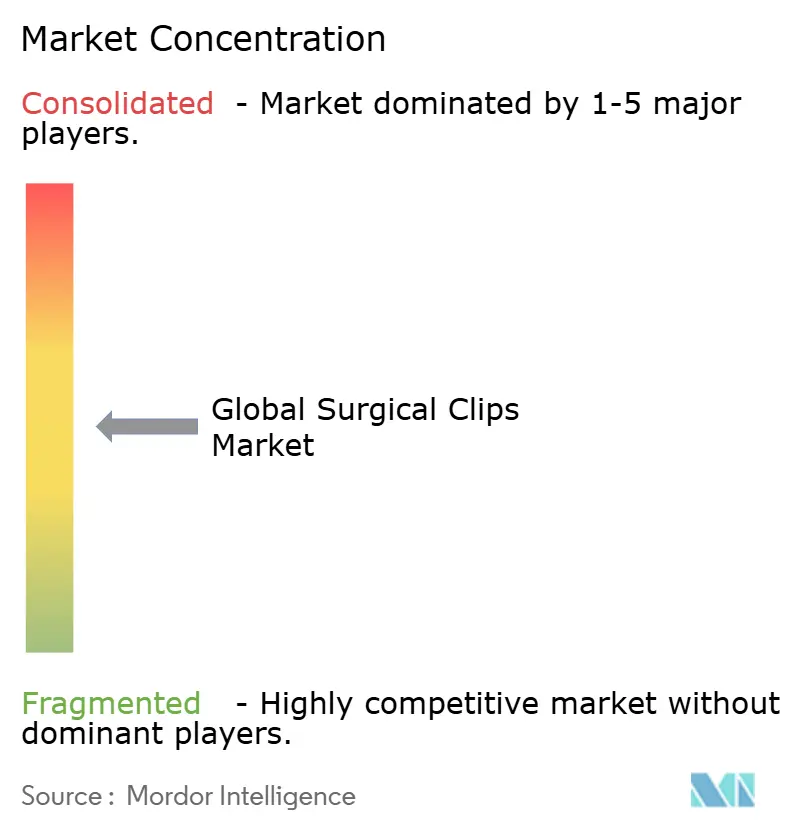
| Market Concentration | Medium |
Major Players *Disclaimer: Major Players sorted in no particular order Image © Mordor Intelligence. Reuse requires attribution under CC BY 4.0. | |
Global Surgical Clips Market Analysis by Mordor Intelligence
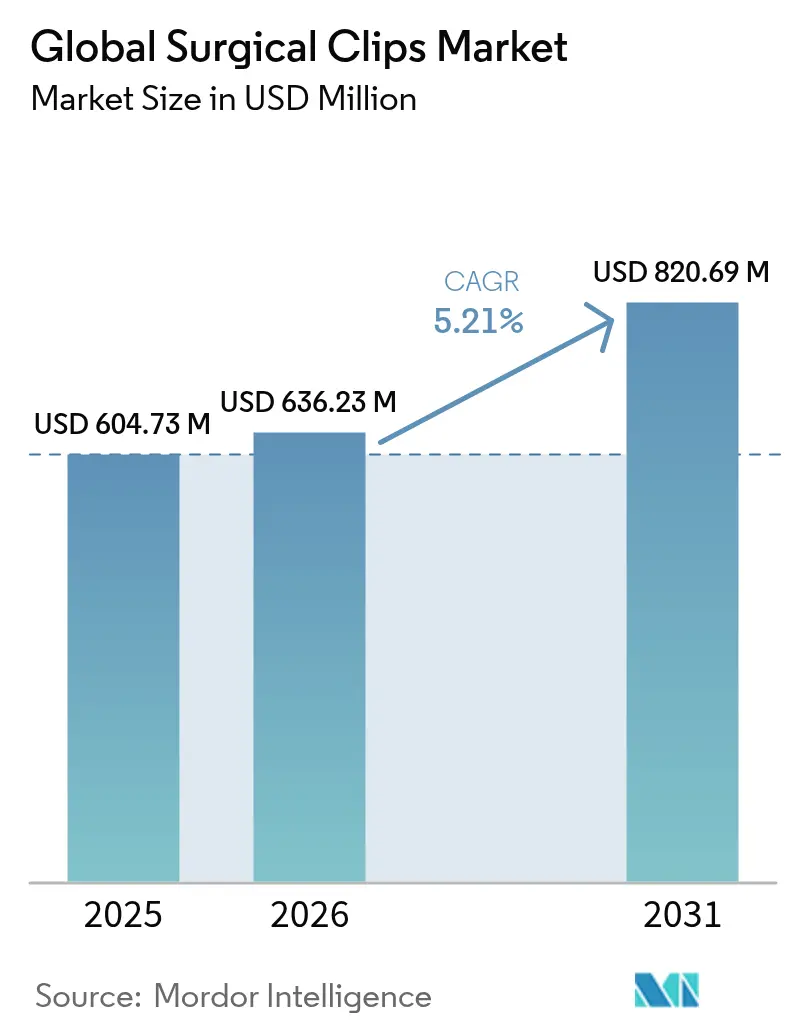
The surgical clips market size is expected to grow from USD 604.73 million in 2025 to USD 636.23 million in 2026 and is forecast to reach USD 820.69 million by 2031 at 5.21% CAGR over 2026-2031. Sustained growth comes from the global rise in minimally invasive procedures, the steady shift toward ambulatory settings, and continuing innovation in clip materials and applicators. Aging demographics enlarge the eligible patient pool, while higher body-mass index profiles and broader antithrombotic use raise the need for dependable hemostasis solutions. Hospitals in developed economies are upgrading to MRI-compatible polymer options, whereas emerging markets prioritize cost-efficient titanium sets. Makers that combine automated delivery with advanced imaging compatibility hold competitive advantages as health systems link device choice to quality and readmission metrics.
Key Report Takeaways
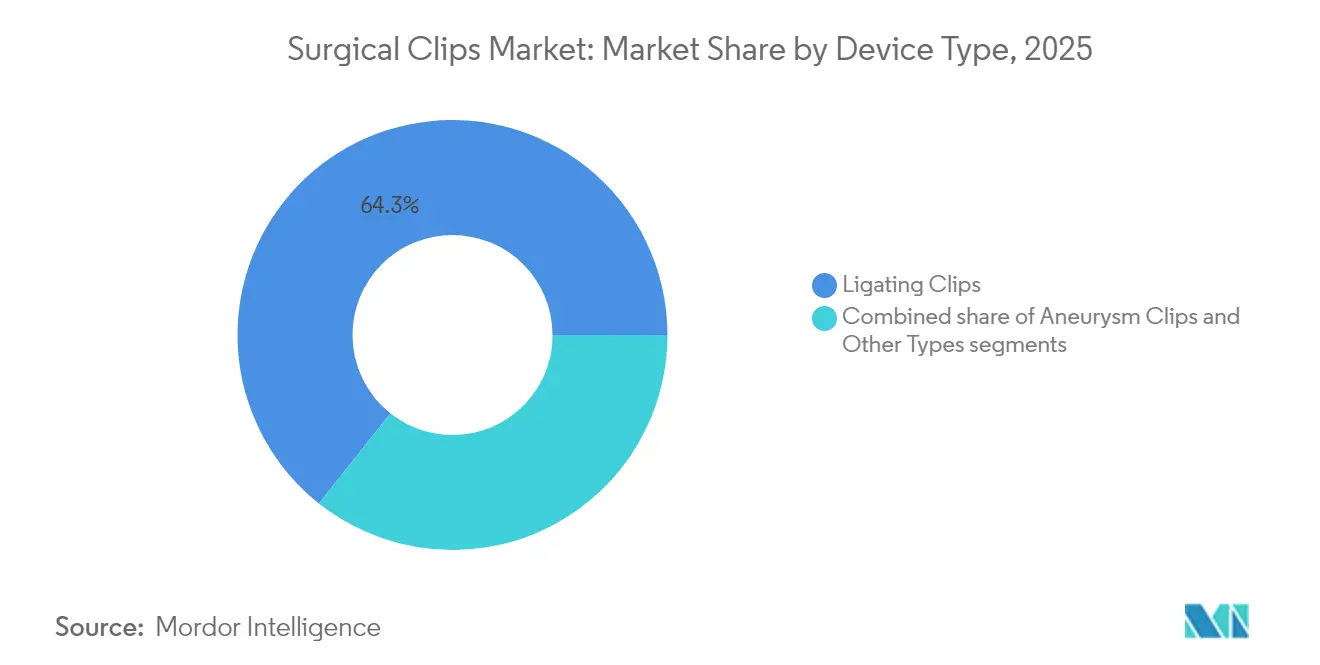
- By device type, ligating clips led with 64.33% of the surgical clips market share in 2025, while aneurysm clips are projected to grow at a 5.88% CAGR through 2031.
- By material, titanium commanded 67.55% share of the surgical clips market size in 2025; polymer variants are expanding at a 5.54% CAGR to 2031.
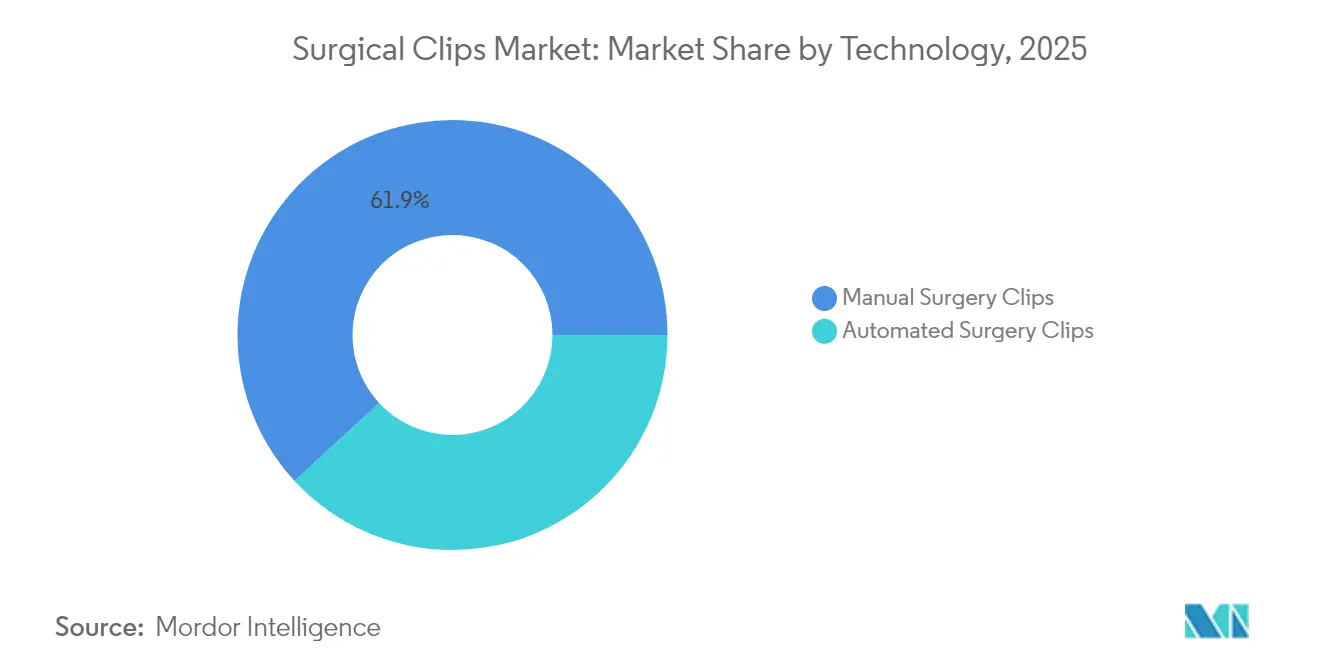
- By technology, manual products held 61.88% revenue share in 2025; automated systems to record the fastest pace at 6.15% CAGR to 2031.
- By end-user, hospitals controlled 55.96% of the surgical clips market share in 2025, whereas ambulatory surgery centers are expanding at a 5.82% CAGR through 2031.
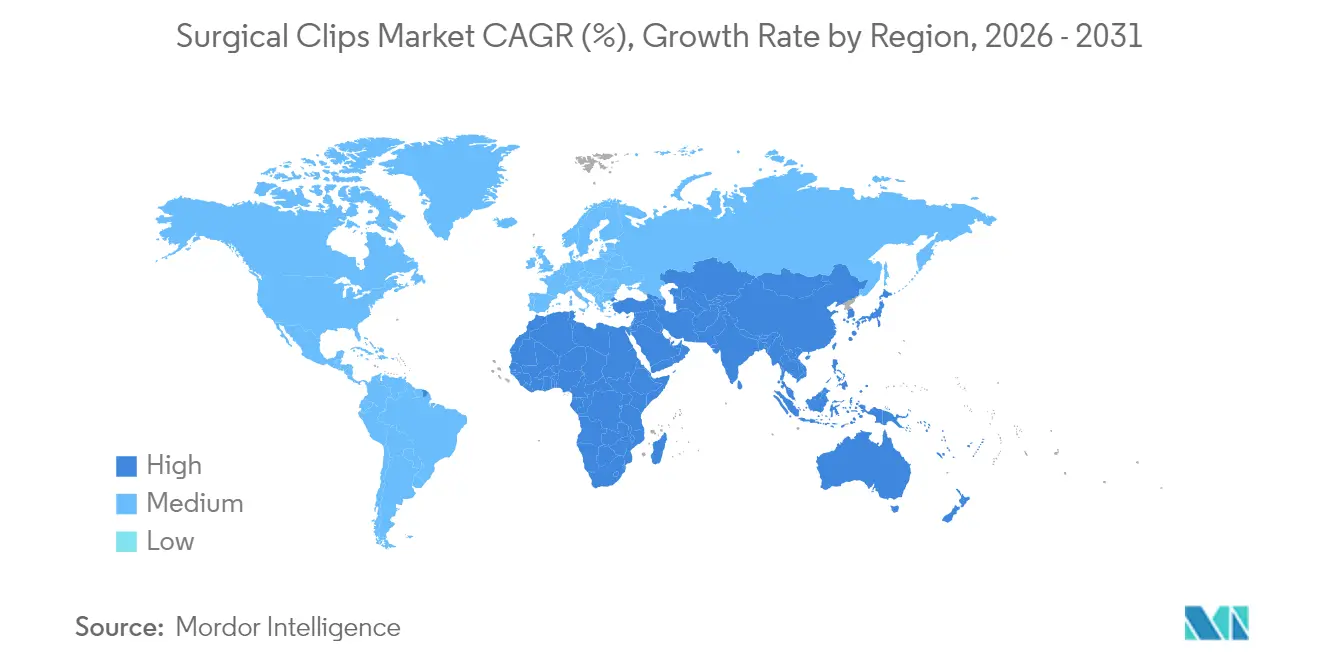
- By geography, North America captured 41.21% of the surgical clips market size in 2025; Asia-Pacific is advancing at a 5.98% CAGR between 2026 and 2031.
Note: Market size and forecast figures in this report are generated using Mordor Intelligence’s proprietary estimation framework, updated with the latest available data and insights as of 2026.
Market Trends and Insights
Drivers Impact Analysis of Global Surgical Clips Market*
| Driver | (~) % Impact on CAGR Forecast | Geographic Relevance | Impact Timeline |
|---|---|---|---|
| Increase in surgical procedures worldwide | +1.2% | Global, with higher impact in North America & Asia-Pacific | Medium term (2-4 years) |
| Surge in global geriatric population | +0.9% | Global, concentrated in developed markets | Long term (≥ 4 years) |
| Rising healthcare expenditure & access to MIS | +0.8% | North America & EU primary, APAC emerging | Medium term (2-4 years) |
| Shift toward MRI-compatible polymer/absorbable clips | +0.6% | Global, led by North America & Europe | Short term (≤ 2 years) |
| Regulatory push for single-use sterile ligation devices | +0.4% | North America & EU, expanding to APAC | Short term (≤ 2 years) |
| Proliferation of hybrid operating rooms | +0.3% | North America & EU core, selective APAC adoption | Medium term (2-4 years) |
| Source: Mordor Intelligence | |||
Increase in surgical procedures worldwide
Steady growth in hernia, orthopedic, and bariatric interventions lifts procedural volume and directly drives the surgical clips market. Hernia repairs alone are expected to rise 19.7% by 2050 to 1.72 million new cases[1] every year. Ambulatory settings report double-digit gains in hip and knee work that depend on quick, reliable vessel ligation. Robotics adoption reinforces demand as the da Vinci 5 platform applies 43% less tissue force, allowing finer clip placement for fragile structures. Growing BMI profiles and wider antithrombotic therapy amplify the need for sturdy yet atraumatic devices across specialties. The combined effect channels recurring unit sales and encourages broader clip portfolios.
Surge in global geriatric population
Median surgical age moved from 55.5 years in 2008 to 58.5 years in 2020 and is on track for 61.5 years by 2030. Older candidates present comorbid diabetes and vascular fragility that heighten bleeding risk, making secure clipping essential. Titanium remains a staple, yet polymer lines gain acceptance because they avoid metal allergies and reduce postoperative imaging artifacts. Providers also adopt applicators with low-profile jaws that suit calcified or delicate tissue common in older adults. As payers tie reimbursement to complication rates, dependable clip performance in geriatric cohorts becomes a purchasing priority and sustains momentum for the surgical clips market.
Rising healthcare expenditure and access to MIS
The United States expects surgical spending to swell from 4.6% to 7.3% of GDP by 2025. Similar trends in Western Europe and affluent Asian economies create budget room for premium devices, including automated or MRI-friendly clips. Concurrently, Asia-Pacific medical-tech outlays could touch USD 140 billion by 2025, deepening the installed base of laparoscopic towers and raising clip usage. Value-based procurement encourages products that shorten theater time or minimize readmissions, further cementing the role of the surgical clips market in modern MIS ecosystems.
Shift toward MRI-compatible polymer or absorbable clips
Conventional titanium devices can leave 5.7 × 8.5 mm² to 17.7 × 20.7 mm² artifacts on MRI scans[2], limiting postoperative assessment. Polymer and biodegradable alloys solve this problem and can even cut per-case cost by USD 75 without sacrificing clinical outcomes. Recent FDA quality-system amendments, effective February 2026, accent device lifecycle management, giving early movers in polymer or magnesium blends a regulatory edge. As imaging pathways standardize around MRI follow-up, hospitals swap legacy metal stock for polymer lines, thereby enlarging the surgical clips market.
Restraints Impact Analysis of Global Surgical Clips Market*
| Restraint | (~) % Impact on CAGR Forecast | Geographic Relevance | Impact Timeline |
|---|---|---|---|
| Clip migration & bile-duct/vascular complications | -0.8% | Global, higher impact in regions with high laparoscopic surgery adoption | Short term (≤ 2 years) |
| Adoption of robotic staplers & energy sealing devices | -0.6% | North America & EU primary, expanding to APAC | Medium term (2-4 years) |
| Adoption of robotic staplers & energy sealing devices | -0.6% | North America & EU primary, expanding to APAC | Medium term (2-4 years) |
| Titanium allergy & slippage safety alerts (ECRI) | -0.5% | Global, concentrated in developed markets with advanced reporting | Short term (≤ 2 years) |
| Source: Mordor Intelligence | |||
Clip migration and bile-duct or vascular complications
More than 100 documented cases link delayed cholecystectomy clip migration to serious biliary events that sometimes surface decades after surgery. Hem-o-lok polymer variants and legacy metals alike appear in reports, signaling a design-agnostic risk. Average migration occurs 26 months post-procedure, leading to costly ERCP retrievals and feeding both surgeon caution and regulatory vigilance. Awareness forces clinicians to limit clip counts, explore alternative sealants, and demand better applicator precision, temporarily tempering growth in the surgical clips market.
Adoption of robotic staplers and energy sealing devices
Advanced vessel sealers such as ENSEAL X1 and LigaSure Maryland XP unite cutting with hemostasis, trimming the need for separate clips in complex work. Robotic platforms deliver targeted energy that minimizes leakage and standardizes outcomes, nudging procedural preference away from standalone clips. Capital costs and training hurdles keep adoption uneven, yet the trend is clear across high-volume centers. As integrated systems mature, they could erode manual clip volumes, capping growth in segments of the surgical clips market.
*Our forecasts treat driver/restraint impacts as directional, not additive. The impact forecasts reflect baseline growth, mix effects, and variable interactions.
Global Surgical Clips Market Segment Analysis
By Device Type:
Aneurysm Clips Drive Innovation Despite Ligating DominanceLigating devices generated the largest contribution to the surgical clips market in 2025, reflecting their 64.33% share in routine laparoscopic and open work. Unit demand remains high for cholecystectomy, colorectal, and general abdominal procedures that rely on quick vessel closure. Uptake persists in lower-resource settings, ensuring stable baseline volumes and reinforcing market resilience.
Aneurysm clips, although smaller in revenue today, grow fastest at 5.88% CAGR as neurovascular caseloads climb with an aging population. Silicon-nitride and zirconia ceramics demonstrate superior closing force without jaw crossing, giving neurosurgeons MRI-safe options for complex locations. Manufacturers bundle these clips with micro-applicators that fit narrow surgical windows, creating premium niches inside the wider surgical clips market. Continuous R&D into jaw geometry and spring metallurgy improves long-term patency and supports broader adoption.

By Material:
Polymer Clips Gain Ground on Titanium DominanceTitanium held 67.55% of segment revenue in 2025 thanks to decades of clinical proof and surgeon familiarity. Its strength-to-weight ratio and inert surface limit tissue reaction, providing dependable performance for diverse procedures. Hospitals continue large-scale buying due to streamlined sterilization and bulk pricing arrangements.
Polymer lines register 5.54% CAGR through 2031 as clinicians pursue MRI clarity and avoid metal allergies. Studies record USD 75 savings per case when switching from metal to polymer clips while maintaining comparable complication profiles. Biodegradable magnesium-titanium hybrids emerge in research pipelines and could remove post-healing foreign bodies altogether. As imaging protocols tighten and patient allergy testing rises, polymer and hybrid shares will likely advance, diversifying the surgical clips market.
By Technology:
Automation Advances Challenge Manual Clip DominanceManual applicators gathered 61.88% of 2025 revenue as their simple mechanics and low cost favor routine settings. Surgeons value tactile feedback and minimal setup, keeping manual demand robust in community hospitals and emerging markets.
Automated platforms, however, expand at 6.15% CAGR. Systems like Resolution 360 offer 1-to-1 rotation and reduce closure time by nearly five minutes in endoscopic bleeding control, translating into faster room turnover. When paired with robotic arms, automation assures uniform clip pressure and placement even for novice users. Cost and learning curves slow uptake but centers that prioritize reproducibility adopt automated clips, lifting high-value brackets of the surgical clips market.
By End-User:
ASCs Challenge Hospital Dominance Through EfficiencyHospitals captured 55.96% of global sales in 2025 by handling trauma, multi-organ transplants, and other intricate cases requiring a wide clip inventory. Their purchasing decisions weigh supply chain reliability and multifunctional kits to standardize care pathways.
Ambulatory surgery centers grow at a 5.82% pace as payers push elective work to cost-effective outpatient venues. ASCs favor compact clip assortments that align with standardized MIS protocols, driving volume contracts for basic titanium or polymer sets. The efficient workflow and shorter patient stay expand day-surgery capacity, adding fresh nodes in the surgical clips market.
Geography Analysis
North America Surgical Clips Market
North America accounted for 41.21% of the surgical clips market share in 2025, sustained by high procedure counts, broad insurance coverage, and rapid adoption of MRI-compatible lines. Surgical spending is set to hit 7.3% of GDP by 2025, supporting premium procurement and keeping the surgical clips market vibrant in the region. FDA quality-system reforms, effective in 2026, further encourage manufacturers to invest in advanced materials.
APAC Surgical Clips Market
Asia-Pacific is the fastest-expanding region for the surgical clips market, with a 5.98% CAGR. Rising incomes and health-insurance penetration in China, India, and Southeast Asia push higher elective surgery counts. Domestic makers supply cost-advantaged titanium options, while high-tier urban centers import polymer and automated systems. Government investments in surgical robotics and hospital infrastructure strengthen regional demand through the forecast period.
EMEA and South America Surgical Clips Market
Europe posts a 4.91% CAGR on the back of aging demographics and rigorous device oversight. Hospitals in Germany, France, and the Nordics value traceability and imaging safety, helping polymer and biodegradable lines gain traction. Group purchasing across national systems steers consistent adoption, while local innovators refine ceramic aneurysm clips that meet stringent MRI guidelines. The Middle East and Africa grow 5.73% as Gulf states channel oil revenue into state-of-the-art surgical suites that prefer premium polymer sets. Emerging sub-Saharan markets focus on affordable manual titanium solutions yet still post rising volumes thanks to expanding urban hospitals. South America advances 5.37% under Brazil and Argentina’s public-private partnerships that enhance access to MIS.
Regulatory Landscape
Surgical clips and clip applicators fall under established medical device frameworks, with market access shaped primarily by US FDA oversight and the EU Medical Device Regulation (EU MDR). Compliance requirements emphasize biocompatibility, performance validation, sterilization controls, and labeling and traceability, which reinforces quality-system rigor and increases documentation workload for suppliers serving hospitals and ambulatory surgery centers.
Recent standards activity also adds practical compliance anchors for manufacturers. ISO 9713:2024 sets specifications for self-closing intracranial aneurysm clips, tightening expectations around design and material performance for neurovascular use. In February 2026, ISO 6335-2:2026 (surgical instruments, staplers, Part 2) was published, reinforcing general requirements that affect adjacent instrument design and information supplied by manufacturers. EU references to harmonized standards in early 2026 further support gap assessments for legacy implantable and instrument portfolios. Trade policy uncertainty entered planning discussions after the USTR proposed additional Section 301 duties on 2 June 2026, prompting MedTech Europe to call for exclusions for essential medical technologies.
Value Chain Analysis
The surgical clips value chain starts with upstream inputs, notably medical-grade titanium and polymer resins, followed by R&D and design engineering for clip geometry, locking mechanisms, and applicator ergonomics. Precision manufacturing then converts raw material into consistent clip dimensions and spring characteristics, using metal forming and finishing for titanium and specialty alloys, and molding for polymers. Quality systems and standards-driven testing run alongside production to support repeatable performance.
Sterilization and packaging (including validation for ethylene oxide residuals where applicable) are critical midstream steps because these devices are used in sterile surgical environments and are increasingly procured as single-use sterile products. Downstream, distribution uses OEM direct sales teams and medical device distributors into hospitals and ambulatory surgery centers, where procurement depends on standardization, traceability, and availability of compatible applicators and replenishment clips. Supply risk concentrates in material availability and logistics disruption, while compliance and post-market surveillance obligations act as structural barriers to entry. Manufacturers that sustain validated sterilization capacity, stable supplies of clip materials, and serialized or well-documented inventory gain advantages as providers move toward tighter documentation and device lifecycle management requirements.
Competitive Landscape
The surgical clips market shows moderate fragmentation. Top multinationals such as Johnson & Johnson’s Ethicon line, Medtronic, and Boston Scientific compete with niche innovators focusing on MRI-safe or biodegradable devices. Ethicon’s PROXIMATE linear cutters demonstrate 34% higher mean leak pressure than rival staplers, indirectly promoting its clip portfolio for adjunct closure tasks. Boston Scientific’s Resolution family reduces closure time by 4 minutes 45 seconds, appealing to endoscopy suites seeking throughput gains.
Medtronic leverages its LigaSure Maryland XP vessel sealer to blend clip functions with energy delivery, creating cross-selling opportunities. In March 2025, Olympus entered gastrointestinal hemostasis with the Retentia HemoClip, extending its presence beyond visualization into clipping consumables. Regional players in China and India produce titanium lines at attractive prices, supplying domestic hospitals and challenging importers in budget segments.
Strategic focus centers on materials R&D, automation, and bundled solutions. Companies pursue patents covering spring mechanisms, jaw geometry, and bioresorbable alloys. Partnerships with robotics firms ensure clip compatibility with next-generation consoles, while digital traceability features align with post-market surveillance rules. These moves keep competition dynamic and propel technological progress within the surgical clips market.
Global Surgical Clips Industry Leaders
-
B. Braun Melsungen AG
-
Boston Scientific Corporation
-
Grena Limited
-
Johnson & Johnson Services, Inc.
-
Medtronic plc
- *Disclaimer: Major Players sorted in no particular order
Global Surgical Clips Market Companies Covered in this Report
- Ackermann Instrumente
- Applied Medical Resources
- B. Braun
- Boston Scientific
- Conmed
- Cook Group
- Edward Lifesciences
- Grena Limited
- Hangzhou Boer Medical
- Johnson & Johnson
- Kangji Medical
- LeMaitre Vascular
- Medtronic
- Meril Life Sciences
- Olympus
- Scanlan International
- Stapleline Medizintechnik
- Stryker
- Teleflex
- XNY Medical Technology
Market Opportunities and Future Outlook
Opportunities are clustering around MRI-friendly materials and GI-specific hemostasis platforms, supported by a steady pace of regulatory clearances and product launches. FDA 510(k) clearances in 2025-2026 for clip products, including Baxter Synovis GEM ZIPCLIP (K242541, January 2025), Hem-o-lok PurplePlus Large Polymer Ligating Clips (K251054, July 2025), the Padlock Clip EFTR Kit (K250842, April 2025), and the Taurus Clip for GI hemostasis (K253734, March 2026), show an active commercialization path for differentiated clip designs and expanded indications. This aligns with care pathways that prioritize rapid hemostasis and reduced imaging artifacts, which broadens the addressable set for polymer and specialized endoscopic clips within internal ligation and hemostasis devices.
Workflow efficiency is another whitespace, particularly for high-volume laparoscopic and endoscopic settings that need repeatable deployment and reduced waste. Innovation themes in the market include 360-degree rotation and one-step deployment for GI hemostasis tools, along with the push toward multiple-clip appliers. Supplier activity reinforces this direction, including Olympus launching Retentia HemoClip for advanced GI bleeding management (announced March 2026, launched in the US in 2025). Longer-horizon differentiation continues around biodegradable and bioresorbable clip concepts, with academic and materials research exploring degradable copolymers that target mechanical strength comparable to incumbent polymer clips while controlling degradation.
Recent Industry Developments in Global Surgical Clips Market
- June 2026: Taiwan Surgical Corporation updated public version status entries in the FDA GUDID database for multiple InnoClip Disposable Clip Applier devices. The update points to ongoing maintenance of US device identification and listing data for disposable clip application tools, supporting commercialization readiness and supply continuity for sterile, single-use workflows.
- March 2026: Taurus Endoscopy received FDA 510(k) clearance (K253734) for the Taurus Clip, a hemostatic metal clip for the GI tract. The clearance expands the set of regulated, commercially available GI hemostasis clips and increases competitive pressure on established endoscopic clip portfolios in hospital and endoscopy suite purchasing.
- July 2025: Boston Scientific updated documentation for its Resolution Clip, highlighting a design change eliminating an outer sheath to reduce component use and associated emissions. The update reflects a product engineering direction that links disposables design to sustainability targets, which is increasingly referenced in hospital value analysis and procurement discussions.
Global Surgical Clips Market Report Scope and Research Methodology
Market Definition and Coverage
This market covers the revenue generated from surgical clips used inside the body to ligate or secure vessels, ducts, or tissues during open, laparoscopic, and robot-assisted procedures, along with the related applicators used to deploy them.
Scope exclusions: External skin-closure clips, endoscopic staplers, and energy-based sealing devices are not counted in this sizing.
Segments Covered in This Report
- By Device Type
- Ligating Clips
- Aneurysm Clips
- Other Types
- By Material
- Titanium
- Polymer
- Other Materials
- By Technology
- Automated Surgery Clips
- Manual Surgery Clips
- By End-User
- Hospitals
- Ambulatory Surgery Centers
- Other End-Users
- By Geography
- North America
- United States
- Canada
- Mexico
- Europe
- Germany
- United Kingdom
- France
- Italy
- Spain
- Rest of Europe
- Asia-Pacific
- China
- India
- Japan
- Australia
- South Korea
- Rest of Asia-Pacific
- Middle East and Africa
- GCC
- South Africa
- Rest of Middle East and Africa
- South America
- Brazil
- Argentina
- Rest of South America
- North America
Data Sources, Market Sizing, and Validation
Desk Research
Desk work started by aligning the clip and applicator definitions and checking what is consistently reported in public sources before any model was built. We relied on non-paywalled references such as the US FDA device databases, the US International Trade Commission trade statistics, the World Bank health expenditure indicators, and the OECD health statistics to understand procedure volumes and the broader spending context. Clinical adoption signals were also reviewed using peer-reviewed surgical journals and guidance from professional surgical societies.
After the baseline picture was set, we reviewed public company annual reports and investor presentations to map product portfolios and geography exposure, followed by reputed press coverage for product launches and regulatory updates. Where needed, paid subscriptions were used for company financials and a patent database was used to validate innovation activity around clip materials and applicator mechanisms. The desk sources listed here are illustrative and not exhaustive, and other public references were also used for data collection, validation, and clarification.
Primary Interviews and Surveys
Primary work focused on validating what desk sources cannot fully explain, specifically how clips are chosen and how pricing moves across hospitals and ambulatory settings. We spoke with a mix of device-side experts, clinicians, and procurement-facing roles across key regions so assumptions around usage per procedure, conversion to polymer clips, and applicator attachment rates could be confirmed and adjusted.
Distribution of primary research fieldwork respondents
| Company type | Respondent position | Region |
|---|---|---|
| Top tier: 36% | CXOs: 15% | APAC: 50% |
| Mid tier: 45% | Functional/Unit leaders: 39% | EMEA: 31% |
| Smaller Players: 19% | Managers: 46% | Americas: 19% |
Market-Sizing & Forecasting
Sizing was built using a top-down and bottom-up blend, where procedure demand and the care-setting mix were used to reconstruct the addressable clip consumption pool and then translated into revenue using region-specific pricing. The totals were corroborated through selective bottom-up approximations, such as sampled ASP times estimated clip volumes by major procedure groups, plus channel checks on applicator pull-through, which helped reduce the risk of over or under counts.
Inputs that mattered most included surgical procedure volumes by specialty, minimally invasive procedure penetration, average clips used per case for key surgeries, the material mix shift between titanium and polymer clips, and pricing patterns by site of care (hospital versus ambulatory surgery centers). When a data gap appeared, a conservative range was applied and then narrowed only after it was tested in interviews and cross-checked against publicly visible shipment or revenue signals.
For forecasting, we used scenario analysis supported by trend lines for procedure growth, expected care shift toward ambulatory settings, and expert views on how quickly polymer clips expand into additional indications. The final forecast was produced after aligning assumptions to realistic adoption timelines and regional reimbursement and procurement behaviors.
Data Validation & Update Cycle
Estimates were validated through multiple checks so that no single data series drove the outcome on its own. We compared model outputs against independent signals such as procedure growth, medical device spending direction, and visible product-cycle activity, and then reviewed any large variances at country and region levels before sign-off.
A second analyst review was completed to re-check unit logic, currency conversions, and whether inclusions and exclusions were applied consistently across the time series. The report is refreshed each year, with interim updates triggered when a material event occurs, such as a major regulatory change, a large acquisition, or a clear demand shock. Before delivery, one more pass is done so clients receive the latest updated view.
Mordor Intelligence's Surgical Clips Market Sizing Compared With Other Published Estimates
Published numbers for surgical clips can look far apart because teams do not always count the same products, and the demand pool is not reconstructed from the same clinical signals. Differences also show up when pricing is assumed to rise quickly, when currency timing is handled differently, or when older base-year values are kept without a fresh validation pass.
The table shows a spread that is largely explained by what is included in the device basket and how procedure-linked usage rates are applied, and in the Mordor Intelligence scope internal surgical clips plus their applicators are counted while external skin-closure clips, staplers, and energy-based vessel sealing devices are excluded.
Benchmark comparison
| Source | Market Size | Gaps in Research Methodology |
|---|---|---|
| Mordor Intelligence | USD 604.73 M (2025) | |
| Global Consultancy A | USD 865.90 M (2024) | Uses a different base year and appears to apply a faster price and adoption uplift into the near term, which can raise the current-year value versus a procedure-linked demand build. |
| Industry Publisher B | USD 655.90 M (2023) | Anchors the market on an earlier base year and may rely more on historical revenue rollups without fully re-testing procedure mix shifts and ambulatory migration across regions. |
Taken together, the comparison suggests that scope boundaries and the way procedure demand is translated into clip usage are the main reasons for the gap. Our approach stays traceable because each step is tied to visible procedure indicators, realistic usage rates, and pricing checks that can be revalidated when the market shifts.
Key Questions Answered in the Report
Why are hospitals switching from titanium to polymer surgical clips?
Hospitals seek to eliminate MRI imaging artifacts and reduce the small risk of metal allergies, prompting a shift toward polymer options that provide clearer postoperative scans and broader patient tolerance.
How are ambulatory surgery centers influencing procurement strategies for surgical clips?
ASCs favor standardized clip sets that streamline workflow and lower per-procedure costs, pressuring suppliers to offer bundled, easy-to-load systems rather than large, diverse inventories.
What role does robotic surgery play in the adoption of automated clip applicators?
Robotic platforms demand precision and consistency, so surgeons increasingly pair them with automated applicators that ensure uniform compression and accurate placement in confined anatomical spaces.
Which safety concern is most frequently cited by surgeons when selecting clip technology?
Clip migration—particularly in biliary and vascular procedures—remains the dominant worry, driving interest in improved jaw designs and alternative sealing methods that minimize displacement risk.
How is the aging population reshaping design priorities for surgical clips?
Older patients’ fragile tissues require clips with gentler closure forces and enhanced biocompatibility, encouraging manufacturers to develop lighter materials and applicators tuned for delicate handling.
What impact do evolving regulatory standards have on material innovation in surgical clips?
Emerging rules emphasize device lifecycle management and traceability, accelerating research into biodegradable alloys and polymer formulations that can simplify long-term patient monitoring and safety reporting.