
Sugarcane Harvesters Market Size and Share
Market Overview
| Study Period | 2021 - 2031 |
|---|---|
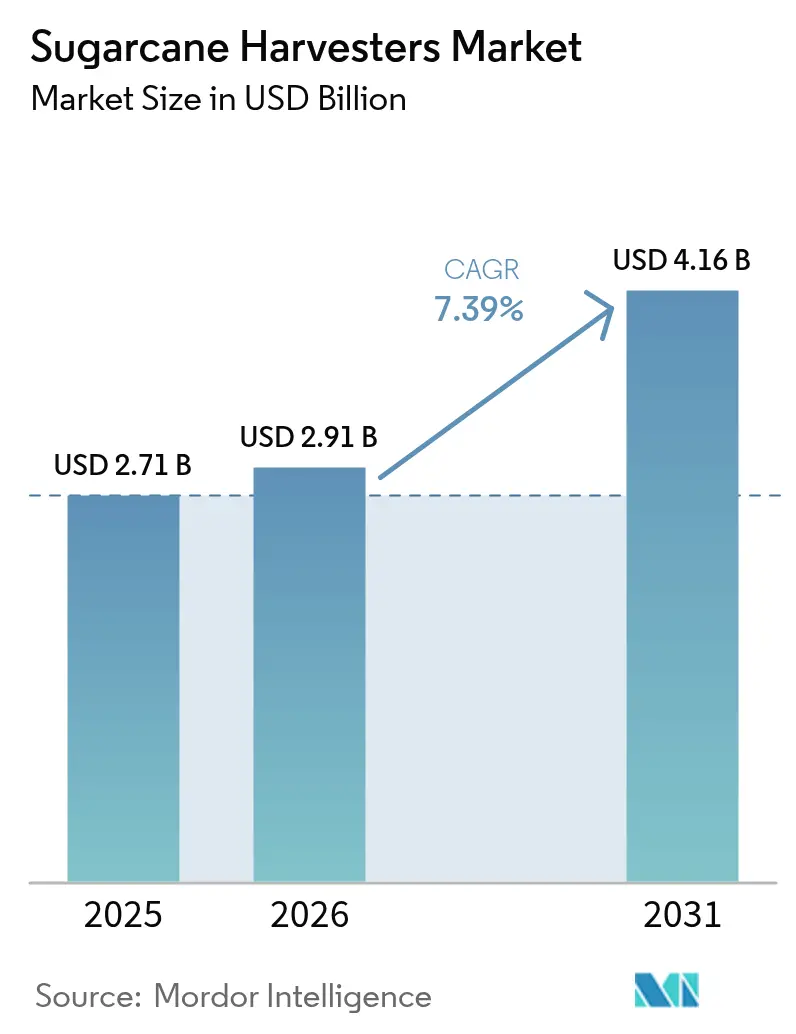
| Market Size (2026) | USD 2.91 Billion |
| Market Size (2031) | USD 4.16 Billion |
| Growth Rate (2026 - 2031) | 7.39 % |
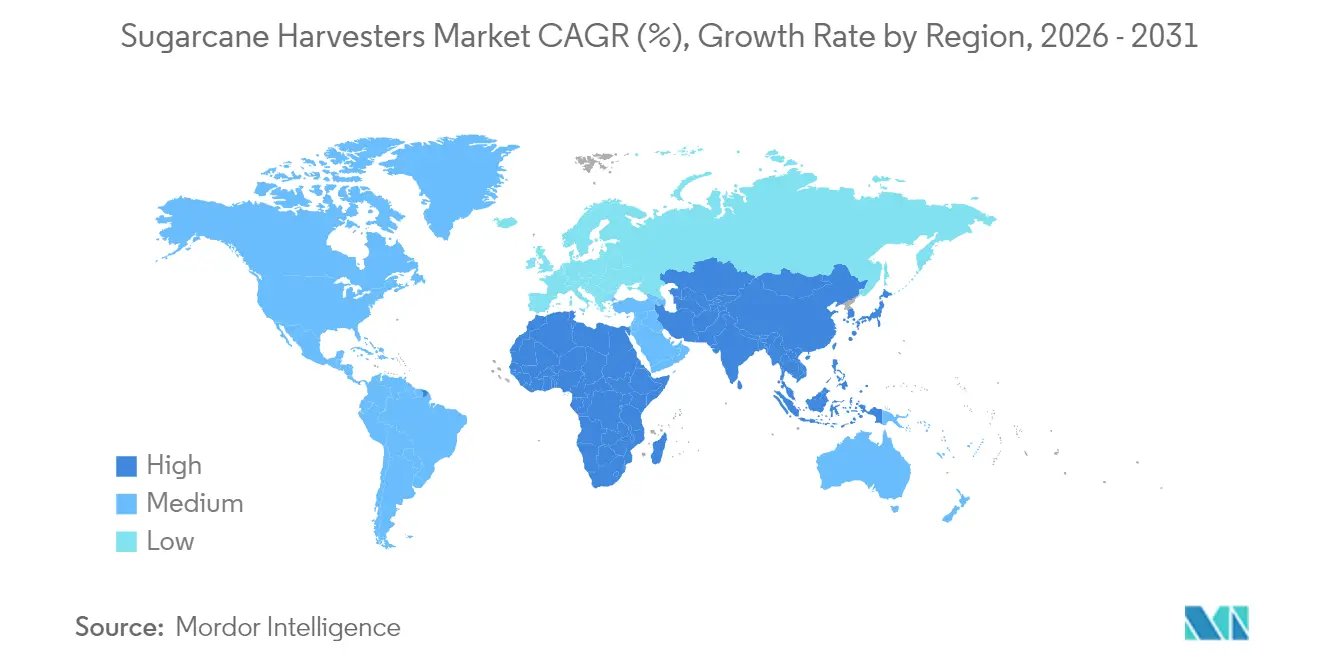
| Fastest Growing Market | Africa |
| Largest Market | Asia Pacific |
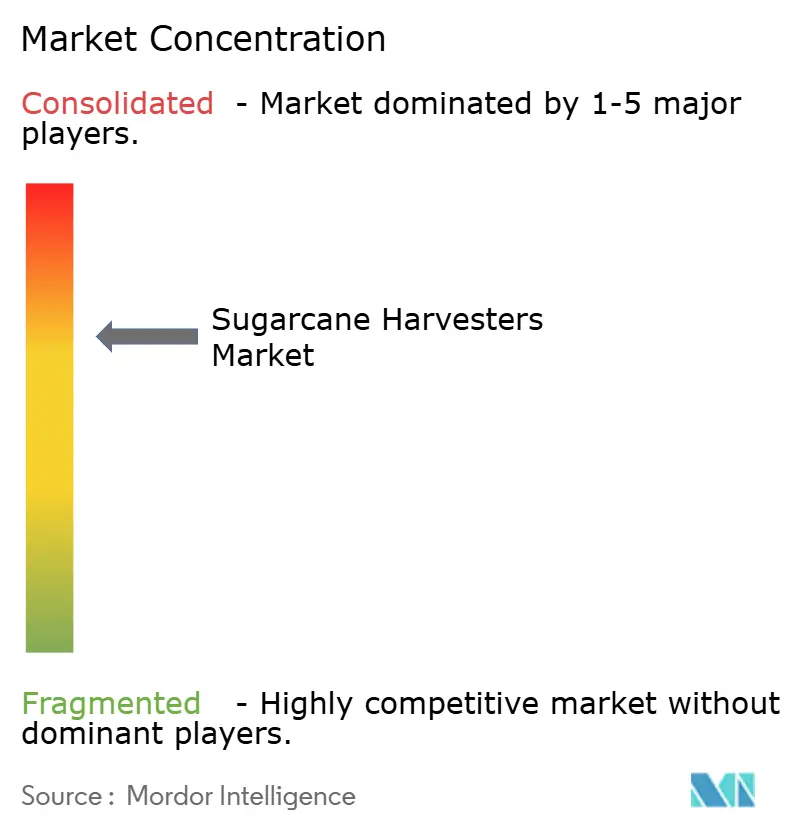
| Market Concentration | Medium |
Major Players *Disclaimer: Major Players sorted in no particular order Image © Mordor Intelligence. Reuse requires attribution under CC BY 4.0. | |
Sugarcane Harvesters Market Analysis by Mordor Intelligence
The sugarcane harvesters market size in 2026 is estimated at USD 2.91 billion, growing from 2025 value of USD 2.71 billion with 2031 projections showing USD 4.16 billion, growing at 7.39% CAGR over 2026-2031. The market growth is primarily driven by increased mechanization in agriculture, labor shortages, and stricter regulatory requirements. Brazil's agricultural sector demonstrates this trend, with almost complete mechanization of its sugarcane harvesting operations, as reported by Energy Research Company (EPE). CNH Industrial N.V.'s investment in Bem Agro's artificial intelligence mapping technology improves sugarcane harvesting operations through efficient field navigation, reduced maintenance downtime, and sustainable agricultural practices in major sugarcane-producing regions.[1]Source: CNH Industrial, “CNH takes minority investment in drone imaging AI company Bem Agro,” Media.cnh.com The Asia-Pacific region holds the largest market share due to extensive sugarcane cultivation in China, India, Thailand, and Indonesia. According to FAOSTAT, the sugarcane harvested area in India and Thailand increased by 13.7% and 14.8%, respectively, from 2022 to 2023. Africa represents an emerging market opportunity, supported by agricultural modernization programs and improved access to equipment financing.
Key Report Takeaways
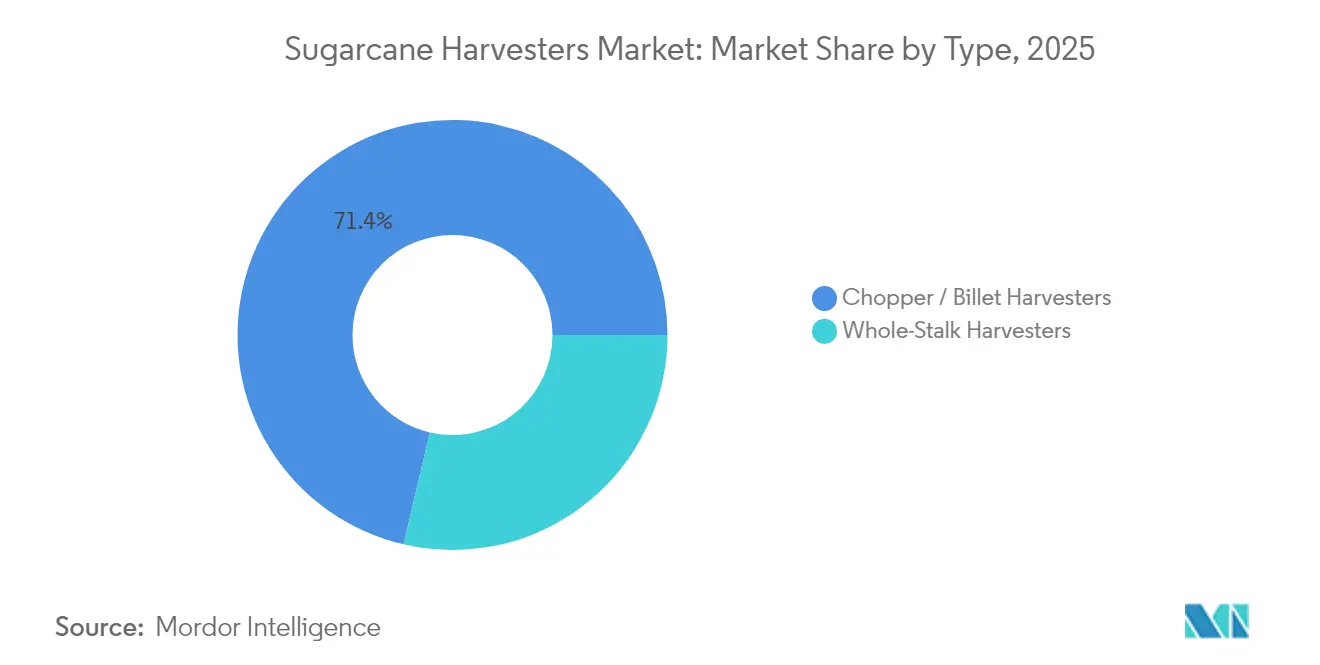
- By type, chopper/billet units led with 71.35% of the sugarcane harvester market share in 2025, whole-stalk harvesters maintain a CAGR of 6.89% to 2031.
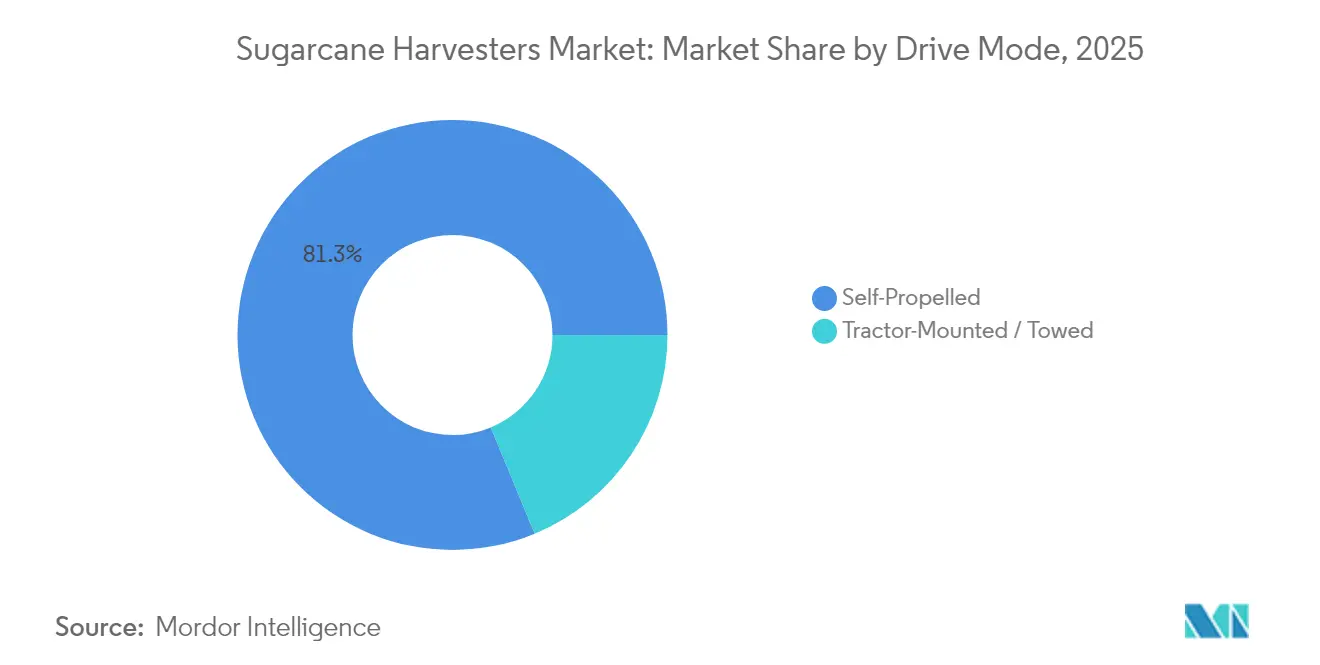
- By drive mode, self-propelled machines held 81.25% of the sugarcane harvesters market size in 2025, while the same segment is on track to advance at an 8.23% CAGR through 2031.
- By row capacity, single-row configurations accounted for 67.20% of the sugarcane harvesters market size in 2025, multi-row systems are poised to grow at a 7.55% CAGR between 2026 and 2031.
- By geography, Asia-Pacific held 54.65% of global revenue in 2025, whereas Africa shows the fastest 7.49% CAGR to 2031.
- CNH Industrial N.V. and Deere and Company together controlled the majority of the market share in 2024, underscoring high competitive concentration.
Note: Market size and forecast figures in this report are generated using Mordor Intelligence’s proprietary estimation framework, updated with the latest available data and insights as of 2026.
Market Trends and Insights
Drivers Impact Analysis of Sugarcane Harvesters Market*
| Driver | (~) % Impact on CAGR Forecast | Geographic Relevance | Impact Timeline |
|---|---|---|---|
| Mechanized-harvesting Mandates in Major Producing Countries | +1.8% | Brazil, India, Thailand, China | Medium term (2-4 years) |
| Permanent Farm-labor Shortages Pushing Adoption of Compact Self-propelled Units | +1.5% | Asia-Pacific, South America | Long term (≥ 4 years) |
| Sugar-ethanol Flex-mill Expansion Demanding Higher Field-throughput Machinery | +1.2% | Brazil, India, Thailand | Medium term (2-4 years) |
| Carbon-credit Premiums for Green-cane Harvesting (No Field-burn) Driving Equipment Spend | +0.9% | Vietnam, Brazil, global pilot zones | Long term (≥ 4 years) |
| OEM Telematics / AI Modules that Cut Billet Losses | +0.8% | North America, Europe, advanced Asia-Pacific | Short term (≤ 2 years) |
| Multi-row Harvester Introductions Lowering Operating Cost | +0.7% | Large farms worldwide | Medium term (2-4 years) |
| Source: Mordor Intelligence | |||
Mechanized-harvesting Mandates in Major Producing Countries
Government regulations prohibiting pre-harvest burning and mandating mechanical harvesting are transforming sugarcane production practices. The Office of the Cane and Sugar Board (OCSB), Thailand, has set an ambitious target to reduce the burning of sugar cane plantations prior to harvest by up to 90% during the 2024-25 harvest season, with the aim of significantly lowering harmful PM2.5 fine particle emissions. Brazil's implementation of these regulations reduced labor requirements by 64%, establishing mechanical harvesting as the primary method.[2]Source: Food and Agriculture Organization, “Labor impacts of agricultural automation,” Openknowledge.fao.org These regulatory measures indicate a fundamental shift toward mechanized, efficiency-focused sugarcane production.
Permanent Farm-labor Shortages Pushing Adoption of Compact Self-propelled Units
Demographic changes and urban migration are reducing the agricultural workforce, necessitating increased mechanization and higher wages. In China, the National Bureau of Statistics (NBS) reported urbanization reached 66.16% in 2023, as younger populations moved from rural areas. The adoption of portable harvesters has enhanced operational efficiency and reduced manual labor requirements. According to Eurostat, in the European Union, agricultural wages increased by 12% to USD 34.4 per hour, primarily due to reduced seasonal immigrant labor availability, highlighting the necessity of compact self-propelled sugarcane harvester units.
Sugar-ethanol Flex-mill Expansion Demanding Higher Field-throughput Machinery
Increased sugar production and growing biofuel demand drive mill expansion and processing upgrades. Significant machinery investments indicate a shift toward integrated processing systems. Large-scale production projects increase field capacity requirements, necessitating rapid modernization by growers and processors. The integrated sugar-ethanol mill model becomes essential for sugarcane production regions, combining energy generation with sugar refining.
OEM Telematics / AI Modules that Cut Billet Losses
Equipment now incorporates sensors that optimize cutting height and billet quality during operation. Manufacturing companies expand these technological capabilities throughout primary sugarcane production regions. The implementation of predictive maintenance systems improves equipment reliability and reduces operational interruptions, enhancing harvesting fleet management. These monitoring systems enable field-level data analysis, improving yield and equipment durability.
Restraints Impact Analysis of Sugarcane Harvesters Market*
| Restraint | (~) % Impact on CAGR Forecast | Geographic Relevance | Impact Timeline |
|---|---|---|---|
| High-price for High-capacity Machines in Developing Regions | -1.2% | Africa, Southeast Asia, South America | Medium term (2-4 years) |
| Limited After-sales Service Network in Rural Areas | -0.8% | Developing regions worldwide | Long term (≥ 4 years) |
| Cane-variety Mismatch with Existing Cutter-base Designs Raising Stool Damage | -0.6% | India, China, minor geographies | Medium term (2-4 years) |
| Financing Barriers as Harvesters Seldom Qualify for Green-asset Tax Credits | -0.5% | Small farms in emerging markets | Long term (≥ 4 years) |
| Source: Mordor Intelligence | |||
High-price for High-capacity Machines in Developing Regions
The significant capital requirements for high-capacity harvesting equipment prevent many small-scale growers from mechanizing their operations. This limited access to modern machinery has led to productivity declines in several regions. While mechanical harvesting reduces per-ton costs over time, the substantial initial investment remains prohibitive. The industry is exploring financing options and cooperative ownership models as potential solutions. However, without broader access to technology, mechanization may increase existing inequalities within the sugarcane sector.
Limited After-sales Service Network in Rural Areas
The concentration of equipment dealers in urban areas results in delayed repairs during critical harvest periods, affecting crop quality and timing. Rural farmers experience extended downtimes and logistical challenges when equipment malfunctions. While predictive maintenance technologies show potential, their effectiveness depends on reliable data connectivity. The inconsistent digital infrastructure in many agricultural regions limits the use of remote diagnostics. Improving service coverage across all farming areas is crucial for realizing the full benefits of mechanization.
*Our forecasts treat driver/restraint impacts as directional, not additive. The impact forecasts reflect baseline growth, mix effects, and variable interactions.
Sugarcane Harvesters Market Segment Analysis
By Type:
Chopper Designs Dominate Efficiency GainsChopper-style harvesters dominate the sugarcane harvesters market size, accounting for 71.35% of the 2025 revenue. These machines are the primary choice for large-scale operations due to their compatibility with high-tonnage mills and performance in leafy cane conditions. The machines feature upgraded blades and extractors that increase throughput and minimize downtime. Integration with smart systems enables automatic adjustment of knife pressure and trash separation, improving operational efficiency across varying field conditions. Whole-stalk harvesters retain their market presence in specialized segments where minimal juice loss is essential, particularly in premium sugar production.
Whole-stalk harvesters maintain a CAGR of 6.89%, supported by demand from premium sugar producers and regions focusing on juice retention through 2031. With increasing field burn restrictions, chopper designs provide enhanced residue management capabilities and reduced clogging. Manufacturers are developing chopper configurations specific to regional agronomic requirements, combining mechanical reliability with precise harvesting capabilities to address environmental regulations and operational requirements.


By Drive Mode:
Self-propelled Units Lead AutomationSelf-propelled sugarcane harvesters constitute the market's automation core, capturing 81.25% of the sugarcane harvesters market share in 2025 and achieving an 8.23% CAGR. These machines optimize operations through thousands of automatic adjustments daily to improve fuel efficiency and minimize human error. Their market position reflects the transition to precision agriculture, incorporating GPS, yield monitors, and machine-to-machine connectivity as standard features. Tractor-mounted and towed equipment remain relevant for diversified farms, offering cross-crop flexibility despite limited automation capabilities.
Self-propelled units connect to cloud-based platforms for performance analysis and operational guidance. These harvesters integrate into smart farming strategies through expanding digital ecosystems. Manufacturers are developing driver-optional technologies toward autonomous harvesting. Self-propelled systems address rising labor costs and sustainability requirements while providing scalable solutions.
By Row Capacity:
Multi-row Systems Gain TractionSingle-row harvesters maintain 67.20% market share in 2025 due to existing field layouts, while multi-row systems advance at a 7.55% CAGR. Dual-row and larger heads demonstrate efficiency benefits, reducing field passes and fuel usage. Brazil's Center-South region exemplifies this transition to wider rows. Manufacturers address soil compaction and machine weight through lighter alloys and wide-contact tracks.
Field tests demonstrate increased biomass recovery without compromising billet quality in multi-row systems. Variable row-spacing capabilities allow broad heads to operate in mixed-width plantations. Multi-row harvesters provide efficiency advantages while minimizing environmental impact, offering practical solutions for modernizing harvesting operations.
Geography Analysis
APAC Sugarcane Harvesters Market
Asia-Pacific holds a 54.65% of the Sugarcane Harvester market share, supported by extensive cultivation areas and government policies. China and India are increasing their mechanization investments to address labor shortages and operational costs. In India, Maharashtra's cooperative mills are providing joint financing for mechanical harvesters to ensure efficient harvesting and reduce reliance on seasonal workers. Thailand's government is offering subsidies to increase adoption among mid-sized farmers. The region is seeing increased collaboration between local manufacturers and global equipment makers to develop harvesting technologies suited to local conditions.
Africa Sugarcane Harvesters Market
Africa, despite its current smaller market share, is growing at a 7.49% CAGR. Research indicates substantial cost reductions through mechanization compared to manual harvesting, particularly in Sudan. South Africa is advancing technologically by incorporating innovations like spray drones for crop management. African governments are working with international financial institutions to create equipment financing options, indicating an industry-wide transition to mechanized and data-based farming practices.
The Americas, Europe and Middle East Sugarcane Harvesters Market
South America maintains its market position, with Brazil producing 705 million metric tons in 2023/24. Colombia and Peru follow Brazil in the adoption of mid-capacity harvester models. Environmental regulations are directing farmers toward green-cane harvesting and ethanol production, while digital solutions enhance operations. In North America, Louisiana's sugar industry is implementing automation to manage labor costs and comply with trade requirements. Europe and the Middle East, with smaller market shares, are prioritizing sustainable and specialty sugar production, increasing demand for efficient, environmentally conscious harvesting equipment.

Regulatory Landscape
Regulation increasingly shapes sugarcane harvester design, validation, and on-road movement in major producing regions. On safety and compliance, the EU published EN ISO 4254-7:2017/A1:2026 to update harvester safety requirements aligned with the Machinery Directive 2006/42/EC, while China implemented GB 10395.7-2025 for agricultural machinery safety (including sugarcane harvesters), replacing the 2006 version and tightening baseline requirements for OEMs selling into that market.
Compliance is also widening into mobility and biosecurity controls. In Brazil, Resolucao Contran no 1.017/2024 (in force from 2025) requires agricultural machines transiting public roads, including harvesters, to be registered in RENAGRO, and the Ministry of Agriculture and Livestock (MAPA) advanced phytosanitary transit controls for used agricultural machinery via Portaria SDA/MAPA No 1.580/2026. This reinforces cleaning and inspection expectations that affect inter-farm transfers and dealer logistics.
Competitive Landscape
The sugarcane harvester market remains moderately consolidated, with the top five manufacturers controlling a major share of the sugarcane harvester market size. CNH Industrial N.V. and Deere & Company lead through comprehensive product portfolios and digital platforms. These companies invest in AI, sensor technologies, and connectivity solutions to improve machine intelligence and field performance. Their market dominance provides significant bargaining power with growers, enabling them to influence pricing, service models, and technology standards across regions. The companies expand their presence in emerging markets through strategic partnerships with domestic manufacturers.
Companies compete through new product launches, acquisitions, and regional collaborations. Service differentiation has become crucial, with dealers providing uptime guarantees, remote diagnostics, and integrated software packages that combine agronomic insights with machine analytics. Contract-harvest service providers have emerged as key buyers, focusing on total ownership costs, rapid parts availability, and fleet management tools for mixed-brand operations. Regional manufacturers in China and Thailand gain market share by serving cost-sensitive buyers through local service networks, increasing competition, and emphasizing operational efficiency and service reliability.
Regional manufacturers from Asia are expanding into the mid-tier segment with products designed for cost-sensitive buyers. The market competition now focuses on predictive maintenance, automation capabilities, and financing packages with sustainability incentives. Safety and emissions regulations continue to create entry barriers for new companies while reinforcing the position of multinational brands in the sugarcane harvester market.
Sugarcane Harvesters Industry Leaders
Deere & Company
CNH Industrial N.V.
AGCO Corporation
Zoomlion Heavy Industry Science and Technology Co., Ltd.
Tirth Agro Technology Private Limited (Shaktiman Agro)
- *Disclaimer: Major Players sorted in no particular order
Sugarcane Harvesters Market Companies Covered in this Report
- Deere & Company
- CNH Industrial N.V.
- AGCO Corporation
- Samart Kasetyon Co., Ltd.
- Zoomlion Heavy Industry Science and Technology Co., Ltd.
- Tirth Agro Technology Private Limited (Shaktiman Agro)
- TAGRM Co. Ltd.
- Grupo Jacto
- Jiangsu World Agriculture Machinery Co., Ltd (World Group)
- Kartar Agro Industries Private Limited
- Yanmar Holdings Co., Ltd.
- Guangxi LiuGong Group
- CANETEC Pty Ltd
- Wuhan Wubota Machinery Co., Ltd.

Market Opportunities and Future Outlook
OEM roadmaps are converging on three near-term whitespace areas: wider-cut, higher-throughput platforms to lower cost per tonne, embedded digital and agronomic intelligence to stabilize quality and reduce losses, and alternative-fuel powertrains aligned with decarbonization programs in sugarcane heartlands. Product activity at Agrishow 2026 reflects this direction, with John Deere introducing the CH7 and CH9 sugarcane harvester families, positioned around impurity reduction and fuel consumption improvements, and Case IH presenting the Model Year 2026 Austoft 9000 with integrated connectivity (Case IH FieldOps) that extends fleet-level monitoring and uptime management from add-ons toward standard buying criteria.
Adoption is also being pulled by mill economics and agronomy-driven scheduling, which creates opportunity for maturity-based harvesting and quality-linked logistics. In India, Mahindra & Mahindra implemented an AI-enabled maturity program at Sahakar Maharshi Shankarao Kolhe SSK Ltd. (Maharashtra) using satellite imaging and spectrometry to time harvests for sugar recovery, supporting demand for machines and services that can execute tighter harvest windows. In Brazil, the ethanol-power pathway is moving from concept to field validation through Case IH and Sao Martinho testing an ethanol-fueled engine prototype on an Austoft harvester, which supports a market space for OEMs and component suppliers that can deliver performance parity while meeting sustainability requirements at large cane operations.
Recent Industry Developments in Sugarcane Harvesters Market
- April 2026: Deere & Company unveiled the CH7 and CH9 sugarcane harvester families at Agrishow 2026, highlighting redesigned cleaning systems and row-spacing adaptability for major cane production systems. The launch targets mill-facing KPIs such as vegetable impurity reduction and fuel efficiency, aligning new machine demand with quality-linked cane payments and logistics performance.
- March 2025: Case IH (CNH Industrial) partnered with Sao Martinho to test an ethanol-powered engine prototype on an Austoft sugarcane harvester in Pradopolis, Brazil, advancing field validation of biofuel-powered harvesting. The work links harvester replacement cycles to decarbonization strategies in ethanol-centric cane regions and influences engine and fuel-system specification requirements across the OEM supply base.
- May 2024: LiuGong launched the S935TA sugarcane harvester at Agrishow Brazil and began field trials across Brazil to tune performance across varying cultivation conditions. These trials supported LiuGong's positioning on durability and operating-cost control, increasing competitive pressure in price-sensitive buyer segments and among contractor fleets.


Sugarcane Harvesters Market Report Scope and Research Methodology
Market Definition and Coverage
For this study, the market covers the sale of sugarcane harvesting machines used to cut, gather, and load cane in field operations. The sizing is captured in value terms (USD) across the main buyer geographies where sugarcane is cultivated and mechanized harvesting is adopted.
Scope exclusions: Used equipment resale, standalone spare parts, and repair or maintenance labor are excluded when they are billed separately from new harvester sales.
Segments Covered in This Report
- By Type
- Whole-Stalk Harvesters
- Chopper / Billet Harvesters
- By Drive Mode
- Self-Propelled
- Tractor-Mounted / Towed
- By Row-Capacity
- Single-Row
- Multi-Row
- By Geography
- North America
- United States
- Canada
- Mexico
- Rest of North America
- Europe
- France
- Spain
- Portugal
- Russia
- Rest of Europe
- Asia-Pacific
- China
- India
- Thailand
- Indonesia
- Australia
- Rest of Asia-Pacific
- South America
- Brazil
- Argentina
- Colombia
- Rest of South America
- Middle East
- United Arab Emirates
- Saudi Arabia
- Turkey
- Rest of Middle East
- Africa
- South Africa
- Egypt
- Sudan
- Rest of Africa
- North America
Data Sources, Market Sizing, and Validation
Desk Research
To build the first set of assumptions, we start with public farming and machinery indicators that can be checked country by country. We use FAOSTAT (sugarcane area and output), USDA crop outlook notes, World Bank macro series, UN Comtrade trade flows for agricultural machinery, and customs or agriculture ministry releases in key producing countries to anchor demand conditions.
From there, the model is shaped using supplier disclosures and practical signals. We review annual reports, investor presentations, press releases, and publicly visible importer and dealer information. In addition, we use paid subscriptions for company financials and intelligence, patent databases, and shipment-level import or export records when needed. The sources listed here are illustrative only, and we also used other public references during data collection, validation, and clarification.
Primary Interviews and Surveys
Primary work is used to pressure test what desk sources cannot fully explain, especially price bands, replacement cycles, and what buyers treat as a like-for-like machine. We speak with a mix of OEM-side contacts, distributors and dealers, large growers, and custom harvesting contractors across major producing regions so regional adoption patterns and utilization realities can be reflected in the final assumptions.
Distribution of primary research fieldwork respondents
| Company type | Respondent position | Region |
|---|---|---|
| Top tier: 35% | CXOs: 13% | APAC: 44% |
| Mid tier: 49% | Functional/Unit leaders: 43% | EMEA: 36% |
| Smaller Players: 16% | Managers: 44% | Americas: 20% |
Market-Sizing & Forecasting
The core sizing starts with a top-down build where sugarcane acreage, harvestable area, and mechanization penetration are translated into an addressable harvester demand pool by region, and then converted into value using typical replacement cycles and average selling prices. Because the market is equipment-led, the main variables we track include sugarcane planted and harvested area, labor availability and wage pressure, farm size trends, contractor share in harvesting, financing access and interest rates, and import reliance where local assembly is limited.
Once the regional totals are formed, we corroborate them using selective bottom-up checks, such as dealer channel checks on unit movement, sampled ASP-by-configuration comparisons, and supplier shipment cues from trade statistics where available. Where country-level unit signals are thin, gaps are handled by using proxy ratios from similar mechanization markets and then re-tested with interview feedback so the totals remain realistic.
For forecasting, scenario analysis is used around a base case, with adoption and pricing assumptions adjusted using expected policy direction, crop profitability outlook, and expected technology upgrades. Shorter series inputs are smoothed where needed, and the final curve is kept consistent with how quickly mechanization typically scales in cane belts rather than assuming sudden step changes.
Data Validation & Update Cycle
Validation is done in layers so the final number is not driven by a single data stream. We compare model outputs against independent signals like machinery import values, known planting and harvesting calendars, and plausible unit-to-area ratios, and then investigate anomalies before sign-off.
If a variance is material, assumptions are re-checked, and experts are re-contacted to confirm whether the change is real or driven by timing effects, such as delayed deliveries. Reports are refreshed annually, with interim updates when major events occur, and a final pre-delivery review so clients receive the latest updated view.
Mordor Intelligence's Sugarcane Harvesters Market Size Versus Other Published Estimates
Published values for sugarcane harvesters can look far apart because each estimate tends to lock on to a different year, pricing basis, and unit boundary. When exchange rate timing, inflation treatment, and the exact machine configuration counted are not aligned, the same shipment story can translate into very different USD totals.
The biggest gap drivers usually come from how average selling prices are built, which geographies are treated as active mechanized markets, and how often the model is refreshed after currency moves or delivery backlogs. In our workflow, currency conversion timing and ASP bands are re-validated through recurring channel checks and expert call-backs, and those refresh-led checks are a key reason the final value differs from the version published by Mordor Intelligence.
Benchmark comparison
| Source | Market Size | Gaps in Research Methodology |
|---|---|---|
| Mordor Intelligence | USD 2.91 B (2026) | |
| Industry Publisher A | USD 0.90 B (2024) | Uses an earlier base year and a narrower equipment value capture, which can understate regions where mechanization is growing but deliveries are lumpy. ASP progression is not clearly explained, so price increases may not be carried consistently across configurations. |
| Market Tracker B | USD 1.28 B (2024) | Reported in US$ million with a strong reliance on manufacturer and trade splits for 2024, which can miss domestic sales where imports are low. The method appears more shipment-share led, with less visibility on replacement cycles and contractor-driven demand timing. |
Overall, the spread mainly reflects timing and scope choices rather than a disagreement that machines are being adopted. By keeping the demand pool tied to crop area and mechanization indicators, and then validating pricing and delivery assumptions with field feedback, the estimate stays traceable to inputs that can be re-checked year after year.


Key Questions Answered in the Report
How large is the Sugarcane Harvesters Market in 2026?
It is valued at USD 2.91 billion, rising toward USD 4.16 billion by 2031.
Which region leads sales of sugarcane harvesters?
Asia-Pacific accounts for 54.65% of global revenue due to extensive cultivation in China, India, Thailand, and Indonesia.
What segment grows the fastest in drive mode?
Self-propelled units register an 8.23% CAGR, driven by labor constraints and automation benefits.
Who are the top players in the market?
CNH Industrial N.V. and Deere & Company together hold nearly half of the total revenue, followed by a small group of other global OEMs.
Page last updated on:


 Your data is secure and never sold or shared.


