
Subscriber Data Management Market Size and Share
Market Overview
| Study Period | 2020 - 2031 |
|---|---|
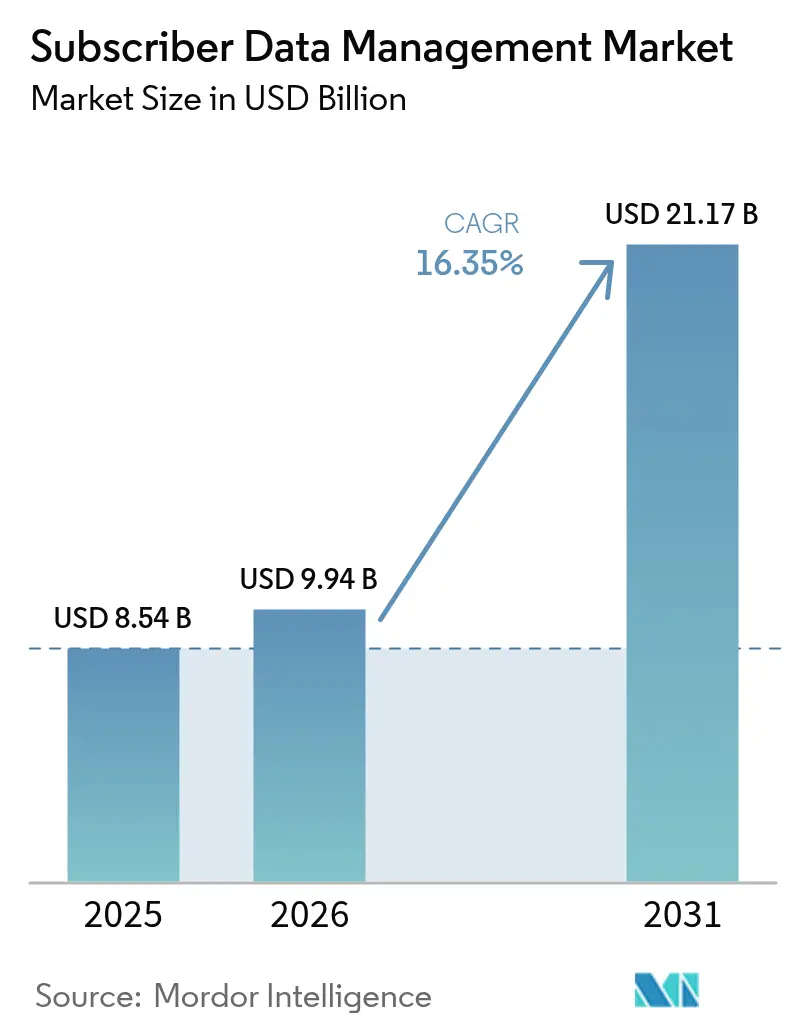
| Market Size (2026) | USD 9.94 Billion |
| Market Size (2031) | USD 21.17 Billion |
| Growth Rate (2026 - 2031) | 16.35 % |
| Fastest Growing Market | Asia Pacific |
| Largest Market | North America |
| Market Concentration | Medium |
Major Players *Disclaimer: Major Players sorted in no particular order Image © Mordor Intelligence. Reuse requires attribution under CC BY 4.0. | |
Subscriber Data Management Market Analysis by Mordor Intelligence
The Subscriber Data Management Market size was valued at USD 8.54 billion in 2025 and estimated to grow from USD 9.94 billion in 2026 to reach USD 21.17 billion by 2031, at a CAGR of 16.35% during the forecast period (2026-2031). This rapid expansion is anchored in the telecommunications sector’s shift to cloud-native cores and the spread of 5G standalone (SA) networks that demand real-time data orchestration and ultra-low-latency policy control. Operators also face mounting regulatory pressure to unify subscriber identities while connecting an ever-larger universe of IoT devices. North America holds the largest regional position thanks to extensive private-5G rollouts and strict data-sovereignty laws, yet Asia-Pacific posts the briskest growth pace on the back of China’s heavy 5G capital spend and India’s enterprise-centric private‐network programs. [1] Deployment preferences are quickly tilting toward cloud and hybrid models as operators juggle compliance with scalability, and large enterprise demand now coexists with a surging small- and medium-enterprise (SME) appetite for sophisticated data functions. Competitive intensity remains moderate: Ericsson, Nokia, and Huawei still command scale advantages, but cloud-native newcomers are applying AI to subscriber analytics, chipping away at incumbents’ share.
Key Report Takeaways
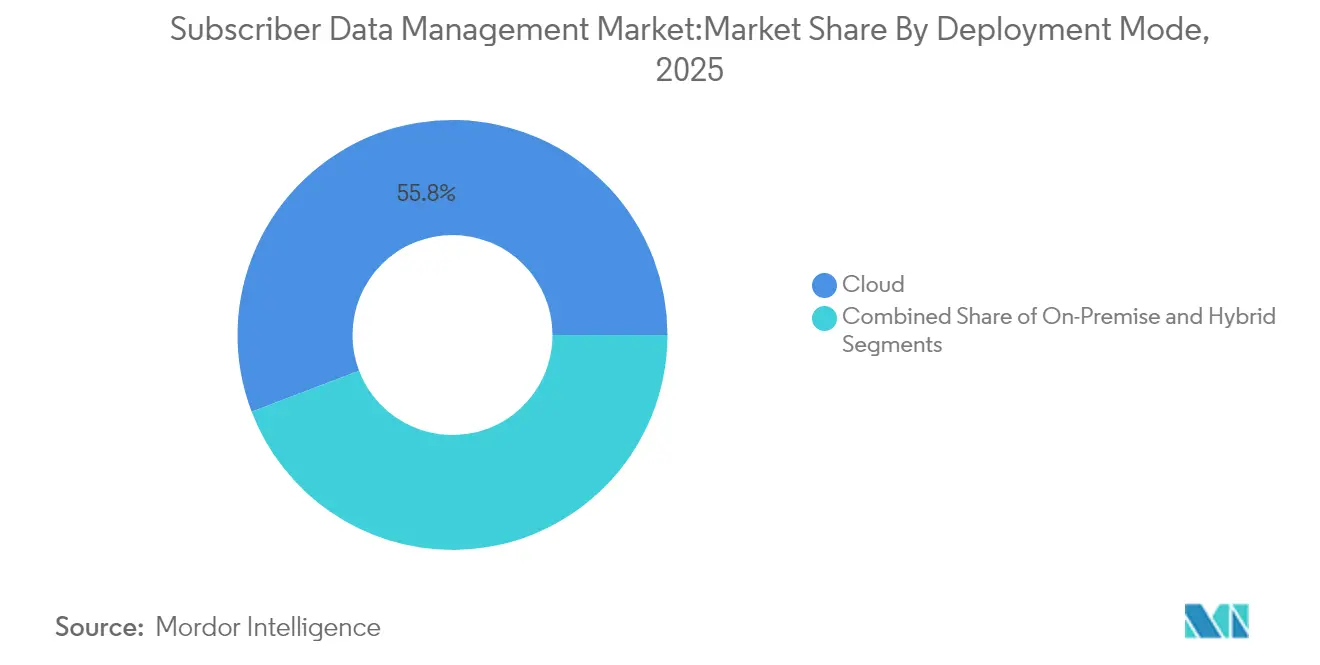
- By deployment mode, cloud deployments captured 55.80% of the subscriber data management market share in 2025; hybrid models are forecast to expand at an 18.1% CAGR to 2031.
- By organization size, large enterprises held 64.00% revenue share in 2025, while SMEs are projected to grow at a 19.1% CAGR through 2031.
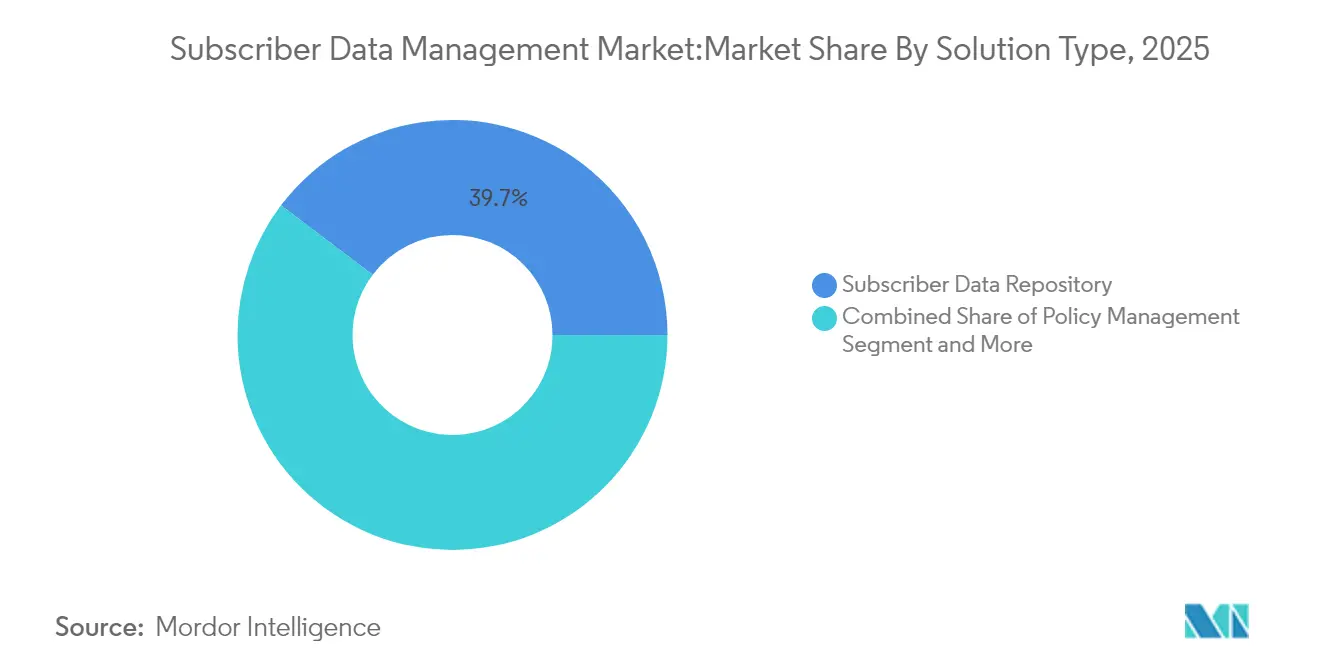
- By solution type, subscriber data repositories commanded a 39.70% share of the subscriber data management market size in 2025; identity-management solutions are set to advance at an 18.4% CAGR to 2031.
- By network type, 4G/LTE networks accounted for a 44.90% share in 2025, whereas 5G standalone networks are poised for a 18.8% CAGR through 2031.
- By end user, mobile-network operators controlled 57.40% share in 2025, while enterprises/IoT service providers exhibit the fastest growth at 19.0% CAGR to 2031.
- By geography, North America dominated with a 35.30% share in 2025, whereas Asia-Pacific is projected to grow at an 18.2% CAGR through 2031.
Note: Market size and forecast figures in this report are generated using Mordor Intelligence’s proprietary estimation framework, updated with the latest available data and insights as of 2026.
Market Trends and Insights
Drivers Impact Analysis of Subscriber Data Management Market*
| Driver | (~)% Impact on CAGR Forecast | Geographic Relevance | Impact Timeline |
|---|---|---|---|
| Rapid rollout of 5G networks | +3.2% | Global; APAC and North America lead | Medium term (2-4 years) |
| Shift toward cloud-native architectures | +2.8% | Global; strongest in Europe and North America | Short term (≤ 2 years) |
| Surge in IoT/mMTC device counts | +2.1% | Global; APAC manufacturing hubs | Long term (≥ 4 years) |
| Regulatory push for unified subscriber identity | +1.9% | Europe and North America primarily | Short term (≤ 2 years) |
| AI-driven real-time policy control adoption | +1.7% | Global; early adoption in developed markets | Medium term (2-4 years) |
| Private 5G and edge micro-core deployments | +1.5% | North America and Europe enterprise sectors | Medium term (2-4 years) |
| Source: Mordor Intelligence | |||
Rapid rollout of 5G networks
Commercial 5G SA cores are now live in more than 50 nations, and China alone recorded over 800 million 5G connections in 2024. SA architecture collapses the control plane into cloud-native functions that centralize data across multiple access types, making subscriber data management the lynchpin for network slicing, enterprise SLAs, and micro-second policy execution. Mobile-core capex accelerated 32% in 2024 as operators recognized that a robust subscriber data layer underpins future monetization—illustrated by Bharti Airtel’s Ericsson-powered SA core geared to differentiated consumer and enterprise slices. [2]
Shift toward cloud-native architectures
Operators migrating from monolithic HSS/UDM stacks to microservices report up to 30% lower total cost of ownership, plus elastic scaling that aligns spend with traffic. Three UK’s move to a cloud core that tops 9 Tbps demonstrates how containerized subscriber data functions support in-service upgrades without downtime. MVNOs exploit the same model, using Optiva’s Google-Cloud hubs for fast launch cycles that fold in AI customer analytics.
Surge in IoT/mMTC device counts
Manufacturing plants using private 5G record 15-20% efficiency gains when subscriber data segmentation isolates sensor traffic from corporate IT flows, as AIS proved at Midea Thailand. Each device often carries its own authentication, policy, and routing attributes, multiplying data-record volume. Scalable unified-data repositories now must support millions of simultaneous IoT identities at edge micro-cores to keep latency below 10 ms for safety-critical workloads.
AI-driven real-time policy control adoption
AI engines embedded in modern policy functions study live session behavior, predict congestion, and pre-assign quality-of-service marks before bottlenecks hit, lifting customer experience metrics while trimming opex. Optiva’s cloud BSS infuses generative AI into real-time analytics so MVNOs can personalize offers and curb churn. Patent activity from Samsung and others underscores a race to embed machine-learning-based traffic classification directly inside user-plane functions for encrypted flows.
Restraints Impact Analysis of Subscriber Data Management Market*
| Restraint | (~) % Impact on CAGR Forecast | Geographic Relevance | Impact Timeline |
|---|---|---|---|
| Data-privacy and sovereignty mandates | -2.1% | Europe prim.; spreading worldwide | Short term (≤ 2 years) |
| Integration complexity with legacy OSS/BSS | -1.8% | Global; mature markets hardest hit | Medium term (2-4 years) |
| Scarcity of Diameter/HTTP-2 signalling talent | -1.2% | Global, acute in developed markets | Long term (≥ 4 years) |
| Proprietary UDR schema lock-in risk | -0.9% | Global, vendor-dependent | Medium term (2-4 years) |
| Source: Mordor Intelligence | |||
Data-privacy and sovereignty mandates
The EU Data Act of 2024 compels cloud providers to guarantee data portability by 2027 and bars exit fees, while GDPR 2025 heightens breach-reporting and cross-border transfer hurdles. Operators must therefore redesign architectures so that sensitive subscriber attributes reside inside national borders even as roaming services traverse them, inflating compliance budgets by up to 25%.
Integration complexity with legacy OSS/BSS
Mature operators juggle decades-old BSS platforms lacking open APIs, so modern subscriber data management microservices often need costly adapters and phased migration to avoid service outages. Three UK dropped two legacy core suppliers to consolidate under Ericsson, precisely to tame that complexity. Industry studies show project overruns can hit 60% when integration scope is underestimated, driving a shift toward digital-overlay models like Qvantel’s that let carriers launch greenfield digital brands while slowly porting legacy subsystems.
*Our forecasts treat driver/restraint impacts as directional, not additive. The impact forecasts reflect baseline growth, mix effects, and variable interactions.
Subscriber Data Management Market Segment Analysis
By Deployment Mode:
Hybrid Models Bridge Legacy GapsHybrid implementations carve out a strategic middle ground, pairing on-premises data stores for regulated identifiers with public-cloud analytics that enhance agility. In revenue terms, the segment already commands 18.1% CAGR, exceeding both pure cloud and on-premise trajectories. European multinationals facing fragmented privacy regimes increasingly select hybrid UDM topologies, storing EU citizen data within continental data centers while hosting policy-analytics functions on hyperscale clouds situated closer to user clusters. That design minimizes legal exposure yet delivers the elastic scaling prized by product teams. As hyperscalers roll out sovereign-cloud zones, operators gain further tools to fine-tune residency, propelling hybrid demand through 2031.A second growth engine stems from converged fixed–mobile operators that must harmonize broadband and wireless subscribers across legacy BSS landscapes. Hybrid footprints allow them to migrate broadband user tables at a measured pace while running 5G SA credentials from day one, avoiding big-bang cutovers. The subscriber data management market sees vendors baking automated data-placement policies into their orchestration layers so records dynamically shift between edge and core depending on latency or compliance triggers. This fluid data-plane architecture positions hybrid as the long-term default for tier-1 groups navigating divergent regional statutes.

By Organization Size:
SME Adoption AcceleratesLarge enterprises still dominate spending thanks to national-scale operators modernizing multi-site cores, but affordability improvements now open advanced data management to SMEs. Cloud-native subscription models turn capex into opex, matching the cash-flow realities of regional MVNOs, utility networks, or campus 5G owners. Start-ups can stand up core functions within weeks, contrasting with the multi-quarter lead times of legacy systems. The subscriber data management market size tied to SMEs is therefore set to multiply as low-code provisioning portals reduce skills barriers.Vendors also curate pre-packaged analytics that pinpoint upsell opportunities for small operators lacking data-science teams. For example, Google-Cloud-based MVNO hubs ingest call-detail records and run churn-prediction models out-of-the-box, letting SMEs target retention campaigns a full quarter sooner than before. As 5G device ecosystems diversify, niche providers serving logistics fleets or smart-grid sensors are expected to expand, cementing SMEs as a high-momentum customer segment.
By Solution Type:
Identity Management SurgesSubscriber data repositories remain the backbone—housing profile, location, and policy data across 2G-to-5G eras—but identity-management solutions now post the most explosive growth. Zero-trust frameworks require fine-grained authentication, and 5G’s SUCI mechanism cloaks IMSIs to curb intercept attacks. Enterprises running private 5G for operational technology environments use the identity layer to segregate robotics, camera, and employee traffic, ensuring only authorized devices tap slice-specific resources. Consequently, identity platforms nested inside the subscriber data management market deliver both compliance and monetization upside through premium security add-ons.Advanced identity schemes also underpin seamless roaming between campus networks and macro coverage. Telecom groups now pilot multi-factor identity combining device attestation and behavioral analytics, increasing the attach rate for value-added enterprise services. These capabilities spur a virtuous cycle: richer identities enable differentiated QoS, fueling further spend on subscriber data-centric innovation.
By Network Type:
5G Standalone Momentum Builds4G LTE remains ubiquitous, but 5G SA uptake is now unmistakable. Malaysia’s Digital National Berhad (DNB) went live with 5G Advanced features in 2025, covering remote surgery and immersive education use cases and confirming that SA cores can host latency-critical workloads at scale. Each of these applications leans heavily on the data layer to map slice policy to user identity within microseconds. The subscriber data management market therefore benefits in lockstep with SA rollouts.Meanwhile, multigenerational support persists: rural sites may stay on 3G for voice fallback, and fiber-to-the-home bundles bring fixed-access data into the same repository. Vendors thus design schemas that tag records with access-type metadata, avoiding duplicated policy logic. The net result is a steadily rising demand curve for unified data stores that knit together heterogeneous access while readying carriers for SA-driven revenue streams.
By End-user:
Enterprise IoT Drives DiversificationEnterprises—especially in manufacturing, energy, and logistics—no longer rely solely on public macro networks. Instead, they commission private slices or standalone networks that require dedicated subscriber data layers. Toyota’s US material-handling operations, modernized via an Ericsson private-5G build, achieved smoother forklift routing and live inventory feeds thanks to a deterministic policy tied to each autonomous vehicle. Mobile-network operators still serve the broader consumer base, yet incremental enterprise spending will outpace retail revenue as digital-transformation budgets migrate to operational technology stacks. The subscriber data management market share linked to enterprise/IoT therefore expands faster than any other end-user cohort.MVNOs positioned on vertical niches also play a role: healthcare MVNOs promise HIPAA-grade identity assurance, while logistics MVNOs treat fleet telematics as priority traffic. Each variant leans on granular subscriber data constructs, broadening total addressable demand beyond traditional telco boundaries.
Geography Analysis
North America Subscriber Data Management Market
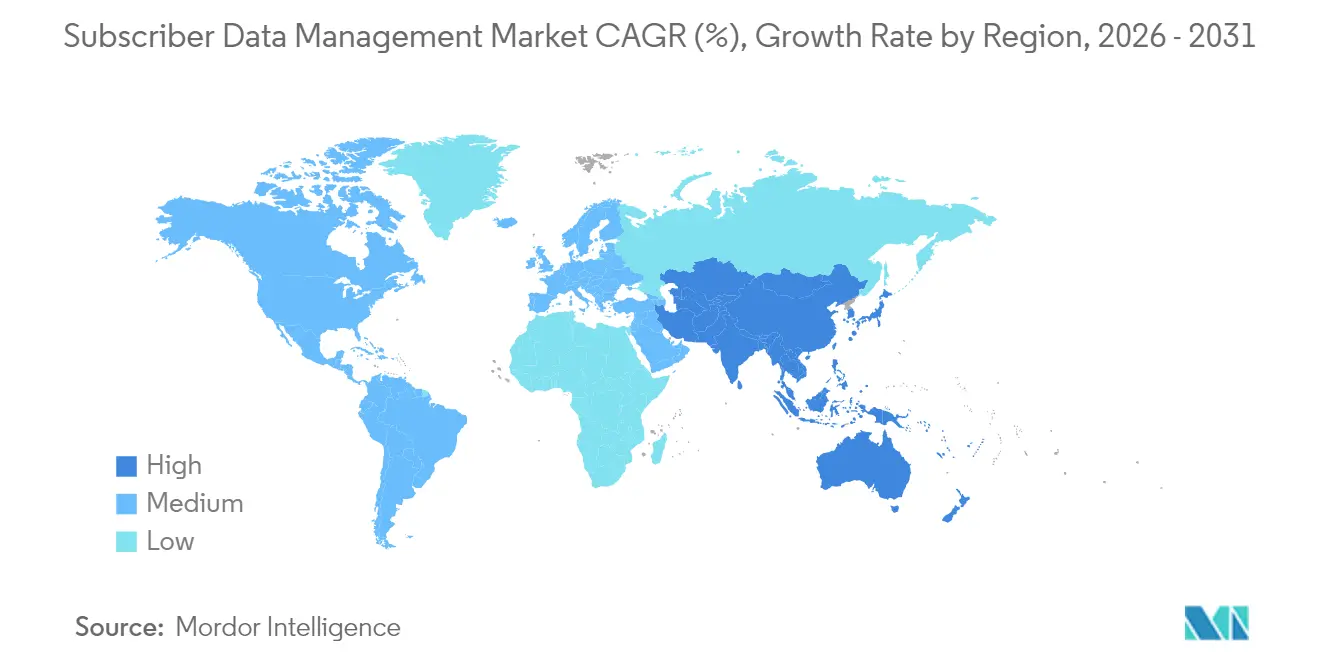
North America’s 35.30% slice of 2025 revenue reflects deep private-5G penetration across manufacturing and warehousing, plus strict sovereign-data rules that amplify demand for on-shore repositories. Verizon’s USD 20 billion fiber acquisition spree and AT&T’s fixed-wireless push exemplify the region’s infrastructure appetite, forcing cores and UDRs to scale for converged access types. Canadian carriers show similar momentum, aligning with federal road maps that require critical-infrastructure traffic to stay within national borders.
APAC Subscriber Data Management Market
Asia-Pacific posts the highest regional CAGR at 18.2%. China’s 800-million-plus 5G user base delivers unmatched scale, and operators there plan vast IoT overlays across ports and industrial parks that hinge on robust subscriber data management market capabilities. India follows with spectrum liberalization that lets factories secure private-network licenses, spurring SME-friendly core packages. South-Korea and Japan continue to pioneer 28 GHz campus networks, each bundling AI-fueled policy analytics to assure VR/AR performance.
Europe Subscriber Data Management Market
Europe balances solid uptake with complex compliance overhead. The GDPR 2025 revision and national prepaid-SIM identity laws, such as Norway’s, place immediate localization pressures on multi-country groups. Carriers respond by piloting sovereign-cloud clusters and encrypt-in-use techniques within the subscriber data management market to meet both performance and legal thresholds. EU funding for very-high-capacity networks adds investment firepower, though rollout tempos depend on how quickly converged operators reconcile fiber, cable, and mobile subscriber schemas into a single UDR.
Regulatory Landscape
Subscriber data management (SDM) deployments are shaped by tightening telecom security requirements and stronger data-protection enforcement, which influence where subscriber records can be stored and how access is audited. In July 2026, the UK Government published version 1.1 of the Telecommunications Security Code of Practice under the Telecommunications (Security) Act 2021 for providers of public electronic communications networks and services, reinforcing audit-ready security controls across sensitive network functions that process subscriber identifiers and policy data.
Across the EU, ongoing digital-rule consolidation adds compliance design requirements for SDM platforms covering consent, portability, and cross-border transfer controls. The European Commission proposal 52026PC0016 (Digital Omnibus) and related 2026 privacy-regulator opinions (EDPB-EDPS and EDPS) point to harmonized obligations for electronic communication services, while China GB/T 43506-2023 focuses on lifecycle protection of user personal information for telecom and internet service providers. In emerging markets, enforcement is becoming more coordinated, for example, the February 2026 MoU between Nigeria NCC and NDPC to strengthen data-protection enforcement for telecom operators under the Nigeria Data Protection Act 2023. This increases the need for consent tracking, access logging, and in-country data handling within UDR/UDM architectures.
Value Chain Analysis
The SDM value chain starts with standards and protocol definitions (3GPP/ETSI specifications such as TS 29.503 for Unified Data Management services) that set interoperability requirements across UDM/UDR and related service-based interfaces. Platform vendors (for example, Ericsson, Nokia, and Alepo) translate these specifications into cloud-native SDM software, usually delivered as containerized network functions with API layers, security modules, and lifecycle tooling. Inputs into the SDM layer include subscriber identifiers, authentication credentials, device and location attributes, service profiles, and policy rules sourced from OSS/BSS, SIM/eSIM provisioning, and core network functions.
Communications service providers and systems integrators then assemble these components into a working core-network data plane. This involves integrating SDM with legacy HLR/HSS where 2G/3G/4G interworking persists, and connecting it to 5G SA functions that require low-latency, high-availability data access. Deployments take place on operator private clouds, hybrid footprints, or managed cloud models, while bottlenecks tend to concentrate around legacy data migration, schema alignment between HSS and UDM/UDR, and sustaining high-throughput transactions as IoT identity volumes scale. Vendor and operator partnerships for modernization programs remain a common final-mile step, with multi-vendor interoperability and phased cutover plans used to reduce service disruption risk.
Competitive Landscape
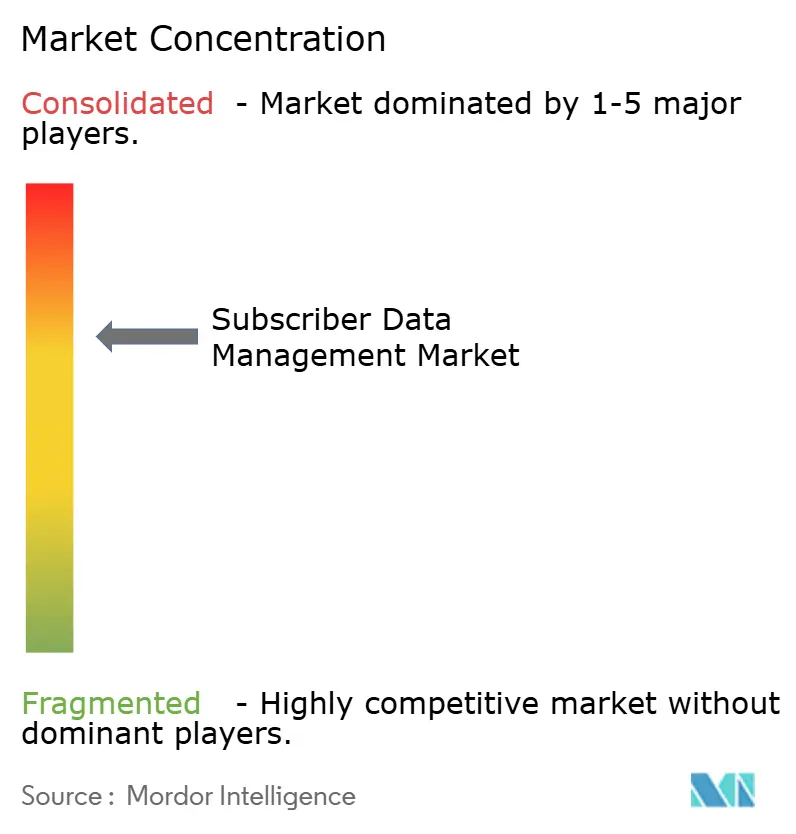
The market sits in a mid-consolidated state: three global heavyweights, Ericsson, Nokia, and Huawei, wield more than 60,000 patents each and have collectively poured over USD 100 billion into core-network R&D. Ericsson’s dual-mode UDM anchors Three UK’s record-sized packet core and underpins Vodafone Spain’s consumer SA launch. Nokia’s cloud-native CoreSuite emphasizes open API breadth, while Huawei leverages integrated radio-to-core portfolios in markets where geopolitical constraints are lighter.
Disruptors zero in on cloud delivery and AI. Oracle joined with Enea to certify a 5G subscriber-data stack on Oracle Cloud Infrastructure, positioning telcos to consume data functions as managed services. Google Cloud’s alliance with Ericsson created a pay-per-use 5G Core-as-a-Service that bundles automated life-cycle management for UDR/UDM. Start-ups such as Comviva and Netcracker package AI workbenches and broadband experience suites that link real-time customer metrics to dynamic policy shifts.
Strategically, vendors differentiate on three fronts: 1) breadth of multi-access data convergence, 2) AI embedded in policy decisions and 3) ease of legacy integration. Those excelling on all three capture the lion’s share of new SA-core awards. Patent filings around AI-based fraud detection indicate a second competitive horizon focused on privacy-preserving analytics.
Subscriber Data Management Industry Leaders
-
Telefonaktiebolaget LM Ericsson
-
Nokia Corporation
-
Huawei Technologies Co. Ltd.
-
Hewlett Packard Enterprise Co.
-
Cisco Systems Inc.
- *Disclaimer: Major Players sorted in no particular order
Subscriber Data Management Market Companies Covered in this Report
- Telefonaktiebolaget LM Ericsson
- Nokia Corporation
- Huawei Technologies Co. Ltd.
- Hewlett Packard Enterprise Co.
- Cisco Systems Inc.
- Oracle Communications
- Amdocs Ltd.
- ZTE Corporation
- Mavenir Systems Inc.
- Enea (Openwave Mobility)
- NetNumber Inc.
- Alepo Technologies Inc.
- Optiva Inc. (Redknee)
- Casa Systems Inc.
- Ribbon Communications Inc.
- BroadForward B.V.
- SigScale Inc.
- Affirmed Networks Inc.
- H3C Technologies Co. Ltd.
- Comba Telecom Systems Holdings Ltd.
- Parallel Wireless Inc.
- STC Solutions
- Kaleyra S.p.A.
- Lumine Group - Subex Ltd.
- Tata Communications Ltd.
Market Opportunities and Future Outlook
A clear whitespace is performance-focused modernization of the subscriber data layer, as 5G SA workloads expose database bottlenecks in authentication, policy lookup, and session state access. In 2026, industry guidance highlighted monolithic database architectures as a constraint in 5G SA deployments, while Enea published technical material on distributed state substrates and a write-anywhere distributed database approach for high availability and low latency in telecom cores. This supports demand for SDM suppliers with distributed data-plane designs, geo-redundant architectures, and operational tooling that enables in-service upgrades while holding stringent latency targets.
Compliance-led feature expansion inside SDM platforms is another opportunity area. Regulators are pushing more explicit security controls, auditability, and privacy governance into telecom environments. The UK Telecommunications Security Code of Practice (v1.1, July 2026) and coordinated data-protection enforcement actions such as the NCC-NDPC MoU in Nigeria (February 2026) increase the importance of embedded access control, logging, and policy automation around sensitive subscriber attributes. On standards, ongoing evolution of 3GPP Release 19 specifications for UDM/UDR services supports further differentiation in interoperability, data sharing, and automation capabilities, favoring vendors that can track specification updates and operationalize them quickly across cloud and hybrid deployments.
Recent Industry Developments in Subscriber Data Management Market
- July 2026: Jazz completed the virtualization of its Subscriber Data Management platform in Pakistan using Nokia on-premises cloud-native Subscriber Data Layer. The change advances cloud-native core modernization by shifting SDM onto a software-defined data layer that supports faster lifecycle operations and service changes.
- June 2025: Ericsson and Google Cloud introduced Ericsson On-Demand, a SaaS 5G core offering with elastic scaling and pay-per-use pricing for network functions. This delivery model reduces deployment friction for operators and MVNOs that want cloud-based subscriber data and policy capabilities without building full on-premises infrastructure.
- February 2024: Ericsson and TIM Brazil implemented a cloud-native 5G user data solution to improve agility and operational efficiency in the core network. The deployment reinforced the shift from monolithic subscriber databases toward cloud-native user data designs that support continuous upgrades and faster rollout of new services.
Subscriber Data Management Market Report Scope and Research Methodology
Market Definition and Coverage
For this methodology, the subscriber data management market covers software and related services used by telecom operators to store, unify, and use subscriber identities, profiles, policy rules, and device data across network and digital touchpoints.
Scope exclusions: We exclude general enterprise master data management tools, standalone HLR or HSS hardware replacements, and non-telecom customer data platforms that do not manage operator subscriber records.
Segments Covered in This Report
- By Deployment Mode
- Cloud
- On-Premise
- Hybrid
- By Organization Size
- Large Enterprises
- Small and Medium Enterprises (SMEs)
- By Solution Type
- Subscriber Data Repository
- Policy Management
- Identity Management
- Location and Device Information
- By Network Type
- 2G/3G
- 4G/LTE
- 5G Stand-Alone
- Fixed/Wireline
- By End-user
- Mobile Network Operators (MNOs)
- Mobile Virtual Network Operators (MVNOs)
- Enterprises/IoT Service Providers
- By Geography
- North America
- United States
- Canada
- Mexico
- South America
- Brazil
- Argentina
- Chile
- Rest of South America
- Europe
- Germany
- United Kingdom
- France
- Italy
- Spain
- Russia
- Rest of Europe
- Asia-Pacific
- China
- India
- Japan
- South Korea
- Singapore
- Malaysia
- Australia
- Rest of Asia-Pacific
- Middle East and Africa
- Middle East
- United Arab Emirates
- Saudi Arabia
- Turkey
- Rest of Middle East
- Africa
- South Africa
- Nigeria
- Rest of Africa
- Middle East
- North America
Data Sources, Market Sizing, and Validation
Desk Research
Desk work starts with public telecom demand signals and standards so the market boundary stays consistent. We relied on sources such as ITU indicators on mobile subscriptions, GSMA publications on mobile and 5G trends, 3GPP documentation for core-network functions and transitions, and OECD digital connectivity statistics to anchor adoption timing.
To convert demand signals into spend, we also used company filings, annual reports, investor presentations, reputable telecom press, and operator procurement disclosures where available. In parallel, we used paid subscriptions for company financials and news screening, plus patent databases to sanity check solution intensity and modernization activity. The sources listed here are illustrative only, and many other public documents were also reviewed for data collection, validation, and clarification.
Primary Interviews and Surveys
Primary work focused on validating what gets bought, how it gets priced, and when upgrades happen across the SDM stack. We spoke with a mix of telecom operators, system integrators, and solution providers across APAC, EMEA, and the Americas so assumptions on cloud migration pace, subscriber growth, and policy control needs could be corrected early.
Distribution of primary research fieldwork respondents
| Company type | Respondent position | Region |
|---|---|---|
| Top tier: 29% | CXOs: 17% | APAC: 44% |
| Mid tier: 49% | Functional/Unit leaders: 28% | EMEA: 31% |
| Smaller Players: 22% | Managers: 55% | Americas: 25% |
Market-Sizing & Forecasting
Sizing is built using a top-down approach where telecom subscriber bases and core-network modernization timelines are used to reconstruct the reachable spend pool for SDM platforms, and then split into software and associated services. The totals are corroborated with selective bottom-up checks, such as sampled deal values from public references, provider revenue cues, and volume times ASP estimates for known deployment patterns, which are then used to adjust outliers.
Key model inputs include mobile subscriber counts and growth, 4G to 5G core progression, the pace of cloud-native migrations for core functions, typical SDM license and subscription pricing progression, and services-to-software attach rates during deployment and upgrades. Where direct spend signals are thin, gaps are handled by using proxy adoption curves from similar operator core investments, followed by interview based ranges to keep assumptions realistic.
For forecasting, scenario analysis is used around 5G standalone rollout speed and cloud adoption, and the central scenario is supported by expert consensus on budget direction and deployment mix. The final forecast is expressed in constant scope terms so year to year growth reflects market movement rather than scope drift.
Data Validation & Update Cycle
Outputs are checked against independent signals such as operator capex direction, subscriber growth trends, and visible core-network upgrade cycles, and then reviewed for abnormal jumps by region or deployment type. When a variance is flagged, assumptions are re-tested and, if needed, experts are re-contacted to confirm whether pricing, timing, or scope drove the change.
Before sign-off, the model and assumptions go through multi-step internal reviews so math consistency, unit logic, and conversion steps are verified. Reports are refreshed annually, and interim updates are made when material events occur, such as major technology shifts, regulation changes, or a step-change in operator spending. Prior to delivery, a final pass is completed so clients receive the latest updated view.
Mordor Intelligence's Subscriber Data Management Market Size Compared Against Other Published Estimates
Published market sizes for subscriber data management can look far apart even when they talk about similar end users. The spread usually comes from what is counted as SDM, how pricing is treated as the market moves toward subscriptions, and which year and exchange rate timing is used.
Refresh timing and price logic are often the biggest drivers in this market because cloud-native SDM shifts spend from one-time licenses into recurring software and services, and that changes the run-rate view. When FX conversion is applied at a different point in time, or when legacy HLR or HSS replacement spend is included, the reported totals can move materially, and this is why the table shows a range.
Benchmark comparison
| Source | Market Size | Gaps in Research Methodology |
|---|---|---|
| Mordor Intelligence | USD 9.94 B (2026) | |
| Regional Consultancy A | USD 10.76 B (2025) | Uses an earlier year and may treat multi-year transformation programs as current-year spend, which can inflate near-term totals when large contracts are front-loaded. |
| Trade Journal B | USD 9.31 B (2025) | Leans on headline growth figures and can apply broad CAGR assumptions with limited validation of ASP changes as deployments shift from on-premises licenses to cloud subscriptions. |
The comparison mainly points to timing, currency conversion points, and pricing treatment as the reasons the figures differ. By keeping assumptions refreshed on subscription pricing and services attach rates close to the base year, and then reconfirming them with operator and integrator checks, Mordor Intelligence keeps the estimate tied to what is being contracted and deployed in the period.
Key Questions Answered in the Report
What is the current value of the subscriber data management market?
The market stands at USD 9.94 billion in 2026 and is set to reach USD 21.17 billion by 2031.
Which region grows the fastest for subscriber data management solutions?
Asia-Pacific leads with an 18.2% CAGR through 2031 driven by China’s vast 5G footprint and India’s enterprise 5G initiatives.
Why are hybrid deployments gaining traction?
They let operators satisfy strict data-residency rules by keeping sensitive records on-premise while using public-cloud elasticity for analytics, balancing compliance and cost.
How do AI capabilities influence subscriber data management?
AI enables real-time policy tweaks, predictive congestion control and fraud detection, improving user experience and operational efficiency.
What are the primary challenges facing operators adopting modern subscriber data management?
Tightening data-sovereignty mandates raise compliance costs, and integrating cloud-native platforms with legacy OSS/BSS often leads to project delays and budget overruns.
Who are the major players in the subscriber data management market?
Ericsson, Nokia and Huawei dominate globally, while Oracle, Enea and cloud-native start-ups provide competitive alternatives focused on SaaS delivery and AI-enhanced analytics.