
Sterilization Equipment Market Size and Share
Market Overview
| Study Period | 2020 - 2031 |
|---|---|
| Market Size (2026) | USD 10.31 Billion |
| Market Size (2031) | USD 14.72 Billion |
| Growth Rate (2026 - 2031) | 7.39 % |
| Fastest Growing Market | Asia Pacific |
| Largest Market | North America |
| Market Concentration | Medium |
Major Players *Disclaimer: Major Players sorted in no particular order Image © Mordor Intelligence. Reuse requires attribution under CC BY 4.0. | |
Sterilization Equipment Market Analysis by Mordor Intelligence
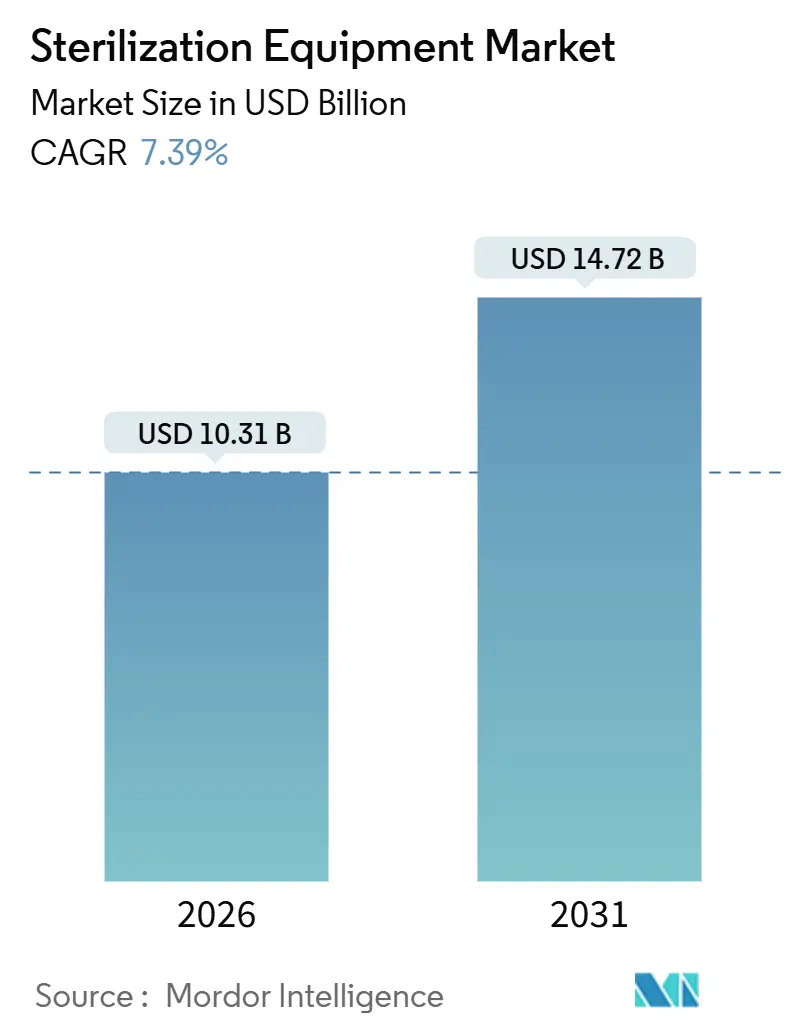
The Sterilization Equipment Market size is estimated at USD 10.31 billion in 2026, and is expected to reach USD 14.72 billion by 2031, at a CAGR of 7.39% during the forecast period (2026-2031).
Demand is rising as hospitals, ambulatory centers, and pharmaceutical plants modernize infection-control infrastructure and scale up throughput. Growth is most visible in low-temperature systems that handle heat-sensitive robotic and flexible endoscopes, while steam autoclaves continue to anchor baseline capacity. Contract service providers are expanding gamma, electron-beam, and ethylene-oxide offerings for device and drug makers that prefer outsourcing over in-house chambers. At the same time, cobalt-60 isotope shortages and environmental scrutiny of chemical sterilants are prompting shifts toward alternative radiation or hydrogen-peroxide plasma cycles. Competitive differentiation centers on validation know-how, digital traceability, and service breadth, creating room for both global manufacturers and niche specialists to capture share.
Key Report Takeaways
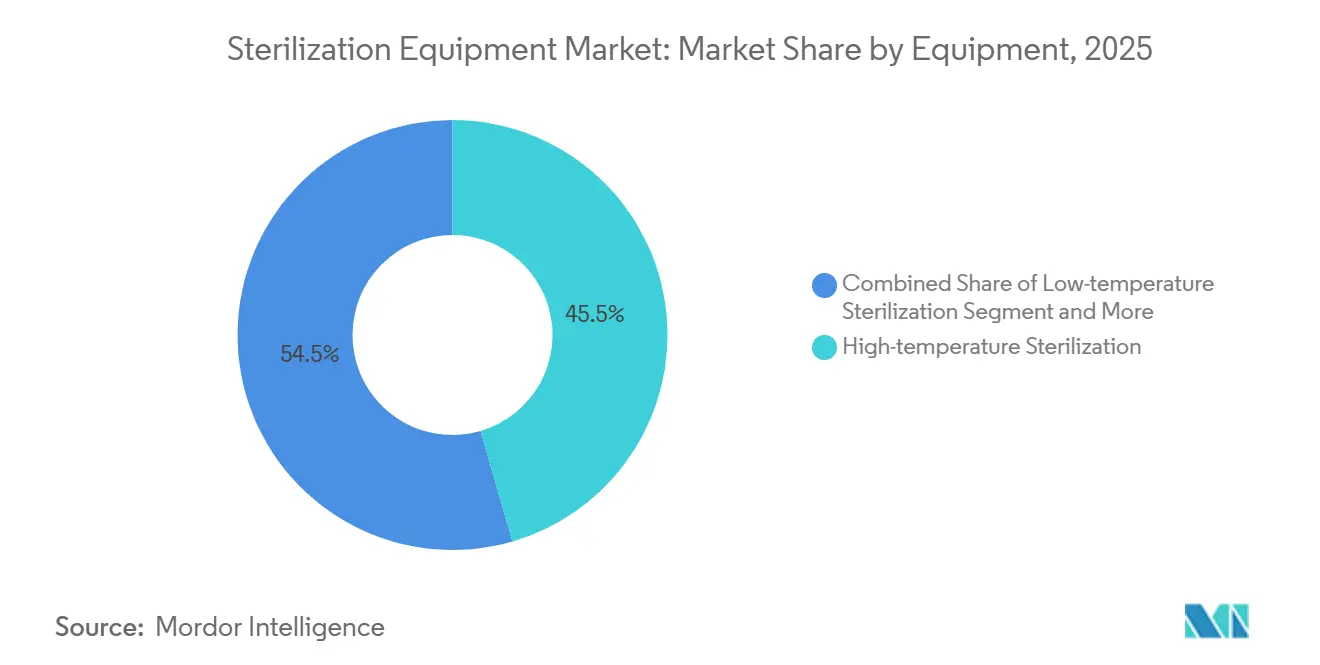
- By equipment, high-temperature sterilization led with 45.55% of sterilization equipment market share in 2025, whereas low-temperature systems are projected to expand at an 11.25% CAGR through 2031.
- By end user, hospitals and clinics held 55.53% of the sterilization equipment market size in 2025, but ambulatory surgery centers are growing at a 9.85% CAGR to 2031.
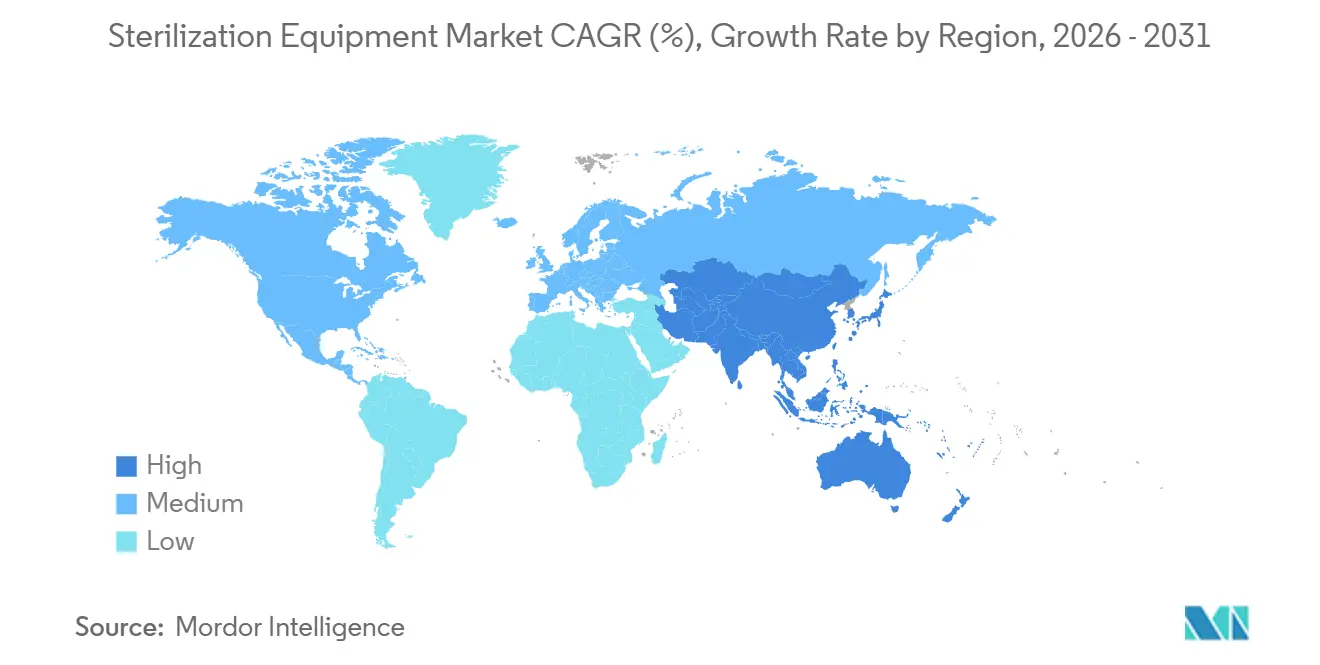
- By geography, North America contributed 39.13% revenue in 2025, while Asia-Pacific is forecast to outpace all regions at an 8.81% CAGR between 2026 and 2031.
Note: Market size and forecast figures in this report are generated using Mordor Intelligence’s proprietary estimation framework, updated with the latest available data and insights as of January 2026.
Market Trends and Insights
Drivers Impact Analysis of Sterilization Equipment Market*
| Driver | (~) % Impact on CAGR Forecast | Geographic Relevance | Impact Timeline |
|---|---|---|---|
| Rising HAIs and cross-contamination risk | +1.8% | North America and Europe | Short term (≤ 2 years) |
| Increase in surgical procedures | +1.5% | Global, led by Asia-Pacific | Medium term (2-4 years) |
| Expansion of pharma & biotech manufacturing | +1.3% | North America and Europe | Medium term (2-4 years) |
| Regulatory tightening on sterilization compliance | +0.9% | North America and EU | Long term (≥ 4 years) |
| Robotics-driven need for low-temperature H₂O₂ plasma | +1.2% | North America and Europe | Medium term (2-4 years) |
| Growth of mobile on-demand sterilization services | +0.7% | Asia-Pacific and Middle East | Long term (≥ 4 years) |
| Source: Mordor Intelligence | |||
Rising HAIs And Cross-Contamination Risk
Healthcare-associated infections affect 1 in 31 U.S. inpatients on any given day, a statistic that keeps infection prevention high on executive agendas[1]. European surveillance shows 3.2 million cases every year, with device-associated episodes accounting for roughly one-third of events. Regulators now require supplemental high-level disinfection for duodenoscopes and similar devices, elevating the urgency of upgrading older autoclaves and ethylene-oxide chambers. Institutions unable to validate consistent cycles risk accreditation penalties, so many are fast-tracking versatile platforms that combine faster turnaround with lower chemical residuals. Spending is greatest in large North American and European systems, yet similar patterns are emerging in tertiary hospitals across Asia-Pacific.
Increase In Surgical Procedures
Robotic and minimally invasive surgeries are expanding procedure counts worldwide. Hip and knee replacements among OECD members increased 4.2% per year between 2019 and 2024, while cataract procedures advanced 3.8% annually[2]. U.S. hospitals report robotic techniques in more than 15% of general-surgery cases, which introduces delicate polymer tools that cannot withstand 132 °C steam cycles. This shift helps explain why low-temperature modalities are outpacing the broader sterilization equipment market. Facilities are layering hydrogen-peroxide plasma or low-temperature steam-formaldehyde units on top of legacy steam capacity to maintain throughput without compromising instrument integrity. Asia-Pacific volumes are accelerating fastest, reflecting rising disposable incomes and hospital construction.
Expansion Of Pharma & Biotech Manufacturing
Sixteen cell and gene therapies won U.S. approval in 2024, each requiring highly controlled aseptic fill-finish operations. Pharmaceutical plants are therefore increasing demand for tunnel sterilizers, hydrogen-peroxide generators, and outside contract services. STERIS disclosed 9% contract-sterilization revenue growth in fiscal 2024, citing biologics customers as a prime driver. European CDMOs echo similar trends as EMA mandates robust sterility assurance for advanced therapies. Growth is strongest in North America and Western Europe, yet spill-over investment is reaching Singapore, South Korea, and India as multinational firms widen biologics footprints.
Regulatory Tightening On Sterilization Compliance
The FDA harmonized its Quality Management System Regulation with ISO 13485:2016 in February 2024, compelling manufacturers to prove validated cycles and retain detailed batch records. Europe’s Medical Device Regulation enforces similar oversight, including audits of sterilization subcontractors during conformity assessments. China’s NMPA adopted guidelines mirroring ISO 11135 and ISO 14937, narrowing domestic-international compliance gaps. Such convergence raises entry barriers yet provides clear protocols that favor vendors with mature validation toolkits. Facilities now bundle data-logging sensors and digital traceability modules into purchase specifications, further boosting equipment refresh cycles.
Restraints Impact Analysis of Sterilization Equipment Market*
| Restraint | (~) % Impact on CAGR Forecast | Geographic Relevance | Impact Timeline |
|---|---|---|---|
| High capital and maintenance costs | -1.1% | Global | Short term (≤ 2 years) |
| Toxicity concerns over chemical sterilants | -0.6% | North America and Europe | Medium term (2-4 years) |
| Co-60 isotope supply constraints | -0.5% | North America and Europe | Short term (≤ 2 years) |
| Shift toward single-use disposable instruments | -0.9% | Global | Long term (≥ 4 years) |
| Source: Mordor Intelligence | |||
High Capital And Maintenance Costs
Hospital-grade steam units range from USD 50,000 to USD 150,000, and hydrogen-peroxide plasma systems often exceed USD 200,000 before validation. Annual service contracts add another 10%–15%, pressuring budgets in smaller ambulatory centers that already face tightening reimbursements. The American Hospital Association ranked sterilizers only fifth in 2024 capital-spending priorities, after electronic records, imaging, robotics, and infrastructure[3]. Many facilities run autoclaves beyond a 15-year service life, accepting higher breakdown risk to defer investment. Emerging-market buyers confront even steeper hurdles because imported equipment is priced in foreign currency and tied to fluctuating exchange rates.
Shift Toward Single-Use Disposable Instruments
Orthopedic and endoscopy suppliers increasingly promote disposable tools that eliminate reprocessing steps. A 2024 JAMA study found single-use duodenoscopes cut infection risk by 78% compared with reusable models. Hospitals tempted by infection-control gains must weigh environmental impacts: a Lancet Planetary Health lifecycle review reported 3.2 kg CO₂-equivalent emissions for a single-use laparoscopic instrument versus 0.4 kg for a reusable item amortized over 50 uses. Sustainability mandates in the United Kingdom, the EU, and some U.S. states are therefore slowing universal conversion, but the trend nonetheless removes part of the addressable sterilization equipment market.
*Our forecasts treat driver/restraint impacts as directional, not additive. The impact forecasts reflect baseline growth, mix effects, and variable interactions.
Sterilization Equipment Market Segment Analysis
By Equipment:
Low-Temperature Modalities Gain GroundLow-temperature systems are projected to grow at an 11.25% CAGR from 2026 to 2031, substantially above the 7.39% pace of the overall sterilization equipment market. Hospitals are layering hydrogen-peroxide plasma, ethylene oxide, and ozone platforms onto existing steam capacity instead of wholesale replacement. The U.S. Environmental Protection Agency tightened ethylene-oxide emission limits in 2024, raising operating costs for commercial chambers and nudging facilities toward hydrogen-peroxide cycles that leave no carcinogenic residuals. Meanwhile, cobalt-60 shortages are accelerating the pivot to electron-beam lines that rely on high-energy electricity rather than isotopes, trimming both turnaround time and disposal liabilities. These dynamics underscore why capital is shifting toward versatile, low-toxicity systems capable of validating mixed instrument loads.
High-temperature steam remains indispensable for wrapped surgical trays, linens, and heat-stable metal tools. Cycle costs hover near USD 0.10, and standard loads finish in under 45 minutes, keeping steam dominant where utility infrastructure is reliable. Dry-heat sterilizers, operating at 160 °C–180 °C for 60–120 minutes, are increasingly confined to glassware and petroleum products as disposable alternatives proliferate. Filtration sterilization supports biologics processing but captures only a narrow slice of sterilization equipment market share. Gamma radiation still handles the bulk of single-use medical device volumes, yet isotope supply gaps have opened doors for 10-MeV electron-beam accelerators. Although a complete accelerator line can cost more than USD 5 million, high-throughput hubs justify the spend through faster cycles and elimination of isotope logistics.

By End User:
Ambulatory Centers AccelerateHospitals and clinics captured 55.53% revenue in 2025 owing to diverse procedural portfolios and validated central sterile supply departments. Ambulatory surgery centers, however, are forecast to advance at a 9.85% CAGR, widening the sterilization equipment market as more orthopedic, ophthalmic, and gastrointestinal cases migrate outpatient. Medicare certified 6,150 U.S. centers by late 2024, a 3.8% annual increase, and ASC procedure volumes climbed 6.2% in the same period. These facilities favor compact tabletop steam units paired with hydrogen-peroxide plasma chambers, achieving high turnover without the spatial demands of hospital-grade autoclaves. The cost-conscious model aligns with private payer incentives that reward same-day discharge.
Pharma and biotech producers form a smaller but rapidly expanding customer base. Each newly approved cell or gene therapy adds dedicated fill-finish lines that depend on validated sterilization tunnels or outsourced gamma, ethylene-oxide, or electron-beam cycles. Academic research institutes, dental offices, and veterinary hospitals round out demand with lower-capacity steam or dry-heat units, adding geographic breadth even if dollar contribution is modest.
Geography Analysis
North America Sterilization Equipment Market
North America accounted for 39.13% of 2025 revenue, anchored by the United States’ dense hospital network and high procedural rates. Replacement sales now dominate, as many facilities defer upgrades amid wider capital pressures, ranking sterilizers behind imaging and robotics in planned spending. Canada is centralizing capacity into regional hubs to spread maintenance overhead, whereas Mexico attracts medical-tourism cases that drive fresh installation of compact multi-modal systems.
APAC Sterilization Equipment Market
Asia-Pacific is forecast to record the fastest 8.81% CAGR through 2031, fueled by hospital construction in China and India, rising insurance coverage, and growing adoption of robotic surgery. China added 1,200 hospitals over 2022-2024, most with central sterile departments large enough to justify mixed low-temperature and high-capacity steam installations. India’s mobile pilot improved instrument availability by 22% in district hospitals, signaling a pragmatic route to scale infection control where fixed infrastructure lags. Japan’s 28.9% 65-plus population share sustains cataract and joint replacement volumes that underpin steady autoclave demand.
EMEA and South America Sterilization Equipment Market
Europe remains technology-focused. The 2024 Medical Device Regulation rollout increased audits of sterilization subcontractors, favoring firms with ISO-aligned documentation. Germany, France, and the United Kingdom represent most spending, while EU cohesion funds spur modernization across Southern and Eastern members. The Middle East is building academic hospitals that meet Joint Commission standards to support medical tourism. Sub-Saharan Africa is adopting solar-powered tabletop steam units and mobile trucks as stop-gaps against chronic power outages. South America’s private networks, especially in Brazil, purchase mid-tier steam and hydrogen-peroxide units to serve metropolitan surgical centers.
Regulatory Landscape
In the United States, sterilization equipment and sterilized medical devices sit under FDA oversight, with a documentation-heavy emphasis on validated cycles, residuals, and sterility assurance in premarket submissions. In January 2024, FDA updated its guidance on the submission and review of sterility information for 510(k) notifications for devices labeled as sterile, tightening expectations around method selection, validation evidence, and labeling. In November 2024, FDA issued final guidance on a Transitional Enforcement Policy for ethylene oxide (EtO) sterilization facility changes for Class III devices, outlining a voluntary pathway intended to reduce supply disruptions when site or process changes are necessary.
In Europe, conformity assessment under the Medical Device Regulation (MDR) and IVDR increasingly hinges on alignment with harmonised standards referenced by the European Commission. Commission Implementing Decision (EU) 2025/679 updated harmonised standards for sterilization, including EN 556-1:2024 and EN 556-2:2024. In January 2026, Commission Implementing Decision (EU) 2026/197 adopted additional harmonised standards such as EN ISO 17665:2024 for moist heat sterilization. For radiation sterilization, the standards landscape also continued to refresh with ISO 11137-1:2025 and national adoptions such as BS EN ISO 11137-1:2026, reinforcing the need for equipment makers and service providers to keep validation packages current and records traceable across geographies.
Competitive Landscape
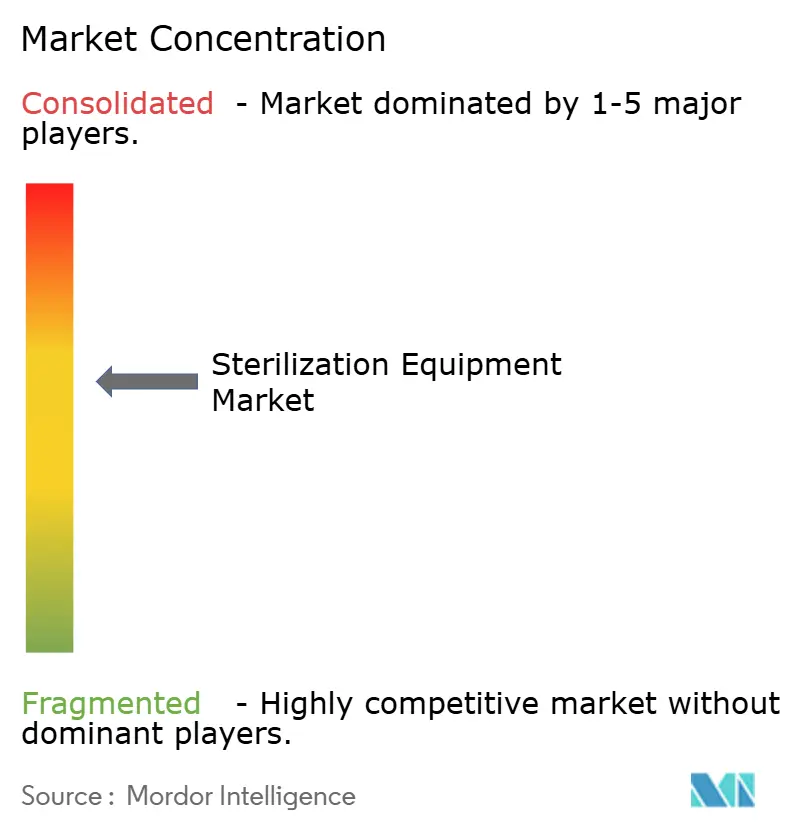
The sterilization equipment market shows moderate concentration. STERIS, Getinge, and Fortive’s Advanced Sterilization Products division collectively supply a majority of installed capital, leveraging multiyear service contracts, sizable R&D budgets, and broad validation toolkits. STERIS’ Applied Sterilization Technologies segment posted 8% year-over-year growth in Q3 2024, driven by outsourced gamma and ethylene-oxide demand. Getinge’s Life Science division recorded 6% organic order growth, largely from biotech clients scaling aseptic lines. Stryker’s acquisition of TSO3 extends its hydrogen-peroxide plasma presence into ambulatory care.
White-space competition comes from mobile service operators and digital tracking specialists. E-BEAM Services invested in additional 10-MeV accelerators to hedge cobalt-60 shortages, highlighting a strategic pivot toward electron-beam capacity. Noxilizer promotes nitrogen-dioxide cycles that run at ambient temperature and leave no carcinogenic residues, targeting combination-product manufacturers. Smaller European vendors such as Belimed, MMM Group, and Steelco refine modular steam and low-temperature cabinets for space-constrained facilities. Regulatory recognition of vaporized hydrogen peroxide under Category A reduces market entry barriers, amplifying competitive churn around cycle chemistry, chamber size, and user-interface simplicity.
Sterilization Equipment Industry Leaders
-
Getinge AB
-
STERIS PLC
-
Fortive Corp. (Advanced Sterilization Products)
-
Solventum Corporation
-
Metall Zug (Belimed)
- *Disclaimer: Major Players sorted in no particular order
Sterilization Equipment Market Companies Covered in this Report
- Andersen Products
- Cosmed Group
- E-BEAM Services
- Fedegari Group
- Fortive Corp. (ASP)
- Getinge
- Hanshin Medical
- Matachana Group
- Metall Zug (Belimed)
- MMM Group
- Noxilizer
- Shimadzu
- Solventum Corporation
- Steelco
- STERILE-LINK
- STERIS
- Stryker (TSO3)
- Tuttnauer
Market Opportunities and Future Outlook
A whitespace is forming around integrated, higher-throughput sterile manufacturing and sterilization capacity that reduces logistics complexity and dependency on external sterilizers, particularly for advanced therapies and high-mix device portfolios. This shows up as life science and device makers placing sterilization closer to production, for example in February 2026 when Becton Dickinson laid the foundation stone for a EUR 42.2 million sterilization plant in Korinye, Hungary to support in-house sterilization, and in January 2026 when Unither Pharmaceuticals began construction of a EUR 140 million industrial facility in Gannat, France that adds sterile multidose systems alongside expanded single-dose output. Together, these investments support demand for validated sterilization equipment, monitoring, and digital traceability inside factories, not only in hospitals and contract service networks.
Regulatory change is also creating actionable opportunities for modality diversification and technology-neutral capacity buildouts. In March 2026, the US EPA published a Federal Register proposal to reconsider and rescind parts of the 2024 NESHAP standards for EtO commercial sterilizers, citing supply chain concerns tied to roughly 20 billion annual medical device sterilizations. That focus on compliance-ready EtO operations coincides with continued investment in alternatives that avoid EtO emissions burdens. Suppliers are also expanding sterility assurance product and radiation processing footprints: in May 2026, STERIS announced a USD 60 million investment to build a new sterility assurance manufacturing plant in Mentor, Ohio by consolidating three facilities, and EU harmonised standards updates, including Implementing Decision (EU) 2026/197 with EN ISO 17665:2024, are pushing manufacturers and healthcare facilities to refresh equipment, validation documentation, and data logging capabilities to maintain conformity.
Recent Industry Developments in Sterilization Equipment Market
- July 2026: STERIS completed an expansion at its Chester, New York, radiation processing campus, adding X-ray processing capability alongside existing electron-beam and gamma irradiation services. The added modality broadens processing optionality for device and pharma customers dealing with cobalt-60 constraints and qualification needs across product types.
- June 2026: Getinge launched the Aquadis Endo 110 automated endoscope reprocessor, positioned to lift processing capacity by up to 36% versus prior models. The release targets hospital and ambulatory reprocessing departments seeking faster turnaround for heat-sensitive flexible endoscopes while tightening traceability and workflow consistency.
- November 2025: Getinge released an updated Solsus 66 steam sterilizer to match evolving central sterile supply department requirements. The update supports replacement and modernization programs where steam remains the baseline modality for wrapped trays and heat-stable instruments, with throughput and documentation features increasingly specified in procurement.
Sterilization Equipment Market Report Scope and Research Methodology
Market Definition and Coverage
This market covers equipment used to sterilize medical instruments, devices, and related loads in healthcare, life sciences, and research settings, where the purpose is to eliminate microorganisms and reduce cross-contamination risk.
Scope exclusions: We exclude sterilization services and routine consumables that are purchased separately from the equipment system (such as wraps, pouches, indicators, and most chemical solutions).
Segments Covered in This Report
- By Equipment
- High-temperature Sterilization
- Wet/Steam Sterilization
- Dry Heat Sterilization
- Low-temperature Sterilization
- Ethylene Oxide (ETO)
- Hydrogen Peroxide Plasma
- Ozone
- Other Low-temperature Methods
- Filtration Sterilization
- Ionizing Radiation Sterilization
- E-beam
- Gamma
- Other Ionizing Technologies
- High-temperature Sterilization
- By End User
- Hospitals & Clinics
- Pharma & Biotech Manufacturers
- Research & Academic Institutes
- Ambulatory Surgery Centers
- Other End Users
- By Geography
- North America
- United States
- Canada
- Mexico
- Europe
- Germany
- United Kingdom
- France
- Italy
- Spain
- Rest of Europe
- Asia-Pacific
- China
- Japan
- India
- South Korea
- Australia
- Rest of Asia-Pacific
- Middle East & Africa
- GCC
- South Africa
- Rest of Middle East & Africa
- South America
- Brazil
- Argentina
- Rest of South America
- North America
Data Sources, Market Sizing, and Validation
Desk Research
For the initial structure of the model, we rely on public references that explain demand drivers, installed base patterns, and safety requirements for sterilization in care delivery. Sources reviewed include, for example, US FDA device and safety communications, US CDC infection prevention guidance, WHO materials on healthcare-associated infections, OECD health statistics for procedure volumes, and United Nations Comtrade for trade flows of relevant equipment categories.
We also screened manufacturer product catalogs, annual reports, and investor presentations to understand typical system configurations and pricing ranges by technology. Where available, we used a paid subscription for company financials and news to sanity-check revenue direction and timing of major capacity additions. The desk sources listed above are illustrative, and other public documents were also reviewed to fill gaps and confirm assumptions.
Primary Interviews and Surveys
Primary interviews and surveys were used to validate which sterilization technologies are being purchased, what is driving replacement cycles, and how buyers compare alternatives across hospitals, ambulatory centers, pharma and biotech sites, and research labs. We spoke with a mix of equipment suppliers, channel partners, and end users across major regions, so the model could be corrected for local purchasing behavior, regulation, and procurement lead times.
Distribution of primary research fieldwork respondents
| Company type | Respondent position | Region |
|---|---|---|
| Top tier: 31% | CXOs: 18% | APAC: 41% |
| Mid tier: 49% | Functional/Unit leaders: 28% | EMEA: 34% |
| Smaller Players: 20% | Managers: 54% | Americas: 25% |
Market-Sizing & Forecasting
The core sizing starts with a top-down build where procedure volumes, hospital bed capacity, sterile processing throughput needs, and life science production activity are translated into an addressable equipment demand pool by technology. Because real purchasing does not follow a single clean pattern, the totals are corroborated using selective bottom-up checks like sampled average selling prices times estimated unit shipments, distributor channel checks, and a supplier-level roll up for a small set of well-tracked product lines.
A few practical inputs that shape the model include: surgery and inpatient activity trends, replacement cycle assumptions for installed sterilizers, adoption pace of low-temperature systems for heat-sensitive instruments, regulatory and accreditation driven upgrades, and import dependency signals visible in trade data. Forecasts are produced using scenario analysis, where base, conservative, and faster-adoption paths are stress-tested with interview feedback on capital budgets and capacity utilization. If a country-level gap appears, we bridge it using regional analogs that share similar healthcare spend, procedure intensity, and facility mix. We only expand the estimate after a reasonableness check against adjacent indicators.
Data Validation & Update Cycle
Outputs are checked against independent signals such as sterilizer installation activity, trade movement direction, and the implied spend per procedure or per facility, which helps spot numbers that look too high or too low. When variances show up, assumptions are revisited, and follow-up questions are triggered with selected respondents before final sign-off.
A second analyst reviews key inputs and math steps, then a final pass is completed close to publication so the latest events are reflected. The report is refreshed annually, and interim updates are made when a material change occurs in regulation, supply availability, or demand conditions.
Mordor Intelligence's Sterilization Equipment Market Estimate Compared With Other Published Estimates
Published figures for sterilization equipment can look far apart even when they describe the same end use, because the counted items and the year basis are not aligned. Differences usually come from what is treated as equipment versus services, how low-temperature technologies are grouped, and which exchange-rate timing is used for global rollups.
Consumables and outsourced sterilization services sit outside Mordor Intelligence's scope here, which reduces the headline value versus estimates that fold in wraps, indicators, and service revenue. The spread can widen further when others use aggressive replacement-cycle assumptions or a longer forecast window.
Benchmark comparison
| Source | Market Size | Gaps in Research Methodology |
|---|---|---|
| Mordor Intelligence | USD 10.31 B (2026) | |
| Industry Publisher A | USD 18.33 B (2025) | Includes consumables, accessories, and sterilization services along with equipment, which expands scope beyond system sales. Uses an earlier base year and a different forecast window, so currency timing and growth compounding are not comparable one-to-one. |
| Industry Publisher B | USD 9.30 B (2025) | Uses a different base year and grouping of product lines, and it also references related services and accessories in some categories, which can shift totals depending on what is counted as equipment revenue. |
Overall, the table shows that scope line items and base-year alignment explain most of the gap, more than small modeling math differences. By keeping the count tied to equipment systems and cross-checking with demand signals like procedure activity, installed base replacement, and trade direction, the estimate stays traceable to clear variables and repeatable steps.
Key Questions Answered in the Report
What is the projected value of the sterilization equipment market in 2031?
The sterilization equipment market size is expected to reach USD 14.72 billion by 2031.
Which equipment segment is growing fastest?
Low-temperature systems, especially hydrogen-peroxide plasma units, are forecast to expand at an 11.25% CAGR through 2031.
Why are ambulatory surgery centers investing heavily in sterilization capacity?
Outpatient migration of orthopedic, ophthalmic, and gastrointestinal procedures requires compact, quick-cycle sterilizers to maintain throughput without inpatient infrastructure.
How are cobalt-60 shortages affecting contract sterilization services?
Supply constraints are encouraging service providers to install electron-beam accelerators that deliver radiation without isotopes and reduce processing times.
Which regions will lead growth between 2026 and 2031?
Asia-Pacific is projected to register the highest 8.81% CAGR, driven by hospital construction in China and India and rising robotic-surgery adoption.