
Sterile Tubing Welder Market Size and Share
Market Overview
| Study Period | 2020 - 2031 |
|---|---|
| Market Size (2026) | USD 2.94 Billion |
| Market Size (2031) | USD 3.82 Billion |
| Growth Rate (2026 - 2031) | 5.39 % |
| Fastest Growing Market | Asia-Pacific |
| Largest Market | North America |
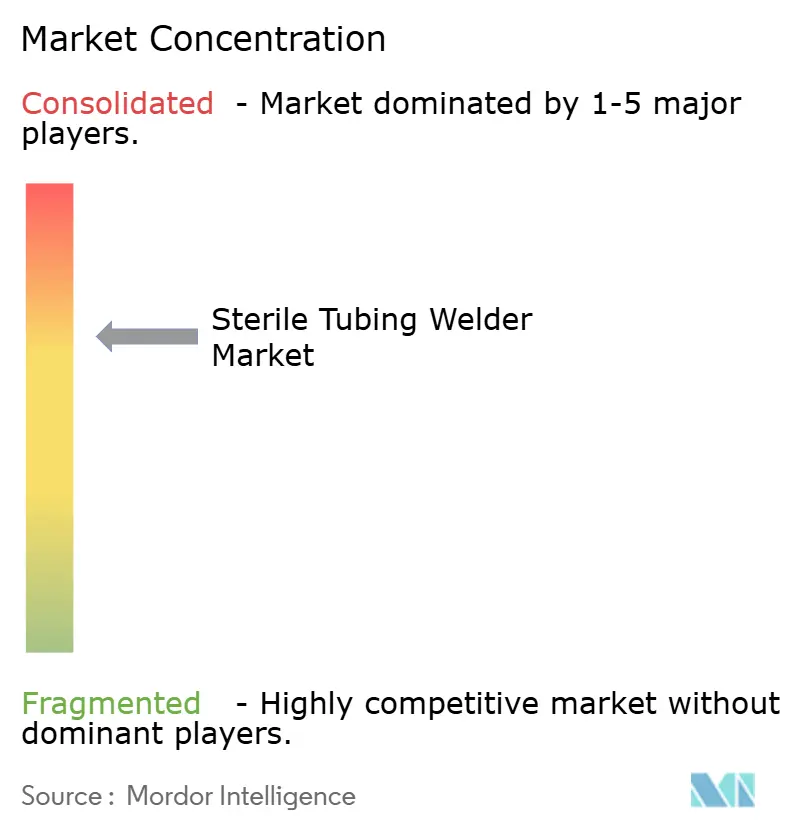
| Market Concentration | Medium |
Major Players *Disclaimer: Major Players sorted in no particular order Image © Mordor Intelligence. Reuse requires attribution under CC BY 4.0. | |
Sterile Tubing Welder Market Analysis by Mordor Intelligence
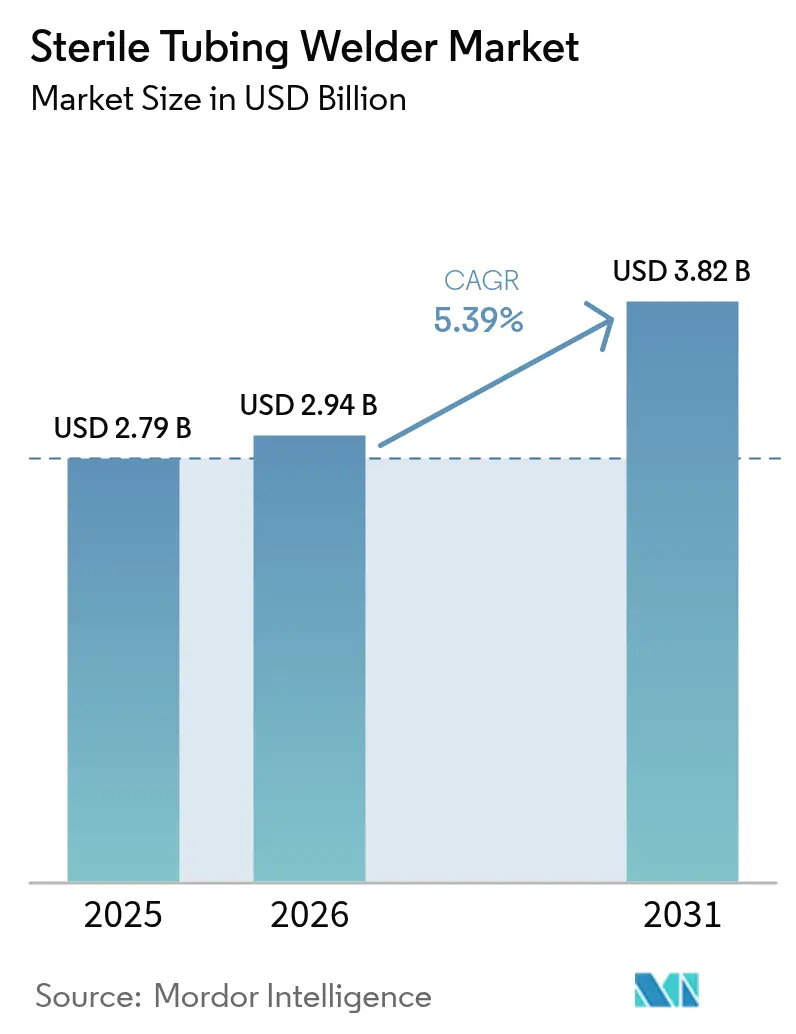
The sterile tubing welder market size is expected to grow from USD 2.79 billion in 2025 to USD 2.94 billion in 2026 and is forecast to reach USD 3.82 billion by 2031 at 5.39% CAGR over 2026-2031. This performance positions the sterile tubing welder market as a critical pillar of modern bioprocessing, buoyed by the pharmaceutical transition to single-use systems, the rapid scale-up of biologics, and increasingly stringent contamination-control rules issued by the FDA and the European Commission. The sterile tubing welder market is also benefiting from the dominance of thermoplastic elastomer (TPE) tubing, the continued preference for automatic welding platforms, and rising demand from blood-component processing centers that require high-throughput, closed-system operations. Regulatory momentum under revised EU GMP Annex 1 has converted automated welding from optional to mandatory in many settings, while advanced therapy manufacturing—cell and gene therapies in particular—creates new volumes of aseptic connections per batch, enlarging the sterile tubing welder market opportunity.
Key Report Takeaways
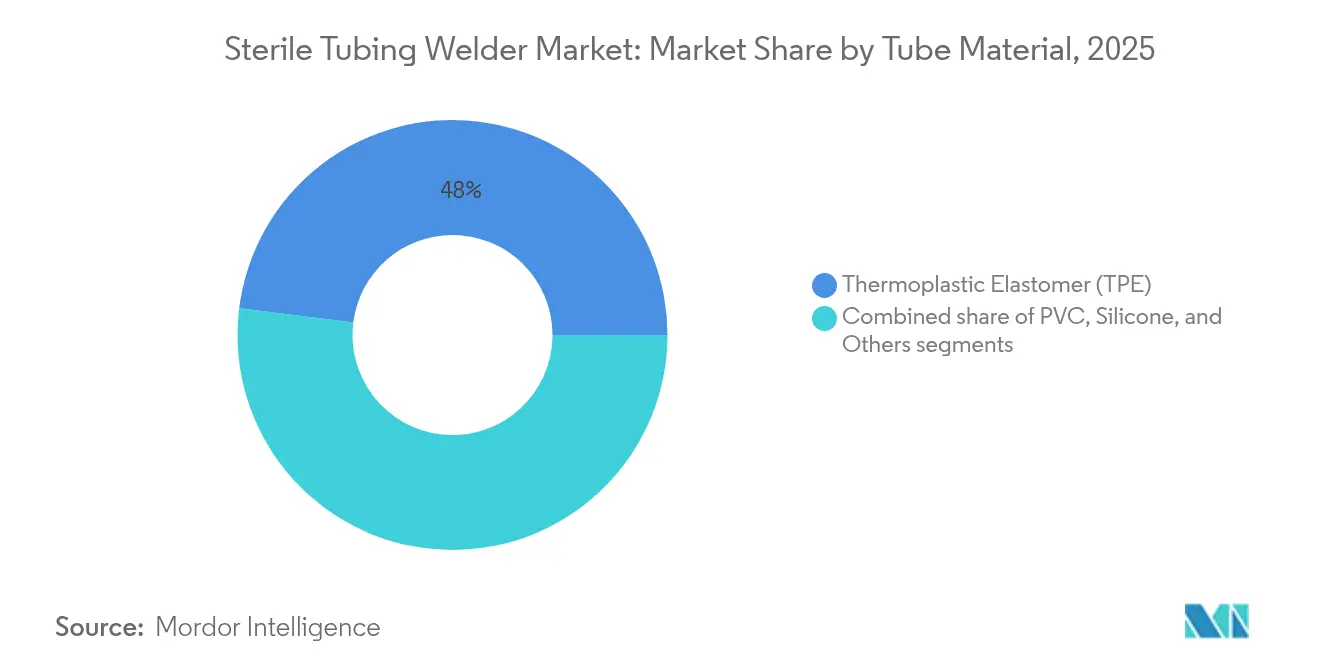
- By tube material, TPE commanded 48.02% of the sterile tubing welder market share in 2025, and PVC alternatives will trail as TPE expands at a 5.55% CAGR through 2031.
- By mode, automatic systems led with 62.10% revenue share in 2025; the same segment is forecast to register a 5.51% CAGR to 2031.
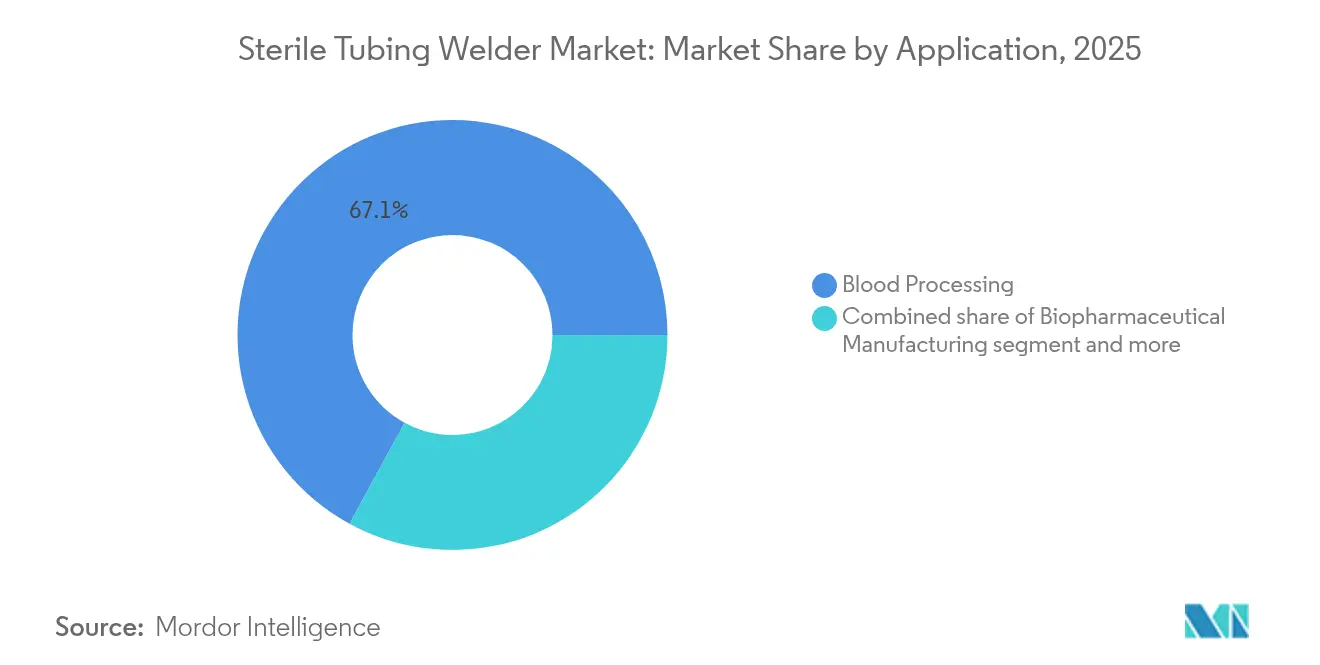
- By application, blood processing held 67.05% of the sterile tubing welder market size in 2025, while biopharmaceutical manufacturing is projected to accelerate at a 5.95% CAGR between 2026 and 2031.
- By end-user, hospitals represented 52.25% share of the sterile tubing welder market in 2025; contract development and manufacturing organizations (CDMOs) are set to log the fastest 5.82% CAGR through 2031.
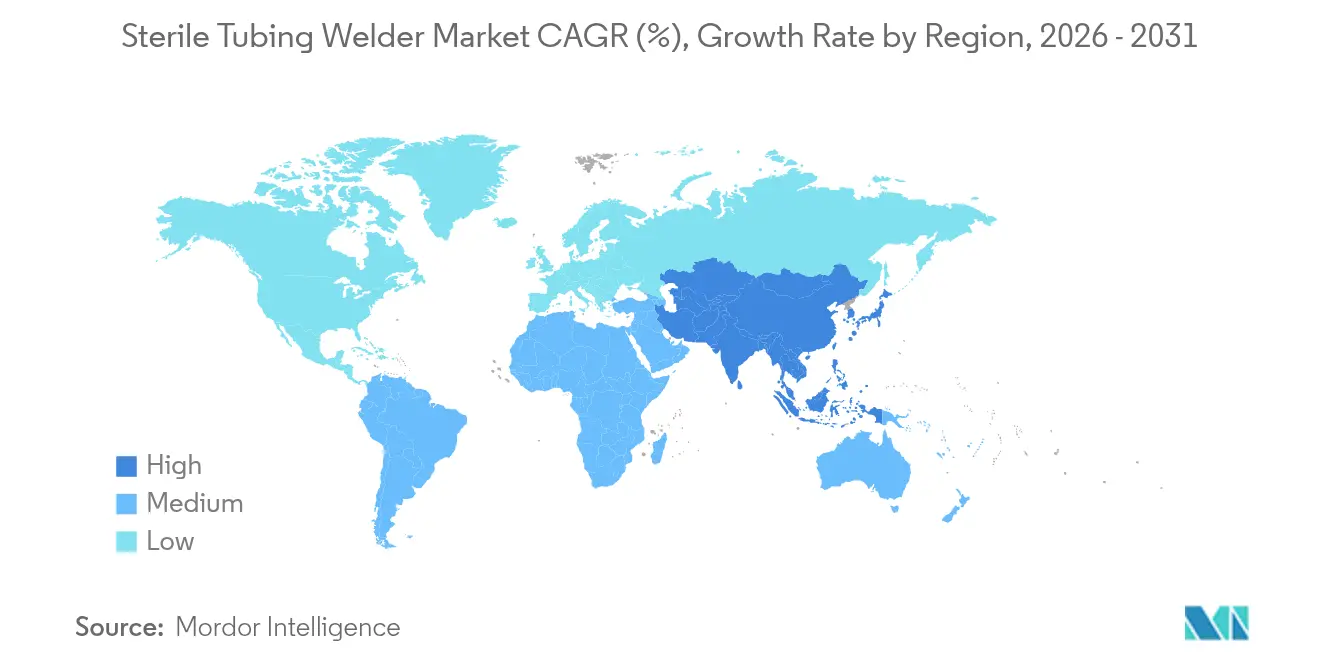
- By geography, North America occupied 38.12% of global revenue in 2025, whereas Asia-Pacific is poised to grow the quickest at 6.07% CAGR to 2031.
Note: Market size and forecast figures in this report are generated using Mordor Intelligence’s proprietary estimation framework, updated with the latest available data and insights as of 2026.
Market Trends and Insights
Drivers Impact Analysis of Sterile Tubing Welder Market*
| Driver | (~) % Impact on CAGR Forecast | Geographic Relevance | Impact Timeline |
|---|---|---|---|
| Rising adoption of single-use bioprocessing | +1.8% | North America & Europe lead | Medium term (2-4 years) |
| Expanding biologics & cell-gene therapy pipelines | +1.5% | North America & EU, increasing APAC | Long term (≥ 4 years) |
| Growth in global blood & plasma collections | +1.2% | Worldwide with APAC acceleration | Long term (≥ 4 years) |
| Stricter cGMP sterility regulations | +0.9% | Global | Short term (≤ 2 years) |
| Decentralized point-of-care manufacturing push | +0.7% | Pilot programs in North America; EU exploration | Medium term (2-4 years) |
| Multi-use aseptic connectors lowering validation cost | +0.5% | Cost-sensitive markets | Short term (≤ 2 years) |
| Source: Mordor Intelligence | |||
Rising Adoption of Single-Use Bioprocessing
Single-use assemblies already support more than 1.2 million sterile connections per year, according to Sartorius. Eliminating cross-contamination between batches can trim facility capital outlays by up to 40%, encouraging large commercial plants to integrate disposables alongside legacy stainless downstream trains. More robust connectors that comply with the ASME BPE code now anchor these systems, satisfying auditor concerns over integrity. As regulatory bodies have endorsed disposables within EU GMP Annex 1, plant managers are expanding inventories of flexible tubing and calling for welders capable of handling TPE, silicone, and multilayer films in fast changeovers. This dynamic secures a durable growth path for the sterile tubing welder market while reinforcing automation investment to close remaining contamination gaps.
Expanding Biologics & Cell-Gene Therapy Pipelines
Cell and gene therapy batches require up to 10 times more sterile connections than legacy small-molecule processing, a reality now shaping equipment budgets across the sterile tubing welder market. Singapore’s investment in mRNA cancer vaccines and South Korea’s USD 1.92 billion allocation for home-grown mRNA platforms underscore regional appetite for advanced modality capacity. Portable, modular factories such as MIT’s InSCyT system highlight how distributed production demands compact welders that can validate hundreds of connections per shift. As regulators draft guidance on decentralized manufacturing, suppliers able to ensure sterility in small-footprint devices will capture share. Continuous activity in novel vectors and personalized immunotherapies sustains elevated connection volumes, pushing the sterile tubing welder market toward higher-throughput, auto-calibrating equipment.
Growth in Global Blood & Plasma Collections
The worldwide plasma fractionation boom keeps blood centers at the top of the sterile tubing welder market hierarchy. Recent FDA approvals[1] for blood processing devices confirm device-maker commitment to closed-loop designs. Emerging economies—from India to Indonesia—are expanding donation infrastructure, and each new collection line typically requires multiple welders to maintain Grade A integrity during bag transfers. In addition, advanced clarification modules such as GEA’s hycon are joining in-line welding to form fully automated plasma processing suites. As throughput per center scales, welded joins remain the gold standard for contamination control, defending market share against connector alternatives in this high-risk segment.
Stricter cGMP Sterility Regulations
EU GMP Annex 1 revisions[2] oblige manufacturers to document every aseptic connection under a contamination-control strategy, evidencing how and where welds are made. In parallel, the FDA stresses proactive risk mitigation, compelling plants to upgrade from manual clamps to programmable welders with electronic batch records. These mandates re-orient cap-ex plans toward automation, igniting brisk replacement of aging manual units. Suppliers are responding with welders that embed electronic signature capture, temperature pairing, and pressure decay tests, features that simplify audits and fast-track batch-release. The sterile tubing welder market therefore moves-in-step with rule-making cycles, as compliance timelines translate directly into procurement deadlines.
Restraints Impact Analysis of Sterile Tubing Welder Market*
| Restraint | (~) % Impact on CAGR Forecast | Geographic Relevance | Impact Timeline |
|---|---|---|---|
| High capital & validation cost of automated welders | -1.1% | Emerging markets, small manufacturers | Long term (≥ 4 years) |
| Availability of sterile connector alternatives | -0.8% | Global | Medium term (2-4 years) |
| Shortage of skilled operators / training gaps | -0.6% | Global, acute in APAC | Short term (≤ 2 years) |
| TPE-grade supply chain volatility | -0.4% | Global supply chains | Medium term (2-4 years) |
| Source: Mordor Intelligence | |||
High Capital & Validation Cost of Automated Welders
A fully qualified welding skid can exceed USD 100,000 and accrues another 30-50% in validation labor. Smaller CDMOs in Latin America and Southeast Asia often postpone purchases, favoring outsourced batch preparation where the welder is already installed. The sterile tubing welder market thus experiences elongated sales cycles in emerging regions. Vendors are piloting equipment-as-a-service contracts that spread payments over multi-year terms, and some offer pre-validated “smart welders” bundled with digital IQ/OQ templates to curb consultant fees.
Availability of Sterile Connector Alternatives
Genderless and multi-use fittings cut qualification steps, winning converts in cost-sensitive labs. CPC’s AseptiQuik G DC, for instance, combines connection and disconnection in a single sterile maneuver, eliminating the melting process inherent to welding. Research outfits with modest batch sizes adopt these connectors to sidestep capital expense, nibbling at sterile tubing welder market share. Front-line vaccine and plasma units, however, still favor weld technology because the molten interface delivers superior barrier integrity, so displacement is incremental rather than wholesale. The rivalry nevertheless forces welder manufacturers to shorten cycle times and introduce entry-level models.
*Our forecasts treat driver/restraint impacts as directional, not additive. The impact forecasts reflect baseline growth, mix effects, and variable interactions.
Sterile Tubing Welder Market Segment Analysis
By Tube Material:
TPE Dominance Drives InnovationTPE tubing captured 48.02% of the sterile tubing welder market share in 2025 and is expanding at a 5.55% CAGR, reflecting pharmaceutical preference for low-extractable, gamma-compatible materials. This leadership locks in large volumes for welders configured specifically for TPE melt temperatures, broadening the sterile tubing welder market size derived from TPE lines alone. PVC persists in budget-focused blood centers, while silicone finds narrow roles where elevated temperatures or solvents demand it.
Manufacturers such as Teknor Apex are launching clear, ultra-low-spallation grades that allow optical inspection during welding. KRAIBURG’s PFAS-free advances future-proof supply amid tightening chemical restrictions, reinforcing TPE’s pull on capital budgets. Meanwhile, force-majeure events have pushed end-users to qualify multiple TPE brands to secure continuity, prompting welder firmware updates that store unique heat profiles for each compound.

By Mode:
Automation Accelerates AdoptionAutomatic units owned 62.10% of the sterile tubing welder market size in 2025 and show the highest 5.51% CAGR, a twin-lead gained by eliminating human contact and standardizing weld quality. Their batch-record integration supports real-time release criteria, a factor especially valued in EU inspections. Because of that compliance edge, automatic platforms are the reference specification for every new commercial bioreactor suite, cementing the sterile tubing welder market size advantage over manual units.
First-generation bench welders required expert setup, yet modern models calibrate themselves through barcode-driven tubing IDs, cutting training hours. Inline sensors measure weld pressure and temperature, feeding data to manufacturing execution systems that trigger preventive maintenance. Manual devices remain in R&D cabinets where flexibility matters, but they now compete on price alone as automatic prices fall.
By Application:
Blood Processing Leads, Biopharma AcceleratesBlood processing generated 67.05% of sterile tubing welder market share in 2025 due to high-volume donation centers that rely on melt-seam integrity for plasma safety. However, biopharmaceutical runs are slated for the quickest 5.95% CAGR as monoclonal antibodies, viral vectors, and mRNA expand. For every 2,000 L single-use reactor, biomanufacturers perform hundreds of sterile cuts and joins, inflating welder cycles per batch.
The Aurora Xi plasmapheresis clearance re-emphasized automated sterile processing as a regulatory requirement in blood centers. In contrast, biopharma expansions such as Samsung Biologics’ 784,000 L project create bulk orders for welders with Industry 4.0 connectivity, effectively doubling software revenue streams tied to analytics modules.
By End-User:
Hospitals Dominate, CDMOs Drive GrowthHospitals retained 52.25% share of the sterile tubing welder market size in 2025 because most national blood programs operate inside clinical networks. Yet CDMOs will post a 5.82% CAGR as pharma sponsors outsource advanced therapy manufacturing to specialist plants. Outsource models enable smaller biotech firms to enter trials without building on-site cleanrooms, thereby consolidating welder demand within contract hubs.
Wuxi Biologics’ decision to expand its Worcester, Massachusetts site from 24,000 L to 36,000 L by 2025 illustrates the magnet effect CDMOs have on equipment vendors. Their bulk purchase power influences welder design roadmaps, encouraging modular assemblies that support multi-client turnover. Hospitals, in contrast, focus on durability and simple user interfaces that accommodate rotating staff.
Geography Analysis
North America Sterile Tubing Welder Market
North America accounted for 38.12% of the sterile tubing welder market revenue in 2025, propelled by its dense biopharma corridor, historic uptake of single-use technology, and a regulatory culture that rewards advanced contamination controls. Thermo Fisher Scientific’s USD 2 billion multi-year capacity investment amplifies the regional order book, while Danaher’s Cytiva-Pall consolidation broadens a service backbone that accelerates validation. Vendor training academies in Boston and San Diego also mitigate operator shortages, sustaining utilization rates across installed fleets.
APAC Sterile Tubing Welder Market
Asia-Pacific is the fastest-growing territory at 6.07% CAGR through 2031. China’s USD 4.17 billion biomanufacturing incentive, Samsung Biologics’ 784,000 L build-out, and Singapore’s mRNA programs are channeling record equipment imports. Regional governments have also streamlined GMP licensing, removing one historical hurdle to automated welding adoption. While skill gaps remain acute, suppliers have localized after-sales hubs in Shanghai, Seoul, and Hyderabad to provide on-site validation.
EMEA and LATAM Sterile Tubing Welder Market
Europe maintains steady expansion under hard-line sterility rules. Annex 1 revisions oblige legacy plants to retrofit welders into Grade A cleanrooms, inflating replacement demand. The continent additionally benefits from aggressive cell-therapy pipelines in France and the United Kingdom, spawning many small clinical-scale units that collectively lift volume. In emerging regions—Latin America, the Middle East, and Africa—market momentum stems from public blood-bank upgrades and new vaccine fill-finish lines, though funding cycles stretch project timelines.
Regulatory Landscape
Sterile tubing welders used in clinical blood-processing workflows fall under medical-device controls in major markets, with U.S. FDA device classification and registration frameworks governing such devices (including products commonly aligned to blood/plasma transfer sets). Manufacturers supplying welders into regulated blood-center environments typically operate under ISO 13485:2016 quality management systems and must demonstrate sterility assurance and weld integrity through documented validation and verification activities.
For biopharmaceutical manufacturing use cases, compliance emphasis shifts toward contamination-control documentation and data integrity, especially where electronic batch records are required. EU GMP Annex 1 (revision issued in 2022) has elevated expectations for validated aseptic connections within contamination-control strategies. In the U.S., 21 CFR Part 11 requirements for electronic records and signatures influence welder software, audit trails, and user-access controls. Global market access additionally commonly requires alignment with core electrical safety and EMC standards for medical electrical equipment (IEC 60601-1 and IEC 60601-1-2) and sterility designation requirements such as EN 556-2:2024 where applicable to device labeling and intended use.
Value Chain Analysis
The sterile tubing welder value chain starts with upstream materials and components, notably life-science-grade thermoplastic tubing (TPE and PVC) and precision electromechanical subassemblies (heating elements, alignment/clamping mechanisms, motion control, and cleanroom-oriented housings). Consumables and accessories are recurring inputs in many installed bases, including cutting elements and heating-wafer or blade kits, along with calibration and verification tools that support GMP validation packages and ongoing preventive maintenance.
Midstream, OEMs integrate hardware with control software that increasingly includes recipe management and traceability features, then route finished units through direct sales to large biopharma and blood-center networks, and through distributors and integrators for hospitals, academic labs, and emerging-market buyers. Downstream value is shaped by service and compliance support, including installation qualification/operational qualification documentation, operator training, and field service for periodic verification, which is especially important for high-throughput blood processing and multi-client CDMO environments. Differentiation along the chain is shifting toward automation and reduced consumable dependence, including waferless approaches and RFID-enabled tracking in some configurations, alongside connectivity to plant digital systems in biopharma operations.
Competitive Landscape
The sterile tubing welder market is moderately consolidated, with the top five players capturing an estimated 55–60% combined share. Danaher’s USD 7.5 billion Pall-Cytiva integration exemplifies strategic bundling of upstream disposables with downstream filtration, offering clients single-source procurement. Thermo Fisher’s proposed USD 4.1 billion purchase of Solventum’s purification and filtration assets further intensifies scale advantages.
Technology differentiation revolves around automation layers—AI-driven weld parameter optimization, onboard analytics, and MQTT connectivity. Smaller innovators compete in portable welders under 15 kg that target point-of-care cell-therapy suites. Component suppliers such as CPC continue to attack with connector systems that threaten low-throughput welder placements, but major weld vendors bundle extended warranty and validation kits to lock in loyalty. Service contracts covering remote calibration and GMP audit preparation now constitute up to 20% of vendor revenue, reflecting how compliance complexity drives ancillary sales.
Looking ahead, integrated software ecosystems will be decisive. Vendors embedding weld data into electronic batch-records help manufacturers fulfill real-time release ambitions. Consolidation among elastomer suppliers may follow the equipment trend, ensuring secure tubing supplies that are pre-qualified to machine parameters, a synergy play that could further entrench incumbents.
Sterile Tubing Welder Industry Leaders
-
Danaher Corporation
-
Genesis BPS
-
MGA Technologies
-
Sartorius AG
-
Terumo Corporation
- *Disclaimer: Major Players sorted in no particular order
Sterile Tubing Welder Market Companies Covered in this Report
- Aseptic Group
- Avantor
- ChargePoint Technology
- Colder Products Company (CPC)
- Danaher
- Entegris
- Genesis BPS
- GMPTEC GmbH
- Hangzhou Cobetter Filtration Equipment Co., Ltd
- Meissner Filtration Products
- MGA Technologies
- Parker Hannifin
- PendoTECH
- Repligen
- Saint-Gobain Life Sciences
- Sartorius
- Terumo
- Thermo Fisher Scientific
- Vante Biopharm/Sebra
- Watson-Marlow Fluid Technology
Market Opportunities and Future Outlook
Product innovation aimed at reducing consumable waste and improving mobility is creating whitespace across both bioprocessing suites and high-mix clinical environments. In April 2026, Ensorcell launched its Versaweld precision tube welding platform at INTERPHEX 2026, positioning a battery-powered, multi-size system with touchscreen recipe control and a spooled cutting ribbon design intended to eliminate sharps. Designs like this map to buyer priorities around cleanroom ergonomics, simplified operator workflow, and standardized weld parameterization across multiple tubing sizes.
Beyond hardware, data and compliance integration is a tangible opportunity as manufacturers implement stricter contamination-control documentation under EU GMP Annex 1 and electronic record controls under 21 CFR Part 11. Welders that natively capture weld parameters, enforce recipe and user controls, and export audit-ready records to manufacturing execution systems help address validation burdens that accompany automated-system adoption. With blood processing holding the largest share of demand, and biopharmaceutical manufacturing and CDMOs increasing connection density per batch, vendors that bundle qualification templates, service contracts, and software toolchains alongside hardware can expand share of wallet beyond the initial equipment sale.
Recent Industry Developments in Sterile Tubing Welder Market
- April 2026: Ensorcell launched the Versaweld precision tube welding platform at INTERPHEX 2026, introducing a battery-powered unit with touchscreen recipe control and a ribbon-based cutting consumable designed to eliminate sharps. The launch targets cleanroom mobility and standardized weld execution across multiple tubing sizes, areas that influence adoption in cell and gene therapy suites and modular single-use operations.
- February 2025: Thermo Fisher Scientific announced an agreement to acquire Solventum's Purification and Filtration business for USD 4.1 billion. The deal strengthens Thermo Fisher's bioprocessing workflow breadth, supporting more integrated single-use and fluid-management portfolios that influence purchasing bundles where sterile connection technologies are specified alongside filtration and disposable assemblies.
- February 2024: Terumo broke ground on a new manufacturing site in Puerto Rico to strengthen global supply resilience for sterile medical devices. Expanded regional manufacturing capacity supports continuity of supply for regulated healthcare customers, which can reduce risk in procurement and validation planning for sterile processing toolkits.
Sterile Tubing Welder Market Report Scope and Research Methodology
Market Definition and Coverage
This market covers sterile tubing welders that create an aseptic connection between compatible thermoplastic tubing used in regulated life-science workflows, where contamination control is required during fluid transfer and processing.
Scope exclusions: It excludes refurbished units, non-sterile industrial tube welders, and general-purpose plastic welding equipment used outside controlled medical and bioprocess environments.
Segments Covered in This Report
- By Tube Material
- Thermoplastic Elastomer (TPE)
- PVC
- Silicone
- Others
- By Mode
- Automatic
- Manual
- By Application
- Blood Processing
- Biopharmaceutical Manufacturing
- Diagnostic Laboratories
- Others
- By End-User
- Hospitals
- Research & Academic Institutes
- Contract Manufacturing
- Others
- By Geography
- North America
- United States
- Canada
- Mexico
- Europe
- Germany
- United Kingdom
- France
- Italy
- Spain
- Rest of Europe
- Asia-Pacific
- China
- India
- Japan
- Australia
- South Korea
- Rest of Asia-Pacific
- Middle East and Africa
- GCC
- South Africa
- Rest of Middle East and Africa
- South America
- Brazil
- Argentina
- Rest of South America
- North America
Data Sources, Market Sizing, and Validation
Desk Research
Desk work started with sterile processing guidance and clean operations rules, since adoption is often driven by compliance needs. We reviewed public materials such as FDA guidance and public databases, European Commission and EMA publications, and EU GMP Annex 1 related references, then checked supporting context from OECD health statistics and World Bank macro indicators.
To keep the model grounded in buying behavior, we also used company annual reports, investor presentations, product brochures, and reputable press coverage to map typical use cases and buying cycles for this equipment class. Where needed, paid access for company financials and intelligence, plus patent databases, helped confirm product activity and revenue exposure for sterile tubing welders. This desk source list is illustrative, and other public references were also used as cross-checks during the work.
Primary Interviews and Surveys
Primary discussions were used to pressure-test what is counted as a sterile tubing welder sale versus adjacent aseptic connection methods, and to confirm how purchasing decisions happen across blood centers, bioprocess sites, and diagnostic labs. We spoke with manufacturers, distributors, and end users across APAC, EMEA, and the Americas so regional replacement cycles, utilization patterns, and pricing assumptions could be reflected in the model.
Distribution of primary research fieldwork respondents
| Company type | Respondent position | Region |
|---|---|---|
| Top tier: 39% | CXOs: 14% | APAC: 48% |
| Mid tier: 47% | Functional/Unit leaders: 37% | EMEA: 33% |
| Smaller Players: 14% | Managers: 49% | Americas: 19% |
Market-Sizing & Forecasting
Sizing was built using a top-down structure where regulated life-science activity levels and adoption rates were used to reconstruct the demand pool for sterile welding equipment, and then translated into value using realistic price bands. The model was then corroborated through selective bottom-up approximations, including sampled average selling price checks, distributor channel feedback, and supplier-side revenue exposure, which helped adjust the total where the first pass looked off.
Inputs were selected to align with how this equipment is actually used, such as growth in single-use bioprocessing setups, biologics production scale-up, blood component processing volumes, cleanroom and contamination-control compliance intensity, and replacement or refurbishment timing for installed units. Forecasts were prepared using scenario analysis, where a base case was anchored to expert expectations on biologics capacity additions and lab expansion, then stress-tested with slower and faster adoption paths. Where sub-country detail was not reliable, we handled gaps by applying region-level penetration and price assumptions that were validated in interviews and kept consistent with public activity indicators.
Data Validation & Update Cycle
Outputs were checked against independent signals such as announced bioprocess capacity additions, lab infrastructure spending cues, and the direction of demand discussed by practitioners, and then reviewed for unusual jumps in volume or pricing. If a variance could not be explained by a clear driver, we revisited the underlying assumptions and, when needed, re-contacted respondents to confirm what changed.
Before sign-off, the model and calculations go through a multi-step internal review so the logic stays consistent across regions and time periods. Reports are refreshed annually, and interim updates are made when material events occur that can shift demand or pricing. Right before delivery, a final pass is completed so clients receive an updated view based on the latest available public information.
Mordor Intelligence's Sterile Tubing Welder Market Size Compared With Other Published Estimates
Published market sizes for sterile tubing welders can differ even when the topic sounds the same, because each estimate may use a different product boundary, base year, and pricing logic. Differences also come from how regional pricing and currency conversion timing are handled, and how frequently the model is refreshed.
Refurbished sterile tubing welders sit outside Mordor Intelligence's scope, which narrows the counted revenue versus estimates that mix new equipment with secondary-market units and service-like rebuild value. Gaps also show up when a source relies mainly on shipment units without a clear ASP progression by region, or when it uses a slower growth path that assumes fewer single-use workflows and delayed compliance-driven upgrades.
Benchmark comparison
| Source | Market Size | Gaps in Research Methodology |
|---|---|---|
| Mordor Intelligence | USD 2.79 B (2025) | |
| Industry Data Publisher A | USD 2.61 B (2024) | Uses a 2024 base with a unit-led build and a flatter pricing path, which can understate 2025 value when regional ASP differences and mix shifts are not fully carried forward. |
| Trade Research Group B | USD 2.55 B (2024) | Broader scope signals are presented at a 2024 snapshot and are not clearly separated from adjacent aseptic connection tools, which can pull the number away from a device-only sterile tubing welder definition. |
The spread across the three figures mainly comes from what is counted as the product, which year is treated as the anchor, and how pricing is moved forward. By keeping the inputs tied to observable life-science activity and validating adoption and pricing assumptions through field checks, our estimate stays traceable and repeatable for planning.
Key Questions Answered in the Report
What regulatory change is currently driving fastest adoption of sterile tubing welders?
Revised EU GMP Annex 1 and parallel FDA contamination-control guidance are pushing manufacturers to automate every aseptic connection, making welders the default compliance solution.
How are single-use bioprocessing lines reshaping welder design requirements?
Flexible, disposable assemblies require welders that can identify multiple tubing chemistries, perform rapid cycle changes, and log parameters directly into electronic batch records.
Which application sees the highest connection frequency, and why?
Cell and gene therapy production demands many more sterile joins per batch than traditional biologics because of small lot sizes and closed, patient-specific workflows.
Why do users increasingly prefer automatic over manual welding units?
Automated systems cut operator intervention, standardize weld quality, and generate audit-ready data, reducing both contamination risk and documentation workload.
How is TPE supply volatility influencing buyer behavior?
To hedge raw-material disruptions, end-users are pre-qualifying multiple TPE grades and favoring welders with programmable heat profiles for rapid material switching.
What strategic role do CDMOs play in the sterile tubing welder ecosystem?
Pharmaceutical outsourcing concentrates high-end manufacturing in specialized hubs, driving bulk purchases of advanced welders and setting industry benchmarks for validation practices.