
Steam Boiler System Market Size and Share
Market Overview
| Study Period | 2021 - 2031 |
|---|---|
| Market Size (2026) | USD 23.5 Billion |
| Market Size (2031) | USD 28.75 Billion |
| Growth Rate (2026 - 2031) | 4.12 % |
| Fastest Growing Market | Asia Pacific |
| Largest Market | Asia Pacific |
| Market Concentration | Medium |
Major Players *Disclaimer: Major Players sorted in no particular order Image © Mordor Intelligence. Reuse requires attribution under CC BY 4.0. | |
Steam Boiler System Market Analysis by Mordor Intelligence
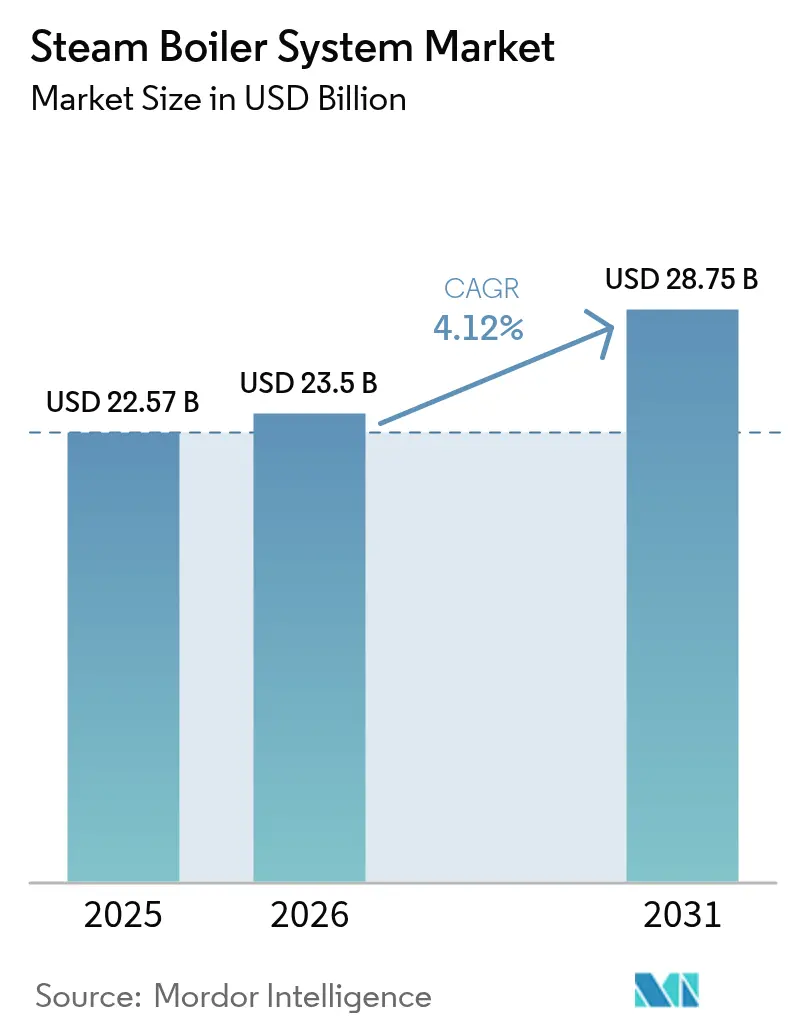
The Steam Boiler System Market size is expected to grow from USD 22.57 billion in 2025 to USD 23.5 billion in 2026 and is forecast to reach USD 28.75 billion by 2031 at 4.12% CAGR over 2026-2031.
Demand comes from both ends of the capacity spectrum, as 10-150 BHP packages proliferate across distributed sites while utility-scale builds above 600 BHP pursue higher thermal efficiency. Regionally, Asia-Pacific retains dual leadership with a 39.3% 2024 revenue share and a 4.9% growth pace that outstrips every other geography. Technology priorities have also shifted: water-tube designs now claim 58.3% share, electrode/electric boilers post a market-leading 6.3% growth rate, and condensing units gain ground as energy costs and emissions rules tighten. Hydrogen-ready retrofits, digital-twin maintenance, and modular offshore systems give suppliers fresh avenues to differentiate, even as nickel and chromium shortages complicate high-alloy tubing supply.
Key Report Takeaways
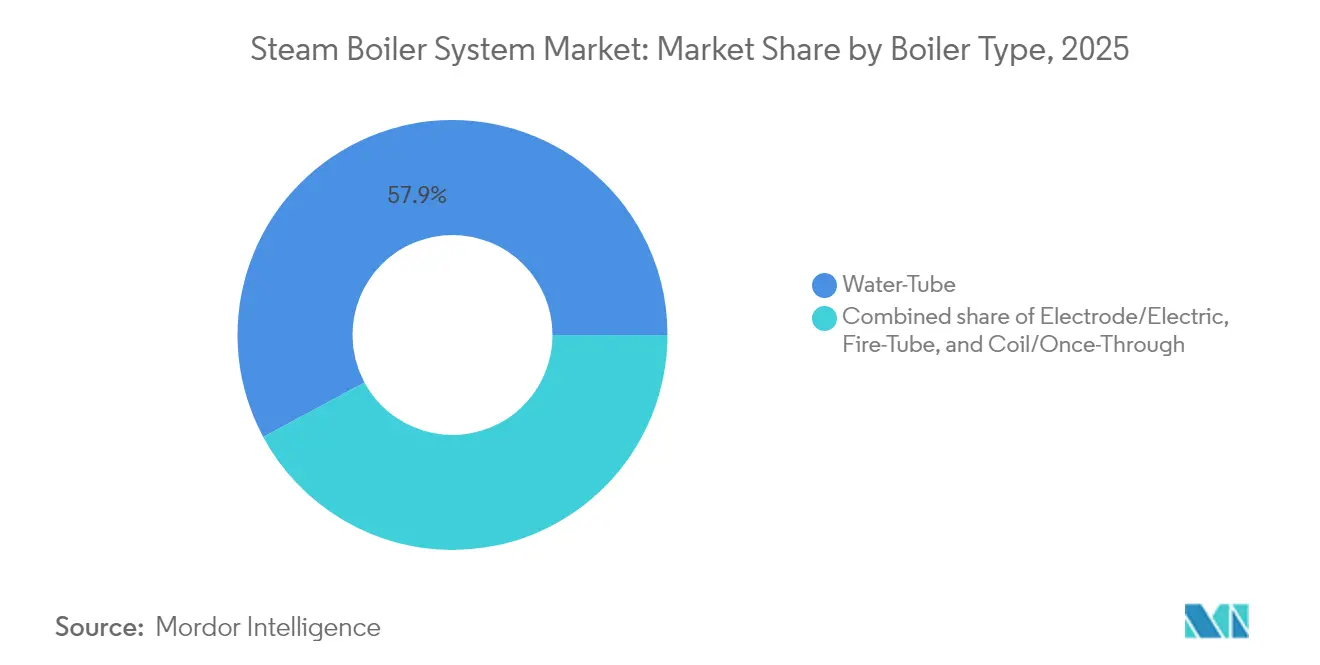
- By boiler type, water-tube systems captured 57.86% of the steam boiler system market share in 2025, whereas electrode/electric units are rising at a 6.08% CAGR through 2031.
- By fuel type, natural gas and biomass together accounted for 41.62% of the steam boiler system market size in 2025, while hydrogen and synthetic fuels are projected to expand at a 5.63% CAGR to 2031.
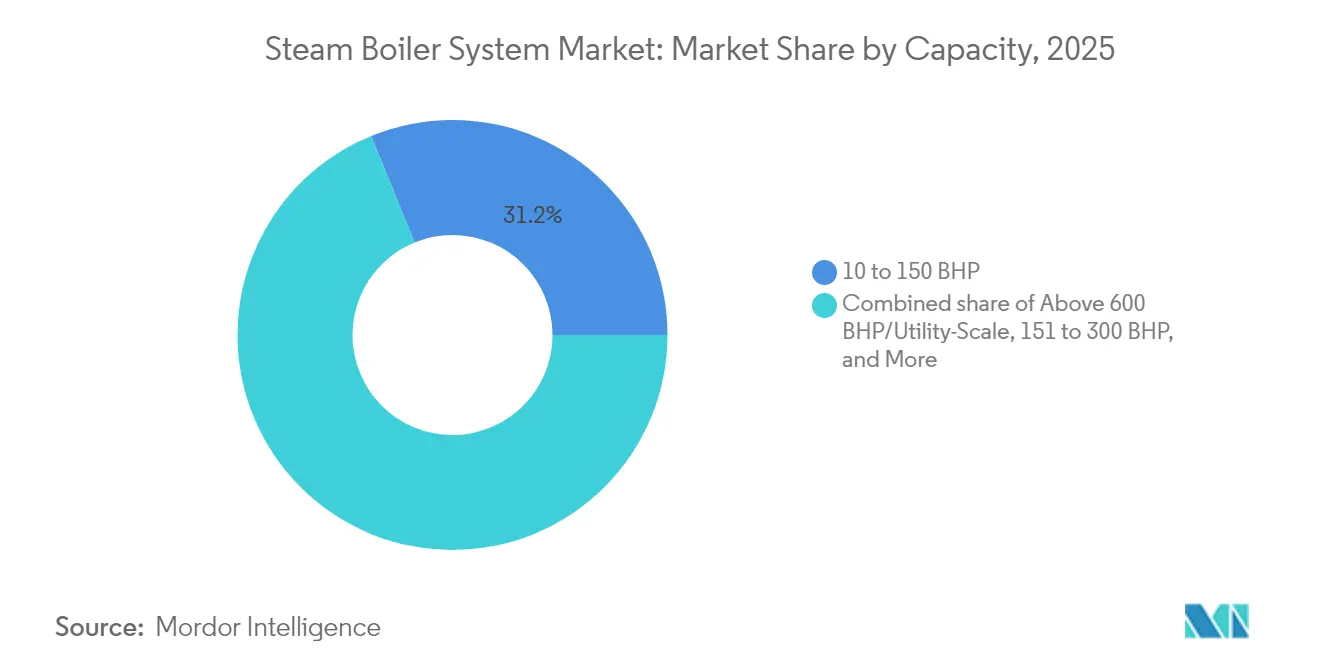
- By capacity, the 10-150 BHP class led with 31.18% share of the steam boiler system market size in 2025, but installations above 600 BHP are forecast to log the quickest 5.05% CAGR during 2026-2031.
- By technology, non-condensing boilers dominated with 75.35% of 2025 revenue, while condensing systems posted the fastest 7.28% CAGR to 2031.
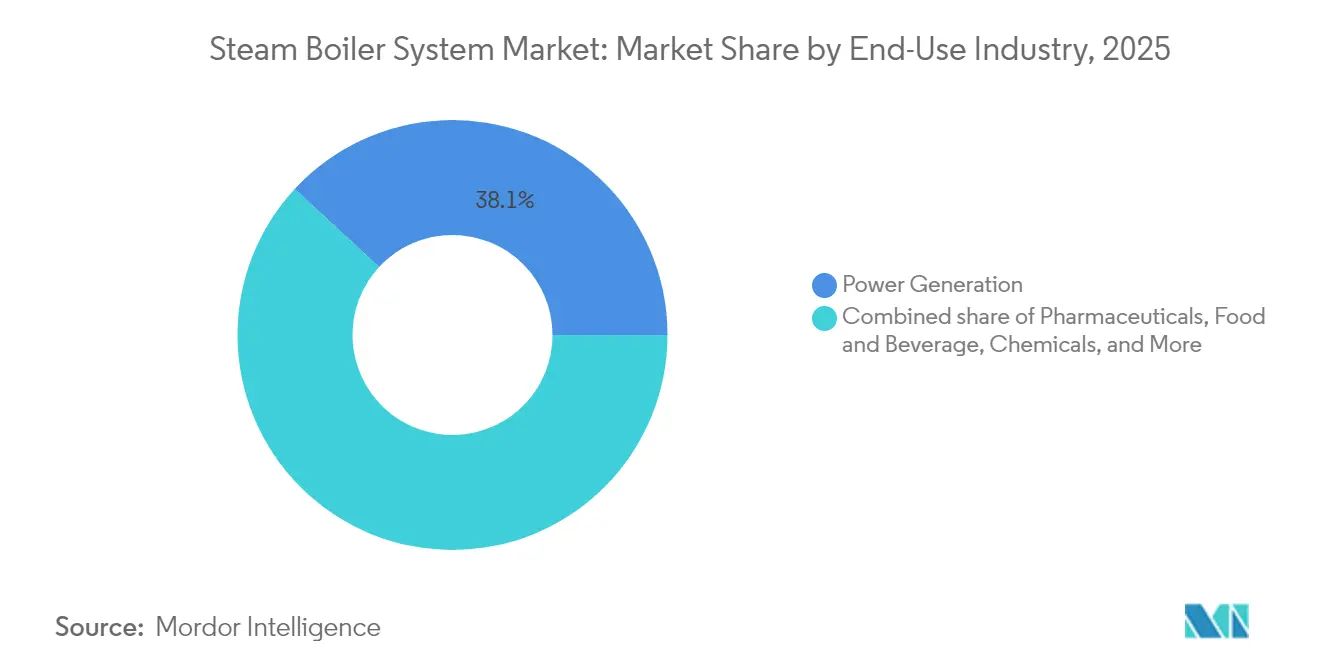
- By end-use, power generation accounted for 38.12% of the steam boiler system market share in 2025, whereas pharmaceuticals are advancing at a 5.43% CAGR to 2031.
- By geography, Asia-Pacific held 39.05% of 2025 revenue and is expanding at a 4.74% CAGR through 2031, ahead of all other regions.
Note: Market size and forecast figures in this report are generated using Mordor Intelligence’s proprietary estimation framework, updated with the latest available data and insights as of 2026.
Market Trends and Insights
Drivers Impact Analysis of Steam Boiler System Market*
| Driver | (~) % Impact on CAGR Forecast | Geographic Relevance | Impact Timeline |
|---|---|---|---|
| Stringent emission-control regulations | +1.2% | EU, North America; cascading worldwide | Medium term (2-4 years) |
| Surging food & beverage processing capacity | +0.8% | Asia-Pacific, North America | Short term (≤ 2 years) |
| Power-plant capacity additions in emerging Asia & Africa | +0.9% | Asia-Pacific, Middle East & Africa | Long term (≥ 4 years) |
| Hydrogen-ready boiler retrofits in refineries | +0.7% | EU, North America early adopters | Medium term (2-4 years) |
| Digital-twin predictive maintenance | +0.5% | Developed markets | Short term (≤ 2 years) |
| Modular offshore steam generators for FPSOs | +0.3% | North Sea, Gulf of Mexico | Long term (≥ 4 years) |
| Source: Mordor Intelligence | |||
Stringent Emission-Control Regulations
The U.S. EPA’s NESHAP mandate compels biennial tune-ups and continuous monitoring for boilers above 10 MMBtu/h, driving investment in low-NOx burners, selective catalytic reduction, and alternative fuels(1)U.S. Environmental Protection Agency, “NESHAP for Industrial Boilers,” epa.gov. Similar tightening is underway in India, where the pending Boilers Bill 2024 raises inspection frequency for roughly 4 million units, prompting demand for self-diagnostic control systems. Compliance outlays can reach 15% of total project budgets, so operators gravitate toward bundled solutions that integrate emission hardware, controls, and service contracts. These rules favor water-tube and electrode designs that inherently accommodate cleaner combustion or all-electric heating. By linking compliance dashboards to enterprise software, suppliers position digital twins as the least-cost pathway to verify real-time performance and avoid non-compliance penalties.
Surging Food & Beverage Processing Capacity
Cold-chain investments and stricter sanitation protocols have sharpened demand for culinary-grade steam that matches pharmaceutical purity benchmarks(2)Oklahoma State University Extension, “Culinary Steam Guidelines,” okstate.edu. Skid-mounted packages appeal because they curb installation time by up to 50% compared with central boiler rooms, letting processors align capacity with seasonal peaks. IoT probes now stream live-stream-quality data to line operators, cutting product-spoilage risk and simplifying regulatory audits. Rising utility bills amplify interest in condensing fire-tube units for packaging halls, whereas electrode systems supply near-instantaneous clean steam for SIP lines without combustion-related contaminants. These features collectively enlarge the food sector's steam boiler system market footprint.
Power-Plant Capacity Additions in Emerging Asia & Africa
Malaysia’s 1 GW Tanjung Bin T4 project illustrates the supercritical push, operating at 270 bar and 600 °C to claim efficiencies above 40%. Saudi Arabia’s gas conversion at Yanbu 2 trims plant emissions by 25% and furthers local content ambitions for boiler fabrication. Domestic manufacturers in China and India leverage these programs to refine welded water-wall panels and ferritic alloys, enlarging export capacity. In the steam boiler system market, supercritical and ultra-supercritical orders lift average selling prices, cushioning margin pressure from commodity inflation.
Hydrogen-Ready Boiler Retrofits in Refineries
ExxonMobil’s Baytown site now fires 100% hydrogen while achieving ultra-low NOx, validating a retrofit model that swaps burners rather than full-pressure parts. Essar’s Stanlow refinery follows suit, flipping between off-gas blends and pure H₂ to future-proof its asset base. Babcock & Wilcox has logged over 60 fielded BrightGen water-tube units ready for hydrogen service. These precedents expand the steam boiler system market because retrofit costs typically run one-third of a greenfield replacement, tempting operators with accelerated payback.
Restraints Impact Analysis of Steam Boiler System Market*
| Restraint | (~) % Impact on CAGR Forecast | Geographic Relevance | Impact Timeline |
|---|---|---|---|
| High upfront capex & O&M costs | -0.9% | Emerging markets hardest hit | Medium term (2-4 years) |
| Volatile natural-gas & coal prices | -0.6% | Global; stronger in import-dependent nations | Short term (≤ 2 years) |
| Shortage of certified boilermakers in OECD | -0.4% | North America, Europe | Long term (≥ 4 years) |
| Nickel & chromium supply risk | -0.3% | Worldwide, high-temp services | Medium term (2-4 years) |
| Source: Mordor Intelligence | |||
High Upfront Capex & O&M Costs
Standard utility builds cost USD 6,000–13,000 per ton-hour, with water treatment, economizers, and cybersecure controls lifting lifecycle spend by 40-60%(3)Steam Boiler Guide, “Industrial Boiler Price Range,” steamboilerguide.com. Smaller firms struggle to finance such outlays, so OEMs now pitch steam-as-a-service contracts in which clients pay a per-ton tariff while suppliers retain asset ownership and maintenance obligations. Digital twins cut unscheduled outages, but their development and data-integration fees add 3-5% to project capital, a hurdle in emerging markets where the cost of capital hovers in double digits.
Volatile Natural-Gas & Coal Prices
Fuel often makes up 70-80% of operating expense. Switching to biomass or hydrogen hedges price swings but introduces new logistics and storage costs. Multi-fuel burners capable of toggling among gas, biomass, and H₂ blends are becoming default specs, albeit at a 10-15% price premium. Some buyers sign index-linked long-term contracts, while others deploy onsite biomass gasifiers that decouple them from fossil volatility. Such strategies cushion but not eliminate the drag on the steam boiler system market investment cycles.
*Our forecasts treat driver/restraint impacts as directional, not additive. The impact forecasts reflect baseline growth, mix effects, and variable interactions.
Steam Boiler System Market Segment Analysis
By Boiler Type:
Water-Tube Dominance Meets Electric MomentumWater-tube units generated 57.86% of 2025 revenue, a commanding steam boiler system market lead. Their large surface area handles 600 °C and 270 bar service, a power and petrochemical complexes. Fire-tube designs remain popular in mid-range duties up to 250 psig due to simpler fabrication and lower upfront cost, while coil/once-through variants excel where footprint trumps capacity.
Electrode/electric boilers outpace every other type at a 6.08% CAGR. They deliver 99.9% electrical-to-thermal efficiency and instant modulation, prized in district energy and pharma sterilization. Vicinity Energy’s 42 MW Cambridge installation exemplifies scale possibilities, supplying carbon-free steam to 30 million ft² of real estate. As renewable electricity cheapens, electric penetration deepens, broadening the steam boiler system market.


By Fuel Type:
Natural Gas Holds Sway as Hydrogen AcceleratesNatural gas and biomass retained 41.62% of 2025 sales, thanks to pipeline reach and renewable credentials. Shale output underpins North American gas security, while biomass rollers benefit from circular-economy incentives in pulp and paper lines. Oil burners fade amid air-quality rules, and coal units retire under 2030-2035 phase-out edicts.
Hydrogen and synthetic fuels clock the fastest 5.63% CAGR. Viessmann shipped its first 100% H₂-ready condensing boiler line in 2024. Refineries already produce off-gas hydrogen, offering low-cost feedstock for on-site steam. Hybrid burners that swap between H₂, nat-gas, and bio-syngas mitigate supply volatility, reinforcing the steam boiler system market appeal of multi-fuel flexibility.
By Capacity:
Small Packages Rule Volume, Utility Builds Rule GrowthInstallations in the 10-150 BHP bracket held 31.18% of 2025 revenue, favored by schools, breweries, and micro-manufacturers seeking modularity. Their factory-assembled skids cut field labor and accelerate commissioning.
Yet builds above 600 BHP and records the quickest 5.05% CAGR. Supercritical boilers exceed 45% efficiency when paired with advanced steam turbines, and nuclear cogeneration, such as Tianwan’s 600 t/h industrial steam pipeline, offsets 400,000 t of coal annually. Modular architectures let utilities incrementally add 100-200 MW blocks, smoothing capex cycles and enlarging the steam boiler system market scope.
By Technology:
Non-Condensing Still Dominant; Condensing GainingNon-condensing drums owned 75.35% of revenue in 2025, indispensable for superheated steam above 200 °C. Heavy-oil extraction and high-temp chemical synthesis keep this base steady.
Condensing designs post a brisk 7.28% CAGR. Reclaiming latent heat, they push efficiency above 90%, an irresistible lever where return water nets below 60 °C. Digital controllers that adjust flue-gas recirculation and feedwater oxygen trim optimize dew-point targeting, closing the performance gap even in warmer climates. Hybrid systems that toggle between condensing and non-condensing modes extend applicability, boosting the steam boiler system market attractiveness for institutions with variable load profiles.
By End-Use Industry:
Power Dominates, Pharma SurgesPower generation contributed 38.12% of 2025 revenue, led by combined-cycle gas turbines integrating high-pressure HRSGs. Coal retirements in the OECD are offset by gas, biomass, and nuclear cogeneration builds elsewhere.
Pharmaceutical buyers push a 5.43% CAGR. Biologics plants demand USP-compliant clean steam for Water-for-Injection, justifying premium electrode or water-tube packages lined with 316L steel. Food processors, chemicals, and pulp makers maintain mid-single-digit growth, while textiles adopt biomass units to meet onsite sustainability targets. This mix enriches the steam boiler system market via application diversity.
Geography Analysis
APAC Steam Boiler System Market
Asia-Pacific generated 39.05% of global revenue in 2025 and expanded at a 4.74% CAGR through 2031. China’s refinery, cement, and chemicals complexes fuel base-load steam, while India’s Make-in-India program spurs mid-range package sales. Japan and South Korea invest in hydrogen-ready combustion and ultra-efficient condensing arrays, exporting those innovations across ASEAN sites.
North America Steam Boiler System Market
North America shows mature replacement demand. Cheap shale gas sustains water-tube retrofits, but decarbonization policies in California and the Northeast propel electric and hydrogen pilots. Digital-twin service contracts gain traction as utilities monetize operational data.
EMEA and South America Steam Boiler System Market
Europe hastens away from coal, reallocating funds to biomass CHP and H₂-blend gas boilers. The Middle East & Africa region charts a 5%-plus trajectory on the back of Saudi industrial diversification and African industrialization corridors. South America’s pulp, mining, and agro-processing plants deliver steady orders, though currency volatility nudges buyers toward modular, pay-as-you-grow packages. Collectively, these currents keep the steam boiler system market in balanced expansion.


Regulatory Landscape
Steam boiler systems are shaped by tightening air-emissions and reporting requirements that increasingly steer buyers toward higher-efficiency and lower-emission designs. In the European Union, the revised Industrial and Livestock Rearing Emissions Directive (Directive (EU) 2024/1785) entered into force on 4 August 2024, with Member States required to transpose it by 1 July 2026. Permitting is anchored to best available techniques, and non-compliance penalties can reach at least 3% of annual EU turnover for legal persons. Regulation (EU) 2024/1244 establishes an Industrial Emissions Portal, strengthening public disclosure of emissions performance and raising expectations for verifiable controls, monitoring, and documentation.
In the United States, EPA NESHAP requirements for Industrial, Commercial, and Institutional Boilers and Process Heaters (Boiler MACT) continue to drive investments in periodic tune-ups, monitoring, and control solutions to meet limits for pollutants such as particulate matter and carbon monoxide. Alongside stricter permitting benchmarks and ongoing hazardous air pollutant compliance, these obligations are pushing adoption of low-NOx combustion systems, emissions-control retrofits, and control platforms that can continuously evidence compliance at operating sites.
Competitive Landscape
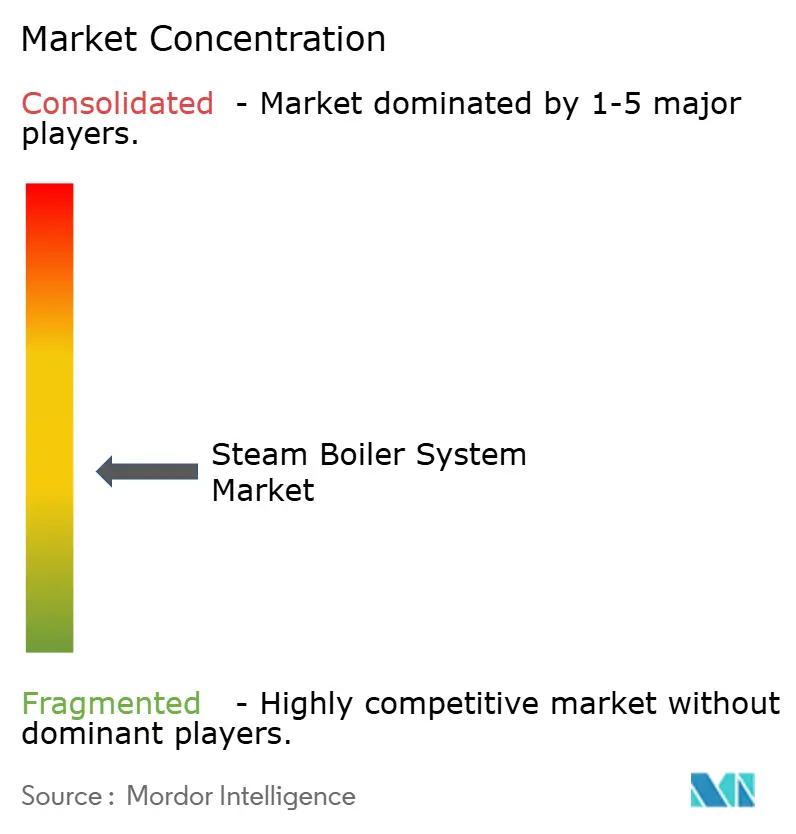
The steam boiler system market is moderately consolidated; the five largest vendors hold about 40% of global revenue, yet niche specialists still thrive. Miura’s purchase of Cleaver-Brooks in 2024 combined strong water-tube hardware with North American service fleets, signaling a pivot toward lifecycle contracts over one-time equipment sales.
Technology defines competitive moats. Babcock & Wilcox leverages its BrightGen portfolio for hydrogen service, while Doosan Enerbility fields utility-scale supercritical packages with 25% fewer welds to expedite construction. Start-ups like AtmosZero raised USD 21 million to scale industrial electric boilers, challenging incumbents on emissions and footprint.
Service differentiation now revolves around AI analytics, parts 3D-printing, and remote operations centers. Suppliers offering 97% guaranteed availability with penalty clauses win multi-year steam-as-a-service contracts, widening revenue streams and deepening customer lock-in across the steam boiler system market.
Steam Boiler System Industry Leaders
Bosch Industriekessel
Mitsubishi Heavy Industries
Babcock & Wilcox Enterprises
Siemens Energy
Cleaver-Brooks
- *Disclaimer: Major Players sorted in no particular order
Steam Boiler System Market Companies Covered in this Report
- Bosch Industriekessel
- Babcock & Wilcox Enterprises
- Mitsubishi Heavy Industries
- Siemens Energy
- Cleaver-Brooks
- Fulton Boiler Works
- Hurst Boiler & Welding
- General Electric
- ANDRITZ AG
- Forbes Marshall
- Thermax Ltd.
- Miura Co., Ltd.
- IHI Corporation
- Johnston Boiler Company
- Harbin Electric Boiler Co.
- Zhangjiagang Future Boiler
- Viessmann Group
- Superior Boiler
- Liming Energy Equipment
- Dongfang Boiler Group

Market Opportunities and Future Outlook
Fuel-flexible and hydrogen-capable steam generation is a meaningful whitespace for operators seeking decarbonization without full plant replacement, especially in chemicals, refining, and large industrial campuses with variable fuel availability. Mitsubishi Power’s August 2025 conversion at ANRPC in Egypt, where an industrial boiler is shifted to 100% hydrogen, provides a concrete retrofit-and-conversion reference point. Additional proof comes from FangKuai Boiler’s hydrogen and methanol-hydrogen dual-fuel steam boilers for chemical production, including a 50 t/h methanol-hydrogen dual-fuel unit in February 2026 and a 65 t/h hydrogen steam boiler in September 2025. These cases support continued demand for multi-fuel burners, upgraded safety systems, and combustion controls as projects move from planning into deployment.
Electrification and software-led differentiation are also opening incremental opportunities in industrial sites and district-energy networks where compliance, responsiveness, and uptime matter. Supplier focus is visible in partnerships targeting medium-voltage electrode boiler technology, including Bosch Industriekessel and A.E.P. Thermal (announced December 2025, with first implementations planned for 2026), which points to scaling electric steam capability beyond small packages. At the same time, EU Industrial Emissions deadlines (including the 2026 transposition window) and ongoing U.S. EPA boiler NESHAP compliance needs are encouraging integrated approaches that bundle hardware, emissions controls, and digital monitoring to streamline documentation and reduce downtime risk.
Recent Industry Developments in Steam Boiler System Market
- July 2026: Mitsubishi Heavy Industries received an order to supply key boiler components for converting existing heavy oil-fired boilers to dual-fuel (natural gas and heavy oil) operation at large-scale thermal power plants in Saudi Arabia. The award highlights ongoing investment in conversion programs that reduce emissions while retaining existing boiler assets. It also reinforces demand for retrofit component supply chains and engineering services alongside new-build boiler packages.
- June 2026: Babcock & Wilcox announced a collaboration with TerraSpark tied to the TerraSpark Energy Campus in West Virginia, covering anticipated design and supply scope for supercritical boilers and emissions control equipment. The initiative links boiler and environmental-control procurement to large, campus-style generation projects where availability and compliance are central. It supports continued ordering of utility-scale steam generation and associated emissions hardware as part of integrated project packages.
- December 2025: Bosch Industriekessel announced a strategic partnership with A.E.P. Thermal Inc. to develop medium-voltage electrode boiler technology, with initial project implementations planned in Europe for 2026. The collaboration targets higher-capacity electrified steam applications that address emissions constraints in dense industrial regions. It also signals product roadmap investment in electric boiler systems and power-electronics integration beyond conventional low-voltage offerings.


Steam Boiler System Market Report Scope and Research Methodology
Market Definition and Coverage
For this study, the steam boiler system market covers equipment and packaged systems used to generate steam for industrial and utility applications, tracked in value terms at the point of sale and deployment across end users.
Scope exclusions: We exclude downstream steam distribution networks, in-plant piping, and non-steam hot water boiler-only systems.
Segments Covered in This Report
- By Boiler Type
- Water-Tube
- Fire-Tube
- Coil/Once-Through
- Electrode/Electric
- By Fuel Type
- Natural Gas and Biomass
- Oil
- Coal
- Hydrogen and Synthetic Fuels
- By Capacity (BHP)
- 10 to 150 BHP
- 151 to 300 BHP
- 301 to 600 BHP
- Above 600 BHP/Utility-Scale
- By Technology
- Condensing
- Non-condensing
- By End-Use Industry
- Power Generation
- Oil Refineries and Petrochemicals
- Food and Beverage
- Chemicals
- Pulp and Paper
- Pharmaceuticals
- Others (Textile, Rubber, etc.)
- By Geography
- North America
- United States
- Canada
- Mexico
- Europe
- Germany
- United Kingdom
- France
- Italy
- Spain
- Russia
- Rest of Europe
- Asia Pacific
- China
- India
- Japan
- South Korea
- Australia
- ASEAN Countries
- Rest of Asia Pacific
- South America
- Argentina
- Brazil
- Rest of South America
- Middle East and Africa
- Saudi Arabia
- United Arab Emirates
- South Africa
- Egypt
- Rest of Middle East and Africa
- North America
Data Sources, Market Sizing, and Validation
Desk Research
Desk work was used to build the initial demand map and to anchor the model to public signals that can be checked. We leaned on sources such as the US Energy Information Administration for power and fuel context, Eurostat for industrial activity indicators, the International Energy Agency for heat and emissions direction, and US EPA boiler emissions rules for compliance driven replacement cycles.
We also used sources such as UN Comtrade for trade direction on boiler related equipment, the World Bank and OECD for macro and industrial production trends, along with company annual reports, investor presentations, and credible press coverage to understand order cycles and pricing commentary. Where helpful, a paid subscription database for company financials and another for patent databases were referenced to confirm supplier exposure and technology shifts. These sources are illustrative and not exhaustive, and many other public documents were reviewed for collection, cross-checking, and clarification.
Primary Interviews and Surveys
Primary work was used to validate what the desk signals could not fully explain, especially replacement timing, pricing movement, and the practical split between water-tube and fire-tube demand. We spoke with boiler OEM staff, EPC and installer teams, plant engineering leaders, and operations managers across APAC, EMEA, and the Americas, and then used the feedback to tighten assumptions and resolve gaps by end user.
When a data point conflicted across sources, the assumption was re-tested with more than one respondent type so the final sizing stayed consistent with real procurement behavior.
Distribution of primary research fieldwork respondents
| Company type | Respondent position | Region |
|---|---|---|
| Top tier: 38% | CXOs: 17% | APAC: 49% |
| Mid tier: 40% | Functional/Unit leaders: 35% | EMEA: 33% |
| Smaller Players: 22% | Managers: 48% | Americas: 18% |
Market-Sizing & Forecasting
Sizing started with a top-down build where industrial activity, power generation additions, and fuel mix shifts were translated into steam demand signals, which were then connected to typical boiler capacity needs and replacement cycles. To keep the numbers grounded, results were corroborated with selective bottom-up approximations based on a sampled supplier roll-up, channel checks with installers, and an ASP times volume view for common capacity bands.
Key inputs used in the model included new thermal capacity announcements, refinery and petrochemical throughput changes, industrial production indices, average system selling prices by configuration, and observed lead times that influence shipment recognition across years. Where direct unit or capacity data was incomplete for a country, we used a proxy approach based on comparable industry structure and then corrected it through interview feedback so the gaps did not inflate totals.
For forecasting, scenario analysis was used because the market is sensitive to capex cycles and policy driven retrofits. A base case was constructed from consensus expectations shared by respondents, and then conservative and aggressive cases were run around fuel price direction, emissions compliance timing, and industrial utilization, before the final path was selected.
Data Validation & Update Cycle
Outputs were checked against independent signals such as trade direction, industrial output trends, and the pace of capacity additions, and then any sharp swings were reviewed to confirm they were not caused by a single input moving unrealistically. We also ran variance checks across regions so that growth did not contradict known investment cycles, and outliers were questioned until a clear explanation was documented.
Before sign-off, the model and key assumptions go through a multi-step analyst review, and respondents are re-contacted when pricing, utilization, or policy timing looks inconsistent with earlier inputs. Reports are refreshed annually, with interim updates when material events occur, and a final pre-delivery review is completed so clients receive the latest updated view.
Mordor Intelligence's Steam Boiler System Market Sizing Compared With Other Published Estimates
Published market values for steam boiler systems can vary because the scope is not always consistent, and the same year can be reported at different points in a project cycle. Differences also come from how firms treat packaged systems versus components, and from whether values are counted at factory gate or as installed project totals.
Boiler house balance-of-plant items (such as steam piping skids and broader plant utilities) sit outside Mordor Intelligence's scope, which narrows the value strictly to steam boiler systems captured through end-user demand and practical selling price ranges. The spread in the table is also influenced by how each publisher updates price assumptions, how currency conversion timing is handled, and whether forecasts lean conservative or aggressive when industrial capex visibility is limited.
Benchmark comparison
| Source | Market Size | Gaps in Research Methodology |
|---|---|---|
| Mordor Intelligence | USD 23.5 B (2026) | |
| Industry Publisher A | USD 17.5 B (2023) | Uses an earlier base year and is commonly presented as a broad steam boiler systems view that may blend adjacent boiler types and applications, which can shift totals depending on what is counted as a system versus supporting equipment. |
| Industry Publisher B | USD 20.42 B (2025) | Often reflects a narrower growth outlook with a different base year and lower implied ASP progression, and the scope may emphasize shipped equipment value without the same level of cross-checks across end-user project timing. |
Overall, the gap is mainly explained by year alignment and what gets counted as part of a steam boiler system versus surrounding plant items. By tying the model to observable demand signals, checking price logic with field feedback, and keeping assumptions traceable, we can present a market value that is easier to reconcile and repeat over time.


Key Questions Answered in the Report
How large is the Steam Boiler System Market today?
The sector is valued at USD 23.5 billion in 2026 and is projected to reach USD 28.75 billion by 2031.
Which region leads in both share and growth?
Asia-Pacific commands 39.05% of revenue and is also the quickest-growing territory at a 4.74% CAGR.
What boiler type is expanding fastest?
Electrode/electric boilers are growing at a 6.08% CAGR as industrial electrification accelerates.
How fast is the pharmaceutical segment advancing?
Pharma applications are increasing 5.43% each year due to rising clean-steam demand.
What fuel segment shows the strongest growth?
Hydrogen and synthetic fuels register the highest 5.63% CAGR amid decarbonization mandates.
How consolidated is supplier competition?
With the top five firms holding about 40% of sales, competition is moderate and innovation-driven.
Page last updated on:


 Your data is secure and never sold or shared.


