

Market Overview
| Study Period | 2020 - 2031 |
|---|---|
| Market Size (2026) | USD 1.25 Billion |
| Market Size (2031) | USD 1.89 Billion |
| Growth Rate (2026 - 2031) | 8.62% CAGR |
| Fastest Growing Market | North America |
| Largest Market | Europe |
| Market Concentration | Medium |
Major Players *Disclaimer: Major Players sorted in no particular order Image © Mordor Intelligence. Reuse requires attribution under CC BY 4.0. | |
Stair Lift Market Analysis by Mordor Intelligence
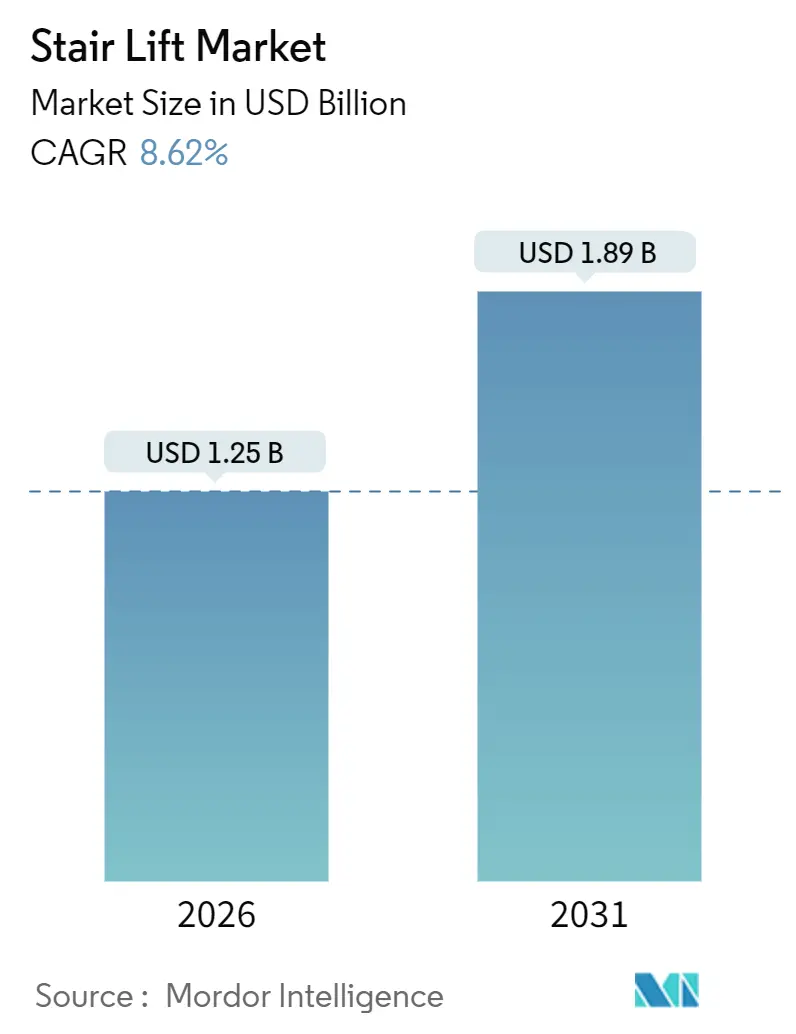
The stair lift market size reached USD 1.25 billion in 2026 and is projected to reach USD 1.89 billion by 2031, growing at an 8.62% CAGR. Population aging is widening the customer base for home mobility equipment as older adults prefer to remain in their homes rather than move into institutions.[1]U.S. Census Bureau, “Older Adults Outnumber Children in 11 States and Nearly Half of U.S. Counties,” U.S. Census Bureau, census.gov Recent code updates and safety standards, including ASME A18.1-2023, are standardizing safety features across brands and reducing permitting friction for installers. Federal and veteran-focused funding programs are also expanding access for eligible households, supporting near-term unit growth. Technological advancements in sensors, lighting, and remote diagnostics are enhancing reliability and reducing service downtime, which strengthens the case for replacement and upgrades in the stair lift market.
Key Report Takeaways
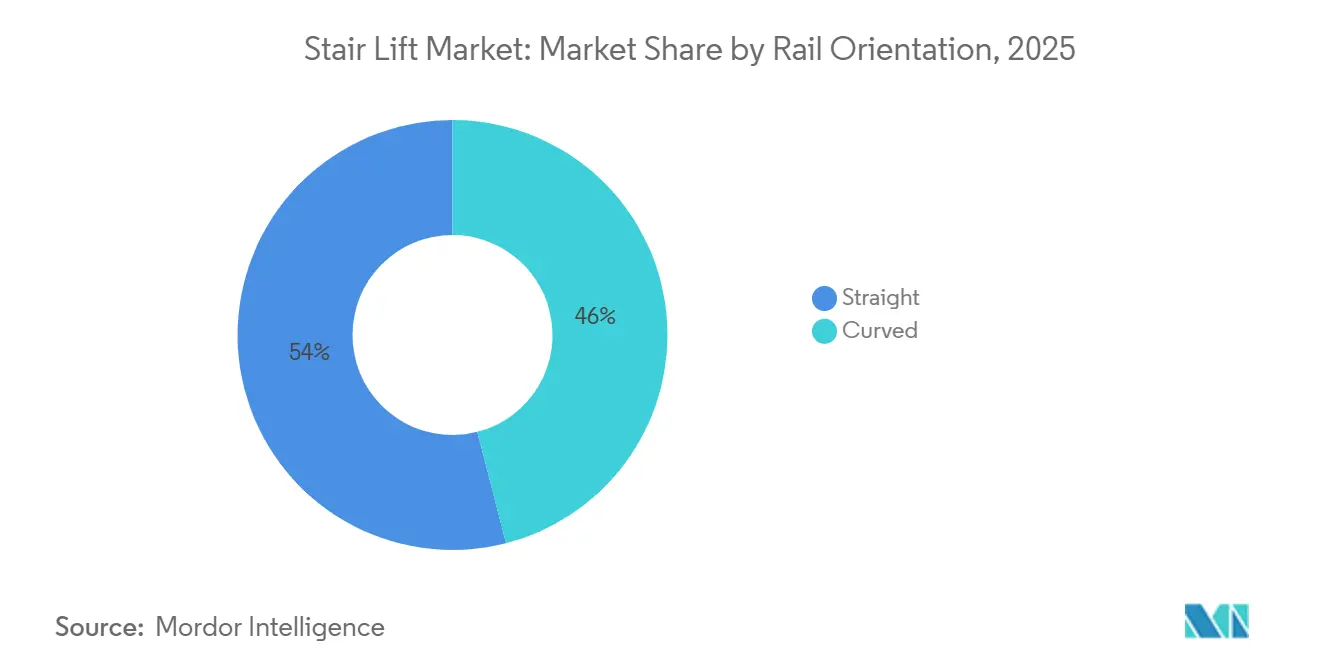
- By rail orientation, straight lifts led with 54% revenue share in 2025, while curved lifts are forecast to expand at a 10.34% CAGR through 2031.
- By user orientation, seated lifts held 48% revenue share in 2025, while standing and perch lifts are projected to record the fastest growth at an 8.76% CAGR to 2031.
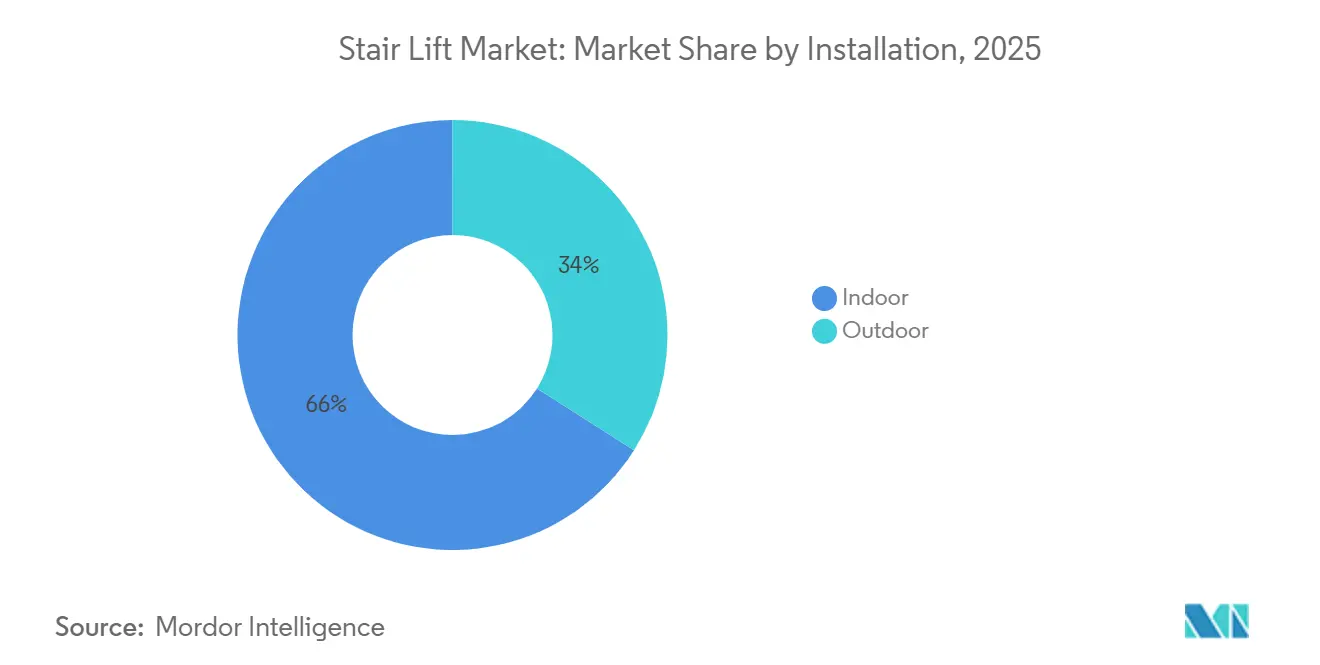
- By 2025, indoor systems are expected to account for a 66% revenue share, and outdoor systems are anticipated to grow at a 9.11% CAGR through 2031.
- By application, residential accounted for 43% revenue share in 2025, and healthcare facilities are set to advance at a 9.32% CAGR through 2031.
- By geography, North America captured a 65% share in 2025, while Asia-Pacific is projected to expand at a 10.50% CAGR through 2031.
Note: Market size and forecast figures in this report are generated using Mordor Intelligence’s proprietary estimation framework, updated with the latest available data and insights as of January 2026.
Global Stair Lift Market Trends and Insights
Drivers Impact Analysis
| Drivers | (~) % Impact on CAGR Forecast | Geographic Relevance | Impact Timeline |
|---|---|---|---|
| Accelerating Population Aging and Aging-In-Place Adoption | +2.8% | Global, with acute pressure in North America, Western Europe, and East Asia core, early gains in Oceania | Medium term (2-4 years) |
| Stricter Accessibility Standards and Code Updates Since 2020 | +1.2% | North America and EU, spill-over to APAC as Singapore and Australia adopt harmonized codes | Short term (≤ 2 years) |
| Residential Renovation and Retrofit Momentum in Multi-Story Homes | +1.5% | APAC core China and India, North America suburban corridors, select EU markets Italy and Spain | Medium term (2-4 years) |
| Advancements in Battery Backup, Sensors, and Remote Diagnostics | +0.9% | Global, with premium uptake in Nordic countries, Germany, Netherlands, U.S. coastal metros | Long term (≥ 4 years) |
| Medicaid Waivers and National Grants Unlocking Home Modifications | +1.3% | National programs in U.S. and Canada, pilot expansions in Brazil and Mexico | Short term (≤ 2 years) |
| State-Level Adoption of ASME A18.1 and Permit Clarity Reducing Friction | +0.9% | U.S. state-by-state rollout, early gains in California, Texas, Florida, New York | Medium term (2-4 years) |
| Source: Mordor Intelligence | |||
Accelerating Population Aging and Aging-In-Place Adoption
The 65-plus population continues to expand, which enlarges the addressable base for residential mobility solutions and supports unit growth for the stair lift market. Globally, aging is widespread with the share of individuals aged 60-plus rising across most regions through 2050, which increases the need for safe home access interventions.[2]World Health Organization, “Ageing and health,” World Health Organization, who.int. Fewer older adults reside in institutional settings compared with prior decades, which shifts budgets toward home modifications such as stair lifts and ramped entries. Straight stair lifts priced in the USD 3,000 to USD 5,000 range provide a practical alternative to facility-based care for many households. International public health initiatives promoting age-friendly communities emphasize the importance of accessible housing design and retrofits.
Stricter Accessibility Standards and Code Updates Since 2020
ASME A18.1-2023 came into effect in March 2024 with enhanced testing for overspeed and updated emergency communication requirements, which raises baseline safety and reduces brand differentiation based on safety signaling alone. Code harmonization and explicit permitting standards help dealers operate across states with fewer delays, which supports more predictable lead times and better customer experience. In parallel, EU harmonization programs such as EN 81-40 and the European Accessibility Act standardize design requirements across member countries, which channels engineering roadmaps toward tactile controls, documentation accessibility, and consistent safety systems. Greater clarity around safety and installation parameters helps reduce rework and aligns builders, architects, and inspectors with consistent expectations for compliant inclined lifts. These changes improve end-user trust and lower perceived risk, which supports replacement and upgrade cycles in the stair lift market.
Residential Renovation and Retrofit Momentum in Multi-Story Homes
Public grants for modifications are scaling, with targeted programs to reduce in-home fall risk and to remove barriers to mobility for low-income seniors. A clear cost gradient between straight lifts and custom curved lifts shapes consumer choice and pushes first-time buyers toward standardized rail systems for faster and more affordable installations. Multi-story homes in North America and parts of Asia are prioritizing accessible entries and safe inside circulation, which increases the volume of retrofit projects that include stairlifts in scope. State and municipal programs that streamline inspection and permit steps limit administrative lag, improving throughput for dealers and installers. Together, these dynamics align with the steady shift toward aging in place and underpin a broad uplift in addressable demand for the stair lift market.
Advancements in Battery Backup, Sensors, and Remote Diagnostics
Manufacturers are introducing integrated lighting, onboard sensors, and predictive diagnostics that improve safety, comfort, and uptime for both straight and curved products. AI-enabled service models such as Savaria’s Smart Ascent are using real-time device telemetry to reduce preventable downtime and to shorten service intervals, which raises perceived value and supports premium positioning. Connected diagnostics in modular curved systems allow dealers to troubleshoot remotely, which accelerates support and reduces truck rolls. IoT data pipelines from third-party providers are now embedded in field deployments, layering predictive analytics over basic monitoring to proactively flag issues. As these capabilities diffuse into mid-market models, the stair lift market benefits from rising replacement demand as households and facilities upgrade for safety and reliability.
Restraints Impact Analysis
| Restraint | (~) % Impact on CAGR Forecast | Geographic Relevance | Impact Timeline |
|---|---|---|---|
| Limited Medicare Coverage and High Out-of-Pocket Burden | -1.8% | U.S. nationwide, acute in rural counties with low Medicare Advantage penetration | Short term (≤ 2 years) |
| High Customization Costs for Curved Rails and Complex Installs | -1.3% | Global, with highest friction in emerging markets Brazil and India and historic city centers Rome, Paris, Edinburgh | Medium term (2-4 years) |
| Egress and ADA Constraints in Non-Residential Stairways | -0.7% | U.S. commercial sector, EU public buildings post-European Accessibility Act | Long term (≥ 4 years) |
| Recalls and Liability Concerns Impacting Procurement Confidence | -0.5% | North America and EU, where regulatory recall databases are publicly accessible | Medium term (2-4 years) |
| Source: Mordor Intelligence | |||
Limited Medicare Coverage and High Out-of-Pocket Burden
Original Medicare does not classify stairlifts as durable medical equipment, which means there is no standardized federal coverage pathway for most beneficiaries. Medicare Advantage plans can offer supplemental benefits, yet inclusion is plan-specific, subject to prior authorization, and limited in scope, which produces uneven access across counties. Medicaid waiver coverage varies by state and can involve long waitlists, which slows conversion even for eligible consumers. By contrast, Veterans Affairs housing grants can be substantial for those who meet the criteria, including the Specially Adapted Housing grant of up to USD 126,526 in fiscal year 2026, which can fund comprehensive accessibility upgrades. Straight stairlifts typically cost USD 3,000 to USD 5,000, and curved lifts can reach well above USD 10,000, which places a significant out-of-pocket expense on fixed-income households when no public or private coverage applies.
High Customization Costs for Curved Rails and Complex Installs
Curved lifts require bespoke rails and multi-stage fabrication, which lengthens delivery times and raises total project costs relative to straight models. Complex geometries such as spirals and intermediate landings increase engineering time and installation hours, which pushes the installed price higher than standardized alternatives. Historic buildings and narrow staircases in dense European cores require slimline rails and specialized fittings, which add cost and favor premium models suited to tight radii. The resale market for curved systems is limited because rails are custom-made and non-transferable, which removes rental and buy-back options that help lower ownership costs for straight lifts. Jurisdictions that require additional permitting add project steps, while codes and egress clearances constrain product selection for some non-residential settings.
Segment Analysis
By Rail Orientation: Modular Systems Propel Curved Growth
Straight stairlifts held 54% of the stair lift market share in 2025, with pre-fabricated rails that shorten installation windows and lower price points for first-time buyers. The stair lift market favors straight runs in retrofit scenarios that involve common residential layouts, which supports dealer volume purchases and consistent inventory turns. Curved systems are forecast to expand at a 10.34% CAGR from 2026 to 2031 as modular rail designs compress lead times and broaden eligible staircase types. Harmar’s modular curved platform introduced connected diagnostics and a thin-rail profile for narrow runs, which helped enable next-day deliveries in select metro areas. Twin-rail configurations for tight bends support premium placements in older European housing stock, which benefits dealers that specialize in high-complexity projects. Faster on-site assembly using stock-able rail sections has improved installation speed and widened choice for buyers who require custom turns without extended fabrication windows.
Comparing adoption patterns shows straight models dominate standardized retrofits while curved lifts concentrate in homes with spirals, mid-landings, and ornate profiles. The stair lift market size for curved lifts is projected to rise in line with modular engineering improvements that cut delivery time and improve serviceability. Hinged rail options and fold-away sections help preserve egress widths at landings and entries, which supports compliance in smaller dwellings and shared stairways. Outdoor curved variants add weatherproofing and corrosion resistance for coastal and high-UV settings, which expands their appeal for deck access and multi-level exterior stairs. Collectively, these features tilt a larger share of complex projects toward curved systems while straight rails remain the high-volume core of the stair lift market.
Get Detailed Market Forecasts at the Most Granular Levels
Download PDF
By User Orientation: Standing Lifts Gain Clinical Endorsement
Seated lifts held 48% share in 2025 based on comfort, intuitive controls, and adjustable seating that suits older adults with limited knee flexibility. Powered swivel options and ergonomic armrests aid transfers at landings, which reduces fall risk and eases use in tight top landings. Standing and perch configurations are projected to grow at an 8.76% CAGR from 2026 to 2031, supported by clinical recommendations for users who cannot tolerate full sitting. Perch designs utilize a semi-standing posture and compact folded depth, which works well on narrow staircases, particularly in legacy homes common in dense urban cores. Integrated models that combine seated and standing options are gaining more use in rehabilitation settings where multi-user flexibility is crucial.
This orientation mix reflects clinical needs and household constraints, which shape product selection and price sensitivity across the stair lift market. Standing solutions fit narrow spaces and certain orthopedic profiles, while seated models set the comfort baseline for the largest user group. Updated safety standards outline seat height ranges and graspability dimensions that help standardize ergonomics across brands, which raises the baseline safety signal for purchasers. Dealers that carry both standing and seated portfolios address multi-user households better than single-orientation brands. Over time, incremental ergonomic refinements are expected to lift satisfaction and reduce service issues in both configurations in the stair lift industry.
By Installation: Outdoor Variants Weather Extreme Climates
Indoor installations led with 66% revenue share in 2025, reflecting steady retrofit momentum in climate-controlled environments that extend equipment longevity. Outdoor units are projected to grow at a 9.11% CAGR, supported by weatherproofing that handles cold and heat extremes, as well as coatings that extend rail life in salt air environments. Outdoor placements enhance access to gardens, garages, and docks, supporting use cases that complement indoor solutions rather than replace them. Marine-grade finishes and sealed electronics expand the viability of deployments in high-UV and coastal environments, which was a constraint for legacy models. Outdoor configurations that maintain operational reliability during grid interruptions align with battery-dependent designs used in modern catalogues.
As climate events reshape building needs, elevated homes and multi-level exterior entries are adopting exterior lifts to maintain safe access. The stair lift market size for outdoor systems is projected to benefit from mitigation spending tied to insurance and building code incentives that reward resilient home designs. Cold-weather markets that incorporate lithium-based batteries benefit from enhanced low-temperature performance, which improves uptime during winter. Demand for hinged or retracting rails that protect egress at entryways supports code compliance goals in small exterior landings. Outdoor products therefore add a complementary growth vector that elevates the overall stair lift market.[3]TK Elevator, “HOME GLIDE SEAMLESS MOVEMENT,” TK Elevator, tkelevator.com
Get Detailed Market Forecasts at the Most Granular Levels
Download PDF
By Application: Healthcare Institutions Navigate Compliance Complexity
Residential applications accounted for 43% share in 2025 as households invest in aging-in-place upgrades and choose stairlifts to maintain access to upper floors. Healthcare facilities are forecast to expand at a 9.32% CAGR from 2026 to 2031 as rehabilitation centers and skilled nursing facilities seek cost-effective ways to provide vertical access where elevators are not viable. Heavy-duty models that support higher weight capacities and caregiver-assisted operation are favored in clinical environments. Institutional procurement focuses on standardized safety features, reliable diagnostics, and service consistency, which plays to manufacturers with connected maintenance platforms.
In public accommodations, platform lifts typically take precedence over chairlifts for compliance because they do not require transfer, and they align with ADA scoping criteria. Egress width rules also affect product selection in commercial corridors, which increases demand for slim-rail options and fold-away rails that preserve passage when not in use. The stair lift market therefore sees resilient demand in homes and selective uptake in healthcare settings where code-conforming alternatives exist. This pattern will continue as new installations and replacements aim to meet stringent safety requirements while balancing project budgets.
Geography Analysis
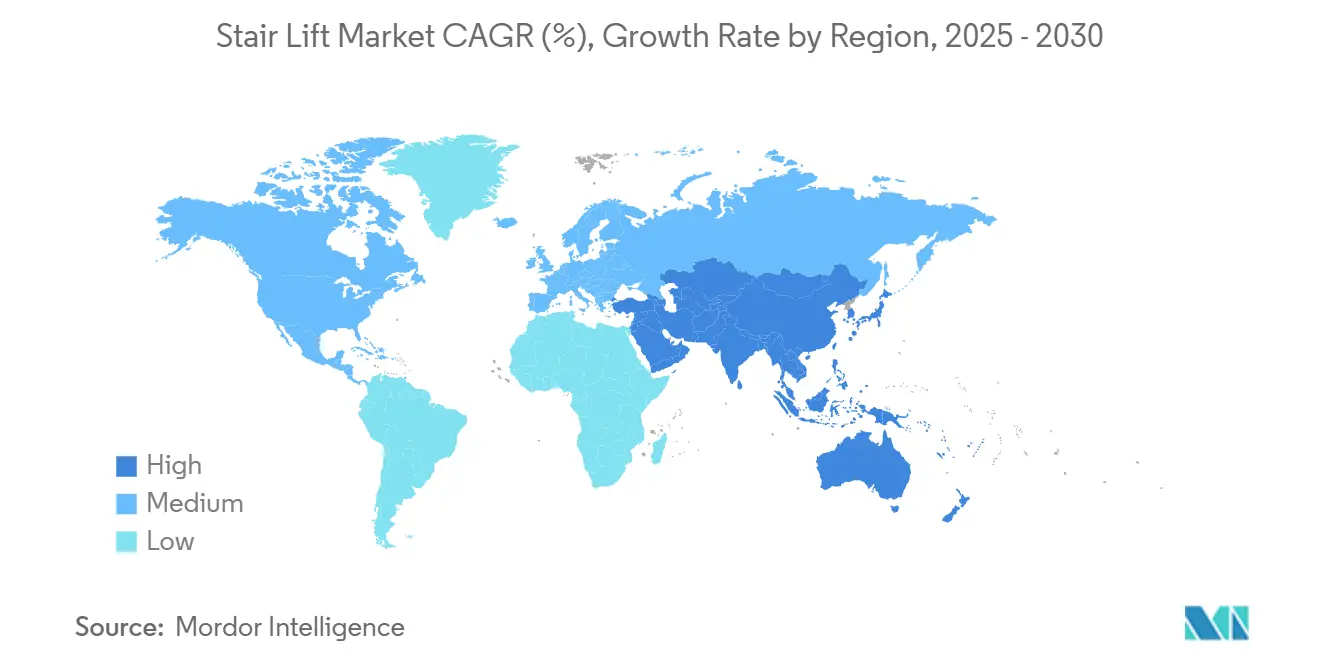
North America held 65.00% share in 2025 on the back of higher disposable incomes and mature dealer networks, which supports out-of-pocket purchases and upgrades in the stair lift market. The U.S. older adult population is rising, which expands the eligible base for home safety modifications and mobility devices. Veterans Affairs housing grants can fund significant accessibility improvements for eligible recipients, which meaningfully reduces the affordability barrier for qualified households. Federal programs directed at low-cost, high-impact modifications have scaled grants to non-profits, which support safer homes for low-income seniors. Manufacturing footprints in Mexico are boosting supply optionality and lowering delivered costs into the U.S. Sun Belt and Midwest dealer networks.
Asia-Pacific is projected to grow at a 10.50% CAGR through 2031, driven by rapid population aging in Japan and growing policy emphasis on barrier-free housing in China. Public programs that incentivize home retrofits for older adults are gaining traction across several markets, which strengthens the long-run outlook for residential installations. Australia’s aging-in-place policies and high household incomes are supporting steady uptake in urban corridors. Early-stage adoption in Southeast Asia and parts of South Asia is concentrated among middle and upper-income households in large cities, which mirrors the typical early expansion path for the stair lift market. The stair lift market size in Asia-Pacific is set to benefit from policy support and dealer network expansion as supply chains adapt to regional demand patterns.
Europe remains a large base for stairlift deployment with strong penetration in the United Kingdom and Germany. Harmonized EU rules elevate product safety and documentation standards, which reduces cross-border product variation and supports multi-country dealer operations. VAT relief and localized grants remain pivotal in some countries even as budgets fluctuate, which shapes quarterly volume patterns. Nordic markets show higher adoption of connected models, which aligns with strong smart-home infrastructure and a preference for premium features. Eastern European markets see constraints where average stairlift prices represent a high share of retiree income, which moderates growth relative to Western Europe. Overall, Europe continues to contribute a significant share of global revenue to the stair lift market, anchored by policy clarity and established distribution.
Get Analysis on Important Geographic Markets
Download PDF
Competitive Landscape
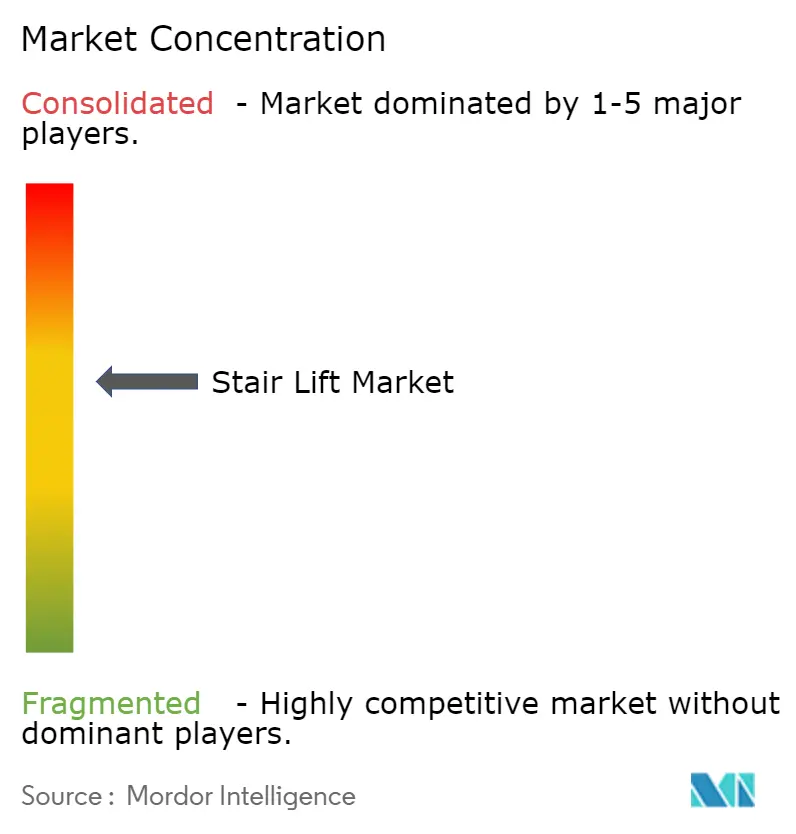
The stair lift market exhibits moderate concentration with the top five manufacturers accounting for an estimated 65% of revenue, which leaves room for regional specialists and new modular entrants. Savaria’s acquisition of Handicare, completed in March 2021 for CAD 521 million, added scale across stairlifts and wheelchair lifts and positioned the combined entity for cross-selling to a larger dealer base, equivalent to USD 416.8 million using the 2021 average exchange rate. The combined pro forma revenue base exceeded CAD 671 million shortly after close, equivalent to USD 536.8 million using the 2021 average exchange rate. Savaria highlighted available funds of CAD 290 million for further M and A, equivalent to USD 223.3 million using the 2022 average exchange rate. TK Elevator’s Access BDD unit launched the Flow X curved lift featuring ASL technology for seat rotation during travel, which increases fit in narrow staircases and creates a strong premium anchor in the range.
Harmar expanded modular curved offerings in the U.S. with a connected platform and a thin rail that fits narrow stair widths, which shortened installation times and accelerated deliveries in select metros. Manufacturers are leaning into predictive maintenance and telemetry to limit downtime and to simplify service scheduling, which reduces lifetime cost and lifts customer satisfaction. Access BDD and other premium brands are adding lighting and sensor suites that guide safe use in low light and improve feedback when restraints are not engaged. These product moves are raising the baseline feature set across mid-range models, which intensifies competition on price, service, and delivery speed in the stair lift market.
Regulatory clarity and code adoption are also shaping competitive strategies, as engineering teams align products to meet ASME A18.1 and local interpretations of egress and platform use. Brands that demonstrate audit-ready compliance and dealer training improve the likelihood of first-time inspection approvals. Suppliers with regional assembly or flexible inventory are better able to support next-day installs for straight runs and faster delivery for modular curved systems. This operational flexibility is becoming a key buying criterion for dealers and end users across the stair lift market.
Stair Lift Industry Leaders
Savaria Corporation
Stannah Lifts Holdings Ltd.
Acorn Mobility Services Limited
Bruno Independent Living Aids, Inc.
Handicare AB
- *Disclaimer: Major Players sorted in no particular order
Need More Details on Market Players and Competitors?
Download PDF
Recent Industry Developments
- December 2025: Stannah announced a major evolution in its governance and leadership structure, strengthening leadership with the sixth generation of the Stannah family to drive growth and reassure long-term commitment, following the company’s record year in which it fitted its one millionth stair lift and reported a 12% bump in annual sales.
- September 2025: Stannah launched the ground-breaking 158 stair lift model simultaneously at NAEC Expo in Houston, USA, and Rehacare International in Düsseldorf, Germany, marking the company’s 158th anniversary and showcasing next-generation motor technology that reduces noise levels by 15 decibels compared with previous models.
- August 2025: Savaria reported record Q2 2025 financial performance, with consolidated revenue of USD 215.8 million up 1.9% year-over-year and adjusted EBITDA margin reaching 20.6%, driven by operational efficiencies from the Handicare integration and better pricing strategies across North American and European markets.
- May 2025: Savaria completed the acquisition of Western Elevator Ltd., a Canadian elevator servicing company, expanding its service network in Ontario and Quebec and adding 120 technicians to its workforce, strengthening its position in the North American accessibility market.
Global Stair Lift Market Report Scope
A stair lift is a mechanical device used for lifting people, typically those with disabilities or older adults, up and down stairs. It provides comfort and can revive liberty for those who have discontinued using the stairs. All stairlifts contain a simple controller that controls their motion. The lift travels up or down the stairway when the rider presses and holds the switch. The chair beeps once and stops automatically when the stairlift arrives at the end of the path. If one releases the control at any point along the way, the lift will start beeping and stop immediately.
The Stair lift Market Report is Segmented by Rail Orientation (Straight, Curved), User Orientation (Seated, Standing, Integrated), Installation (Indoor, Outdoor), Application (Residential, Healthcare, Government, Leisure and Entertainment), and Geography (North America, South America, Europe, Asia-Pacific, Middle East, Africa). The Market Forecasts are Provided in Terms of Value (USD).
By Rail Orientation
| Straight |
| Curved |
By User Orientation
| Seated |
| Standing |
| Integrated |
By Installation
| Indoor |
| Outdoor |
By Application
| Residential |
| Healthcare |
| Government |
| Leisure and Entertainment |
By Geography
| North America | United States |
| Canada | |
| Mexico | |
| South America | Brazil |
| Argentina | |
| Chile | |
| Rest of South America | |
| Europe | Germany |
| United Kingdom | |
| France | |
| Italy | |
| Spain | |
| Russia | |
| Netherlands | |
| Sweden | |
| Switzerland | |
| Poland | |
| Rest of Europe | |
| Asia-Pacific | China |
| Japan | |
| India | |
| South Korea | |
| Australia | |
| New Zealand | |
| Indonesia | |
| Malaysia | |
| Thailand | |
| Vietnam | |
| Philippines | |
| Rest of Asia-Pacific | |
| Middle East | Saudi Arabia |
| United Arab Emirates | |
| Turkey | |
| Israel | |
| Qatar | |
| Kuwait | |
| Rest of Middle East | |
| Africa | South Africa |
| Nigeria | |
| Egypt | |
| Morocco | |
| Kenya | |
| Rest of Africa |
| By Rail Orientation | Straight | |
| Curved | ||
| By User Orientation | Seated | |
| Standing | ||
| Integrated | ||
| By Installation | Indoor | |
| Outdoor | ||
| By Application | Residential | |
| Healthcare | ||
| Government | ||
| Leisure and Entertainment | ||
| By Geography | North America | United States |
| Canada | ||
| Mexico | ||
| South America | Brazil | |
| Argentina | ||
| Chile | ||
| Rest of South America | ||
| Europe | Germany | |
| United Kingdom | ||
| France | ||
| Italy | ||
| Spain | ||
| Russia | ||
| Netherlands | ||
| Sweden | ||
| Switzerland | ||
| Poland | ||
| Rest of Europe | ||
| Asia-Pacific | China | |
| Japan | ||
| India | ||
| South Korea | ||
| Australia | ||
| New Zealand | ||
| Indonesia | ||
| Malaysia | ||
| Thailand | ||
| Vietnam | ||
| Philippines | ||
| Rest of Asia-Pacific | ||
| Middle East | Saudi Arabia | |
| United Arab Emirates | ||
| Turkey | ||
| Israel | ||
| Qatar | ||
| Kuwait | ||
| Rest of Middle East | ||
| Africa | South Africa | |
| Nigeria | ||
| Egypt | ||
| Morocco | ||
| Kenya | ||
| Rest of Africa | ||
Need A Different Region or Segment?
Customize Now
Key Questions Answered in the Report
What is the growth outlook for the stair lift market through 2031?
The stair lift market size is projected to reach USD 1.89 billion by 2031 at an 8.62% CAGR, supported by aging demographics, funding programs, and safety code harmonization.
Which product categories are leading and which are growing fastest?
Straight lifts led with 54.00% share in 2025, while curved lifts are forecast to grow fastest at a 10.34% CAGR to 2031 as modular rails compress lead times.
How do installation settings influence purchasing decisions?
Indoor installs dominate share due to lower wear and faster installs, while outdoor units are the fastest growing with a 9.11% CAGR as weatherproofing extends reliable operation across climates.
Where is regional demand strongest for stair lifts?
North America held 65.00% share in 2025 due to incomes and funding access, while Asia-Pacific is projected to grow fastest at a 10.50% CAGR as policies and demographics expand adoption.
What coverage or grants can households access for stairlifts?
Original Medicare generally does not cover stairlifts, though some Medicare Advantage plans may, while Veterans Affairs grants can fund larger accessibility projects for eligible recipients.
Which technologies are differentiating new stairlift models?
Connected diagnostics, predictive maintenance, and safety lighting are becoming standard, improving uptime and user confidence and supporting replacement cycles.


