
Market Overview
| Study Period | 2020 - 2031 |
|---|---|
| Forecast Data Period | 2026 - 2031 |
| Base Year Market Size (2025) | USD 160.58 Million |
| Market Size (2026) | USD 165.99 Million |
| Market Size (2031) | USD 195.93 Million |
| Growth Rate (2026 - 2031) | 3.37 % |
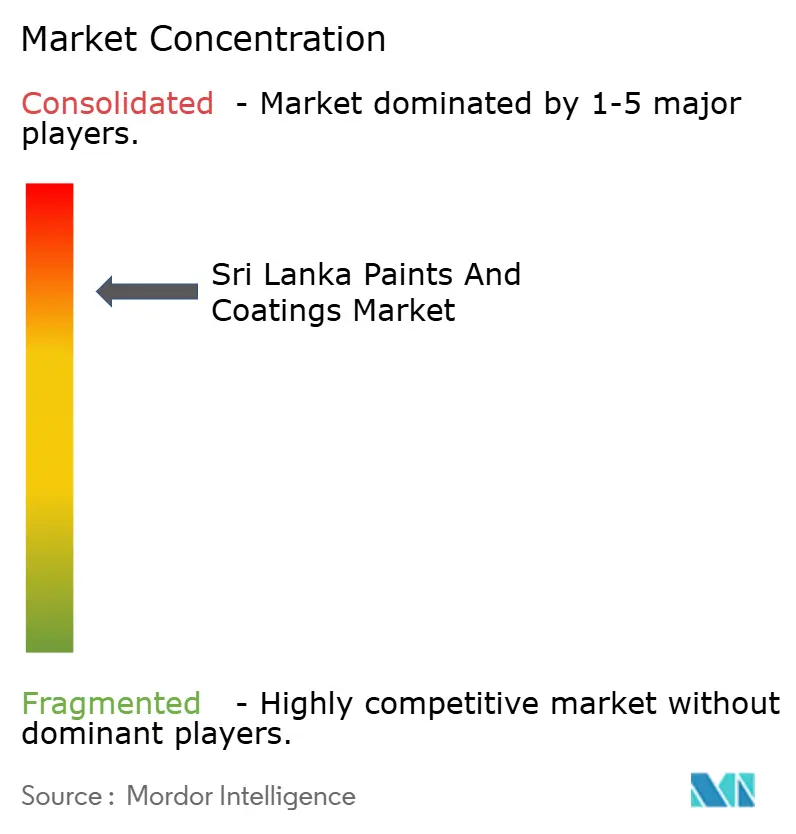
| Market Concentration | High |
Major Players *Disclaimer: Major Players sorted in no particular order Image © Mordor Intelligence. Reuse requires attribution under CC BY 4.0. | |
Sri Lanka Paints And Coatings Market Analysis by Mordor Intelligence
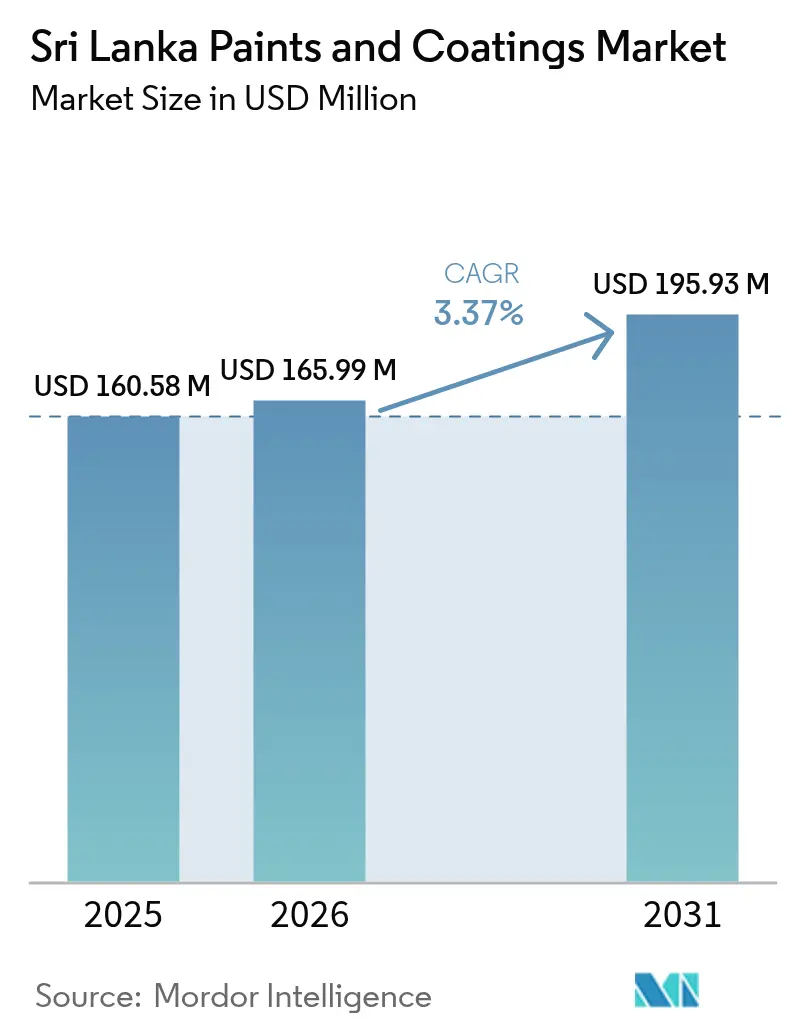
Sri Lanka Paints and Coatings market size in 2026 is estimated at USD 165.99 million, growing from 2025 value of USD 160.58 million with 2031 projections showing USD 195.93 million, growing at 3.37% CAGR over 2026-2031. Tourism-led construction activity, steady industrial output gains, and a gradual return of consumer confidence after the 2022 balance-of-payments crisis underpin this growth trajectory. The construction sector’s revival is visible in hotel, resort, and mixed-use projects designed to meet rising visitor inflows, while public-sector infrastructure upgrades accelerate demand for protective and waterproof systems. Parallel regulatory tightening on volatile organic compounds steers local producers toward water-borne binders and recycled-content powders that satisfy sustainability mandates and hospitality air-quality guidelines. Currency stabilization, a stronger import-finance pipeline, and healthy remittance inflows have collectively eased raw-material procurement constraints and encouraged producers to restore pre-crisis capacity utilization.
Key Report Takeaways
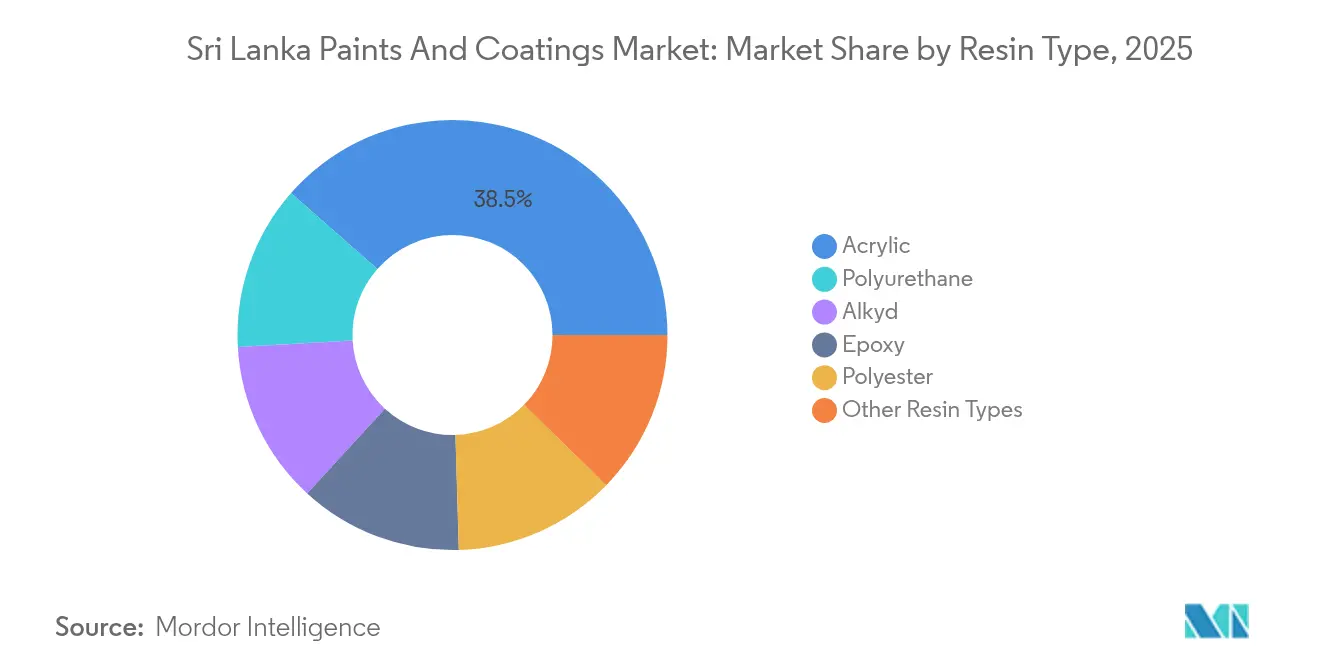
- By resin type, acrylic products accounted for 38.52% of the Sri Lanka Paints and Coatings market share in 2025; polyurethanes are projected to expand at a 3.52% CAGR through 2031.
- By technology, solvent-borne systems held 46.02% revenue share in 2025, whereas water-borne technologies are forecast to post a 3.48% CAGR over 2026-2031.
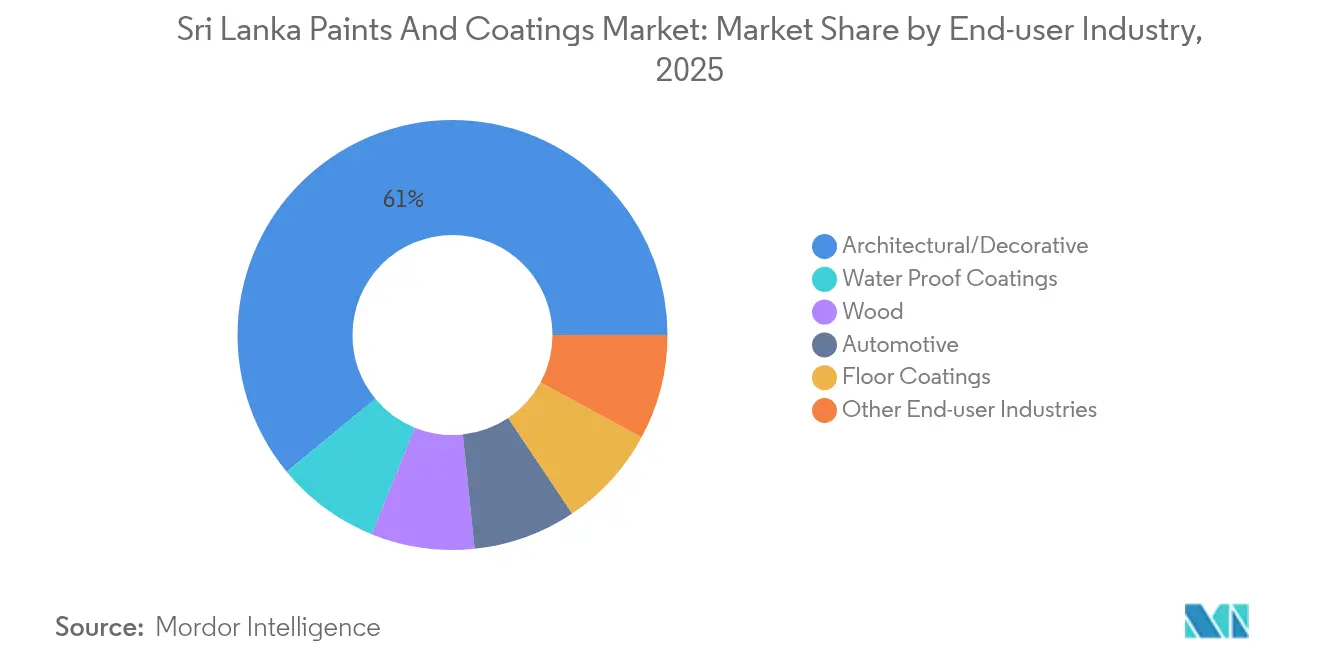
- By end-user, architectural and decorative formulations captured 60.98% revenue share in 2025; waterproof coatings are set to grow the fastest at a 3.58% CAGR to 2031.
Note: Market size and forecast figures in this report are generated using Mordor Intelligence’s proprietary estimation framework, updated with the latest available data and insights as of 2026.
Sri Lanka Paints And Coatings Market Trends and Insights
Drivers Impact Analysis*
| Driver | (~) % Impact on CAGR Forecast | Geographic Relevance | Impact Timeline |
|---|---|---|---|
| Post-crisis Construction Rebound | +0.8% | National, with concentration in Western Province | Medium term (2-4 years) |
| Expansion of Automotive Refinish (used-car) Demand | +0.5% | National, with urban concentration | Short term (≤ 2 years) |
| Rising Preference for Polyurethane Performance Coatings | +0.4% | National, industrial zones focus | Long term (≥ 4 years) |
| Government-backed Home-improvement Loan Schemes | +0.6% | National, rural and suburban focus | Medium term (2-4 years) |
| Shift to Water-borne Decorative Paints Driven by VOC Limits | +0.3% | National, manufacturing compliance focus | Long term (≥ 4 years) |
| Source: Mordor Intelligence | |||
Post-crisis Construction Rebound
Building activity rebounded sharply after macro-stability returned, delivering a 5% GDP expansion in 2024 that unlocked stalled private investment[1]. Colombo’s USD 1 billion City of Dreams resort and the 687-room Cinnamon Life hotel illustrate large-floor-area projects that elevate premium exterior and interior demand. Protective coatings volumes rose with boat-building exports, which reached USD 13.37 million in April 2025 and required marine-grade anti-corrosion systems. Certification under Central Environmental Authority protocols steers new builds toward water-borne and low-VOC formulations. Industrial estate expansion in Western and Southern provinces boosts demand for floor coatings specified for chemical resistance, while hospitality developers insist on low-odor products to minimize downtime during phased renovations.
Expansion of Automotive Refinish Demand
Foreign-exchange normalization lifted used-car imports, and the existing 4.8 million-unit fleet drives steady refinishing throughput in urban workshops. Central bank reserves of USD 5.7 billion have relaxed import licensure, enabling distributors to stock advanced water-borne basecoats and high-solids primers that match global OEM shades[2]. Collision-repair operators increasingly promote nano-ceramic clearcoats that deliver self-cleaning properties aligned with consumer preferences for lower maintenance cycles. Demand also stems from aftermarket integration of sensors for advanced driver-assistance systems, which require optically clear protective topcoats. Local distributors now leverage tariff reductions under the proposed Indo-Sri Lanka and Sri Lanka-Thailand trade accords to import refinish consumables more cost-competitively.
Rising Preference for Polyurethane Performance Coatings
Manufacturing growth of 8.7% in 2025 fuels the uptake of two-component polyurethanes that offer abrasion resistance and extended durability on food-processing machinery. Petrochemical-resistant tank linings specified for upcoming refinery upgrades in Hambantota and Trincomalee further boost volumes. Polyurethane formulations’ shorter return-to-service intervals help offset skilled-labor shortages on project sites. Their compatibility with automated spray systems aligns with productivity gains sought by export-oriented apparel, pharmaceutical, and electronics plants. Board of Investment incentives that reward compliance with the International Organization for Standardization (ISO) 14001 environmental management frameworks reinforce migration to low-emissions polyurethane chemistries.
Government-backed Home-improvement Loan Schemes
Policy-rate reductions from 15.5% to 8% over 2024 enabled commercial banks to relaunch repair-and-renovation credit lines capped at LKR 3 million (USD 8,300) per household. Borrowers increasingly opt for low-odor emulsions and elastomeric waterproofing that qualify for green-finance rebates tied to energy conservation. Rural self-construction, encouraged by microfinance providers, favors affordable acrylic distempers supplied in recyclable pouches that reduce packaging material cost. Housing-deficit mitigation programs that target 189,000 units over 2025–2030 underpin demand for economy-grade exterior emulsion sold through hardware franchises in interior districts.
Restraints Impact Analysis*
| Restraint | (~) % Impact on CAGR Forecast | Geographic Relevance | Impact Timeline |
|---|---|---|---|
| Currency Volatility Inflating Imported Raw-material Costs | -0.7% | National, import-dependent manufacturers | Short term (≤ 2 years) |
| Softening of New Building Permits Amid Tighter Credit | -0.4% | Urban areas, commercial construction | Medium term (2-4 years) |
| Skilled Applicator Shortage Due to Outward Migration | -0.3% | National, construction and industrial sectors | Long term (≥ 4 years) |
| Source: Mordor Intelligence | |||
Currency Volatility Inflating Imported Raw-material Costs
Sri Lanka imported USD 321.59 million of miscellaneous chemical intermediates and USD 255.21 million of organics in 2024, exposing formulators to exchange swings. Smaller paint makers lack hedging tools, forcing monthly price resets that erode channel confidence. Global epoxy shortages after European anti-dumping tariffs and United States probe findings have pushed Asia-origin bisphenol-A epoxy prices up by 18% since 2023. Working-capital requirements balloon when suppliers demand shorter credit tenors, compelling local firms to trim SKU breadth and defer R&D projects. End-users postpone noncritical repainting when retail tags spike, constraining immediate volume recovery.
Softening of New Building Permits Amid Tighter Credit
Although mortgage rates fell in 2024, loan-to-value ceilings tightened, lengthening developers’ presales cycles and delaying groundbreaks. Colombo’s construction cost index remains one of Asia’s highest, lifted by imported steel and cement surcharges. Commercial landlords struggle to secure anchor tenants under 5-year leases, making lenders cautious about exposure to speculative Grade-A office builds. Public-sector fiscal discipline under the International Monetary Fund (IMF) program restricts capital-works outlays, further tempering institutional demand. Consequently, premium architects defer specifying textured exterior finishes and Polyvinylidene fluoride (PVDF) topcoats with higher square-meter pricing.
*Our forecasts treat driver/restraint impacts as directional, not additive. The impact forecasts reflect baseline growth, mix effects, and variable interactions.
Segment Analysis
By Resin Type: Acrylic Dominance Across Applications
Acrylic formulations accounted for 38.52% of Sri Lanka Paints and Coatings market share in 2025 and are projected to deliver the fastest 3.55% CAGR through 2031. The Sri Lanka paints and coatings market size for acrylic offerings will grow in absolute value alongside residential repainting and hospitality refurbishments that favor low-odor, quick-dry emulsions. Demand also benefits from the resin’s broad compatibility with solvent-borne enamels and water-based lattices, allowing manufacturers to adjust product portfolios without re-engineering entire production lines. Domestic leader JAT Holdings recently installed a 7,200 tpa alkyd plant in Bangladesh to hedge against imported resin cost spikes, signaling the supply-security dividends of backward integration.
The versatility of acrylics extends to textured renders, elastomerics for parapet walls, and direct-to-metal primers that resist tropic humidity. Rural markets still buy budget alkyd gloss enamels for doors and grills, yet rising incomes and brand marketing are nudging consumers toward odor-controlled acrylic enamels. Polyurethane systems capture institutional buyers who need heavy-duty abrasion resistance in food-processing or pharma plants, while epoxy volumes rise where corrosion demands dictate higher cross-link density. Nevertheless, acrylics remain the default binder in the economy and mid-tier masonry segments because tooling and surface-preparation requirements are minimal, keeping contractor labor costs contained.

By Technology: Water-borne Transition Accelerates
Solvent-borne chemistry held 46.02% revenue share in 2025, but water-borne lines are outpacing at a 3.48% CAGR, reflecting the regulatory pull of Central Environmental Authority emissions caps. The Sri Lanka paints and coatings market size for water-borne systems is expected to surpass USD 73.4 million by 2031, buoyed by retail chains’ inventory pivots toward eco-labels that publicize VOC content. Consumer familiarity has improved through Do It Yourself (DIY) campaigns led by national hardware stores, mitigating the traditional perception that water-borne finishes underperform in sheen retention. Powder lines remain niche, reserved for architectural aluminum, domestic-appliance panels, and original equipment manufacturer (OEM) steel furniture, but application is widening following PPG’s launch of ultralow bake ranges that cure at 150°C and lower energy bills.
Solvent products still dominate automotive and industrial maintenance niches that require rapid rebuilds or very high gloss. However, global resin suppliers invest in next-generation water-reducible alkyds and self-cross-linking acrylics to achieve solvent-like flow. Equipment bottlenecks persist because contractors must invest in stainless-steel spray guns and humidity-controlled curing spaces to extract full performance gains. Technical service centers operated by multinationals such as AkzoNobel and Jotun, in alliance with local distributorships, provide the training and color-matching data needed to de-risk the shift at job sites.
By End-user Industry: Architectural Segment Leads Recovery
The architectural and decorative cluster represented 60.98% of 2025 revenues, reflecting robust urban refurbishment and greenfield hospitality builds driven by tourism arrivals that reached 85% of 2019 levels by August 2024. That share underscores how closely the Sri Lanka Paints and Coatings market tracks home-improvement loan origination and commercial lodging occupancy. Shops and multi-family dwelling owners adopt elastomeric waterproof layers for balconies and rooftop parapets given monsoon exposure. In the industrial realm, food-grade epoxy tanks and warehouse floor topcoats register steady orders as processing plants chase Hazard Analysis Critical Control Point (HACCP) certification for export markets.
Waterproof coatings post the fastest 3.58% CAGR because climate adaptation budgets prioritize flood-resistant design. Government civil works agencies mandate positive-side membranes on basements and substructures in coastal zone projects, pulling through large-volume orders. Automotive clearcoat demand is rising after import quotas eased, while the thriving teak-and-rubber furniture sector in Central Province pushes volume in UV-curable wood systems. Marine coatings volumes edge higher as boat-building yards near Galle and Trincomalee clock export contracts for fiberglass leisure craft destined for the Maldives, reinforcing niche demand for anti-fouling tributyltin-free formulations.
Geography Analysis
Western Province generates almost half of the national GDP and is the logistical fulcrum for the Sri Lanka Paints and Coatings market. Colombo’s port handles more than 70% of inbound resin and pigment cargos, giving nearby formulators a freight-cost advantage. The province’s 72.4% services employment share and 25.8% industry share underpin skyscraper refurbishments that specify high-build elastomeric claddings and marine-grade polyurethane for façade metalwork. Major transport-oriented developments such as the Port City SEZ are catalysts for specialized protective systems rated to ISO 12944 C5 coastal classifications. Western Province also houses the densest franchise retail depots, amplifying reach for premium brands that propagate color-consultancy services.
Central and Northern provinces provide steady demand from agro-processing, with Kandy’s 25.6% industrial workforce requiring corrosion-resistant linings on tea dryers and spice grinders. Lower disposable incomes in these districts tilt purchases toward mid-sheen economy emulsions packaged in 1 L and 4 L SKUs. Yet localized manufacturer clinics deliver skill-upgrading workshops that promote higher-margin products by demonstrating washability and mildew-resistance. Northern infrastructure restoration projects, including road resurfacing and public school repainting, channel recurring tender volumes to compliant suppliers carrying Central Environment Authority (CEA) discharge permits.
Eastern and Southern provinces exhibit nascent but fast growth across tourism and fisheries. Trincomalee’s deep-water port expansion attracts ship-repair operations that consume tank-coating cycles measured in thousands of square meters per voyage. Boutique resorts in Arugam Bay and Mirissa elevate demand for pastel-tone exterior emulsions formulated with UV absorbers that withstand sea-spray mist. Hardware cooperatives facilitate procurement for dispersed cottage-construction crews, but distance from resin import nodes adds 5%–8% landed-cost premiums that local stockists pass on through slimmer rebate structures.
Value Chain Analysis
The value chain begins with imported petrochemical and mineral inputs, and local formulators and blenders depend on overseas supply for resins, pigments, and additives (over 90% import reliance, spanning roughly 300 active ingredients annually). Colombo Port is the main entry route for these materials, after which large-scale manufacturers and a long tail of SMEs handle dispersion, tinting, and batching across architectural, industrial, wood, and specialty coating lines, followed by packaging (cans and pails) and distribution. Market structure is concentrated at the top, with seven large-scale players accounting for about 90% of the local market and total annual production capacity estimated near 35 million liters, while around 200 SMEs serve price-sensitive or niche pockets.
Downstream, products move through national distributors, hardware and building-material retail networks, project sales teams supporting contractors and hospitality/infrastructure projects, and specialist channels for automotive refinish and industrial maintenance. Key bottlenecks remain import lead times, FX-driven cost volatility, and supply disruption risk. PetroKem Lanka has flagged that Middle East instability in 2026 disrupted petrochemical supply chains, which led manufacturers to run production intermittently, timed to shipment arrivals rather than stable scheduled runs. Compliance checkpoints (Ministry of Industries oversight, Sri Lanka Standards Institute marking, and Central Environmental Authority licensing) influence product reformulation and plant operations, which in turn raises the value of incumbent technical service, quality systems, and documentation capabilities for channel trust and tender eligibility.
Competitive Landscape
The Sri Lanka Paints and Coatings market is consolidated. Regional challengers compete through rapid-recoat exterior grades that promise 4-hour shower resistance. Kansai Nerolac’s August 2025 injection in fresh equity positions its subsidiary to scale a 6,000 tpa plant in Horana, enabling faster service to southern districts. Jotun’s powder-coating range leverages global marine certification to capture vessel new-builds and dry-dock overhauls. Meanwhile, Sherwin-Williams and PPG run Sri Lanka technical service teams through distributors who align product specs to multinational food-and-beverage client audits. Market entrants must secure Central Environmental Authority operating licenses and Sri Lanka Standards Institute marks, procedural hurdles that favor incumbents familiar with file-review cycles.
Sri Lanka Paints And Coatings Industry Leaders
-
Asian Paints
-
JAT Holdings PLC
-
Nippon Paint Lanka (Pvt) Ltd
-
Multilac Inc.
-
AkzoNobel Paints
- *Disclaimer: Major Players sorted in no particular order
Market Opportunities and Future Outlook
The clearest opportunities cluster around reducing exposure to imported intermediates, and supplying compliance-ready, performance-focused systems that fit the construction revival and refurbishment cycle. A specific near-term signal is JAT Holdings completing a second-phase expansion of its acrylic binder manufacturing plant in March 2026, increasing capacity by 76% and strengthening backward integration. This aligns with the market’s high import dependence for raw materials and the need for cost and supply continuity. Similar whitespace also exists for locally produced water-borne binders, high-performance waterproofing systems, and contractor-ready application support that improves adoption outcomes in humid, monsoon-affected conditions.
Product and technology upgrading also supports differentiation in wood and decorative categories, where consumers, hospitality developers, and retailers are emphasizing lower-odor, sustainability-linked offerings. Asian Paints Causeway introduced new wood-coating solutions and the Renner Italy water-based wood coating line in Sri Lanka in March 2026, reflecting active portfolio premiumization around water-based technology. Separately, Nippon Paint Lanka receiving Eco Label Sri Lanka certification for its water-based paints in February 2026 provides a basis for broader shelf-space and specification opportunities for certified low-emission products, particularly where institutional buyers and organized retail reference eco-labels and related compliance credentials.
Recent Industry Developments
- March 2026: JAT Holdings PLC completed the second-phase expansion of its acrylic binder manufacturing plant in Sri Lanka, increasing capacity by 76%. The added upstream capability strengthens backward integration and helps reduce reliance on imported intermediates, improving supply continuity for local paint and coatings production.
- February 2026: Nippon Paint Lanka secured Eco Label Sri Lanka certification for its water-based paint range. The certification supports differentiation in decorative coatings where buyers and retail shelves increasingly prioritize verified low-emission and sustainability credentials.
- September 2025: JAT Holdings PLC launched Hydro+, a waterproofing paint positioned around UV-cross-linking Acrylic-PUD technology for tropical climates. The launch expands the company’s specialty waterproofing portfolio, aligning with rising demand for protective and moisture-resistant solutions in monsoon-exposed building envelopes.
Research Methodology Framework and Report Scope
Market Definition and Coverage
For this methodology, the Sri Lanka paints and coatings market is measured as the revenue generated from paints and coating materials sold for use in Sri Lanka across decorative and protective applications, valued in USD at the prevailing market exchange rates.
Scope exclusions: We exclude painting tools and accessories, application labor services, and upstream raw materials such as solvents, resins, and pigments when sold as standalone chemicals.
Segmentation Overview
- By Resin Type
- Acrylic
- Alkyd
- Polyurethane
- Epoxy
- Polyester
- Other Resin Types
- By Technology
- Water-borne Coatings
- Solvent-borne Coatings
- Other Technologies
- By End-user Industry
- Architectural/Decorative
- Automotive
- Wood
- Floor Coatings
- Water Proof Coatings
- Other End-user Industries
Data Sources, Market Sizing, and Validation
Desk Research
Desk research starts with building the country context that drives paint consumption, and then mapping it back to coatings demand. We refer to public construction and macro indicators from sources such as Sri Lanka's Department of Census and Statistics, Central Bank releases, and customs trade statistics published by Sri Lanka Customs.
To keep inputs grounded, we also review technical and regulatory signals that affect product mix, such as VOC and chemical safety discussions from government publications and standards bodies, along with academic papers on coatings technologies in journals. Company annual reports, investor presentations, and reputed local business press are used to understand pricing direction, channel changes, and capacity or import dependence. Where needed, our analysts use paid subscriptions for company financials and intelligence, shipment-level trade data, and patent databases to cross-check the direction of resin and technology shifts. These examples are illustrative, and many other sources were also consulted for data collection, validation, and clarification.
Primary Interviews and Surveys
Interviews and surveys with Sri Lanka-based manufacturers, importers, distributors, dealers, contractors, and end-user representatives help clarify local production and import flows, price changes, and the extent to which official statistics combine paints with wider chemical products. Respondent input is compared with customs records, production indicators, and the market model before final assumptions are accepted.
Distribution of primary research fieldwork respondents
| Company type | Respondent position |
|---|---|
| Top tier: 30% | CXOs: 15% |
| Mid tier: 50% | Functional/Unit leaders: 30% |
| Smaller Players: 20% | Managers: 55% |
Market-Sizing & Forecasting
The sizing model begins with a top-down reconstruction of the addressable demand pool using Sri Lanka construction activity and renovation signals, and then converts this into paint and coatings value using consumption intensity and typical selling price ranges. Once the total is formed, it is corroborated with selective bottom-up checks, such as sampled dealer throughput, importer volumes from trade statistics, and a price times volume validation for a few high-usage categories.
Key inputs used in the model include the split between decorative demand and protective end uses, the share of water-borne versus solvent-borne technologies, resin mix shifts (for example acrylic versus alkyd trends), repaint frequency in housing, and relative activity in automotive refinish and wood finishing. When interview feedback indicates gaps in channel visibility, we adjust using conservative fill rates, then re-check totals against import dependence and local production signals.
For forecasting, scenario analysis is used because demand is tied to construction starts, renovations, and macro conditions that can change quickly. The scenarios are built around expected building activity, price inflation pass-through, and mix movement toward lower-VOC products, and then the final forecast path is selected based on what most respondents view as the realistic case.
Data Validation & Update Cycle
Outputs are validated through triangulation across independent signals, and variances are reviewed before sign-off. We run checks for unusual jumps in value versus expected construction activity, compare implied pricing with trade and channel feedback, and then re-contact sources when a key assumption falls outside a normal range.
Before publication, the model goes through multi-step analyst reviews, where the logic, conversions, and currency treatment are rechecked. Reports are refreshed annually, and interim updates are made when material events occur, such as sharp currency moves, major import policy changes, or abrupt construction slowdowns. Right before delivery, an analyst performs a fresh pass so clients receive the latest updated view.
Mordor Intelligence's Sri Lanka Paints and Coatings Market Estimate Compared With Other Published Estimates
Published market values can differ even when they appear to describe the same Sri Lanka market, and the differences usually come from what is counted and how the value is converted into USD. Timing also matters because pricing and exchange rates can move quickly, which changes the reported market size even when volumes are stable.
In this market, the most common gap drivers are whether adjacent chemicals are included, whether application services are mixed into product revenue, and how decorative versus protective usage is treated. Another driver is the year chosen as the anchor year and whether price progression is assumed smoothly or adjusted for step changes caused by inflation, shortages, or sudden demand shifts.
Benchmark comparison
| Source | Market Size | Gaps in Research Methodology |
|---|---|---|
| Mordor Intelligence | USD 160.58 M (2025) | |
| Industry Ministry Brief A | USD 150.00 M (2023) | Uses a local currency range for paints and then requires currency conversion choices, and coatings and adjacent chemical items can be discussed together, which can shift what is counted. |
| Business Journal Interview B | USD 110.00 M (2022) | Often reflects a stated sector value without a clear base year method, and it may blend distributor level pricing with retail perceptions, which can understate industrial and project-linked demand. |
The table shows a spread that mainly comes from scope and conversion timing, and under Mordor Intelligence's model the value is limited to paints and coatings product revenue sold in Sri Lanka, and it is kept consistent across resin, technology, and end-use use cases instead of mixing in broader chemicals or services. With clear year labeling and repeatable checks against channel and trade signals, the final number stays traceable to simple inputs that can be revisited in each update.
Key Questions Answered in the Report
What is the current value of the Sri Lanka Paints and Coatings market?
It is valued at USD 165.99 million in 2026 and is forecast to grow to USD 195.93 million by 2031.
Which resin type leads sales in Sri Lanka?
Acrylic formulations capture 38.52% share and are also growing the fastest at a 3.55% CAGR.
Why are water-borne coatings gaining ground?
Central Environmental Authority VOC limits and hospitality air-quality standards are accelerating the switch from traditional solvent-borne chemistry.
How big is the architectural segment?
Architectural and decorative lines account for 60.98% of 2025 revenues, benefiting from tourism-linked construction and home-improvement loans.
What are the main challenges for suppliers?
Currency volatility that inflates imported raw-material costs and skilled-applicator shortages due to outward labor migration remain key constraints.
Which company holds the largest individual niche?
JAT Holdings commands 57% of wood-coating revenues through its Italian technology alliances and applicator training programs.