
Sports Gun Market Size and Share
Market Overview
| Study Period | 2020 - 2031 |
|---|---|
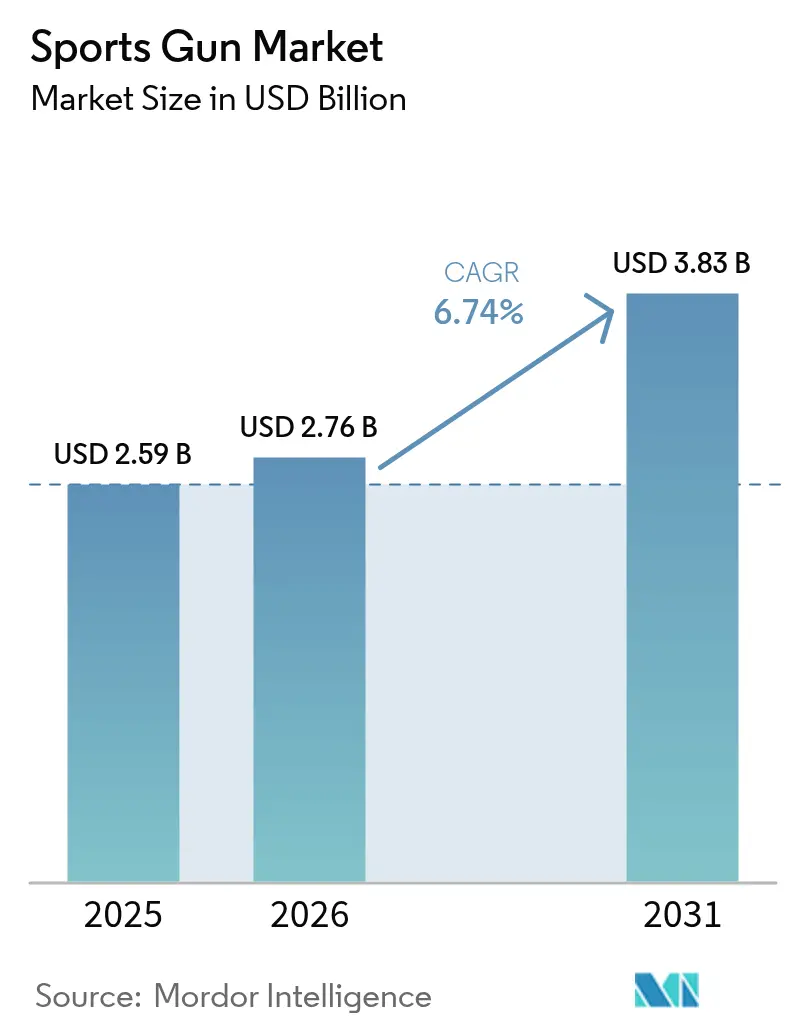
| Market Size (2026) | USD 2.76 Billion |
| Market Size (2031) | USD 3.83 Billion |
| Growth Rate (2026 - 2031) | 6.74 % |
| Fastest Growing Market | Asia Pacific |
| Largest Market | North America |
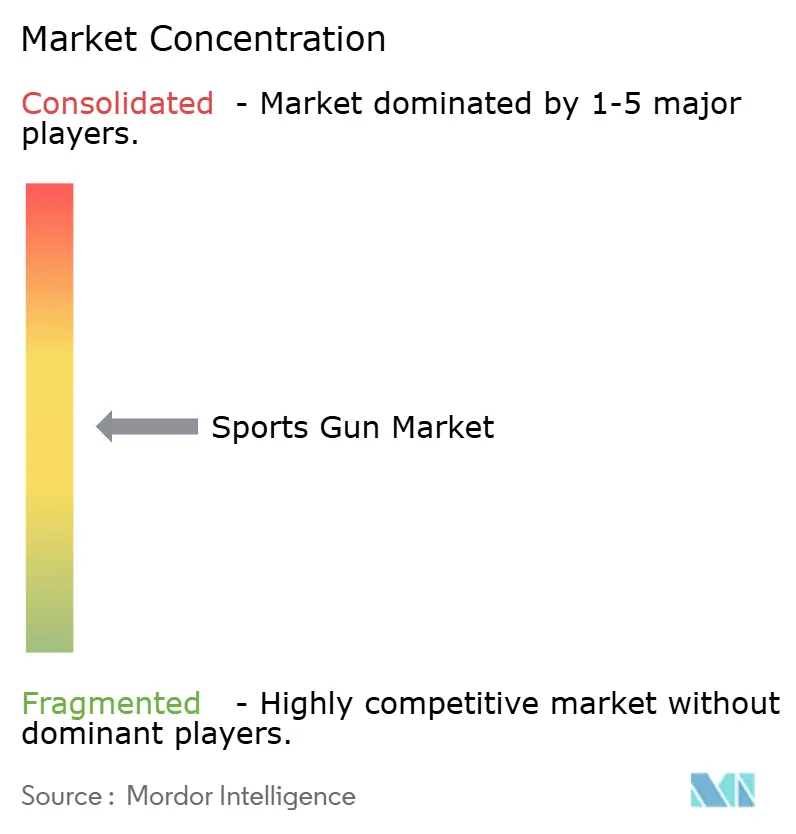
| Market Concentration | Medium |
Major Players *Disclaimer: Major Players sorted in no particular order Image © Mordor Intelligence. Reuse requires attribution under CC BY 4.0. | |
Sports Gun Market Analysis by Mordor Intelligence
Sports gun market size in 2026 is estimated at USD 2.76 billion, growing from 2025 value of USD 2.59 billion with 2031 projections showing USD 3.83 billion, growing at 6.74% CAGR over 2026-2031. This momentum comes despite tightening regulations because product designers keep raising performance through lighter composites, modular components, and smart-gun electronics that command premium prices. Demand also benefits from the digital shift toward direct-to-consumer channels, which gives small brands cost-effective reach and better compliance tools. Competitive pressure is visible in how lever-action rifle sales jumped 57% in 2024, even as handgun volumes fell 17%, indicating that enthusiasts are willing to switch categories for new experiences. Rising participation among younger shooters, fresh club memberships, and cross-border tourism packages reinforce the sports gun market’s resilience.
Key Report Takeaways
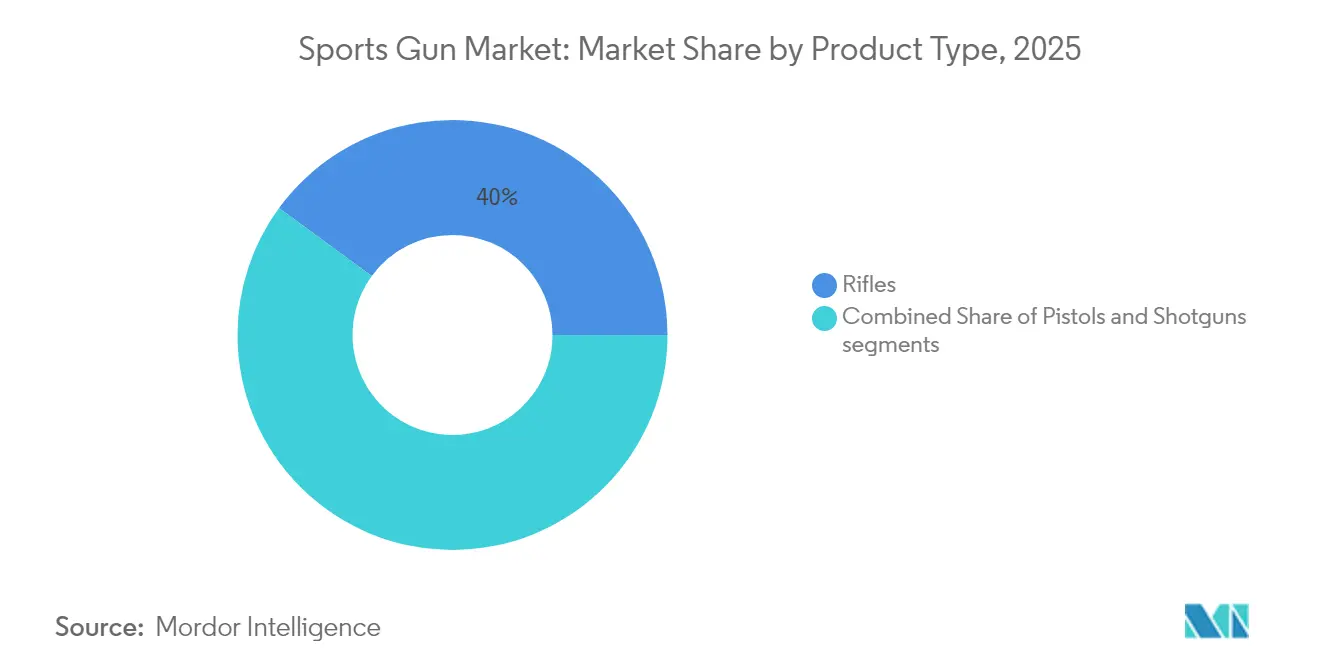
- By product type, rifles led the sports gun market with a 39.95% share in 2025, and their segment revenue is projected to expand at a 7.83% CAGR through 2031.
- By caliber, small-caliber platforms accounted for a 37.05% share of the sports gun market in 2025; medium-caliber firearms are set to grow the fastest, at an 8.03% CAGR to 2031.
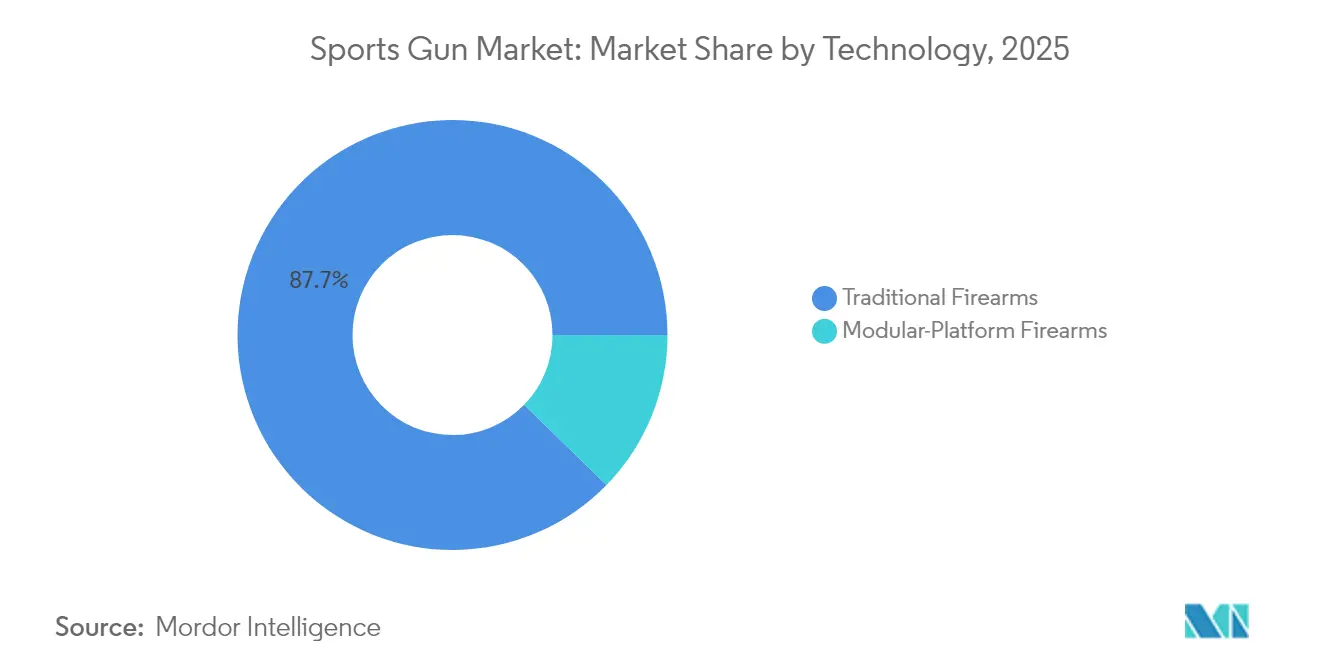
- By technology, modular-platform systems posted a 10.40% CAGR outlook, the quickest within the sports gun market, even though traditional designs still held 87.71% revenue share in 2025.
- By end user, hunting remained dominant with a 45.38% share in 2025, whereas recreational shooters are forecasted to record a 10.12% CAGR through 2031.
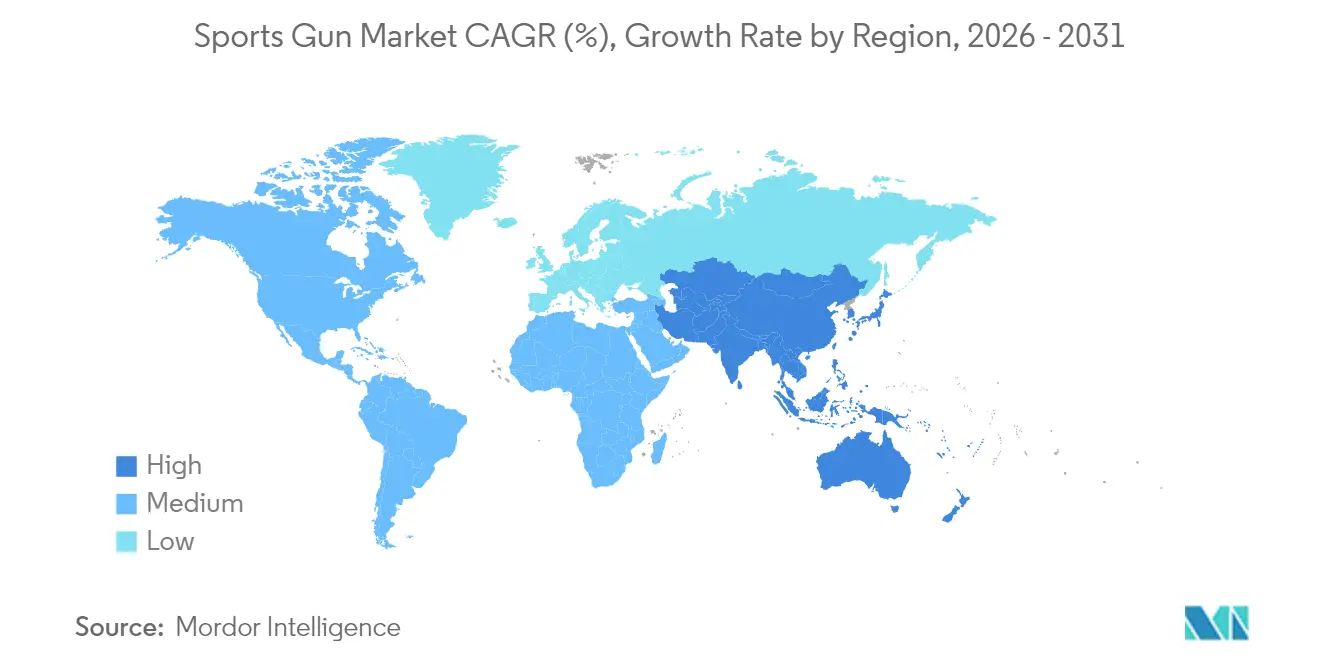
- By geography, North America retained 36.55% revenue share in 2025, and Asia-Pacific is positioned for the fastest 8.24% CAGR up to 2031.
Note: Market size and forecast figures in this report are generated using Mordor Intelligence’s proprietary estimation framework, updated with the latest available data and insights as of 2026.
Market Trends and Insights
Drivers Impact Analysis of Sports Gun Market*
| Driver | (~) % Impact on CAGR Forecast | Geographic Relevance | Impact Timeline |
|---|---|---|---|
| Rising participation in recreational shooting and hunting | +1.2% | North America, Europe | Medium term (2-4 years) |
| Advancements in lightweight materials and optical enhancements for sporting firearms | +0.9% | North America, EU, APAC | Long term (≥ 4 years) |
| Rising adoption of e-commerce channels for firearm sales | +0.8% | North America, EU, APAC | Medium term (2-4 years) |
| Emergence of smart-gun pilot programs fueling demand for high-end models | +0.6% | North America, EU | Long term (≥ 4 years) |
| Expanding participation from women and youth in shooting sports | +1.1% | Global, led by North America and Europe | Medium term (2-4 years) |
| Growth in cross-border shooting tourism and experience-based packages | +0.4% | Europe, North America | Medium term (2-4 years) |
| Source: Mordor Intelligence | |||
Increasing Engagement in Recreational Shooting and Hunting Activities
Participation in shooting sports keeps climbing as new clubs open and existing ones add members, fueling equipment replacement cycles that lift the sports gun market. Japan’s decision to allow councils to license hunters for emergency bear control underscores official acceptance of hunting as a wildlife-management tool and signals additional demand for specialty rifles. Once considered niche, Lever-action platforms recorded the fastest 57% sales rise among long guns in 2024. This shows how younger buyers blend nostalgia with modern ergonomics to expand the sports gun market. In Australia, mandatory annual participation hours for club members keep firearm owners active and willing to upgrade optics and barrels, strengthening aftermarket revenue.[1] Outdoor travel firms now bundle shooting sessions with adventure tourism, adding incremental gear purchases to each trip. These patterns help cushion the sports gun market from broader volatility in general-purpose firearm sales.
Advancements in Lightweight Materials and Optical Enhancements for Sporting Firearms
Carbon-fiber hand-guards, polymer lowers, and slimline rails cut rifle weight by double-digit percentages, making them more accurate over long competition days and bolstering the sports gun market. Japan’s Type 20 adoption demonstrates how military R&D migrates quickly into civilian modular rifles that feature full-length Picatinny rails for quick optic swaps. Smart optics that adjust aim-points dynamically are becoming key selling points in premium price tiers, although vendors keep specifications proprietary to protect intellectual property. Ammunition innovation parallels SIG Sauer’s new NATO round, which targets flatter trajectories that match lightweight rifle characteristics, lifting the sports gun market’s margin profile. The cost of exotic materials remains high, so only brands with scale or strong price positioning can capture full value. Nevertheless, performance gains create a persuasive upgrade path for competitive shooters who value every tenth of a second.
Rising Adoption of E-Commerce Channels for Firearm Sales
Smith & Wesson generated 44% of its 2025 quarterly sales from models launched with digital-first campaigns, proving that e-commerce can move premium pistols even under strict scrutiny. Suppressor sales jumped 80% online, depleting inventories and showing the supply-chain stress produced by concentrated digital demand. New US export rules now demand extra licenses for certain semi-automatic shipments, forcing online merchants to embed real-time classification checks in checkout flows. Platforms with robust compliance code deepen competitive moats, and their scale attracts exclusive SKUs that keep the sports gun market growing faster than overall firearm retail.
Emergence of Smart-Gun Pilot Programs Fueling Demand for High-End Models
The Biofire 9 mm pistol, priced at USD 1,499, places biometric recognition into a commercial sporting firearm for the first time, carving out a premium slice of the sports gun market.[2] Early pilots rely on voluntary uptake to sidestep legislative mandates, reducing political backlash and allowing iterative engineering. If police departments adopt the technology, their field-test data could ease civilian concerns about reliability, further lifting the sports gun market. High pricing fits the broader premiumization trend in which buyers expect advanced features and will pay for them. However, any perceived failure in biometric locks would stall momentum, making rigorous quality assurance essential.
Restraints Impact Analysis of Sports Gun Market*
| Restraint | (~) % Impact on CAGR Forecast | Geographic Relevance | Impact Timeline |
|---|---|---|---|
| Tightening and evolving firearm regulatory frameworks | -0.7% | Canada, EU, select US states | Short term (≤ 2 years) |
| Significant initial investment required for high-performance sporting guns | -0.5% | Emerging markets, global | Medium term (2-4 years) |
| ESG-related financial barriers limiting funding for firearms manufacturers | -0.4% | North America and EU core, expanding globally | Medium term (2-4 years) |
| Market diversion due to increasing use of realistic airsoft and laser-based simulators | -0.3% | Global, with concentration in urban markets | Long term (≥ 4 years) |
| Source: Mordor Intelligence | |||
Tightening and Evolving Firearm Regulatory Frameworks
Canada outlawed 503 specific firearm models between December 2024 and March 2025, causing immediate product withdrawals that shrink the sports gun market. The UK moved to full cost recovery on licensing in early 2025, adding application fees that raise ownership costs for casual participants. Western Australia now requires health assessments for every license renewal, creating another administrative layer that strains small retailers. Even firearm-friendly Czechia overhauled its code, mandating digital tracking of every weapon by 2026. Each new rule increases uncertainty, discouraging capital investment and nudging consumers toward rental or club-owned guns.
Significant Initial Investment Required for High-Performance Sporting Guns
Advanced modular rifles and biometric pistols cost far more than entry-level .22 LR trainers, limiting immediate addressable demand in lower-income regions of the sports gun market. Japan’s Type 20 units cost JPY 274,000 each (USD 1,830), showing how military-grade components raise civilian price points. Top-tier optics, compensators, and suppressors often double the total package cost, which squeezes affordability just as ESG-driven lending curbs consumer financing availability. Brands must balance technology ambition with cost-down engineering or risk pricing out new shooters in emerging economies.
*Our forecasts treat driver/restraint impacts as directional, not additive. The impact forecasts reflect baseline growth, mix effects, and variable interactions.
Sports Gun Market Segment Analysis
By Product Type:
Rifles Drive Innovation LeadershipRifles generated 39.95% of 2025 revenue, and their 7.83% CAGR keeps the segment at the core of the sports gun market. Bolt-action platforms retain hunting loyalty, while semi-automatic AR-style and the modular Type 20 pattern accelerate demand for quick-change uppers and lighter hand-guards. Lever-action designs enjoy a renaissance with younger hobbyists who value heritage styling, helping the sports gun market diversify its rifle mix. Manufacturers concentrate R&D on integrated suppressor barrels and tunable gas blocks that simplify competition prep.
Shotguns show volume erosion as tactical rifles absorb clay-sport enthusiasts, yet field guns see modest gains alongside rising waterfowl license numbers. Pistols remain a dependable revenue pillar for indoor ranges; Smith & Wesson’s Bodyguard 380 became an instant digital bestseller, validating compact formats in the sports gun market. Revolvers keep niche pricing power due to craftsmanship appeal. Altogether, rifle innovation sets performance benchmarks that spill over into other categories.

By Caliber:
Small-Caliber Accessibility Versus Medium-Caliber PerformanceSmall-caliber options have a 37.05% share of the sports gun market, thanks to low recoil and inexpensive ammunition. Ranges use .22 LR platforms for safety courses, ensuring steady base-level demand. Regulatory leniency in many jurisdictions also lifts small-caliber popularity as entry pathways for youth programs.
Medium-caliber firearms expand at 8.03% CAGR as competitors transition to cartridges that balance flat trajectory and manageable recoil. New match-grade loads support precision disciplines and keep the margin per round higher than bulk rimfire. Large-caliber rifles remain niche but profitable for international safari bookings and extreme-distance matches. Ammunition makers coordinate forward contracts on copper and powder to hedge cost swings and protect sports gun market profitability.
By Technology:
Traditional Platforms Face Modular DisruptionLegacy fixed-configuration guns still hold 87.71% of revenue because users trust their reliability, yet growth lags. Production lines are fully amortized, allowing competitive pricing that keeps the sports gun market accessible to cost-conscious buyers. Dealers stock these models heavily to meet the impulse buying that follows hunting-season advertising.
Modular systems are growing at a 10.40% CAGR as athletes demand flexible setups without purchasing multiple complete guns. Removable trigger packs, quick-change caliber kits, and hand-guard interfaces enable one chassis to serve 3-4 disciplines, boosting lifetime spend per buyer. Electronics integrate smoothly in modular frames, paving the way for smart-gun add-ons that could significantly lift the sports gun market size by 2031.
By End User:
Recreational Shooters Emerge as Growth EngineHunting retains a 45.38% share through legacy participation and equipment intensity per outing. Licensing data show stable hunter numbers in mature markets, giving brands a predictable baseline. Gear bundles for turkey, deer, and upland segments drive package promotions ahead of peak seasons, stabilizing cash flow.
Recreational shooters increase at a 10.12% CAGR as urban residents treat target practice as a social hobby. Indoor ranges supply rental pools, steering first-time visitors toward eventual ownership, enlarging the sports gun market. Competitive clubs provide structured progression paths that prompt incremental upgrades from entry-level .22 LR to full race-gun setups. Law-enforcement training schools purchase high-reliability sidearms and carbines that share parts with commercial models, generating cross-segment economies of scale.
Geography Analysis
North America Sports Gun Market
North America retained 36.55% revenue share in 2025, underpinned by established dealer networks and favorable regulations in many US states. Smith & Wesson recorded 46.8% sequential sales growth on the back of new launches, showing how innovative SKUs can still unlock volume within a mature sports gun market. Canada’s ban on 503 models forces OEMs to redesign or abandon certain SKUs, temporarily depressing shipments but encouraging compliance-oriented product lines. Mexico’s climbing IPSC enrollment hints at incremental demand once distribution hurdles ease.
APAC and EMEA Sports Gun Market
Asia-Pacific posts the leading 8.24% CAGR through 2031. Japan procures 8,577 Type 20 rifles for USD 23.3 million, signaling rising technical standards that spill into civilian products. Australia’s state-by-state regimes complicate logistics and create service niches that digital platforms exploit. South Korea and India cultivate small yet fast-growing shooting communities, while the Chinese state-owned Norinco leverages scale for selective export under tight licensing. Europe combines deep sporting traditions with stiff rules. The UK’s full cost recovery model and component quotas raise total ownership cost, slowing casual uptake but reinforcing premium positioning for heritage brands. Germany’s engineering pedigree keeps match-rifle innovation alive even under strict storage codes. Czechia’s digital weapons agenda will become a regional test case for paperless licensing when it goes live in 2026. The Middle East builds luxury ranges that import high-end US and European firearms, while South Africa leverages hunting tourism to sustain riflescope and large-caliber sales.
Regulatory Landscape
Regulation continues to tighten and standardize across major markets, shaping SKU availability, cross-border flows, and competitive-use product design. In the European Union, Regulation (EU) 2025/41 recast import, export, and transit measures for firearms, essential components, and ammunition to implement UN Firearms Protocol controls, increasing the compliance load for manufacturers and distributors moving products across borders.
Rules for competition-grade firearms and equipment also updated at the sport-governing level. The International Shooting Sport Federation (ISSF) Rule Book 2026 Edition became effective on 1 January 2026, alongside updated Equipment Control Guides (rifle and shotgun), tightening and clarifying requirements such as rifle clothing stiffness tolerances and live-aiming related procedures, which can force redesigns or re-certification work for match-focused platforms and accessories. In the United States, ATF proposed updates in May 2026, including aligning proscribed-country import restrictions with U.S. Department of State lists (22 CFR 126.1) and a proposal to allow certain firearms to enter customs-bonded warehouses without triggering import-definition requirements, which can change importer logistics and compliance workflows.
Value Chain Analysis
The sports gun value chain runs from metals and chemical inputs through precision manufacturing, proofing and compliance, and then into wholesale, retail, and range or club channels with a growing digital overlay. Upstream inputs include steel and aluminum for receivers and barrels, and brass, copper, and lead for ammunition. Supply-constrained components such as nitrocellulose and antimony can affect propellant and primer availability.
Manufacturing includes both vertically integrated OEMs and a more distributed model where brands source subassemblies and finished firearms from specialized clusters and foreign OEM partners. Established hubs such as Gardone Val Trompia in Italy remain relevant for high-precision sporting arms and component ecosystems. Downstream, distribution is shaped by licensing, marking and traceability, and export-import rules, with trade associations such as NSSF in the United States and ESFAM/IEACS in Europe supporting standards and policy engagement. Cost and lead-time volatility also propagate through the chain: tariffs on steel and aluminum effective March 2025 lift raw-material costs, while the May 2024 suspension of Alliant Powders smokeless powder shipments to prioritize nitrocellulose allocation for defense contracts illustrates how defense-driven capacity diversion can tighten availability for sporting channels. Retail and fulfillment increasingly depend on compliance-enabled e-commerce and FFL handoff logistics, driving investment in real-time classification, background-check integration, and inventory visibility to reduce stockouts during demand spikes.
Competitive Landscape
Industry structure is moderately fragmented. The top five firms captured under 40% revenue in 2024, leaving room for agile specialists focusing on accessories or niche calibers. Smith & Wesson’s USD 50 million buyback illustrates capital discipline to stabilize valuation in a cyclical sports gun market. Suppressor manufacturers report 80% sales spikes yet struggle to keep shelves stocked, giving vertically integrated brands a supply-side edge.
Technology is the decisive battlefield. Biofire leverages venture funding to commercialize biometric locks, capturing early mindshare in a potential multibillion-dollar smart-gun subcategory. SIG Sauer broadens its ammunition and systems portfolio, including a new UK factory, to control more of the shooter’s ecosystem. GrabAGun’s pending public listing will inject fresh capital into e-commerce infrastructure, scaling compliance software that smaller dealers cannot match.
Funding dynamics also shape competition. Only 29.8% of EU and UK ESG funds retain defense exposure, shrinking credit lines for traditional gun makers and favoring firms that classify themselves strictly within the sports gun market rather than wider defense sectors. This financial segmentation encourages OEMs to spin off sporting divisions as stand-alone entities to secure bank support and separate from restricted sectors.
Sports Gun Industry Leaders
-
Sturm, Ruger & Co. Inc.
-
SMITH & WESSON BRANDS, INC.
-
Carl Walther GmbH
-
GLOCK, Inc.
-
Fabbrica d'Armi Pietro Beretta SpA
- *Disclaimer: Major Players sorted in no particular order
Sports Gun Market Companies Covered in this Report
- Sturm, Ruger & Co. Inc.
- SMITH & WESSON BRANDS, INC.
- SIG SAUER, Inc.
- GLOCK, Inc.
- Fabbrica d'Armi Pietro Beretta SpA
- RemArms LLC
- Carl Walther GmbH
- FN America, LLC
- Heckler & Koch GmbH
- SPRINGFIELD, INC.
- Taurus Holdings, Inc.
- Savage Arms Inc.
- O.F. Mossberg & Sons, Inc.
- Crosman Corporation
- FX Airguns AB
- Daisy Outdoor Products
- J.G. ANSCHUTZ GmbH & Co. KG
- Chiappa Firearms Srl
Market Opportunities and Future Outlook
A whitespace area is emerging around performance-improving electronics and software that can be adopted without changing the firearm itself, particularly optics, training, and range infrastructure that support recreational and competitive segments. At SHOT Show, 2026 introductions highlighted computational optics that integrate environmental sensors and ballistic calculators for real-time adjustments from brands such as Maztech, Revic, and Burris, reinforcing premium upgrade cycles for rifles where weight reduction and modularity already drive customization. Training technology is also moving closer to mainstream range adoption: Eyeviation introduced its VCAT Virtual Cognitive-Aware Training system in January 2026, translating military and law-enforcement training methodologies into civilian range settings and adding a software-enabled instruction spend stream that complements firearm and ammunition purchases.
Regulation and sport-governing standards also point to opportunity in compliance-ready product design and equipment control services. The ISSF 2026 rules and equipment control guides push manufacturers and accessory suppliers toward standardized, verifiable configurations, and, where used, lightweight tracking devices for live-aiming visualization trials, which can support faster validation of modular components and optics at inspection. Environmental and facility compliance opens another growth lane tied to shooting venues: solutions that reduce lead exposure and improve recovery align with range investment priorities, including acoustic-net target systems tested during the 2025-2026 biathlon season to enable lead recovery and immediate performance feedback. Together, these shifts support a broader bundling model where brands, ranges, and digital platforms pair hardware with data, coaching, and compliance services rather than relying on unit firearm sales alone.
Recent Industry Developments in Sports Gun Market
- June 2026: Smith & Wesson Brands, Inc. released its fourth quarter and full fiscal year 2026 results, emphasizing performance in sporting goods sales channels. The update reinforced how product cadence and channel mix (including digitally influenced demand) are being managed as key levers for sell-through in a scrutinized category.
- June 2025: Online firearms retailer GrabAGun entered a USD 250.54 million merger agreement with Colombier Acquisition Corp. II to form GrabAGun Digital Holdings Inc., planned to trade as "PEW". The transaction spotlighted continued capital formation around compliance-forward e-commerce infrastructure and direct-to-consumer reach in the sports gun market.
- October 2024: Bushmaster introduced the V-Radicator series of varmint rifles with fluted stainless-steel barrels and Magpul components, chambered in .223 Wylde. The launch expanded choice in recreational long-range and varmint use cases, supporting category switching toward rifles as enthusiasts pursue new shooting experiences.
Sports Gun Market Report Scope and Research Methodology
Market Definition and Coverage
This market covers revenue generated from sports guns used mainly for target shooting, competition, and sport-related hunting activities. Values are counted at the point of sale in USD across key regions.
Scope exclusions: Excludes military-issue weapons procurement and most non-sport tactical systems that are not purchased for civilian sporting use.
Segments Covered in This Report
- By Product Type
- Rifles
- Bolt-Action Rifles
- Semi-Automatic Rifles
- Lever-Action Rifles
- Air Rifles
- Pistols
- Semi-Automatic Pistols
- Revolvers
- Air Pistols
- Shotguns
- Pump-Action Shotguns
- Semi-Automatic Shotguns
- Break-Action Shotguns
- Rifles
- By Caliber
- Small
- Medium
- Large
- By Technology
- Traditional Firearms
- Modular-Platform Firearms
- By End User
- Competitive Shooting Clubs
- Hunting Enthusiasts
- Recreational Shooters
- Law-Enforcement Training Academies
- By Geography
- North America
- United States
- Canada
- Mexico
- Europe
- Germany
- United Kingdom
- France
- Italy
- Spain
- Rest of Europe
- Asia-Pacific
- China
- Japan
- India
- Australia
- South Korea
- Rest of Asia-Pacific
- South America
- Brazil
- Rest of South America
- Middle East and Africa
- Middle East
- United Arab Emirates
- Saudi Arabia
- Rest of Middle East
- Africa
- South Africa
- Rest of Africa
- Middle East
- North America
Data Sources, Market Sizing, and Validation
Desk Research
Desk work starts by building a clean fact base around participation levels, regulatory constraints, and trade patterns, then mapping those inputs to how sports guns are sold and priced in practice. We typically refer to public sources such as UN Comtrade for trade flows, national customs and tariff schedules, and government statistics on hunting licenses and sport shooting participation (where available).
To avoid relying on one viewpoint, the secondary set is widened using association websites and safety or standards bodies relevant to firearms and sporting use, along with peer reviewed journals that discuss sports shooting trends and injury or safety patterns. Company filings, annual reports, investor presentations, and reputed press interviews are also used to understand product mix, pricing direction, and distribution shifts across offline and online retail. Where needed, we supplement this with paid subscriptions for company financials and intelligence, patent databases, and shipment level import export databases, mainly to validate volumes, product positioning, and cross border supply signals. The sources listed here are illustrative only, and many other public and reference materials were also checked to clarify and validate assumptions.
Primary Interviews and Surveys
Primary work is used to pressure test the desk assumptions on what qualifies as a sports gun sale, how pricing moves by product type, and how demand behaves across recreational shooters, competitive clubs, and hunting focused buyers. We speak with a mix of manufacturers, distributors, retailers, and range or club operators across APAC, EMEA, and the Americas, and then align any differences through follow up questions so the model stays consistent across segments and regions.
Distribution of primary research fieldwork respondents
| Company type | Respondent position | Region |
|---|---|---|
| Top tier: 30% | CXOs: 16% | APAC: 47% |
| Mid tier: 54% | Functional/Unit leaders: 28% | EMEA: 32% |
| Smaller Players: 16% | Managers: 56% | Americas: 21% |
Market-Sizing & Forecasting
Sizing is built using a top-down approach where participation and licensing indicators, import export movement, and retail channel activity are reconstructed into a demand pool, then converted into value using typical pricing bands. The model stays practical by focusing on variables that can be tracked year over year, such as the number of active sport shooters and hunting license holders, range and club activity, online versus offline mix, product mix across rifles, pistols, and shotguns, and observed average selling price progression by caliber and build materials.
Once that structure is in place, selective bottom-up checks are used to corroborate totals. This includes rolling up a sample of supplier revenues by region, validating channel shares through distributor and retailer checks, and sanity testing volumes using unit proxies such as club membership driven replacement cycles. When data gaps appear, we fill them with conservative assumptions that are agreed in interviews, then back tested against trade and participation signals so the numbers do not drift.
For forecasting, scenario analysis is used because this market is sensitive to regulatory changes and consumer sentiment that can shift quickly. Growth rates are adjusted using a small set of drivers that experts usually agree on, including new product introductions, pricing trends, participation momentum, and country level policy direction, which helps keep the forecast explainable on a client call.
Data Validation & Update Cycle
Validation is done in layers so the final figures are not dependent on a single data stream. We run variance checks across regions, compare implied volumes and prices against trade movement and participation signals, and review outliers that appear when a single assumption is changed.
Before sign off, the model and narrative are reviewed by another analyst, and follow ups are triggered when interview feedback disagrees with what desk sources suggest. Reports are refreshed annually, and interim updates are made when material events occur, such as major regulatory shifts or abrupt pricing changes. Right before delivery, a fresh pass is completed so clients receive the latest updated view aligned to the most recent public signals.
Mordor Intelligence's Sports Gun Market Sizing Compared With Other Published Estimates
Published market sizes for sports guns often differ because the included product boundary, the year used as the base, and how pricing is averaged vary across studies. Differences also show up when one estimate leans more on trade signals while another leans more on consumer participation, which then changes the implied demand pool.
The benchmark table shows a spread that mostly comes from scope timing and what gets counted as a sports gun sale. In Mordor Intelligence's model, the 2026 value is aligned to rifles, pistols, and shotguns used for sporting and hunting use cases, with online and offline retail captured without folding in adjacent categories like airsoft or paintball equipment. When another publisher starts from an earlier base year or applies a faster price ramp, the resulting 2030s number can move higher even if volumes do not grow at the same pace.
Benchmark comparison
| Source | Market Size | Gaps in Research Methodology |
|---|---|---|
| Mordor Intelligence | USD 2.76 B (2026) | |
| Industry Publisher A | USD 2.60 B (2025) | Uses a different base year and a longer forecast window, and the definition of sports guns may vary by application grouping, which can shift the starting point before growth is applied. |
| Research Publisher B | USD 2.39 B (2024) | Starts from an earlier year and applies a higher growth curve through 2032, which can reflect more aggressive assumptions on participation growth, channel expansion, or ASP uplift that are not always validated region by region. |
When the year, included categories, and pricing logic are aligned, the remaining difference usually narrows to a few practical choices like currency timing and how online sales are treated. That is why we keep the sizing steps traceable to clear demand signals, and then cross check them with channel feedback so the final number stays consistent with how this market actually trades.
Key Questions Answered in the Report
What is the current valuation of the sports gun market?
The sports gun market stands at USD 2.76 billion in 2026 and is projected to reach USD 3.83 billion by 2031 at a 6.74% CAGR.
Which product category holds the largest share of the sports gun market?
Rifles lead with 39.95% revenue share in 2025 and are also the fastest-growing product group at 7.83% CAGR.
Why is Asia-Pacific the fastest-growing regional market for sporting firearms?
Asia-Pacific benefits from Japan’s modernization programs, Australia’s clarified licensing paths, and expanding middle-class interest, driving an 8.24% CAGR through 2031.
How are online platforms influencing sports gun sales?
Integrated e-commerce systems automate compliance checks and logistics, allowing direct-to-consumer models that improve margin and expand reach, as evidenced by GrabAGun’s NYSE listing plans.
What effect do stricter regulations have on the sports gun market?
New bans, higher licensing fees, and health checks increase compliance costs and reduce SKU availability, trimming the global CAGR by an estimated 0.7 percentage points over the short term.