
Spirulina Blue (Phycocyanin) Market Size and Share
Market Overview
| Study Period | 2021 - 2031 |
|---|---|
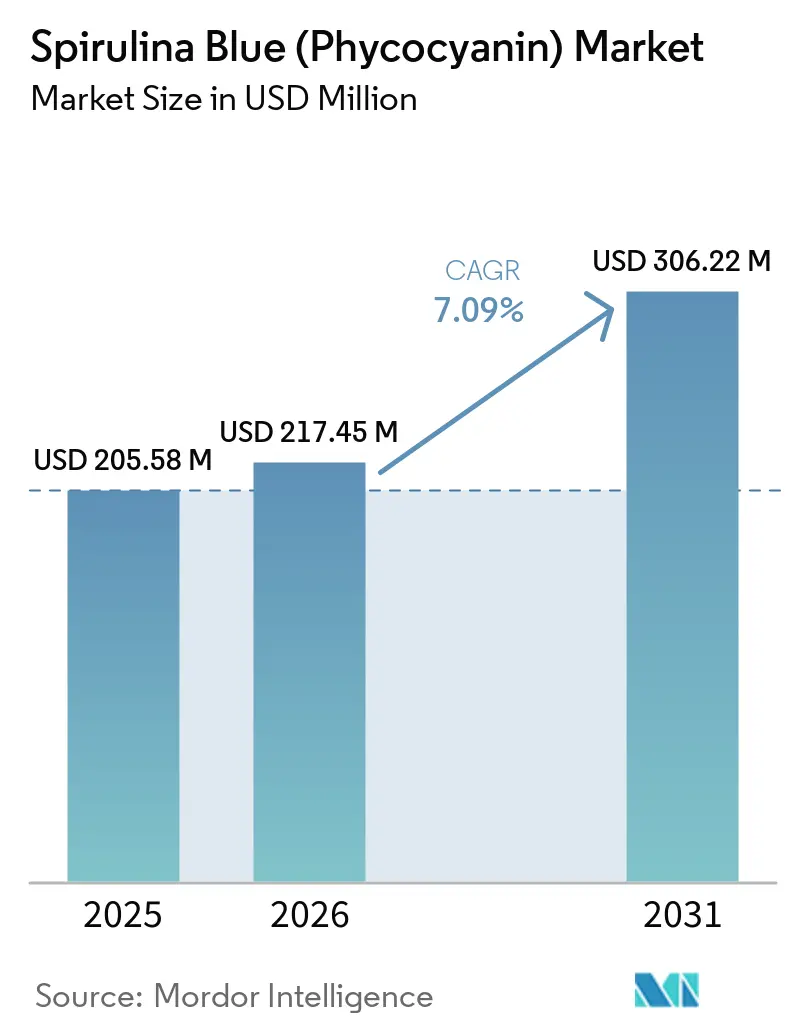
| Market Size (2026) | USD 217.45 Million |
| Market Size (2031) | USD 306.22 Million |
| Growth Rate (2026 - 2031) | 7.09 % |
| Fastest Growing Market | Asia-Pacific |
| Largest Market | North America |
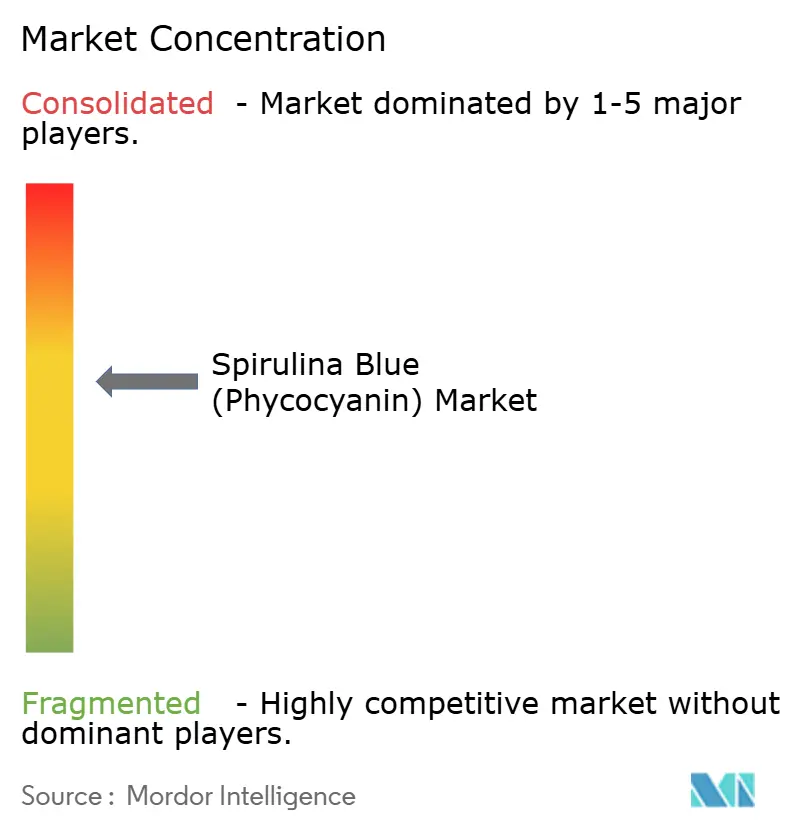
| Market Concentration | Medium |
Major Players *Disclaimer: Major Players sorted in no particular order Image © Mordor Intelligence. Reuse requires attribution under CC BY 4.0. | |
Spirulina Blue (Phycocyanin) Market Analysis by Mordor Intelligence
The spirulina blue (phycocyanin) market size is expected to grow from USD 205.58 million in 2025 to USD 217.45 million in 2026 and is forecast to reach USD 306.22 million by 2031 at 7.09% CAGR over 2026-2031. The market is expanding as food manufacturers replace petroleum-based colors with plant-derived alternatives after recent U.S. regulatory changes. The FDA’s February 2026 expansion of permitted spirulina-extract uses created access to a broader range of food applications and improved the commercial case for reformulation. The phycocyanin market also benefits from demand for ingredients that provide color and support clean-label product positioning. Production economics and poor performance in acidic or heat-treated foods continue to limit adoption in some high-volume applications. Competition is increasingly based on reliable supply, application support, regulatory capability, and solutions that protect color stability.
Key Report Takeaways
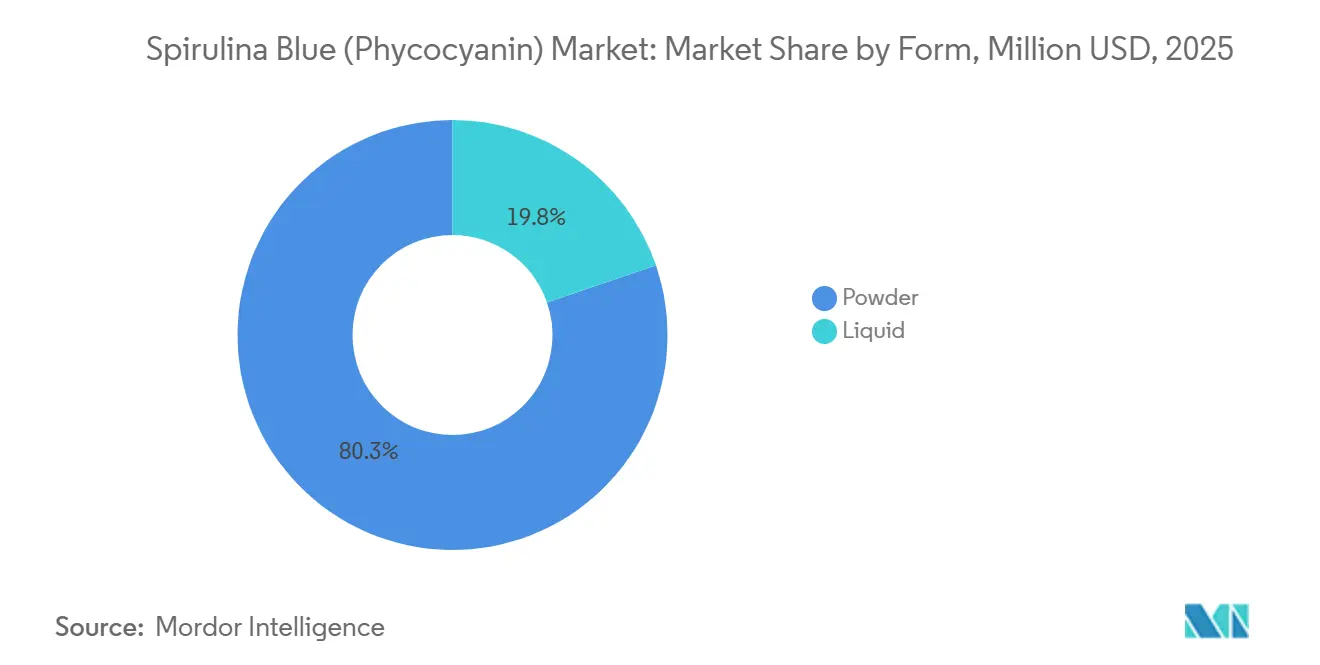
- By form, powder held 80.25% of the phycocyanin market share in 2025, while liquid is forecast to grow at a CAGR at 8.32% through 2031.
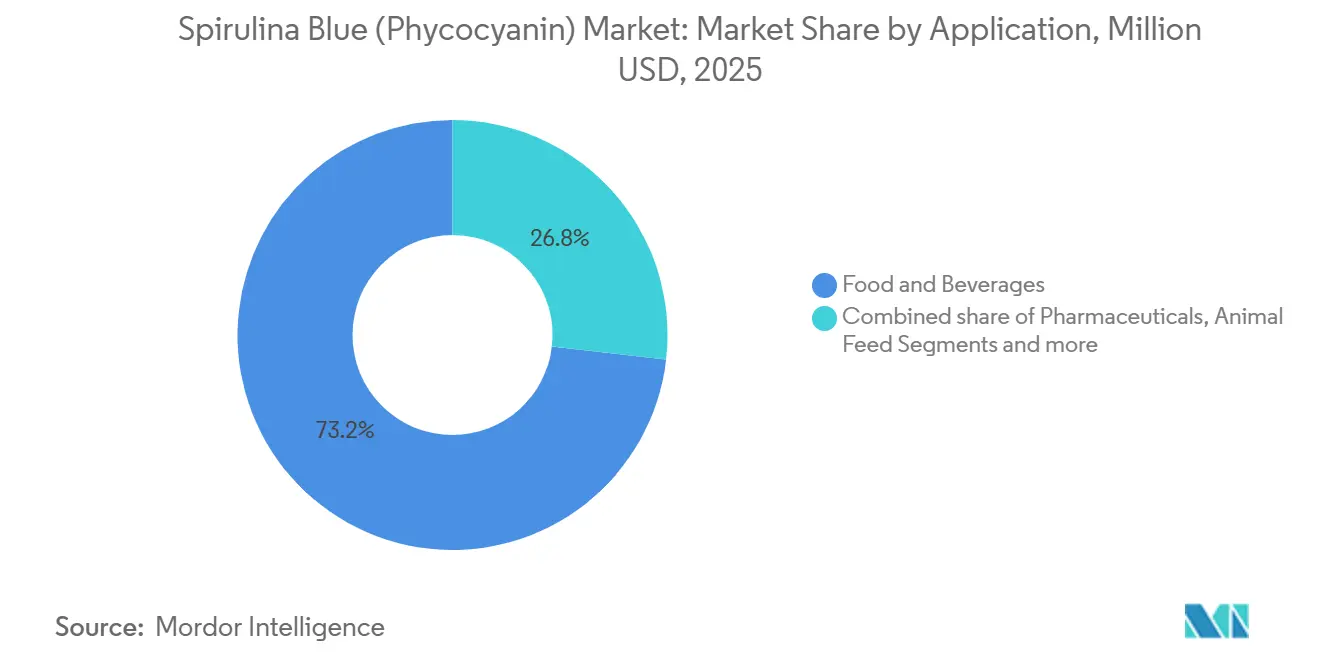
- By application, food and beverages accounted for 73.18% of the phycocyanin market size in 2025, while nutraceuticals and dietary supplements are forecast to grow at an 8.69% CAGR through 2031.
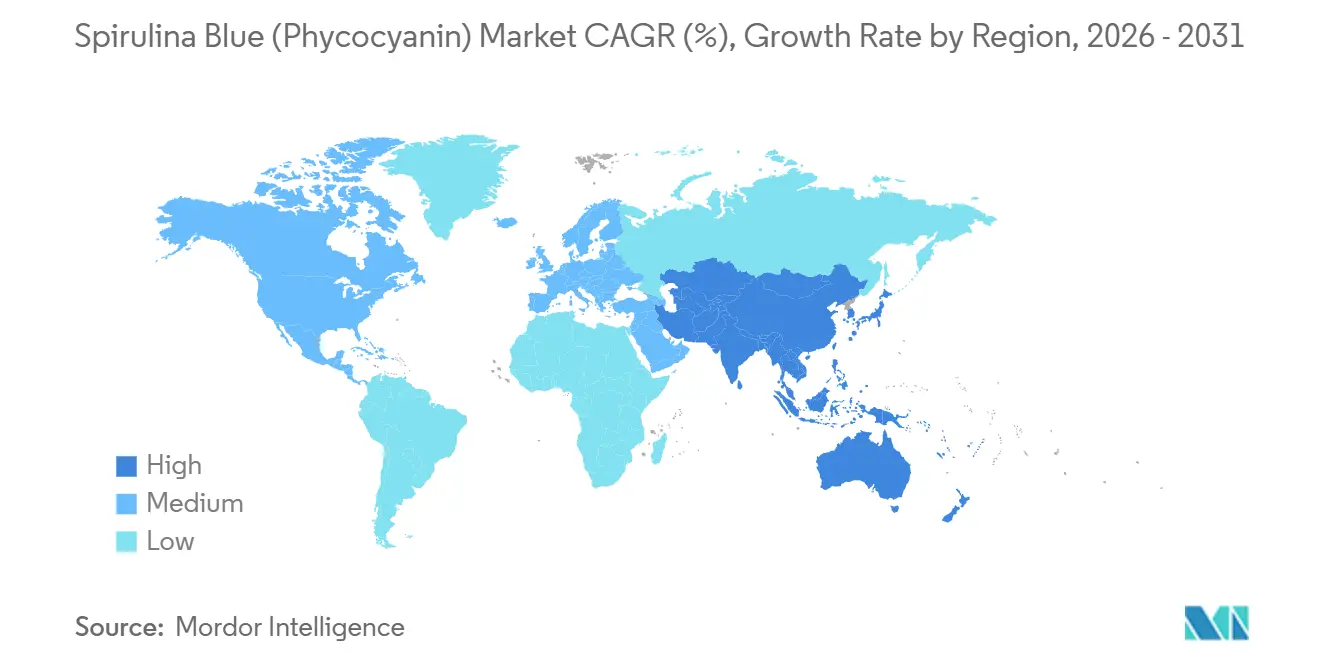
- By geography, North America commanded 34.11% revenue in 2025, while Asia-Pacific is poised for 8.91% CAGR growth through 2031.
Note: Market size and forecast figures in this report are generated using Mordor Intelligence’s proprietary estimation framework, updated with the latest available data and insights as of January 2026.
Market Trends and Insights
Drivers Impact Analysis of Spirulina Blue (Phycocyanin) Market*
| Driver | (~) % Impact on CAGR Forecast | Geographic Relevance | Impact Timeline |
|---|---|---|---|
| Rising demand for natural food colorants | +2.5% | Global | Short term (≤ 2 years) |
| Growing clean-label and artificial color-free product adoption | +1.8% | North America and Europe | Short term (≤ 2 years) |
| Increasing awareness of phycocyanin’s antioxidant properties | +1.0% | Global | Medium term (2-4 years) |
| Growing use in functional foods and nutraceuticals | +1.2% | North America, Europe, and Asia-Pacific | Medium term (2-4 years) |
| Expansion of natural ingredients in cosmetics and personal care | +0.6% | Europe and Asia-Pacific | Long term (≥ 4 years) |
| Increasing consumer preference for sustainable ingredients | +0.5% | Global | Long term (≥ 4 years) |
| Source: Mordor Intelligence | |||
Rising Demand for Natural Food Colorants
The phycocyanin market is gaining from the FDA’s February 2026 decision to permit spirulina extract in foods generally, following GNT USA’s petition. The decision allows formulators to consider spirulina-based blue colors across a wider range of food and beverage products, potentially supporting greater adoption of natural blue coloring solutions. It also provides suppliers with a clearer regulatory basis for customer discussions and product development involving applications such as bakery, confectionery, dairy, beverages, and other processed foods. The FDA’s approval of Galdieria extract blue in May 2025 further confirms that food companies have multiple natural blue coloring options to evaluate as they seek alternatives to synthetic colors[1].
Growing Clean-label and Artificial Color-free Product Adoption
The shift toward natural, transparent, and artificial-color-free formulations is increasing demand for Spirulina Blue as manufacturers seek alternatives to synthetic blue colorants. According to research by the Centre for the Promotion of Imports from Developing Countries (CBI), Ministry of Foreign Affairs, clean-label products are projected to account for more than 70% of product portfolios in 2025 and 2026, up from 52% in 2021[2]. This trend is particularly evident across food, beverage, and nutraceutical categories, where consumers increasingly scrutinize ingredient lists. Phycocyanin provides a naturally derived blue color while supporting clean-label positioning. Consequently, food and beverage manufacturers are increasingly exploring Spirulina Blue as an alternative to artificial colorants.
Increasing Awareness of Phycocyanin’s Antioxidant Properties
The phycocyanin market benefits from scientific research that differentiates C-phycocyanin from related pigments. A 2025 study reported that purified C-phycocyanin exhibited greater antioxidant and anti-inflammatory activity than allophycocyanin, highlighting its potential relevance for health-oriented product development. Research on C-phycocyanin provides product developers with a scientific basis to consider the ingredient beyond its visual properties, particularly in formulations targeting antioxidant and anti-inflammatory benefits. These findings support the use of phycocyanin in wellness formulations for applications beyond coloration. Studies in Japanese quail also found that dietary supplementation with spirulina-derived phycocyanin improved growth performance, antioxidant status, and immune gene expression, further indicating its potential functional value in nutrition-focused applications.
Growing Use in Functional Foods and Nutraceuticals
The phycocyanin market is gaining additional demand from functional foods and nutritional supplements, as the ingredient provides blue coloration and bioactive benefits. A 2025 review identified phycobiliproteins as water-soluble compounds with antioxidant, neuroprotective, and immunomodulatory properties. These attributes align with premium wellness products that feature plant-derived ingredients, clean-label positioning, and concise ingredient lists. Phycocyanin also supports product differentiation in applications where manufacturers seek natural alternatives to synthetic blue food colors. The phycocyanin market may further benefit as manufacturers increasingly use liquid formats in beverages and shots that require efficient mixing, stable dispersion, and consistent color.
Restraints Impact Analysis of Spirulina Blue (Phycocyanin) Market*
| Restraint | (~) % Impact on CAGR Forecast | Geographic Relevance | Impact Timeline |
|---|---|---|---|
| High production and extraction costs | -1.5% | Global, North America | Short term (≤ 2 years) |
| Poor stability at high temperatures | -0.8% | Global, Asia-Pacific core | Short term (≤ 2 years) |
| Limited stability during food processing and storage | -0.7% | Global, Europe, North America | Medium term (2-4 years) |
| Complex extraction and purification processes | -0.6% | Global | Medium term (2-4 years) |
| Source: Mordor Intelligence | |||
High Production and Extraction Costs
The phycocyanin market faces a significant cost barrier because cultivation, extraction, purification, and drying require specialized equipment and substantial resource inputs. A 2025 techno-economic study reported production costs of up to USD 250 per kg and identified spray drying as a major variable cost[3]. It also noted that producing 1 kg of spirulina biomass can require around 800 liters of water, while biomass contains only 10–20% phycocyanin. This relatively low pigment yield increases resource and processing requirements for high-purity phycocyanin, making production efficiency and economies of scale important for cost competitiveness. Separately, a 2025 study estimated direct fixed capital investment of about USD 1.4 million for a commercial cosmetic-grade process using a 100 kg spirulina-per-batch facility, creating an additional entry barrier for smaller suppliers.
Limited Stability During Food Processing and Storage
The phycocyanin market faces limitations in food applications that require high heat resistance, low pH stability, extended shelf life, or transparent packaging. Spirulina-derived blue pigment has limited compatibility with demanding heat and acidic conditions, restricting its direct replacement of conventional colorants in processed foods and beverages. A 2025 study documented pigment losses following UV-B exposure, highlighting a concern for products exposed to light, particularly those sold in clear packaging or stored under retail lighting. Researchers are evaluating encapsulation and modified PEGylation to improve structural stability and protect pigment performance during processing and storage. These limitations make technical support, application-specific formulation expertise, and validated formulations critical to commercial success in the phycocyanin market.
*Our forecasts treat driver/restraint impacts as directional, not additive. The impact forecasts reflect baseline growth, mix effects, and variable interactions.
Spirulina Blue (Phycocyanin) Market Segment Analysis
By Form:
Powder Leads, While Liquid Delivers Faster GrowthBy form, powder accounted for 80.25% of the global phycocyanin market in 2025, making it the dominant segment. Powdered phycocyanin offers longer shelf stability and is easier to transport, store, and incorporate into different formulations. Its versatility makes it suitable for use in food and beverages, nutraceuticals, dietary supplements, and other applications. Powder form also allows manufacturers to achieve consistent dosing and formulation during product development. The growing use of phycocyanin as a natural blue colorant and functional ingredient is supporting demand for powdered formats.
Liquid phycocyanin is projected to register the highest CAGR of 8.32% from 2026 to 2031, supported by increasing demand for convenient and ready-to-use natural color formulations. Liquid phycocyanin can be directly incorporated into beverages and other liquid food products, reducing the need for additional processing. Its ease of blending makes it particularly suitable for beverage applications, where natural blue coloring is gaining attention. Consequently, the liquid segment is expected to gain market share steadily throughout the forecast period.
By Application:
Food and Beverages Retain Scale as Nutraceuticals Grow FasterFood and beverages accounted for 73.18% of the market in 2025, making it the dominant application segment. Phycocyanin is increasingly used as a natural blue colorant in beverages, confectionery, dairy products, and other food formulations. Growing consumer preference for clean-label and naturally derived ingredients is encouraging manufacturers to replace synthetic colorants with alternatives such as phycocyanin. Its additional antioxidant properties also enhance its appeal as a functional ingredient in food and beverage products.
Nutraceuticals and dietary supplements are projected to be the fastest-growing application segment, registering a CAGR of 8.69% from 2026 to 2031. Growth is supported by increasing consumer interest in natural ingredients with functional and antioxidant properties. Phycocyanin is gaining attention as a bioactive compound that can be incorporated into supplements, wellness products, and functional formulations. Rising demand for plant-based and naturally sourced nutritional ingredients is further expanding its application potential.

Geography Analysis
North America Spirulina Blue (Phycocyanin) Market
North America accounted for 34.11% of the market revenue in 2025, making it the leading regional market. The region benefits from strong demand for natural and clean-label food colors, particularly as food and beverage manufacturers seek alternatives to synthetic additives. Phycocyanin is increasingly used in functional beverages, nutraceuticals, dietary supplements, and other health-oriented products. Growing consumer interest in plant-based and naturally derived ingredients is further supporting market adoption. The presence of established food, beverage, and nutraceutical manufacturers, along with strong distribution networks, also facilitates the commercialization of phycocyanin products.
APAC Spirulina Blue (Phycocyanin) Market
Asia-Pacific is projected to be the fastest-growing regional market, recording a CAGR of 8.91% from 2026 to 2031. Growth is supported by increasing demand for natural food colors and functional ingredients across countries such as China, Japan, India, and Australia. The region has an established spirulina cultivation base, particularly in China and India, providing manufacturers with access to raw materials for phycocyanin extraction. Rising disposable incomes and growing consumer awareness of functional foods and dietary supplements are further expanding demand.
EMEA and South America Spirulina Blue (Phycocyanin) Market
Europe represents another important market, supported by strong demand for clean-label and naturally sourced food ingredients and stringent consumer preferences regarding synthetic additives. South America benefits from growing interest in functional foods and the availability of spirulina cultivation in countries such as Brazil. The Middle East and Africa are emerging markets, with growth supported by increasing interest in health and wellness products and natural food ingredients. However, comparatively lower product penetration and limited local production capabilities may constrain market expansion in some countries.
Competitive Landscape
The Spirulina Blue (phycocyanin) market is moderately concentrated, with a limited group of established suppliers holding strong positions across cultivation, extraction, purification, and commercialization. Leading companies benefit from integrated production capabilities, technical expertise, and established relationships with food, beverage, nutraceutical, and cosmetic manufacturers. Their ability to provide consistent pigment quality, stable formulations, and regulatory support creates barriers for smaller competitors.
Competition is increasingly focused on product quality, purity, stability, and application-specific solutions rather than only production capacity. Companies are investing in improved extraction and purification technologies to enhance phycocyanin yield, color intensity, and stability during processing. Suppliers are also expanding their portfolios across powdered and liquid formats to address the requirements of different end-use industries.
At the same time, the market remains open to specialized and regional producers, particularly as demand for natural blue colorants expands globally. Smaller companies can compete through customized formulations, organic or sustainably produced spirulina, and application-specific solutions for beverages, nutraceuticals, and cosmetics. Strategic partnerships, capacity expansions, and new product launches are therefore expected to remain important competitive strategies.
Spirulina Blue (Phycocyanin) Industry Leaders
-
DIC Corporation
-
Cyanotech Corporation
-
GNT Group B.V.
-
Sensient Technologies Corporation
-
E.I.D. Parry (India) Limited
- *Disclaimer: Major Players sorted in no particular order
Spirulina Blue (Phycocyanin) Market Companies Covered in this Report
- DIC Corporation
- Cyanotech Corporation
- GNT Group B.V.
- Sensient Technologies Corporation
- E.I.D. Parry (India) Limited
- Givaudan / DDW The Color House
- Döhler GmbH
- Yunnan Alphy Biotech Co., Ltd.
- Tianjin Norland Biotech Co., Ltd.
- Dongtai City Spirulina Bio-Engineering Co., Ltd.
- Fuqing King Dnarmsa Spirulina Co., Ltd.
- Naturalin Bio-Resources Co., Ltd.
- Far East Bio-Tec Co., Ltd. (FEBICO)
- Fraken Biochem Co., Ltd.
- Zhejiang Binmei Biotechnology Co., Ltd.
- AlgoSource
- Phyco-Biotech
- Bluetec Naturals Co., Ltd.
- Pond Technologies Inc.
- Fermentalg SA
Recent Industry Developments in Spirulina Blue (Phycocyanin) Market
- March 2026: Fermentalg received a positive safety opinion from the European Food Safety Authority (EFSA) for its Galdieria Blue extract, marking a key regulatory milestone and paving the way for formal authorization by the European Commission.
- March 2026: Sensient Technologies launched Project Prism to expand its natural color manufacturing facility in St. Louis, supporting increased production capacity as part of an investment program of up to USD 250 million.
- February 2026: The FDA expanded the approved uses of spirulina extract as a color additive for foods generally, broadening its potential applications across food products following GNT USA’s petition.
- August 2025: GNT showcased its plant-based EXBERRY® colors for beverages, including beer-based drinks and ciders, offering natural alternatives to synthetic dyes. The portfolio included blue shades from spirulina and brown shades as alternatives to caramel colors, supporting clean-label beverage development.
Global Spirulina Blue (Phycocyanin) Market Report Scope
Spirulina Blue, commonly known as phycocyanin, is a natural blue pigment-protein complex extracted primarily from spirulina, particularly Arthrospira platensis. It is used as a natural blue colorant in food and beverage products and is also valued for its antioxidant and functional properties. The market is segmented by form, application and geography. Based on the form, the market is segmented into powder and liquid. Based on application, the market is segmented into food and beverages, nutraceuticals and dietary supplements, cosmetics and personal care, pharmaceuticals, animal feed and other applications. By geography, the market is segmented into North America, Europe, Asia-Pacific, South America, and Middle-East and Africa. For each segment, the market sizing and forecasting have been done in value terms (USD million).
| Powder |
| Liquid |
| Food and Beverages |
| Nutraceuticals & Dietary Supplements |
| Cosmetics and Personal Care |
| Pharmaceuticals |
| Animal Feed |
| Other Applications |
| North America | United States |
| Canada | |
| Rest of North America | |
| Europe | United Kingdom |
| Germany | |
| France | |
| Italy | |
| Rest of Europe | |
| Asia-Pacific | China |
| Japan | |
| India | |
| Australia | |
| Rest of Asia-Pacific | |
| South America | |
| Middle East and Africa |
| By Form | Powder | |
| Liquid | ||
| By Application | Food and Beverages | |
| Nutraceuticals & Dietary Supplements | ||
| Cosmetics and Personal Care | ||
| Pharmaceuticals | ||
| Animal Feed | ||
| Other Applications | ||
| By Geography | North America | United States |
| Canada | ||
| Rest of North America | ||
| Europe | United Kingdom | |
| Germany | ||
| France | ||
| Italy | ||
| Rest of Europe | ||
| Asia-Pacific | China | |
| Japan | ||
| India | ||
| Australia | ||
| Rest of Asia-Pacific | ||
| South America | ||
| Middle East and Africa | ||
Key Questions Answered in the Report
What is the projected size of the phycocyanin market by 2031?
The phycocyanin market is forecast to reach USD 306.22 million by 2031, from USD 217.45 million in 2026, at a 7.09% CAGR.
Which phycocyanin form is growing fastest?
Liquid phycocyanin is forecast to grow at an 8.32% CAGR through 2031, supported by beverage and dairy processing needs.
Which application has the largest demand for phycocyanin?
Food and beverages held 73.18% of demand in 2025, supported by use in confectionery, drinks, dairy products, and bakery goods.
Why does phycocyanin face formulation limits?
The ingredient can lose color during high-temperature processing, in acidic products, and under UV-B exposure.