
Specimen Validity Testing Market Size and Share
Market Overview
| Study Period | 2020 - 2031 |
|---|---|
| Market Size (2026) | USD 2.49 Billion |
| Market Size (2031) | USD 3.41 Billion |
| Growth Rate (2026 - 2031) | 6.47 % |
| Fastest Growing Market | Asia Pacific |
| Largest Market | North America |
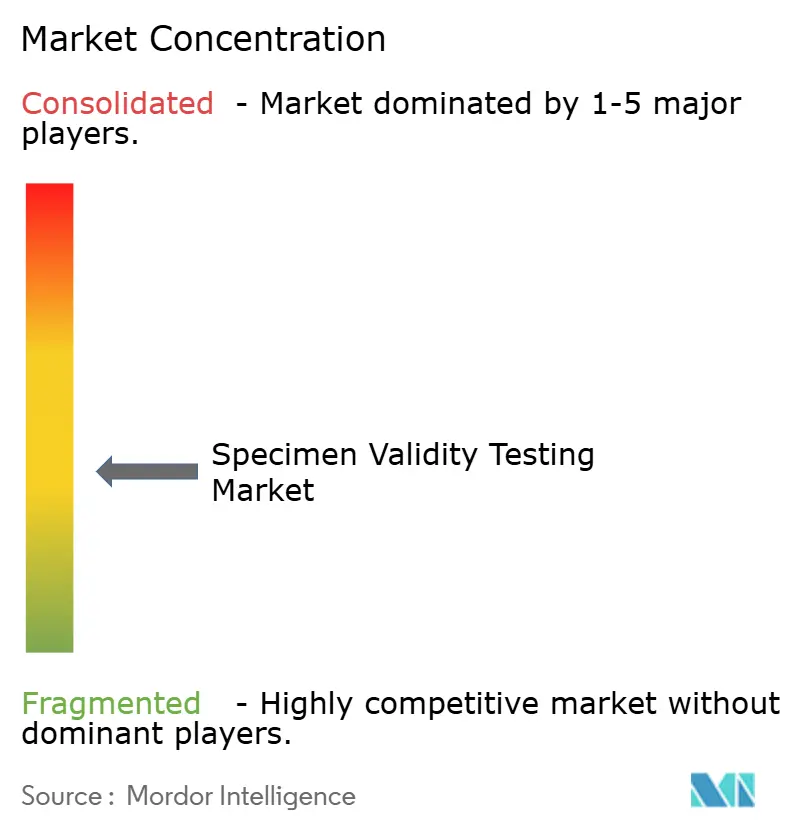
| Market Concentration | Medium |
Major Players *Disclaimer: Major Players sorted in no particular order Image © Mordor Intelligence. Reuse requires attribution under CC BY 4.0. | |
Specimen Validity Testing Market Analysis by Mordor Intelligence
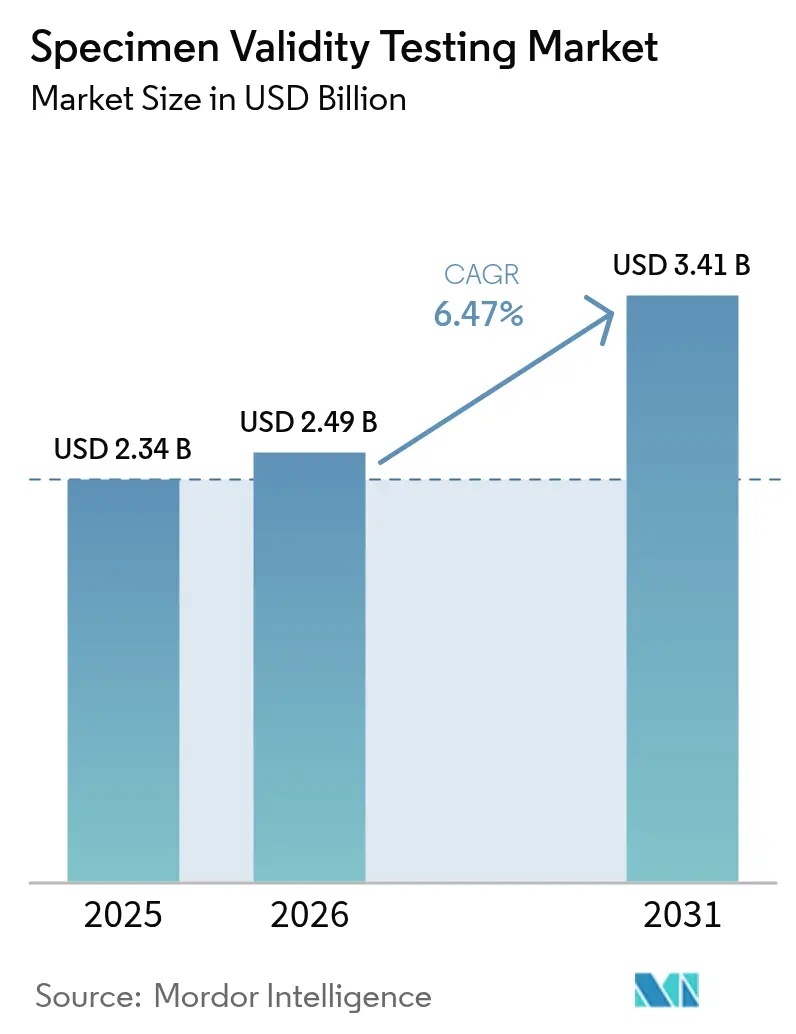
The specimen validity testing market size is expected to grow from USD 2.34 billion in 2025 to USD 2.49 billion in 2026 and is forecast to reach USD 3.41 billion by 2031 at 6.47% CAGR over 2026-2031. The trajectory reflects tightening workplace-safety mandates, accelerated adoption of point-of-care (POC) testing platforms, and technology upgrades that detect sophisticated adulteration attempts. Employers in transportation, energy, and healthcare continue to widen testing coverage, while government updates—such as the January 2025 federal panel expansion that now includes fentanyl and norfentanyl—raise the integrity bar for all laboratories. Rising telehealth use has also opened a new remote-collection channel, prompting demand for tamper-evident devices and AI-driven analytics that verify specimen integrity in real time. Although non-urine matrices are gaining favor, the specimen validity testing market remains buoyed by high-volume urine programs that still dominate regulated settings.
Key Report Takeaways
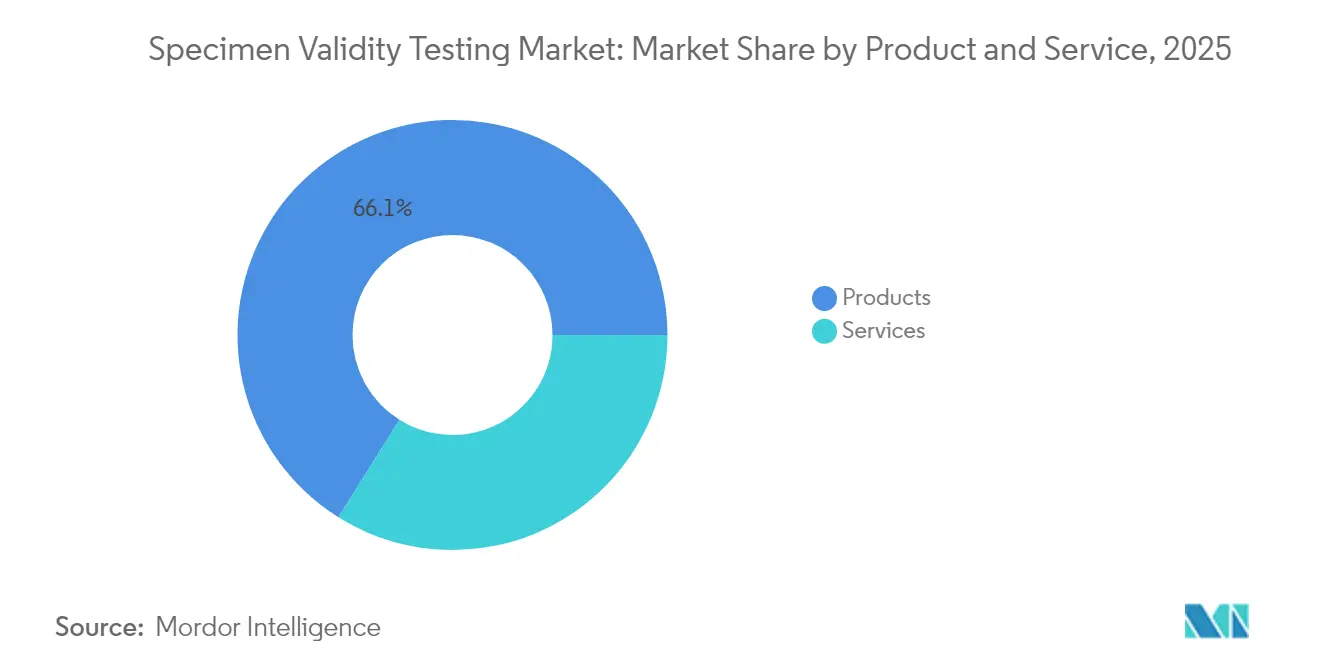
- By product & service, consumable products maintained 66.10% revenue share in 2025, whereas services are forecast to post the fastest 7.12% CAGR through 2031.
- By type, laboratory testing held 59.10% of the specimen validity testing market share in 2025, while POC platforms are slated to expand at a 7.18% CAGR to 2031.
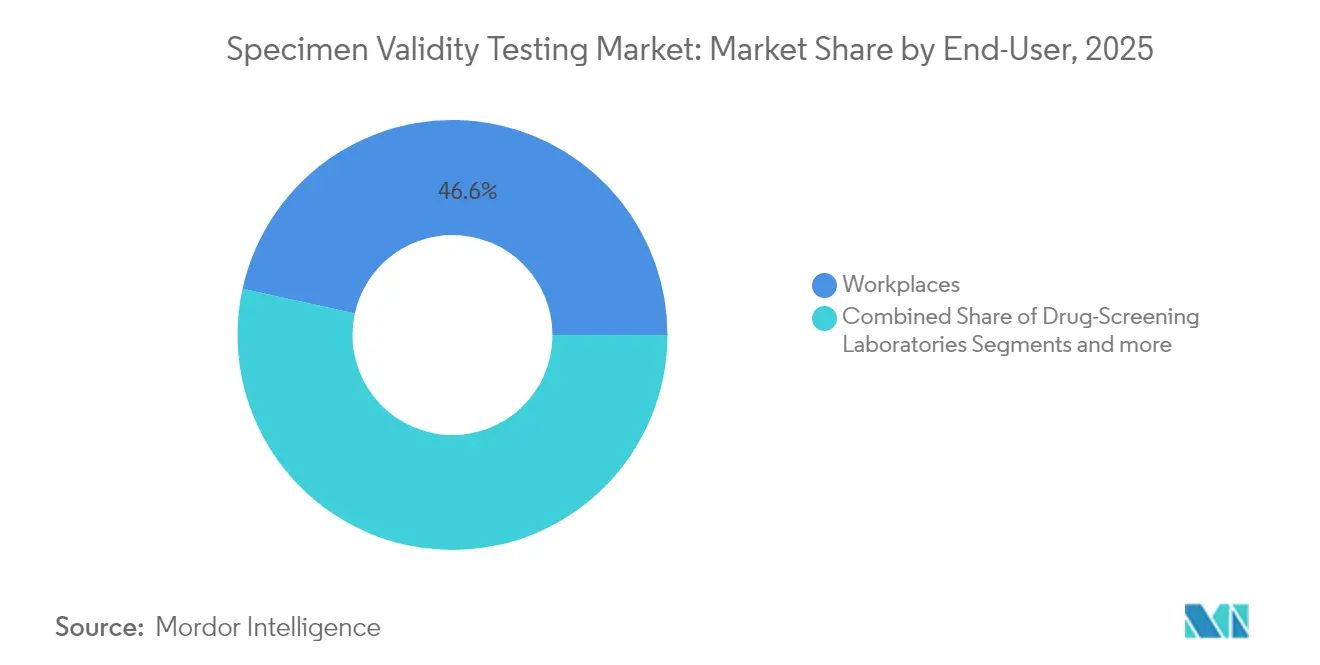
- By end-user, workplace programs led with 46.55% revenue share in 2025; drug-screening laboratories record the highest projected 7.22% CAGR through 2031.
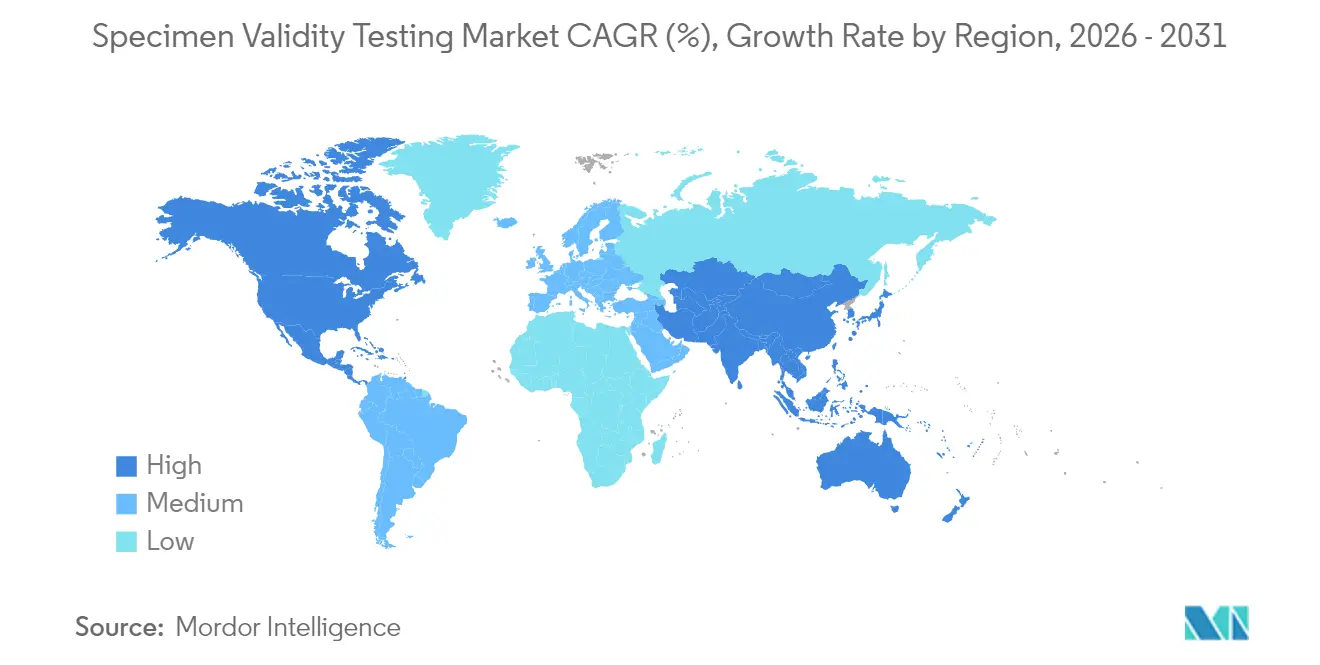
- By geography, North America commanded 41.00% share of the specimen validity testing market size in 2025; Asia-Pacific is set to grow at a 7.30% CAGR from 2026-2031.
Note: Market size and forecast figures in this report are generated using Mordor Intelligence’s proprietary estimation framework, updated with the latest available data and insights as of 2026.
Market Trends and Insights
Drivers Impact Analysis of Specimen Validity Testing Market*
| Driver | ( ~ ) % Impact on CAGR Forecast | Geographic Relevance | Impact Timeline |
|---|---|---|---|
| Growing workplace drug-testing mandates | +1.2% | Global, concentrated in North America & EU | Medium term (2-4 years) |
| Rapid adoption of POC SVT devices | +0.9% | North America & Asia-Pacific | Short term (≤ 2 years) |
| Telehealth expansion spurring at-home kits | +0.7% | North America & EU | Medium term (2-4 years) |
| Machine-learning algorithms for live adulteration detection | +0.6% | Global, led by North America | Long term (≥ 4 years) |
| Cannabis legalization driving differentiated panels | +0.5% | North America, spreading to EU | Short term (≤ 2 years) |
| Supply-chain security boosting sterile controls | +0.4% | Global | Medium term (2-4 years) |
| Source: Mordor Intelligence | |||
Growing Workplace Drug-Testing Mandates
Regulators on six continents are strengthening corporate safety rules, pushing employers to verify not only drug presence but the authenticity of each sample. OSHA-aligned directives in the United States, Canada’s Transportation of Dangerous Goods Regulations, and the Oman Ministry of Manpower’s compulsory oil-and-gas testing order underscore a collective move toward stricter specimen validity checks. Large conglomerates increasingly embed chain-of-custody software and Medical Review Officer (MRO) oversight into standard operating procedures, mitigating litigation risk after accidents. The resulting demand multiplier lifts recurring sales of temperature strips, oxidant assays, and digital custody systems [1].
Rapid Adoption of POC SVT Devices
Newly cleared handheld analyzers now complete adulterant screens in under six minutes, meeting the “immediacy” standard required in post-incident investigations. U.S. Food and Drug Administration (FDA) clearance for on-site fentanyl assays has set a precedent for integrating validity checks into single-step POC cups. Employers value reduced downtime, while laboratories see fewer rejected samples, shortening billing cycles. Vendors respond with modular readers that print compliance-ready reports, reinforcing recurring consumable revenues.
Telehealth Expansion Spurring At-Home SVT Kits
Remote management of opioid-dependence and pain-management patients demands self-collection kits that guard against substitution. Academic trials show over 80% completion rates for remote urine submissions when validity parameters—temperature, pH, creatinine—are built into collection devices. Health insurers now require documentary proof of validity before reimbursing high-complexity codes, driving clinics to adopt tamper-evident transport tubes and Bluetooth temperature sensors.
Machine-Learning Algorithms for Live Adulteration Detection
Research laboratories deploy deep-learning models that compare time-series spectra, flagging anomalies impossible to see through single-parameter assays. Early validation studies achieve 95%+ accuracy in identifying synthetic urine or oxidant spikes. Commercial rollout is poised to cut false-negative rates and ease the interpretation burden on MROs, giving suppliers of compatible mass-spectrometry reagents a competitive edge [2].
Restraints Impact Analysis of Specimen Validity Testing Market*
| Restraint | ( ~ ) % Impact on CAGR Forecast | Geographic Relevance | Impact Timeline |
|---|---|---|---|
| Limited awareness among small & mid-size clinics | -0.8% | Global, more acute in Asia-Pacific & MEA | Short term (≤ 2 years) |
| Shift toward non-urine matrices | -0.6% | North America & EU | Medium term (2-4 years) |
| Data-privacy constraints on biometric platforms | -0.4% | EU & North America | Long term (≥ 4 years) |
| Sporadic reagent shortages & raw-material spikes | -0.3% | Global | Short term (≤ 2 years) |
| Source: Mordor Intelligence | |||
Limited Awareness Among Small & Mid-Size Clinics
Smaller healthcare providers often underestimate liability tied to invalid samples. Surveys highlight that 59% of point-of-care implementation barriers relate to training and quality assurance, leaving many clinics without temperature verification or specific-gravity checks. Reimbursement policies now deny claims lacking validity documentation, but knowledge gaps persist, slowing uptake [3].
Shift Toward Non-Urine Matrices Reducing SVT Demand
Federal authorization of oral-fluid testing for government employees has prompted private firms to adopt saliva as a primary matrix, which lowers adulteration risk and thus the need for multi-parameter urine validity panels. Forecasts suggest 30% of federally regulated tests could migrate to oral fluid within four years, trimming growth potential for urine-focused consumables.
*Our forecasts treat driver/restraint impacts as directional, not additive. The impact forecasts reflect baseline growth, mix effects, and variable interactions.
Specimen Validity Testing Market Segment Analysis
By Product & Service:
Products Retain Scale, Services AccelerateProducts anchored 66.10% of 2025 revenue, sustained by the consumable nature of assay kits, oxidant reagents, creatinine standards, and single-use collection cups. Temperature-indicator strips alone generated a high-velocity replacement cycle, especially in large logistics and energy enterprises. Services, however, post a 7.12% CAGR through 2031 as employers outsource result interpretation and compliance audits to MRO consultants and specialty laboratories. Medical-legal environments favor bundled offerings that merge chain-of-custody management with machine-learning analytics. The specimen validity testing market size for services is forecast to reach USD 1.2 billion by 2031, maintaining momentum despite the dominance of consumables.
The services wave also rides on remote-collection medicine. Telehealth platforms contract third-party labs to verify sample temperature and oxidant levels on arrival, paying premium fees for same-day adjudication. Demand spikes for virtual MRO reviews in cross-border employment programs, broadening addressable revenue and solidifying the specimen validity testing market as a holistic solution rather than a product vertical alone.

By Type:
Laboratory Testing Dominant, POC Gains SpeedLaboratory workflows held 59.10% share in 2025. Centralised labs wield liquid-chromatography tandem mass-spectrometry (LC-MS/MS) systems that analyse temperature, specific gravity, creatinine, pH, and oxidants with regulatory precision. That infrastructure underpins the specimen validity testing market share leadership of large reference laboratories. Yet POC formats advance 7.18% CAGR, propelled by portable photometers and immunochromatographic cups that cross-check three or more validity parameters in minutes. The specimen validity testing market size tied to POC platforms is expected to climb to USD 1.45 billion by 2031 as device accuracy approaches lab standards.
High-risk sectors such as construction now deploy ruggedised POC analyzers at job sites for post-incident testing, curbing downtime. Meanwhile, hybrid models see specimens first screened by POC devices and only positives—together with any flagged validity anomalies—sent to labs, optimising workload distribution.
By End-User:
Workplaces Lead, Laboratories AccelerateCorporate programs accounted for 46.55% of 2025 revenue, cementing their role as the primary consumer of validity consumables. Transportation, oil and gas, and public sector employers maintain mandatory pre-employment and random testing, ensuring steady volume. Drug-screening laboratories rise fastest at 7.22% CAGR, mirroring consolidation that pulls smaller clinic volumes into high-throughput hubs.
Pain-management clinics, under payer scrutiny, increasingly outsource to specialised facilities capable of furnishing comprehensive validity metrics. Criminal-justice agencies, another critical niche, demand chain-of-custody traceability and have begun requesting machine-readable temperature logs, deepening the role of advanced validity platforms.
Geography Analysis
North America Specimen Validity Testing Market
North America retained 41.00% revenue in 2025 and remains regulatory pacesetter for the specimen validity testing market. The Department of Health and Human Services requires each regulated urine specimen to document temperature (32-38 °C), pH (4.5-8.0), specific gravity (≥1.003), and creatinine (≥20 mg/dL) immediately after collection SAMHSA. The January 2025 panel revision, which added fentanyl and norfentanyl, further heightened laboratories’ need for precise validity confirmation to avoid false negatives under new analyte cutoffs Federal Register. Parallel Department of Transportation mandates apply to roughly 10 million safety-sensitive workers, guaranteeing high test volumes. Canada’s privacy-oriented framework reduces random testing but emphasises oral-fluid programs that still rely on temperature and chain-of-custody documentation for defensibility.
APAC Specimen Validity Testing Market
Asia-Pacific posts the fastest 7.30% CAGR through 2031, propelled by multinational factories in China and India that embed U.S. Occupational Safety and Health Administration (OSHA) best practices into local operations. Global diagnostic giants have opened regional hubs to supply assay kits and provide MRO services in native languages. Cross-border trade compliance drives companies to adopt U.S.-style chain-of-custody systems, giving the specimen validity testing market fresh scale. Regional governments are studying mandatory drug-testing statutes, particularly in transportation and mining, which would further embed specimen integrity checks.
Europe Specimen Validity Testing Market
Europe offers fragmented regulation. German rail operators apply stringent specimen-validity rules modelled on U.S. federal guidelines, whereas France limits testing to safety-sensitive roles and imposes stricter privacy filters. The EU’s In Vitro Diagnostic Regulation (IVDR) imposes performance and post-market surveillance obligations on validity devices entering the bloc, raising entry barriers yet standardising quality. Pan-European employers thus lean toward CE-marked collection systems that integrate barcoded integrity seals and cloud custody logs.
MEA and South America Specimen Validity Testing Market
The Middle East and Africa follow international oil-and-gas contracting standards. GCC aviation regulators require MRO-overseen validity checks, with chain-of-custody protocols mirroring U.S. SAMHSA guidelines. South Africa’s mining houses partner with global laboratories to meet buyer expectations for high-integrity testing metrics. South America is led by Brazil, where Law 13.103/15 compels professional drivers to undergo periodic toxicological assessments that include specimen validity documentation; hair testing’s popularity nonetheless demands cross-validation protocols to confirm authenticity. Argentina’s expanding automotive sector imports U.S. DOT guidelines to satisfy supply-chain partners.
Regulatory Landscape
Specimen validity testing (SVT) is anchored in government workplace-drug-testing rules and related laboratory certification requirements. In the United States, the Department of Health and Human Services (HHS) Mandatory Guidelines for Federal Workplace Drug Testing Programs using urine set out required validity checks (including creatinine, pH, and adulterant indicators) and standardized reporting, with the updated urine guidelines effective February 1, 2024. These requirements shape procurement for SVT consumables and influence method validation and proficiency expectations for laboratories supporting regulated programs.
In 2026, HHS published the Mandatory Guidelines for Federal Workplace Drug Testing Programs: Authorized Testing Panels, which formalizes which Schedule I and II drugs and biomarkers are authorized for federal testing and reinforces the need for defensible validity workflows tied to the permitted panels. Regulated testing ecosystems also rely on chain-of-custody and result-verification practices embedded in federal workplace frameworks, including Medical Review Officer processes. That linkage increases documentation expectations across laboratory and point-of-care settings when specimens are flagged as adulterated, substituted, or dilute.
Competitive Landscape
The specimen validity testing market features moderate fragmentation. Abbott, Thermo Fisher Scientific, Laboratory Corporation of America, Quest Diagnostics, and Siemens Healthineers collectively account for a decent portion of the global revenue. Scale advantages stem from integrated assay-to-analytics portfolios and extensive logistics networks. Abbott’s iCUP platform now embeds real-time temperature monitoring and oxidant strips, bundling validity with rapid drug screens Abbott. Quest Diagnostics has expanded its international footprint to 80+ nations, offering cloud-based chain-of-custody dashboards that streamline multinational compliance Quest Diagnostics.
Technology differentiation drives current competition. Partnerships between reference labs and AI vendors deliver machine-learning adulteration classifiers, raising service stickiness. Siemens Healthineers pilots cloud-linked mass-spectrometry workflows that flag atypical creatinine-to-specific-gravity ratios in near-real-time, cutting report burdens on MROs. Meanwhile, specialty suppliers such as Labcon emphasise medical-grade, IATA-compliant collection cups, addressing supply-chain sterility concerns Labcon.
Start-ups focus on saliva and microsampling innovations—areas poised to erode urine volumes yet still require proof of donor identity and sample integrity. Incumbents hedge by acquiring or licensing these technologies, maintaining revenue irrespective of matrix shifts. Regional providers in Asia-Pacific court multinational contracts by offering bilingual MRO support and turnkey cloud tracking, challenging North American dominance.
Specimen Validity Testing Industry Leaders
-
Abbott
-
Thermo Fisher Scientific
-
LabCorp
-
Healgen Scientific LLC
-
Premier Biotech, Inc.
- *Disclaimer: Major Players sorted in no particular order
Specimen Validity Testing Market Companies Covered in this Report
- Abbott Laboratories
- Thermo Fisher Scientific
- Laboratory Corporation of America (LabCorp)
- Quest Diagnostics
- Siemens Healthineers
- Dragerwerk
- Omega Laboratories
- Premier Biotech Inc.
- Sciteck Inc.
- Alfa Scientific Designs
- QIAGEN
- PerkinElmer
- Orasure Technologies
- Neogen
- Roche
- Healgen Scientific LLC
- Vision Diagnostics Inc.
- Rochester Regional Health (ACM Global Labs)
- Nona Scientific Laboratory
- Applied BioCode Corp.
Market Opportunities and Future Outlook
Technology whitespace is emerging around stronger identity and anti-adulteration assurance as synthetic urine and sophisticated substitution attempts pressure traditional marker-only approaches. One visible pathway is molecular authentication that reduces reliance on observed collections. In April 2026, Precision Diagnostics published a whitepaper describing VerifID, a DNA-based short tandem repeat (STR) approach for urine specimen identity verification. By moving beyond chemistry parameters, the approach expands the SVT toolset and supports premium service and consumables opportunities for laboratories and programs seeking higher evidentiary defensibility in pain management, forensic, and employment testing workflows.
An additional opportunity centers on advanced analytics and instrumentation to differentiate adulteration at higher certainty, including mass spectrometry and data-driven anomaly detection in integrity-sensitive settings. Published 2026 research describes methods such as isotope ratio mass spectrometry to distinguish synthetic urine from authentic urine even in mixtures, and other 2026 work applies machine-learning models to detect sample swapping from large-scale biomarker profile data. As telehealth and remote collection channels expand, these capabilities translate into demand for tamper-evident collection devices, integrated chain-of-custody documentation, and lab services that can adjudicate questionable specimens with validated, audit-ready evidence.
Recent Industry Developments in Specimen Validity Testing Market
- April 2026: Precision Diagnostics published a whitepaper describing VerifID, a DNA-based short tandem repeat (STR) approach to authenticate urine specimen identity. The release highlights a shift from indirect validity markers toward molecular-level verification for programs that want stronger defensibility without relying on observed collections. It also creates a new lane for specialty laboratory services and workflows that combine identity verification with traditional SVT parameters.
- September 2025: Siemens Healthineers launched the Atellica DT 250 Analyzer, a benchtop drug testing system that integrates automated specimen validity testing to detect dilution, adulteration, and substitution. Bringing SVT into an automated analyzer format supports standardized, higher-throughput processing and reduces manual variability in high-volume testing environments. The platform-level integration strengthens vendor pull-through for associated assays and lab consumables tied to defensible reporting.
- December 2024: BD and Babson Diagnostics introduced capillary-blood microsampling technology, extending integrity and pre-analytical quality concepts into small-volume blood collection. While SVT is most established in urine programs, microsampling adds momentum to broader sample-authentication and handling controls across matrices. The move supports development of validity and integrity checks that fit decentralized collection models, including remote or near-patient settings.
Specimen Validity Testing Market Report Scope and Research Methodology
Market Definition and Coverage
This market covers revenues generated from tools and services used to verify whether a collected clinical or forensic specimen is suitable for drug testing, meaning it is not diluted, substituted, or adulterated, and the integrity markers are within acceptable ranges.
Scope exclusions: We exclude confirmatory drug testing panels themselves (for example, GC-MS or LC-MS confirmation) when they are billed as standalone toxicology services rather than as specimen validity work.
Segments Covered in This Report
- By Product and Service
- Products
- Assay Kits
- Reagents & Calibrators
- Disposables
- Services
- Products
- By Type
- Laboratory Testing
- Rapid and POC Testing
- By End-User
- Workplaces
- Law-Enforcement and Criminal-Justice Systems
- Drug-Screening Laboratories
- Pain-Management Centers
- Others
- By Geography
- North America
- United States
- Canada
- Mexico
- Europe
- Germany
- United Kingdom
- France
- Italy
- Spain
- Rest of Europe
- Asia-Pacific
- China
- Japan
- India
- Australia
- South Korea
- Rest of Asia-Pacific
- Middle East and Africa
- GCC
- South Africa
- Rest of Middle East and Africa
- South America
- Brazil
- Argentina
- Rest of South America
- North America
Data Sources, Market Sizing, and Validation
Desk Research
To build a clean starting point, we first map the industry boundaries and common testing workflows by reading public healthcare and laboratory guidance, then checking how testing is billed and procured. For specimen integrity and adulteration markers, we rely on reference materials such as CDC publications, FDA databases for relevant in vitro diagnostics, and peer reviewed clinical toxicology literature that describes typical cutoffs and how tests are used in practice.
We also review official statistics and activity signals to form a demand picture, including SAMHSA and OSHA resources tied to workplace testing and substance use programs, plus public tender notices and procurement portals where laboratory services and consumables are purchased. Company filings, investor presentations, and reputable press are used to track product mix changes, distribution routes, and service outsourcing patterns. Where needed, we supplement with paid subscriptions for company financials and intelligence, patent databases, and shipment level import export records to sanity check supplier scale and directional growth. These source examples are illustrative only, and other public references were used for data collection, validation, and clarification.
Primary Interviews and Surveys
Primary work is used to stress test what we saw in desk research, especially where public data is thin on pricing and utilization. We speak with laboratory operations staff, procurement teams, product managers, and compliance focused stakeholders across major regions so assumptions on testing frequency, average selling prices, and service attach rates can be adjusted to real world practice.
Distribution of primary research fieldwork respondents
| Company type | Respondent position | Region |
|---|---|---|
| Top tier: 32% | CXOs: 14% | APAC: 48% |
| Mid tier: 49% | Functional/Unit leaders: 29% | EMEA: 31% |
| Smaller Players: 19% | Managers: 57% | Americas: 21% |
Market-Sizing & Forecasting
Sizing starts with a top-down build where testing volumes are reconstructed from observable demand pools, including workplace screening intensity, lab based toxicology throughput, and the share of drug tests that require specimen integrity checks before reporting. Once that demand is framed, the model converts activity into value using price points for common validity markers and workflows (for example, creatinine and specific gravity checks, oxidant and adulterant panels, and rapid validity formats), then aligns to the split between products and associated services where outsourcing is common.
To keep the model realistic, the totals are corroborated with selective bottom-up approximations, such as rolling up a sampled set of suppliers and labs, using channel checks on kit and consumable pull through, and validating typical ASP ranges by end user setting. Key inputs we track include the share of laboratory testing versus rapid and point of care testing, utilization per test episode, mix shifts toward multi-analyte panels, outsourcing penetration for validity services, and regional testing policy intensity. When a country level pricing or volume point is missing, we bridge gaps using proxy markets with similar testing practices, then adjust for income levels and laboratory cost structures.
For forecasting, we rely on scenario analysis supported by expert views on policy direction, employer testing programs, and laboratory automation adoption, then apply conservative to base growth paths to the core variables before the revenue curve is finalized.
Data Validation & Update Cycle
Outputs are checked through multiple steps so obvious overcounts and undercounts are caught early. We compare the market totals against independent signals such as instrument placement direction, consumables pull through logic, and the expected share of drug tests that run validity checks, then we rework assumptions where the ratios look abnormal.
Before sign-off, the model is reviewed by another analyst, with variance checks across regions, end users, and product versus service splits. If a key input shifts materially, such as a large change in testing mix or pricing behavior, primary contacts are revisited to confirm what changed and why. The report is refreshed annually, and interim updates are made when major regulatory or demand events are observed, followed by a final pre-delivery pass so clients receive the latest updated view.
Mordor Intelligence's Specimen Validity Testing Market Sizing Compared With Other Published Estimates
Published numbers for this market can look far apart because firms do not always count the same revenue pool, and they also pick different base years and pricing paths for similar test workflows. Differences are usually driven by whether services are included, how rapid formats are treated versus lab based workflows, and whether adjacent toxicology work is bundled into the same total.
The table shows a spread that is largely explained by scope and year choices, and in Mordor Intelligence's model the 2025 value is built from both product revenue and validity related services, while keeping confirmatory drug testing itself outside the total unless it is directly part of specimen validity billing.
Benchmark comparison
| Source | Market Size | Gaps in Research Methodology |
|---|---|---|
| Mordor Intelligence | USD 2.34 B (2025) | |
| Global Consultancy A | USD 2.52 B (2025) | Uses a different product and service split and appears to include a broader set of analyzers and workflow related services, which can lift the counted revenue even when test volumes are similar. |
| Industry Publisher B | USD 2.72 B (2025) | Back-solves from a higher growth path and may apply faster ASP progression for rapid and point of care formats, which increases the starting year value when normalized to USD. |
After lining up the inclusions and the year being compared, the remaining variance is mainly about how each study treats services and how quickly prices are assumed to move. Our approach keeps the total traceable to clear activity drivers and realistic pricing inputs, which makes the final number easier to reproduce and defend in planning discussions.
Key Questions Answered in the Report
What is the current size of the specimen validity testing market?
The specimen validity testing market size stands at USD 2.49 billion in 2026 and is projected to reach USD 3.41 billion by 2031.
Which region dominates the specimen validity testing market?
North America leads with 41.00% revenue share in 2025 due to stringent federal workplace requirements.
Why are services growing faster than products?
Rising protocol complexity, remote testing, and the need for expert Medical Review Officer interpretation are driving a 7.12% CAGR for services.
How is AI influencing specimen validity testing?
Machine-learning models now detect sophisticated adulteration patterns with 95%+ accuracy, enhancing laboratory reliability and competitive differentiation.
What impact do non-urine matrices have on market growth?
The shift toward oral fluid and hair testing reduces demand for traditional urine validity consumables but opens opportunities for new integrity verification tools tailored to alternative matrices.
Which end-user segment is expanding most rapidly?
Drug-screening laboratories, buoyed by consolidation and outsourcing trends, are set to grow at a 7.22% CAGR through 2031.