
Spain Tropical Fruits Market Size and Share
Spain Tropical Fruits Market Analysis by Mordor Intelligence
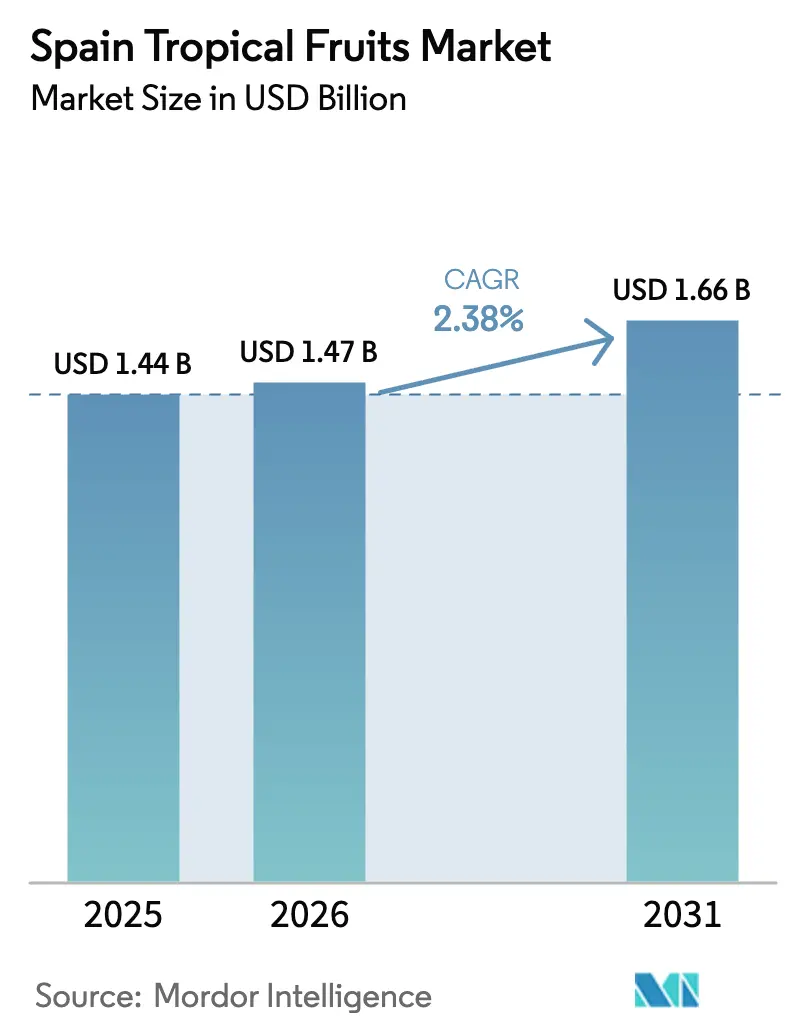
The Spain tropical fruits market size was valued at USD 1.44 billion in 2025 and estimated to grow from USD 1.47 billion in 2026 to reach USD 1.66 billion by 2031, at a CAGR of 2.38% during the forecast period (2026-2031). Continued premiumization, expansion of Protected Geographical Indication (PGI) labels, and investment in controlled-atmosphere logistics shift growth from sheer tonnage to higher value per kilogram. Larger operators are consolidating supply chains to meet stringent European Union residue limits, while water-scarcity pressures accelerate adoption of desalination, precision irrigation, and drought-tolerant cultivars to protect quality and yields. Madrid, Barcelona, and Valencia supermarkets now dedicate branded sections to exotic produce, signaling mainstream acceptance that underpins stable demand. Companies with integrated production, post-harvest, and distribution networks increasingly capture negotiating power with retailers and food-service chains, reinforcing a moderate-to-high entry barrier for new participants in the Spain tropical fruits market.
Key Report Takeaways
- In Spain, the Canary Islands led with 37.85% of the Spain tropical fruits market share in 2025. Andalusia is projected to expand at an 8.05% CAGR through 2031.
Note: Market size and forecast figures in this report are generated using Mordor Intelligence’s proprietary estimation framework, updated with the latest available data and insights as of 2026.
Spain Tropical Fruits Market Trends and Insights
Drivers Impact Analysis*
| Driver | (~) % Impact on CAGR Forecast | Geographic Relevance | Impact Timeline |
|---|---|---|---|
| Rising health-and-wellness purchasing | +0.8% | National, with premium segments in Madrid, Barcelona, Valencia | Medium term (2-4 years) |
| Growing immigrant communities broadening taste | +0.6% | Madrid, Barcelona, Valencia, Murcia - concentrated urban areas | Long term (≥ 4 years) |
| Retail private-label premiumization | +0.5% | National retail chains, strongest in Catalonia and Madrid | Short term (≤ 2 years) |
| Expansion of Canary banana PGI promotional programs | +0.4% | Canary Islands production, national distribution | Medium term (2-4 years) |
| Controlled-atmosphere shipping corridor | +0.3% | Andalusia, Valencia, Murcia export hubs | Short term (≤ 2 years) |
| Indoor cultivation pilots for subtropical crops | +0.2% | Almeria, Valencia, experimental sites | Long term (≥ 4 years) |
| Source: Mordor Intelligence | |||
Rising Health-and-Wellness Purchasing
Sales of antioxidant-rich mango, papaya, and guava rise as older consumers look for heart-supportive and immune-boosting foods. Retail scanners show premium tropical fruit stock-keeping units earning 15–20% higher margins than conventional counterparts, encouraging supermarkets to spotlight origin and nutrition on shelf labels. Producer groups couple controlled irrigation with harvest-maturity indices to safeguard vitamin C and phenolic content, reinforcing the perception of tropical fruits as functional staples rather than indulgent treats. E-commerce platforms amplify the trend by offering mixed “immune packs” containing assorted exotic fruit portions. Altogether, the health narrative steadily widens the customer base for the Spain tropical fruits market.
Growing Immigrant Communities Broadening Taste
American and Asian residents consume nearly double the per-capita exotic fruit volume of native Spaniards, and their culinary preferences now influence mainstream assortments. Urban ethnic restaurants and specialty grocers source hard-to-find varieties, sparking curiosity among local diners who later replicate dishes at home. Second-generation households maintain traditional fruit recipes but benefit from higher disposable incomes, translating to larger basket sizes. The demographic effect concentrates in Madrid, Barcelona, and Valencia, three regions that together absorb more than 60% of imported passion fruit, guava, and lychee shipments. In turn, wholesalers route higher volumes from Andalusia and Murcia farms to meet metropolitan demand seasons, reinforcing the Spain tropical fruits market’s urban pull.
Retail Private-Label Premiumization
Chains such as Mercadona and Carrefour replace commodity labels with in-house brands that promise local sourcing, strict pesticide control, and recyclable packaging. Direct farming contracts shorten lead times, improve traceability, and let retailers pocket supply-chain savings. Shoppers trust store brands to guarantee consistent sweetness and ripeness, allowing supermarkets to price private-label bananas and avocados only 5–8% below branded imports while protecting margins. As private labels climb toward 40% share of exotic-fruit shelf space, competing growers must either match quality specs or pivot toward niche heirloom cultivars. Private-label acceleration, therefore, reshapes bargaining dynamics within the Spain tropical fruits market.
Expansion of Canary Banana PGI Promotional Programs
Plátano de Canarias surpassed 440,000 metric tons in 2023, valued at EUR 1.347 billion (USD 1.45 billion), and its success propels new PGI filings for Canary avocados. Subsidized advertising stresses volcanic soil attributes, while unified packaging preserves brand integrity across 8,000 smallholders. Mainland distributors partner with cooperative Cupalma to forward-book volumes, ensuring a stable supply during high-priced winter windows. The PGI halo effect lifts adjacent products such as papaya and pineapple, whose per-kilogram prices trade at a 12% premium over non-PGI equivalents. Consequently, protected origin marketing adds incremental value to the Spain tropical fruits market.
Restraints Impact Analysis*
| Restraint | (~) % Impact on CAGR Forecast | Geographic Relevance | Impact Timeline |
|---|---|---|---|
| Stringent EU MRL and phytosanitary checks | -0.4% | National, affecting imports and domestic production standards | Short term (≤ 2 years) |
| High logistics cost from island production centers | -0.3% | Canary Islands to mainland distribution | Medium term (2-4 years) |
| Water-scarcity risk | -0.5% | Andalusia, Valencia, Murcia production regions | Long term (≥ 4 years) |
| Limited R&D incentives for niche tropical varieties | -0.2% | National research institutions and private sector | Long term (≥ 4 years) |
| Source: Mordor Intelligence | |||
Stringent EU MRL and Phytosanitary Checks
New Commission Regulation (EU) 2024/1314 tightens allowable pesticide residues for tropical fruits, obliging growers to refresh integrated pest-management protocols[1]Source: European Commission, “Regulation (EU) 2024/1314,” eur-lex.europa.eu. Compliance adds laboratory fees and may force early harvests that reduce sugar accumulation, trimming profitability. Import bans linked to Phyllosticta citricarpa detections in third-country fruit have prompted auditing of packinghouses and expanded buffer zones. Smaller orchards lack funds for real-time residue testing and certification, deterring entry. Thus, regulatory rigor nudges the Spain tropical fruits market toward consolidation around capital-rich operators.
High Logistics Cost from Island Production Centers
Shipping a refrigerated container from Santa Cruz de Tenerife to Valencia costs 15–20% more than a comparable mainland haul because of mandatory inter-island transfers and bunker charges. The differential erodes price competitiveness for low-value exotics such as papaya. Island growers mitigate the gap by targeting premium segments and pre-booked retailer programs, yet volume expansion remains constrained. Fuel surcharges and International Maritime Organization emissions rules could widen the cost spread, challenging the Spain tropical fruits market’s island production strategy.
*Our forecasts treat driver/restraint impacts as directional, not additive. The impact forecasts reflect baseline growth, mix effects, and variable interactions.
Geography Analysis
Spain tropical fruit production clusters into four climatic zones that collectively underpin Europe’s only sizable tropical fruit supply. The Canary Islands’ volcanic soils and marine airflow enable growers to harvest bananas 52 weeks a year with minimal frost risk, sustaining their commanding 37.85% share in 2025. Bollo Natural Fruit acquired Cortijo Cuevas to boost pineapple fresh-cut operations and streamline logistics. Anecoop posted a USD 1.02 billion turnover in 2024, representing over 5% of national produce exports and illustrating the economies of scale required to finance residue-testing labs and climate-smart technologies. Andalusia delivers the fastest growth, posting an 8.05% CAGR forecast through 2031, due to advanced irrigation sensors and cultivar trials targeting drought resilience, which support a spain tropical fruits market size that is expanding across Mainland Spain.
Valencia Community exploits integrated citrus infrastructure and Spain’s top container port to ship fresh and processed exotics across the Mediterranean, tightening delivery rhythms to northern Italy, southern France, and the Balkans. Murcia’s semi-arid fields deploy ultrafiltration and fertigation to achieve top-quartile yields for passion fruit, further diversifying regional output. Collectively, mainland hubs reduce dependence on island supply during peak European summer demand, enhancing national self-sufficiency and boosting resilience for the spain tropical fruits market.
Catalonia’s role hinges on distribution sophistication rather than on-farm output. The Port of Barcelona integrates block-trained reefers and artificial-intelligence berth allocation to minimize dwell times. As restrictions on diesel trucks inside metropolitan low-emission zones tighten, intermodal rail links ferry tropical fruit pallets to logistics parks in Zaragoza and Lleida, where wholesalers re-sort consignments for Western Europe. This network efficiency helps Spain reach European channels within 48 hours post-harvest, safeguarding quality and reinforcing Spain’s status as a continental leader in tropical fruit distribution. The geographic mosaic thus sustains layered supply chains, fulfilling diverse customer requirements and cementing competitive depth in the spain tropical fruits market.
Regulatory Landscape
Spain tropical fruits operate under EU plant-health, residue, and marketing-standard requirements that shape both domestic supply and third-country imports. Phytosanitary compliance follows the EU framework for harmful organism controls and import conditions (notably Regulation (EU) 2019/2072). Marketing standards and labeling requirements are aligned to EU rules such as Implementing Regulation (EU) 2023/2430 and Regulation (EU) 2023/2429, which reflect UNECE and OECD quality frameworks for produce categories including avocados.
Food-safety controls for pesticide Maximum Residue Levels are enforced through official inspection systems in Spain, with AESAN (Agencia Espanola de Seguridad Alimentaria y Nutricion) providing oversight of food-safety compliance. Spain also maintains an official table of fresh fruit and vegetable quality standards and interpretative brochures via the Ministry of Economy, Trade and Enterprise, supporting consistent grading and labeling checks at the point of marketing and import clearance.
Value Chain Analysis
The Spain tropical fruits value chain combines domestic production (notably the Canary Islands and expanding mainland clusters) with import flows and re-export distribution into the European Union. Upstream activities include farm inputs (planting material, irrigation systems, and crop protection), on-farm production under water-stress management, and harvesting aligned to retailer ripeness and residue specifications. Post-harvest activities are concentrated in packinghouses, where grading, labeling, and traceability are executed to meet EU marketing standards. Controlled-temperature logistics then connect island and mainland origins to consumption hubs such as Madrid, Barcelona, and Valencia, using ports and intermodal corridors for time-sensitive movement.
Midstream and downstream, large producer organizations, cooperatives, and integrated operators consolidate volumes, run quality assurance and residue testing, and negotiate programs with modern retail and food service. Sector monitoring and operational-program linkages sit within MAPA-administered fruit and vegetable frameworks (through the General Directorate for Agricultural Productions and Markets), and trade and campaign reporting provide transparency on volumes and flows that inform procurement decisions across wholesalers, retailers, and exporters.
Market Opportunities and Future Outlook
Premium, branded, and origin-linked tropical fruit programs create room for suppliers that can evidence compliance and deliver consistent eating quality. Retail private-label premiumization by chains such as Mercadona and Carrefour raises the value of integrated supply (production plus packing plus distribution), particularly for bananas, avocados, mangoes, and fresh-cut formats where repeatable ripeness and traceability affect shelf performance. The Canary Islands PGI platform (Platanos de Canarias) shows how protected-origin marketing can lift willingness to pay and also offers a reference point for adjacent tropical fruit categories seeking clearer differentiation.
Export-oriented routing and faster cold-chain handling support opportunities for Spanish operators that serve both the domestic market and nearby EU outlets from Mediterranean hubs. MAPA trade tracking for subtropical categories such as pinas, aguacates y mangos shows active cross-border movement (for example, EUR 93.16 million recorded for January to May 2025), reinforcing Spain's role as a distribution and commercialization base as well as a production location. Water scarcity and tighter residue limits also increase demand for investment in precision irrigation, controlled-atmosphere logistics, and lab-backed quality systems, which can favor suppliers with scaled infrastructure and retailer-aligned specifications.
Recent Industry Developments
- March 2026: MAPA (Ministerio de Agricultura, Pesca y Alimentación) reports Spanish tropical fruit production for the 2025/26 campaign projected to exceed 35,000 hectares. The expansion indicates a wider cultivation area and potential shifts in supply dynamics and price pressure within the sector. The development underscores Spain's increased farming footprint for tropical fruits, aligning with regional investments to bolster supply resilience.
- January 2026: Government of the Canary Islands announces Lairaga tropical project launched, allocating 593,614 euros to enable 100 new hectares for avocado, mango, and papaya cultivation. The regional program broadens subtropical crop cultivation and diversifies supply networks for tropical fruits. The investment strengthens Canary Islands' role as a tropical fruit production cluster and enhances regional self sufficiency.
- October 2025: Interprofessional Organization of Avocado and Mango (OIAM) Extended Norm approved, allowing funding of collective projects for promotion, research, and market transparency. The regulatory framework supports collective investment in tropical fruit market activities. Strengthens market transparency and cooperative promotion, impacting competition and consumer awareness.


Research Methodology Framework and Report Scope
Market Definition and Coverage
For this report, the Spain tropical fruits market is defined as the value generated from the sale of tropical fruits consumed in Spain, covering domestically produced and imported volumes that move through the fresh supply chain.
Scope exclusions: It excludes processed fruit products (frozen, canned, juices, purees) and non-fruit tropical crops.
Segmentation Overview
- Production Analysis (Volume)
- Consumption Analysis (Value and Volume)
- Export Analysis (Value and Volume)
- Import Analysis (Value and Volume)
- Price Trend Analysis
Data Sources, Market Sizing, and Validation
Desk Research
We start by setting the factual base for Spain using official production, trade, and consumption series, and then we map those series to the fruit categories covered in the report. Public sources that are helpful here include Spain's Ministry of Agriculture, Fisheries and Food (MAPA) for household consumption and price reporting, Eurostat for trade and price indicators, FAOSTAT for cross checks on crop outputs, and Spanish port and customs statistics that explain import seasonality.
To avoid leaning on one dataset, we also use supporting material such as retailer and wholesaler releases, cooperative and association publications, and company annual reports that discuss procurement, sourcing shifts, and packaging throughput. When financial disclosures are thin, we complement them with paid subscriptions for company financials and news, and an import-export shipment-level database to validate route patterns and origin mix. The desk sources cited are illustrative only, and many other public datasets and references were used for collection, verification, and clarification.
Primary Interviews and Surveys
Primary work is used to test what desk indicators cannot fully explain, like packhouse price movements, retailer margin expectations, and how shortages or quality issues change sourcing in season. We speak with growers, importers, distributors, and retail and foodservice buyers across Spain, and insights are then used to adjust assumptions around sell-in timing, grade mix, and typical wastage allowances.
Distribution of primary research fieldwork respondents
| Company type | Respondent position |
|---|---|
| Top tier: 30% | CXOs: 14% |
| Mid tier: 48% | Functional/Unit leaders: 32% |
| Smaller Players: 22% | Managers: 54% |
Market-Sizing & Forecasting
Sizing is built using a top-down and bottom-up approach, where Spain's demand pool is reconstructed from production plus net trade, and then converted into market value using observed price points by fruit and season. Results are corroborated with selective bottom-up approximations, such as sampled wholesale and retail price checks applied to estimated volumes, plus distributor throughput discussions that help confirm the practical volume flowing into the market.
Key model inputs include import and export values and volumes by fruit, domestic harvested area and yield signals for the main producing zones, household purchase volumes and average prices, seasonality of arrivals by origin, and observed value per kilogram changes during tight supply periods. Where gaps appear in category splits or price series, proxy indicators are applied (for example, aligning missing months to nearby seasonal averages) and then corrected using primary feedback.
For forecasting, we typically use scenario analysis supported by simple time-series smoothing on the core trade and consumption indicators, and then we apply primary-led views on how fast prices normalize after supply shocks. The forecast is kept traceable so each year's movement can be explained by volume availability and price progression, rather than by unexplained curve fitting.
Data Validation & Update Cycle
Validation is done through multiple checks that link value outputs back to independent signals, such as trade values, implied unit prices, and consumption totals that should move in a consistent direction. When a step produces a mismatch, assumptions are revisited, and targeted re-contacts are triggered with trade participants to confirm whether the shift was driven by price, mix, or real volume change.
Before sign-off, the model is reviewed by another analyst, and outliers are challenged using a fresh look at source series and key conversion factors. Reports are refreshed annually, and interim updates are made when material events occur, such as sharp supply disruptions or major regulatory changes affecting residues and border controls. Right before delivery, an analyst runs a final pass so clients receive the latest updated view.
Mordor Intelligence's Spain Tropical Fruits Market Size Versus Other Published Estimates
Published market sizes for Spain tropical fruits often do not line up because the boundary is not always the same, and the link between volumes and pricing can be treated very differently. Some estimates are built mainly from retail value signals, while others lean heavily on import value, which can miss domestic supply and re-exports.
Trade value and volume by fruit, together with implied unit prices and household purchase trends, are the checks that keep Mordor Intelligence's estimate tied to the Spain consumption pool instead of counting transit trade or processed formats.
Benchmark comparison
| Source | Market Size | Gaps in Research Methodology |
|---|---|---|
| Mordor Intelligence | USD 1.44 B (2025) | |
| Industry Association A | USD 1.90 B (2025) | Often reported using retail scan or consumer spend proxies that can fold in prepared fruit, fresh-cut, and broader exotic produce, which lifts value beyond whole fresh tropical fruits. |
| Trade Journal B | USD 1.12 B (2024) | Commonly derived from import value totals for selected HS codes, which can undercount domestic production and can be distorted by re-export flows and short-term price swings. |
The spread across sources mostly comes down to what is counted (fresh whole fruit only versus wider exotic baskets) and whether domestic output and re-exports are treated cleanly. By anchoring the model to consistent volume-flow accounting and then pricing those flows with observed unit values, the result stays explainable and easier to replicate over time.


Key Questions Answered in the Report
How large is the Spanish tropical fruits market in 2026?
The market is valued at USD 1.47 billion and is projected to climb to USD 1.66 billion by 2031.
Which region leads Spanish production of tropical fruits?
The Canary Islands hold the largest share at 37.85% due to PGI status and favorable climate.
Which Spanish region shows the fastest growth for tropical fruits?
Andalusia posts the fastest regional CAGR at 8.05% between 2026 and 2031 due to irrigation tech and cultivar trials.
What is the main growth driver for tropical fruit demand in Spain?
Rising health-and-wellness purchasing is adding 0.8% points to forecast CAGR.
What challenge most threatens Spanish tropical fruit producers?
Long-term water-scarcity risk could subtract 0.5% points from market CAGR without further efficiency gains.
Page last updated on:


 Your data is secure and never sold or shared.


